

- About Us
- Information
-

The Author ensures that the research has been conducted responsibly and ethically with adherence to all relevant regulations. read more..
- For Authors
- For Reviewer
- Manuscript Guidelines
- Membership
- Publication Ethics
-
- Journals
- Reprints
- e-Books
- Videos
- Policies
- Contact Us
 COVID-19
- Submissions



Full Text
Novel Research in Sciences
Metal Oxide Nanosensors for H2 Detecting Safety in Energy Applications: A Mini Review
Omer Faruk Noyan* and Nezih Pala
The Center for Ethnic and Cultural Studies, USA
*Corresponding author:Omer Faruk Noyan, The Center for Ethnic and Cultural Studies, Fort Myers, FL 33967, USA
Submission: February 27, 2026;Published: July 30, 2026
.jpg)
Volume17 Issue 2July 30, 2026
Abstract
As not to fall short of the goal to meet 18% of global energy demand with Hydrogen (H2) by 2050 the critical progresses are needed in global H2 energy production, environmental requirements, and safety technologies. Due to the unique physical properties of Hydrogen the H2 energy systems require a total safety from production to end-user utilization stage. Especially metal oxide nanosensors for H2 detection have the multidimensional development and application potentials. High sensitive, selective, stable, costeffective H2 nanosensors with fast response-recovery times at different temperature ranges and especially room temperature are of great significance for the safe application and the public acceptance of a H2 energy economy on global scale. Metal oxide H2 nanosensor technology shows great progresses to facilitate the implementation of the H2 energy applications.
Introduction
The high percentage of fossil fuels in global energy production-consumption threats life on the planet and makes us face energy-ecology dilemma. Carbon in coal, oil and natural gas takes part, by combustion, in the formation of Carbon Dioxide (CO2), which is the strongest contributor to Greenhouse Gases (GHGs) in the atmosphere, and causes global heating and climate change. “These last two pose the greatest threat to life and are considered biggest challenges that humanity has ever faced. In 2022, about 80% of global energy demand is met by fossil fuels” [1].
“The International Hydrogen Energy Commission has claimed that hydrogen will satisfy 18% of the global energy demand by 2050, with a market value of more than USD 2.5 trillion, and H2 Fuel Cell Vehicles (FCVs) will account for 20-25% of vehicles worldwide” [2].
Hydrogen Gas (H2) is a synthetic derivation of the clean Renewable Energy (RE) sources (Solar, Wind, Hydropower, Wave, Geothermal etc) with its abundant, sustainable, and environmentally friendly nature. It is being widely used as energy source in food products, space, medicine, industries, laboratories, steel manufacturing, automotive-transportation sector, electricity production, etc. “As a fuel, H2 has considerably higher energy per unit weight than gas, diesel, and methanol, and has an immense market potential for the transportation sector and industry. H2 technologies emerge as a clean energy eco-system in its productionstorage- distribution-utilization stages, by its synergistic integration with solar-wind-hydraulic, and other clean RE sources, and with the existing energy infrastructure. When the electricity for H2 production is supplied by clean REs, the produced H2 is regarded as zero-carbon green H2. This means cleanliness, inexhaustibility, and independence from geopolitical effects” [3,4]. However, because H2 is an odorless-tasteless-colorless and highly flammable explosive gas “efficiently monitoring, checking and fast detection of H2 leakage or its release in different environments such as FCVs, large electric vehicle batteries, and H2 Refueling Stations (HRSs) are major challenges for sensing applications” [5].
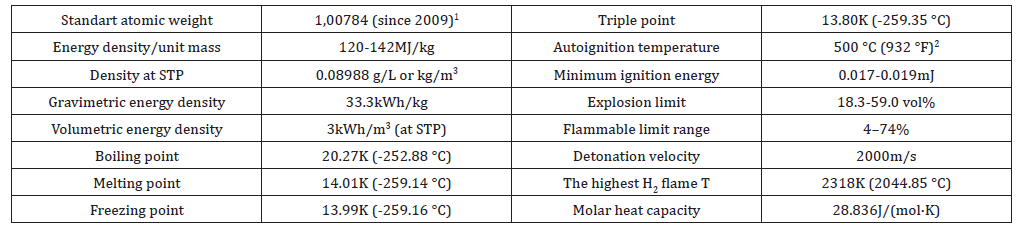
“With an atomic weight of 1.00784, hydrogen is the lightest (2.016 × 10⁻³ kg/mol) and also most abundant element in the universe (main physical properties of H2 are seen in the Table 1). On Earth, elemental free hydrogen is relatively rare even not readily available as it forms compounds with most elements. H2 is an energy-efficient fuel for it has a high calorific value of combustion (142KJ/g), low boiling point and ignition energy, fast ignition rate, wide flammable and detonable range, and high flame velocity” [6].
Table 1:Physical properties of H2 (1https://www.ciaaw.org/hydrogen.htm); (2Patnaik P (2007) A Comprehensive Guide to the Hazardous Properties of Chemical Substances. Wiley-Interscience, p. 402. ISBN 978-0-471-71458-3. Archived from the original on 26 January 2021. Retrieved 3 September 2020.)
H2 Effects in Industry/Energy Applications and Importance of Safety
“The leakage rate of H2 is much higher than propane and natural gas in the diffusion and turbulent states” [7]. “H2 diffuse and penetrate into metals, flow into the air from storage tank, valve, pipelines, and cause corrosion, and embrittlement that reduces the strength of materials, affects their mechanical properties, form local stress concentration and leakage. H2 deteriorate the metals internally, resulting in blistering where ductility, strength and fracture toughness are affected. H2 that is absorbed as low as 1ppm can cause cracking, a key point in high temperature applications” [8].
Hence, the most major issue that H2 economy system has to solve is the safety problem. “In the H2 energy industry, from 2000 to 2020, there were more than 90 incidents due to design defects, seal failures, equipment failure, operation errors, improper maintenance and traffic accidents” [9]. Here, storage is a key element in H2 energy systems. “Although H2 generally is stored in the gaseous and liquid-state, compressed gas storage in tanks with high pressure (35 or 70 MPa) is considered the most efficient and widespread method due to its technical simplicity and reliability. H2 can be stored in two ways: mobile (FCVs) and stationary (hydrogen refueling stations, HRSs)” [10]. As FC technology directly and efficiently converts H2’s stored chemical energy to electric “the FC with high energy efficiency and an alternative to ICEs, is used as power sources in automotive, as a backup for generators and small power plants” [11]. “As vehicle-mounted high-pressure H2 cylinders and transmission pipes are more prone to corrosion the selection of appropriate materials and design is important for FCVs. Fully wrapped aluminum lined carbon fiber cylinders are widely used because of their high H2 storage density and light weight. A safety monitoring device can ensure the timely detection and treatment of vehicle fuel system faults” [12].
“In the HRS areas crowded with humans and vehicles the dispensers are frequently used, increasing the chance of accidents” [13]. “HRS can have various designs depending on how the H2 is provided to the station (onsite production by electrolysis, tubetrailer, pipeline) and how the H2 is stored onsite (low/high pressure bank, compressors). Therefore, sensors must be implemented in more suitable locations” [14]. “Both the hydrogen-oxygen mixture flame and combustion flame emit UV radiation, which can’t be detected by human senses. A H2 sensor and a UV detector are required to detect H2 concentration and to alert to the formation of potentially explosive mixtures with air. Hence it is imperative to safely detect H2’s low concentrations (parts per billion, ppb), at room temperature (RT)” [15].
H2 Sensors in Energy Applications
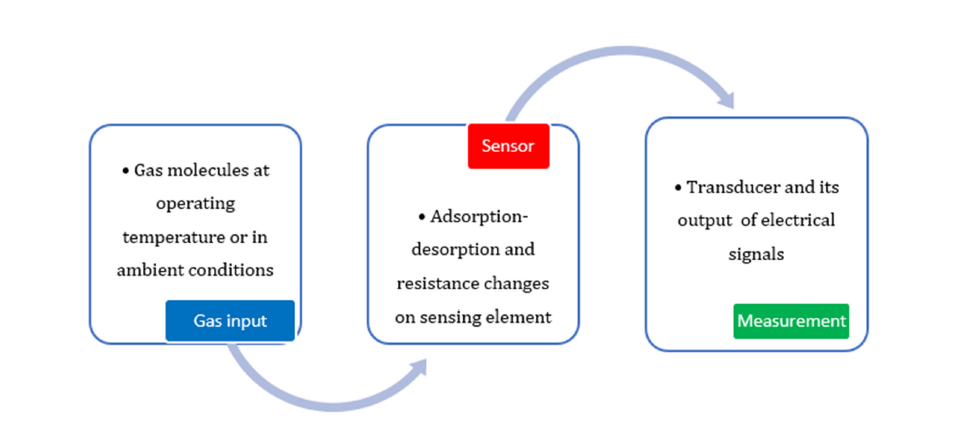
H2 sensing process occurs on nano-scale, and consists of interactions between H2 and sensing material. “A gas sensor refers to an instrumented system composed of a sensing element, a control circuitry, a transducer element and an interface that provides useful information to the end-user (Figure 1). The sensor’s receptor deals with the H2 adsorption/desorption, and resistance changes upon the sensing materials, whereas the transducer (a discrete chemical or physical sensing element) recognizes these changes and outputs sensible electrical signal with the help of metallic electrodes and electronics” [16].
Figure 1:Simplified flow sheet in an electronic gas sensor’s functioning.
Electronic gas sensors detect and quantitatively measure presence or leakage of various analyte ambient gases and their changes in the environment by producing electrical signal responses such as voltage, current, frequency and resistance with a magnitude proportional to the gas concentration. Their most important requirements are high precision, cross-sensitivity, selectivity, fast response/recovery times, long-time stability, strong anti-interference ability and cost-effectiveness. “The main metrological criteria for gas sensors include accuracy, baseline drift, environmental effects, final indication, hysteresis, limit of quantification, linear range/measuring range, noise, operation range (temperature, pressure, and relative humidity), uncertainty, reversibility, resolution, and saturation. H2 sensors are set in places where H2 is prone to leak, such as pipeline interfaces, valves and FC stacks.
The pressure monitoring and protection device can automatically depressurize and cut off the H2 source when the pressure is too high. In case of collision, it interrupts the H2 supply to avoid leakage. H2 leakage can also be predicted in advance by monitoring the voltage change caused by the membrane rupture. The vibration and impact generated by the vehicle during function will inevitably be transmitted to the FC stack. Therefore, its safety design should ensure it to resist vibration, high-pressure, hightemperature and has the function of ventilation, and monitoring working voltage” [7]. “H2 sensors should be able to detect H2 concentration below the lower flammability limit, and its performance must be adequate to give a fast sensor response if the H2 concentration suddenly increases” [17]. “However, the use of these techniques is limited by the large size of instrument, high cost and maintenance, the time-consuming processes, and the need of trained personnel to perform the analyses. So, the development of light weight, low-cost, low maintenance, easy to install rapid sensing portable devices appropriate for use by untrained individuals is highly required” [18].
Solid-State H2 Sensors
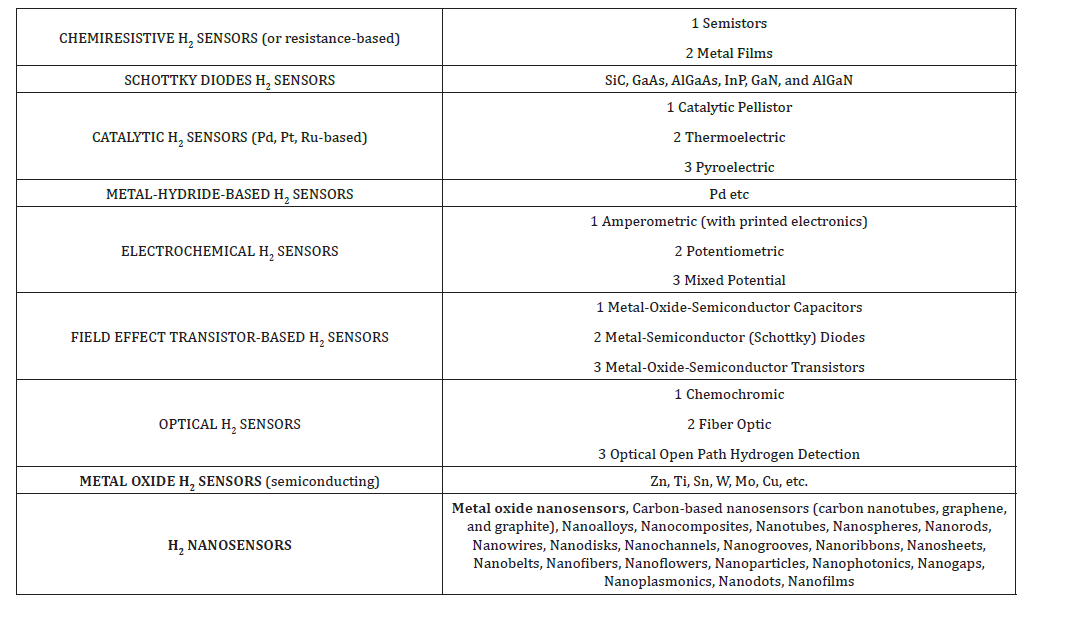
“For different types of H2 sensors, the international institution specify the performance such as reliable sensitivity, selectivity, fast response and recovery time, low cross-sensitivity, low power consumption and small size. The sensitivity is characterized by the slope of the relationship curve between the sensor signal value and the H2 concentration. Selectivity is expressed by the ratio of the response value or sensitivity of the H2 to other interfering gases. The response time is defined as the time for the sensor signal to reach 90% of the stable response value, and recovery time is defined as the time for the sensor signal to return 10% of the stable response value, respectively”. A H2 sensor classification based on solid-state sensors is in Table 2.
Table 2:The principal solid-state H2 sensors.
Metal Oxid H2 Sensors (MOS)
Metal oxide sensors are electrochemical devices. By definition of the International Union of Pure and Applied Chemistry (IUPAC) “a chemical sensor is a device that transforms chemical information, ranging from the concentration of a specific sample component to total composition analysis, into an analytically useful signal” [19]. Solid-state semiconducting metal oxides (MOXs) used in sensor manufacturing for H2 detection, are as follows: Zinc Oxide (ZnO), Titanium Dioxide (TiO2), Tin Oxide (SnO2), Tungsten oxide (WO3), Molibden Oxide (MoO3), Aluminum Oxide (Al2O3), Copper Oxide (CuO), Niobium pentoxide (Nb2O5), Indium Oxide (In2O3), Nickel oxide (NiO), Iron Oxide (FeO), Vanadium Pentoxide (V2O5), and so on. “These resistive H2 gas sensors (MOS) offer advantages, such as low cost, low power consumption, and high sensitivity. They are also easy to test, integrate, and suitable for detecting low concentrations of H2 gas in ambient air” [20].
“With suitable physical and chemical properties, rapid and costeffective fabrication, compact size, unique shape and structure, thermal stability, good reversibility, high dopant solubility, ease of synthesis and morphology tuning, high accuracy and sensitivity towards H2 most commercial MOS are based on appropriately structured and doped MOXs (ZnO, TiO2, SnO2, etc.). Having unique advantages in gas detection with the low power consumption due to their special surface physical properties their fundamental sensing mechanism is based on the change in electrical conductivity due to charge transfer between surface complexes, such as O−, O2−, H+, and OH−, and interacting molecules. This process requires an activation energy so that classical MOS are only functioning at high temperatures, generally above 200 °C” [22,22].
Metal Oxide H2 Nanosensors (MOSs)
Metal Oxides (MOX) have specific and especially sui generis physico-chemical characteristics for being Nanosensors (NSEs) which “are devices with at least one of their sensing dimensions being up to 100nm. NSEs are used in for a variety of tasks, including sensing physical and chemical changes, and evaluating lethal and contaminating constituents encountered in industry and the environment” [23,24]. Hence “H2 sensor should possess a small limit of detection as small as <1ppm or parts per billion (ppb) level” [25].
“Various NMs, namely Gold, Iron, Titanium Dioxide, Zinc Oxide, Silica, Carbon Nanoparticles (NPs), Polymers, Silicon and Silver Nanowires (NWs), and some semiconductor NPs called ‘Quantum Dots’ (QDs) have excellent chemical and physical properties in terms of simplicity, sensitivity, selectivity, stability, electrical and thermal conductivity, catalysis, optical properties, and flexibility. They have multiple functional characteristics, such as strong ability to detect specific gases and possess unique optical, magnetic, electrical, and mechanical properties that make them excellent materials such as catalysts, sensors, batteries, optoelectronic devices, etc. Using these advantages metal oxide materials synthesized in the form of Nanoscale Rods (NRs), Belts (NBs), Sponges (NSPs), Wires (NWs) and Tubes (NTs) have shown encouraging sensing properties.” [26- 29].
“Various NMs have been employed for H2 sensors such as SnO2, WO3, Carbon/Graphene, Pd, Si, and GaN. Significant breakthroughs of H2 sensors have been achieved by means of material architecture design.” [30]. “It is demonstrated that controlling the material size, shape, micro/NS, effects of oxygen vacancies, and exposed crystal planes can improve gas sensing and response properties of MOSs” [31,32].
“The NPs-loaded MOXs exhibit favorable performance in many areas (sensing, catalysis, optical devices). As a promising strategy, the binary MOX composites or heterojunctions have been adopted to enhance the H2 sensing. The “backbone” materials, such as ZnO, TiO2, SnO2, WO3, MoO3, Al2O3, CuO, Nb22O5, In2O3, NiO, FeO, V2O5 etc form a heterojunction with a low cost, reliable fabrication processes, high surface-to-volume ratios, superior electrical properties, characteristic charge carriers, high sensitivity, fast and sensitive response towards H2 with low concentration at RT, and stability. Meanwhile “the recent progress of QDs, which are used as cathode, anode, and membranes for FCs, solar cells, sensors, and various energy storage devices receive discernible attention due to their high surface-to-volume ratio, unique optical and electronic and active surface adsorption properties.” [33,34].
H2 NSEs can be roughly classified as carbon-based, optical fiber, metal hydride and MOX H2 NSEs (MOSs) etc. The one, two and three dimensional (1-D, 2-D and 3-D) semiconducting MOX or carbon-based nanostructures (NSs) made by special NMs, that have key chemical and physical properties are promising for H2 sensing. “Due to their high surface-to-volume ratio, crystallinity, and high sensitivity at RT the 1-D MOX NSs, such as NWs, NBs, NTs and nanofibers (NFs), are the best candidates for building fast and high performance ultrasensitive H2 NSEs with ultra-low power consumption” [35]. “H2 sensors employing 2-D materials have gained prominence due to atom-scale thicknesses and special structure which give rise to unique electrical and mechanical properties in combination with the potential for submicron miniaturization. Most of these sensors detect H2 through resistance change upon gas exposure. Current 2-D material-based H2 sensors can detect concentrations as low as 0.1 ppm, with < 1 s response time at RT” [36].
Concluding Remarks
The transition to the global hydrogen economy is accelerating. This situation brings with it various technical and material problems and search for solutions related to many elements of this economy. H2 sensors, as the most critical safety element, constitute the most important link both in terms of technical aspects, human resources, and end users, that represent public tendency. In this mini review, the last developments in metal oxide H2 Nanosensor (MOSs) technology have been reviewed. There are many functions that low cost and reliable H2 sensors with low power consumption must fulfill for the sustainable safety of the H2 energy applications, such as easy operation; accurate and high sensitivity; high sensitivity in selectivity; inhibited or low inter-cross sensitivity to other gases and vapors; fast response and recovery under all ambient and moderate-high operating conditions such as variable temperature, pressure, gas composition and relative humidity; accurate and stable electronic signals with low noise; robustness; low sensitivity to environmental effects; easy short-time maintenance with long service interval, and long-term stability.
The light weight, small size, ease of transport-installationassembly- interface-backup processes are advantageous aspects of H2 nanosensor technology and its use. The great experience and knowledge about metal oxide H2 sensors before nanotechnology was emerged helped develop (MOSs). However, almost all types of (MOSs) need to be improved in many aspects. ZnO, TiO2, SnO2, In2O3, WO3, Fe2O3, NiO, CuO etc are some important metal oxides on which nanostructured materials are based to manufacture (MOSs).
The superiority of MOSs in terms of sensitivity can be attributed to the nanoengineering, ultrathin nanostructures, fabrication processes, enhanced gas reception, electron transport, catalytic activity, lower power consumption etc. Larger catalytic surface obtained via morphological and architectural variations lead to increase in sensitivity and selectivity performance and decrease in response time and operating temperature. The research and experiments showed that the noble and rare earth metal or additive-doped or carbon material-loaded 1-D, 2-D and 3-D MOSs (nanopowders, nanodots, NWs, NBs, NFs, NTs etc), exhibit more performance and lower operating temperatures than pure metal oxide-based ones. Their nanometric diameters increase specific surface area and atoms, which improve surface reactivity and interactions between sensing element and H2.
Figure 2:The properties and functions of H2 Nanosensors..
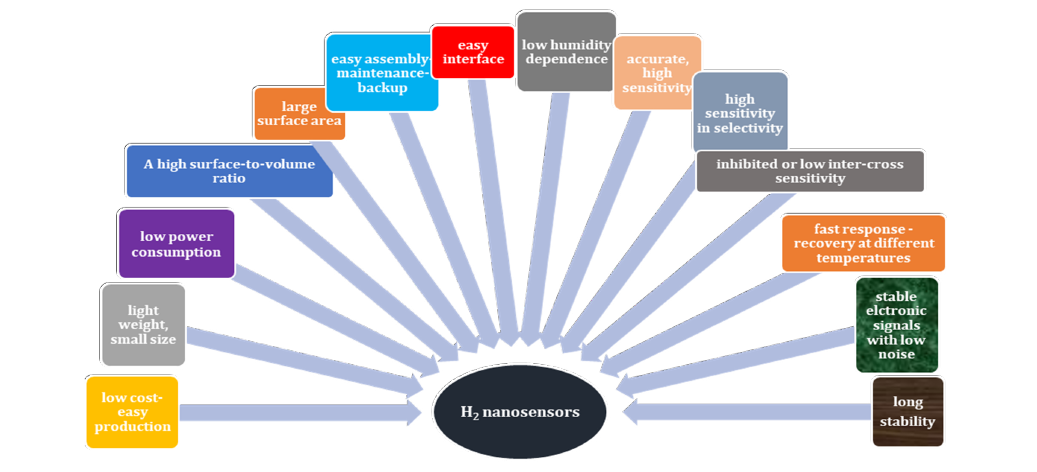
High surface-catalytic effect and work function of noble metal NPs largely enhance the H2 adsorption-desorption, promote electron accumulation, transportation and redox process of MOS materials, and improve sensitivity and selectivity performance of H2 sensors with ultra-low power consumption. However, the high cost of the noble metals and rare earth elements, the environmental concerns of the public opinion about it (in the frame of the green hydrogen) and the mass-production requirements will encourage to develop new materials, new nanocomposites (dopped, decorated or modified; or increase number of active metal sites), new heterojunctions and new techniques for the production of low-cost and reliable H2 nanosensors in terms of the globality and sustainability of H2 energy economy. Also, combining other hydrogen sensor types with metal oxides ones in one detecting/ measuring device can help improve the performance and safety parameters, increase efficiency and therefore deserves to be investigated. The near future will accelerate these efforts. On the other hand today new hydrogen energy applications/economy and especially FCVs’ hydrogen use require a new breakthrough. Today the next generation H2 nanosensors (nanochip technology) for scale utilizations are expected to work with artificial intelligence/ machine learning system, to use smart algorithms and to be connected to the Internet of Things (Figure 2).
References
- Noyan OF, Hasan, MM, Pala NA (2023) Global Review of the Hydrogen Energy Eco-System. Energies 16(3): 1484.
- Sun D, Guo D, Xie D (2023) Using multicriteria decision making to evaluate the risk of hydrogen energy storage and transportation in cities. Sustainability 15(2): 1088.
- Office of Energy Efficiency & Renewable Energy: Hydrogen Storage (2022)
- IEA (2021) World Energy Model Documentation. IEA, Paris, France.
- Ziling Z, Junhao M, Yu D, Yuan R, Wenhe X, et al. (2023) Polymerization-Induced Aggregation Approach toward Uniform Pd Nanoparticle-Decorated Mesoporous SiO2/WO3 Microspheres for Hydrogen Sensing. ACS Appl Mater Interfaces 15(12): 15721-15731.
- Huanhuan Z, Wei W, Tiyue T, Xinlei L, Xiaohong X (2023) Hierarchical NiO/TiO2 heterojuntion-based conductometric hydrogen sensor with anti-CO-interference. Sensors and Actuators B: Chemical 380: 133321.
- Chen X, Zhang C, Li Y (2022) Research and development of hydrogen energy safety. Emergency Management Science and Technology 2: 3.
- Chao W, Jiaxuan Y, Jiale L, Chenglin L, Xiaowei X, et al. (2023) Solid-state electrochemical hydrogen sensors: A Review. Int J of Hydrogen Energy 48(80): 31377-31391.
- Leigh C (2023) Hydrogen explosion in Austria. Accelerate Hydrogen.
- Sahar F, Masoud MD, Zahra F, Rouzbeh A, Amir R, et al. (2021) Sensing advancement towards safety assessment of hydrogen fuel cell vehicles. Journal of Power Sources 489: 229450.
- Reza HV, Roya SP, Sayyad N, Kittisak J (2020) Designing a miniaturized photoacoustic sensor for detecting hydrogen gas. Int J of Hydrogen Energy 45(41): 21148-21156.
- Buttner W, Rivkin C, Burgess R, Hartmann K, Bloomfield I, et al. (2017) Hydrogen monitoring requirements in the global technical regulation on hydrogen and fuel cell vehicles. Int J of Hydrogen Energy 42(11): 7664-7671.
- Yu X, Kong D, He X, Ping P (2023) Risk analysis of fire and explosion of hydrogen-gasoline hybrid refueling station based on accident risk assessment method for industrial system. Fire 6(5): 181.
- Bacquart T, Murugan A, Carré M, Gozlan B, Aupretre F, et al. (2018) Probability of occurrence of ISO 14687-2 contaminants in hydrogen: Principles and examples from steam methane reforming and electrolysis (water and chlor-alkali) production processes model. Int J Hydrogen Energy 43(26): 11872-11883.
- Ashni MMP, Ujwal SM, Anupama VJ, Vidya C, Ranganath D (2022) Competitor analysis of hydrogen sensing systems. ECS Trans 107: 4377.
- Beniwal V, Sharma N, Jain J (2023) Synthesis and application of metal and Metal Oxide-Based Nanosponges as Sensors. In: Gulati S (Eds.), Nanosponges for Environmental Remediation, Springer.
- Linke S, Dallmer M, Werner R, Moritz W (2012) Low energy hydrogen sensor. Int J of Hydrogen Energy 37(22): 17523-17528.
- Peiyu D, Qingkui P, Songlin Z, Qiangling D, Huahua X, et al. (2023) Synthesis of self-assembled hollow spherical Au/SnO2@rGO and its enhanced hydrogen sensing properties to ppb-level. Sensors and Actuators B: Chemical 375: 132872.
- Hulanicki A, Glab S, Ingman F (1991) Chemical sensors: Definitions and classification. Pure Appl Chem 63(9): 1247-1250.
- Gao L, Tian Y, Hussain A, et al. (2024) Recent developments and challenges in resistance-based hydrogen gas sensors based on metal oxide semiconductors. Anal Bioanal Chem 416(16): 3697-3715.
- Wojcieszak D, Domaradzki J, Mazur M, Kotwica T, Kaczmarek D (2022) Investigation of a memory effect in a Au/(Ti-Cu)Ox-gradient thin film/TiAlV structure. Beilstein J Nanotechnol 13: 265-273.
- Gayan WC, Kumarage, Hadjer H, Elisabetta C (2023) Recent advancements in TiO2 Nanostructures: sustainable synthesis and gas sensing. Nanomaterials 13(8): 1424.
- Abdel KR, Reda Y, Abdel FA (2020) Review-nanostructured materials-based nanosensors. J Electrochem Soc 167: 037554.
- Randa AK (2023) Advanced approaches in micro- and nano-sensors for harsh environmental applications: A Review. Modern Nanotechnology, pp. 585-612.
- Aihua Z, Bowei S, Tao W, Hao J, Yizhu X, et al. (2021) Ultrafast H2 gas nanosensor for ppb-level H2 gas detection based on GaN honeycomb nanonetwork. Sensors and Actuators B: Chemical 329: 129079.
- Lun D, Xu K (2022) Recent progress in gas sensor based on nanomaterials. Micromachines 13(6): 919.
- Richard O Afolabi (2024) A comprehensive review of nanosystems’ multifaceted applications in catalysis, energy, and the environment. Journal of Molecular Liquids 397: 124190.
- Ankita SG, Sutripto M, Srikanta M (2024) Composite based on metal oxides and 2D metal dichalcogenides for gas sensing. Technology and New Trends, Metal Oxides 2: 257-290.
- Abdul G (2024) Nanomaterials in environmental sensors. Handbook of Nanomaterials 2, Biomedicine, Environment, Food, and Agriculture Micro and Nano Technologies, pp. 607-634.
- Daejin Y, Itai K, Doo YY, Avner R, Il‐Doo Kim (2010) Ultrasensitive and highly selective gas sensors based on electrospun SnO2 Advanced Functional Materials 20(24): 4258-4264.
- Wang B, Sun L, Schneider RM, Lang KD, Ngo HD (2021) Recent Advances and challenges of nanomaterials-based hydrogen sensors. Micromachines 12(11): 1429.
- Ang Li, Sikai Z, Jinzhou B, Shuling G, Dezhou W, et al. (2022) Optimal construction and gas sensing properties of SnO2@TiO2 heterostructured nanorods. Sensors and Actuators B: Chemical 355: 131261.
- Mohammed Al M, Muhammad T, Ranwa Al S, Zeina Y, Omar T, et al. (2024) New insights on applications of quantum dots in fuel cell and electrochemical systems. Int J of Hydrogen Energy 52(Part D): 694-732.
- Ankita S, Lopamudra B, Rama RB (2023) Carbon Quantum dots for sustainable energy and optoelectronics. Carbon quantum dot-based nanosensors. Woodhead Publishing Series in Electronic and Optical Materials, pp. 205-224.
- Oleg L, Vasile P, Thierry P, Bruno V, Maik-IT, et al. (2019) Room temperature gas nanosensors based on individual and multiple networked Au-modified ZnO nanowires. Sensors and Actuators B: Chemical 299: 126977.
- Thi Kieu Ngan Pham, Joseph JB (2020) Hydrogen sensors using 2-Dimensional materials: A Review. ChemistrySelect 5(24): 7277-7297.
© 2026 Omer Faruk Noyan. This is an open access article distributed under the terms of the Creative Commons Attribution License , which permits unrestricted use, distribution, and build upon your work non-commercially.
Editor In Chief







.jpg)































Signup for Newsletter

Quick Links
 Editorial Board Registrations
 Submit your Article
 Best Paper of the Volume
 Reprints
 Refer a Friend
 Advertise With Us
Our Recent Edition

.jpg)



Top Editors




.jpg)

















.bmp)
.jpg)
.png)
.jpg)













.jpg)






.png)

.png)




.png)




Financial Support

Sponsors

Latest e-Books

Latest Video

 a Creative Commons Attribution 4.0 International License. Based on a work at www.crimsonpublishers.com.
Best viewed in
a Creative Commons Attribution 4.0 International License. Based on a work at www.crimsonpublishers.com.
Best viewed in 
 | Above IE 9.0 version