

- About Us
- Information
-

The Author ensures that the research has been conducted responsibly and ethically with adherence to all relevant regulations. read more..
- For Authors
- For Reviewer
- Manuscript Guidelines
- Membership
- Publication Ethics
-
- Journals
- Reprints
- e-Books
- Videos
- Policies
- Contact Us
 COVID-19
- Submissions



Full Text
Novel Research in Sciences
Environment and Territory in Periodical Press Contents: Some Divulgative Aspects
Silvano Tozzo*
Politecnico di Milano, Italy
*Corresponding author:Silvano Tozzo, Politecnico di Milano, Milano, Italy
Submission: October 15, 2025;Published: December 01, 2025
.jpg)
Volume17 Issue 2December 01, 2025
Summary
This study entails a reconnaissance of the contents of the periodical press concerning the geographicalenvironmental themes. Within a vast offering perceivable in newspapers and magazines, several articles have been selected and analysed because of their adherence to quality and compliance with the two thematic fields just mentioned. The selected writings include descriptions and reports relating to places and routes, presenting a discreet geographical and environmental attractiveness. However, the analysis also covers articles that highlight criticality and emergencies relating to the ecosystem and its components. Overall, it offers a partial overview of what is published in the daily and weekly press within two bordering and often integrated subjects in the narrative relating to territory and nature.
Keywords: Publishing; Environment; Climate; Geography; Geomorphology
Introduction
The specific context of this writing, as evident from the title, focuses on the information that is published about environmental and geographical subjects. The multidisciplinary disclosure perceivable in the daily and periodical press is presented in all its vastness and heterogeneity when it preliminarily tries to reorder the material object of evaluation (Note 1). The analytical immersion in the contents of newspapers and magazines and their transformation into computer data (Table 1) highlights the real complexity of what is published within this editorial genre in quantitative and qualitative terms.
Table 1:The organisation of data extracted from periodical press.
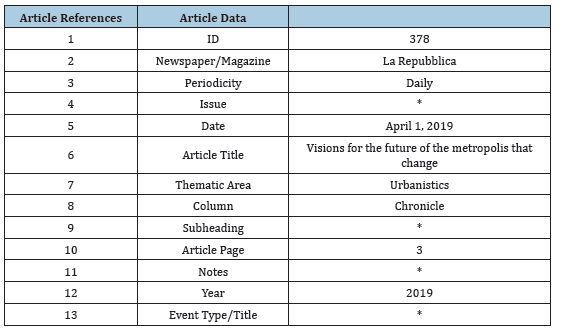
Note 1: Table 1 shows a schematic synthesis concerning the organisation of data extracted from about 1200 elements (articles, reviews, promotional inserts, annexes, etc.) published in the following newspapers/magazines: Corriere della Sera, La Repubblica, Il Giorno, La Provincia, Sette, Il Venerdì, La Lettura, L’Espresso.
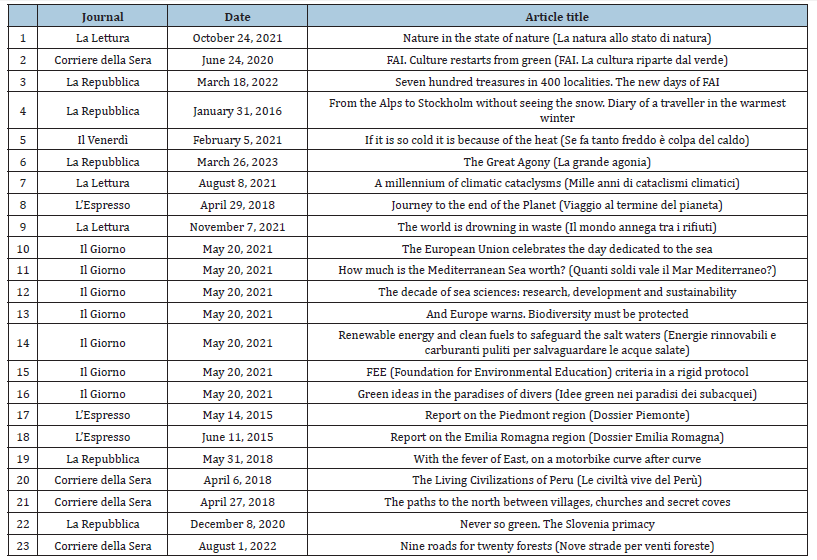
The material in this analysis (Appendix A) --selected from over a thousand articles published between 2013 and 2023--has been chosen on the basis of its adherence to subjects generically included in the two thematic areas cited above. The articles relating to environmental matters are examined in the first part, whereas the second part is mainly focused on the geographical context in its wider definition [1].
The Different Aspects of Environmental Issues in Periodical Press Articles
The environmental theme comes resumed within the periodical press, in the manifold profiles through which it manifests itself, such as the naturalistic descriptions of places and areas protected or characterised by distinctive situations, arguments relating to the consequences produced by climate change, thematic insights about pollution and its repercussions on the ecosystem, and reports referring to deforestation and wild exploitation of soil. It is advisable to focus on the writings regarding the situation of the seas and oceans and scientific (and not) interpretations of ice melting. The selection presented below includes, more or less, the arguments just cited, which are sufficiently indicative of content quality and subject representativeness.
The article (Appendix A/1) published in issue 517 of “La Lettura”, a weekly supplement of “Corriere della Sera”, proposes through text and images, a testimony discreetly extensive on the integral Reserve of Sasso Fratino, situated between the Regions Toscana and Emilia Romagna and included in the National Park of the Casentinesi Forests (Italy) [2]. The narration alternates the environmental description with the historical events relating to the green area and its evolution throughout the centuries in terms of property and limited exploitation of resources. In effect, “the use of the woodland remains prudent until the eighteenth century,” [3] subsequently protected in the second half of the twentieth century. The annotation, readable in the final part of the article, regards the importance of the reserve for climatic studies, effectuated by exponents of the Italian and European academic worlds. The arguments treated in this case are presented in a descriptive context from which the naturalistic value of the place emerges, safeguarded by specific legislation and therefore extraneous to the emergencies found in other environmental situations.
FAI (Note 2), [4] with its initiatives is often present in the daily and weekly press. The occasion to read about this organisation usually regards the inauguration of places (historical architectures, parks and green areas, natural reserves, etc.) that are accessible on the specific days dedicated to them. Two articles (Appendix A/2-3), among others, published by “Corriere della Sera” and “La Repubblica,” respectively in 2020 and 2022, present the first, Moroni Mansion and its historic gardens (Bergamo, Italy) exhibited through a photograph clearly visible above the title. This text also resumes the weekend program, comprising 150 other localities, including a naturalistic area in the Teramo province (Italy). Effectively, the first part of the article reiterated the intention of FAI to propose access to parks and forests, privileging sites characterised by nature and landscape. The second writing - reminding the thirtieth edition of FAI openings - exposes the extensive program as: “Seven hundred beauty coffers (historical architectures, gardens, parks), dislocated in four hundred Italian localities, (…) open their doors to the public” Published on the culture-oriented page of the newspaper, it cites some of the numerous inaugural places disseminated in different regions, putting the accent “on the crucial role of cultural heritage, key of the identity of every nation”.
The article selection just comments on the environmental dimension in its most attractive part. The common element found in the writings examined until now is the description of situations in which terms like green and nature, remain the key attributes. The articles cited below follow a literary format that adheres to the criticalities generated by climate change, such as the use of the planet’s resources and the many associated variables.
A travel report (Appendix A/4) published in “La Repubblica” in 2016 resumes the theme relating to the environmental repercussions resulting from climate variability. The peculiarity of what recounts is the chronology of the various movements between December and January in European and national places. The common denominator, despite the different latitudes, is the temperature increase; in fact, “it is ten degrees higher than normal” and relatively to Italy, “the thermal inversion has blocked a blanket of fog in the Padana plains”. A more scientific accent is noticed in writing published in 2021 in a weekly supplement of La Repubblica, “Il Venerdì”, (Appendix A/5) on the page dedicated to the presentation of studies coming from the experts. The explanation of a theory developed by climatologists in a university context clarifies some mechanisms concerning global warming and related environmental events [5].
The topics just mentioned are resumed, by a major extension, within an editorial insert, Longform, readable in “La Repubblica” (Appendix A/6). The deepening analysis on the implications of climate variability, published in March 2023, comes exposed in an extended format, sufficient for reading comprehensively about meteorological instability and its consequences. Some considerations legible in the text, such as “The increase of greenhouse gas (…) in forty years has raised the average temperature between 1 and 3 degrees”, formulated by experts, confirm an assumption largely debated. In any case, the journey in North-East (Italy) highlights the diverse environmental criticalities, like “The fact to have the Alpine lakes empty, lacking the snow, does not affect only hydroelectric production” and also “today in the Alpine arc the availability of water is lower than the request of a development model unsustainable in the plain too” without forgetting the reference to glaciers, such as “The frozen mass of the Stelvio mount has halved in twenty years” [6]. Overall, a reconnaissance is realistic and quite catastrophic, in which the distorted landscape, paragraph title recalled in closing, probably expresses the sense and philosophy of what is communicated in the extensive report.
Appendix A:List of cited articles in order of appearance in the text.
Forwarding the same theme, a historical compendium (Appendix A/7) on the phenomena connected to climate change was proposed in “La Lettura” in August 2021. The period examined is “between the end of the Roman Empire and the beginning of the Industrial Revolution” [7] through an excursion on the causes of meteorological instability-linked phenomena occurring over the centuries. It starts from affirmations relating to the ancient period, where “a favourable (climatic) situation (…) contributed to the agricultural and productive strengthening of the (Roman) empire”, passing through the small glaciation that occurred between the fifth and tenth centuries, to continue in the following two hundred years, with the explanation of phenomena based on which climatic anomaly can be defined for a significant increase in temperatures. The exposition continues by describing the climatic situation of the following centuries, with the relative consequences in terms of environmental disasters, until the specification of a date reference (1816) known for the explosion of a volcano with important consequences, like “a sort of nuclear winter lasted a year”. The final considerations accentuate the extreme climatic variability associated with the period of interest. Recapitulating, an interesting historical narration referring to a subject not simple to explain and probably based on testimonial sources, was drafted in eras in which the absence of adequate technology did not enable a deeper knowledge of atmospheric phenomena [8].
The writings above discussed portray the climate argument from different perspectives. The subsequent articles propose themes connected to deforestation, pollution, and the situation of the big water basins. A travel report published by L’Espresso in April 2018 (Appendix A/8) concerning the Amazon Forest resumes the theme of deforestation through descriptions rather efficacious, originating from situations in which “mountains of cut wood, barren and torn landscapes, teams of (…) wood hewers, a forest violated”. The crossing of “one of the largest natural reserves in the world” promotes a testimony, partial but useful, imaging contexts in the following words, “The shore continues to offer the desolate spectacle of the tormented forest”. The final part of the article recalls the devastating impact of the various actions aimed at soil exploitation on the green regions and finishes citing an imminent apocalypse, a conclusive assertion in line with what is reported in the text.
In its different forms, the arguments connected to environmental pollution find a discreet space in newspapers and magazines. An article (Appendix A/9) published in “La Lettura” in November 2021 resumes the subject by proposing merciless data visualised through a graphic scheme formulated by crossing geographical elements (the list of the most polluting rivers divided by country) and numerical (the quantification of what is transported by watercourses). The text, concise but efficacious, positioned in the lower part of the sheet, treats the theme in general, not referring merely to what is legible in the model presented on the upper side of the page. Effectively, it displays the percentages relative to the continental subdivision of two billion tons of waste produced worldwide, adding a desolating assertion like this, “it is estimated that 33% of garbage be thrown everywhere” [9]. Between percentages and various considerations, the final paragraph promotes the auspice for the formation of a waste management system for emerging countries. With the support of graphics and numbers, the article probably offers a better comprehension of the phenomenon, framing it in a global context through legible and geographical indications.
The newspaper “Il Giorno” proposes a supplement of sixteen pages on this topic on the occasion of European Sea Day. The theme is mainly concerned with the economic and environmental aspects. The writings (Appendix A), referring to the first one, make a point of the situation, reminding us, “in pre-covid epoch the ninety percent of commercial traffic passed through the ports” (A/10). It also recalled economic evaluations effectuated by international organisations relating to the value of large water basins, as “the Mediterranean Sea is worth almost 60 billion euros” (A/11), followed by assessments referring to the Atlantic Ocean and North Sea. The issues connected to environmental sustainability are most evoked in the manifold articles that form the supplement. Among assertions as “the period between 2021 and 2030 will be the decade of marine sciences for sustainable development” (A/12), and “the stress to which our seas are subjected (…) is putting strain the ecosystem conditions” (A/13), the emphasis is placed on the criticalities and projects aimed at “increasing the knowledge of what the sea needs to be protected” (A/12). In conclusion, a wide portrait of the fundamental issues relating to large water basins includes the themes regarding energy (A/14), the criteria utilised for the qualitative classification of waters and coasts (A/15), the description of marine reserves of “great suggestion” (A/16).
The Geographical Dimension in the Contents of Newspapers and Magazines
The geographical theme assumes a certain relevance within what is published. The subject is exhibited in dossiers and articles with diversified content characterised by analysing specific places, naturalistic itineraries, and regional areas.
The first reference of this section regards two dossiers of “L’Espresso” relating to two Italian regions (Piemonte and Emilia Romagna-Appendix A/17-18), respectively comprising eight and ten pages and presented as an exploratory report on the two geographical districts. They highlight the economic and productive context and the environmental one in terms of interesting itineraries. The interval of pages dedicated to these fields allows an exposition that is more fluid and less superficial on the two territorial realities.
A travel report (Appendix A/19) focusing on Greece, Turkey, and Georgia reveals routes and places on the long journey through attractive illustrations relating to the entire itinerary. The descriptive alternation between the natural environment and the cities characterizes the whole article, supported by different images, including the graphic indication of the route defined on a geographical map The journalistic service, composed of text and six photographs, occupies two full pages and provides an interesting representation of the various localities visited.
Remaining to the contents inserted in the geographical context, serial proposals and circumstantial writings, which are more or less extensive, reveal places and itineraries that are passable through various alternative forms of mobility.
The articles legible in the “Corriere della Sera” within the series “Journeys” show different destinations, which include Peru and Corsica. An unexpected representation of the first country mentioned is the one readable in the article of April 6, 2018 (Appendix A/20). A brief reconnaissance between historical and natural itineraries, introduced by the assumption that “if Peru remains one of the most visited tourist destinations in the world, it is because its ancient civilisations are still alive”, resumes, in alternation, places known as the capital city Lima to others, probably less famous. The narration also offers environmental descriptions as “an extreme nature, from the desert on the shores of the Pacific Ocean to the spectacular Andean Cordillera” and citations relating to Islands and Lakes. Between historical insertions and naturalistic descriptions, the text proposes a suggestive vision of Peru; the written part is also supported by a graphic section composed of a map which is connected to some images (drawings) relating to the sites cited in the article.
The second proposed article, cited above, relates to Corsica (Appendix A/21). The itineraries described revolve around the northern side of the French Mediterranean island, as specified in the title. They are generically displayed on a coloured map placed within a larger image, containing four photographs of the sites outlined in the text and indicated in the graphic frame beside it. Among geographic references and route suggestions “whoever does not know northern Corsica can only start (…) from Patrimonio, ancient village of rocks and trees”, the exposition continues highlighting coastal ways and moves towards the inland “where it announces the mountain ridge that unites the north to the south of the island with peaks over 2600 meters”. Some comments relating to the past, inserted in the text, complete the representation of this part of the island, which is particularly interesting for its environmental characteristics [10].
A surprising portrait of a country bordering Italy, Slovenia, comes from an article (Appendix A/22) published in “La Repubblica” in December 2020. Right from the first line, it perceives the green dimension of the country, constituted by “an extraordinary patrimony composed of vast forests, natural parks and thermal water springs” and “forests that cover sixty percent of the territory of which almost forty percent is safeguarded as protected areas” [11]. The text occupies an entire page with two articles and four photographs; the longer writing resumes what is mentioned above, while the short one on the bottom page recalls the modalities of quality certification through a classification system based on environmental and receptive parameters of localities and accommodation structures [12].
The last review regards the introduction to an itinerant guide published in 2022 (Corriere della Sera”- Appendix A/23). It highlights the characteristics of the book (Note 3), revealing its content and the editorial references, all supported by useful integrations on the topic emphasized and photographs of routes described in the text. Among the various itineraries proposed, the one resuming the route between the provinces of Mantova and Verona stands out, within which it crosses some natural areas such as the Mincio Park and the Fontana Wood, both included in the Mantova district. The first one is “…a territory that shows particular morphological and naturalistic features, and it follows the Mincio River for 73 kilometers…”. This itinerary is divided into three parts along the river route. In the high stretch, “the river crosses and cuts the Garda moraine amphitheater and the gravel terraces of the high plain.” Carrying on in the medium trait, the river flows “…drawing wide meanders in a plain territory between crops and meadows…” This is the route part where Fontana Wood is reachable. It is “…one of the last examples remaining in Italy of the original (in naturalistic and geological terms) Padana Plain Forest…”. The last section of the Mincio River, the low one before it finishes its journey in the Po River, “offers a last naturalistic view with an aspect much more similar to a canal, surrounded by an alluvial plain formed by recent soils [13].”
The articles mentioned above close the chapter regarding the geographical dimension. The literary depiction of places and itineraries transmits, within representative texts, a convincing image of every described locality.
Final Considerations
The topics treated in this review offer a vision on two subjects discreetly represented in the daily and weekly press. The selection presented in the second chapter, regarding the environmental dimension, resumes some aspects of the subject findable in the articles proposed. The first one is the highlighting of themes connected to green and nature in the presentation of places where these characteristics are evident. The second one regards arguments where the climate theme has been examined in reference to its problematic alterations and under the historical viewpoint. While it is not difficult to find articles regarding climatic variables, it becomes more demanding to identify interesting writings concerning climate evolution across the centuries. The third aspect affects contents in which environmental criticalities are highlighted through efficacious descriptions. Overall, the material presented in this context is probably sufficient to have a general vision about the environmental issues revisited by the periodical press. Also in the third chapter, the writings analyzed include, partially, contents like those specified above. In effect, the arguments referred to geography, environment, and territory are often integrated inasmuch as they are contained in subjects strictly bordering. Anyway, in this part, the geographical dimension is exhibited through itineraries and various destinations. The cited articles promote an interesting image of countries and localities through texts that insist on naturalistic and territorial descriptions inserted in the general representation of the places taken into consideration.
References
- Federici PR, Axianas L (1978) Outlines of general geography (Lineamenti di geografia generale), Bulgarini, Firenze, Italy.
- Padula M (1984) The natural integral reserve of Sasso Fratino in the Casentinesi public forests (La riserva naturale integrale di Sasso Fratino nelle foreste demaniali casentinesi), Department of Agriculture and Forests, Roma, Italy.
- Santucci G (2021) Nature in the state of nature (La natura allo stato di natura) Corriere della Sera, Milano, Italy.
- Borromeo LD (2013) The Book of the Foundation FAI (Il libro del FAI). Skira, Milano, Italy.
- Bosellini A (1984) The climate. In: Earth sciences (Le scienze della terra) Bovolenta, Ferrara, Italy, pp. 349-360.
- Castiglioni GB (2004) Glacial morphology. In: Geomorphology (Geomorfologia) Utet, Torino, Italy, pp. 255-298.
- Feniello A (2021) A millennium of climatic cataclysms (Mille anni di cataclismi climatici) Corriere della Sera, Milano, Italy.
- Vittori O (1989) Climate and history (Climate storia) Editori Riuniti, Roma, Italy.
- Massarutto A (2021) The world is drowning in waste (Il mondo annega tra i rifiuti) Corriere della Sera, Milano, Italy.
- Rothan E (2019) Corsica, EDT, Torino, Italy.
- Passariello M (2020) Never so green. The Slovenia primacy (Mai così verde Slovenia da record), La Republica, Roma, Italy.
- Franconi A (2017) Slovenia, Morellini, Milano, Italy.
- Mincio Park Regional Agency (2009) Destination Mincio. The river narration (Destinazione Mincio Il racconto del fiume) Eurograf, Mantova, Italy.
© 2025 Silvano Tozzo. This is an open access article distributed under the terms of the Creative Commons Attribution License , which permits unrestricted use, distribution, and build upon your work non-commercially.
Editor In Chief







.jpg)































Signup for Newsletter

Quick Links
 Editorial Board Registrations
 Submit your Article
 Best Paper of the Volume
 Reprints
 Refer a Friend
 Advertise With Us
Our Recent Edition

.jpg)



Top Editors




.jpg)

















.bmp)
.jpg)
.png)
.jpg)













.jpg)






.png)

.png)




.png)




Financial Support

Sponsors

Latest e-Books

Latest Video

 a Creative Commons Attribution 4.0 International License. Based on a work at www.crimsonpublishers.com.
Best viewed in
a Creative Commons Attribution 4.0 International License. Based on a work at www.crimsonpublishers.com.
Best viewed in 
 | Above IE 9.0 version