

- About Us
- Information
-

The Author ensures that the research has been conducted responsibly and ethically with adherence to all relevant regulations. read more..
- For Authors
- For Reviewer
- Manuscript Guidelines
- Membership
- Publication Ethics
-
- Journals
- Reprints
- e-Books
- Videos
- Policies
- Contact Us
 COVID-19
- Submissions



Full Text
Modern Research in Dentistry
Endodontic Therapy of Bifurcated Mandibular First Premolar: A Case Report
Vignesh Vikram1* and Gold Pearlin Mary2
1Graduate Student, Boston University Henry M Goldman School of Dental Medicine, USA
2Reader, Department of Conservative Dentistry and Endodontics, Sree Balaji Dental College and Hospital, Bharath Institute of Higher Education and Research, India
*Corresponding author: Vignesh Vikram, Boston University Henry M Goldman School of Dental Medicine, Boston, Massachusetts, USA
Submission: January 13, 2026;Published: January 30, 2026

ISSN:2637-7764Volume8 Issue5
Abstract
Success in root canal treatment often combines a thorough anatomical knowledge of tooth morphology, proper debridement and a 3-dimensional obturation followed by a good hermetic seal and post endodontic restoration. Failure to achieve efficacy in any of the above steps often leads to the failure of the root canal treatment. Straight access to additional canals is also restricted by the relatively small diameter of the tooth. A patient presented to our practice with a history of severe pain in the lower left side tooth region for the past 2 days. Intra oral examination revealed that there was a fractured restoration in relation to tooth#34 and the tooth was highly tender on percussion. Radiographic examination revealed variation in the radicular anatomy unusual to this tooth and we found the tooth to have 2 separate roots with 2 different canals of different entry. Root canal therapy was successfully completed for the patient and post-operative radiograph was taken. The patient was recalled after 5 days for initial review and found to be asymptomatic. This case report presents the root canal treatment of mandibular first premolar with a unique radicular anatomy with 2 roots having 2 distinct canals and separate exits. Mandibular first premolars presenting with 2 roots having 2 distinct canals and separate exits (Vertucci classification IV) are quite rare and minimally documented in literature; the incidence of two roots in mandibular first premolar is found to be 1.8%.
Keywords:Furcation; Mandibular premolars; Morphology; Root canal therapy; Case report
Introduction
Root canal anatomy often comes with numerous variations making it a challenge for the clinician to identify and treat disease progression. Major failure of endodontic treatment occurs due to the lack of sound knowledge in the same [1]. Success of treatment and prevention of post-operative complications stems from the clinician’s preparedness and awareness of normal root canal anatomy as well as documented diversities [2]. Over 42% of canals or roots are overlooked during routine root canal treatment and led to retreatment [3]. The mandibular first premolar presents a wide variety of anatomical variations in both the root and root canal morphology; it is regarded as the most challenging among all teeth in achieving endodontic success [4]. Variations in root canal morphology were suggested as most likely reason of flare ups and failures. Symptoms of overlooked canals could be extreme, ranging from asymptomatic teeth to acute responses to hot and cold stimuli and from slight sensitivity to percussion and/or palpation to acute abscesses [5]. In one of the first studies to exclusively document MFP, Cleghorn et al compared the results of studies conducted among different ethnic populations and showed that multiple root canal systems were seen in 24.2% of the teeth and two or more apical foramina were seen in 21.1% of the teeth. The incidence of two roots in mandibular first premolar was found to be 1.8% [1]. Anatomically, MFP usually presents with single root and a single canal. Vertucci reported that the prevalence of two or more root canals in MFP has been reported to range from 2.7% to 62.5%; the occurrence of furcation in MFP was seen in 0.7% of teeth assessed [6]. This case report presents the root canal treatment of Mandibular First Premolar (MFP) with a unique radicular anatomy with 2 roots having 2 distinct canals and separate exits. (Vertucci classification IV).
Case Presentation
A 67-year-old Indian female patient reported to Parvathi Dental Care Centre, Chennai with a history of severe pain in the lower left side tooth region for the past 2 days. She gave a past dental history of pain present 2 months back wherein she had visited a dentist and a restoration done in the aforementioned tooth. Upon examination, any systemic abnormalities were ruled out and the vitals were normal. Intra oral examination revealed that there was a fractured restoration in relation to tooth#34 and the tooth was highly tender on percussion. She also gave a history of severe tooth pain which aggravated in the supine position. Pain relieved for few hours with medication and comes back spontaneously after few hours. Intra-Oral Periapical Radiograph (IOPAR) was taken with radio visiography (KaVo Gendex GXS-700 Sensor, KaVo Dental, Charlotte, North Carolina, United States of America) and clearly revealed that the cavity preparation was extensive and encompassing into the pulp chamber. IOPAR also revealed variation in the radicular anatomy unusual to this tooth (Figure 1). Case discussion was done with the patient and root canal therapy was initiated after obtaining written consent from the patient.
Figure 1:Pre-operative radiograph of mandibular left first premolar (tooth #34) showing a radiolucency involving enamel, dentin and pulp suggestive of extensive cavity preparation done. The root morphology of the tooth was indicative of presence of multiple roots.
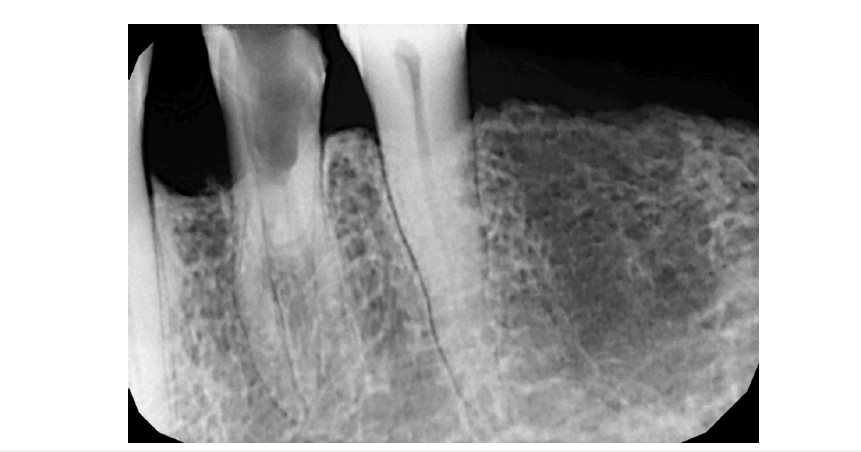
Figure 2:Intra-operative working-length radiograph showing mandibular left first premolar (tooth #34) with a unique radicular anatomy with 2 roots having 2 distinct canals and separate exits.
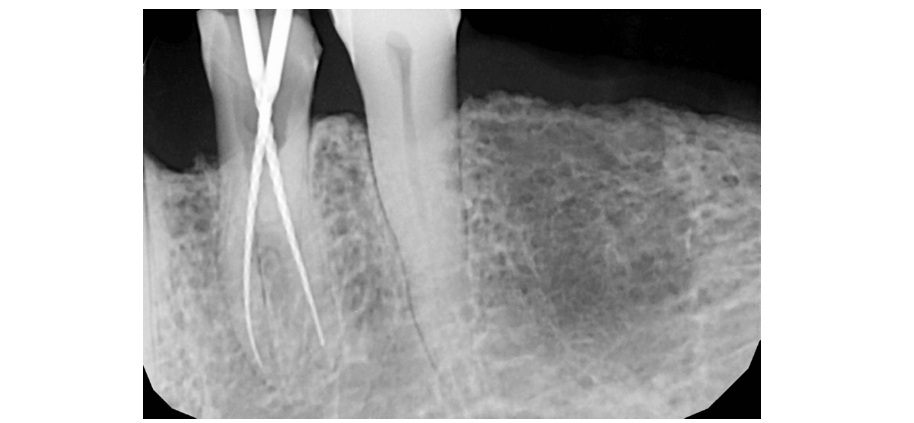
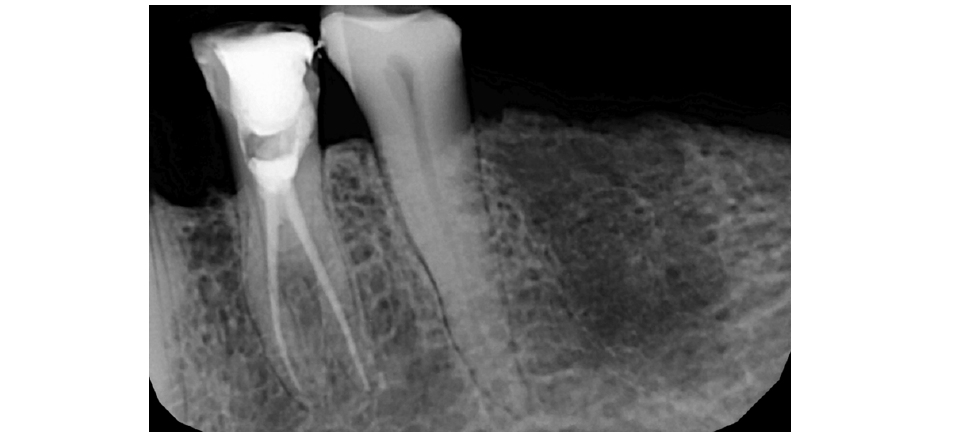
Adequate anaesthesia was achieved with inferior alveolar nerve block. Since the senior citizen had severe gag reflexes the procedure could not be done under rubber dam isolation. The existing cavity preparation was modified, and access cavity was made with round bur; the pulp chamber was entered, and root canal orifices were identified. IOPAR was taken after the initial filing with size 15K-File (Mani, Tochigi, Japan) and found the tooth to have 2 separate roots with 2 different canals of different entry and exit (Figure 2). Working length in each canal was found to be 21 mm. The cleaning and shaping were completed till 6% 25 Hero Shaper files (Micro Mega, Becacon, France). Obturation was done with 6% 25 Master Cone with AH 26 (Dentsply, Germany) as a sealant followed by temporary dressing with Cavit G (3M ESPE, Germany) and postoperative radiograph was taken (Figure 3). Tooth were relieved from occlusion in the functional cusps. The patient was recalled after 5 days for initial review and found to be asymptomatic.
Figure 3:Post-operative radiograph of mandibular left first premolar (tooth #34) following obturation of 2 separate root canals.
Discussion
Root canal anatomy variations are far and wide; they could be influenced by gender, race, ethnicity and genetics. A study conducted among the Indian population showed that 82% of MFP had a single apical foramen and 24% had multiple root canals. 10% teeth had Vertucci type IV root canal anatomy. Analysis of anatomic patterns in root canal anatomy have been conducted on American, African, Jordanian, Burmese, Chinese, and Thai populations and the results show distinct racial deviations. Such racial variances are interesting and could be due to multiple study designs followed by different investigators; additional research is requisite for a better understanding of these anatomical variations [7]. MFP frequently shows complex anatomy that cannot be clearly identified in twodimensional periapical radiographs [8]. The conventional intraoral radiographs are problematic leading to misdiagnosis because of confusing radiographic features like superimposition and inability to visualize the bucco-lingual perspective [9].
CBCT imaging allows the analysis and documentation of the entire dentition of numerous patients belonging to a distinct population sequentially and simultaneously and is seen as the ideal investigation to map out the prevalence of anatomical variants in individuals/subsets [10]. In vivo Cone Beam Computed Tomography (CBCT) provides an accurate analysis of root canal anatomy, and more samples can be evaluated due to its noninvasive nature of application wherein the study samples are not restricted to extracted teeth alone. CBCT analysis of MFP showed that men had significantly more root canals and C-shaped canals compared to women. Among the MFP with 2 canals, CBCT analysis concluded that there was higher incidence of Vertucci type V configuration in contrast to previous in vitro studies where other Vertucci types (i.e., II or IV) were shown to be more prevalent [11]. Burklein et al. [12] assessed the premolar root and root canal morphology in a German population using CBCT imaging and reported a higher incidence of Vertucci type IV root canal anatomy among MFP (14.7%) following the evaluation of over 1000 samples [12].
Conclusion
Endodontic management of MFP is made interesting by the presence of different canal configurations, plus a C-shaped variant. Straight access to additional canals is also restricted by the relatively small diameter of the tooth. 2-dimensional imaging can often obscure multiple canals or roots present in MFP making treatment very challenging for most practitioners. MFP presents with 2 roots having 2 distinct canals and separate exits. (Vertucci classification IV) are quite rare and minimally documented in literature; Dentists should be heedful in locating all root canal systems in MFP; most endodontic failures occur due to missed canals.
Conflict of Interest
The authors have no conflicts of interest to declare. All coauthors have seen and agree with the contents of the manuscript and there is no financial interest in reporting. We certify that the submission is original work and is not under review at any other publication.
References
- Cleghorn BM, Christie WH, Dong CC (2007) The root and root canal morphology of the human mandibular first premolar: A literature review. J Endod 33(5): 509-516.
- Karabucak B, Bunes A, Chehoud C, Kohli MR, Setzer F (2016) Prevalence of apical periodontitis in endodontically treated premolars and molars with untreated canal: A cone-beam computed tomography study. J Endod 42: 538-541.
- Walton R, Torabinejad M (1996) Principles and practice of endodontics. In: Rudolph P (Ed.), (2nd edn), WB Saunders Co, Philadelphia, Pennsylvania, USA, pp. 166-181.
- Slowey RR (1979) Root canal anatomy: Road map to successful endodontics. Dent Clin North Am 23(4): 555-573.
- Mittal S, Kumar T, Mittal S, Sharma J (2014) Mandibular premolars with aberrant canal morphology: An endodontic challenge. Journal of Conservative Dentistry 17(5): 491-494.
- Vertucci FJ (1978) Root canal morphology of mandibular premolars. J Am Dent Assoc 97(1): 47-50.
- Singh S, Pawar M (2014) Root canal morphology of South Asian Indian mandibular premolar teeth. J Endod 40(9): 1338-1341.
- Gutmann JLFB (2016) Tooth morphology, isolation, and access. In: Hargreaves KM, Berman LH (Eds.), (11th edn), St. Louis: Mosby-Elsevier, Missouri, USA, p. 135-136.
- Pineda F, Kuttler Y (1972) Mesiodistal and buccolingual roentgenographic investigation of 7,275 root canals. Oral Surg Oral Med Oral Pathol 33(1): 101-110.
- Martins JN, Versiani M (2018) CBCT and micro-CT on the study of root canal anatomy. In: Versiani M, Basrani B, Sousa-Neto M (Eds.), The Root Canal Anatomy in Permanent Dentition, Springer International Publishing, New York, USA, pp. 89-180.
- Jang YE, Kim Y, Kim B, Kim SY, Kim HJ (2019) Frequency of non-single canals in mandibular premolars and correlations with other anatomical variants: an in vivo cone beam computed tomography study. BMC Oral Health 19(1): 272.
- Bürklein S, Heck R, Schäfer E (2017) Evaluation of the root canal anatomy of maxillary and mandibular premolars in a selected German population using cone-beam computed tomographic data. J Endod 43(9): 1448-1452.
© 2026 Vignesh Vikram. This is an open access article distributed under the terms of the Creative Commons Attribution License , which permits unrestricted use, distribution, and build upon your work non-commercially.
Editor In Chief







.jpg)































Signup for Newsletter

Quick Links
 Editorial Board Registrations
 Submit your Article
 Best Paper of the Volume
 Reprints
 Refer a Friend
 Advertise With Us
Our Recent Edition

.jpg)



Top Editors




.jpg)

















.bmp)
.jpg)
.png)
.jpg)













.jpg)






.png)

.png)




.png)




Financial Support

Sponsors

Latest e-Books

Latest Video

 a Creative Commons Attribution 4.0 International License. Based on a work at www.crimsonpublishers.com.
Best viewed in
a Creative Commons Attribution 4.0 International License. Based on a work at www.crimsonpublishers.com.
Best viewed in 
 | Above IE 9.0 version