

- About Us
- Information
-

The Author ensures that the research has been conducted responsibly and ethically with adherence to all relevant regulations. read more..
- For Authors
- For Reviewer
- Manuscript Guidelines
- Membership
- Publication Ethics
-
- Journals
- Reprints
- e-Books
- Videos
- Policies
- Contact Us
 COVID-19
- Submissions



Full Text
Modern Concepts & Developments in Agronomy
AI-Driven Forest and Agroforestry Monitoring: Modern Remote Sensing Tools for Climate-Smart Agronomy
Vivek Chauhan1*, Akanshu2, Krishna Chauhan3, Ankit Chamoli1, Tara Chand1, K Chandra Sekar4 and Vijender Pal Panwar1
1Forest Ecology and Climate Change Division, Indian Council of Forestry Research and Education-Forest Research Institute (ICFRE-FRI), India
2College of Horticulture, Veer Chandra Singh Garhwali Uttarakhand University of Horticulture and Forestry (VCSG UUHF), India
3College of Agriculture, Govind Ballabh Pant University of Agriculture and Technology (GBPUAT), India
4Garhwal Regional Centre, Govind Ballabh Pant National Institute of Himalayan Environment (GBPNIHE), India
*Corresponding author:Vivek Chauhan, Forest Ecology and Climate Change Division, Indian Council of Forestry Research and Education-Forest Research Institute (ICFRE-FRI), Dehradun, Uttarakhand, 248006, India
Submission: February 10, 2026;Published: February 26, 2026

ISSN 2637-7659Volume15 Issue 5
abstract
Forests and agroforestry systems are increasingly vulnerable to climate-driven stressors such as drought, heatwaves, wildfires, and pest outbreaks, all of which alter ecosystem structure, productivity, and carbon dynamics. Traditional field-based monitoring approaches are spatially limited and insufficient to capture the rapid pace, scale, and complexity of these changes. Recent advances in Artificial Intelligence (AI) and Remote Sensing (RS) now enable high-resolution, multi-temporal monitoring of ecological processes across large and heterogeneous landscapes. This review synthesizes current AI-RS innovations relevant to climate-smart agronomy and forestry. Drawing upon peer-reviewed literature covering multispectral, hyperspectral, LiDAR, SAR, UAV, and IoT sensing, alongside Machine Learning (ML) and Deep Learning (DL) architectures such as CNNs, RNNs, transformers, and anomaly-detection models, we identify eight thematic areas where AI-RS integration is transforming environmental assessment: Structural monitoring, productivity and carbon modelling, resilience evaluation, disturbance forecasting, early-warning systems, multi-sensor fusion, cloud-based platforms, and research challenges. AI-RS fusion enhances forest monitoring by improving biomass estimation, species differentiation, canopy structural mapping, and phenological analysis, while multi-sensor combinations, especially LiDAR-optical and SAR-optical, significantly strengthen detection of degradation, drought signals, fire susceptibility, and regeneration patterns. AI-powered early-warning systems detect drought, fire, and pest risks weeks before observable symptoms, and predictive analytics enable scenario modelling for climate adaptation planning. Persistent challenges include limited ground-truth datasets, reduced model transferability across biomes, computational constraints, interpretability issues in DL models, and socio-ecological barriers to adoption. Nonetheless, AI-enabled RS provides a scalable, data-rich foundation for climate-smart forestry and agroforestry by supporting accurate carbon accounting, early threat detection, and adaptive management. Addressing existing gaps in data, transparency, and governance will be crucial for fully operationalizing these technologies and strengthening resilience in rapidly changing landscapes.
Keywords:Forestry; Climate change; Agroforestry; Artificial intelligence; Remote sensing
Abbreviations: AI: Artificial Intelligence; AI-RS: Artificial Intelligence-Remote Sensing; AGB: Aboveground Biomass; CNN: Convolutional Neural Network; CSF: Climate-Smart Forestry; CHM: Canopy Height Model; DL: Deep Learning; DSS: Decision Support System; eDNA: Environmental DNA; ET: Evapotranspiration; EWS: Early-Warning System; GEDI: Global Ecosystem Dynamics Investigation; GIS: Geographic Information System; GLAD: Global Land Analysis and Discovery; IoT: Internet of Things; LAI: Leaf Area Index; LiDAR: Light Detection and Ranging; LSTM: Long Short-Term Memory (Network); ML: Machine Learning; MRV: Monitoring, Reporting and Verification; MSI: Moisture Stress Index; NDVI: Normalized Difference Vegetation Index; NDWI: Normalized Difference Water Index; NISAR: NASA-ISRO Synthetic Aperture Radar; REDD: Reducing Emissions from Deforestation and Forest Degradation; RNN: Recurrent Neural Network; RS: Remote Sensing; SAR: Synthetic Aperture Radar; SDM: Species Distribution Model; SHAP: SHapley Additive exPlanations; SMAP: Soil Moisture Active Passive; SOC: Soil Organic Carbon; TCN: Temporal Convolutional Network; UAV: Unmanned Aerial Vehicle; VIIRS: Visible Infrared Imaging Radiometer Suite; WUE: Water-Use Efficiency; XAI: Explainable Artificial Intelligence
Introduction
Forests and agroforestry systems play essential roles in global climate regulation, ecological stability, and sustainable agricultural productivity by contributing to carbon sequestration, hydrological regulation, biodiversity maintenance, and soil fertility enhancement. Their significance has grown as climate change accelerates forest degradation, alters phenological cycles, and intensifies disturbance regimes such as drought, fires, and pest outbreaks. Traditional fieldbased monitoring approaches, although fundamental for ecological understanding, remain constrained by limited spatial extent, high labor requirements, and insufficient temporal frequency. This has driven a transition toward remote, automated, and data-rich monitoring frameworks that leverage advancements in Remote Sensing (RS) and Artificial Intelligence (AI) to capture continuous ecosystem dynamics across vast and heterogeneous landscapes [1- 3]. Recent technological progress in multispectral, hyperspectral, LiDAR, and Synthetic Aperture Radar (SAR) sensors, used across satellite, airborne, and UAV platforms, has significantly strengthened capabilities for assessing forest structure, canopy traits, biomass distribution, and disturbance processes. LiDAR-optical fusion has enhanced structural and biomass mapping, enabling estimation of canopy height, foliage profiles, and aboveground carbon stocks with high precision [4,5]. SAR-based models offer all-weather observations critical for monitoring in cloud-prone tropical and montane environments, improving detection of canopy moisture stress, degradation signals, and post-disturbance recovery [6,7].
Machine learning and deep learning approaches further expand the analytical value of RS datasets by surpassing linear model constraints and enabling robust pattern extraction, classification, and anomaly detection [8,9]. Applications of RS-AI integration have expanded rapidly in forest carbon accounting, particularly in mountainous ecosystems where topography drives strong altitudinal gradients in biomass and species composition. Studies in Himalayan temperate forests, for example, show that elevation, slope, and stand age significantly influence aboveground biomass distribution, demonstrating the importance of spatially explicit monitoring frameworks [10,11]. Climate-driven phenological shifts in high-altitude vegetation have also been widely documented using satellite-based time-series analyses, revealing advancing green-up dates, delayed senescence, and increasing sensitivity to warming, patterns with important implications for carbon uptake and ecosystem productivity [12,13].
Agroforestry systems, due to their structural diversity and multifunctionality, also benefit substantially from RS-AI monitoring. Their contributions to carbon sequestration, soil fertility, microclimate regulation, and livelihood resilience have been documented across tropical and temperate regions [14,15]. RS-based approaches now support accurate biomass estimation, species discrimination, and productivity assessment in agroforestry mosaics that are otherwise challenging to quantify through field methods alone [16]. RS tools also play a growing role in ecological restoration monitoring. UAV-based imagery, coupled with ML-driven vegetation detection, provides high-resolution tracking of recovery following interventions such as hydroseeding, reforestation, and slope stabilization [17]. Urban and peri-urban forestry applications similarly rely on RS to evaluate canopy health, pollution tolerance, and ecosystem services in rapidly changing city environments [18]. AI-driven analysis of satellite time series has strengthened early-warning systems for climate-related disturbances, including drought, fire, and pests. Deep learning models trained on multisensory datasets now detect subtle stress signatures, such as canopy water loss, thermal anomalies, or spectral deviations, before visible symptoms emerge, improving risk assessment and response planning [19,20].
Cloud computing infrastructures such as Google Earth Engine enable scalable deployment of these models, providing near-realtime monitoring capabilities for national forestry agencies and restoration programs [2]. Complementary innovations such as digital twins of ecosystems, blockchain-enhanced Monitoring- Reporting-Verification (MRV) frameworks, and integrated big-data architectures are reshaping how forest and agroforestry systems are managed under climate change [21,3]. Collectively, the convergence of remote sensing, AI, and ecological modelling is transforming global forest and agroforestry monitoring. These technologies provide unprecedented capacity for accurate carbon estimation, early disturbance detection, climate-resilience assessment, and data-driven agronomic planning. As climate pressures intensify, RSAI integration will remain central to sustainable land management and climate-smart decision-making. In this context, the present review provides a comprehensive and integrative synthesis of advances in artificial intelligence-enabled remote sensing for monitoring forests and agroforestry systems under changing climatic conditions. The primary purpose of this study is to critically evaluate how multi-sensor RS platforms, combined with machine learning, deep learning, and cloud-based analytics, are reshaping assessments of forest structure, carbon dynamics, phenology, disturbance regimes, and management outcomes across diverse ecological settings. By systematically examining methodological developments, applications, limitations, and emerging innovations, this review bridges disciplinary boundaries between forest ecology, agroforestry, geospatial science, and artificial intelligence. Ultimately, this synthesis aims to inform future research directions and support the development of robust, transparent, and climatesmart monitoring frameworks capable of guiding sustainable forest and agroforestry management in an era of accelerating environmental change.
AI-remote sensing foundations for forest structural monitoring
Forest structure metrics and the role of AI-RS: Remote Sensing (RS) provides the foundational data infrastructure for large-scale forest structural monitoring, and its analytical capacity has expanded substantially with the integration of Artificial Intelligence (AI). Forest structural attributes, including canopy height, vertical foliage distribution, crown geometry, basal area, and aboveground biomass, are critical indicators of ecosystem functioning, carbon storage, habitat quality, and disturbance regimes. Traditional monitoring approaches relying primarily on optical imagery were constrained by spectral saturation indense canopies and limited sensitivity to three-dimensional forest structure. The advent of LiDAR, SAR, hyperspectral imaging, and AIdriven feature extraction has enabled more accurate and scalable quantification of forest structure across diverse ecological contexts [22,4].
Optical remote sensing and deep learning for canopy analysis: Optical multispectral systems such as Landsat and Sentinel-2 continue to play an essential role in canopy condition assessment and long-term structural change detection. Although optical sensors do not directly measure canopy height, texturebased metrics and deep learning-enabled feature extraction have significantly improved the retrieval of crown attributes, gap dynamics, and canopy heterogeneity. Convolutional Neural Networks (CNNs) and transformer-based encoders have shown strong performance in tree crown delineation, canopy opening detection, and structural complexity mapping by learning latent spatial patterns associated with biophysical properties [23,24]. These approaches effectively reduce the impacts of illumination variability and mixed-pixel effects that limit traditional index-based analyses.
LiDAR-based structural characterization and biomass estimation: LiDAR remains the most accurate remote sensing technology for characterizing forest vertical structure. Airborne LiDAR provides high-resolution Canopy Height Models (CHMs), foliage vertical profiles, and tree-level metrics such as crown diameter and stem density (Table 1). Spaceborne LiDAR missions, particularly NASA’s GEDI, have expanded access to globally consistent structural observations, enabling improved biomass estimation across tropical and temperate forests [25]. Machine learning techniques, including random forests, gradient boosting, and deep neural networks, are increasingly applied to translate LiDAR-derived metrics into aboveground biomass estimates, enhancing predictive accuracy in structurally complex and heterogeneous landscapes [26,27].
Table 1:Major remote sensing sensors used in forest structural monitoring and the primary biophysical attributes derived from each sensor type.
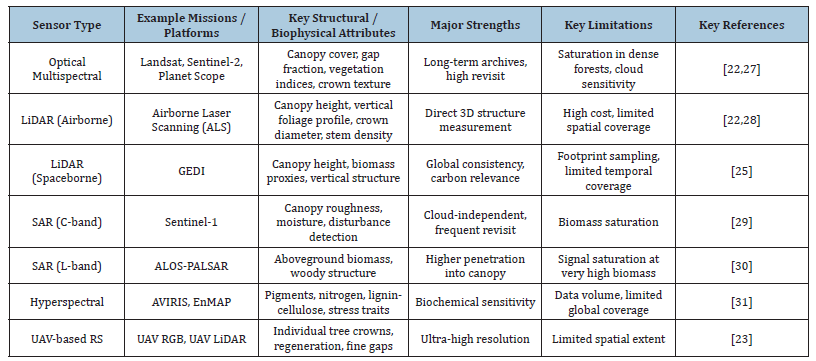
SAR for structural degradation and moisture dynamics: Synthetic Aperture Radar (SAR) complements optical and LiDAR data by offering cloud-penetrating and moisture-sensitive observations, which are especially valuable in tropical and monsoon-dominated regions [28]. L-band SAR (e.g., ALOS-PALSAR) and C-band SAR (e.g., Sentinel-1) exhibit strong relationships with woody biomass, canopy roughness, and sub-canopy moisture conditions. Multi-temporal SAR coherence metrics have proven effective for detecting selective logging, structural degradation, and early canopy thinning prior to visible spectral changes [29-31]. AIdriven SAR inversion models further improve structural estimation by capturing nonlinear relationships between radar backscatter and forest attributes, particularly in high-biomass systems where saturation remains problematic [32].
Hyperspectral contributions to structural and biochemical mapping: Hyperspectral remote sensing adds a biochemical dimension to forest structural monitoring by capturing information on pigment composition, cellulose-lignin content, leaf water status, and canopy stress, which are closely linked to forest age, species composition, and successional stage. When integrated with LiDAR or SAR, hyperspectral data substantially improve species-structure modelling and discrimination of forest structural types within mixed and heterogeneous landscapes [33]. Recent advances in deep spectral-spatial learning, particularly 3D CNNs, have enhanced the estimation of structural traits by jointly exploiting spectral richness and spatial texture [34].
UAV-based structural mapping and fine-scale validation: Unmanned Aerial Vehicle (UAV)-based remote sensing serves as a critical link between field measurements and satellite observations. UAV photogrammetry and UAV-mounted LiDAR provide ultrahigh- resolution structural data capable of detecting saplings, early regeneration, fine-scale canopy gaps, and localized disturbances. These datasets are increasingly used in precision forestry, ecological restoration monitoring, and validation of satellite-derived structural products. Object-detection and instance-segmentation frameworks, including Mask R-CNN, have demonstrated high accuracy in individual tree crown detection and structural trait extraction from UAV imagery [23].
Multi-sensor fusion and cloud-based scaling: Multi-sensor data fusion represents one of the most significant advances in contemporary forest structural monitoring. The integration of LiDAR with optical imagery enhances biomass estimation and canopy complexity mapping, while SAR-optical fusion improves detection of degradation under persistent cloud cover or optically saturated conditions. Hyperspectral-LiDAR fusion further enables speciesspecific structural modelling in heterogeneous forest mosaics [35]. AI-based fusion frameworks facilitate integration at both feature and decision levels, effectively leveraging complementary spectral, spatial, and structural information. Cloud-based geospatial platforms such as Google Earth Engine have become essential for scaling AI-RS workflows from plot-level studies to regional and continental analyses (Table 2). These platforms provide access to multi-decadal satellite archives, integrated machine learning libraries, and automated processing pipelines, enabling near-realtime forest structural monitoring at unprecedented spatial and temporal scales [2].
Table 2:Artificial intelligence and machine-learning approaches commonly applied to forest and agroforestry monitoring, with typical applications and strengths.
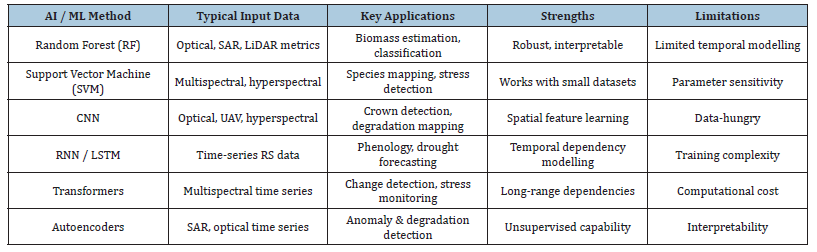
Overall, the convergence of AI and advanced remote sensing technologies has fundamentally transformed forest structural monitoring. By integrating multi-sensor observations with robust computational models, these approaches deliver more accurate, scalable, and ecologically meaningful structural metrics, forming a critical foundation for applications in carbon accounting, biodiversity assessment, disturbance detection, and climate-smart forest management.
AI for agroforestry productivity, carbon dynamics & system optimization
Structural complexity and AI-RS opportunities: Agroforestry systems represent complex, multifunctional landscapes where trees, crops, soils, and microclimates interact to influence productivity, ecological resilience, and carbon dynamics. Due to their pronounced spatial heterogeneity and multistrata architecture, agroforestry systems have historically been difficult to quantify using conventional field-based approaches alone. The integration of Artificial Intelligence (AI) with multisensor Remote Sensing (RS) now provides a robust analytical framework capable of capturing these interactions at farm, landscape, and regional scales. Machine Learning (ML) and Deep Learning (DL) approaches enable the extraction of key biophysical parameters, such as canopy cover, leaf area index, photosynthetic activity, biomass allocation, and soil moisture, with substantially greater precision than traditional vegetation index-based methods [36,37]. High-resolution satellite platforms, including Sentinel-2 and Planet Scope, together with UAV-based photogrammetry and multispectral sensing, facilitate detailed assessment of tree-crop interactions, shading effects, and spatial variability in productivity, supporting climate-smart agronomic decision-making.
Biomass and carbon stock estimation: One of the most important applications of AI-RS in agroforestry is biomass and carbon stock estimation. Conventional allometric equations often perform poorly in mixed-species, uneven-aged systems typical of agroforestry landscapes. ML regression techniques, including random forests, support vector regression, and gradient boosting, integrate spectral, structural, and textural features derived from satellite and LiDAR datasets to improve biomass accuracy [38,39]. LiDAR-derived canopy height models further enhance tree-level and stand-level biomass estimates, particularly in multistrata agroforestry mosaics. Spaceborne LiDAR observations from missions such as GEDI provide globally consistent structural datasets which, when fused with optical and SAR imagery, strengthen carbon stock assessments in regions with limited field inventory data [25].
Microclimate regulation and water dynamics: Agroforestry systems exert strong control over microclimatic conditions through shading, evapotranspirative cooling, and soil-vegetation feedback. Thermal remote sensing, particularly from Landsat TIRS and ECOSTRESS sensors, enables spatial estimation of Evapotranspiration (ET) and Water-Use Efficiency (WUE) across tree-crop interfaces. AI models trained on combined thermal, multispectral, and meteorological datasets can quantify microclimate regulation, identify heat-stress hotspots, and support optimization of tree spacing, orientation, and species selection for climate adaptation [40]. The integration of soil moisture products from missions such as SMAP with ML approaches further improves prediction of water balance, drought sensitivity, and root-zone dynamics in agroforestry systems [41].
Soil health and nutrient dynamics: Soil fertility assessment is another domain substantially strengthened by AI-RS integration. Soil Organic Carbon (SOC), nitrogen status, and erosion risk can be inferred using spectral libraries and ML models trained on multispectral and hyperspectral imagery [42]. UAV-based multispectral imaging combined with soil classification algorithms enhances fine-scale soil health mapping, which is particularly critical for managing agroforestry systems in semi-arid and smallholder-dominated regions.
Temporal modelling and growth trajectories: Temporal AI modelling provides new insights into agroforestry growth trajectories, carbon accumulation rates, and responses to management interventions. Recurrent Neural Networks (RNNs) and Temporal Convolutional Networks (TCNs) applied to multitemporal RS datasets enable detection of tree growth dynamics, pruning cycles, mortality events, and long-term productivity trends [43]. Such models are increasingly relevant for carbon neutrality planning, as they allow forecasting of biomass and carbon trajectories under alternative climate and management scenarios (Figure 1).
Figure 1:AI-RS applications ranging from biophysical to socio-economic impacts.

Decision support, socioeconomics, and MRV: AI-powered Decision-Support Systems (DSS) integrate RS-derived biophysical indicators with climate, soil, and socio-economic datasets to recommend optimal agroforestry designs, species combinations, and management regimes. These systems enhance resourceuse efficiency, increase resilience to climatic stress, and support farmer adoption of climate-smart agroforestry practices [44]. Socio-economic integration is increasingly recognized as critical for successful agroforestry adoption. ML models incorporating demographic characteristics, land-tenure arrangements, and market-access variables help identify barriers and drivers of agroforestry uptake across regions [45]. When combined with RSbased suitability mapping, AI provides a powerful evidence base for policy planning that aligns ecological potential with livelihood benefits. In the context of carbon markets and climate-finance mechanisms, AI substantially strengthens Monitoring, Reporting, and Verification (MRV) processes by automating biomass estimation, detecting land-use change, and generating transparent carbon metrics (Table 3). Blockchain-enabled MRV frameworks are emerging as tools to improve traceability and verification of agroforestry carbon credits, reducing uncertainty and increasing investor confidence [46].
Table 3:Applications of AI-integrated remote sensing in agroforestry systems, including biophysical focus and management relevance.
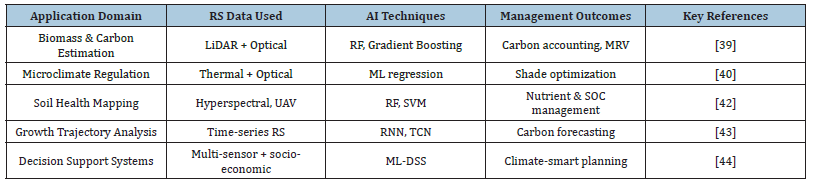
Overall, the integration of AI and remote sensing offers transformative capabilities for agroforestry monitoring by improving quantification of productivity, carbon dynamics, microclimate regulation, and soil health, while supporting system optimization and climate adaptation. These advances provide a strong scientific foundation for scaling agroforestry as a climatesmart and multifunctional land-use system.
Climate-smart forestry adaptation & resilience through AI
Climate-smart forestry conceptual framework and AIRS integration: Climate-Smart Forestry (CSF) seeks to enhance forest resilience, sustain ecosystem services, and strengthen climate-change mitigation through improved carbon sequestration, adaptive management, and disturbance-responsive strategies. As climate change accelerates the frequency and severity of droughts, storms, heatwaves, wildfires, and pest outbreaks, monitoring forest vulnerability and adaptive capacity requires high-resolution, continuous, and scalable observational frameworks. AI-Integrated Remote Sensing (AI-RS) systems provide this capability by enabling multidimensional assessment of forest structure, physiology, phenology, and disturbance regimes across broad spatial extents and fine temporal resolutions. By integrating multi sensor datasets, including multispectral, hyperspectral, SAR, LiDAR, and UAV imagery, with Machine Learning (ML) and Deep Learning (DL) algorithms, AI-RS frameworks facilitate predictive modeling of climate-driven changes and inform adaptive forest management interventions.
Optical indicators of stress and AI-based temporal analysis: Optical multispectral remote sensing is foundational for detecting physiological stress, canopy health decline, and droughtinduced changes in vegetation condition. Spectral indices such as NDVI, EVI, NDWI, MSI, and red-edge metrics serve as proxies for pigment concentration, water status, and thermal stress. However, optical signals alone are constrained by atmospheric interference and cloud cover. AI-based models substantially enhance sensitivity and classification accuracy by integrating temporal context and spatial complexity. Convolutional Neural Networks (CNNs) and temporal architectures, including LSTMs and transformer-based models, effectively distinguish seasonal variability from persistent climate-induced stress using satellite time-series imagery [47]. These approaches enable early detection of subtle spectral changes associated with heat stress, drought onset, and incipient canopy decline that are often undetectable using threshold-based vegetation indices.
LiDAR-based structural vulnerability and resilience assessment: LiDAR is a core component of climate-smart forestry due to its unique capacity to quantify three-dimensional canopy structure, vertical foliage distribution, gap dynamics, and biomass allocation, attributes closely linked to forest vulnerability and adaptive capacity. Spaceborne LiDAR missions, particularly NASA’s GEDI, have revolutionized structural monitoring by delivering globally consistent waveform-derived height and biomass metrics [25]. AI-based regression models that integrate LiDAR-derived structure with climatic drivers improve prediction of drought-induced mortality, storm damage susceptibility, and post-disturbance regeneration patterns [48]. In mountainous and topographically complex forests, where microclimatic gradients strongly shape resilience, LiDAR-AI frameworks are increasingly used to identify climate refugia, characterize structural thresholds associated with tipping points, and model long-term vulnerability trajectories.
SAR for moisture dynamics and disturbance detection: Synthetic Aperture Radar (SAR) complements optical and LiDAR observations by providing cloud-independent measurements of canopy moisture, surface roughness, and structural density. L-band SAR systems, including ALOS PALSAR and upcoming missions such as NASA-ISRO NISAR, exhibit strong sensitivity to aboveground biomass and moisture anomalies. AI-enabled SAR modeling enhances drought detection, soil moisture estimation, and stormrelated disturbance mapping by capturing nonlinear relationships in radar backscatter and coherence time series [49]. SAR time-series anomaly detection methods are particularly effective in identifying drought-driven canopy desiccation, which increases susceptibility to wildfire and pest outbreaks. Fusion of SAR and optical datasets through AI further improves early detection of climate-induced canopy degradation.
Phenological shifts and climate sensitivity: Phenological monitoring using remote sensing is increasingly central to climatesmart forestry, as shifts in phenology represent some of the earliest biological responses to climate warming. Long-term satellite observations reveal widespread advancement of spring leaf-out, delayed senescence, and altered growing-season dynamics across temperate and montane forests [50]. AI-enhanced phenological models improve detection of deviations from historical baselines and allow quantification of species-specific sensitivity to temperature and moisture anomalies. These models also identify phenological mismatches between climatic cues and biological responses, increasing forest vulnerability to late frosts, heatwaves, and pest outbreaks.
Predictive modeling and adaptive management: Predictive modeling constitutes a cornerstone of climate-smart forestry planning. AI approaches, including random forests, boosted regression models, hybrid physical-ML frameworks, and recurrent neural networks, are increasingly used to forecast future forest conditions based on climate projections, structural attributes, disturbance history, and species traits. These models simulate biomass trajectories, drought-related mortality risk, fire susceptibility, and species redistribution under alternative climate scenarios [51]. Predictive AI tools enable forest managers to identify high-risk stands, prioritize adaptive interventions, and evaluate long-term resilience pathways under uncertainty.
Restoration, carbon dynamics, and cloud-based decision support: AI also supports climate-adapted forest restoration by integrating RS-derived degradation assessments with ecological suitability modeling. Machine-learning Species Distribution Models (SDMs) identify candidate species and provenance selections for climate-resilient planting, while UAV-based AI monitoring tracks sapling survival, structural recovery, and microclimate stabilization at fine spatial scales. Carbon-oriented climate-smart forestry relies heavily on AI-RS monitoring to quantify aboveground biomass, carbon fluxes, and disturbance-driven emissions. AI models integrating LiDAR structure with multi sensor RS data improve estimation of carbon gains and losses, strengthening carbon accounting and REDD+ Monitoring, Reporting, and Verification (MRV) frameworks [52]. Emerging blockchain-supported MRV platforms, enhanced by AI-derived indicators, offer transparent and tamper-resistant mechanisms for climate finance and forest carbon markets. Finally, cloud-based AI geospatial platforms such as Google Earth Engine democratize access to climate-smart forestry analytics by enabling large-scale model deployment, time-series analysis, and near-real-time risk mapping. These platforms allow forest managers and policymakers to apply predictive tools without extensive computational infrastructure, supporting evidence-based adaptation strategies across regions (Figure 2).
Figure 2:AI-RS applications ranging from biophysical to socio-economic impacts.

Collectively, AI-RS systems are fundamentally reshaping climate-smart forestry by enabling multidimensional vulnerability assessment, early stress detection, resilience modeling, and adaptive management under climate change. Their integration is essential for anticipating climate impacts, safeguarding forest carbon stocks, and sustaining ecosystem services in rapidly changing environments.
AI-enabled early-warning systems (pests, drought, fire, degradation)
Rationale for AI-driven early-warning systems: Climatedriven disturbances, including drought, wildfire, pest outbreaks, and progressive forest degradation, are intensifying globally, creating an urgent need for highly sensitive and scalable Early-Warning Systems (EWS). The integration of Artificial Intelligence (AI) with multi-sensor Remote Sensing (RS) has substantially advanced early detection capabilities by enabling continuous monitoring, anomaly detection, and predictive modeling across forest and agroforestry landscapes. These AI-RS systems detect subtle pre-disturbance signals that are often undetectable through field observation or simple spectral thresholds, providing managers with actionable lead times necessary for climate-smart interventions.
Drought detection and forecasting: Drought represents one of the most pervasive climate stressors affecting forests and agroforestry systems. Remote sensing indicators such as land surface temperature, shortwave infrared reflectance, and vegetation moisture indices serve as proxies for drought stress, but their interpretive power is significantly enhanced through AI-based analysis. Deep learning models applied to time-series MODIS, Sentinel-2, and Landsat imagery can detect early declines in canopy moisture and photosynthetic efficiency, effectively distinguishing normal phenological dry-down from emerging drought stress. Neural networks trained on combined climatic and vegetation datasets have demonstrated the capacity to forecast drought conditions weeks in advance [53], enabling proactive interventions such as adaptive thinning, irrigation scheduling, or species-specific protection in agroforestry systems. Soil moisture observations from NASA’s SMAP mission further improve drought detection, particularly when integrated with AI-driven downscaling approaches that generate high-resolution soil moisture estimates [41].
Wildfire risk monitoring and pre-fire detection: Wildfire early-warning systems increasingly rely on AI-RS integration as ignition frequency, fuel aridity, and fire-season length intensify under climate change. While thermal anomaly detection from MODIS and VIIRS underpins operational fire monitoring, AI models extend capability by identifying pre-fire conditions through integration of fuel moisture status, vegetation stress, topography, and meteorological variables. Machine-learning fire-risk models, including random forests and boosted regression trees, have shown strong performance in predicting ignition probability and potential fire spread [54]. SAR data, particularly L-band observations from missions such as ALOS-2, enhance fire-risk mapping due to their sensitivity to canopy water content and structural dry-down. AI models trained on SAR backscatter time series detect pre-fire desiccation patterns even under persistent cloud cover, making them especially valuable in tropical and monsoon-dominated regions. UAV-based thermal imaging combined with object-detection neural networks further supports real-time fire perimeter mapping and hotspot detection in inaccessible terrain.
Pest and disease early detection: Pest and disease outbreaks pose escalating threats to forest resilience as rising temperatures accelerate insect life cycles, expand pest distributions, and weaken host-tree defenses. Hyperspectral remote sensing is particularly effective for early pest detection because it captures biochemical indicators such as chlorophyll degradation, pigment imbalance, nitrogen variability, and altered leaf water content. Machine learning and deep learning classifiers applied to hyperspectral datasets can differentiate pest-induced damage from nutrient stress, drought effects, and fungal infections [55]. AI-enhanced spectral anomaly detection has enabled bark beetle infestations to be identified weeks to months earlier than conventional ground surveys. UAVbased multispectral imagery analyzed using CNN architecture further improves the detection of localized infestations, enabling rapid intervention before outbreaks propagate.
Forest degradation detection and MRV: Forest degradation detection remains among the most challenging aspects of earlywarning systems because degradation often occurs subtly through selective logging, understory removal, canopy fragmentation, invasive species expansion, or gradual biomass decline without immediate loss of canopy cover. Multi-temporal SAR coherence analysis, LiDAR-derived structural metrics, and texture-based spectral indicators provide early signals of degradation. AI-driven anomaly detection approaches, including autoencoders and deep similarity networks, substantially improve detection sensitivity by identifying deviations from long-term structural and spectral baselines. These methods play a critical role in REDD+ Monitoring, Reporting, and Verification (MRV) by enhancing the accuracy and transparency of carbon-loss estimates [56].
IoT integration and operational scaling: The integration of Internet of Things (IoT) sensor networks, including soil moisture probes, microclimate stations, pheromone traps, and automated pest sensors, further strengthens AI-enabled early-warning systems. AI algorithms fuse IoT data streams with RS observations to refine stress detection, calibrate satellite-derived indicators, and provide high-temporal-resolution alerts. Cloud-based platforms such as Google Earth Engine facilitate large-scale deployment of early-warning workflows, while AI-driven dashboards deliver real-time risk maps and forecast scenarios to forest managers, policymakers, and local institutions. These advances substantially reduce response time between disturbance onset and management action, improving resilience in both forest and agroforestry systems.
Overall, AI-enabled early-warning systems represent a critical advancement in climate-smart land management by enabling proactive detection of drought, fire, pest outbreaks, and forest degradation. Their integration into operational monitoring frameworks is essential for minimizing ecological damage, safeguarding carbon stocks, and sustaining ecosystem services under accelerating climate change.
Multi-sensor fusion, cloud computing & digital platforms
Rationale and scope of multi-sensor fusion: Multi-sensor fusion has emerged as one of the most powerful strategies for improving the accuracy, consistency, and scalability of forest and agroforestry monitoring. Optical, LiDAR, SAR, hyperspectral, UAV-based, and Internet of Things (IoT) datasets each capture distinct biophysical attributes of vegetation, yet no single sensor can comprehensively represent canopy structure, biochemical condition, and temporal dynamics. Artificial Intelligence (AI) enables deep integration of these heterogeneous data streams, allowing spectral, structural, and temporal information to be combined into unified analytical frameworks. Optical-LiDAR fusion, for example, substantially improves biomass estimation and canopy-structure characterization by coupling LiDAR-derived vertical geometry with multispectral indicators of canopy chemistry and phenology. AI-based fusion approaches have demonstrated significantly enhanced aboveground biomass estimation accuracy across tropical and temperate forest systems [28,57].
Optical-SAR fusion for structural and moisture monitoring: The fusion of optical remote sensing with Synthetic Aperture Radar (SAR) further strengthens monitoring capacity in cloudprone regions, as SAR provides sensitivity to forest structure and moisture conditions while remaining largely unaffected by atmospheric interference. Multi-frequency SAR fusion, particularly the integration of C-band and L-band observations, has proven effective for detecting forest degradation, selective logging, and biomass change across heterogeneous landscapes [30]. AI-driven fusion models exploit complementary sensor responses to improve detection sensitivity and temporal consistency under variable observation conditions.
Hyperspectral-LiDAR integration and UAV-satellite synergy: Hyperspectral-LiDAR integration has advanced species discrimination, functional trait mapping, and biodiversity assessment. Hyperspectral data offer fine spectral resolution linked to plant pigments, nitrogen content, water status, and lignin-cellulose composition, while LiDAR supplies information on canopy height, vertical foliage distribution, and structural complexity. When processed using deep learning models, integrated hyperspectral-structural datasets enable high-resolution mapping of species composition and functional diversity in ecologically complex environments [58]. Unmanned Aerial Vehicles (UAVs) further bridge the spatial gap between ground measurements and satellite observations by providing centimeter-scale imagery and LiDAR data. UAV-satellite fusion supports precise monitoring of regeneration dynamics, restoration outcomes, seedling establishment, and fine-scale canopy structural change that are unresolved by satellite sensors alone [59].
IoT-remote sensing integration for near-real-time monitoring: IoT-based sensing has become an increasingly important component of multi-sensor fusion frameworks. Soil moisture probes, microclimate sensors, pest traps, and eddycovariance flux towers provide continuous ground-based observations that improve calibration and validation of AI-RS models. AI pipelines integrating IoT and remote sensing data streams enable near-real-time monitoring of environmental conditions, stress responses, and management impacts. This synergistic integration enhances climate-smart forestry and agroforestry by supporting data-driven irrigation management, stress-response modeling, and adaptive silvicultural planning [60].
Cloud computing infrastructure and AI scalability: Cloudcomputing platforms such as Google Earth Engine, NASA Earth data Cloud, the Microsoft Planetary Computer, and ESA’s DIAS infrastructure have fundamentally transformed the scalability of AI-RS workflows. These platforms host petabyte-scale archives of open-access satellite data, including Landsat, Sentinel, GEDI, VIIRS, ECOSTRESS, and global SAR repositories, allowing large-scale model deployment without reliance on local high-performance computing. Google Earth Engine has played a particularly influential role in democratizing access to AI-ready remote sensing by enabling national- to continental-scale forest monitoring, disturbance detection, phenology analysis, and biomass modeling [2]. The integration of cloud-native machine learning tools allows continuous model training, deployment, and updating, substantially lowering technical barriers for forest agencies and research institutions.
Digital platforms, MRV, and governance applications: Digital dashboards and cloud-based monitoring platforms now play a central role in climate governance, Monitoring, Reporting, and Verification (MRV), and decision support. Platforms such as Global Forest Watch, FAO’s SEPAL system, and national MRV dashboards integrate multi-sensor RS with AI-driven changedetection algorithms to visualize land-cover change, track forest degradation, and generate near-real-time alerts for fires, drought stress, logging, and carbon-stock variation [61]. These systems enhance transparency and accountability in forest monitoring at multiple governance levels.
Digital twins and blockchain-enabled MRV: Digital twins, dynamic virtual representations of forest ecosystems, represent an emerging frontier in AI-enabled forest monitoring. By integrating multi-sensor remote sensing, ecosystem process models, and AIbased forecasting, digital twins enable simulation of disturbance scenarios, restoration pathways, carbon-flux trajectories, and long-term climate impacts. These tools are increasingly applied to evaluate alternative management strategies under projected climate conditions, supporting evidence-based climate-smart forestry planning [62]. Finally, blockchain-integrated MRV infrastructures enhance transparency and traceability in forest carbon accounting. When AI-derived indicators and multi-sensor RS outputs are securely recorded on distributed ledgers, verification processes become more resistant to manipulation, reducing monitoring costs and facilitating equitable participation in forest carbon markets [63]. Collectively, these advances demonstrate that multisensor fusion, cloud computing, and digital platforms form the technological backbone of next-generation forest and agroforestry monitoring systems (Figure 3).
Figure 3:AI-RS applications ranging from biophysical to socio-economic impacts.

AI-enabled early-warning systems for pests, drought, fire & degradation
Need for AI-based early-warning systems: Climate change has intensified the frequency and severity of disturbances in forest and agroforestry landscapes, increasing vulnerability to droughts, wildfires, pest outbreaks, and progressive forms of degradation. Traditional detection approaches, such as periodic ground surveys, single-date satellite observations, and expert-driven heuristic models, are no longer sufficient for monitoring rapidly evolving stress conditions. The integration of Artificial Intelligence (AI) with multi-sensor Remote Sensing (RS) provides a transformative earlywarning capability by enabling detection of subtle biophysical anomalies well before visible symptoms emerge.
Drought early warning and forecasting: Drought early warning systems have particularly benefited from AI-RS integration. Satellite-derived indicators, including land surface temperature, evaporative stress metrics, vegetation water content, and shortwave-infrared reflectance, allow spatially explicit assessment of water stress across large regions. Machine-learning models substantially improve upon index-based approaches by capturing nonlinear relationships between climatic anomalies and vegetation responses. Temporally resolved deep learning models applied to MODIS and ECOSTRESS data have demonstrated the ability to predict moisture deficits weeks in advance of observable canopy desiccation, enabling forest managers to implement mitigation measures proactively [64,65] (Figure 4).
Figure 4:AI-RS applications ranging from biophysical to socio-economic impacts.

Wildfire risk detection and fire-behavior modeling: Wildfire early-warning systems increasingly rely on AI-enhanced multi-sensor RS because SAR, multispectral, and thermal datasets collectively capture fuel moisture, vegetation stress, and ignition likelihood. Thermal sensors detect emerging hotspots, while SAR time series reveal progressive canopy drying that elevates flammability even under persistent cloud cover. AI-driven fire-risk models trained using meteorological variables, fuel-load proxies, topography, and vegetation condition, have demonstrated strong predictive skill across fire-prone regions [54]. These systems support forecasting of high-risk fire periods and simulation of potential fire spread, providing critical decision support for fire prevention and suppression planning. UAV-mounted thermal sensors further enhance early detection by identifying microhotspots in rugged terrain that are difficult to resolve using satellite platforms alone.
Pest and disease early detection: Pest and disease outbreaks, which are increasing under shifting temperature regimes and altered phenology, represent another domain where AI-enabled RS has proven highly effective. Hyperspectral imaging detects biochemical changes in foliage, such as reductions in chlorophyll, pigment imbalance, and altered leaf water content, that occur during early infestation stages. Machine-learning classifiers and deep neural networks trained on hyperspectral signatures can reliably distinguish pest-induced stress from abiotic stressors such as drought or nutrient deficiency. These approaches have enabled early detection of bark beetle infestations in coniferous forests well before visible canopy discoloration occurs, improving the feasibility of targeted intervention [66]. When combined with UAV imagery, AIbased detection supports precision mapping of outbreak hotspots at fine spatial scales, which is especially important in mixed-species agroforestry systems.
Forest degradation detection and carbon implications: Forest degradation encompasses processes such as selective logging, understory removal, invasive species establishment, and soil erosion, changes that often progress gradually and evade coarse land-cover classifications. Multi-temporal SAR coherence analysis, LiDAR-derived structural metrics, and spectral texture indicators enable AI systems to quantify subtle degradation dynamics. Deep learning change-detection models, including Siamese networks and autoencoders, identify deviations from baseline ecosystem conditions with greater sensitivity than conventional differencing methods. These approaches have successfully detected selective logging and post-disturbance recovery trajectories across tropical regions [29,61]. Early detection of degradation is particularly important for carbon accounting and restoration planning, as degradation can contribute substantially to emissions despite limited changes in canopy cover.
Predictive analytics, IoT integration, and cloud deployment: The predictive capability of AI further strengthens early-warning systems by integrating climate forecasts, phenological information, and historical disturbance patterns. Machine-learning pest-risk models combine temperature projections, host distribution, and remotely sensed phenology to anticipate outbreak dynamics under future climate scenarios [67]. Similarly, drought-forecasting models that fuse RS-derived soil moisture with atmospheric and climate-model outputs allow managers to prepare for extreme events months in advance. AI-based fire-behavior models simulate ignition risk and potential spread under varying fuel and climate conditions, supporting strategic planning for fuel reduction and firebreak implementation. Integration of Internet-of-Things (IoT) sensor networks, including soil moisture probes, microclimate stations, automated insect traps, and weather sensors, further enhances early-warning capacity. IoT observations provide highfrequency ground validation for calibrating AI-RS models, reducing uncertainty and enabling near-real-time monitoring. When RSderived predictors are combined with continuous ground-based sensor streams, decision-support systems can issue automated alerts for drought stress, pest activity, and fire risk through cloudbased dashboards and mobile platforms [68]. Cloud platforms such as Google Earth Engine, Amazon Web Services, and ESA’s DIAS infrastructure have significantly expanded the operational reach of AI-enabled early-warning systems. These environments support automated ingestion of multi-sensor imagery, large-scale execution of AI models, and visualization of emerging disturbances at national to continental scales. Operational monitoring systems, including Global Forest Watch’s GLAD alerts, rely on cloud-based pipelines to deliver near-real-time warnings of forest loss and degradation [69]. Such systems are increasingly central to REDD+ programs and climate-policy mechanisms that require timely, transparent disturbance detection (Table 4).
Table 4:AI-enabled early-warning systems for major forest disturbances and associated remote sensing.
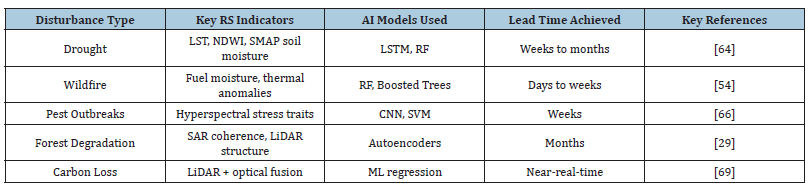
Overall, AI-enabled early-warning systems represent a cornerstone of climate-smart forestry and agroforestry. By integrating multi-sensor remote sensing, high-frequency IoT data, climatic information, and machine learning, these systems provide unprecedented capacity to detect, predict, and monitor disturbances that threaten forest health and carbon stability. Their importance will continue to grow as climate variability accelerates disturbance regimes and as AI models and remote-sensing archives become increasingly sophisticated.
Challenges, knowledge gaps, and global research priorities for AI-driven forest and agroforestry monitoring
Despite rapid advances in Remote Sensing (RS) and Artificial Intelligence (AI), substantial scientific, technical, and governancerelated challenges continue to constrain their effective application in forest and agroforestry monitoring. These challenges span limitations in ground-truth data availability, sensor constraints, model interpretability, uncertainty quantification, socio-economic barriers, and the detection of biodiversity change and subtle forest degradation. Addressing these interlinked constraints is critical for ensuring that AI-RS systems are reliable, transferable, and operationally meaningful across diverse ecological and sociopolitical contexts.
Ground-truth limitations, data inequity, and model generalizability: One of the most persistent limitations in AI-driven forest monitoring is the scarcity of high-quality, geographically diverse ground-truth datasets required for training and validating models. Ecological plots, biomass inventories, and long-term phenological observations remain heavily biased toward temperate regions, while tropical, montane, and arid ecosystems, where monitoring needs are often most urgent, remain underrepresented. This imbalance limits model generalizability and increases the risk of biased predictions when AI systems trained in one biome are transferred to regions with contrasting species composition, canopy architecture, and climatic regimes [70]. Empirical evidence demonstrates that biomass models calibrated using LiDAR data in Amazonian forests often perform poorly when transferred to African or Asian forests due to fundamental structural and floristic differences [71]. Similarly, spectral-phenological models developed in temperate forests may fail to detect early stress responses in tropical agroforestry systems characterized by multi-layered canopies and asynchronous phenology [72]. Addressing these issues requires coordinated international data-sharing initiatives, harmonized field protocols, and integration of community-based monitoring to strengthen training datasets in underrepresented regions.
Sensor constraints and multi-sensor fusion challenges: Sensor-related limitations further compound these challenges. Optical imagery is frequently constrained by cloud contamination, particularly in humid tropical regions; SAR backscatter saturates in high-biomass forests, reducing sensitivity to carbon stocks in mature stands; and hyperspectral imagery, while rich in biochemical information, remains computationally demanding and unevenly available at global scales. LiDAR provides highly accurate structural information but is costly to acquire over large areas, leading to disparities in data availability between well-funded research regions and resource-constrained countries. These sensorspecific constraints necessitate sophisticated fusion strategies, yet multi-sensor integration remains technically challenging due to mismatches in spatial resolution, temporal revisit frequency, and radiometric properties [27]. While AI-based fusion models offer a promising pathway to overcome individual sensor limitations, their performance remains strongly dependent on the availability of robust, harmonized training data.
Ecological complexity and limits of pattern-based AI: Ecological complexity and nonlinear ecosystem dynamics pose additional constraints on AI-driven monitoring. Forest and agroforestry systems are governed by interactions among climate variability, species identity, soil properties, microtopography, and disturbance regimes. While AI excels at identifying patterns in large datasets, it often struggles to represent long-term mechanistic processes such as successional change, species migration, and disturbance-recovery feedback. These limitations become particularly evident when models trained on historical RS observations are used to predict ecosystem behavior under novel climate conditions. Hybrid modeling approaches that integrate mechanistic ecosystem models with machine-learning predictions offer a promising pathway forward. For example, coupling dynamic vegetation models or individual-based forest simulators with RS-derived AI outputs improves realism in forecasting biomass trajectories and resilience under climate change [73]. However, such hybrid frameworks remain computationally intensive and data-demanding, constraining their operational deployment.
Model interpretability, explainable AI, and trust: Limited interpretability of contemporary AI architectures represents a major barrier to operational adoption. Deep learning models, including convolutional neural networks, transformers, and multimodal fusion networks, often achieve high predictive accuracy but provide limited transparency regarding the ecological relationships underlying their outputs. This “black box” nature complicates regulatory acceptance and reduces trust among forest managers and policymakers, particularly in contexts such as carbon markets, REDD+ reporting, and conservation planning. Explainable AI (XAI) techniques, such as saliency mapping, SHAP values, featureattribution methods, and attention-based visualization, are increasingly explored to address this limitation. However, their application in forestry and agroforestry remains limited and often fails to reveal mechanistic ecological drivers [74,75]. Strengthening interpretability and explicitly linking AI outputs to ecological processes is therefore a critical research priority.
Uncertainty quantification and risk-aware decision making: Uncertainty quantification remains a major gap limiting the operational utility of AI-RS models. Forest ecosystems exhibit strong spatial and temporal heterogeneity driven by species composition, phenological dynamics, microclimatic gradients, and stochastic disturbances. Remote sensing data further introduces uncertainty through atmospheric effects, sensor noise, pixel mixing, and topographic distortion. Despite this, many AI workflows provide deterministic outputs without associated uncertainty estimates, limiting their usefulness for risk assessment and policy formulation. This shortcoming is particularly problematic in carbon accounting, where small biomass estimation errors can lead to substantial discrepancies in reported emissions or sequestration [76]. Bayesian deep learning, ensemble modeling, and probabilistic neural networks offer viable solutions, but their computational demands have constrained large-scale adoption [77].
Infrastructure, digital divide, and socio-economic barriers: Operational and infrastructural challenges further restrict adoption, particularly in the Global South. Processing large RS datasets, including multi-decadal Sentinel archives, LiDAR point clouds, hyperspectral data cubes, and SAR time series, requires high-performance computing, reliable internet connectivity, and substantial data storage. Although cloud platforms such as Google Earth Engine and Amazon Web Services have lowered technical barriers, digital divides, data-sovereignty concerns, and cybersecurity constraints continue to limit access in many regions [78]. Socio-economic and governance constraints also play a critical role. Many forest-dependent communities lack the technical capacity and institutional support required to engage with AIdriven monitoring systems. Insecure land tenure, weak governance structures, insufficient long-term funding, and concerns related to data privacy and sovereignty further undermine adoption. Ethical challenges arise when high-resolution monitoring exposes unauthorized logging or land-use change with legal or political implications [79].
Biodiversity monitoring and multi-modal integration: Biodiversity monitoring remains one of the most technically challenging frontiers for AI-RS integration. Species-level discrimination in structurally complex forests is constrained by spectral overlap, intra-species variability, phenological differences, and multi-layered canopies. Even hyperspectral and LiDAR datasets often require extensive field validation to resolve fine-scale compositional differences. Integrating RS with complementary data streams, such as environmental DNA, bioacoustics, and close-range UAV imagery, offers promising pathways for improving biodiversity detection and functional diversity assessment, but demands substantial interdisciplinary coordination and methodological standardization [80].
Detecting subtle forest degradation: Forest degradation detection, particularly for subtle and non-stand-replacing processes such as selective logging, understory thinning, and fuelwood extraction, remains a persistent challenge. These disturbances often produce weak spectral or structural signals that evade conventional RS metrics. Recent advances using SAR coherence change, LiDAR-based structural anomaly detection, and deep learning-based change-detection models show promise but remain limited by sparse ground validation and inconsistent data availability.
Global research priorities and the way forward: Addressing these interconnected challenges defines a set of critical global research priorities. These include developing generalizable AI models supported by internationally harmonized training datasets; expanding and sustaining multi-sensor RS archives; advancing explainability and uncertainty quantification frameworks; improving equitable access to digital infrastructure; strengthening participatory and community-based monitoring approaches; and integrating socio-economic variables with biophysical models to support holistic climate-smart forestry and agroforestry strategies. Achieving these goals will require sustained international collaboration, shared data infrastructures, and interdisciplinary partnerships linking ecology, artificial intelligence, remote sensing, climate science, and the social sciences. Establishing global benchmarking datasets, harmonized calibration standards, and coordinated RS-AI monitoring alliances will be essential for ensuring that technological innovation translates into climateresilient, transparent, and socially just management of forest and agroforestry systems.
Conclusion
The integration of Artificial Intelligence (AI) with multi-sensor Remote Sensing (RS) constitutes a transformative advancement in the monitoring, assessment, and management of forest and agroforestry systems under accelerating climatic change. By synergistically exploiting spectral, structural, and temporal information from optical, LiDAR, hyperspectral, SAR, UAV, and IoT-based observations, AI-driven frameworks enable the highresolution characterization of ecosystem processes that were previously difficult to quantify consistently across space and time. These capabilities have substantially expanded the scope of forest and agroforestry monitoring, improving the estimation of biomass and carbon stocks, enhancing species and structural mapping, and enabling early detection of drought stress, fire risk, pest outbreaks, and gradual degradation processes.
Through their capacity to model complex, nonlinear relationships within high-dimensional datasets, machine learning and deep learning approaches provide actionable insights that support anticipatory, rather than reactive, management strategies aligned with climate-smart forestry and agronomy objectives. Across forest ecosystems, AI-enabled RS has demonstrably strengthened carbon accounting and disturbance monitoring by reducing uncertainty in aboveground biomass estimation and improving the temporal detection of change dynamics. The fusion of LiDAR-derived three-dimensional structural information with multispectral and SAR observations has proven particularly effective in capturing forest heterogeneity, supporting more robust greenhouse gas inventories and Monitoring, Reporting, and Verification (MRV) frameworks. Time-series AI models applied to long-term satellite archives further facilitate the identification of early warning signals associated with climatic stressors, enabling timely interventions in regions where ecological vulnerability is amplified by elevation gradients, complex terrain, or high species turnover. These advances are especially relevant in tropical and montane systems, where conventional field-based monitoring remains constrained by accessibility, scale, and cost.
Agroforestry systems, defined by their multifunctionality and structural complexity, similarly benefit from AI-RS integration. Landscape-scale monitoring of tree-crop interactions, microclimatic regulation, biomass accumulation, and soil condition provides a quantitative foundation for optimizing agroforestry design under climate variability. AI-supported decision frameworks allow practitioners and policymakers to evaluate trade-offs among productivity, resilience, and carbon sequestration, reinforcing agroforestry’s role as a nature-based solution for climate mitigation, adaptation, and livelihood security. Importantly, these technologies also enhance the transparency and credibility of agroforestryrelated carbon finance mechanisms by supporting scalable and verifiable MRV systems. Despite these advances, the long-term effectiveness of AI-driven forest and agroforestry monitoring remains contingent upon addressing persistent challenges related to data availability, model transferability, interpretability, uncertainty quantification, and equitable access to computational resources. Ecological heterogeneity, species diversity, and regionspecific management practices continue to limit the generalizability of AI models trained on geographically constrained datasets. Moreover, socio-economic inequalities and digital divides risk excluding forest-dependent and agroforestry communities from the benefits of emerging technologies, underscoring the need for inclusive governance, transparent data policies, and participatory monitoring approaches. Advancing explainable and uncertaintyaware AI architectures is equally critical for ensuring scientific credibility, policy relevance, and stakeholder trust.
Looking ahead, the integration of AI-RS systems with digital twins, cloud-native geospatial platforms, hybrid ecological-AI models, and blockchain-enabled MRV infrastructures represents a key frontier for climate-smart land management. These emerging frameworks offer the potential to simulate ecosystem trajectories, evaluate management scenarios, and support long-term resilience planning at multiple spatial scales. Realizing this potential will require sustained interdisciplinary collaboration, harmonized ground-truth networks, open-access multi-sensor datasets, and coordinated international benchmarking initiatives to reduce methodological fragmentation and enhance reproducibility. In conclusion, AI-driven remote sensing has evolved from a largely experimental toolset into a central pillar of climate-smart forestry and agroforestry. When coupled with ecological understanding, transparent governance, and equitable implementation, AIRS frameworks provide a scientifically robust pathway for strengthening ecosystem resilience, optimizing agroforestry productivity, supporting carbon-neutral development, and guiding adaptive responses to accelerating environmental change.
Acknowledgement
The author gratefully acknowledges the institutional support provided by the Indian Council of Forestry Research and Education (ICFRE) and the Forest Research Institute, Dehradun, for creating an enabling environment to pursue research at the interface of forestry, remote sensing, and climate-resilient land management. Access to computational and geospatial facilities significantly contributed to the synthesis presented in this review. The author also recognizes the contributions of the broader scientific community whose advancements in artificial intelligence, remote sensing, and ecological monitoring form the foundation of this work. Although not directly involved in the preparation of this manuscript, their published research has been indispensable in shaping understanding of AI-driven forest and agroforestry monitoring. Finally, the author appreciates the global commitment of researchers, practitioners, and land managers working toward climate-smart forestry and sustainable agroecosystem development.
Conflict of Interest
The author declares that there are no commercial or financial relationships, personal affiliations, or competing interests that could be construed as influencing the content, analysis, or conclusions presented in this manuscript. The research and interpretations provided herein are conducted independently and solely reflect the author’s scholarly assessment of current scientific advancements in AI-driven forest and agroforestry monitoring.
References
- Wulder MA, White JC, Loveland TR, Woodcock CE, Belward AS, et al. (2016) The global Landsat archive: Status, consolidation, and direction. Remote Sensing of Environment 185: 271-283.
- Gorelick N, Hancher M, Dixon M, Ilyushchenko S, Thau D, et al. (2017) Google earth engine: Planetary-scale geospatial analysis for everyone. Remote Sensing of Environment 202: 18-27.
- Reichstein M, Camps-Valls G, Stevens B, Jung M, Denzler J, et al. (2019) Deep learning and process understanding for data-driven Earth system science. Nature 566(7743): 195-204.
- Asner GP, Mascaro J, Anderson C, Knapp DE, Martin RE, et al. (2013) High-fidelity national carbon mapping for resource management and REDD+. Carbon Balance and Management 8(1) : 7.
- Chen Q, Laurin GV, Valentini R (2015) Uncertainty of remotely sensed aboveground biomass over an African tropical forest: Propagating errors from trees to plots to pixels. Remote Sensing of Environment 160: 134-143.
- Englhart S, Jubanski J, Siegert F (2013) Quantifying dynamics in tropical peat swamp forest biomass with multi-temporal LiDAR datasets. Remote Sensing 5(5): 2368-2388.
- Hirschmugl M, Deutscher J, Gutjahr KH, Sobe C, Schardt M (2017) Combined use of SAR and optical time series data for near real-time forest disturbance mapping. In Proceedings of the 9th International Workshop on the Analysis of Multitemporal Remote Sensing Images, IEEE, Brugge, Belgium, pp. 1-4.
- Maxwell AE, Warner TA, Fang F (2018) Implementation of machine-learning classification in remote sensing: An applied review. International Journal of Remote Sensing 39(9): 2784-2817.
- Zhu XX, Tuia D, Mou L, Xia GS, Zhang L, et al. (2017) Deep learning in remote sensing: A comprehensive review and list of resources. IEEE Geoscience and Remote Sensing Magazine 5(4): 8-36.
- Nandy S, Ghosh S, Kushwaha SPS, Senthil Kumar A (2018) Remote sensing-based forest biomass assessment in northwest Himalayan landscape. In Remote Sensing of Northwest Himalayan Ecosystems, Springer, pp. 285-311.
- Sharma CM, Tiwari OP, Rana YS, Krishan R, Mishra AK (2016) Plant diversity, tree regeneration, biomass production and carbon storage in different oak forests on ridge tops of Garhwal Himalaya. Journal of Forest and Environmental Science 32(4): 329-343.
- Liu N, Townsend PA, Naber MR, Bethke PC, Hills, et al. (2021) Hyperspectral imagery to monitor crop nutrient status within and across growing seasons. Remote Sensing of Environment 255: 112303.
- Chauhan V, Mohammed H, Sharma J, Parmar S, Chand T, et al. (2025) Phenological responses of key tree species to climatic variables in Garhwal Himalaya. Journal of Sustainable Forestry 44(8): 713-728.
- Nair PKR (2012) Carbon sequestration studies in agroforestry systems: A reality-check. Agroforestry Systems 86(2): 243-253.
- Mbow C, Smith P, Skole D, Duguma L, Bustamante M (2014) Achieving mitigation and adaptation to climate change through sustainable agroforestry practices in Africa. Current Opinion in Environmental Sustainability 6: 8-14.
- Thapa B, Lovell S, Wilson J (2023) Remote sensing and machine learning applications for aboveground biomass estimation in agroforestry systems: A review. Agroforestry Systems 97(6): 1097-1111.
- Wang R, Sun Y, Zong J, Wang Y, Cao X, et al. (2024) Remote sensing application in ecological restoration monitoring: A systematic review. Remote Sensing 16(12): 2204.
- Nowak DJ, Hirabayashi S, Bodine A, Greenfield E (2014) Tree and forest effects on air quality and human health in the United States. Environmental Pollution 193: 119-129.
- Bhowmik RT, Jung YS, Aguilera JA, Prunicki M, Nadeau K (2023) A multi-modal wildfire prediction and early-warning system based on a novel machine learning framework. Journal of Environmental Management 341: 117908.
- Senf C, Seidl R (2021) Mapping the forest disturbance regimes of Europe. Nature Sustainability 4(1): 63-70.
- Ramirez SG, Hales RC, Williams GP, Jones NL (2022) Extending SC-PDSI-PM with neural network regression using GLDAS data and permutation feature importance. Environmental Modelling & Software 157: 105475.
- Lefsky MA, Cohen WB, Parker GG, Harding DJ (2002) LiDAR remote sensing for ecosystem studies: Lidar, an emerging remote sensing technology that directly measures the three-dimensional distribution of plant canopies, can accurately estimate vegetation structural attributes and should be of particular interest to forest, landscape, and global ecologists. BioScience 52(1): 19-30.
- Weinstein BG, Marconi S, Bohlman S, Zare A, White E (2019) Individual tree-crown detection in RGB imagery using semi-supervised deep learning neural networks. Remote Sensing 11(11): 1309.
- Zhu J, Chen X, Zhang H, Tan Z, Wang S, et al. (2023) Transformer based remote sensing object detection with enhanced multispectral feature extraction. IEEE Geoscience and Remote Sensing Letters 20: 1-5.
- Dubayah R, Blair JB, Goetz S, Fatoyinbo L, Hansen M, et al. (2020) The global ecosystem dynamics investigation: High-resolution laser ranging of the Earth’s forests and topography. Science of Remote Sensing 1: 100002.
- Fassnacht FE, Latifi H, Stereńczak K, Modzelewska A, Lefsky M, et al. (2016) Review of studies on tree species classification from remotely sensed data. Remote Sensing of Environment 186: 64-87.
- Zhu XX (2019) Optical multi-sensor harmonization study. Remote Sensing of Environment.
- Asner GP, Clark JK, Mascaro J, Galindo García GA, Chadwick KD, et al. (2012) High-resolution mapping of forest carbon stocks in the Colombian Amazon. Biogeosciences 9(7): 2683-2696.
- Reiche J, Verbesselt J, Hoekman D, Herold M (2015) Fusing Landsat and SAR time series to detect deforestation in the tropics. Remote Sensing of Environment 156: 276-293.
- Lucas R, Armston J, Fairfax R, Fensham R, Accad A, et al. (2010) An evaluation of the ALOS PALSAR L-band backscatter, above ground biomass relationship Queensland, Australia. IEEE Journal of Selected Topics in Applied Earth Observations and Remote Sensing 3(4): 576-593.
- Asner GP, Martin RE, Knapp DE, Tupayachi R, Anderson CB, et al. (2017) Airborne laser-guided imaging spectroscopy to map forest trait diversity and guide conservation. Science 355(6323): 385-389.
- Cartus O, Santoro M, Kellndorfer J (2012) Mapping Forest aboveground biomass in the Northeastern United States with ALOS PALSAR dual-polarization L-band. Remote Sensing of Environment 124: 466-478.
- Cho MA, Skidmore AK, Sobhan I (2009) Mapping beech (Fagus sylvatica L.) forest structure with airborne hyperspectral imagery. International Journal of Applied Earth Observation and Geoinformation 11(3): 201-211.
- Audebert N, Le Saux B, Lefèvre S (2019) Deep learning for classification of hyperspectral data: A comparative review. IEEE Geoscience and Remote Sensing Magazine 7(2): 159-173.
- Ballanti L, Blesius L, Hines E, Kruse B (2016) Tree species classification using hyperspectral imagery: A comparison of two classifiers. Remote Sensing 8(6): 445.
- Bendig J, Yu K, Aasen H, Bolten A, Bennertz S, et al. (2015) Combining UAV-based plant height from crop surface models, visible, and near infrared vegetation indices for biomass monitoring in barley. International Journal of Applied Earth Observation and Geoinformation 39: 79-87.
- Belgiu M, Drăguţ L (2016) Random Forest in remote sensing: A review of applications and future directions. ISPRS Journal of Photogrammetry and Remote Sensing 114: 24-31.
- Mutanga O, Adam E, Cho MA (2012) High density biomass estimation for wetland vegetation using WorldView-2 imagery and random forest regression algorithm. International Journal of Applied Earth Observation and Geoinformation 18: 399-406.
- Rodríguez-Veiga P, Quegan S, Carreiras J, Persson HJ, Fransson JE, et al. (2019) Forest biomass retrieval approaches from earth observation in different biomes. International Journal of Applied Earth Observation and Geoinformation 77: 53-68.
- Anderson MC, Allen RG, Morse A, Kustas WP (2012) Use of Landsat thermal imagery in monitoring evapotranspiration and managing water resources. Remote Sensing of Environment 122: 50-65.
- Entekhabi D, Njoku EG, O'Neill PE, Kellogg KH, Crow WT, et al. (2010) The Soil Moisture Active Passive (SMAP) mission. Proceedings of the IEEE 98(5): 704-716.
- Vågen TG, Winowiecki L, Tondoh JE, Desta LT, Gumbricht T (2016) Mapping of soil organic carbon stocks for spatially targeted interventions in agricultural landscapes. Scientific Reports 6: 26638.
- Lira Melo de Oliveira Santos C, Lamparelli RAC, Figueiredo GKDA, Dupuy S, Boury J, et al. (2019) Classification of crops, pastures, and tree plantations along the season with multi-sensor image time series in a subtropical agricultural region. Remote Sensing 11(3): 334.
- Coe R, Sinclair F, Barrios E (2014) Scaling up agroforestry requires research ‘in’ rather than ‘for’ development. Current Opinion in Environmental Sustainability 6: 73-77.
- Mercer DE (2004) Adoption of agroforestry innovations in the tropics: A review. Agroforestry Systems 61(1): 311-328.
- Chauhan V, Jain N, Waghmare M, Parmar A, Nandeha N, et al. (2025) Blockchain and big data analytics in agriculture: A review of digital innovations. Journal of Experimental Agriculture International 47(11): 58-68.
- Kattenborn T, Leitloff J, Schiefer F, Hinz S (2021) Review on Convolutional Neural Networks (CNN) in vegetation remote sensing. ISPRS Journal of Photogrammetry and Remote Sensing 173: 24-49.
- Frolking S, Palace MW, Clark DB, Chambers JQ, Shugart HH, et al. (2009) Forest disturbance and recovery: A general review in the context of spaceborne remote sensing of impacts on aboveground biomass and canopy structure. Journal of Geophysical Research: Biogeosciences 114(G2):
- De Luca G, Silva JM, Modica G (2022) Post-fire vegetation regrowth characterization using optical and SAR time-series. Geocarto International 37(27): 15428-15462.
- Piao S, Fang J, Zhou L, Ciais P, Zhu B (2006) Variations in satellite-derived phenology in China's temperate vegetation. Global Change Biology 12(4): 672-685.
- Anderegg WRL, Kane JM, Anderegg LDL (2013) Consequences of widespread tree mortality triggered by drought and temperature stress. Nature Climate Change 3(1): 30-36.
- Goetz S, Hansen M, Houghton R, Walker W, Laporte NT, Busch J (2015) Measurement and monitoring for REDD+. Center for Global Development Working Paper 392.
- AghaKouchak A, Chiang F, Huning LS, Love CA, Mallakpour I, et al. (2020) Climate extremes and compound hazards in a warming world. Annual Review of Earth and Planetary Sciences 48(1): 519-548.
- Chuvieco E, Aguado I, Yebra M, Nieto H, Salas J, et al. (2010) Development of a framework for fire risk assessment using remote sensing and GIS technologies. Ecological Modelling 221(1): 46-58.
- Govender M, Chetty K, Bulcock H (2007) A review of hyperspectral remote sensing and its application in vegetation and water resource studies. Water SA 33(2): 145-151.
- Dupuis C, Lejeune P, Michez A, Fayolle A (2020) How can remote sensing help monitor tropical moist forest degradation? Remote Sensing 12(7): 1087.
- Potapov P, Li X, Hernandez-Serna A, Tyukavina A, Hansen MC, et al. (2021) Mapping global forest canopy height through integration of GEDI and Landsat data. Remote Sensing of Environment 253: 112165.
- Kilgore A, Restrepo C (2025) Integrating hyperspectral imaging and soil-lithology to uncover mountain scape disturbance dynamics. Remote Sensing 17(11): 1806.
- White JC, Wulder MA, Varhola A, Vastaranta M, Coops NC, et al. (2013) A best practice guide for generating forest inventory attributes from airborne laser scanning data. The Forestry Chronicle 89(6): 722-723.
- Moesinger L, Zotta RM, Van der Schalie R, Scanlon T, De Jeu R, et al. (2022) Monitoring vegetation condition using microwave remote sensing: The Standardized Vegetation Optical Depth Index (SVODI). Biogeosciences 19(21): 5107-5123.
- Hansen MC, Potapov PV, Moore R, Hancher M, Turubanova SA, et al. (2013) High-resolution global maps of 21st-century forest cover change. Science 342(6160): 850-853.
- Sasaki N, Abe I (2025) A digital twin architecture for forest restoration: Integrating AI, IoT, and blockchain for smart ecosystem management. Future Internet 17(9):
- Hirlekar AV (2025) A decentralized blue-carbon MRV system and tokenized carbon credit marketplace. In Proceedings of ICICNIS, IEEE, pp. 882-889.
- AghaKouchak A, Farahmand A, Melton FS, Teixeira J, Anderson MC, et al. (2015) Remote sensing of drought: Progress, challenges and opportunities. Reviews of Geophysics 53(2): 452-480.
- Fisher JB, Lee B, Purdy AJ, Halverson GH, Dohlen MB, et al. (2020) ECOSTRESS: NASA's next generation mission to measure evapotranspiration From the International Space Station. Water Resources Research 56(4): e2019WR026058.
- Lausch A, Erasmi S, King DJ, Magdon P, Heurich M (2016) Understanding Forest health with remote sensing: Part I. Remote Sensing 8(12): 1029.
- Jactel H, Bauhus J, Boberg J, Bonal D, Castagneyrol B, et al. (2017) Tree diversity drives forest stand resistance to natural disturbances. Current Forestry Reports 3(3): 223-243.
- Jhansi Rani G, Shanmukhi Rama G, Marrikukkala RK, Srikanth Y, Reddy CVK (2020) An IoT based environmental monitoring system. IOP Conference Series: Materials Science and Engineering 981(3): 032025.
- Hansen MC, Krylov A, Tyukavina A, Potapov PV, Turubanova S, et al. (2016) Humid tropical forest disturbance alerts using Landsat data. Environmental Research Letters 11(3): 034008.
- Réjou-Méchain M, Barbier N, Couteron P, Ploton P, Vincent G, et al. (2019) Upscaling Forest biomass from field to satellite measurements: Sources of errors and ways to reduce them. Surveys in Geophysics 40(4): 881-911.
- Avitabile V, Herold M, Heuvelink GB, Lewis SL, Phillips OL, et al. (2016) An integrated pan-tropical biomass map using multiple reference datasets. Global Change Biology 22(4): 1406-1420.
- Latifi H, Fassnacht F, Koch B (2012) Forest structure modeling with combined airborne hyperspectral and LiDAR data. Remote Sensing of Environment 121: 10-25.
- Fisher RA, Koven CD, Anderegg WRL, Christoffersen BO, Dietze MC, et al. (2018) Vegetation demographics in earth system models: A review of progress and priorities. Global Change Biology 24(1): 35-54.
- Roscher R, Bohn B, Duarte MF, Garcke J (2020) Explainable machine learning for scientific insights and discoveries. IEEE Access 8: 42200-42216.
- Liu J, Wang Y, Lu Y, Zhao P, Wang S, et al. (2024) Application of remote sensing and Explainable Artificial Intelligence (XAI) for wildfire occurrence mapping. Remote Sensing 16(19): 3602.
- Roxburgh SH, Paul KI, Clifford D, England JR, Raison RJ (2015) Guidelines for constructing allometric models for the prediction of woody biomass. Ecosphere 6(3): 1-27.
- Abdar M, Pourpanah F, Hussain S, Rezazadegan D, Liu L, et al. (2021) A review of uncertainty quantification in deep learning. Information Fusion 76: 243-297.
- Larson AM, Brockhaus M, Sunderlin WD, Duchelle A, Babon A, et al. (2013) Land tenure and REDD+: The good, the bad and the ugly. Global Environmental Change 23(3): 678-689.
- Bush A, Sollmann R, Wilting A, Bohmann K, Cole B, et al. (2017) Connecting Earth observation to high-throughput biodiversity data. Nature Ecology & Evolution 1(7): 0176.
- Bullock EL, Woodcock CE, Olofsson P (2020) Monitoring tropical forest degradation using spectral unmixing and Landsat time series analysis. Remote Sensing of Environment 238: 110968.
© 2026 Vivek Chauhan. This is an open access article distributed under the terms of the Creative Commons Attribution License , which permits unrestricted use, distribution, and build upon your work non-commercially.
Editor In Chief







.jpg)































Signup for Newsletter

Quick Links
 Editorial Board Registrations
 Submit your Article
 Best Paper of the Volume
 Reprints
 Refer a Friend
 Advertise With Us
Our Recent Edition

.jpg)



Top Editors




.jpg)

















.bmp)
.jpg)
.png)
.jpg)













.jpg)






.png)

.png)




.png)




Financial Support

Sponsors

Latest e-Books

Latest Video

 a Creative Commons Attribution 4.0 International License. Based on a work at www.crimsonpublishers.com.
Best viewed in
a Creative Commons Attribution 4.0 International License. Based on a work at www.crimsonpublishers.com.
Best viewed in 
 | Above IE 9.0 version