

- About Us
- Information
-

The Author ensures that the research has been conducted responsibly and ethically with adherence to all relevant regulations. read more..
- For Authors
- For Reviewer
- Manuscript Guidelines
- Membership
- Publication Ethics
-
- Journals
- Reprints
- e-Books
- Videos
- Policies
- Contact Us
 COVID-19
- Submissions



Full Text
Modern Concepts & Developments in Agronomy
Effect of Rachis Leachate on populations of Root- Knot Nematodes of the Genus Meloidogyne Spp.
Lilian Morales Romero*, Vaniert Ventura Chávez and Juan Ramón Gálvez Guerra
Research Institute of Tropical Roots and Tuber Crops (INIVIT), Cuba
*Corresponding author:Lilian M Morales Romero, Senior Researcher, Pest Management Directorate Postal address: Instituto de Investigaciones de Viandas Tropicales, Apartado 6. Santo Domingo, CP 53000, Villa Clara, Cuba
Submission: October 10, 2024;Published: October 28, 2024

ISSN 2637-7659Volume14 Issue 4
Abstract
More than 40 genera of phytonematodes act as obligate parasites of higher plants. Considered hidden enemies, difficult to control and responsible for large losses in crops of economic importance. Currently, efforts are dedicated to its management through the search for biocontrollers and the use of organic fertilizers of plant or animal origin, whose action allows increasing antagonistic organisms and/or inducing unfavorable conditions for their development. In this context, the Research Institute of Tropical Roots and Tubers Crops (INIVIT) has validated, with the participation of producers, the benefits of banana rachis leachate obtained at the institution as a nutritional supplement in foods, vegetables and grains. In this sense, observations and results of its application during the years 2022 and 2023 lead to the present work with the objective of reporting the effect of rachis leachate on populations of Root-Knot Nematodes (RKN) of the genus Meloidogyne spp. The method used consisted of visual analysis of the root system and determination of the galling index in treated and untreated plants. The root system of untreated plants exhibited grade 4 (30 to 99 galls per plant). The first communication is made on the biocontrol potential of banana rachis leachate (10%) in reducing visible symptoms of infection by root-knot nematodes, showing a regulatory effect on population levels of phytonematodes in tomato and pepper plants. Studies aimed at understanding the mechanisms of action of the bioproduct as biological control of nematodes of the genus Meloidogyne spp. are recommended.
Keywords:
Bionematicides; Management; Root-knot nematodes; Tomato; Bell pepperIntroduction
Cultivated plants are subjected to different factors exerted by the environment, whether abiotic or biotic, which contribute to reduce potential yields, decrease the quality of agricultural products, increase production costs and even cause losses due to severe pest infestations [1]. In this context, soil phytopathogens constitute an important group of biotic factors, including several species of fungi, nematodes and bacteria, whose effective management is considered of vital importance for the successful development of crops, due to the potential damage they can cause [2]. Among the different threats to a wide range of economically important crops worldwide, plant pathogenic nematodes are one of the most important. They are very small worms that feed on plant roots and are considered silent enemies, as they remain hidden inside the roots or in the soil, making it difficult to detect their presence early and, therefore, to take effective actions to contain them [3].
Meloidogyne species, known as Root-Knot Nematodes (RKN), are a group of plant parasitic nematodes with a worldwide distribution [4]. It is the most damaging of all phytonematode genera attacking tomatoes in tropical and subtropical regions, causing yield losses estimated at up to 30% [5].
Nematode management has often been based on the application of nematicidal molecules, despite their reasonable efficacy; the use of nematicidal chemical compounds is becoming a growing concern due to various environmental aspects, risks to human health and high cost to farmers [6]. In the last 20 years, studies exploring the use of antagonistic and competitive microorganisms against RKNs have gained great attention [7].
Chemical compounds can control this pest faster and more effectively, however, the damage caused to the ecosystem as well as the residual effects have led to increased interest in finding safer substitutes. In this sense, the application of novels and methods that are more selective to control Meloidogyne spp. is promoted. The search for natural microbial antagonists can offer new alternatives for the biological control of nematodes. In Cuba several microbial species, such as Pochonia chlamydosporia [8], which are used in different crops have shown great efficacy in controlling this type of phytopathogen under certain management conditions and soil types. Other isolates (Stenotrophomona ssp. CIGB G1 and Sphingobacterium sp. CIGBTb) have shown some activity against zoonematodes in in vitro assays and have shown potential as biocontrols [9].
The production of organic fertilizers is an economic alternative for the future for small producers, which guarantees its use to improve soil properties, nutrients for the crop and its health [10]. In this context, the Research Institute of Tropical Roots and Tuber Crops (INIVIT), has developed a bioproduct for agricultural use obtained from harvest residues from banana and plantain production [11].
The studies corresponding to the quality and identity of substances of the bioproduct developed by the institution in late 2019 and early 2020 were carried out by Cuban institutions with up-to-date analytical methodologies and techniques available, recognized for the commercial registration of biofertilizers and biopesticides in Cuba. The studies affirm that the bioproduct obtained does not generate unacceptable risks to human health and the environment [12,13]. The use of rachis leachate in vegetables, tropical roots and grains has been validated by INIVIT’s research-development team with the participation of producers who have evidenced the benefits of the bioproduct as a nutritional supplement, by contributing to crop nutrition, provoking the growth of roots, stems and leaves and increasing plant vigor [14]. In this sense, observations and results of its application during the years 2022 and 2023 lead to the present work with the objective of reporting the effect of the bioproduct developed from rachis leachate on populations of gill-forming nematodes of the genus Meloidogyne spp.
Materials and Methods
The research is part of the validation process (years 2022- 2023) of the use of the bioproduct developed at INIVIT from banana residues (rachis leachate), for which polygons were established to evaluate its effect on vegetable production among them: tomato (Solanum lycopersicum L. var. HA-3019) and pepper (Capsicum annuum L. var. California Wonder st), in areas of INIVIT in the period November-May of the years 2022 and 2023 in a carbonated brown fluffy soil [15].
The bioproduct used was obtained at the INIVIT at from banana rachis leachate (Musa AAA, Cavendish subgroup, cultivar ‘Gran enano’) according to the methodology proposed by Morales & Maza [11]. The application of the bioproduct was carried out weekly at a concentration of 10% and in all study cases; treatment without application (absolute control) was used. The foliar and soil applications were carried out in the morning hours (9:00am) with aspray backpack (Spain, Matabi) of 16L capacity, with a Lurmark AN 2.5 flood-jet nozzle with apressure from 1.5 to 2.0 bar.
Taking into account the objectives of communication, only results obtained from root analysis (number of galls) using the visual method without resorting to laboratory analysis, using the scale proposed by Taylor & Sasser [16] (Table 1), will be referred to. Fifty percent of the treated and untreated plants were sampled.
Table 1:Aging index scale proposed by Taylor & Sasser [16].

Results and Discussion
The effect of banana rachis leachate (10%) on the reduction of visible symptoms of infection by gill-forming nematodes was evident (Figures 1-3), showing a regulating effect on population levels of phytonematodes of the genus Meloidogyne. Visual observation and the use of a damage scale (0-5 degrees), according to the number of galls (derived from the functional alterations caused by the juveniles in the tissues during their growth), made it possible to determine the minimum reduction (degree 0) in the root system of treated plants and a degree 4 in the roots of untreated plants, corresponding to 30 to 99 galls. Bello et al. [17] reports that the visual analysis method allows assessing the effectiveness of the techniques used in the control of Meloidogyne without the need to resort to laboratory analysis.
Figure 1:Visible symptoms of infection by gill-forming nematodes on untreated plants.
Note: tomato roots with different nodulation rates.
Photo taken by L. Morales, INIVIT, 2023.
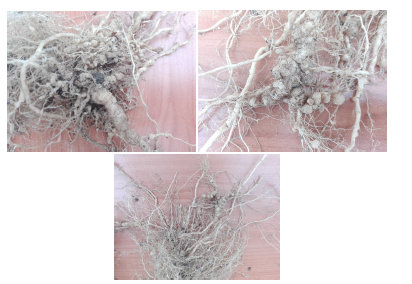
Figure 2:Root system of tomato plants treated with plantain rachis leachate (10%) obtained at INIVIT. Note: reduction to a minimum of nodules or absence of typical galls. Photo taken by L. Morales, INIVIT, 2023.
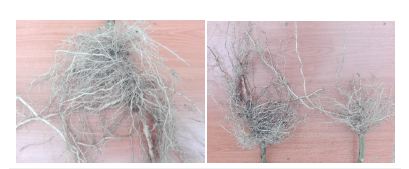
Figure 3:Root system of untreated bell pepper plant showing grade 4 (number of galls 30-99). Note: Photo taken by V. Ventura, INIVIT, 2023.
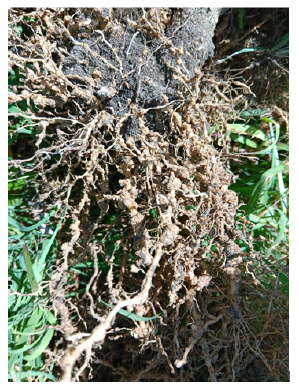
In the untreated plants of the two crops, symptoms representative of the Meloidogyne genus were observed in the roots. The roots thickened in the invasion zone and the development of galls or nodules typical of this pathogen, which had diameters two to three times larger than healthy roots. Heavily infested roots were much shorter than healthy roots and exhibited fewer lateral roots and root hairs. Diseased plants with roots showing typical galls or nodules showed poor growth, small leaves, and pale green or yellowish color. Verdejo-Lucas [18] points out that Meloidogyne species are the nematodes that mainly affect tomato root functionality by interfering with water uptake and nutrient transport. RKNs establish an intimate relationship with their hosts, as they induce the formation of typical galls on roots, which are the first visible symptoms of this kind of infection Rehman et al. & Kyndt T et al. [19].
The regulatory effect on population levels of root-knot nematodes could be attributed to the benefits of rachis leachate as a nutritional supplement in crops that stimulates defense mechanisms that favor resistance to pathogens, an action that is favored by the microbial load determined in the composition of the leachate developed at the INIVIT (4.4 x 10⁶CFU/mL) of bacteria of the genus Bacillus sp. [11].
Research on the potential for control of phytopathogenic fungi through leachate applications has suggested the viability of these products [20]. In Costa Rica, research has been conducted with leachates, mainly to control black sigatoka (Mycosphaerella fjiensis Morelet) [21,22].
Rachis leachates have been evaluated in tomato crops, finding greater microbial activity in the flowering and harvest stage [23,24]. They have also been effectively teste in the control of powdery mildew and in the production of roses [22,25]. Its use combined with Tagetes patula are alternatives that can be used to mitigate moko (Ralstonia solanacearum Smith) infestations in plantains and bananas [26].
The results obtained constitute findings of great importance and constitute the first communication on the biocontrol potential of plantain rachis leachate in the reduction of visible symptoms of infection by gill-forming nematodes in tomato and bell pepper crops and suggest the need to take full advantage of the benefits of leachate obtained from plantain rachis in the management of rootknot nematodes. In the current situation, in which numerous active substances of phytosanitary action are being withdrawn from the market because they are highly toxic and leave residues in the harvested products, the results obtained through the use of banana rachis leachate in the production of vegetables such as tomatoes and peppers could contribute to mitigate the incorporation of high concentrations of fertilizers and allow ecological recovery of nutrients to the soil and the communities of organisms that inhabit it, which is promising for the development of integrated strategies for the management of phytopathogenic nematodes and suggest studies aimed at understanding the mechanisms of action of its use as a biological control of nematodes of the genus Meloidogyne spp [27,28].
Conclusion
The use of banana rachis leachate suggests the possibility of its use and represents a novel alternative for the biocontrol of soil phytoparasite communities by significantly reducing the nodulation rate of gill-forming nematodes of the genus Meloidogyne. The results exhibited with the use of the bioproduct obtained at INIVIT corroborate its usefulness as a nutritional and sanitary supplement for agricultural use and arouse the interest of in-depth studies on the mechanisms of action involved in the search for biocontrollers of phytopathogenic nematodes.
Acknowledgment
The authors express their gratitude to the Science, Technology and Innovation Sector Program PS131LH0004: Development and sustainable use of agricultural bioinputs and veterinary medicines (LABIOFAM Business Group), which supports the development of research on the bioproduct obtained by the institution.
References
- Sikora RA, Fernández E (2005) Nematode parasites of Vegetables. In: Luc M, Sikora RA (Eds.), En: Plant parasitic nematodes in subtropical and tropical agriculture. (2nd edn), J. Bridge, CABI Publishing, Egham, UK, pp. 319-392.
- Fernández-Larrea O (2007) Biopesticide products. Current events and perspectives in Cuba. Memoirs of the international course-workshop Agroecological management of pests in the production system, pp. 51-57.
- Chavarria-Quicaño E, Torre-González F, González-Riojas M, Rodríguez-González J, Asaff-Torres A (2023) Nematicidal lipopeptides from Bacillus paralicheniformis and Bacillus subtilis: A comparative study. Appl Microbiol Biotechnol 107(5-6): 1537-1549.
- Jones JT, Haegeman A, Danchin EGJ, Gaur HS, Helder J (2013) Top 10 plant-parasitic nematodes in molecular plant pathology. Mol Plant Pathol 14(9): 946-961.
- Netscher C, Sikora RA (1990) Nematode parasites of vegetables. Plant parasitic nematodes in subtropical and tropical agriculture. Luc M, Sikora RA, Bridge J (Eds.), CAB International, Wallingford, UK, pp: 237-283.
- Mollinari-Mercedes N, López SL, Murguía CA (2014) Efficacy of Bacillus subtilis native strain as a suppressive agent of the knot Nematode Meloidogyne In Capsicum annuum (ají pi mien to piquillo) crop. Journal of Agricultural and Environmental Research (RIAA).
- Dong LQ, Zhang KQ (2006) Microbial control of plant-parasitic nematodes: a five-party interaction. Plant and Soil 288: 31-45.
- Manzanilla-López RH, Lopez-Llorca LV (2017) Perspectives in sustainable Nematode management through Pochonia chlamydosporia applications for root and rhizosphere health, Springer, Switzerland.
- Sánchez OI, Álvarez LI, Wong PI, Somontes D, Basulto MR, et al. (2018) Characterization of Cuban native bacteria isolated from nematodes as potential biological control agents for Meloidogyne spp, 33(1): 1-11.
- Viltres B, Román-Jer (2023) Manual of agroecological innovations. Máscafé-Cuba project. Editorial Italian development cooperation agency (AICS), p. 51.
- Morales L, Maza N (2020) Obtaining banana rachis at Inivit. Rev. Tropical Agriculture 6(1): 60-64.
- Morales RL, Izquierdo M, Díaz LY, Melo AL (2020) Microbial load and innocuousness of the extract of plants obtained from banana rachis leachate produced in Cuba. Biomedical Journal Scientific & Technical Research 29(3): 22449-22452.
- Citma (2022) Bioproduct for agricultural use obtained from harvest residues from the production of plantains and bananas. Citma Provincial Prize, Main executing entity: Tropical Viands Research Institute (INIVIT), Resolution, p. 49.
- INIVIT (2023) Technical scientist report. Project Development and use of bioproduct for the prevention, management of pests and plant nutrition in root vegetables, vegetables and grains. Sector Program for Science, Technology and Innovation: Development and sustainable use of agricultural bioinputs and veterinary medicines. Labiofam Business Group, Havana, Cuba.
- Hernández A, Pérez-Jiménez JM, Bosch YN, Castro (2015) Genetic classification of the soils of Cuba. Soil Institute, INCA Editions.
- Taylor AL, Sasser JN (1983) Biología, identificación y control de los nematodos de nódulo de la raíz (especies de Meloidogyne). Departamento de Fitopatología de la Universidad del Estado de Carolina del Norte y la Agencia de Estados Unidos para el Desarrollo Internacional.
- Bello A, López-Pérez JA, Alvarez AG (2003) Biofumigation in extensive irrigated agriculture: integrated horticultural production. Mundi-Prensa Libros, p. 670.
- Verdejo-Lucas S, Sorribas FJ, Talavera M (2019) Nematodes in tomato: emerging or persistent risk? Phytohemeroteca, 314.
- Kyndt T, Nahar K, Haegeman A, Vleesschauwer DD, Höfte M, et al. (2013) Comparing systemic defence-related gene expression changes upon migratory and sedentary nematode attack in rice. Plant Biol 1: 73-82.
- Xu D, Raza W, Yu G, Zhao Q, Shen Q, et al. (2012) Phytotoxicity analysis of extracts from compost and their ability to inhibit soil-borne pathogenic fungi and reduce root-knot nematodes. World Journal of Microbiology and Biotechnology 28(3): 1193-1201.
- Escobar-Velez JH, Castaño-Zapata J (2005) Fulvic acid applications for the management of diseases caused by Mycosphaerella Infomusa 14(2): 15-17.
- Álvarez E, Pantoja A, Lederson G, Ceballos Germán (2013) Production of banana stem leachate in the coffee belt of Colombia. International Center for Tropical Agriculture (CIAT), Cali, Colombia.
- Muñoz RE, Madriñán MR (2005) Effect of banana rachis leachates on microbial activity and biomass during flowering and harvest of tomato. Acta Agronómica 54(1): 1-8.
- Vásquez IS (2021) Bioecological alternatives for the control of phytopathogenic Nematodes in red tomato (Solanum lycopersicum) grown in a greenhouse. D Space Repository.
- Vázquez L (2021) Agroecological pest management. Lessons, pp. 48-66.
- Mollogón F, Carolina V, Valencia A, Yomara J (2019) Moko (Ralstonia solanacearum) in plantain and banana: Incidence and alternative control measures in the Colombian context. Monograph, National Open and Distance University, Specialization in Agricultural Biotechnology, p. 71.
- Simon FÁ, Perez Vicente LF (2021) Strategic tactics for the integrated management of pests and diseases in banana. Brazilian Journal of Animal and Environmental Research 4(4): 4973-5000.
- Vázquez LL, Fernández E, Lauzardo RJ, García TT (2005) Agroecological management of pests in urban agriculture farms (MAPFAU). City of Havana, Cuba, p. 60.
© 2024 Lilian Morales Romero. This is an open access article distributed under the terms of the Creative Commons Attribution License , which permits unrestricted use, distribution, and build upon your work non-commercially.
Editor In Chief







.jpg)































Signup for Newsletter

Quick Links
 Editorial Board Registrations
 Submit your Article
 Best Paper of the Volume
 Reprints
 Refer a Friend
 Advertise With Us
Our Recent Edition

.jpg)



Top Editors




.jpg)

















.bmp)
.jpg)
.png)
.jpg)













.jpg)






.png)

.png)




.png)




Financial Support

Sponsors

Latest e-Books

Latest Video

 a Creative Commons Attribution 4.0 International License. Based on a work at www.crimsonpublishers.com.
Best viewed in
a Creative Commons Attribution 4.0 International License. Based on a work at www.crimsonpublishers.com.
Best viewed in 
 | Above IE 9.0 version