

- About Us
- Information
-

The Author ensures that the research has been conducted responsibly and ethically with adherence to all relevant regulations. read more..
- For Authors
- For Reviewer
- Manuscript Guidelines
- Membership
- Publication Ethics
-
- Journals
- Reprints
- e-Books
- Videos
- Policies
- Contact Us
 COVID-19
- Submissions



Full Text
Modern Concepts & Developments in Agronomy
Effect of Viusid® Agro on the Foliar Emission Rate in Bananas
Lilián Morales Romero1*, Nilo Maza Estrada1, Juan Ramón Gálvez1, Osmany Molina Concepción1 and Bulent Kukurtcu2
1Research Institute of Tropical Roots and Tuber Crops (INIVIT), Cuba
2Scientific Advisor Catalysis, Spain
*Corresponding author:Lilián M Morales Romero, Researcher, Pest Management Direction, Instituto de Investigaciones de Viandas Tropicales, Apartado 6, Santo Domingo, CP 53 000, Villa Clara, Cuba
Submission: May 24, 2024;Published: June 19, 2024

ISSN 2637-7659Volume14 Issue 2
Abstract
The number of functional leaves in the commercial production of bananas (Musa spp.) is directly related to the bunch weight and size. The emission of leaves is negatively affected by adverse environmental conditions, and the emission rate may vary. The Spanish company Catalysis S.L. is in charge of producing and then commercializing the bioproduct VIUSID® agro, and it develops an excellent promotional work for the development of research in many countries. This research was carried out at the Research Institute of Tropical Roots and Tuber Crops (INIVIT), located in the municipality of Santo Domingo, province of Villa Clara to determine the effect of VIUSID® agro doses on the Foliar Emission Rate (FER) in bananas, during the period July-September 2021. Nine applications every seven days, two months before flowering at the dose of 0.50L/ha/application, offered a significant influence on the variable, whose value doubles in relation to the control treatment, this aspect is essential for the quantitative analysis of the growth of banana Musa AAA cultivar, Cavendish subgroup, ‘ Cavendish gigante’ cultivar. The treated plants reached flowering with a greater number of formed leaves. The number of emitted leaves per each plant every seven days can be modified by the man´s work by using VIUSID® agro.
Keywords:
Bioproducts; Number of leaves; BananasIntroduction
Plantains and bananas (Musa spp.) are among the main plants grown in tropical and subtropical areas of Latin America, Asia and Africa, where high temperatures and relative humidity prevail. In Cuba, bananas and plantains are a high priority in the national food program, due to their capacity to produce every month of the year, their high productive potential, deep-rooted consumption habit and diversity of uses. The production of plantains and bananas is of great significance within the production of roots and tuber crops in Cuba, since they represent more than 40% of this indicator annually [1].
Foliar emission is usually associated with a number of emitted leaves, generally true leaves, the consideration of this interval in successional plants, should always be in function of these leaves [2]. The knowledge of the plant foliar development, for example, is important because flowering begins when the foliar area of the plant has reached a favourable level, besides the fundamental role that leaves play in the bunch filling [3].
The emission of leaves is negatively affected by adverse environmental conditions or positively by favorable conditions, and the emission rate may vary [4]. In Cuba, thanks to donations from the company Catalysis S.L., researchers´ teams from the Research Institute of Tropical Roots and Tuber Crops (INIVIT) joined the bioproduct evaluations, and they have shown its beneficial effect on garlic (Allium sativa L.), cucumber (Cucumis sativum L.), papaya (Carica papaya L.), cocoyam (Xanthosoma spp.) and taro (Colocasia esculenta Schott.), and cassava (Manihot esculenta Crantz.) [5-9].
Many natural products have been used to enhance the ecological management of agroecosystems, including biopesticides, phytostimulants and biostimulants. In Cuba, several organic products used, allow plants overcome stress situations in adverse environmental conditions, favoring growth, development, and yield with a decrease in the use of chemicals in recent years [10]. For these reasons, the present study was carried out with the objective of determining the effect of VIUSID® agro doses on the Foliar Emission Rate (FER) in bananas.
Materials and Methods
The work was developed in experimental areas, which belong to the Research Institute of Tropical Roots and Tuber Crops (INIVIT), located in Santo Domingo municipality, Villa Clara province, during the period July-September 2021. The research was carried out on a Musa AAA plantation, Cavendish subgroup, ‘Cavendish gigante’ cultivar, coming from corms, planted at a distance of 3.80 x 2.0 x 2.0 m on a Calcic Haplic Phaeozems soil, (Hernández et al., 2015).
The cultural attentions of the plantation, with exception of irrigation, which was deficient, an aspect that was considered an opportunity to evaluate the effect of the bioproduct under abiotic stress conditions were conducted as established in the Banana Technical Instruction Guide [1]. The applications were carried out by hand, using a 16-liter Jacto Knapsack Sprayer. The first application to initiate flowering was made two months before the estimated period. A total of nine applications were made at sevenday intervals.
The following treatments were established:
1. T1 - 0.5L/ha/application of VIUSID® agro (20cc/ knapsack)
2. T2 - 1.0L/ha/application of VIUSID® agro (40cc/ knapsack)
3. T3 - 1.5L/ha/application of VIUSID® agro (60cc/ knapsack)
4. T4 - Control (without application)
The applications were made until flowering weekly, and the following evaluations were made during the study.
Foliar Emission Rate (FER) (20 Plants/Treatment)
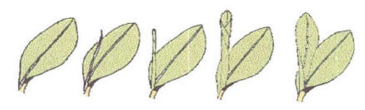
The number of emitted leaves per plant was counted from bottom to top every seven days, moreover the candela leaf status was also determined. For this last observation, the development stages described by (Brun, 1963) were considered (Figure 1). The calculation of (FER) is obtained from the subtraction between the Current Foliar Emission (CFE) and the Past Foliar Emission (PFE). The emission rate is obtained by dividing the sum of FER per number of days, among evaluations (N). This variable is interpreted as the number of emitted leaves per plant every seven days.
Figure 1:Candela status of Brun’s scale (1963).
FER= (CFE-PFE) x (7/N) where:
CFE=average of previous emission
PFE=average of present emission
N=frequency of data collection
C=constant, 7 days a week
The R programming language (R Development Core Team [11]) was used to process the information. The variance analysis to estimate if there are significant differences among treatments was performed with the aov () function, described in the R stats package, and the multiple comparisons, with the objective of estimating the differences among them, the Tuckey´s Test was used, implemented in the agricolae package in the HSD. test () function.
Result and Discussion
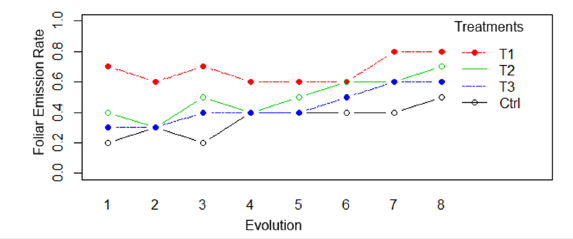
The results obtained indicate that the average values of the FER for seven days in treated plants with VIUSID® agro, showed higher values in relation to the Control treatment, where this value ranged between 0.2-0.4 leaves per week. It is necessary to highlight the effect of the bioproduct on plants with an active development, but subjected to stress, because they are not well irrigated. During the experience, this value for the case of treatment (T1 - 0.5L/ha/ application of VIUSID® agro) was of 0.7-0.9 values closer to the average of one leaf per week, characteristic of well-nourished and irrigated plantations (Figure 2).
Figure 2:Evolution of the variable Foliar Emission Rate in four treatments during eight weeks.
Pérez [12] expresses that the average values of the FER for 10 days in plantations with adequate nutrition and irrigation result as an average of one leaf per week. In this regard, Herbert (2004) points out that the foliar area of plants is fundamental in their life cycle, and the capacity to maintain it at a given moment guarantees crop productivity, if there are no limiting factors. It is also an essential variable for the quantitative analysis of growth, and its estimation makes it possible to establish the capacity of plants to intercept light, carry out photosynthesis and produce goods.
It is important to bear in mind that the number of functional leaves is directly related to the bunch weight and size. Studies have shown that a plant needs a minimum of eight leaves throughout its life cycle to produce a good condition bunch, and that the plant can withstand losses of up to 50% of its foliage at any time of its vegetative development, without affecting the development and production quality [13]. The variable Foliar Emission Rate can also be used as a valuable management tool to monitor and predict the growth of plants (Cherry et al., 2002).
After the acorn is released, the emission of leaves and roots ends; the formed leaves are the source for the filling of fruits; at the same time, there is a considerable decrease in the absorption of nutrients, so it is not appropriate to fertilize or manure, because the absorption system is considerably reduced. Efficient phytosanitary management should be implemented to preserve the present foliar area. The environment plays an important role in the development and production of banana crop; therefore, stress due to drought or moisture excess has a direct impact on the plant growth and development, which is mainly manifested in height decreases and emission of leaves that can be delayed for up to 30 days [4].
The results obtained with the application of VIUSID® agro at a dose of 0.50 L/ha/application, which allowed duplicate the value of the number of emitted leaves per plant in relation to the Control every seven days, suggest the effectiveness of the bioproduct to counteract adverse effects, like plantation situations with deficient irrigation. It is also important to point out that Ascophyllum nodosum is present in 15% of VIUSID Agro® formulation. It is an alga found on the coasts of the North Atlantic, where it is nourished by large quantities of minerals carried by glaciers. The alginic acid is a polysaccharide, a structural component in the cell walls of A. nodosum, which is decisively involved in the water balance and physiological response to abiotic stress [14]. This could explain the results achieved in this research when this bio stimulant was applied.
The growth promoter VIUSID Agro® is a product that essentially contains amino acids, vitamins and minerals, and it was subjected to a biocatalytic process of molecular activation to improve its biological activity and the biochemical reactivity of all its molecules. This makes it possible to favor the vegetative and reproductive phase of crops. It also increases the length of the stems, as well as the number of leaves and it stimulates the number of flowers and fruits, which positively influences the increase of yields.
It is a formulation used as a stimulant for the growth of plants. It has the particularity that all its components (amino acids, vitamins and minerals) are subjected to the molecular activation technique, a procedure that provides a considerable increase in the biological action of the substances. When applying it, it allows overcome critical periods in crops and strengthens plants in droughts [14]. VIUSID Agro® was used in Honduras by Coello [15], in horticultural, fruit and banana crops, with good results on the growth of plants. It brought about advances in the vegetative cycle and significant increases in flowering, fruiting, and consequently in final production.
The product has been used in various crops and stages of their development, generally with a positive effect, depending on the objective of its application. VIUSID agro® is usually applied by spraying (foliar) or by immersion, always at relatively low doses compared to other traditional products. Thanks to the wide scope of research with this product worldwide, there have already been obtained very good results in vegetables (lettuce, onion, tomato, cucumber, broccoli), grains (bean, corn, soybean), ornamentals (roses, anthurium) and others, such as tobacco and pastures (brachiaria, other grasses) [16].
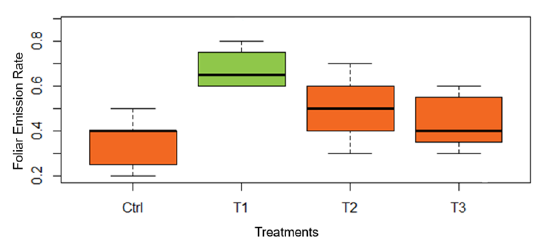
Figure 3:Box diagram with graphical representation of the Foliar Emission Rate in the studied treatments. Note: Treatments: T1 0.5/Ml of water T2 1/Ml of water T3 1.5 /ML of water T4 Control.
Morales et al. [9] refer the use of VIUSID agro® (0,2mL L-1) had a positive effect on the growth and development of in vitro plants of banana Musa AAA, Cavendish subgroup, ‘Gran enano’ cultivar at the ex-vitro acclimatization phase under nursery conditions. When analyzing the variance analysis, it was found that it was possible to establish significant statistical differences among treatments.
If a Variance Analysis is significant, it indicates that at least two of the compared means are significantly different between them, but it is not indicated which ones. To identify them, the means of all the included treatments in the analysis must be compared two by two through a t-test or another test that compares two groups; this is known as post-hoc analysis. The procedures of multiple comparisons allow the detection of differences among the treatment means. In this case, Tukey’s honestly significant difference method was used, whose results are shown in (Figure 3). Treatment T1 showed statistical differences with the rest of the treatments, to which it is attributed the best response of the plants, showing the highest FER value in the conditions where the experiment was carried out. In addition to that, this box-andwhisker diagram graphically represents the foliar emission rate through its quartiles. It can be clearly seen through them, where half of the data is located.
Conclusion
A. The use of VIUSID® agro at a dose of 0.50L/ha/application offered a significant influence on the variable Foliar Emission Rate, an essential variable for the quantitative analysis of the growth of plants. The number of emitted leaves per plant in the ‘Cavendish gigante’ cultivar every seven days was double in relation to untreated plants. B. The number of emitted leaves per plant every seven days can be modified by the man´s work by using VIUSID® agro. C. With the application of VIUSID® agro, plants were able to reach flowering with a greater number of formed leaves, which constitute the source for the filling of fruits with a significant influence on the bunch weight.
Acknowledgment
The authors express their gratitude to the Direction of the Scientific Department of Catalysis, S.L. for the given trust in us, so that Cuban specialists could have the opportunity to validate the effect of the plant growth promoter VIUSID® agro on banana plantations.
References
- Minag (2008) Technical Instructions for Banana Cultivation. ACTAF Library. 1st (edn), Cuban Association of Agricultural and Forestry Technicians, Cuba.
- Vargas A, Acuña P, Valle H (2015) Plantain foliar emission and its relationship with floral differentiation. Agron Mesoam 26(1): 119-128.
- Aristizábal M (2008) Evaluation of the growth and leaf development of the dwarf Honduran banana (MUSA AAB) in a Colombian coffee region. Agron 16(2): 23-30.
- Barrera JL, Cardona C, Gerardo D (2011) The cultivation of banana (Musa AAB Simmonds): ecophysiology and sustainable cultural management. 1st (edn), Zenu Publishing House, p. 102.
- Beovides Y, Rodríguez D, Kolima P, Gálvez D, Molina O, et al. (2017) Effect of VIUSID agro® on colocasia 'INIVIT MC-2012' taro plants produced in vitro during the acclimatization phase. Agricultura Tropical 3(2): 57-61.
- Caballero W, Maza NY, Pérez F (2018) Effect of germination promoters in papaya (Carica papaya ) to attenuate dormancy in cv. 'Maradol Roja'. Rev Agricultura Tropical 4(2): 1-9.
- Gálvez GD, Rodríguez S, Dominguez K, Robaina A, Rubio A (2019) VIUSID Agro® in the in vitro propagation of garlic (Allium sativum). Rev Tropical Agriculture 5(1): 34-44.
- Maza N, Wilfredo M, Álvarez CM, Toledo G, Bermúdez A (2019) Influence of VIUSID agro on cucumber (Cucumis sativus ) seed production. Rev Agricultura Tropical 5(1): 1-11.
- Morales L, Estrada NM, Gálvez JR, Concepcióno OM, Chávez E, et al. (2023) Effect of viusid Agro® on the growth of banana (Musa) seedlings under nursery conditions. Int J Agri Res Env Sci 4(2): 1-5.
- Nguyen HT (2014) Germination of somatic embryos of Coffea arabica cv. Red caturra in Temporary Immersion Systems type RITA® and its conversion into a cultivation house. Thesis as an option for the Academic Degree of Master in Sustainable Agriculture. Universidad Central “Marta Abreu” de Las Villas, Santa Clara, Cuba, p. 48.
- R Development Core Team (2020) R: A language and environment for statistical computing. R Foundation for Statistical Computing. R Foundation for Statistical Computing.
- Pérez V (2016) Manual for the evaluation of the speed of evolution and severity of black Sigatoka for biological-climatic signaling (pre-notice) of fungicide treatments. Banana production seminar.
- Belalcázar S, Cayón G, Arcila MI (1998) Management of plantations. In International Seminar on banana production. Quindio, Armenia, pp. 123-136.
- Catalysis (2017) VIUSID agro®, growth promoter.
- Coello R (2010) Agricol verification in some crops in Honduras. Honduras, p. 20.
- Peña K, Rodríguez JC, Olivera D, Meléndrez JF, Rodríguez L, et al. (2017) Effects of growth promoter on different vegetable crops. International Journal of Development Research 7(2): 11737-11743.
© 2024 Lilián Morales Romero. This is an open access article distributed under the terms of the Creative Commons Attribution License , which permits unrestricted use, distribution, and build upon your work non-commercially.
Editor In Chief







.jpg)































Signup for Newsletter

Quick Links
 Editorial Board Registrations
 Submit your Article
 Best Paper of the Volume
 Reprints
 Refer a Friend
 Advertise With Us
Our Recent Edition

.jpg)



Top Editors




.jpg)

















.bmp)
.jpg)
.png)
.jpg)













.jpg)






.png)

.png)




.png)




Financial Support

Sponsors

Latest e-Books

Latest Video

 a Creative Commons Attribution 4.0 International License. Based on a work at www.crimsonpublishers.com.
Best viewed in
a Creative Commons Attribution 4.0 International License. Based on a work at www.crimsonpublishers.com.
Best viewed in 
 | Above IE 9.0 version