

- About Us
- Information
-

The Author ensures that the research has been conducted responsibly and ethically with adherence to all relevant regulations. read more..
- For Authors
- For Reviewer
- Manuscript Guidelines
- Membership
- Publication Ethics
-
- Journals
- Reprints
- e-Books
- Videos
- Policies
- Contact Us
 COVID-19
- Submissions



Full Text
Journal of Biotechnology & Bioresearch
Biogeochemical Theory of Climate Change—Global Biotechnology Will Take an Irreplaceable Part of Climatestabilizing Practice
Manfred Ringpfeil*
Fasanenstraße 27, 10719 Berlin, Germany
*Corresponding author:Manfred Ringpfeil, Fasanenstraße 27, 10719 Berlin, Germany
Submission: June 09, 2026;Published: August 04, 2026

Volume6 Issue 3August 04, 2026
Abstract
Present Climate Change is a result of human activity. It has been provoked by rise of CO2 concentration in the atmosphere. That hinders removal of excess heat into space. CO2 is the universal product of carbon oxidation and specifically the by-product of industrial energy production from fossil carbon, coal, oil and gas. It cannot be completely replaced from the atmosphere because it enables the climate that man can inhabit the Earth. Moreover, it is the starting material for plant growth. Biotechnology can handle CO2 and suppress Climate Change. Basic process for this is the phototrophic reaction of the carbon cycle. Its products are semi-oxidized organic compounds and O2. The semi-oxidized compounds are subject to aerobic and anaerobic reactions in this cycle delivering energy for further life forms including humans as well as for human’s technique. The anaerobic part needs mechanical transport of the reactants to locations where anaerobic conditions prevail and vice versa. Natural events as well as human activity perform these material movements. Phototrophy, aerobiosis and anaerobiosis make the complete carbon cycle. Products are hydrocarbons, semi-oxidized organic substances and CO2. In the atmosphere CO2 has the property of a trace gas. When it reaches certain excess Climate Change occurs. To avoid that the CO2 concentration must be held in subcritical ranges for Climate Change but high enough to let not cool the surface of the Earth too much and also for feeding undisturbedly the plant world. The CO2 concentration in the atmosphere, cco2, must be held on one proper level to cover three needs, avoidance of Climate Change by unwanted rising temperatures of the Earth surface, avoidance of the contrary effect of unwanted cooling the Earth surface and avoidance of disturbing plant growth. Methods can be of different origin, however principally regarding the needs of climate stability. Among them are use of carbon-free materials and energies for usable energy production, storing CO2 and CO2-resulting biomass in the subsoil and production of usable energy by recycling the carbon of CO2 into energy-delivering materials. For the latter the full carbon cycle is needed. Its phototrophic reaction brings energy into the carbonaceous substances resulting in semi-oxidized compounds. The aerobic processes occur at the surface of the Earth delivering their energy-containing substances into living organisms being used there by oxidation to CO2. The anaerobic processes occur in absence of molecular oxygen artificially at the surface in apparatuses and naturally in the subsoil of the Earth. There, the semi-oxidized carbon compounds are turned by disproportionation reactions into hydrocarbons and CO2. These hydrocarbons are the end products of the anaerobic part of the carbon cycle. If they should be integrated again into the aerobic processing they must be transported mechanically into the atmosphere to meet molecular oxygen. The energy of these hydrocarbons can be qualified as machine-friendly compared to that of the semi oxidized compounds which contain less energy and can be defined as organism-friendly. Thus, the full carbon cycle is able to provide energy for technique and nature. If the CO2 comes from fossil sources Climate Change can occur. If the CO2 comes from biomasses Climate Change will not occur. It is advisable to introduce a world-wide institution to control CO2 and CO2-delivering substances in the atmosphere, at the surface of the Earth and in the subsoil.
Introduction
Climate change is becoming a scourge for humanity. Humanity itself has set the cause of this. Use of fossil carbon for energy production, as coal, oil and gas, results in a continuously increasing level of CO2 in the atmosphere. It hinders the dissipation of heat from the surface of the Earth into space. If nothing will be done humanity is threatened by the coming inhabitability of the Earth for them. Fight against Climate Change will become the primary task for mankind. The means for this fight are from a present view the decarbonization of the national economies, the development of methods of carbon-free production of energy, as e.g. from sunshine, wind or natural hydrogen and the storage of CO2 or CO2-creating substances, e.g. biomasses, in the subsoil apart from the atmosphere. Under these conditions the carbon atoms can be reduced, collecting energy.
The decarbonization [1] is in contrast to the increasing demand of carbon from coal, oil and gas for the rising energy production. The development of carbon-free production of energy from sunshine and wind meets the inability of electricity to store large quantities and to transport it over large distances. The use of natural hydrogen, available from previous Earth processes, seems to be promising [2]. The wanted energy can be produced with water as byproduct instead of CO2. However, a certain level of CO2 has to be kept in the atmosphere in order to guarantee that the average temperatures of the Earth surface do not drop below the current level and that an undisturbed growth of plants can take place. This seems to be possible by the parallel maintenance of a definite turnover of the carbon deposits on Earth. Measuring and estimating carbon in the soil and subsoil, in the seas, on the Earth surface and especially in the atmosphere is necessary. The creation of an international body for the collection and use of carbon data is recommended. Due to the complex nature of these data and its various influences on natural processes it seems to be advisable to integrate artificial intelligence.
The previous period of industrial development has shown rising use of fossil carbon from the reserves in the subsoil but not an adequate return. The present situation can be described as

Equilibrium condition is, however,


Early hints came through the MIT from its Sleipner experiment [3]. They proposed to store the CO2 from the oxidation of fossil carbon in the emptied oil deposits. In Germany this mode should be introduced in the lignite industry using natural hollows in the subsoil. But people didn’t like to sit on compressed gases. That technology didn’t come into practice [4]. However, there might be a way out. Instead of storing gaseous CO2 solid or liquefied plant biomasses as built from CO2 can be stored in the subsoil [5]. Till now without response. That proposal enables not only to store these biomasses. The anaerobic conditions in the subsoil give microorganisms the possibility to grow and to let disproportionate the semi-oxidized components of the biomass into hydrocarbons and CO2 in two steps:
Step 1: Quite common to store CO2 as carbohydrates and organic acids through natural plant growth

Step 2: To bring plant biomasses into anaerobic conditions where their carbohydrate and acid compounds disproportionate under microbial or chemical action into hydrocarbons and CO2


Step 1 happens in the usual way by feeding plants or phototrophic microorganisms through atmospheric CO2. Step 2 can happen after mechanical transport of the products of step 1 into anaerobic conditions-into apparatuses separating the reactants from the atmosphere or into the subsoil. There, microbial or chemical disproportionations to hydrocarbons and CO2 take place (see Equation 5 & 6). If there are conditions which do not allow microbial life, e.g. temperatures above 100 °C, chemical disproportionations can take place leading to similar products. However, suitable technologies are not developed until now beginning with the transport of these undoubtedly large quantities of materials to move to the reaction sites. Enzymatic liquefaction of biomasses can economize the required transports [6]. Liquefied biomasses are principally aqueous solutions and would be transportable similar like oil or water. Technologies allowing the conversion of large amounts of solid plant material into liquid maintaining their reduction potential also don’t exist till now.
In the past, CO2, as by-product of the necessary energy production from fossil carbon, has been kept away from the atmosphere without costs by the existence of natural CO2 absorbers, as e.g. the oceans. These CO2-catching reserves are approaching now their saturation. It has become the task of man with his technology to ensure a constant and favourable CO2 concentration in the atmosphere, subcritical for Climate Change and not critical for climate constancy with regard to avoid lowering the average temperatures at the Earth surface under the present ones as well as to avoid disturbances of plant growth.
However, exact figures about these CO2 concentrations are not known. But the time when it was able to let absorb excess CO2 by nature without costs reaches its end. Now, the handling of excess CO2 costs money. It cannot be saved totally, but it can be minimized regarding the necessary concentrations for processes vital for humans. This is achieved best by separating CO2-producing substances as plant biomasses from the atmosphere. If they are not harvested and stored apart from the atmosphere in due time they disintegrate at the end of their growth in presence of molecular oxygen to CO2 (and H2O, some minerals and the inherent energy)

The mechanical transfer of biomasses into anaerobic conditions provides their use both directly for storage in order to avoid Climate Change and indirectly by chemical or microbial transformation into hydrocarbons appropriate for machinery drive.
CO2 is a by-product of all energy-delivering processes. Its uptake by plants closes the cycle. Engine of Climate Change is the conversion of fossil carbon compounds into useful energy accompanied by CO2 formation, which thereby increases its concentration in the atmosphere, cco2, up to critical values that trigger Climate Change. This situation is now given. To avoid this situation, adult plants can be harvested and transported into the subsoil. This prevents CO2 increase in the atmosphere
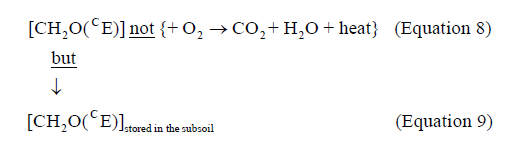
Thus, a subcritical value of CO2 can be maintained in the atmosphere according to the amount of the exported CO2-producing plant material into the subsoil, which shall correspond to the fossil CO2 brought into the atmosphere by the energy-producing process

Energy supply is secured. Climate Change cannot occur.
This method will show all the better effects, the more effectively the transport technologies can be designed. They combine the reactions of the natural carbon cycle to a natural whole. However, this theory leaves unanswered questions primarily these how components of the biomass that do not fit the decarboxylation picture can be brought to be converted into hydrocarbons. Experimental investigations are required. If a new technical name is wanted for the described method, “subsoilfill” may be considered.
Thus, decarbonization of the economy alone does not be the right way to get rid of Climate Change. Rather, a couple of methods including the carbonization of the economy should be investigated. The decarbonization calls for the renunciation of the currently indispensable methodology of human energy supply, the oxidation of carbon compounds. The presently offered alternative based on electric energy from light and wind is despite significant spread not sufficient because its energy cannot be stored in line with its demand. (Oil and gas can be stored in any quantities, electric energy not. Oil and gas are exchanged between continents, electric energy not. Flying is usual with oil, with electric energy not). The question is whether there are principally and economically more favourable methods for avoiding Climate Change than the method of subsoil fill. If there is nothing more favourable, subsoil fill might be developed to application maturity. Necessary preliminary work for this is to gather more knowledge about the formation of hydrocarbons from biomasses and the development of energy-saving transport of plant masses from their area-bound generation to their point shaped storage and processing.
If the biomass remains as a living plant or microorganism connected to the atmosphere it can remain alive and increase its weight in accordance with the seasons. Once, its lifetime has elapsed CO2 is formed again from that biomass under the influence of molecular oxygen. Biomass can be seen as a temporary CO2- storage. Its transfer into the subsoil extends its storage effect and creates the possibility of anaerobic conversion of the biomass increasing its value.
Hydrocarbons and CO2 are the end products of the anaerobic degradation of plant biomass in the subsoil. Hydrocarbons must be transported to the surface and there to its users. Methane as a gaseous hydrocarbon is mixed with CO2. The “blemish of beauty” is the occurrence of CO2 in the anaerobic disproportionations. Either it is technically intercepted- then as mixture with methaneor it wanders through the subsoil with the tendency to rise into the atmosphere. What arrives there increases the concentration of CO2 in the atmosphere. Measurements of CO2 and correspondingly increased transport of biomass into the subsoil are required.
This closes the circle. To the previously valid parts of the carbon cycle have been added a further one, the anaerobic part. This completes the picture of the carbon cycle showing a phototrophic as well as an aerobic and an anaerobic part. The engine of the complete carbon cycle is the phototrophic synthesis of mesooxidized carbon compounds. The engine of useful biological energy production is the conversion of the semi-oxidized products to CO2. And the engine of delivery of hydrocarbons to human industry is the anaerobic disproportionation of the semi-oxidized products into hydrocarbons and CO2.
The complete Carbon Cycle can be formulated as follows:
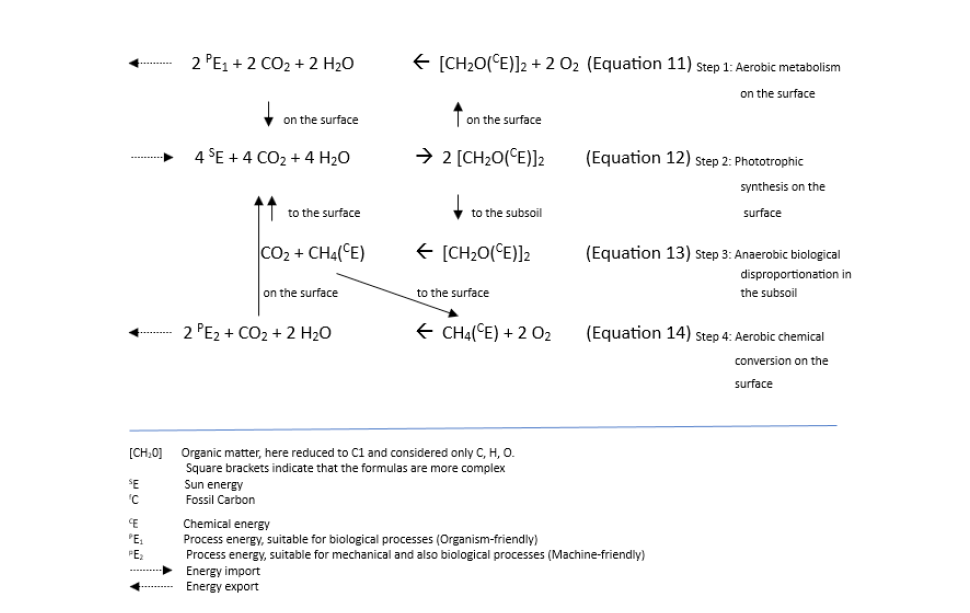
With the help of the reactions of the complete carbon cycle, organism-friendly energy is raised to the level of machine-friendly energy. This significantly expands the scope of biological energies. It should be noted that in the case of methane production a separation of the methane from the CO2 is advantageous.
These processes of energy shift, the disproportionations in the subsoil, provide hydrocarbons. With them, a process can be constructed, as is customary for the use of fossil materials. The current benefit lies in the fact that the CO2 coming from the process of energy acquisition is not a burden for the atmosphere, since its raw material comes from atmospheric CO2. So, there is no worry about the CO2 with this type of energy generation. It can be released into the atmosphere without harm.
In addition-and this has an inestimable significance for the future-the process of energy generation from carbon compounds can be continued when the supplies of fossil carbon come to an end.
Thus, man is able to use nature for his own purposes through biotechnology without causing damage to them. In this way, man secures his existence on earth.
References
- Dümpelmann M, Perner J, Westphal B (2016) Decarbonization is a challenge for the industrial nation of Germany. FES Manager Circle Impulses, pp. 51-54.
- Wikipedia: Natural hydrogen 2026.
- (1996) Sleipner fact sheet: Carbon dioxide capture and storage project.
- (2014) How citizen protests brought down an entire technology.
- Ringpfeil M (2023) Energy supply, climate change and carbon cycle-what would bring the use of recent carbon? J Biotech Biores 5(2): 691-699.
- Biopract (2025) Your enzyme specialist for the biogas process.
© 2026 Manfred Ringpfeil. This is an open access article distributed under the terms of the Creative Commons Attribution License , which permits unrestricted use, distribution, and build upon your work non-commercially.
Editor In Chief





.jpg)




























Signup for Newsletter

Quick Links
 Editorial Board Registrations
 Submit your Article
 Best Paper of the Volume
 Reprints
 Refer a Friend
 Advertise With Us
Our Recent Edition

.jpg)


Top Editors



.jpg)

















.bmp)
.jpg)
.png)
.jpg)












.jpg)





.png)

.png)




.png)




Financial Support

Sponsors

Latest e-Books

Latest Video

 a Creative Commons Attribution 4.0 International License. Based on a work at www.crimsonpublishers.com.
Best viewed in
a Creative Commons Attribution 4.0 International License. Based on a work at www.crimsonpublishers.com.
Best viewed in 
 | Above IE 9.0 version