

- About Us
- Information
-

The Author ensures that the research has been conducted responsibly and ethically with adherence to all relevant regulations. read more..
- For Authors
- For Reviewer
- Manuscript Guidelines
- Membership
- Publication Ethics
-
- Journals
- Reprints
- e-Books
- Videos
- Policies
- Contact Us
 COVID-19
- Submissions



Full Text
Journal of Biotechnology & Bioresearch
Microbial Enzymes for the Conversion of Biomass to Bioenergy as an Biofuel
Chitte RR1*, Kulkarni GA2 and Patel HD1
1 Microbiology Department, School of Science and Technology, Vanita Vishram Women’s University Surat 395001, India
2 Birlasoft Limited, plot No. 35 & 36, Rajiva Gandhi Infotech Park (MS), Phase-I, MIDC, Hinjawadi Pune 411057, India
*Corresponding author:Chitte RR, Microbiology Department, School of Science and Technology, Vanita Vishram Women’s University Surat 395001, India
Submission: March 24, 2026;Published: May 06, 2026

Volume6 Issue 2May 06, 2026
Abstract
Microbial lignocellulolytic enzymes play important role in the early stage of energy generation. Microbial
cells produces various types of lignocelluloytic enzymes. Among that screening and cocktail of enzymes
take significant role in the hydrolysis of complex lignin molecule into the simple form. Some strain
produces the simple reducing sugars which are used for various energy related product formation using
appropriate microorganism of different fermentation conditions.
Thermophilic Streptomyces sp. MCMB 375 partially characterized for the production optimization
parameter for activity of cellulase enzyme. Optimum temperature is 50 °C, pH 10 with incubation time
of 22hrs. It produces multiple forms of the endo and exo cellulases. The enzyme having broad substrate
specificity. Its optimum temperature and work at alkaline pH so this would be used in the process of
the fermentation for specific product formation. The degradation products generated could be evaluated
using microscopy studies and specific action of the enzyme using the substrate specificity will be needed
for further studies. The mechanism of action of enzyme need to study on broad range of substrate for
efficient process development. AI driven further optimization parameters could be further improve the
Process.
Keywords:Lignocellulolytic enzyme; Cellulases; Thermophiles; AI tool software optimization
Introduction
The report on the lignocellulose degrading ability of actinomycetes, which can be potentially used in the production of different value-added products Saini A, et al. [1] Applications of lignin-degrading enzymes involves pretreatment of recalcitrant lignocellulosic biomass for biofuel production, use in paper industry, textile industry, food industry, waste water treatment, bioremediation, organic synthesis, cosmetic and pharmaceutical industries Abdel H, et al. [2].
Cellulose is efficiently hydrolyzed with cellulases cocktail with high sugar yields over a relatively short time Lignocellulose degradation systems from extremely thermophilic microorganisms are ideal candidates for the development of more active, cost-effective enzymes for cellulose processing. Elevated operating temperatures would also be beneficial in fermentations to produce biofuels. In addition to lower risk of microbial contamination, a higher temperature would reduce cooling costs and facilitate ethanol (or, for example, butanol) removal and recovery. Cellulose, a polymer of glucose, is the most abundant and renewable biopolymer on earth. Converting cellulosic biomass to biofuels is a renewable alternative to fossil fuels. A major impediment to the commercial conversion of cellulose to biofuels is the difficultly of breaking the cellulose down into glucose, which can then be used in fermentation or chemical processes to produce fuels. Cellulases, enzymes that degrade cellulose, are limited by high production costs, low hydrolysis efficiency, and poor stability. We are therefore pursuing multiple strategies to understand and improve these enzymes with the end goal of making biofuel production practical Protein engineering has proven to be a powerful tool in creating enzymes with new and improved properties Mohanram [3]. Among cellulase producing actinomycetes, Cellulomonas fimi, Microbispora bispora, and Thermobifida fusca have been studied extensively
Thermobifida fusca is a thermophilic, spore forming actinomycete Athanasios L [4]. The genome of T. fusca consists of 3.6 billion bp in a single circular chromosome, with 3117 coding sequences, and has 67.5% G+C content which stabilizes DNA in extreme temperature conditions. The genome encodes for 36 glycoside hydrolases distributed in 22 GH (glycoside hydrolases) families. Cellulase system of T. fusca is comprised of six extracellular cellulases (4 endocellulases and 2 exocellulases) and one intracellular 𝛽-glucosidase. To ensure that the replacement of linker with spacer sequence in the CD-CBM fusion constructs do not distort the stability of either domain and reported spacer sequences to ensure proper folding and stability in multidomain proteins Chen, et al. [5].
While it is possible to obtain cellulose hydrolysis of close to 100% by enzymatic hydrolysis Ogier, et al. [6], it is difficult to achieve such high yield with the acid hydrolyses. Furthermore, several inhibitory compounds are formed during acid hydrolysis, whereas this problem is not so severe for enzymatic hydrolysis [7-9]. Complexed systems known as cellulosomes are characteristics of anaerobic bacteria, consisting of multienzyme complex protuberances from cell surface stabilized by docker in and adhesion proteins. In aerobic bacteria, including most of the actinomycetes, cellulases are noncomplexed or free and are secreted extracellularly using specific secretion pathways
Material and Methods
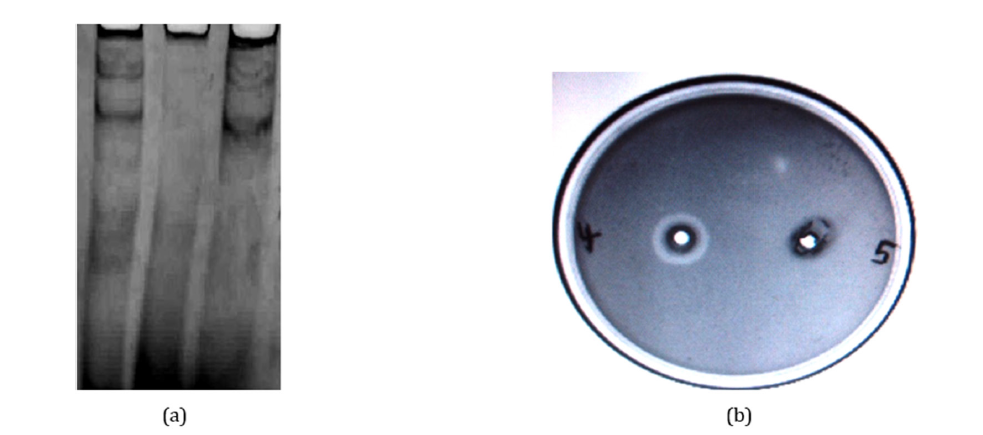
Microbial strain from the culture collection used for the screening of the lignocelluloytic enzymes. Medium and buffers are purchased from the Sisco Research Laboratory (SRL) (Figures 1a&1b).
Figure 1:(a) SDS-PAGE of cellulase enzyme, (b) Cellulase assay using Congo red.
Culture Growth Condition
So, in present study we have mainly focused on the cellulase produced by Streptomyces sp B-375 which is a thermophile. The objective of this investigation is to study the production of cellulases by Streptomyces sp a thermophile isolated from different ecosystem as well as the influence of different cultural conditions on enzyme production by this species in the laboratory. We have optimized the various parameters like incubation time, temperature, pH and media component concentration for enzyme production. Optimization of these parameters can give us enzyme with maximum efficiency which can be helpful for industrial application. We have carried out the partial purification of enzyme. The isolated culture of Streptomyces from ARI culture collection was tested organism for study. The different srains of individual test organisms (50μl) as MCMB-375, 378 & 380 were inoculated into the 200ml GYP medium in sterile flask and kept on the incubator shaker for 18 hours at 55 °C and at 30rpm. By using these crude enzymes, the gel diffusion assay was carried out on CMC agar plates in following ways
Enzyme activity
CM Case assay the presence of enzyme filter paper assay
Mechanism of action of the enzyme
Structure of the enzyme: Thermophiles
Total reducing sugar released using this culture using the filter paper which is exo and endogluca.
Extracellular Secretion of Enzyme
Production of enzyme during the growth cycle
The thermophilic strains of actinomycetes from MACS-ARI culture collection were grew in GYP medium for 18hrs of growth condition at 55 °C. The cell free supernant were analyzed for further studies of cellulase enzyme.
Qualitative analysis
After incubation, the plates were flooded with 0.5% after Congo red solution. After 15min excess dye was drained. Then 1M NaCl was added until colour disappears which shows the clear zone of hydrolysis around the cellulase producing organism. The well of MCMB-375 showed maximum zone of hydrolysis, so that strain is used for further studies.
Optimization of parameters of the enzymes
The crude enzyme uses for the optimization studies such as inoculation time, temperature, pH, metal ions etc.
Optimization of parameters
Incubation time: The effect of incubation time on enzyme activity was studied at different time for 30 & 60 minutes respectively. For this, we have carried out the reactions of enzyme assay by using protocol of DNSA as described by Miller, G.L. In this method, yellow coloured Dinitrosalicylic Acid Reagent (DNSA) is reduced to 3-amino, 5-nitro salicylic acid which has orange color in presence of reducing sugar. Thus, method estimates the reducing sugars
Optimization of temperature
Using Streptomyces B-375 as a cellulase producer, the effect of temperature on the production of crude cellulases was studied at various temperatures ranging from 37 to 60 °C using phosphate buffer at pH 7. For this, we have carried out the reactions of enzyme assay by using same protocol of DNSA described by Miller GL but at various temperature.
Optimization of pH
Figure 2:Effect of pH on the cellulase activity.
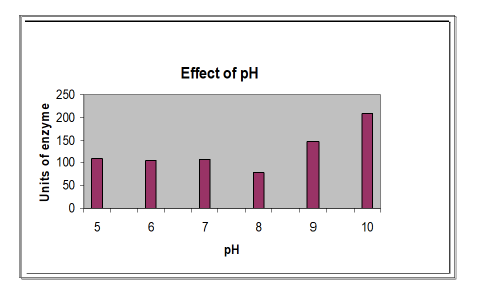
The effect of pH value on enzyme activity was determined by measuring the Enzyme activity at different pH values ranging from 5 to 10. For this enzyme assay, was carried out by DNSA method (Miller GL 1959) but using phosphate buffers of different pH ranging from 5 to10 (Figure 2).
Optimization of media component
In his we had taken the varying concentration of media component mainly glucose concentration which is main carbon source in GYP medium and enzyme assay was carried out by DNSA method (Miller GL 1959) using same protocol and have checked the effect on activity. Artificial Intelligence (AI) is significantly transforming the way we optimize enzymes from thermophilic Microbial species for energy production. These bacteria are “workhorses” in biotechnology because their enzymes (like cellulases, xylanases, and amylases) can withstand the high temperatures required for efficient biofuel production and industrial processings. Enzyme productivity isn’t just about one thing; it’s a delicate balance of several factors. If you change one, the others often shift in unpredictable ways. The conditions such temperature, pH and substrate concentration effect on enzyme production various with AI tool it’s possible to optimized and predict the fermentation designed condition for better yield of enzyme Wang, et al. [10].
AI could be helps to simulate the entire metabolism of the microbial strain to predict how deleting certain genes (like those for competing antibiotics) will boost the yield of the desired energyproducing lignocelluloytic enzyme
1. GYP medium (100ml) pH-8.2
Glucose: 0.25g
Yeast extract: 0.5g
Peptone: 0.5g
NaCl: 0.5g
2. GYP medium (100ml): pH-8.2
Glucose: 0.5g
Yeast extract: 0.5g
Peptone: 0.5g
NaCl: 0.5g
3. GYP medium (100ml): pH-8.2
Glucose: 1g
Yeast extract: 0.25g
Peptone: 0.25g
NaCl: 0.25g
10% CaCl2
Media no. 3 is the best
All 3 media of different component concentrations were prepared and 50μl of B- 375 was inoculated in all 3 media after addition of 10% CaCl2 and kept on the shaker incubator for 18 hours at 55 °C and at 130rpm 2) Centrifugation was carried out at 6100rpm for 20 minutes and at 10 °C. 3) After centrifugation, the pellet was removed and the supernatant was decanted in sterile flask which is crude enzyme from 1, 2 and 3 media having different glucose concentration [11].
Effect of metal ion on enzyme activity
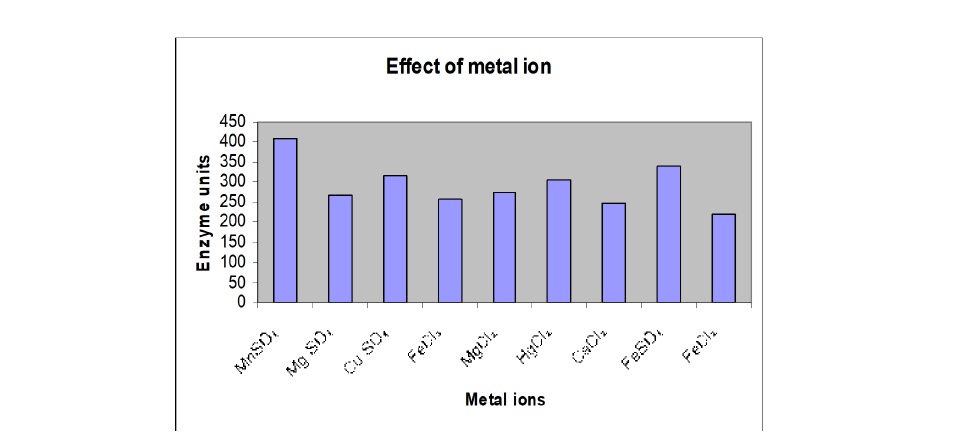
For enzymes some metals enhance the enzyme activity while some metals inhibit it. To see this metal effect enzyme assay was carried out again using DNSA (Miller GL 1959) with addition of different metal ions (Figure 3).
Figure 3:Effect of metal ions on the cellulase activity.
Zymography
Is an electrophoretic technique, based on SDS-PAGE that includes a substrate copolymerized with the polyacrylamide gel for the detection of enzyme activity. Samples are prepared for PAGE. (Figure 1a) following electrophoresis, and crude enzyme activity is observed on CMC plate using congo red (Figure 1b). The part of unstain PAGE-gel is used the zymogram optimized length of time at 50 °C. The zymogram is subsequently stained using Congo red and areas of digestion appear as clear bands against a darkly stained background where the substrate has been degraded by the enzyme. These protocols, however, are subject to much adjustment. Zymography has been applied to a variety of enzymes, including xylanases, proteases, cellulase, proteases, lipases, chitinases etc. (Beguin P 1983).
Cellulase Activity
EG activity is commonly determined using the soluble substrates Carboxymethyl Cellulose (CMC). CMC is considered a selective EG substrate because it is sterically hindered to enter the tunnel-like structure of the catalytic center of the ExG enzymes (Table 1a).
Table 1a: Effect of medium component of test on the cellulase activity.

The experiment was performed to study the effect of different medium component concentration in order to developed optimized medium. The optimized medium containing 1% glucose and half the concentration of peptone, yeast extract, NaCl than concentration in basal composition recorded a higher enzymatic activity than that of the basal one (Tables 1b&1c).
Table 1b: Effect of medium component of test on the cellulase activity.

Table 1c: Effect of medium component of test on the cellulase activity.

Result and Discussion
In present study of cellulase, we have optimized the different conditions for production of cellulase from Streptomyces B-375, which is a thermophile. The results showed that the maximum cellulase production with maximum enzyme activity occurs at the optimum temperature of 50 °C for optimum incubation time of 60 minutes at pH 10 which is optimum pH. We have demonstrated that the high concentration of MnSO4 and the low concentration of FeCl₂ increased the cellulase production. The GYP medium containing 1% glucose and 0.25% of peptone, yeast extract and sodium chloride showed maximum cellulase activity. AI driven optimization of various production, fermentation process condition, metabolic pathway alteration using r-DNA technology increase the further productivity using AI tools and softwares.
Conclusion
As per given data of cellulase enzyme optimization using medium and metal ions such as magnesium sulphate is best for optimum activity and parameters also optimized for better activity. Further AI tool and software will be used to enhance the better activity and yield of cellulase and lignocellulase formulation towards modern front-line area of bioenergy and biofuel production technology.
References
- Anita S, Neeraj KA, Anuja S, Anita Y (2015) Actinomycetes: A source of lignocellulolytic enzymes. Enzyme Research 20: 279381.
- Abdel HAM, Solbiati JO, Cann IK (2013) Insights into lignin degradation and its potential industrial applications. Advances in Applied Microbiology 82: 1-28.
- Mohanram S, Dolamani A, Jairam C, Anju A, Lata N (2013) Novel perspectives for evolving enzyme cocktails for lignocellulose hydrolysis in biorefineries. Sustainable Chemical Processes 1(1): 1-12.
- Athanasios L, Konstantinos M, Natalia I, Iain A, Miriam L, et al. (2007) Genome sequence and analysis of the soil cellulolytic actinomycete thermobifida fusca YX. J Bacteriol 189(6): 2477-2486.
- Chen X, Zaro J, Shen WC (2013) Fusion protein linkers: Property, design and functionality. Adv Drug Deliv Rev 65(10): 1357-1369.
- Ogier JC, Ballerini D, Leygue JP, Rigal L, Pourquie J (1999) Ethanol production from lignocellulosic biomass, oil & gas science and technology. Review 7 of the French Petroleum Institute 54(1): 67-94.
- Lee YY, Iyer P, Torget RW (1999) Dilute-acid hydrolysis of lignocellulosic biomass. Advances in biochemical engineering/biotechnology. Recent Progress in Bioconversion of Lignocellulosics 65: 93-115.
- Taherzadeh MJ (1999) Ethanol from lignocellulose: Physiological effects of inhibitors and fermentation strategies. Chemical Reaction Engineering, Chalmers University of Technology, Göteborg, Sweden.
- Wyman CE (1996) Handbook on bioethanol: Production and utilization. (1st edn), Taylor & Francis, New York, USA, pp: 1-444.
- Wang Y, Wang Y, Feng X (2026) Artificial intelligence-driven fermentation optimization for α-amylase hyper production enabled by Raman monitoring and metabolic network analysis. Bioresource Technology 439: 133287.
- Albadarin AB, Al-Muhtaseb AH, Al-laqtah NA, Walker GM, Allen SJ, et al. (2011) Biosorption of toxic chromium from aqueous phase by lignin: Mechanism, effect of other metal ions and salts. Chemical Engineering Journal 169(113): 20-30.
© 2026 Chitte RR. This is an open access article distributed under the terms of the Creative Commons Attribution License , which permits unrestricted use, distribution, and build upon your work non-commercially.
Editor In Chief







.jpg)































Signup for Newsletter

Quick Links
 Editorial Board Registrations
 Submit your Article
 Best Paper of the Volume
 Reprints
 Refer a Friend
 Advertise With Us
Our Recent Edition

.jpg)



Top Editors




.jpg)

















.bmp)
.jpg)
.png)
.jpg)













.jpg)






.png)

.png)




.png)




Financial Support

Sponsors

Latest e-Books

Latest Video

 a Creative Commons Attribution 4.0 International License. Based on a work at www.crimsonpublishers.com.
Best viewed in
a Creative Commons Attribution 4.0 International License. Based on a work at www.crimsonpublishers.com.
Best viewed in 
 | Above IE 9.0 version