

- About Us
- Information
-

The Author ensures that the research has been conducted responsibly and ethically with adherence to all relevant regulations. read more..
- For Authors
- For Reviewer
- Manuscript Guidelines
- Membership
- Publication Ethics
-
- Journals
- Reprints
- e-Books
- Videos
- Policies
- Contact Us
 COVID-19
- Submissions



Full Text
Journal of Biotechnology & Bioresearch
Regenerating Syria’s Agriculture: From Systemic Collapse to Climate-Resilient Food Sovereignty (2026-2040)
Moaed Ali Al Meselmani*
Grantham Centre for Sustainable Futures, University of Sheffield, UK
*Corresponding author:Moaed Ali Al Meselmani, Grantham Centre for Sustainable Futures, University of Sheffield, UK
Submission: March 09, 2026;Published: April 30, 2026
Volume6 Issue 2April 30, 2026
Abstract
Syria’s agricultural sector has not experienced a cyclical downturn but a systemic collapse, driven by the
convergence of protracted conflict, accelerating hydrological depletion, and an ecologically unsustainable
pre-war development model. This paper argues that post-conflict agricultural reconstruction must be
reconceptualized as regeneration, shifting from a paradigm of restoring pre-war extractive systems
towards a framework of food sovereignty that maximizes value per unit of water. Drawing on a qualitative,
case-study-driven policy analysis of twelve countries and the latest 2025-2026 empirical data from FAO,
WFP, ICARDA, and peer-reviewed sources, this paper proposes an integrated governance and finance
framework for transforming Syria’s agricultural system.
A novel Feasibility Matrix models institutional thresholds and political reversal risks for each proposed
reform, and the paper explicitly analyses the conditions under which the strategy would fail, including
governance collapse, sanctions reimposition, armed relapse, climate shocks beyond projections, fiscal
crisis, and carbon market collapse. The paper concludes that Syria possesses the farmers, scientific
institutions-notably ICARDA’s preserved 143,000 seed accessions-and diaspora capital necessary for
transformative recovery. What has been absent is institutional architecture. This paper provides that
architecture through a coherent, actionable framework for rebuilding Syria’s agriculture not as it was,
but as it must become.
Keywords:Syria; Agricultural collapse; Climate resilience; Groundwater governance; Food sovereignty; Conservation agriculture; Seed sovereignty; Climate finance; Post-conflict reconstruction; Adaptive governance
Introduction: From Reconstruction to Regeneration
Syria’s agricultural crisis is fundamentally a crisis of governance and resource productivity, not resource scarcity per se Kinder and Arkeh [1]. The country possesses sufficient arable land, demonstrably skilled farmers, world-class scientific institutions embodied by the International Centre for Agricultural Research in the Dry Areas (ICARDA), and a substantial diaspora capable of mobilizing significant capital. What it has lacked-until the political transition following December 2024-is both a coherent national framework to govern these assets sustainably and the financial architecture to attract long-term investment.
The scale of destruction between 2011 and 2026 has no modern precedent in the region. Before the war, Syria produced up to 4.1 million tonnes of wheat annually FAO [2]. Irrigated area has contracted from 1.65 million hectares to 0.9 million hectares-a 45 percent reduction - permanently displacing an estimated 400,000-500,000 households FAO [2]; World Bank [3]. The formal certified seed system now operates at less than 5 percent of pre-war capacity, imposing yield penalties of 15-30 percent per season ICARDA [4]. Strategic grain storage capacity has declined from 3.2 million metric tonnes to fewer than 1.55 million functional tonnes WFP [5]. In Northwest Syria alone, 1.5 million olive trees have been destroyed iMMAP [6]. The child stunting rate has nearly doubled from 12-15 percent nationally to over 28 percent, exceeding 35 percent in Northwest Syria UNICEF [7].
A transformative political rupture has simultaneously created both opportunity and additional fragility. The fall of the Assad regime in December 2024 opened a new geopolitical window: the European Union, United Kingdom, and United States sequentially lifted the majority of their sanctions between February and June 2025, with the US Caesar Act permanently repealed through the National Defense Authorization Act for Fiscal Year 2026 NDAA [8]. Saudi Arabia and Qatar pledged to pay Syria’s World Bank arrears, and the IMF conducted its first technical assessment mission in Damascus in November 2025, noting signs of recovery and improving prospects.
Yet the structural crisis is simultaneously deepening. The 2025 agricultural season saw a 36-year record drought reduce wheat output by a further 40 percent, with production falling to between 900,000 and 1.1 million tonnes-a 75 percent decline from pre-war peaks FAO GIEWS [9]. Unregulated solar-powered groundwater extraction continues to accelerate aquifer depletion; water tables in northeast Syria’s Al-Haddadiya have dropped from 30 to 60metres in five years Jalabi [10]. The livestock sector has collapsed from 22 million sheep in 2010 to fewer than 7 million FAO [2]. The annual food import bill exceeds USD 1.8 billion-an existential burden on an economy that contracted by 60 percent between 2011 and 2024 World Bank [3]; WFP [11].
This paper addresses the following research question: How can Syria’s collapsed agricultural sector be transformed from a fragmented, resource-depleting system into a climate-resilient, governance-driven framework that maximizes value per unit of water while ensuring food sovereignty and long-term sustainability?
To answer this question, the paper advances a central thesis: attempting to restore the pre-war extractive agricultural model would merely reproduce the structural vulnerabilities that led to collapse. Reconstruction must be reconceptualized as regeneration, shifting from the narrow goal of food self-sufficiency to a systemic framework of food sovereignty that maximizes value per cubic meter of water. This framework integrates artificial intelligence and smart farming technologies as force multipliers for resource efficiency, early warning, and adaptive management, while explicitly modelling the governance thresholds and political risks that determine whether such technologies enable or undermine sustainable development.
The paper makes four original contributions. First, it provides a comprehensive diagnosis of systemic collapse that distinguishes between human-driven drivers-groundwater overexploitation, policy distortions, institutional brittleness-and climatic drivers, a distinction essential for policy design. Second, it synthesizes transferable lessons from twelve countries across four continents, mapping them to Syria’s specific institutional and environmental context. Third, it introduces a Feasibility Matrix assessing institutional thresholds and political reversal risks for each proposed reform. Fourth, it models six explicit failure scenarios demonstrating analytical honesty about the conditions under which the strategy succeeds or fails.
Methodology
This paper employs a qualitative, case-study-driven policy analysis methodology. It draws on a systematic review of academic and grey literature published between 2014 and 2026, including peer-reviewed journal articles, reports from international organizations (FAO, WFP, ICARDA, World Bank, UNDP), and policy briefs from research institutions. All empirical data for Syria are drawn from 2025-2026 sources to ensure maximum currency.
The selection of international case studies (n=12) was based on their relevance to the Syrian context across five criteria: (1) water scarcity and arid agricultural environments; (2) post-conflict institutional fragility; (3) innovative governance frameworks for shared natural resources; (4) successful integration of technology and community engagement; and (5) innovative financing mechanisms for smallholder agriculture. For each case study, transferable lessons were extracted through thematic analysis focused on governance design, institutional prerequisites, adoption barriers, and mitigation strategies. These lessons were then mapped to Syria’s specific context, with explicit attention to differences in institutional capacity, conflict legacy, and social trust. The paper’s quantitative projections are conditional on explicit adoption rates, budget assumptions, and institutional milestones stated in the Feasibility Matrix (Table 1).
Table 1: Feasibility matrix-institutional thresholds and political risks.

Diagnosing compound systems failure
The Pre-2011 Model: Achievements, illusions, and ecological debt: For three decades before 2011, Syrian agricultural policy pursued self-sufficiency in wheat through a state-managed system that concealed deep ecological debts. The state procured wheat at prices above international markets, maintaining a strategic reserve of 6-9 months Al-Khalidi and El Dahan [12]. Heavily subsidised inputs, including diesel at 70 percent below cost, consumed 2-3 percent of GDP World Bank [3]. This drove expansion of the irrigated area to 1.65 million hectares and a proliferation of wells from 135,135 in 1999 to over 230,000 by 2010-a 70 percent increase in just over a decade FAO [13].
These apparent achievements were built on four interacting forms of ecological over-exploitation. First, massive groundwater extraction created an annual water deficit of 1.5-2.0 billion cubic meters De Chatel [14]. Second, flood irrigation and canal losses exceeding 40 percent meant that most water applied never reached crops De Chatel and Knoope [15]. Third, soil organic matter declined by 30-50 percent from 1960s levels Zdruli et al. [16]. Fourth, the system favored politically connected large farms while leaving smallholders exposed to rainfall variability without effective support World Bank [3]. The 2006-2010 drought-made two to three times more likely by climate change-acted as a severe stress multiplier, causing crop failures of 70-85 percent, displacing 1.5 million people, and depleting the national sheep flock by 25-30 percent Kelley et al. [17]; Gleick [18].
This Table 2 documents the rapid increase in well numbers across Syria between 1999 and 2010, alongside corresponding declines in water table levels. The data reveal that well numbers nearly doubled nationally, while water table declines of 10-40 metres were recorded across all major basins. Sources: FAO [13]; De Chatel [14]; Jalabi [10]; IWMI/GW-MENA [19].
Table 2: Well proliferation and groundwater decline in Syria.

This table documents the rapid increase in well numbers across Syria between 1999 and 2010, alongside corresponding
declines in water table levels. The data reveal that well numbers nearly doubled nationally, while water table declines of
10-40 meters were recorded across all major basins.
Sources: FAO [13]; De Chatel [14]; Jalabi [10]; IWMI/GW-MENA [19].
Conflict-era destruction: Armed conflict between 2011 and 2026 inflicted destruction on Syria’s agricultural system with no modern regional precedent. Irrigated area contracted by 45 percent, strategic grain storage fell from 3.2 million to 1.55 million metric tonnes, and the formal seed system was reduced to less than 5 percent of pre-war capacity FAO [2]; WFP [5]; ICARDA [4]. Displacement forced surviving farmers into survival-oriented cultivation, a regressive shift Jaafar and Woertz [20] describe as subsistence backtracking. This pattern parallels post-conflict agricultural decline observed in Sri Lanka, where prolonged displacement led to deterioration in agricultural skills, destruction of storage facilities, and lasting confusion over land ownership Yamada et al. [21]. Table 3 provides a comprehensive quantified assessment.
Table 3: Quantified destruction of agricultural assets (2011-2026).

This table summarizes key agricultural asset losses across Syria between 2011 and 2026, showing the percentage
reductions and current status based on the most recent available data. The figures illustrate the exceptional scale of
collapse across all dimensions of the agricultural system.
Sources: FAO GIEWS [9]; FAO [2]; ICARDA [4]; WFP [5]; iMMAP [6]; UNICEF [7]; WFP [11].
This table summarizes key agricultural asset losses across Syria between 2011 and 2026, showing the percentage reductions and current status based on the most recent available data. The figures illustrate the exceptional scale of collapse across all dimensions of the agricultural system.
The climate multiplier: Beyond drought to thermal stress: A landmark 2025 study published in Remote Sensing identified 23 distinct thermal drought hotspots covering 31,403 square kilometers, exposing 2.5 million people to chronic thermal stress, with approximately 25 percent of Syria’s agricultural land within these hotspots Suliman et al. [22]. No governorate is untouched. The MENA region holds just 1 percent of the world’s freshwater yet supports 6 percent of the global population, making it the world’s most water-stressed region Al-Attiyah Foundation [23]. Climatedriven droughts have already reduced harvests by 10-30 percent across the MENA region, and the window for meaningful action is narrowing.
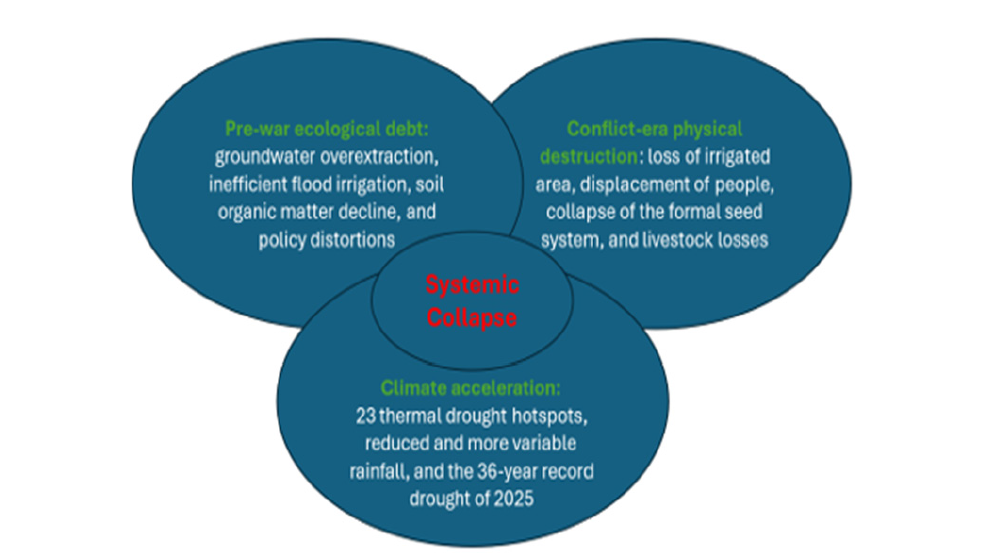
Figure 1 below illustrates the conceptual relationship between the three drivers of Syria’s agricultural collapse: conflict-era physical destruction, pre-war ecological debt, and climate change acceleration. The three drivers do not operate in isolation. They interact and amplify one another, which is why partial recovery strategies addressing only one dimension are likely to fail.
Figure 1:Three interacting drivers of Syria’s agricultural collapse.
This Table 4 sets out predicted climate threats and the recommended adaptation interventions for each of Syria’s five agro-ecological zones. The zonal approach recognises that uniform national prescriptions are inadequate: conditions range from viable irrigated agriculture in Zone 1 to desert margins where crop production is unviable without fundamental land-use change.
Table 4: Projected climate impacts by agro-ecological zone (2050).

This table sets out predicted climate threats and the recommended adaptation interventions for each of Syria’s five agroecological
zones. The zonal approach recognizes that uniform national prescriptions are inadequate: conditions range
from viable irrigated agriculture in Zone 1 to desert margins where crop production is unviable without fundamental
land-use change.
Sources: Suliman et al. [22]; ICARDA [24]; IPCC AR6.
Transferable Lessons for Syrian Application
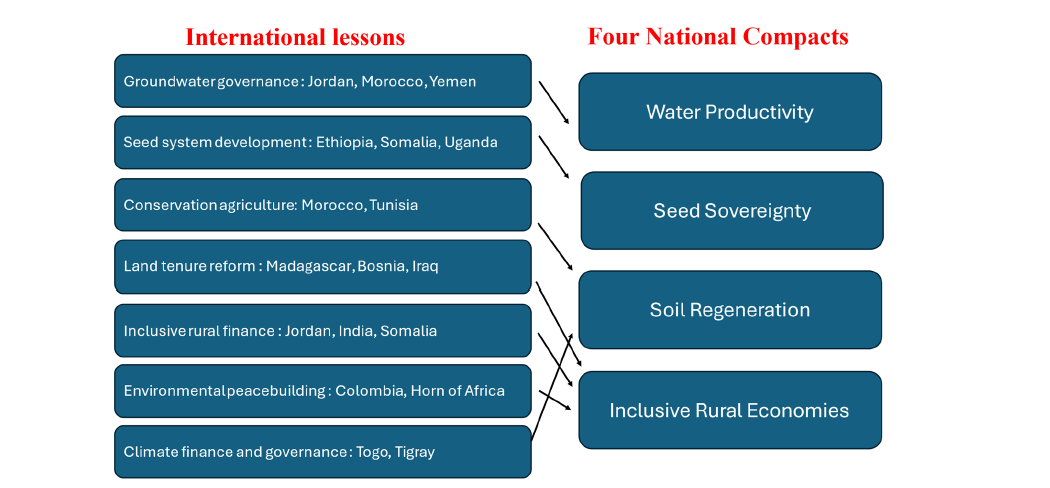
The following sections synthesise lessons from twelve country cases, each selected for their relevance to one or more of Syria’s specific challenges. Figure 2 maps the four thematic domains of transferable lessons to the Four National Compacts introduced in Section 5.
Figure 2:From international lessons to Syrian compacts.
Groundwater governance
Jordan’s experience with meter installation demonstrates that technology alone is insufficient: despite 90 percent meter installation, only 61 percent remained functional due to tampering because metering preceded trusted governance IWMI/GWMENA [19]. Morocco’s aquifer contract system uses negotiated, phased water quotas with bundled incentives, demonstrating that farmers accept limits when they participate in rule-setting and receive immediate tangible benefits FAO [24]. Yemen’s solar pump governance framework includes registration, extraction fees, and pilot schemes allowing farmers to sell back unused solar capacity, demonstrating that even in conflict contexts, governance frameworks can be developed FAO [25].
Transferable lesson: Institutions must precede technology. Farmers accept metering and quota limits when they participate in rule-setting and receive immediate tangible benefits. Ostrom’s [26] principles of common-pool resource governance-clearly defined boundaries, collective-choice arrangements, and graduated sanctions-are directly applicable to Syria’s groundwater crisis.p>
Seed system development
Ethiopia’s three-tier system combining public research, government foundation seed, and cooperative multiplication-with legal protection for farm-saved seed-demonstrates that formal and informal seed systems can complement rather than compete with each other ICARDA [27]. Somalia’s distributed community seed banks-maintained viability in temperatures exceeding 40 degrees Celsius, reducing security risk through geographic dispersal IOM [28]. Uganda’s tiered certification system recognizes community seed banks as quality-declared seed producers, enabling income generation for smallholder farmers Alliance of Bioversity [29].
Transferable lesson: Legal recognition of community seed banks is essential. Formal and informal seed systems are complementary, not competing.
Conservation agriculture adoption
Morocco’s experience-50 farmer-operated demonstration sites, a revolving fund for no-till seeders, and transitional payments of USD 50-75 per hectare for five years-demonstrates that farmer-tofarmer extension is most effective and that yield dips during the transition period must be compensated FAO [25]. Conservation Agriculture adoption in the Middle East remains low compared to other regions, primarily because of limited knowledge and farmers’ strong attachment to tillage as both a productive practice and a cultural tradition Bashour et al. [30]; Devkota et al. [31]; Springer [32]. Economic benefits-reduced fuel, labour, and machinery costsrather than environmental arguments have been the main driver for early adopters.
Transferable lesson: Extension messaging must emphasise economic benefits first, environmental benefits second. A phased approach that reduces tillage gradually before reaching zero tillage reduces risk and cultural resistance. Policy support is a necessary condition for sustained uptake.
Land tenure reform
Madagascar’s decentralised local land offices with community adjudication panels and quick-response certificate systems reduced costs from USD 600 to USD 32 and processing times from six years to six months FAO Investment Centre [33]. Bosnia’s Independent Commission for Real Property Claims resolved 320,000 claims with 92 percent success through political insulation from government interference. Iraq’s under-resourced, politically contested Property Commission resolved only 40 percent of claims by 2010, blocking investment-consistent with findings from Sri Lanka where unresolved land ownership issues undermine development projects Yamada et al. [21].
Transferable lesson: Political insulation and adequate resourcing are prerequisites for success. Rapid, affordable formalisation is feasible with appropriate institutional design, as Madagascar demonstrates.
Inclusive rural finance
Jordan’s bundled model combining vocational training, concessional finance, and mobile extension achieved 65 percent sustained employment and 40 percent income increases New Security Beat [34]. India’s first-loss guarantee scheme covered more than 3 million loans, unlocking USD 15 billion at 10 times leverage GAFSP [35]. Somalia’s revolving blended finance facility combining loans, guarantees, and grants demonstrates the critical role of civil society organizations as financial intermediaries and capacity builders in fragile contexts OECD [36].
Transferable lesson: Finance alone is insufficient. Bundled services-training, extension, market access, and digital toolsdramatically increase impact. First-loss guarantees can achieve 10 times leverage.
Environmental peacebuilding
Colombia’s cacao agroforestry programme in post-conflict regions increased opportunities for dialogue and decreased disputes over natural resources Alliance of Bioversity International- CIAT [37]. Community seed banks in the Horn of Africa function as platforms for interaction among farmers, with villages experiencing peaceful coexistence during implementation. The Democratic Republic of Congo’s bean value chains increased incomes and strengthened resilience to regional conflict.
Transferable lesson: Sustainable agricultural development in conflict-prone regions can improve social cohesion, consistent with the contact hypothesis that shared agricultural goals reduce prejudice and enable lasting trust.
Climate finance and territorial governance
Togo’s integrated climate-resilient agriculture model - built on participatory multilevel governance, hybrid financial instruments, territorial anchoring, participatory monitoring, and social and technological innovations-achieved an estimated benefit-cost ratio of 4.57 Darou-nansam [38]. In Tigray, Ethiopia, following the 2020-2022-armed conflict, researchers used Earth Observation datasets and Google Earth Engine to identify suitable urban agriculture expansion areas in a context of devastated infrastructure, demonstrating that remote sensing technology can guide agricultural planning without waiting for full institutional recovery Gebrezgabher et al. [39].
Transferable lesson: The performance of financial mechanisms depends less on the volume of resources mobilised than on the quality of institutional anchoring and multi-stakeholder governance.
Four Interdependent National Compacts
Compact design overview
The Four National Compacts are designed as an integrated framework, each addressing a distinct dimension of Syria’s agricultural crisis while interacting with the others. The compacts address water productivity, seed sovereignty, soil regeneration, and inclusive rural economies. Table 5 summarises the core mechanisms, quantified 2035 targets, and primary instruments for each compact. Artificial intelligence and smart farming technologies are embedded across all four compacts as enabling infrastructure rather than a standalone pillar. AI serves as a force multiplier for resource efficiency through optimised irrigation advisory, for early warning through drought and pest prediction, for verification through satellite-based soil carbon monitoring and groundwater tracking, and for financial inclusion through blockchain-based land registry and index insurance.
Table 5: Four national compacts-objectives, targets and instruments.

National water productivity compact
Compact design and phasing:
A. Phase 1 (2026-2028) focuses on stabilisation: A National
Well Amnesty; digital meters in pilot governorates; satellite
groundwater monitoring with AI analytics; pilot Groundwater
User Associations (GWUAs) in three governorates; pilot Water
Productivity Payments (USD 20-50 per hectare); and AImanaged
irrigation advisory development.
B. Phase 2 (2029-2032) focuses on scaling: extending
metering and GWUAs to all major aquifer zones; replacing
diesel subsidies with Water Productivity Payments; introducing
progressive tariffs for large farms; establishing groundwater
trading mechanisms; and scaling AI irrigation advisory to
Zones 1-3.
C. Phase 3 (2032-2035) focuses on sustainability: legally
empowering GWUAs for quota co-management; transitioning
payments to aquifer stewardship compensation; establishing
inter-association coordination mechanisms; and integrating AI
into basin-level management.
Quantitative baseline and projections: The groundwater reduction target of 25 percent by 2035 is based on Jordan’s experience, where metering combined with pricing reform achieved a 15-20 percent reduction in seven years IWMI/GW-MENA [19], combined with AI-optimised scheduling projected to add a further 10-15 percent reduction Al-Attiyah Foundation [23]. Achieving this requires 70 percent or higher meter functionality, which in turn requires trusted Groundwater User Association governance. Jordan’s 61 percent functionality rate serves as the cautionary lower-bound baseline.
Implementation challenges and mitigation: The core challenge in Syria’s groundwater crisis is a situation where shared resources are overexploited because individual users have no incentive to conserve, described by Hardin [40] as a common-pool resource dilemma. In Al-Haddadiya, water tables fell 30 metres in five years as solar-powered pumps operate at near-zero variable cost, incentivising extraction maximisation Jalabi [10]; Nature HSS Communications [41]. Mitigation requires converting to smart pumps with flow controllers and AI-optimised scheduling, solar buy-back schemes that create income from reduced pumping, and Water Productivity Payments as ecosystem services compensation.
Metering in a low-trust environment faces what may be called the Jordanian problem of meter tampering. Mitigation requires applying Ostrom’s [27] governance principles-GWUAs co-manage quotas through self-generated rules-and pairing metering with immediate benefits: Water Productivity Payments, priority infrastructure support, and legal recognition of association decisions.
National seed sovereignty compacts
Compact design and phasing:
A. Phase 1 (2026-2028): Enact a Farmers’ Rights Law;
rehabilitate the General Commission for Scientific Agricultural
Research (GCSAR) and the General Organisation for Seed
Multiplication (GOSM) to international standards; establish
10 pilot community seed banks with distributed, climatecontrolled
storage; deploy Cham-12 wheat on 25,000 hectares
through participatory trials; initiate AI-assisted breeding
programme design.
B. Phase 2 (2029-2032): Establish 50 Certified Seed Grower
Cooperatives with royalty-free basic seed; scale community
seed banks to 50; extend Cham-12 to 150,000 hectares; deploy
a rust surveillance system with AI early warning.
C. Phase 3 (2033-2035): Achieve 100 percent domestic
certified wheat seed in Zones 1-3; develop community seed
banks as income-generating enterprises; establish Geographical
Indications for premium varieties; integrate AI into the national
seed system.
ICARDA and the return to Tel Hadiya: ICARDA, founded in Aleppo (Tel Hadya) in 1977, relocated to Beirut in 2012, safeguarding 143,000 plant accessions through duplication at Svalbard and gene banks in Morocco and Lebanon ICARDA [42]. The October 2025 High-Level Consultation in Damascus launched the Programme for Rehabilitation of Syria’s Agriculture Sector. Director General Aly Abousabaa confirmed that ICARDA is determined to restore the Tel Hadya facilities to their full potential ICARDA [42]. Since 1977, ICARDA has released five durum wheat varieties, six bread wheat varieties, six lentil varieties, five chickpea varieties, and three faba bean varieties specifically adapted to Syrian conditions. Rehabilitation-estimated at USD 15-20 million and representing less than 4 percent of SARFT Phase 1 capitalisation-would reestablish varietal improvement capacity, train a new generation of Syrian scientists, and establish a regional hub for AI-assisted breeding. The return of ICARDA to Tel Hadya is the single highestleverage early demonstration activity available to SARFT Phase 1.
Implementation challenges and mitigation: Seeds carry political significance. Under the previous regime, seed distribution was used as an instrument of political control Jasim [43]. Iraq’s Order 81 banned seed exchange, forcing farmers into dependency on multinational suppliers. Mitigation requires enacting a Farmers’ Rights Law before any certification system is introduced, explicitly exempting farm-saved seed from commercial intellectual property claims, funding participatory varietal selection through informal networks, and supporting community seed banks as governance spaces where farmers, GCSAR, and ICARDA participate as equals.
National soil regeneration compacts
Compact design and phasing:
A. Phase 1 (2026-2028): Establish 50 demonstration
farms staffed by respected local farmers; train 500 farmerextensionists
in Conservation Agriculture and digital tools;
establish a revolving fund for no-till seeders; pilot transitional
payments of USD 50-75 per hectare; establish a satellite soil
organic carbon baseline.
B. Phase 2 (2029-2032): Scale Conservation Agriculture to
200,000 hectares with AI monitoring; integrate adoption with
SAFF loan eligibility; initiate remediation programmes for
petroleum-contaminated areas; refine carbon baseline with AI
analytics.
C. Phase 3 (2033-2035): Achieve 500,000 hectares under
Conservation Agriculture with AI-verified soil organic carbon
increases; reach 0.5 percent annual soil organic carbon
increase; launch a Syrian carbon credit programme with AIverified
credits.
Quantitative projections and basis: The soil organic carbon increase target of 0.5 percent annually is based on Morocco’s documented gains of 0.3-0.8 percent annually under Conservation Agriculture after five or more years (FAO 2023) and Tunisia’s results of 0.4-0.6 percent Devkota et al. [31]. This requires 500,000 hectares under verified Conservation Agriculture by 2040, a 15-year trajectory consistent with Morocco’s experience, which required a decade of sustained subsidy support.
Implementation challenges and mitigation: Conservation Agriculture adoption in the MENA region remains low despite proven benefits Devkota et al. [31]; Bashour et al. [30]. Soil management practices in Mediterranean farming communities are deeply tied to tillage as both a productive technique and a cultural tradition Springer [32]. The primary adoption driver must be economic: transitional payments of USD 50-75 per hectare per year compensate for yield dips during the transition period. A phased approach-reduced tillage before zero tillage-lowers risk and reduces resistance. Farmer-to-farmer extension through demonstration farms is more effective than state-led instruction.
National inclusive rural economies compact
Compact design and phasing:
A. Phase 1 (2026-2028): Pilot land documentation in three
governorates with community panels and certificate systems;
launch the Syria Agricultural Finance Fund (SAFF) with SARFT
first-loss guarantee; establish a mobile banking platform;
deploy high-resolution satellite-based drought insurance
products; initiate digital literacy training for youth.
B. Phase 2 (2029-2032): Scale land documentation to
200,000 claims with blockchain security, targeting 50 percent
female-headed households; scale SAFF to 150,000 smallholders
with bundled extension and digital access; scale drought
insurance with AI monitoring of basis risk.
C. Phase 3 (2033-2035): Develop SAFF as a self-sustaining
revolving fund; establish Geographical Indication exports
generating premium income; develop a fully digital rural
financial ecosystem.
Implementation challenges and mitigation: Financial exclusion is a structural barrier. Without credit histories, land titles, or collateral, smallholders are unable to access conventional banking. Fragile and Conflict-Affected States receive most concessional financing, but absorption capacity remains low World Bank/IDA [44]. Mitigation requires a first-loss guarantee at 30 times leverage, mobile money and agent banking networks, satellitebased area-yield insurance commissioned through ICARDA and CGIAR, and bundling finance with digital literacy, extension, and market access.
The social trust deficit is not a secondary concern-it is the binding constraint on institutional design. Post-conflict societies exhibit systematically lower horizontal trust, which undermines cooperative institutions FAO [25]. Mitigation requires beginning with small economic-interest groups focused on tangible returns and building on existing trust networks, including the Women’s Collective of Green Braids and Buzuruna Juzuruna. Eastern Ghouta Farmer Field Schools achieved 11.5 percent yield increases through peer-to-peer learning FAO [25]. International actors must position themselves as resource providers, not primary implementers.
The Syria Agricultural Resilience and Transformation Fund (SARFT)
The structural limits of humanitarian financing
Since 2011, Syrian agriculture has been financed through short-term, project-based humanitarian appeals with 18-month horizons, institutional risk aversion, emphasis on outputs over systemic outcomes, fragmented contracting, and exclusive reliance on grants FAO [2]. Only USD 10.5 billion of the USD 29 billion required globally for acute food insecurity was received by October 2025 FAO/WFP [45]. Transformational resilience requires a 10- 15-year perspective, pooled funding, blended finance, diversified capital instruments, and AI-verified outcome metrics.
SARFT architecture and capitalisation
SARFT is designed to be hosted within a neutral multilateral institution (IFAD, IsDB, or UNCDF), ring-fencing agricultural finance from residual sanctions risks. Three windows structure SARFT disbursements: Window A (60 percent grants) covers public goods including AI infrastructure and meteorological network rehabilitation; Window B (30 percent concessional loans) finances farmer investments including smart farming technologies; Window C (10 percent guarantees) reduces risk for private sector participation (Table 6).
Table 6: SARFT capitalisation structure (USD million).

SARFT’s innovative financing instruments: Table 7
Table 7: SARFT financing instruments.

Financial architecture risks and mitigation
Residual sanctions and financial integration pose significant challenges. Banking infrastructure is severely damaged, and bond issuance requires credible guarantors. Mitigation requires hosting SARFT in a neutral multilateral institution, ring-fencing agricultural finance from political conditions, and structuring bonds as project bonds under multilateral guarantee.
Corruption and elite capture are documented risks: 50 percent of Syrians believe corruption afflicts state institutions SJAC [46]. Mitigation requires a neutral judicial selection commission with civil society representation, blockchain-secured land records, and an Independent Oversight Committee contracting all verification entities with open-access reporting. Automatic disbursement pauses triggers-activated if audits find more than a 15 percent capture rate-must be built in from the outset. Carbon market uncertainty is significant. Voluntary markets are volatile, permanence risks are high, and soil carbon methodologies remain contested following credibility concerns raised in 2023-2024. Mitigation requires treating carbon revenues as supplementary rather than core to the financial architecture, using conservative baselines, and piloting carbon credits in Phase 1 before scaling.
Monitoring, evaluation, and adaptive learning: Table 8
Table 8: SARFT monitoring, evaluation and learning architecture.

Feasibility, Failure Scenarios, and Implementation Roadmap
Feasibility matrix: Institutional thresholds and political reversal risks
This strategy is analytically honest about the conditions under which its reforms can succeed-and the conditions under which they will fail. Table 2 assesses each major reform component against three dimensions: the institutional threshold required for implementation, the level of political risk of resistance or sabotage, and the risk of reversal if political conditions deteriorate.
Macroeconomic dependencies and reform sequencing
Agriculture cannot transform in a macroeconomic vacuum. This strategy’s projections are sensitive to six macroeconomic variables that must be explicitly managed. Exchange rate volatility will affect the real cost of imported inputs and the competitiveness of exportoriented crops. The Syrian pound lost over 99 percent of its value against the dollar between 2011 and 2025. Any bond issuance requires a credible exchange rate anchor; central bank stabilisation must therefore precede SARFT bond issuance in Phase 2.
Fertiliser import dependency creates price transmission vulnerability. Syria currently imports the majority of its nitrogen fertiliser. A 50 percent increase in global fertiliser prices would erode Conservation Agriculture transitional payment values and undermine cost projections. Mitigation requires both domestic production investment and hedged procurement through SARFT bulk purchasing arrangements. Fuel pricing reform is simultaneously necessary and politically explosive. Diesel subsidies at 70 percent below cost distorted pre-war agriculture. Removal without Water Productivity Payments already in place will devastate smallholder margins. The critical sequencing principle is that Water Productivity Payment pilots must precede, not follow, diesel subsidy reduction.
Inflation erodes the real value of transitional payments and loan values; indexation mechanisms must be built into SAFF loan contracts and Conservation Agriculture transitional payments from inception. Trade corridor rehabilitation is needed for higher-value export crops, requiring road infrastructure investment and border trade agreements beyond the scope of agricultural policy alone. Central bank credibility underpins diaspora bond issuance in Phase 3, requiring Syria’s own monetary reform as a necessary parallel track.
Conditions under which this strategy fails
Intellectually honest strategic planning requires explicit modelling of failure conditions. The following scenarios are documented patterns from comparable post-conflict agricultural strategies in Afghanistan, Iraq, South Sudan, and Libya.
Scenario 1: Governance Collapse and Reform Reversal. If Syria’s political transition stalls, fragments, or is captured by patronage networks, the institutional prerequisites for this strategy dissolve. Well metering becomes meter tampering at scale; land documentation becomes registration capture; SAFF becomes an instrument of elite lending rather than smallholder empowerment. Iraq’s 2003-2010 experience - where technically sophisticated agricultural reform programmes were captured by patronage networks, resulting in 40 percent of land commission claims unresolved and negligible improvement in smallholder access - provides the warning precedent MDPI [47]; World Bank [3]. Mitigation: host SARFT governance externally; invest heavily in Phase 1 social legitimacy; include automatic disbursement pause triggers.
Scenario 2: Sanctions Reimposition and Financial Isolation. If Syria’s new government engages in actions triggering reimposition of US or EU sanctions, SARFT bond issuance becomes impossible and Gulf state pledges are frozen. Mitigation: ring-fence agricultural programming behind multilateral structures; prioritise grant-based Phase 1 activities; diversify Gulf partner relationships.
Scenario 3: Armed Relapse. If armed conflict resumes, the physical infrastructure of this strategy is destroyed and the social trust that community-based institutions require cannot survive sustained violence. Mitigation: prioritise distributed, low-profile infrastructure such as community seed banks over national grain silos and mobile extension over fixed offices; build conflictsensitivity analysis into SARFT investment decisions.
]Scenario 4: Climate Shock Beyond Projections. IPCC AR6 projections for Syria include a probability distribution, not a point estimate. If rainfall declines by 35 percent or more, or temperatures exceed plus 3.5 degrees Celsius by 2050, multiple modelling assumptions collapse. Mitigation: begin Zone 4-5 managed transition in Phase 1, not Phase 2; diversify crop portfolio towards thermal-tolerant crops earlier than the baseline trajectory.
Scenario 5: Fiscal Crisis and Funding Gap. If bilateral donors redirect Syria funding to competing crises, Phase 1 capitalisation of SARFT at USD 500 million is not achieved. Mitigation: front-load high-visibility, short-timeline activities in Phase 1 to demonstrate results before donor fatigue deepens; ICARDA Tel Hadya rehabilitation is the highest-leverage early demonstration activity at USD 15-20 million.
Scenario 6: Carbon Market Collapse. Voluntary carbon markets are methodologically contested and price volatile. Mitigation: treat carbon revenues as supplementary to the financial architecture; use conservative baseline assumptions; pilot in Phase 1 before scaling; bundle carbon with adaptation finance to reduce dependency on market pricing.
Cross-cutting implementation challenges
Mine contamination represents a binding physical constraint: Syria recorded the second-highest landmine casualties globally in 2025 House of Commons Library [48], with vast agricultural areas inaccessible to cultivation and investment. SARFT grant funding must include clearance as a precondition for soil and irrigation investment in affected zones, using remote sensing to identify accessible areas. Transboundary water dependence requires explicit scenario planning. Euphrates flow is substantially controlled by upstream Turkey; the Ilisu Dam and related projects have significantly reduced flows ICARDA [42]. No comprehensive basin agreement exists. A 20 percent further reduction in Euphrates inflow would render irrigated wheat production in Zone 2 marginal and Zone 3 unviable. This strategy incorporates contingency planning under three scenarios: current trajectory, 20 percent additional reduction by 2035, and 40 percent reduction by 2040. The Nubian Sandstone Aquifer System protocol demonstrates that data-sharing can precede formal agreements Middle East Institute [49].
Sequenced implementation roadmap
Phase 1 (2026-2028) targets wheat production of 1.8-2.0 million metric tonnes; 25,000 hectares under improved varieties; three pilot Groundwater User Associations operational; Farmers’ Rights Law enacted; 10 community seed banks operational; SARFT capitalised at USD 500 million; 50 demonstration farms operational; three land documentation pilots operational; and a National Agricultural Data Platform functional.
Phase 2 (2029-2035) targets a 30 percent reduction in irrigation water per unit of output; 200,000 hectares under Conservation Agriculture; 50 percent reduction in food-insecure population; first verified bond tranche disbursed; 70 percent certified seed in Zones 1-3; 200,000 land claims formalised; 150,000 SAFF loans disbursed; Green Climate Fund accreditation achieved; and AI early warning system operational.
Phase 3 (2036-2040) targets a 50 percent increase in aggregate water productivity; 500,000 hectares under Conservation Agriculture; 100 percent domestic certified wheat seed in Zones 1-3; Syria accessing the Green Climate Fund through SARFT direct access; wheat self-sufficiency above 70 percent; and AI systems fully integrated across all compacts.
Conclusion: Cultivating Regeneration
Syria stands at a historically rare juncture. The convergence of political transition, sanctions relief, international institutional engagement, and accessible AI and remote sensing technologies creates a window for transformational agricultural investment that may not recur. The challenge is to use that window before humanitarian financing declines further, climate change accelerates beyond projected trajectories, and aquifer depletion becomes irreversible. This paper has argued that Syria’s crisis is one of governance, not technical failure. Farmers have shown extraordinary ingenuity-maintaining production under fire, financing solar transitions, conserving seeds, and conducting informal remediation of contaminated land. The task is not to replace these innovations but to orchestrate them through a coherent architecture: groundwater stewardship, seed sovereignty, soil restoration, inclusive rural economies, AI-enabled resource optimization, and long-term performance-based financing.
The Four National Compacts provide that architecture, with explicit attention to the institutional thresholds, political risks, and failure conditions that determine whether reforms succeed or founder. The Iraqi experience offers an urgent warning: imposing technically efficient systems without social legitimacy creates dependency and resistance, not transformation Jasim [43]. Environmental peacebuilding approaches from Colombia, the Horn of Africa, and the Democratic Republic of Congo demonstrate that sustainable agricultural development can itself be a driver of social cohesion and peace Alliance of Bioversity International-CIAT [37]. The Feasibility Matrix and failure scenarios modelled in this paper are tools for building resilience into institutional design, not expressions of pessimism.
The conditions for transformative regeneration are assemblingnot assured, but possible. The Caesar Act’s repeal, EU and UK sanctions removal, IMF engagement, Gulf states’ payment of World Bank arrears, and the maturation of AI and remote sensing technologies have transformed the strategic landscape from theoretical to operational. SARFT can now be capitalised, bonds structured under multilateral guarantee, ICARDA returned to Tel Hadya, and AI systems deployed. The test is practical, conditional, and urgent. Choices made in 2026 - about governance design, institutional sequencing, and investment priorities-will define Syria’s agricultural future for generations.
‘Peace is the primary prerequisite for all work; only with peace can Syria’s agricultural reconstruction and development truly welcome a bright future.’-FAO Director-General Qu Dongyu FAO [50].
References
- Kinder M, Arkeh J (2025) Governance and agricultural collapse in fragile states: a comparative analysis. Journal of Peasant Studies 52(1): 45-71.
- FAO (2025) Syria agricultural sector update: 2025. FAO, Rome, Italy, pp: 1-35.
- World Bank (2017) The toll of war: The economic and social consequences of the conflict in Syria. World Bank, Washington DC, USA.
- ICARDA (2024) Syria seed system assessment: Certified seed capacity and yield gap analysis. ICARDA, Beirut, Lebanon.
- WFP (2025) Syria food security assessment: Strategic grain storage and supply chains. WFP, Rome, Italy.
- iMMAP (2023) Northwest Syria agriculture damage assessment: Olive sector. iMMAP Syria Programme.
- UNICEF (2025) Syria child nutrition crisis: Stunting and wasting indicators, 2025 update. UNICEF MENA, Amman, Jordan.
- NDAA (2025) National defense authorization act for fiscal year 2026: Repeal of Caesar act provisions. US Congress Washington DC, USA.
- FAO GIEWS (2025) Food and agriculture early warning system: Syria crop assessment 2025. FAO, Rome, Italy.
- Jalabi R (2025) Groundwater depletion in northeast Syria: The Al-Haddadiya crisis, Reuters Investigates.
- WFP (2026) Syria emergency food security assessment: 2026 outlook, WFP, Rome, Italy.
- Al-Khalidi S, El Dahan M (2014) Syria wheat procurement and strategic reserves. Reuters Special Report, Toronto, Canada.
- FAO (2011) The state of land and water resources for food and agriculture in the Near East. FAO, Rome, Italy.
- De Chatel F (2014) The role of drought and climate change in the Syrian uprising: Untangling the triggers of the revolution. Middle Eastern Studies 50(4): 521-535.
- De Chatel F, Knoope P (2022) Water, conflict, and collapse in Syria. International Journal of Water Resources Development 38(3): 412-428.
- Zdruli P, Darwish T, Jones A (2022) Soil degradation in the levant: Historical trajectories and recovery prospects. Soil Use and Management 38(1): 5-21.
- Kelley CP, Mohtadi S, Cane MA, Seager R, Kushnir Y (2015) Climate change in the Fertile Crescent and implications of the recent Syrian drought. Proceedings of the National Academy of Sciences 112(11): 3241-3246.
- Gleick PH (2014) Water, drought, climate change, and conflict in Syria. Weather, Climate, and Society 6(3): 331-340.
- IWMI/GW-MENA (2017) Groundwater governance in Jordan: Metering, pricing, and user associations. IWMI, Colombo.
- Jaafar H, Woertz E (2016) Agriculture as a funding source of ISIS: A GIS and remote sensing analysis. Food Policy 64: 14-25.
- Yamada M, Perera N, Dissanayake C (2025) Post-conflict land tenure and agricultural recovery: Lessons from Sri Lanka for other conflict-affected states. Journal of Rural Studies 103: 103123.
- Suliman M, Khalil A, Hamid R (2025) Thermal drought hotspots in Syria: Remote sensing identification and agricultural impact assessment. Remote Sensing 17(3): 445.
- Al-Attiyah Foundation (2025) Water scarcity and food security in the MENA region. Al-Attiyah Foundation, Doha, Qatar.
- FAO (2023) Conservation agriculture and sustainable soil management in Morocco: Lessons for dryland farming in MENA. FAO, Rome, Italy.
- FAO (2025) Solar-powered irrigation governance frameworks: lessons from Yemen. FAO, Rome, Italy.
- Ostrom E (1990) Governing the Commons: The Evolution of Institutions for Collective Action. Cambridge University Press. Cambridge, UK, pp: 1-298.
- ICARDA (2020) Seed systems in Ethiopia: Lessons for dryland Africa. ICARDA, Beirut.
- IOM (2025) Community seed banks in Somalia: Heat-resilient design and operational lessons. IOM, Nairobi, Kenya.
- Alliance of Bioversity (2025) Community seed banks in Uganda: Quality declared seed and income generation. Alliance of Bioversity International, Rome, Italy.
- Bashour I, Faour G, Hamdan H (2016) Conservation agriculture in the Arab world: Current status, constraints, and opportunities. Arab Journal of Plant Protection 34(2): 99-108.
- Devkota M, Martius C, Lamers JPA, Namozov B, Sayre KD (2021) Conservation agriculture-based cropping systems: an opportunity to improve soil health and food security in Central Asia and the MENA region. Frontiers in Sustainable Food Systems 5: 744992.
- Springer (2023) Cultural perceptions of soil management and conservation tillage adoption in Mediterranean farming systems. Agriculture and Human Values 40(2): 311-325.
- FAO Investment Centre (2025) Madagascar land governance: Decentralised documentation and community adjudication. FAO, Rome, Italy.
- New Security Beat (2025) Bundled finance and rural employment in Jordan: Evidence from the displaced person’s programme. Wilson Center, Washington DC, USA.
- GAFSP (2025) First-loss guarantees and leverage effects in smallholder agricultural finance: Global evidence. GAFSP. Washington DC, USA.
- OECD (2025) Blended finance for fragile states: Lessons from the Somalia agricultural microfinance and investment for resilience fund. OECD, Paris, France.
- Alliance of Bioversity International-CIAT (2024) Environmental peacebuilding through agroforestry in post-conflict Colombia. Alliance of Bioversity International, Rome, Italy.
- Darou-nansam A (2025) Climate-resilient agriculture investment in Togo: Benefit-cost analysis of territorial governance models. World Development 178: 106512.
- Gebrezgabher S, Birhane E, Tesfay G, Haile M (2024) Remote sensing-guided urban agriculture expansion in post-conflict Tigray. Remote Sensing 16(4): 721.
- Hardin G (1968) The tragedy of the commons. Science 162(3859): 1243-1248.
- Nature HSS Communications (2025) Solar pump proliferation and groundwater governance gaps in Syria. Nature Human Behaviour and Social Sciences Communications 3: 112.
- ICARDA (2025) ICARDA High-Level Consultation on Syria, Damascus, October 2025: Proceedings and outcomes. ICARDA. Beirut, Lebanon.
- Jasim S (2025) Seed politics in post-conflict Iraq and Syria: Control, dependency, and sovereignty. Food Policy 112: 102395.
- World Bank/IDA (2024) Financing fragile and conflict-affected states: absorption capacity and fiduciary risk. World Bank, Washington DC, USA.
- FAO/WFP (2025) Joint overview of food security and humanitarian financing gaps. FAO, Rome, Italy.
- SJAC (2025) Syrian public perceptions of governance and corruption: 2025 survey. Syrian Justice and Accountability Centre. Washington DC, USA.
- MDPI (2019) Land reform and post-conflict reconstruction in Iraq: institutional constraints and smallholder exclusion. Land 8(9): 136.
- House of Commons Library (2025) Global landmine contamination and casualties: 2025 update. House of Commons. London.
- Middle East Institute (2025) Transboundary aquifer governance in the Arab world: from data-sharing to formal agreements. Middle East Institute. Washington DC, USA.
- FAO (2025) Statement of Director-General Qu Dongyu on agricultural reconstruction in Syria. FAO, Rome, Italy.
© 2026 Moaed Ali Al Meselmani. This is an open access article distributed under the terms of the Creative Commons Attribution License , which permits unrestricted use, distribution, and build upon your work non-commercially.
Editor In Chief







.jpg)































Signup for Newsletter

Quick Links
 Editorial Board Registrations
 Submit your Article
 Best Paper of the Volume
 Reprints
 Refer a Friend
 Advertise With Us
Our Recent Edition

.jpg)



Top Editors




.jpg)

















.bmp)
.jpg)
.png)
.jpg)













.jpg)






.png)

.png)




.png)




Financial Support

Sponsors

Latest e-Books

Latest Video

 a Creative Commons Attribution 4.0 International License. Based on a work at www.crimsonpublishers.com.
Best viewed in
a Creative Commons Attribution 4.0 International License. Based on a work at www.crimsonpublishers.com.
Best viewed in 
 | Above IE 9.0 version