

- About Us
- Information
-

The Author ensures that the research has been conducted responsibly and ethically with adherence to all relevant regulations. read more..
- For Authors
- For Reviewer
- Manuscript Guidelines
- Membership
- Publication Ethics
-
- Journals
- Reprints
- e-Books
- Videos
- Policies
- Contact Us
 COVID-19
- Submissions



Full Text
Journal of Biotechnology & Bioresearch
Development of Microbial Consortia and Its Impact on Reservoir Engineering
Hakan Alkan* and Mohd Amro
TU Bergakademie Freiberg, Germany
*Corresponding author:Hakan Alkan, TU Bergakademie Freiberg, Germany
Submission: February 09, 2026;Published: March 18, 2026

Volume6 Issue 2March 18, 2026
Abstract
We emphasize the importance of microbiology in modern reservoir engineering as well as its interaction with other reservoir components and engineering fundamentals. Underground hydrocarbon and water reservoirs are unique deep-subsurface ecosystems and are characterized by extreme conditions, including high temperatures and pressures, high salinity levels, and an anaerobic gas content with considerable diversity of physiologically distinct microorganisms present in these reservoirs. Clearly, the development of microbial consortia and the activities of these communities have a substantial influence on reservoir environments, consequently exerting a significant impact on reservoir performance studies. The formation of Hydrogen Sulfide (H₂S) in petroleum reservoirs through the activity of anaerobic microorganisms (specifically, Sulfate-Reducing Bacteria, SRB) is known as biogenic souring of reservoirs. Microbial Enhanced Oil Recovery (MEOR) involves the action of microbes by reacting with a substrate to form metabolites to recover a part of the remaining oil in the reservoir after primary and secondary recoveries. Since Geologic Carbon Storage (GCS) is designed for long-term CO₂ sequestration, containment of the storage formation is the most important aspect; therefore, any microbiological impact on the integrity of the overlying formations is of particular interest. Methanogenesis and H2S formation are cited as among the challenges of Underground Hydrogen Storage (UHS). Current technological developments provide excellent opportunities for microbiological monitoring of reservoirs and production facilities, enabling the timely implementation of effective mitigation measures.
Introduction
Reservoir Engineering (RE) is defined as the application of scientific principles to fluid flow through porous media during the development and production of hydrocarbon and geothermal reservoirs. The goal is to achieve higher economic recovery. However, this definition does not encompass all areas of RE responsibility. The injection of CO₂ for long-term sequestration (Geological Carbon Storage, GCS) and H₂ for temporary storage (Underground Hydrogen Storage, UHS), before energy conversion in geological formations, is a process designed, conducted, and monitored using long-term petroleum reservoir engineering experience and physical and numerical modelling tools to predict storage and exploration performance. Field measurements and monitoring methods, developed within the domain of reservoir science and engineering, are used to calibrate and validate these tools.
Figure 1 illustrates the fundamental components of modern RE, depicting an injectionproduction process within a hydrocarbon reservoir. Water coexists with oil and/or gas in a porous geological medium within hydrocarbon reservoirs. The RE originates from the Darcy equation [1], which is pivotal to comprehending and modelling the flow of water in porous media. Over time, the Darcy equation has undergone a process of generalization, resulting in its current ability to encompass the flow of oil and gas in porous media under various boundary conditions. This development has been accompanied by stronger incorporation of petrophysics. When considered alongside the Darcy equation, hydrodynamics forms the basis of RE (I in Figure 1). The second pillar of RE involves studying thermodynamics (II in Figure 1) and examining how the phases and compositions of fluids change in geological media when the Pressure (P) and Temperature (T) are altered by disturbances to the natural equilibrium of the reservoir caused by injection and/or production. Incorporating the Equations of State (EoS) into RE is imperative to account for the impact of pressure and temperature variations within the reservoir. This approach should also consider the salinity of the formation brine and the composition of any injected fluids. The fundamentals are frequently combined with geochemistry, taking into account alterations in mineral compositions.
Figure 1:Fundamental pillars of reservoir engineering (inj: injection; prod: production).
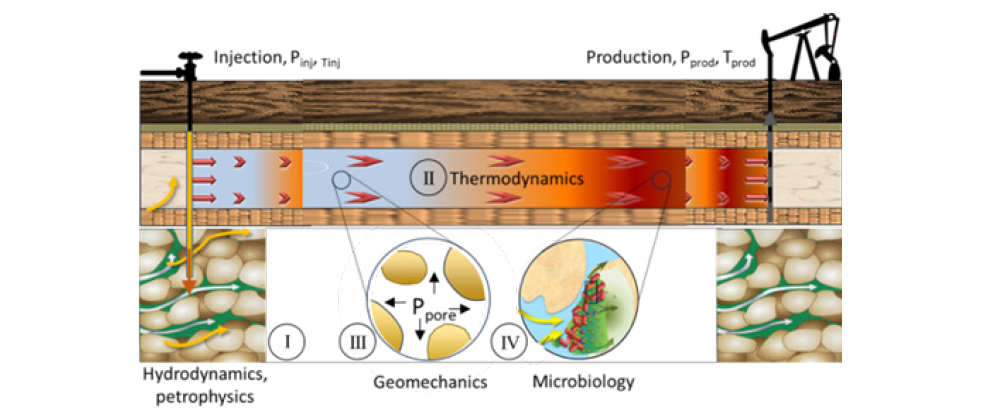
Changes in P and T can substantially influence the geomechanical equilibrium of geological formations. Variations in Pore pressure (Ppore) resulting from fluid production or injection lead to shifts in geological stresses, which can induce fracturing, for example. This, in turn, directly influences the flow dynamics within the reservoir. Integrating geomechanics (III in Figure 1) into Reservoir Engineering (RE) is particularly significant in geological storage projects involving continuous and/or cyclic injection and production.
The challenges posed by microbes and their development as microbial consortia in reservoir habitats have been recognized since the establishment of the oil industry in the mid-19th century. Sulfate-Reducing Bacteria (SRB), for example, have been identified as the cause of H₂S formation in reservoirs and surface facilities, which raises health and safety concerns. Although studies attempting to mitigate this issue have failed to deliver a definitive solution, they have underscored the importance of microbiology (IV in Figure 1) in reservoir and production studies. [2] suggested that the development of microbial consortia could assist in recovering residual oil in reservoirs. This idea paved the way for the subsequent development and implementation of Microbial Enhanced Oil Recovery (MEOR), which is one of the most wellknown Enhanced Oil Recovery (EOR) methods. Using geological formations for the permanent storage of CO₂ (Geological Carbon Storage, GCS) or the temporary storage of H₂ (Underground Hydrogen Storage, UHS) has led to a better understanding of the importance of incorporating microbiology into reservoir studies (e.g., [3,4]). Despite these advancements, microbiology remains one of the most disregarded yet pivotal fundamentals of RE.
This overview study emphasizes the importance of microbiology in modern RE, as well as its interaction with other RE components and factors. It should be noted that the cited studies are just a few recent examples chosen to demonstrate how microbiology is applied in various domains of RE.
Microbiology of Hydrocarbon Reservoirs
Underground hydrocarbon and water reservoirs are unique deep-subsurface ecosystems. They are characterized by extreme conditions, including high temperatures and pressures, high salinity levels, and an anaerobic gas content. In recent decades, a significant number of studies have drawn attention to the considerable diversity of physiologically distinct microorganisms present in these reservoirs [5-7], advancing our understanding of subsurface microbial consortia and their functions. Clearly, the activities of these microorganisms substantially influence reservoir environments and therefore have a significant impact on reservoir performance studies.
As might be expected, the petrophysical and thermodynamic conditions of reservoirs can either enhance or limit microbiological habitats and life. Reservoirs with temperatures higher than 80 °C exhibit less or no microbial activity, as indicated by a lack of biotransformation [8]. Depth can serve as a criterion when an estimation of reservoir temperature is necessary. In general, effects on microbial growth, such as changes in biomolecular conformation, are not expected to occur below 500 bar unless there is a sudden change in pressure. This is considerably higher than the pressure in conventional hydrocarbon reservoirs [9]. Various studies confirm the importance of permeability to bacterial movement in porous media [10,11]. Although microorganisms have various geometries, a general scale of 1-5μm can be reasonably assumed for bacteria. This dimension is crucial for low-permeability cores with narrow pore throats. Thus, low-to very low-permeability reservoirs (e.g., less than 10mD) are not necessarily hospitable environments for bacteria. Recent studies on reservoir microbiology and related applications, such as MEOR, have shown that Halanaerobiales bacteria are present and active in reservoirs with extremely high salinities of up to 220g/L [12].
Microbial Interactions in the Reservoirs
The importance of considering microbial activity in RE has become clearer over time, partly due to technological developments. Samples of reservoir fluids can be taken either at the wellhead or, if necessary, within the wellbore, to reveal the effects of pressure and temperature [13]. These samples are then characterized for their microbiological activity in a specialized laboratory. In this laboratory, the presence, number, physiological state, and morphology of microbial consortia and microorganisms are determined using microscopy and other analytical tools and methods. These include direct enumeration of specific bacterial groups using microscopy (e.g., Fluorescence in Situ Hybridization [FISH]). Alternative methods (e.g., qPCR and DGGE) entail the direct extraction of genetic material from cells (DNA/RNA) [14]. Subsequently, the amplified DNA is subjected to high-throughput sequencing. The use of BLAST analyses for microbial sequences facilitates the identification of microorganisms. This information can then be used to solve related challenges and mitigate risks of the following tasks of RE, as given in the following examples:
Biogenic souring (H2 S) management
The formation of hydrogen sulfide (H₂S) in petroleum reservoirs through the activity of anaerobic microorganisms (specifically, Sulfate-Reducing Bacteria, SRB) is known as biogenic souring of reservoirs. This process poses a significant risk to the petroleum industry, as H₂S is highly toxic, flammable, and corrosive, causing severe damage to reservoirs and associated surface facilities. SRB are also one of the most important sinks for hydrogen. SRB use hydrogen as an electron donor to reduce sulfate to hydrogen sulfide (H₂S) and often compete with other microorganisms for the available hydrogen.
For SRB, this is an energy-creating process that depends on the presence of volatile fatty acids or other carbon sources. If water is injected into the reservoir, for example, for producing more oil, there is a higher chance of biogenic souring if the water used for injection and/or formation contains sulfate and/or carbon sources like organic acids. This major technical risk exists in all water injection processes if the thermodynamic conditions allow and the microbiological composition of formation water and/or injection water contains SRBs. For its mitigation, specific attention is given to the concept of nitrate injection (mostly as calcium-nitrate) for the mitigation of reservoir souring. There are already some examples available for the use of nitrate in oil fields reporting mixed positive effects on corrosion and souring [15,16]. However, using nitrates cannot solve the problem completely, as they also exhibit side effects such as Microbially Induced Calcite Precipitation (MICP), which can block pores, reducing permeability and thus the flow of its contents. The use of other mitigation agents, such as molybdate, is currently being investigated [17]. Anaerobic microbial corrosion, which is caused by interactions in reservoirs and corrosion by-products, as well as bacterial growth, can significantly reduce permeability. This process produces solids, such as iron sulfide or oxides, which block flow paths. Bacteria, such as SRB, also form biofilms and contribute to the production of hydrogen sulfide [18].
SRB are present in almost all types of reservoir habitats. Although they are obligate anaerobes, they can also be found in oxygenated environments in a dormant state. They are now well recognized for their involvement in Microbially Induced Corrosion (MIC) as well. Microbial corrosion depends on the formation of a biofilm on the attacked surface, which provides favorable conditions for the development of microbial consortia, including SRB. MIC is a major concern in the oil and related industry [19,20].
Microbial Enhanced Oil Recovery (MEOR)
The extraction of oil from geological formations is governed by natural physical principles. Consequently, a significant portion of the oil remains in the reservoir after primary depletion. This residual oil can account for 40 to 95 percent of the original oil in situ. After waterflooding, Enhanced Oil Recovery (EOR) processes are applied to produce the remaining oil. There have been many attempts to categorize EOR methods, including thermal, gas, and chemical methods [21,22]. However, one method stands alone in all classifications: Microbial Enhanced Oil Recovery (MEOR).
MEOR stands for an EOR technology alongside thermal, gas, and chemical methods and involves the action of microbes by reacting with a substrate to form metabolites to recover a part of the remaining oil in the reservoir after primary and secondary recoveries. In ex situ MEOR, as a general application, a microbial metabolite resulting mostly in a biopolymer or biosurfactant is prepared in an industrial facility, is transported, and injected into the field. In in situ MEOR, metabolites are generated in the reservoir as a reaction of the injected substrates with targeted microbial consortia living in the reservoirs or injected from the surface.
From a pragmatic RE point of view, the ideal way forward for an MEOR application is to investigate the reservoir microbiology, isolate the microbes, and catalog them according to their EOR capabilities. Such catalogs are published periodically; however, they always need to be reviewed as new bacteria appear in newly studied fields. A recent collection is provided by [23]. Most of the bacteria are used for ex situ MEOR to produce biosurfactants and biopolymers. Some others, which are mainly used for in situ MEOR, are grouped under the name fermentative bacteria. Currently, in situ or ex situ MEOR is applied in many fields worldwide as a costeffective, easy-to-apply technology for recovering more oil from reservoirs [24].
In EOR fluid injection applications, including MEOR, it is crucial to prevent ex situ bacteria from entering the formation via the injected fluids and accumulating near the wellbore. Conversely, it may be imperative to impede the action of in situ bacteria on the biosurfactants or biopolymers introduced for EOR treatments, thus diminishing their efficacy. In such cases, the utilization of a screened biocide directed against the targeted bacteria is strongly recommended. Consequently, the implementation of routine sampling, testing, and analysis is imperative to facilitate timely intervention and avert substantial harm. The dosage of the biocide and oxygen scavenger (if deemed necessary) must also be accurately determined to prevent under- or overdosing.
Another noteworthy type of microbial interaction in oil and gas reservoirs is the fermentation of organic matter to produce hydrogen. This process, referred to as dark fermentation, occurs in the absence of light and can utilize a diverse array of organic substrates, including waste products and refined sugars. Nevertheless, the economic controversy of the process is rooted in the low yield of hydrogen produced by bacteria when they are used to break down organic compounds [15,16,25].
Microbial implications in GCS and UHS
As a short-term solution for addressing the greenhouse effect and climate change, anthropogenic CO₂ is injected into deep geological formations rather than being released into the atmosphere. This process, widely referred to as GCS, utilizes Depleted Hydrocarbon Reservoirs (DHR), saline aquifers, and occasionally salt caverns. The presence of active microbiological life in these reservoirs is contingent upon the existence of favorable thermodynamic and petrophysical conditions. However, the impact of CO₂ on subsurface microbial communities remains a subject of limited research. A low-pH, high-CO2 environment may favor some species and harm others. In environments where there is a significant reduction of CO2, the injection of CO2 may stimulate microbial consortia that reduce CO2 to methane (CH4). In other reservoirs, the injection of CO2 could cause a short-term stimulation of iron (III)-reducing communities (Onstott, 2005). An enhanced activity and quantity of the microbial population after five months of CO2 storage in saline aquifer indicated that the in-situ consortium was able to adapt to the extreme conditions of the deep biosphere and to the extreme changes of these anthropogenically modified conditions [26]. From an operational perspective, the formation of biofilms can alter the effective permeability of storage and confining formations. Given that GCS is designed for long-term CO2 sequestration, containment of the storage formation is of paramount importance; consequently, any microbiological impact on the integrity of the overlying formations is of particular interest. Microbially Induced Calcite Precipitation (MICP) is a sustainable technology or natural process that utilizes biochemical pathways to generate calcium carbonate cement barriers, thereby sealing leakage zones in geological formations [27]. New research initiatives are underway to ascertain the potentially beneficial or unfavorable biological side effects of CO₂ sequestration (e.g., [3]).
Depending on the duration of storage and demand, a range of UHS options can respond to the cyclic process. The utilization of porous media structures, including deep aquifers, depleted oil and gas reservoirs, and salt caverns, has been demonstrated to accommodate substantial volumes. Recent studies indicate that microbiology should be considered from the beginning in such UHS operations. Homoud RA et al. [4] highlighted that, in addition to the H2S impurity, which has been a subject of concern in UHS, CH4 formation due to methanogenesis is another issue in UHS. Consequently, all endeavors are focused on preserving the high purity of the stored hydrogen. A numerical study revealed that the utilization of non-reactive cushion gases, such as nitrogen, instead of CO₂, results in a reduction of H2S generation and an enhancement of hydrogen containment conditions. This reduction in H2S generation and improvement in hydrogen containment conditions, in turn, minimize hydrogen dissolution and pyrite reactivity. The methanogenesis has been observed to result in substantial hydrogen loss, with reductions of up to 50% in in situ hydrogen volume. This decrease in hydrogen volume, in turn, lowers the effectiveness of hydrogen storage, thereby highlighting the need for preliminary microbial assessment and judicious cushion gas selection. The authors further concluded that it is imperative to investigate the impact of pressure and temperature on geochemical and microbiological reactions and to analyze microbial growth rates. The acquisition of comprehensive data in these areas is essential for enhancing our comprehension of the lifecycle of microbes in hydrogen storage environments. Moreover, [28] observed that SRB present in salt caverns consume H₂, which is accompanied by a significant pH increase. This phenomenon leads to a decline in activity over time. This self-limiting process of pH increase during sulfate reduction is advantageous for H2 storage in low-buffering environments, such as salt caverns [29-37].
Table 1 provides a broad overview of the relevance of microbiology to reservoir engineering based on various applications.
Table 1: Broad overview of the relevance of microbiology to reservoir engineering based on various applications.

Conclusion
Although reservoir engineering has long survived without the support of microbiology, this has resulted in misinformation and failed decisions, particularly with regard to risk assessments and mitigations. Technological advances and developments in associated domains have converged to elevate microbiology to a pivotal role within the RE framework, complementing disciplines such as hydrodynamics, thermodynamics, and geomechanics. This is particularly relevant given the expanding range of applications of RE in various subsurface energy initiatives, including oil recovery technologies, transforming remaining hydrocarbons into viable energy sources after depletion, and reducing risks in geological carbon and hydrogen storage projects. Whereas MEOR represents a favorable application of microbiology with the cultivation of microbial consortia through the injection of substrates into the reservoir, biogenic souring remains the predominant challenge to be dealt with using microbiological science and technology. Concerns pertaining to matters that have the potential to either diminish or disrupt reservoir performance, whether through the production or storage of energy, must be addressed by the implementation of mitigation measures aimed at restoring optimal conditions. In the context of microbial factors, it is imperative to address these factors by incorporating the principles and methodologies of microbiological science and technology. It is of particular importance to direct attention towards injectors and wells that undergo frequent stimulation and workover operations. These wells probably provide conditions favorable for the development of microbial consortia. Recent technological advancements have rendered effective microbiological monitoring of reservoirs and production facilities a viable prospect. This, in turn, facilitates the timely implementation of effective mitigation measures.
References
- Darcy H (1856) The public fountains of the city of Dijon. Dalmont, Paris.
- Beckmann JW (1926) The action of bacteria on mineral oil. Ind Eng Chem, News Edition 4, pp: 23-26.
- Manchester (2025) New research to reveal hidden microbial impact on CO2 University of Manchester, England, UK.
- Homoud RA, Machado MVB, Daigle H, Ates H (2025) Critical geochemical and microbial reactions in underground hydrogen storage: Quantifying hydrogen loss and evaluating CO2 as cushion gas. Hydrogen 6(1): 4.
- Pannekens M, Kroll L, Müller H, Mbow FT, Meckenstock RU (2018) Oil reservoirs, an exceptional habitat for microorganisms. New Biotechnology 49: 1-9.
- Magot M, Ollivier B, Patel BK (2000) Microbiology of petroleum reservoirs. Antonie Van Leeuwenhoek 77(2): 103-116.
- Mu BZ, Nazina TN (2022) Recent advances in petroleum microbiology. Microorganisms 10(9): 1706.
- Head IM, Jones DM, Larter SR (2003) Biological activity in the deep subsurface and the origin of heavy oil. Nature 426(6964): 344-352.
- Oger PM, Jebbar M (2010) The many ways of coping with pressure. Research in Microbiology 161(10): 799-809.
- Raleigh JT, Flock DL (1965) A study of formation plugging with bacteria. Journal of Petroleum Technology 17(2): 201-206.
- Halim A, Shapiro A, Lantz AE, Nielsen SM (2014) Experimental study of bacterial penetration into chalk rock: Mechanisms and effect on permeability. Transport in Porous Media 101: 1-15.
- Kögler F, Mahler E, Dopffel, N, Schulze MD, Borovina, A, et al. (2021) The Microbial Enhanced Oil Recovery (MEOR) potential of halanaerobiales under dynamic conditions in different porous media. Journal of Petroleum Science and Engineering 196: 107578.
- Krüger M, Dopffel N, Sitte J, Mahler E, Mukherjee S, et al. (2016) Sampling for MEOR: Comparison of surface and subsurface sampling and its impact on field applications. Journal of Petroleum Science and Engineering 146: 1192-1201.
- Skovhus TL, Enning D, Lee JS, (2017) Microbiologically influenced corrosion in the upstream oil and gas industry. CRC Press, Florida, USA, pp. 558.
- Alkan H, Bauer JF, Burachok O, Kowollik P, Olbricht M, et al. (2024) Hydrogen from depleted/depleting hydrocarbon reservoirs: A reservoir engineering perspective. Applied Sciences 14(14): 6217.
- Alkan H, Kögler F, Namazova G, Hatscher S, Jelinek W, et al. (2024) Assessment of the biogenic souring in oil reservoirs under secondary and tertiary oil recovery. Energies 17(11): 2681.
- Kögler F, Hartmann FSF, Schulze MD, Herold A, Alkan H, et al. (2020) Inhibition of microbial souring with molybdate and its application under reservoir conditions. International Biodeterioration & Biodegradation 157: 105158.
- Kermani HM, Barzegar S, Nick HM (2025) Bio-physico-chemical formation damage prediction in subsurface water injection applications. Journal of Hydrology 663(Part A): 134127.
- Reza J (2017) Microbiologically influenced corrosion: An Engineering Insight. (2nd edn), Springer, UK.
- Procópio L (2022) Microbially induced corrosion impacts on the oil industry. Arch Microbiol 204: 138.
- Mokheimer EMA, Hamdy M, Abubakar Z (2018) A comprehensive review of thermal enhanced oil recovery: Techniques evaluation. Journal of Energy Resources Technology 141(3): 030801.
- Shafiai SH, Gohari A, (2020) Conventional and electrical EOR review: The development trend of ultrasonic application in EOR. Journal of Petroleum Exploration and Production Technology 10: 2923-2945.
- Safdel M, Anbaz MA, Daryasafar A, Jamialahmadi M (2017) Microbial enhanced oil recovery, a critical review on worldwide implemented field trials in different countries. Renewable and Sustainable Energy Reviews 74: 159-172.
- Alkan H, Mukherjee S, Koegler F (2023) Microbial enhanced oil recovery. Recovery Improvement. (1st edn), Gulf Professional Publishing, USA, pp. 427-531.
- Sampaio ICF, De Moura IVL, Matos JBTL, Jones CM, De Almeida PF (2025) Use of depleted oil and gas reservoirs as bioreactors to produce hydrogen and capture carbondioxide. Fermentation 11(9): 490.
- Morozova D, Zettlitzer M, Let D, Würdemann H (2011) Monitoring of the microbial community composition in deep subsurface saline aquifers during CO2 storage in Ketzin, Germany. Energy Procedia 4: 4362-4370.
- Landa-Marbán D, Tveit S, Kumar K, Gasda S (2021) Practical approaches to study microbially induced calcite precipitation at the field scale. International Journal of Greenhouse Gas Control 106: 103256.
- Dopffel N, Mayers K, Kedir A, Alagic E, An-Stepec BA, et al. (2023) Microbial hydrogen consumption leads to a significant pH increase under high-saline-conditions: Implications for hydrogen storage in salt caverns. Scientific Reports 13(1): 10564.
- Alkan H, Mukherjee S, Kögler F (2020) Reservoir engineering of in situ MEOR; impact of microbial community. Journal of Petroleum Science and Engineering 195: 107928.
- Alkan H, Szabries M, Dopffel N, Koegler F, Baumann R, et al. (2019) Investigation of spontaneous imbibition induced by wettability alteration as a recovery mechanism in microbial enhanced oil recovery. Journal of Petroleum Science and Engineering 182: 106163.
- Boon M, Buntic I, Ahmed K, Dopffel N, Peters C, et al. (2024) Microbial induced wettability alteration with implications for underground hydrogen storage. Scientific Reports 14(1): 8248.
- Castro-Dominguez B, Gröls JR, Alkandari S, Laurent Perge, Sierra-Avila C, et al. (2025) Biopolymers and biocomposites: A comprehensive review of feedstocks, functionalities, and advanced manufacturing techniques for sustainable applications. Biotechnol Sustain Mater 2: 8.
- Eddaoui N (2021) Patterns in bioreactive transport in underground storage of hydrogen: Impact of natural and induced heterogeneity. Mechanics [physics]. University of Lorraine, Hassan II University (Casablanca, Morocco), Lyon, France.
- Gaol CL, Ganzer L, Mukherjee S, Alkan H (2020) Investigation of clogging in porous media induced by microorganisms using a microfluidic application. Environmental Science Water Research & Technology 7(2): 441-454.
- Hagar HS, Foroozesh J, Kumar S, Zivar D, Banan N, et al. (2022) Microbial H2S generation in hydrocarbon reservoirs: Analysis of mechanisms and recent remediation technologies. Journal of Natural Gas Science and Engineering 106: 104729.
- Kögler F, Dopffel N, Mahler E, Hartmann FS, Schulze-Makuch D, et al. (2021) Influence of surface mineralogy on the activity of Halanaerobium sp. during microbial enhanced oil recovery (MEOR). Fuel 290: 119973.
- Tyne RL, Barry PH, Lawson M, Byrne DJ, Warr O, et al. (2021) Rapid microbial methanogenesis during CO2 storage in hydrocarbon reservoirs. Nature 600(7890): 670-674.
© 2026 Hakan Alkan. This is an open access article distributed under the terms of the Creative Commons Attribution License , which permits unrestricted use, distribution, and build upon your work non-commercially.
Editor In Chief







.jpg)































Signup for Newsletter

Quick Links
 Editorial Board Registrations
 Submit your Article
 Best Paper of the Volume
 Reprints
 Refer a Friend
 Advertise With Us
Our Recent Edition

.jpg)



Top Editors




.jpg)

















.bmp)
.jpg)
.png)
.jpg)













.jpg)






.png)

.png)




.png)




Financial Support

Sponsors

Latest e-Books

Latest Video

 a Creative Commons Attribution 4.0 International License. Based on a work at www.crimsonpublishers.com.
Best viewed in
a Creative Commons Attribution 4.0 International License. Based on a work at www.crimsonpublishers.com.
Best viewed in 
 | Above IE 9.0 version