

- About Us
- Information
-

The Author ensures that the research has been conducted responsibly and ethically with adherence to all relevant regulations. read more..
- For Authors
- For Reviewer
- Manuscript Guidelines
- Membership
- Publication Ethics
-
- Journals
- Reprints
- e-Books
- Videos
- Policies
- Contact Us
 COVID-19
- Submissions



Full Text
Journal of Biotechnology & Bioresearch
Biology, Economy, and the Unseen Cost: A Grounded Narrative of Bioeconomy in the Age of Pollution
Chee Kong Yap*
Department of Biology, Faculty of Science, University Putra Malaysia, Malaysia
*Corresponding author:Chee Kong Yap, Department of Biology, Faculty of Science, University Putra Malaysia, Malaysia
Submission: December 19, 2025;Published: February 26, 2026
Volume6 Issue 1February 26, 2026
Abstract
This article offers a personal and reflective explanation of the bioeconomy from the lens of a biologist and ecotoxicologist. Rather than relying on abstract definitions or policy frameworks, the narrative begins with real-world biological cycles including the fish in the sea, mussels in polluted estuaries, and the mangroves that quietly sustain livelihoods. It presents the bioeconomy as the transformation of living biological resources into economic value, from food and energy to environmental services and public health. By tracing how contaminated ecosystems ultimately affect human well-being through chronic exposure and rising medical costs, the article argues that the bioeconomy must be understood not only in terms of high-tech innovation but also through the health of basic natural systems. This perspective is further expanded by tracing the historical evolution from “bioeconomics” to modern bioeconomy strategies in the AI era, highlighting both the promises and pitfalls of over-commercialization. The piece aims to educate and provoke thought: that even the smallest seed of biology is the foundation of every forest of economy. Without biological integrity, economic systems are unsustainable, regardless of policy rhetoric or industrial ambition.
Keywords:Bioeconomy; Ecological health; Environmental pollution; Biological resources; Sustainability
Introduction
After engaging with people from diverse academic and professional backgrounds, I realized how difficult it can be to explain complex ideas like the bioeconomy, to those who come from different schools of thought or prioritize different values. Even within the same field, differing mindsets and perspectives often create unexpected communication barriers. This challenge becomes even greater when speaking with individuals from fields such as the social sciences, business management, consulting, or training, or when personality traits shape how people receive and process new information.
The article by Langer and Henshaw [1], titled “The interacting effects of public health, fertility behavior and general economy on standards of living. IV. Characterization of thresholds and stages of development in the bioeconomic mechanism,” is among the earliest known Scopus-indexed publications to use the term “bioeconomic”, appearing in a medical journal nearly seven decades ago. Though not titled with “bioeconomy” in the modern sense, this work explores how biological and economic factors interact to shape human well-being, particularly through public health and fertility patterns. Its historical significance lies in illustrating that the foundations of bioeconomy thinking were rooted in health, demography, and the socio-economic thresholds that define human development. This reinforces the argument that the bioeconomy must not be confined to laboratories or green technologies, but it was always, and still is, about life systems, survival, and the allocation of biological and economic resources in shaping our collective future.
The paper by Berry and Bronson [2], titled “Life history and bioeconomy of the house mouse,” is the earliest Scopusindexed article found with the keyword “bioeconomy” in its title, identified on 2 August 2025. Its focus on the house mouse, which is a simple, common organism, does highlight a powerful message: that foundational studies in biology, even at the smallest scale, are crucial to understanding how biological traits drive resource allocation, survival, and reproduction. The use of “bioeconomy” in this context emphasizes the intrinsic relationship between biology and energy budgeting within an organism’s life history. It reminds us that the principles of bioeconomy do not begin with high-tech labs or policies, but with the basic biological truths that govern life itself.
The earliest traces of the bioeconomy concept, as seen through scientific literature, reveal how fundamentally biological sciences have shaped its trajectory. The study by Berry and Bronson [2], focused on the life history and bioeconomy of the house mouse, illustrates that even basic ecological and reproductive data on a common species can inform broader understandings of biological energy allocation and population dynamics within economic contexts. Decades earlier, Langer and Henshaw [1] introduced the term “bioeconomic mechanism” in a groundbreaking analysis linking public health, fertility behaviour, and economic development, thus clearly rooting economic thresholds in biological and demographic realities. These pioneering studies reflect a foundational truth: bioeconomy is not born from policy papers or high-tech labs alone, but from field biology, life science observations, and medicaldemographic data that reflect real-world human and ecological conditions.
This article aims to reinterpret the bioeconomy not just as a tool for innovation, but as a biological imperative for survival in a polluted world, drawing from the lived perspective of an ecotoxicologist and the overlooked wisdom embedded in environmental cycles. While this article adopts a personal and reflective narrative style, it is not intended as a purely experiential account. Rather, the narrative is used as an interpretive framework to connect empirical ecological observations with economic reasoning and public health implications. By grounding conceptual discussions of bioeconomy in lived ecological realities, the paper seeks to bridge scientific abstraction and practical environmental experience. This narrative approach therefore complements conventional analytical perspectives by situating bioeconomic processes within observable biological systems and real exposure pathways.
How I, as a biologist, explain bioeconomy in a simple way
Let me explain bioeconomy not from a textbook, not from buzzwords shaped by consultants, and certainly not from PowerPoint slides used to impress investors. Let me explain it from the lens of a biologist who walks the mangroves barefoot, who sees life not in silos but in cycles.
Figure 1 illustrates how the bioeconomy emerges from the intersection of biological systems and economic activity. The diagram highlights that biology provides the foundation of living systems and natural resources, while the economy represents human livelihoods and value creation. In the overlapping space, the bioeconomy is shown as the generation of sustainable value from biological life, integrating ecological processes with economic pathways. This visual representation emphasizes that a resilient and future-oriented bioeconomy depends on maintaining the integrity of natural systems while fostering innovation, production, and societal wellbeing.
Figure 1:The intertwined roots of the bioeconomy.
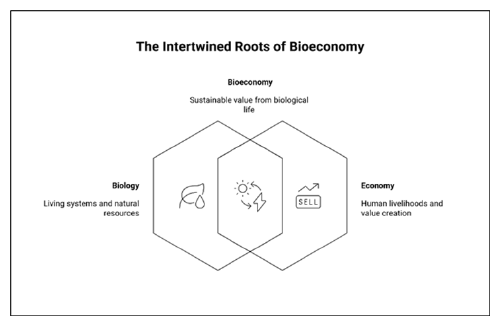
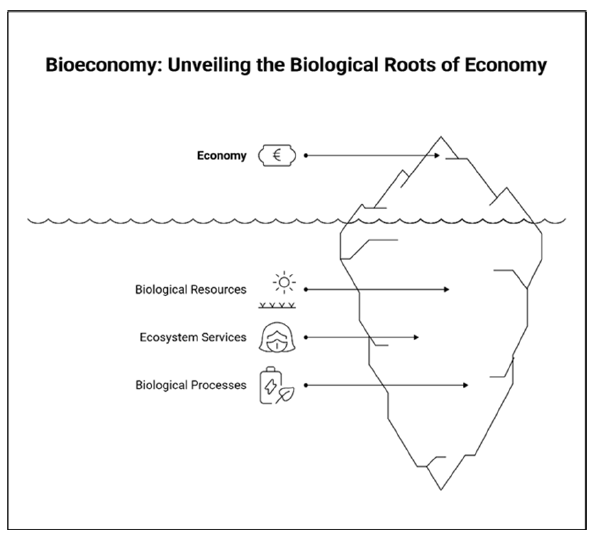
Figure 2 presents the bioeconomy as an iceberg to show that the visible economy at the surface rests on deeper, often overlooked biological foundations. Beneath the waterline, the diagram highlights three essential layers: biological resources, ecosystem services, and biological processes. These hidden components support and regulate human economic activity, illustrating that sustainable economic growth ultimately depends on the integrity and functioning of natural systems.
Figure 2:Bioeconomy as an iceberg revealing the hidden biological foundations of economic systems.
Bioeconomy, at its core, is nothing more, and nothing less, than biology plus economy. That’s it. The economy we speak of, surely money, salary, business, which does not fall from the sky. It does not magically appear from AI algorithms or policy briefs. It comes from the ground. From the breath of mussels, the leaves of trees, the tides of estuaries, and the roots of living biological resources. It is not a digital concept. It is natural. It is real.
Let us take the sea as an example. Fishermen cast their nets. They haul in fish. These are cleaned, iced, transported, sold in wet markets or packed into hypermarkets, and eventually end up on our plates as dinner. Everyone along this chain, walking from the person tying the fishing knots to the cashier scanning the barcode, all need to earn a living. So, when people eat, they are not just feeding themselves; they are nourishing an entire economic cycle powered by biological life [3,4].
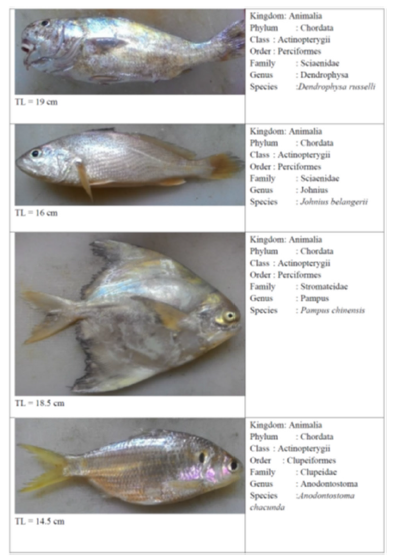
But what sustains these fish? Mangroves. The tangled trees filter pollutants from upstream. Mussels and oysters clean the waters. These are ecosystem services, often unrecognized, yet fundamentally priceless [5]. When those waters become cleaner, prawns and fish breed in healthier conditions. And so, we enjoy delicious commercial fish (Figure 3) at our dinner table, not realizing it all started from a tree root or a mussel’s breath.
Figure 3:Representative specimens of commercial marine fish purchased from landing sites across Peninsular Malaysia. These samples include (from top to bottom): Dendrophysa russelii (TL=19cm), Johnius belangerii (TL=16cm), Pampus chinensis (TL=18.5cm), and Anodontostoma chacunda (TL=14.5cm). All individuals were photographed fresh upon arrival to document key morphological features and taxonomic classification. These species are commonly consumed in Malaysian diets and were selected for trace metal analysis in relation to ecological risk assessment and food safety studies. Their collection from actual landing points reflects the real-world exposure pathways for human consumers and underscores the importance of monitoring seafood quality from sea to table. All photos are provided by student Mr. Ravendran.
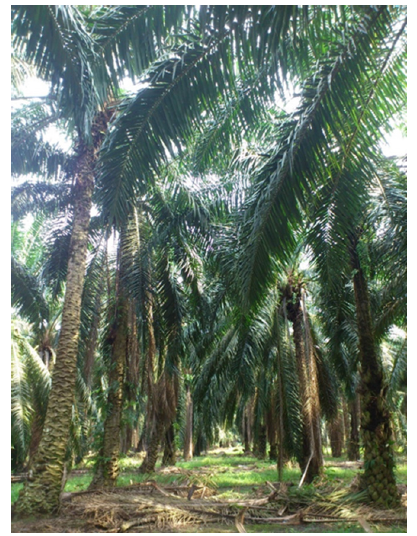
Even after death, biology continues to serve the economy. Take the biomass from oil palm fronds, discarded leaves, or felled old trees, were once alive, now dead (Figure 4). They are burnt and turned into energy, lighting up our homes after sunset. That light we enjoy at night came from a once-living biological entity. That’s the true economy of biology. This is what we call bioeconomy. Not a futuristic construct, but the age-old interdependence between life and livelihood [6,7].
Figure 4:A typical oil palm plantation in Peninsular Malaysia, where felled fronds and leaves are visibly scattered across the ground. These biomass residues, often considered agricultural waste, hold significant potential for valorization in Malaysia’s emerging bioeconomy. When properly collected and processed, such materials can be converted into bio-based products including compost, biochar, or second-generation biofuels-supporting the transition to a circular and low-carbon economy. This image underscores the untapped value of biomass resources already present within conventional monoculture systems. This photo was taken by Nur Aishah.
So, without biology, where exactly do you extract value from? Where would your food, your electricity, or your medicine come from? The breath of mangroves. The heartbeat of rivers. These are not just poetic metaphors; they are economic engines. If one cannot see that the food we eat, the air we breathe, the soil we till, and the water we drink are all part of integrated biological systems, then of course one will reject what I am talking as “too basic.” I accept that rejection, but I do not accept the ignorance behind it. Because I am speaking from the roots, not from the clouds. I am building understanding from soil, not selling dreams from the sky. That is why my mindset might look too basic to some. But as a biologist, I will always say this: never underestimate the seed just because it is small. Without it, there is no tree. Without the tree, there is no forest. And without the forest, there is no future bioeconomy.
How I, as an ecotoxicologist, explain bioeconomy in the era of pollution
Let me speak not from a high-rise office, but from the muddy riverbanks where I have bent my knees, lifted mussels from polluted waters, and scraped sediments with my students under the burning sun. I have done this work not for glamour or grants, but because someone has to monitor the silent warnings that our environment keeps whispering. I am an ecotoxicologist, not by title alone, but by lived experience. And from this muddy ground, I see a side of the bioeconomy that many in air-conditioned rooms often overlook.
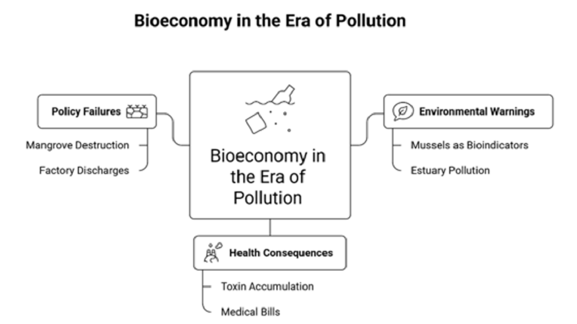
Figure 5 illustrates how the bioeconomy becomes increasingly vulnerable when pollution undermines the ecological systems that sustain it. The diagram shows three interconnected pressures: policy failures such as mangrove destruction and factory discharges, environmental warnings observed through bioindicator species like mussels and rising estuary contamination, and the resulting health consequences including toxin accumulation and rising medical burdens. Together, these elements demonstrate that a polluted environment weakens both ecological resilience and economic wellbeing, highlighting the need for stronger governance and ecosystem protection to sustain a viable bioeconomy.
Figure 5:Bioeconomy in the era of pollution.
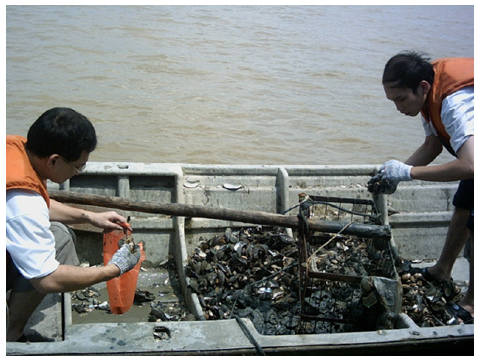
Bioeconomy is not only about innovation, agriculture, or green technology. In today’s world, mostly polluted, fragmented, and intoxicated, it is about survival. It is about whether your child will eat a clean fish or a contaminated one. Whether a mother will cook a soup that nourishes or slowly poisons. Whether a father can afford medicine when his liver shows shadows on an MRI scan because of decades of ingesting what looks clean but carries silent killers. Walk with me along the coastline, and I will show you the ‘Kupang’ Perna viridis (Figure 6) that are harvested from estuaries we have allowed to choke with sludge. These creatures feed millions, yet they are filter feeders, living sieves that accumulate every bit of heavy metal, microplastic, pesticide, and detergent that flows from our cities into their habitat. And what do we do? We celebrate food festivals. We Instagram our seafood platters. But no one sees the cadmium in the mussel, or the mercury in the prawn’s vein.
Figure 6:On the left is myself, and on the right is my most dedicated and talented student at the time, Mr. Wan Hee Cheng who is now a full Professor at INTI International University. Note: This photo captures a memorable field trip on 15 September 2004, where we were sampling Perna viridis (kupang) in the muddy, tidal waters of the Muar Estuary. We had only a simple boat, coarse gloves, and a handmade dredge basket, but our shared passion for science and discovery made the heavy lifting feel light. That day was not just about collecting mussels; it was about shaping a legacy in environmental research and mentorship that continues to inspire me today. This photo was taken by Mrs. Yap.
One day, you feel weak. You go to the clinic. The doctor smiles politely and says, “Let’s do some tests.” An MRI. A CT scan. A full blood panel. You wait. Then comes the line that collapses your world: “There’s a suspicious shadow in your kidney.” You sit there, stunned. You ask yourself, “Why? I don’t smoke. I don’t drink. I eat seafood.” And therein lies the problem. Because the poison did not come with a skull-and-crossbones label. It came with sambal made of mixed seafood. It came with lime. It came with your favourite meal on your birthday. That is bioeconomy too.
It is the economy that leaks silently from our hospitals, our pharmacies, our mental health clinics. You think your medical bills are personal? No, they are collective economic burdens rooted in how we failed to protect our biological systems. When fish carry toxins, humans carry consequences. And we all pay not only with money, but with energy, peace, relationships, and life itself. What’s most tragic is that we allowed this. The black sludge in the mangroves? We approved it. The wastewater from factories? We said, “Just a small discharge.” The chemical-filled river? We filed the Environmental Impact Assessment and moved on. And now, it is returning to us in the most painful way which is through our food, our water, our children’s health consequences. You can’t dodge it with wealth. You can’t outrun it with prestige. When nature collapses, everyone breathes the same air. Everyone drinks the same water.
And yet, we rarely ask: did we ever fund the ecotoxicologist who warned us (as what I have published in my academic papers [8])? Did we listen to the early signs in the mussel’s tissue? Or did we laugh it off as just another basic study which you think is too primitive, too “not AI enough” to be relevant? People say bioeconomy is about biotechnology. Yes, that’s one dimension. But it is also about tragedy and accountability. A crab filled with arsenic is also bioeconomy. A child with liver damage from contaminated water is also bioeconomy. A government that spends more on dialysis than education; this, too, is bioeconomy.
So, when I speak in simple metaphors, it is not because I lack complexity. It is because the truth is simple. If we cannot even keep our mangrove swamps clean, how can we talk about circular bioeconomy? How can we dream of green futures while we bury our toxins in estuaries and hope they stay hidden? Let me tell you what I have learned: the human body remembers what policymakers forget. The pollutants we ignore today will resurface tomorrow in the forms of in tumours, in chronic pain, in broken families sitting outside emergency rooms. That is the true cost of a bioeconomy that neglects biology. And no innovation lab can undo that. So, if you ask me why my thoughts sound basic, I say this: we must begin at the roots. Only from there can we grow trees that bear fruit, shade, and medicine. Only from there can we build a bioeconomy that heals, not harms.
The roots of bioeconomy: from bioeconomics to global strategy
The concept of bioeconomy was not born recently. It traces back to the original term “bioeconomics,” which first emphasized how biological resources like fish stocks, forests, or croplands contribute to economic value. Over the past few decades, bioeconomy has grown from this narrow ecological-economics framework into a more complex system shaped by biotechnology, renewable energy, and sustainability policies [3,7]. The European Union played a key role in elevating bioeconomy into a policy vision, prompting countries across the world to develop their national strategies [5,9].
Figure 7:PESTEL framework illustrating the multidimensional global strategy for advancing the bioeconomy.
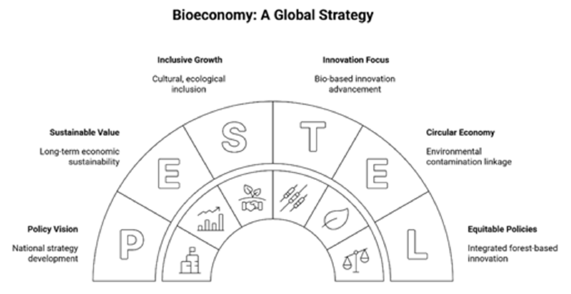
The PESTEL framework in Figure 7 provides a structured way to analyse the broader forces shaping the global bioeconomy by examining Political, Economic, Social, Technological, Environmental, and Legal dimensions. Politically, national strategies and long-term policy visions guide investment, regulation, and institutional coordination. Economically, the bioeconomy depends on sustainable value creation that supports long-term growth while reducing dependence on non-renewable resources. Social factors emphasise inclusive growth that recognises cultural and ecological diversity, ensuring that community’s benefit from bio-based transitions. Technological considerations focus on innovation that advances bio-based production, biotechnology, and circular resource systems. Environmental aspects address contamination linkages and the need to integrate ecosystem protection with biobased development. Legally, equitable policy frameworks establish fair, transparent, and integrated regulations that support forestbased innovation and sustainable industry practices. Together, these PESTEL components offer a holistic understanding of how the bioeconomy evolves across multiple governance, societal, and ecological contexts.
But the essence remains the same: without biological systems, there is no true foundation for long-term economic sustainability. My view as a biologist aligns with the broader interpretation of bioeconomy, where all life-based processes, even the basic ones, are seen as sources of value, jobs, and security. The bioeconomy, as experienced from ground-zero pollution sites, cannot be divorced from the frameworks of circular economy and environmental justice. While high-level policies often highlight bio-based innovation and value chains, what we need is an urgent redefinition: one that links environmental contamination directly to bioeconomic failure. Prasad [10] emphasized that bioremediation is not only a technique but a socioeconomic necessity when contamination becomes systemic. The integration of waste-to-value technologies, such as enzymatic hydrolysis and pyrolysis [11], show that pollutants can indeed be transformed but only if society chooses to invest not only in labs but also in the fieldworkers, the samplers, the silent observers of environmental decay [12].
As Francocci et al. [13] argued, the success of bioeconomy projects in contaminated sites depends on valuing local knowledge, site-specific remediation, and interdisciplinary effort. Meanwhile, Ogwu et al. [6] showed that the Global South suffers doubly from pollution and from being left out of the policy-design table. A circular bioeconomy that fails to address health outcomes that sees dialysis machines as separate from drainage pollution, is not circular at all. It is fractured. And what is fractured, collapses.
The value of bioeconomy is also reflected in how marginal lands are creatively transformed. Schlecht et al. [14] demonstrated how bio-based value chains can emerge from underused landscapes. Philippidis et al. [15] showed the systemic impact of bioeconomy transition on bio-based chemicals in the EU, while Klimek-Kopyra et al. [16] detailed how sustainable biomass production is central to a future circular economy. Ding et al. [17] expanded this by showing how residual biomass from grasslands can power biobased industries. In Ecuador, Cuestas-Caza et al. [18] integrated indigenous knowledge into bio-based governance. These works remind us that bioeconomy cannot be technocratic alone; it must be cultural, ecological, and inclusive.
Even within industry, inter-organizational cooperation is necessary to push bio-based plastics forward [19]. This spirit of collaboration extends to food and health as well. For instance, Pessoa et al. [20] proposed algae-based exopolysaccharides from dairy wastewater for rheology-modified biomaterials, while Parlato and Pezzuolo [21] showed how bio-based construction integrates agriculture with architecture. From South Africa, Hlangwani et al. [22] argued for innovation-driven bioeconomy through local technological capacity. Le et al. [23] emphasized how the Global South, especially Vietnam, can drive bioeconomy through circular and culturally adapted designs. As Beer et al. [24] concluded, bioeconomy policies in the EU must shift from forest extraction to integrated forest-based innovation and equity. Let us build a bioeconomy where a child’s clean plate means more than GDP. Let us count health, hope, and honesty in our indicators. Let the ecotoxicologist’s mud-stained hands be part of the conversation. That is where healing begins.
Seeing through the mangroves: a field-based understanding
Figure 8:Molluscs sampling at the mangrove area near Jetty Pengkalan Nelayan Telok Gong, Klang, captured on 25 March 2023. On the left is Mr. Austin Hew, and on the right is Mr. Ezzafel; both of whom were my hardworking and dedicated final-year undergraduate students. This photo captures their commitment as they braved the thick estuarine mud to collect samples for their ecotoxicological project. This photo was taken by Maisara.
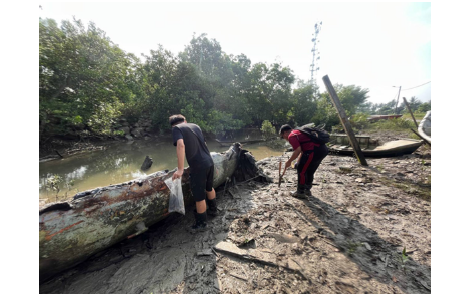
Let me take you to the mangroves again (Figure 8). When we step into the mudflats, I do not see only trees and crabs. I see an economic engine driven by nature. Mangroves trap sediments, protect shorelines, and allow juvenile fish to grow. They provide wood, honey, and even ecotourism. Yet these are not captured in conventional GDP. That is the failure of many bioeconomy experts who only measure from satellites, not soil.
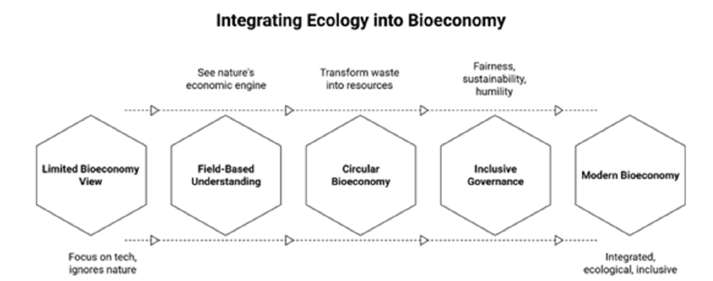
Figure 9 illustrates the gradual transition from a narrow, technology-driven view of the bioeconomy to a modern approach that is ecological, integrated, and inclusive. The sequence shows how understanding nature’s economic functions, adopting circular practices, and embedding fairness and sustainability in governance collectively reshape the bioeconomy into a system grounded in ecological principles and societal wellbeing.
Figure 9:Integrating ecology into the bioeconomy.
Even the byproducts of life including the wastes, decomposing material, shells, and, fronds, all can be transformed into bioenergy, compost, and biochemicals. That is the logic of circular bioeconomy [6,17]. The humble mussel that filters seawater does more than survive because it provides ecological services that eventually support local fishing communities and global seafood markets.
Today, bioeconomy is often wrapped in terms like artificial intelligence, synthetic biology, or digital agriculture. These are valid and exciting. But innovation must not erase origin. The strength of the bioeconomy lies not just in genetic codes or labbased fermentation, but in how we manage our rivers, soils, forests, and microbial life. The transition to a modern bioeconomy must integrate the small-scale, the ecological, and the inclusive. Scholars have highlighted the risks of corporate control and inequality in the bioeconomy transition [25], emphasizing the need for governance that does not forget the mangrove roots. Future bioeconomic policies must combine innovation with fairness, and sustainability with humility [26].
This idea is reinforced by Cuestas-Caza et al. [18], who showed that bioeconomy governance in indigenous territories requires cultural adaptation. Foschi et al. [19] highlighted how mutual learning between organizations fosters circularity in the bio-based plastics sector. Pessoa et al. [20] showed that even dairy waste can generate useful materials for industry, strengthening local circular bioeconomy systems. Le et al. [23] argued for bio-based construction from local residues to support climate adaptation in Southeast Asia. The same applies to forest-based bioeconomy models described by Beer et al. [24], which call for inclusive stakeholder collaboration. In short, the future of the bioeconomy depends not only on how fast we digitize biology, but on how deeply we honor its rhythms. And that is why I, as a biologist, will always argue that what looks basic is often the most essential.
Conclusion
The bioeconomy is not a complicated concept once we return to its essence: biology that drives economy. It is not merely a strategy in a national plan or a keyword in a conference brochure. It is life itself: how it grows, sustains, and transforms into value that feeds households, powers cities, and supports human health. If our biological resources are polluted, neglected, or overexploited, then the economy that depends on them will eventually collapse under its own weight. That collapse will not be theoretical but it will be visible in our medical bills, our mental health, and the rising costs of food, water, and survival itself. A contaminated mussel in the mangrove may look small, but when consumed repeatedly, it becomes a silent killer and story of bioaccumulation, illness, and socio-economic burden. This is the reality many fail to connect: that the polluted coastal mud becomes a blood test result in the clinic.
As an ecotoxicologist and biologist, I do not speak from abstraction. I speak from decades of walking muddy shores, analyzing contaminated tissues, and witnessing firsthand how environmental degradation reaches our dinner plates. Bioeconomy, therefore, cannot be separated from environmental ethics, food safety, and public health. The economy we build must be rooted in biology that is clean, respected, and sustainably managed. And to do that, we must stop treating nature as an infinite supplier and start recognizing it as a fragile partner. Because when the mangrove dies, the economy will collapse as well. When the mussel is contaminated, the people suffer. And when we ignore the biology beneath our wealth, we trade tomorrow’s health for today’s illusion of prosperity. The bioeconomy is not a future vision. It is already here. The question is: are we nurturing it, or slowly killing it?
Beyond its scientific and economic dimensions, the bioeconomy must also be understood as a social responsibility framework. Biological resources sustain livelihoods, but their degradation redistributes risk across populations, particularly through food safety, environmental exposure, and healthcare burdens. A sustainable bioeconomy therefore requires not only technological innovation but also ethical governance, social accountability, and protection of ecological systems that underpin public wellbeing.
References
- Langer A, Henshaw PS (1956) The interacting effects of public health, fertility behavior and general economy on standards of living. IV. Characterization of thresholds and stages of development in the bioeconomic mechanism. The American Journal of the Medical Sciences 231(4): 407-426.
- Berry RJ, Bronson FH (1992) Life history and bioeconomy of the house mouse. Biological Reviews of the Cambridge Philosophical Society 67(4): 519-550.
- Birner R (2018) Bioeconomy: Shaping the transition to a sustainable, biobased economy. Lewandowski I (Ed.), (1st edn), Springer, UK, pp: 17-38.
- Kriegl M, Kluger C, Gorris P (2022) Coastal livelihood resilience to abrupt environmental change: The role of social capital in a Peruvian Bay. Reg Environ Change 22: 103.
- De Besi M, McCormick K (2015) Towards a bioeconomy in Europe: National, regional and industrial strategies. Sustainability 7(8): 10461-10478.
- Ogwu MC, Izah SC, Vazquez-Arenas JG, Feleke ST, Wei X (2025) Sustainable bioeconomy development in the global south: Volume II Bioeconomy techniques (1st edn), Springer, Singapore.
- Zilberman D, Hochman G, Khanna M, Wesseler J (2024) The political economy of the bioeconomy. Handbook on the Bioeconomy. Edward Elgar Publishing, Cheltenham, UK, pp: 38-50
- Yap CK, Peng TSH, Chee SL (2019) Contamination in pasir Gudang area, peninsular Malaysia: What can we learn from Kim Kim River chemical waste contamination? Journal of Humanities and Education Development 1(2): 84-87.
- Béfort N, Fouchécour FD, Rouffignac AD, Holt CA, Leclère M, et al. (2019) Toward a European bioeconomic transition: Is a soft shift enough to challenge hard socio-ecological issues? Nat Sci Soc 27(4): 438-444.
- Prasad MNV (2024) Bioremediation, bioeconomy, circular economy, and circular bioeconomy-strategies for sustainability. Prasad MNV (Ed.), Bioremediation and Bioeconomy (2nd edn), Elsevier, Amsterdam, Netherlands, pp: 3-32.
- Mukherjee G, Dhiman S (2025) Value addition and utilization of lignocellulosic biomass: Through novel technological interventions (1st edn) Springer, Singapore.
- M'barek R, Wesseler J (2023) The rapid development of bioeconomy policies in the EU and other regions of the world. EuroChoices 22(3): 5-12.
- Francocci F, Trincardi F, Barbanti A, Zacchini M, Sprovieri M (2020) Linking bioeconomy to redevelopment in contaminated sites: Potentials and enabling factors. Front Environ Sci 8: 144.
- Schlecht V, Vargas-Carpintero R, Von CM, Lewandowski I (2025) Developing marginal-land-based bioeconomy systems-A design and development approach for bio-based value chains and webs. GCB Bioenergy 17(5): e70034.
- Philippidis G, M'barek R, Van ZWJ (2023) Bioeconomy transition pathways-potential impacts for the EU bio-based chemicals sector. EuroChoices 22(3): 28-36.
- Klimek-Kopyra A, Szewczyk W, Lategan F, Hejduk S, Kopyra M (2025) Production for the bioeconomy: Sustainable primary and secondary production of bio-based resources. The Circular Bioeconomy: Institutional and Production Perspectives, Routledge, Oxfordshire, UK, pp: 255-288.
- Ding Z, Hamann KT, Grundmann P (2024) Enhancing circular bioeconomy in Europe: Sustainable valorization of residual grassland biomass for emerging bio-based value chains. Sustainable Production and Consumption 45: 265-280.
- Cuestas-Caza J, Toledo L, Rodríguez F (2024) Transcultural bioeconomy governance in a plurinational state: Sumak Kawsay and bio-based production in two Kichwa territories of Ecuador. Forest Policy and Economics 163: 103227.
- Foschi E, Alimehmeti G, Paletta A (2025) Understanding inter-organizational dynamics to boost circular bioeconomy in the bio-based plastics industry. World Sustainability Series Part F409 pp: 139-163.
- Pessôa LC, Attar SBE, Sánchez-Zurano A, Ciardi M, Morillas-España A, et al. (2024) Exopolysaccharides as bio-based rheology modifiers from microalgae produced on dairy industry waste: Towards a circular bioeconomy approach. International Journal of Biological Macromolecules 279(Pt 3): 135246.
- Parlato MCM, Pezzuolo A (2024) From field to building: Harnessing bio-based building materials for a circular bioeconomy. Agronomy 14(9): 2152.
- Hlangwani E, Mpye KL, Matsuro L, Dlamini B (2023) The use of technological innovation in bio-based industries to foster growth in the bioeconomy: A South African perspective. Sustainability: Science, Practice, and Policy 19(1): 2200300.
- Le DL, Salomone R, Nguyen QT, Versele A, Piccardo C, et al. (2025) Circular bioeconomy in the global south: The case of circular bio-based building material use in Vietnam. Journal of Environmental Management 376: 124437.
- Beer K, Böcher M, Ganzer C, Blöbaum A, Engel L, et al. (2025) Forest-based bioeconomy and bio-based chemical production in the European Union: Policy issues, institutions, actors, and instruments in a changing forest policy subsystem. Forest Policy and Economics 177: 103521.
- Bastos LMG (2021) Corporate power in the bioeconomy transition: The policies and politics of conservative ecological modernization in Brazil. Sustainability 13(12): 6952.
- Mac Clay P, Sellare J (2025) The nexus between innovation, value chains, and social sustainability in the context of a bioeconomy upgrading. Bus Strat Dev 8(1): e70087.
© 2026 Chee Kong Yap*. This is an open access article distributed under the terms of the Creative Commons Attribution License , which permits unrestricted use, distribution, and build upon your work non-commercially.
Editor In Chief






.jpg)




























Signup for Newsletter

Quick Links
 Editorial Board Registrations
 Submit your Article
 Best Paper of the Volume
 Reprints
 Refer a Friend
 Advertise With Us
Our Recent Edition
.jpg)

Top Editors



.jpg)
















.bmp)
.jpg)
.png)
.jpg)











.jpg)




.png)

.png)




.png)


Financial Support
Sponsors

Latest e-Books

Latest Video
 a Creative Commons Attribution 4.0 International License. Based on a work at www.crimsonpublishers.com.
Best viewed in
a Creative Commons Attribution 4.0 International License. Based on a work at www.crimsonpublishers.com.
Best viewed in 
 | Above IE 9.0 version