

- About Us
- Information
-

The Author ensures that the research has been conducted responsibly and ethically with adherence to all relevant regulations. read more..
- For Authors
- For Reviewer
- Manuscript Guidelines
- Membership
- Publication Ethics
-
- Journals
- Reprints
- e-Books
- Videos
- Policies
- Contact Us
 COVID-19
- Submissions



Full Text
Gastroenterology Medicine & Research
The Relational Politics of Academic Citation: A Gastrointestinal Approach in Coprophilic Style
Jimmie Manning*
Department of Communication Studies, University of Nevada, Reno, USA
*Corresponding author:Jimmie Manning, Department of Communication Studies, University of Nevada, Reno, Reno, Nevada, USA
Submission:October 22, 2026;Published: November 16, 2026

ISSN 2637-7632Volume8 Issue3
Abstract
Academic citations are generally presented as orderly acknowledgments of intellectual debt, yet their communicative consequences extend beyond accurate attribution. This conceptual essay examines citation as a relational practice through which scholars construct identities, distribute recognition, negotiate power, and position others within academic communities. Drawing on communication as constitutive of relationships, relational-identity theory, and Gunn’s coprophilic critique of scholarly respectability, it introduces shitation: citational action in which appropriate relevance or acknowledgment is displaced, distorted, or neglected by relational, strategic, institutional, or epistemic processes. An intentionally excessive self-citation preface demonstrates how the same bibliographic practice can invite incompatible interpretations of expertise, generosity, narcissism, status, and scholarly legitimacy. The essay then develops a provisional typology of fourteen forms of shitation organized into five families: affiliation and recognition, status and self-presentation, coercion, epistemic distortion, and informal invocation. These forms include exclusionary omissions, retaliatory acknowledgment, self-promotional citation, coercive reference demands, misrepresentation, and hallucinated scholarship. Extending a gastrointestinal metaphor of intellectual consumption, digestion, circulation, and waste, the essay argues that a formally pristine reference list can conceal consequential relational politics. Rather than promising perfectly hygienic citation or diagnosing authorial motives from citation counts, it advocates relational accountability to cited scholars, readers, and the communities constituted through scholarly recognition and its absence.
Keywords: Shitation; Academic citation; Scholarly communication; Interpersonal communication; Relational identity; Citation ethics; Intellectual recognition; Academic publishing; Relational accountability; Gastrointestinal metaphor
Abbreviations: AI: Artificial Intelligence; CCR: Communication as Constitutive of Relationships; COPE: Committee on Publication Ethics; ICMJE: International Committee of Medical Journal Editors
Preface
My scholarship has explored interpersonal and family communication in an arguably ridiculous number of directions, including relationships, identity, popular culture, and the academic practices through which scholars make sense of them [1-14]. Some of this work concerns sexuality, queer identities, coming out, sexual health, and family relationships [15-48]. Other publications consider communication technologies and digitally mediated relationships [49-55]. I have also produced methodological work and essays about what it means to conduct and represent communication research [56-68]. And because academic writing apparently demands introductions to introductions, there have been introductions, forewords, and other contributions to edited collections [69-75]. Some of these publications have received considerable scholarly attention. Others, to the best of my knowledge, have never been cited at all [67,4,57,62,63,66,31,58,52,59,47,48,55]-until now. Whether this constitutes a meaningful contribution to scholarship or merely an elaborate act of selfpromotion is, of course, another question entirely.
Introduction
What was the purpose of my Preface? No, really, why was itand all those citations-there? Beyond citing myself an arguably ridiculous number of times-which might enhance my scholarly visibility, contribute to citation metrics, or at least make my work more discoverable [76,77]-what did all those citations accomplish? As a reader, perhaps you found the paragraph difficult to read. Perhaps you wondered whether all those references were really necessary. Spoiler alert: None of them needed to be there in quite that way.
Perhaps you thought the author was unusually accomplishedor unusually full of himself-or unusually full of shit. Maybe the self-citation seemed well intentioned at first, only to become excessive as the parenthetical references accumulated. Perhaps you wanted to put the essay down or minimize the window on your screen out of boredom. The citations might have communicated expertise, productivity, continuity, narcissism, insecurity, authority, desperation, thoroughness, or some combination of these-or none of these at all. Whatever your response, the point is that citations do not always sit quietly on the page. We experience them, respond to them, and, importantly for this essay, make judgments about the people and relationships they appear to represent. We might evaluate the intellectual relevance of a reference, but we also assess the scholar who put it there. Why cite this source? Why so many? Why that particular person? And what, exactly, am I supposed to think about an author who keeps doing that? Academic citation has been examined through a variety of scholarly traditions, including bibliometrics, research ethics, disciplinary knowledge construction, and the politics of intellectual recognition. Citation studies document how references distribute scholarly credit, shape perceptions of influence, contribute to institutional measures of productivity, and reproduce inequalities in whose knowledge becomes visible or authoritative [78-80,76,81,77]. This scholarship makes clear that citations are hardly neutral records of intellectual indebtedness. They are rhetorical, institutional, and political practices through which scholarly communities establish what counts as knowledge and who receives recognition for producing it. Yet these larger patterns also emerge through individual decisions: a reference included, another excluded, a famous scholar invoked, a colleague acknowledged, or an intellectual debt quietly forgotten. Each decision may seem inconsequential, particularly when reduced to an ordinary-looking parenthetical reference. Collectively, however, such acts help constitute the relationships and identities through which academic life operates. In this essay, I approach citation as a relational practice. Communication scholars have increasingly challenged the assumption that relationships merely provide contexts within which messages are exchanged, emphasizing instead how relationships and identities are constituted through communication [6,8]. Relational meaning need not arise exclusively through direct, simultaneous, or reciprocal conversation. Communicative texts and practices can position people in relation to one another, invite interpretations of those relationships, and contribute to understandings of who people are-even when the individuals involved have never met. Citations offer an especially revealing example because they simultaneously connect present arguments to prior scholarship, position authors within intellectual communities, and invite readers to interpret those connections. A scholar may intend a citation as acknowledgment while a reader interprets it as self-promotion, favoritism, obligation, or an attempt to borrow authority. As Burleson [82] reminds us, the production of a message does not guarantee that its interpretation will match the communicator’s intentions. The citation sent, in other words, is not necessarily the citation received.
Consider self-citation. The relationship between citer and cited is rather obvious, making self-citation an especially tempting site for judgments about motives, character, and identity. Why does this person keep citing himself? Does he really think all his work is that important? Of course a White man cites himself way too much in the opening paragraph of his essay. Such interpretations may or may not be warranted. The Preface could reflect an earnest attempt to document an intellectual genealogy, an obnoxious display of scholarly productivity, a deliberate provocation, or some combination of these possibilities. Yet even the speculation becomes consequential because readers are making judgments about who the scholar is, what kind of academic he might be, and how he positions himself in relation to others. Those judgments are not culturally innocent: expectations surrounding humility, authority, gender, race, professional status, and scholarly accomplishment shape what readers perceive and how they evaluate it. Self-citation is therefore not merely a question of how frequently an author cites previous work. It can also become a communicative occasion through which scholarly identity is performed, interpreted, and contested. Nor is self-citation the only place where citation becomes affective and relational. Scholars notice when their work is citedand when it is not. They notice when other scholars are cited and sometimes wonder why. We may admire an author for engaging scholarship broadly, resent someone for overlooking work we consider foundational, or become skeptical when the same names appear again and again. Equally consequential are the relationships citation practices render invisible, particularly when disciplinary conventions and structural inequalities shape whose scholarship is recognized as worth citing. Citation therefore does more than document intellectual relationships; it participates in constituting them and the scholarly worlds readers imagine around them. To explore these processes, I bring Manning’s [8] relational-identity perspective into conversation with Gunn’s [83] coprophilic ShitText, developing the concept of shitation to describe citational practices in which appropriate scholarly relevance or acknowledgment becomes displaced, distorted, or neglected through relational, identity-based, institutional, strategic, or careless processes. The argument is not that all relational citation is shitty. Intellectual acknowledgment is necessarily social, and relationships can enrich rather than compromise scholarship. Instead, I examine how cultural expectations, cognitive understandings, and relational practices shape what scholars cite, what they omit, and what their decisions communicate-sometimes quite differently from what they intend. After considering existing scholarship on citation as recognition and power, I develop this theoretical approach and offer a typology of 14 forms of shitation, ranging from affiliative and exclusionary practices to coercive, misrepresentational, and downright coprohagiac scholarly invocation. Ultimately, the essay argues for a more relationally accountable approach to citation: one that recognizes not only whose scholarship appears on the page, but whose identities, relationships, and intellectual contributions are constituted-or obscured-through the apparently ordinary act of citing.
Discussion
Citation as recognition, relation, and power
Citation is conventionally understood as an epistemic practice through which scholars acknowledge intellectual debts, support claims, situate arguments, and enable readers to trace the origins of ideas. Yet citations also distribute recognition and establish scholarly authority. Kim [84] conceptualizes citation within an intellectual economy in which ideas become capital and scholars gain legitimacy through established networks of acknowledgment. Mott [81] similarly emphasize citation’s performative capacity to reproduce or challenge hierarchies of knowledge, shaping whose contributions become foundational and whose disappear from disciplinary memory. Citation is therefore not simply a record of intellectual influence but one of the practices through which scholarly communities determine what and who counts as knowledge. These politics of recognition have measurable consequences. Chakravartty et al. [78] document racial inequalities in publication, citation, and editorial representation within communication studies, while Dion et al. [79] identify gendered citation gaps across socialscience fields. Citation practices can thus reproduce structural inequalities even without explicitly discriminatory intentions. Selfcitation introduces another complication: Scholars must establish continuity with their previous work without appearing excessively invested in their own importance. Hyland and Jiang [85], Ioannidis [86], and Szomszor et al. [87] caution against equating self-citation with misconduct, emphasizing legitimate intellectual continuity and contextual variation. As Hyland and Jiang [76] demonstrate, citation also helps construct scholarly authority and disciplinary belonging, making recognition inseparable from the rhetorical and social expectations of academic writing. Together, this scholarship establishes that citation is epistemic, rhetorical, political, and relational. What remains useful to examine more closely is how these dimensions become communicatively consequential in particular citational acts. Citation networks emerge from decisions made within particular cultural expectations, intellectual identities, and scholarly relationships. A relational-identity perspective helps explain how those decisions constitute, negotiate, and sometimes distort relationships-even when authors, cited scholars, and readers understand the same citation differently.
Theoretical approach: Relational identity, shittext, and shitation
These small impressions, decisions, and judgments accumulate within larger systems of scholarly recognition. To understand how that accumulation happens, I draw on two complementary theoretical resources: a Communication as Constitutive of Relationships (CCR) perspective and its relational-identity model [6,8], and Gunn’s [83] deliberately unruly coprophilic style. The former helps explain how citation constitutes scholarly relationships and identities through communicative action; the latter challenges the conventions through which academic publishing sanitizes, disciplines, and disguises its own politics. Together, they offer a means of investigating not simply whether scholars cite appropriately, but what citations do, what relationships they construct, and how the seemingly respectable business of academic acknowledgment can become an exercise in distributing, withholding, consuming, and sometimes flinging shit. A CCR perspective begins by challenging the familiar assumption that relationships are containers within which communication occurs. Rather, communication is constitutive of relationships: it helps create, sustain, define, transform, and sometimes end them [6,8]. Crucially, this constitution is not limited to interaction between people who understand themselves as relational partners. Relationships are also constituted through cultural discourses, communication about relationships by outsiders, institutional expectations, and the interpretations people bring to their own and others’ communicative actions. Duck’s [88] notion of relational relativity further emphasizes that relationships can be understood differently depending on the positions and perspectives of those observing them. Applied to academic publishing, these ideas suggest that scholarly relationships do not exist only among collaborators, mentors, rivals, or colleagues who communicate directly. They are also constituted through published texts, intellectual genealogies, scholarly reputations, and the judgments of people who observe those connections. A scholar who has never met another scholar can nonetheless position that person as an intellectual ancestor, theoretical ally, methodological authority, disciplinary outsider, or opponent through citation. The cited scholar might never know that this relationship has been proposed. Readers, however, can encounter it, interpret it, and reproduce or contest its meaning.
The relational-identity model [8] provides a means of explaining how these possibilities develop through the interplay of cultural, cognitive, and relational processes. At the cultural level, scholarly communities circulate expectations about what appropriate citation looks like, whose work deserves acknowledgment, how intellectual authority is demonstrated, and how scholars should present themselves. These messages do not always agree. Authors are encouraged to establish their expertise through previous scholarship but warned against excessive self-citation; expected to acknowledge intellectual debts but sometimes rewarded for citing prestigious names; encouraged to engage diverse scholarship while being socialized into particular theoretical traditions and disciplinary canons. At the cognitive level, scholars encounter these expectations through their own experiences, memories, identities, feelings, and interpretations. An author might remember a mentor’s contribution, resent a colleague’s work, admire a disciplinary celebrity, overlook an unfamiliar scholar, anticipate a reviewer’s reaction, or worry that citing too much of their own scholarship will make them appear narcissistic. At the relational level, these cultural and cognitive processes become communicatively consequential through particular acts: citing, withholding citation, acknowledging intellectual debts, claiming scholarly affiliations, criticizing previous work, or complying with requests to include certain references. These levels do not operate independently or in a fixed sequence. Particular citational interactions can reinforce or disrupt cognitive expectations and, through repetition, help remake the cultural standards that initially rendered those actions meaningful. Consider a scholar deciding whether to cite a former mentor whose work is relevant but with whom the scholar has experienced a painful professional fallingout. Cultural expectations concerning intellectual attribution and collegiality may conflict with cognitive experiences of gratitude, resentment, or anxiety. The decision to cite or omit the mentor’s work becomes a relational act, but its significance remains open to interpretation: acknowledgment to the writer, reconciliation to the mentor, perhaps theoretical allegiance to a reader. The citationor its absence-does not carry an inherently stable relational meaning. This distinction between production and interpretation is particularly important. Burleson [82] conceptualizes interpersonal communication through the production and interpretation of messages, distinguishing what communicators seek to express from what recipients understand those messages to mean. People may understand the words being communicated while disagreeing about what an action accomplishes, what the communicator intended, or what relational significance should be assigned to it. A citation likewise has an apparent epistemic function-connecting a claim to previous scholarship-but can simultaneously invite interpretations concerning expertise, affection, loyalty, status, legitimacy, resentment, or obligation. The author who cites a former colleague as a gesture of respect might be interpreted as currying favor. The author who includes extensive self-citation to establish intellectual continuity might instead be judged insecure or selfaggrandizing. Conversely, a reader may experience recognition or solidarity through a citation that the writer included for entirely routine reasons. The citation sent is not necessarily the citation received. Indeed, citation can produce relational meanings that its author neither intended nor anticipated.
Burleson’s [82] more specifically message-centered definition emphasizes reciprocal communicative intentions, and not every citation constitutes an interpersonal exchange in that narrower sense. A citation may remain unread by its subject, circulate long after an author’s death, or acquire relational significance through readers who were never directly addressed. That is precisely where the broader CCR perspective becomes useful. What matters is not whether every citation establishes a conventional dyadic relationship, but how communicative artifacts participate in constituting relationships and relational identities across time, distance, and audiences. Duck’s [88] relational relativity further helps explain why a citing author, cited scholar, and third-party reader can arrive at legitimately different interpretations of the same citational act. The presence of a particular reference does not establish the writer’s private motives, just as its absence does not automatically establish hostility or exclusion. Nevertheless, the judgments readers make about those choices can themselves become communicative and relationally consequential through conversations, reviews, recommendations, reputations, and subsequent citation practices.
These relational processes operate within academic conventions that ostensibly make citation straightforward. References are generally expected to acknowledge intellectual contributions, support claims, identify relevant previous scholarship, and allow readers to trace the development and evidentiary foundations of an argument. The International Committee of Medical Journal Editors [89], for example, recommends citing directly pertinent scholarship, consulting original sources when possible, verifying reference accuracy, and avoiding citations deployed to promote authors’, editors’, or reviewers’ self-interests. The Committee on Publication Ethics [90] similarly distinguishes legitimate requests for relevant references from inappropriate citation manipulation. Such expectations offer important standards of scholarly accountability, but they do not render citation apolitical or eliminate questions of judgment. Scholars still decide which sources count as pertinent, which contributions deserve foregrounding, and whose intellectual work becomes indispensable to a particular argument. As Mott [81] demonstrate, these choices can reproduce established hierarchies or become practices of conscientious engagement that challenge them. Citation is therefore not simply a matter of following rules correctly; it involves negotiating the relationships, identities, and values through which scholarly relevance itself is interpreted. Gunn’s [83] ShitText offers a rather less hygienic way to think about these negotiations. His coprophilic style challenges the conventions through which academic discourse regulates respectable scholarly production, particularly the expectation that good scholarship should be polished, controlled, disciplined, and sufficiently sanitized for publication. Drawing on an anal economy of giving, withholding, ownership, repression, and excess, Gunn treats academic writing as a bodily and political practice whose unruly dimensions are continually managed through scholarly conventions. His notion of perfumativity is particularly instructive: what appears clean and respectable may depend upon concealing the labor, desire, control, and filth that helped produce it. The resulting scholarship can look impeccable while disguising the relations of power through which it became possible. Gunn’s concern is not simply that academics should swear more often or produce deliberately disgusting prose. Rather, he questions the assumption that disciplinary cleanliness is evidence of intellectual virtue and challenges the institutional processes that distinguish acceptable scholarly expression from material that ought to be rejected, contained, or flushed.
Citation provides a compelling site for extending this critique because few academic practices appear more orderly than the reference list. Names and dates are arranged according to established conventions; intellectual debts are made to look traceable and properly attributed; scholarly arguments present themselves as the products of careful and disciplined engagement. Yet that tidy arrangement reveals relatively little about the relationships that produced it. A citation added to appease a powerful reviewer looks much like one included after thoughtful consideration. A reference to a friend’s tangentially relevant work may appear indistinguishable from recognition of a genuinely foundational contribution. A deliberately omitted adversary leaves no bibliographic trace at all. The formal apparatus of citation can thus perfume the relational politics underlying scholarly acknowledgment, presenting what is sometimes a mess of admiration, anxiety, ambition, rivalry, obligation, and neglect as an orderly record of intellectual influence. This does not make proper citation conventions inherently objectionable. Rather, it reminds us that a clean reference list and a clean citational conscience are not necessarily the same thing. The gastrointestinal metaphor is more than a convenient opportunity for scatological humor. Digestion involves the transformation of ingested material through interconnected physiological processes, including chemical breakdown, nutrient absorption, and the formation and elimination of waste [91]. As Śródka’s [92] history of gastroenterology demonstrates, scientific understandings of these processes have evolved considerably, moving from ancient theories of bodily humors toward increasingly sophisticated accounts of chemical, neural, and hormonal regulation. Scholarly production can be understood through a similarly interconnected, if metaphorical, digestive system. Scholars ingest existing research, break down and interpret ideas, absorb intellectual contributions into their own thinking, and produce new scholarship for others to consume. Citation ostensibly identifies where this intellectual nourishment originated and how it contributed to what was eventually produced. Yet not everything ingested is adequately digested, not everything cited is intellectually absorbed, and not everything produced is particularly nourishing. Sources may be swallowed without understanding, regurgitated without verification, or enthusiastically recirculated because academic communities have learned to appreciate the taste of their own shit. Of course, excretion is not itself a pathology, nor is scholarly production inherently wasteful. Digestion requires eliminating material that cannot be absorbed, just as responsible scholarship requires intellectual selectivity. The problem is not that academic work produces waste, but that scholarly institutions sometimes mistake waste for nourishment, reward its production, or compel others to consume it. An academic digestive system can sustain intellectual life. It can also become badly constipated, contaminated, or full of shit.
Following Gunn’s [83] lead, I use shitation-pronounced similarly to citation, but recognizing the shitty ways citations can function in academic life-to describe citational action in which appropriate scholarly relevance or acknowledgment becomes displaced, distorted, or neglected through relational, identity-based, strategic, institutional, reputational, metric, coercive, or careless processes. The concept brings a CCR perspective into conversation with coprophilic critique by directing attention to what citational acts do within a field of relationships. Shitation does not mean that citation is inherently shitty because it communicates affiliation, identity, or status. Those are ordinary and sometimes valuable dimensions of academic life. A scholar might appropriately cite a friend, acknowledge a mentor, recognize a rival, or reference their own previous research. Shitation emerges when the relational or institutional work a citation performs compromises the intellectual work that citation is expected to accomplish. The distinction is not between citations that are relational and citations that are not, but between relational practices that remain accountable to scholarly relevance and those that subordinate, distort, or neglect it. Shitation should be distinguished from what might more casually be called shitty citational attitudes. Believing that extensive references necessarily indicate stronger scholarship, assuming that celebrated scholars provide greater authority, treating self-citation as inherently narcissistic, or interpreting noncitation as a personal slight are orientations toward citation rather than citational acts. Such attitudes help establish the cultural and cognitive conditions within which shitation becomes possible, but shitation occurs when these orientations become materially expressed through citation, noncitation, or other scholarly invocation. Even then, a reader’s suspicion of shitation does not establish its occurrence. Authors’ intentions, the communicative actions they perform, and the meanings readers attribute to those actions may differ substantially. A citation intended as intellectual generosity, for example, might be interpreted as strategic flattery. Shitation does not require malicious intent. Scholars may shitate strategically, accidentally, reluctantly, habitually, or under pressure from others. It can occur through presence, when a citation displaces or distorts scholarly relevance, or through absence, when relevant scholarship is withheld because of rivalry, affiliation, discomfort, or fear of appearing self-promotional. The same act may also constitute multiple relationships: a junior scholar might add a weakly relevant reference at a reviewer’s insistence, simultaneously accommodating institutional authority, benefiting the cited scholar, and misleading readers about the source’s contribution. Even ostensibly nonrelational citation errors have relational consequences because citations position authors not only in relation to prior scholarship but also to readers who rely upon them. Shitation can therefore emerge not only from problematic relationships with those we cite, but also from failures to imagine adequately those for whom we cite. For these reasons, shitation cannot be diagnosed by counting references, calculating percentages of self-citation, or assuming that particular citational patterns reveal authors’ motives. A crowded reference list might reflect careful scholarship; a sparse one might conceal consequential exclusions. Nor is relational influence itself objectionable: citing a friend, recognizing a mentor, or acknowledging one’s own contributions can be entirely appropriate. The more useful questions concern what intellectual claims citations support, what relational meanings they invite, whose contributions they recognize or obscure, and whether they remain accountable to scholars, readers, and scholarly communities. The typology that follows identifies some of the ways these processes can go wrong. Put differently, it asks not merely how much shit scholars produce, but what they do with it, whom they expect to receive it, and what happens when somebody else is left to clean it up.
A provisional typology of shitation
If shitation names citational action in which appropriate scholarly judgment is displaced, distorted, or neglected within citation’s relational field, then it can take many forms. The typology offered here is intentionally provisional, identifying recurring patterns of communicative action rather than fixed categories of scholarly behavior or, worse, types of scholars. Drawing on the relational-identity perspective developed above, these forms of shitation emerge through the interplay of cultural expectations, cognitive understandings, and relational practices. Importantly, the action itself, the intention motivating it, and the meanings attributed to it by others are not necessarily the same. A scholar might cite a colleague out of genuine intellectual respect while a reader interprets the citation as professional favoritism; another might deliberately omit a rival’s scholarship without readers ever recognizing the omission. Thus, the appearance of shitation does not necessarily establish its occurrence, nor does the absence of suspicion indicate that nothing shitty has happened. The categories are neither exhaustive nor mutually exclusive, and a single citation may involve several varieties at once. A citation added because a reviewer demands recognition of their own scholarship, for example, could simultaneously involve forced, self-promotional, and metric shitation depending on whose position in the interaction is considered. Likewise, citing a friend in anticipation that the friend will someday return the favor could be both affiliative and transactional. These overlaps demonstrate that shitation cannot always be reduced to a single motivation, interpretation, or relational consequence. The point is not to locate every citation permanently within a box but to make visible some of the relational practices concealed by an otherwise ordinary-looking parenthetical reference. What follows, then, is not a diagnostic guide for identifying shitty scholars but a vocabulary for examining the many ways scholars can do shitty things with citations.
Relational shitation: Relational shitation occurs when interpersonal attachments, intellectual affiliations, or socially recognized group memberships displace judgments about what scholarship belongs in an argument. As a first example, affiliative shitation involves citing friends, mentors, collaborators, students, or other valued colleagues substantially because of the relationship rather than the intellectual contribution of the source. Such citation need not be consciously manipulative. Familiar scholars may simply come to mind more readily, and a colleague’s work may feel especially relevant because the author knows the person, their research program, or the circumstances in which the scholarship developed. Agarwal et al. [93], for example, identify author bias toward colleagues, mentors, and well-known scholars as a source of poor citation practice. The problem is not citing people we know-indeed, their scholarship may be genuinely indispensablebut allowing interpersonal attachment to substitute for scholarly relevance. Tribal shitation extends this dynamic from interpersonal ties to intellectual communities. Scholars may privilege their own disciplines, theoretical traditions, methodologies, institutions, or professional networks while overlooking equally or more relevant contributions from elsewhere. Unlike affiliative shitation, tribal shitation does not require knowing the people being cited. Instead, shared intellectual membership helps establish which sources feel familiar, credible, and worth acknowledging. A scholar may repeatedly invoke the same theoretical tradition not because its contributions are always the strongest available, but because alternative intellectual communities have never been recognized as legitimate participants in the conversation. Tribal shitation thus helps reproduce the boundaries of disciplinary belonging through ordinary citational practices.
Exclusionary shitation involves citational practices that reproduce structurally unequal recognition through racialized, gendered, heteronormative, cisnormative, ableist, linguistic, geographic, colonial, or other hierarchies of intellectual legitimacy. Although it can overlap with tribal shitation, the two are not synonymous. Tribal shitation privileges intellectual belonging; exclusionary shitation marginalizes scholarship through broader systems that make some scholars and knowledge traditions more readily recognizable as authoritative than others. As Chakravartty et al. [78] demonstrate in communication studies, racial inequalities shape whose scholarship becomes visible and valued, while Dion et al. [79] document gendered patterns of citation across socialscience fields. Mott [81] likewise illustrate how citation practices can reproduce hierarchies of recognition. Exclusionary shitation need not involve explicit prejudice or intentional discrimination. It may occur through inherited reading lists, disciplinary canons, journal hierarchies, language preferences, and assumptions about where authoritative knowledge originates. A scholar may never consciously decide to exclude Black feminist scholarship, queer theorizing, or research produced in the Global South; those contributions may simply never enter the intellectual field from which citations are selected. The consequential absence is not necessarily evidence of an individual author’s discriminatory intentions, but it can nevertheless participate in the communicative constitution of scholarly inequality. Retaliatory shitation occurs when recognition is withheld or scholarly work is invoked primarily to punish, diminish, or distance oneself from another scholar. Its omissive expression involves excluding relevant scholarship because an author is disliked, regarded as a rival, or considered undeserving of acknowledgment. Its flinging expression involves invoking another scholar’s work principally to embarrass, belittle, or damage that person’s professional standing. The two practices differ in their communicative form: one withholds recognition, while the other weaponizes it. Neither noncitation nor negative scholarly evaluation is inherently retaliatory, however. An author may reasonably omit irrelevant work or criticize inadequate research. Retaliatory shitation occurs when relational grievances displace intellectual judgment, turning the citation-or its conspicuous absence-into an instrument of punishment.
Finally, transactional shitation treats scholarly recognition as a form of exchange: I cite you because you cite me, because I hope you eventually will, or because acknowledgment helps maintain some other professional relationship. Such exchanges may be implicit, habitual, or explicitly negotiated. Citation cartels offer an especially organized form of this practice, as scholars coordinate recognition to enhance measured scholarly impact. Transactional shitation differs from affiliative shitation because the central displacement is not affection or familiarity but anticipated return. It also reveals how academic relationships can become organized around reciprocal obligations that have little to do with the intellectual contributions being acknowledged. Reciprocity itself is not necessarily shitty; scholarly communities depend upon mutual recognition and engagement. The problem emerges when the expectation of return determines who receives acknowledgment, regardless of what their scholarship contributes. Together, these forms of relational shitation illustrate how citations can reward affection, reproduce intellectual belonging, sustain structural exclusion, enact punishment, and facilitate professional exchange. Although their consequences may overlap, they arise through distinguishable relational processes. Most importantly, they remind us that the scholarly relationships constituted through citation are not necessarily the relationships authors consciously intend to create. Sometimes a citation gives recognition; sometimes it withholds it; sometimes it communicates an affiliation that neither the cited scholar nor the reader would recognize. And sometimes the most consequential scholarly relationship is the one that citation practices make difficult to see at all.
Status-oriented shitation: Status-oriented shitation occurs when citations become instruments for managing scholarly visibility, credibility, or measured influence rather than recognizing contributions relevant to an argument. As Hyland [80] and Hyland [76] demonstrate, citation is already a means through which writers establish intellectual authority and position themselves within scholarly communities. Such identity work is not inherently shitty. Self-promotional shitation occurs when authors invoke their previous scholarship primarily to display productivity, expertise, or authority rather than to illuminate the present argument. The Preface opening this essay deliberately performs an exaggerated version of this practice, inviting readers to judge both the citations and the person responsible for depositing them. Prestige shitation borrows authority from others, invoking famous scholars, canonical theories, or celebrated publication venues principally because their reputations make an argument appear more credible. Metric shitation is more explicitly quantitative, using citations to inflate author citation counts, h-indices, journal impact measures, or other indicators of scholarly influence. As Plevris [77] explains, the institutional rewards attached to such measures can encourage citation inflation and manipulation. In each case, the citation may be accurate while its primary communicative function shifts from intellectual acknowledgment toward the performance or accumulation of status.
Yet the corrective to excessive self-citation is not necessarily less self-citation. Self-suppressive shitation occurs when scholars omit their own genuinely relevant work because they fear appearing narcissistic, self-promotional, or insufficiently modest. Ioannidis [86] emphasizes that self-citation can be appropriate and necessary, particularly when scholarship develops from previous contributions. The relational-identity tension is especially apparent here: scholars are expected to demonstrate expertise while avoiding the appearance of self-importance. Sometimes holding one’s own shit in produces a less accurate intellectual genealogy. Performing modesty is not necessarily the same thing as practicing intellectual integrity.
Coercive shitation: Some shitation emerges less from voluntary affiliation or status management than from unequal power. Forced shitation occurs when authors include citations because reviewers, editors, advisors, funders, or other authorities pressure them to do so, even when those references contribute little to the argument. Ioannidis [86] identifies coercive forms of induced self-citation, while Agarwal et al. [93] and Plevris [77] describe citation demands associated with peer review and editorial influence. Such pressure need not take the form of an explicit ultimatum; an author anticipating an editor’s preferences may insert otherwise unnecessary references to improve the manuscript’s prospects. Not every requested citation is coercive, of course, and conscientious reviewers regularly identify scholarship that authors have overlooked. Forced shitation occurs when compliance with authority displaces scholarly judgment. The result is a particularly revealing relational contradiction: the author performs the citational act, but someone else exercises the power, and someone else may reap the recognition. The person doing the shitting is not always the one who wanted that shit deposited.
Epistemically shitty citation practices: Epistemically shitty citation practices distort the relationship between scholarly claims and the evidence ostensibly supporting them. Constipated shitation occurs when a writer feels that a claim ought to have a citation and strains until something vaguely adjacent emerges. The source is real, and may even be topically related, but it does not actually support what the sentence asks it to support. The writer has produced a citation, but not necessarily intellectual nourishment. Misrepresentational shitation occurs when existing scholarship is inaccurately attributed, interpreted, or reproduced through miscitation, reliance on secondary references, citation drift, unjustified extrapolation, or inadequate verification. Agarwal et al. [93] identify problems including factual errors, incorrect interpretations, and citation of inappropriate sources, while Subramanian et al. [94] emphasize the importance of accurately representing original scholarship. Unlike constipated shitation, which forces an insufficiently relevant source into evidentiary service, misrepresentational shitation distorts what a source actually contributes. Neither practice requires deliberate deception, and both can spread when scholars cite material they have not adequately digested.
Hallucinated shitation takes epistemic distortion further by inventing scholarly sources, findings, or intellectual connections. A cited publication may not exist, or an actual source may be credited with content it never contained. Sakai et al. [95] identified nearly 300 published ACL, NAACL, and EMNLP papers from 2024– 2025 containing at least one hallucinated reference. Although generative AI creates new opportunities for such fabrication, nonexistent references should not automatically be treated as evidence of AI use; Sakai et al. caution that they can also propagate through secondary sources and other mechanisms. The relational consequences extend beyond factual inaccuracy. Citations invite readers to trust that the present argument maintains a traceable intellectual relationship with previous scholarship. Hallucinated shitation manufactures that relationship, offering the appearance of scholarly ancestry where none exists. The reference list may look fully formed, but some of its intellectual relatives are imaginary.
Informal forms of shitation: Not all shitation requires a parenthetical reference or a properly formatted bibliography. Coprohagiac invocation occurs when scholars excessively or strategically praise, endorse, or circulate intellectually deficient scholarship because doing so serves affiliation, status, or professional advantage. Declaring questionable work “groundbreaking,” “transformative,” or “essential” can be more than ordinary flattery or kissing ass; it can amount to intellectual coprophagia, enthusiastically consuming and redistributing scholarly shit while insisting that everyone else ought to appreciate its nutritional value. The problem is not generous acknowledgment or disagreement about scholarly quality, but the displacement of intellectual judgment by relational advantage. Indeed, scholarship need not be universally recognized as shitty for the invocation to become coprohagiac; the communicative process involves presenting work as valuable primarily for what that praise accomplishes relationally rather than what the scholarship actually contributes.
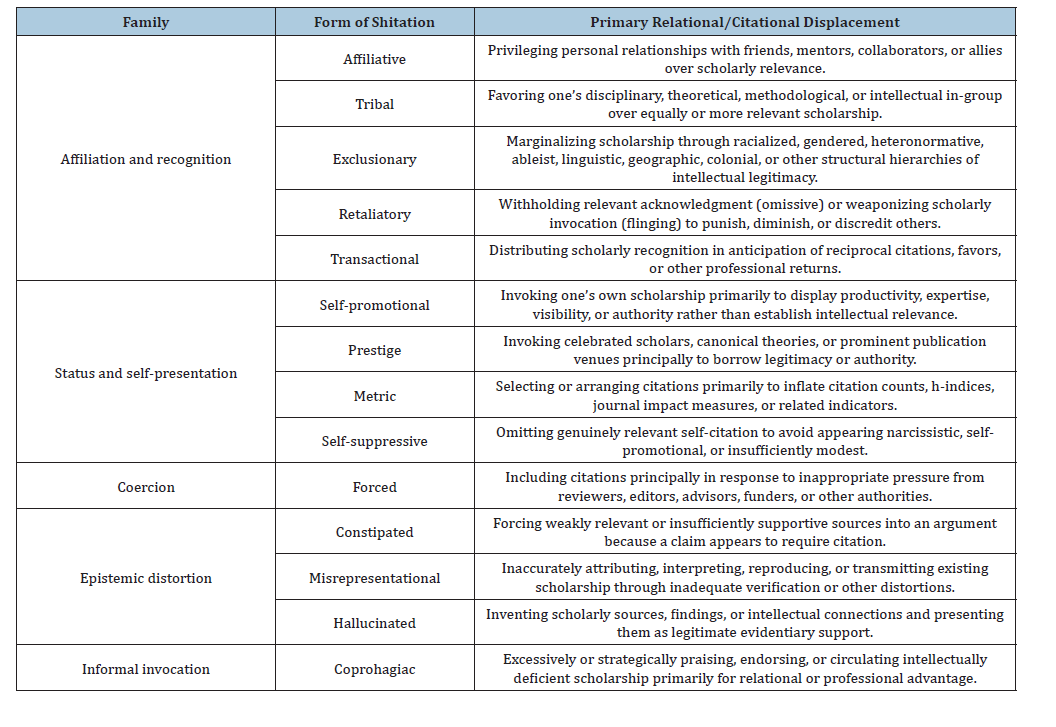
Taken together, these forms suggest that shitation is less a catalogue of citation sins than a vocabulary for examining how scholarly relationships are constituted through recognition, omission, attribution, and invocation. Some shitation rewards people; some punishes them. Some makes us look important. Some protects us from looking too important. Some reproduces structural exclusion or accommodates authority. Some reflects carelessness toward readers; some manufactures intellectual evidence altogether. These practices can overlap, as Table 1 summarizes, because a single citation can perform multiple forms of relational work. And although the resulting reference lists may look remarkably similar, the communicative processes that produced them can be worlds apart.
Table 1:An emerging typology of shitation practices.
Conclusion: Toward a Less Shitty Academy
A less shitty academy would not require citation to become apolitical, impersonal, or free of self-interest. That possibility is neither realistic nor especially desirable. Citation inevitably distributes recognition, communicates affiliation, and helps constitute the relationships and identities through which academic life operates. What a relational-identity perspective adds is an account of how these processes happen: through cultural expectations about scholarly legitimacy, cognitive judgments about whose work matters, and communicative acts that recognize, overlook, elevate, or diminish others. Shitation names the moments when these relational processes displace, distort, or neglect intellectual responsibility. The problem is not that scholars have relationships. It is what sometimes happens when those relationships take control of the bibliography. Consider, once more, the Preface. Its excessive self-citation might have suggested productivity, authority, narcissism, insecurity, White male entitlement, or simply an author who badly needed an editor. Yet those interpretations reveal as much about readers’ cultural expectations and relational judgments as they do about the citations themselves. The author may intend one thing while readers receive something altogether different. Even a strategically ridiculous Preface cannot control the relationships and identities its citations invite readers to imagine. That is precisely the point: citation does not merely document intellectual relationships; it participates in constituting them, sometimes in ways no one anticipated. What would happen if we treated citation less as a reward to distribute and more as an account of how our thinking came to be? Would we still withhold relevant scholarship because its author irritated us? Suppress our own work to perform modesty? Invoke the Famous Scholar™ to borrow intellectual legitimacy? Continue reproducing racialized, gendered, geographic, or disciplinary hierarchies because familiar scholarship feels authoritative? And would we cite differently if we imagined an actual reader trying to follow our intellectual digestion rather than an abstract audience expected to swallow whatever we serve? These questions point toward relational accountability: responsibility to the scholars whose contributions make ours possible, to readers who trust us to represent those contributions accurately, and to the scholarly communities our accumulated citation practices help create. Relational accountability does not demand the absence of affection, ambition, resentment, or uncertainty. It asks that we recognize those influences without allowing them to override the intellectual obligations of citation. None of this serves as the magical toilet paper that promises clean tushies. Scholars will continue to cite imperfectly, strategically, emotionally, and sometimes badly. Indeed, a completely sanitized bibliography might conceal as much shitation as it prevents. The goal is not an academic digestive system that never produces waste, but one more attentive to what it consumes, what it absorbs, what it circulates, and what it leaves for others to clean up. We will never eliminate shit from academic life. We might, however, become more thoughtful about where we put it.
Acknowledgement
None declared.
Conflict of Interest
The author declares no financial conflict of interest related to this manuscript.
References
- Adler RB, Proctor II RF, Manning J (2023) Looking out, looking in (16th edn), Cengage, USA.
- Johnson R, Manning J (2015) Mad Men in the classroom: A collection of classroom-tested teaching tools. In: Dunn JC, Manning J, Stern DM (Eds.), Lucky Strikes and a three martini lunch: Thinking about television’s Mad Men, Cambridge Scholars Publishing, UK, (2nd edn), pp. 302-346.
- Manning J (2008) I never would have slept with George! Symbolic boasting and Grey’s Anatomy. In: Burkhead C, Robson H (Eds.), Grace under pressure: Grey’s Anatomy uncovered. Cambridge Scholars Publishing, UK, pp. 130-145.
- Manning J (2010) But Luke and Lorelai belong together! Relationships, social control, and Gilmore Girls. In: Diffrient DS, Lavery D (Eds.), Screwball television: Critical perspectives on Gilmore Girls. Syracuse University Press, USA, pp. 302-320.
- Manning J (2012) Finding yourself in Mad Men. In: Stern DM, Manning J, Dunn JC (Eds.), Lucky Strikes and a three martini lunch: Thinking about television’s Mad Men. Cambridge Scholars Publishing, UK, pp. 89-96.
- Manning J (2014) A constitutive approach to interpersonal communication studies. Communication Studies 65(4): 432-440.
- Manning J (2015) Ipsedixitism, ipseity, and ipsilateral identity: The fear of finding ourselves in the fissures between phishing and Catfish. In: Herbig A, Herrmann A, Tyma A (Eds.), Beyond new media: Discourse and critique in a polymediated age. Lexington Books, USA, pp. 83-107.
- Manning J (2020) Communication is the relationship. In: Tyma A, Edwards A (Eds.), Communication is perspectives on theory. Cognella, USA, pp. 33-48.
- Manning J, Denker KJ (2021) Beyond the hammer: A critical turn for interpersonal and family communication studies. Review of Communication 21(3): 177-186.
- Manning J, Dunn JC (2018) Rachel Dolezal, transracialism, and the Hypatia controversy: Difficult conversations and the need for transgressing feminist discourses. In: Dunn JC, Manning J (Eds.), Transgressing feminist theory and discourse: Advancing conversations across disciplines. Routledge, UK, pp. 3-15.
- Manning J, Lambert South AN (2018) Family favoritism: Defining a communication-oriented construct. Qualitative Research Reports in Communication 19(1): 18-24.
- Noland CM, Manning J, MacLennan J (2010) Case studies of communication about sex. Cambridge Scholars Publishing, UK.
- Peck B, Manning J, Tri A, Skrzypczynski D, Summers M, et al. (2016) What do people mean when they say they “had sex”? Connecting communication and behavior. In: Manning J, Noland CM (Eds.), Contemporary studies of sexuality & communication: Theoretical and applied perspectives. Kendall Hunt, USA, pp. 3-13.
- Rossetto KR, Manning J, Green EW (2017) Perceptions of paternal support after transitioning to college: Interpretations based on the generative fathering framework. Western Journal of Communication 81(4): 405-425.
- Bloedel A, Manning J (2017) Exploring polyamory online: Ethics, relationships, and understanding. In: Nixon PG, Düsterhöft I (Eds.), Sex in the digital age. Routledge, UK, pp. 158-167.
- Center D, Manning J, Fette E, Graham C, Isaacs S, et al. (2010) The birthday spankings: Seven stories of sexual harassment. In: Noland CM, Manning J, MacLennan J (Eds.), Case studies of communication about sex. Cambridge Scholars Publishing, UK, pp. 180-188.
- Cooke-Jackson A, Rubinsky V, Gunning JN, Gerlikovski E, Holman A, et al. (2024) Elaborating on ‘the talk’ in ‘sex talks’: An interdisciplinary exploration of the place of communication science in sexuality education and advocacy. American Journal of Sexuality Education 19(4): 453-471.
- Emerson T, Manning J (2016) Sexuality in the workplace: Understanding policies about sexual harassment and consenting relationships. In: Manning J, Noland CM (Eds.), Contemporary studies of sexuality & communication: Theoretical and applied perspectives. Kendall Hunt, USA, pp. 321-338.
- Jozkowski KN, Manning J, Hunt M (2018) Sexual consent in and out of the bedroom: Disjunctive views of heterosexual college students. Women’s Studies in Communication 41(2): 117-139.
- Keyton J, Clair R, Compton CA, Dougherty DS, Forbes Berthoud D, et al. (2018) Addressing sexual harassment in a sexually charged national culture: A Journal of Applied Communication Research forum. Journal of Applied Communication Research 46(6): 665-683.
- Manning J (2009) Because the personal is the political: Politics and unpacking the rhetoric of (queer) relationships. In: Drushel B, German K (Eds.), Queer identities/political realities. Cambridge Scholars Publishing, UK, 1-8
- Manning J (2011) Masculinities in dating relationships: Reality and representation at the intersection of race, class, and sexual orientation. In: Watson E, Shaw ME (Eds.), Performing American masculinities: The 21st century man in popular culture. Indiana University Press, USA, pp. 167-191.
- Manning J (2013) Interpretive theorizing in the seductive world of sexuality and interpersonal communication: Getting guerilla with studies of sexting and purity rings. International Journal of Communication 7: 2507-2520.
- Manning J (2014) Coming out conversations and gay/bisexual men’s sexual health: A constitutive model study. In: Harvey VL, Housel TH (Eds.), Health care disparities and the LGBT population, Lexington Books, USA, pp. 27-54.
- Manning J (2014) Communication and healthy sexual practices: Toward a holistic communicology of sexuality. In: Eaves MH (Ed.), Applications in health communication: Emerging trends, Kendall Hunt, USA, pp. 263-286.
- Manning J (2014) Exploring family discourses about purity pledges: Connecting relationships and popular culture. Qualitative Research Reports in Communication 15(1): 92-99.
- Manning J (2015) Communicating sexual identities: A typology of coming out. Sexuality & Culture 19(1): 122-138.
- Manning J (2015) Families living in closets: Talking about alcoholism in and out of family households. In Brann M (Ed.), Contemporary case studies in health communication (2nd edn), Kendall Hunt, USA, pp. 161-173.
- Manning J (2015) Paradoxes of (im)purity: Affirming heteronormativity and queering heterosexuality in family discourses of purity pledges. Women’s Studies in Communication 38(1): 99-117.
- Manning J (2015) Positive and negative communicative behaviors in coming-out conversations. J Homosex 62(1): 67-97.
- Manning J (2016) A constitutive model of coming out. In Manning J, Noland CM (Eds.), Contemporary studies of sexuality & communication: Theoretical and applied perspectives, Kendall Hunt, USA, pp. 93-108.
- Manning J (2017) Examining health and relationship beliefs in family discourses about purity pledges: Gender, faith values, and the communicative constitution of reality. Western Journal of Communication 81(1): 87-104.
- Manning J (2017) Queer methods. In: Allen M (Ed.), The SAGE encyclopedia of communication research methods, pp. 1389-1396)
- Manning J (2019) Thinking about interpersonal relationships and social penetration theory: Is it the same for lesbian, gay, or bisexual people? In: Liberman CJ, Rancer AS, Avtgis TA (Eds.), Casing communication theory, Kendall Hunt, USA, pp. 293-306.
- Manning J (2020) Queering family communication. In: Soliz J, Warner Colaner C (Eds.), Navigating relationships in the modern family: Communication, identity, and difference, Peter Lang, Switzerland, pp. 69-95.
- Manning J (2021) Communication studies about sex: Implications for relationships, health, culture, and identity: A review. Information professional 30(1): e300114.
- Manning J (2021) Continuing the conversation: Additional directions for interpersonal sexual communication. In: Coffelt TA (Ed.), Interpersonal sexual communication across the lifespan, Peter Lang, Switzerland, pp. 185-195.
- Manning J (2021) Intimate conversations about sex and sexuality: Lessons learned from studying purity pledges. In: Cooke-Jackson A, Rubinsky V (Eds.), Communicating intimate health, Lexington Books, USA, pp. 51-62.
- Manning J (2021) Purity pledges. In: Armstrong HL (Ed.), Encyclopedia of sex and sexuality: Understanding biology, psychology, and culture, ABC-CLIO, USA, pp. 560-562.
- Manning J (2021) Queer. In: Armstrong HL (Ed.), Encyclopedia of sex and sexuality: Understanding biology, psychology, and culture. ABC-CLIO, USA, pp. 563-564.
- Manning J (2025) Queer studies. In: Nai A, Grömping M, Wirz D (Eds.), Elgar encyclopedia of political communication. Edward Elgar Publishing, UK 3: 397-401.
- Manning J (2025) Queer theory. In: Roberts LK (Ed.), The SAGE international encyclopedia of politics and gender. Sage.
- Manning J (2026) Unspecified sexual dysfunction in the Diagnostic and Statistical Manual of Mental Disorders, Fifth Edition, Text Revision-Diagnostic classification, systemic assessment, and clinical intervention. Psychiatry International 7(5): 192.
- Manning J (2027) Queer theory: Challenging heteronormative expectations of family. In: Suter EA, Floyd K, Hintz EA, Braithwaite DO (Eds.), Engaging theories in family communication: Multiple perspectives (3rd edn), Routledge, UK, pp. 277-290.
- Manning J, Adams TE (2022) Queer theory: Troubling interpersonal expectations of sex, gender, and sexuality. In: Braithwaite DO, Schrodt P (Eds.), Engaging theories in interpersonal communication: Multiple perspectives (3rd edn), pp. 284-295.
- Manning J, Stern DM (2018) Heteronormative bodies, queer futures: Toward a theory of interpersonal panopticism. Information, Communication & Society 21(2): 208-223.
- Manning J, Adams TE, Atay A (2020) Gay, Grey, gray, and play: Fifty shades queer. In: Kratzer JMW (Ed.), Communication in kink: Understanding the influence of the Fifty Shades of Grey phenomenon, Lexington Books, USA, pp. 217-228.
- Manning J, Asante G, Huerta Moreno L, Johnson R, LeMaster B, et al. (2020) Queering communication studies: A Journal of Applied Communication Research forum. Journal of Applied Communication Research 48(4): 413-437.
- Denker KJ, Manning J, Heuett KB, Summers ME (2018) Twitter in the classroom: Modeling online communication attitudes and student motivations to connect. Computers in Human Behavior 79: 1-8.
- Manning J (2014) Construction of values in online and offline dating discourses: Comparing presentational and articulated rhetorics of relationship seeking. Journal of Computer-Mediated Communication 19(3): 309-324.
- Manning J (2014) Social media, definition and classes of. In: Harvey K (Ed.), Encyclopedia of social media and politics, pp. 1158-1162.
- Manning J (2016) Social media. In: Nash JC (Ed.), Macmillan interdisciplinary handbook: Love. Macmillan Reference, pp. 271-287.
- Manning J (2026) Constitutive artificial intelligence identity theory: How generative artificial intelligence shapes, creates, and performs the relational self. Journal of Autoethnography 7(3): 314-330.
- Manning J, Denker KJ, Johnson R (2019) Justifications for ghosting out of developing or ongoing romantic relationships: Anxieties regarding digitally-mediated romantic interaction. In: Hetsroni A, Tuncez M (Eds.), It happened on Tinder: Reflections and studies on internet-infused dating, Institute of Network Cultures, pp. 114-132.
- Manning J, Rahman MM, Oguejiofor N (2026) Mobile AI as relational infrastructure: Translating meaning and belonging in international student onboarding. AI in Education 2(2): 10.
- Adams TE, Manning J (2015) Autoethnography and family research. Journal of Family Theory & Review 7(4): 350-366.
- Manning J (2010) There is no agony like bearing an untold story inside you: Communication research as interventive practice. Communication Monographs 77(4): 437-439.
- Manning J (2016) Rethinking studies of relationships and popular culture: Notes on approach, method, and (meta)theory. In: Herrmann A, Herbig A (Eds.), Communication perspectives on popular culture, Lexington Books, USA, pp. 153-165.
- Manning J (2018) Making the most of our conferences and associations: An important component for communication research, teaching, and service. Communication Studies 69(5): 605-616.
- Manning J (2019) Academic blogs. In: Leavy P (Ed.), The Oxford handbook of methods for public scholarship, Oxford University Press, UK, pp. 572-602.
- Manning J (2026) Doing qualitative workplace relationship research: Current trends, new directions, and quality indicators. Behavioral Sciences 16(3): 394.
- Manning J, Adams TE (2015) Popular culture studies and autoethnography: An essay on method. The Popular Culture Studies Journal 3: 187-221.
- Manning J, Denker KJ (2015) Doing feminist interpersonal relationship research: A call for action, two methodological approaches, and theoretical potentials. Women & Language 38(1): 133-142.
- Manning J, Kunkel A (2014) Making meaning of meaning-making research: Using qualitative research for studies of social and personal relationships. Journal of Social and Personal Relationships 31(4): 433-441.
- Manning J, Kunkel A (2014) Researching interpersonal relationships: Qualitative methods, studies, and analysis. Sage.
- Manning J, Kunkel A (2015) Qualitative approaches to dyadic data analyses in family communication research: An invited essay. Journal of Family Communication 15(3): 185-192.
- Manning J, McNally J, Verst S (2007) Questioning the self, questioning others, questioning relationships: A qualitative inquiry into the pedagogical value of Judy Blume. MP: An Online Feminist Journal 1(6): 7-15.
- Moore J, Manning J (2019) What counts as critical interpersonal and family communication research? A review of an emerging field of inquiry. Annals of the International Communication Association 43(1): 40-57.
- Allen J, Denker KJ, Manning J (2023) Family communication as choice: Thinking about and theorizing family. In: Manning J, Allen J, Denker KJ (Eds.), Family communication as. Exploring metaphors for family communication, pp. 1-10.
- Denker KJ, Manning J (2023) Foreword. In: Symonds-LeBlanc S, O’Shay S (Eds.), Casing the family: Theoretical and applied approaches to understanding family communication (2nd edn), Kendall Hunt, USA, pp. 1-4.
- Dunn JC, Manning, J, Stern DM (2012) Introduction. In: Stern DM, Manning J, Dunn JC (Eds.), Lucky Strikes and a three martini lunch: Thinking about television’s Mad Men. Cambridge Scholars Publishing, UK, pp. 1-11.
- Houston R, Manning J (2015) The movement to engaged scholarship. Women & Language 38(1): 7-10.
- MacLennan J, Manning J, Noland CM (2010) Introduction. In: Noland CM, Manning J, MacLennan J (Eds.), Case studies of communication about sex. Cambridge Scholars Publishing, UK, pp.11-21.
- Manning J (2009) Introduction: The future of relationships. Kentucky Journal of Communication 28(2): 7-8.
- Manning J (2022) Foreword: A critical need for critical case studies in interpersonal communication pedagogy. In: Faulkner SL (Ed.), Inside relationships: Critical creative case studies in interpersonal communication (2nd edn), Routledge, UK, pp. 12-16.
- Hyland K, Jiang F (2019) Points of reference: Changing patterns of academic citation. Applied Linguistics 40(1): 64-85.
- Plevris V (2025) From integrity to inflation: Ethical and unethical citation practices in academic publishing. Journal of Academic Ethics 23(4): 1847-1877.
- Chakravartty P, Kuo R, Grubbs V, McIlwain C (2018) Communication so white. Journal of Communication 68(2): 254-266.
- Dion ML, Sumner JL, Mitchell SM (2018) Gendered citation patterns across political science and social science methodology fields. Political Analysis 26(3): 312-327.
- Hyland K (1999) Academic attribution: Citation and the construction of disciplinary knowledge. Applied Linguistics 20(3): 341-367.
- Mott C, Cockayne D (2017) Citation matters: Mobilizing the politics of citation toward a practice of conscientious engagement. Gender, Place & Culture 24(7): 954-973.
- Burleson BR (2010) The nature of interpersonal communication: A message-centered approach. In: Berger CR, Roloff ME, Roskos-Ewoldsen DR (Eds.), The handbook of communication science (2nd edn), SAGE Publications, pp. 145-163.
- Gunn J (2006) ShitText: Toward a new coprophilic style. Text and Performance Quarterly 26(1): 79-97.
- Kim AL (2020) The politics of citation. Diacritics 48(3): 4-9.
- Hyland K, Jiang F (2018) Changing patterns of self-citation: Cumulative inquiry or self-promotion? Text & Talk 38(3): 365-387.
- Ioannidis JPA (2015) A generalized view of self-citation: Direct, co-author, collaborative, and coercive induced self-citation. Journal of Psychosomatic Research 78(1): 7-11.
- Szomszor M, Pendlebury DA, Adams J (2020) How much is too much? The difference between research influence and self-citation excess. Scientometrics 123(2): 1119-1147.
- Duck S (2026) Reimagining relationships. Edward Elgar Publishing, UK.
- International Committee of Medical Journal Editors (2026) Recommendations for the conduct, reporting, editing, and publication of scholarly work in medical journals.
- COPE Council (2019) COPE discussion document: Citation manipulation. Committee on Publication Ethics.
- Hussain I (2023) Gastrology: A review of digestive health, disorders, and advances in gastrointestinal medicine. ISAR Journal of Medical and Pharmaceutical Sciences 1(3): 20-21.
- Śródka A (2003) The short history of gastroenterology. Journal of Physiology and Pharmacology 54(Suppl 3): 9-21.
- Agarwal A, Arafa M, Avidor-Reiss T, Hamoda TAAAM, Shah R (2023) Citation errors in scientific research and publications: Causes, consequences, and remedies. The World Journal of Men’s Health 41(3): 461-465.
- Subramanian P, Soundararajan R, Makol J (2025) Building credibility with comprehensive citation practices. Indian J Radiol Imaging 35(Suppl 1): S95-S101.
- Sakai Y, Kamigaito H, Watanabe T (2026) Hallu Citation matters: Revealing the impact of hallucinated references with 300 hallucinated papers in ACL conferences. In: Liakata M, Moreira VP, Zhang J, Jurgens D (Eds.), Proceedings of the 64th Annual Meeting of the Association for Computational Linguistics. Association for Computational Linguistics 1: 47295-47376.
© 2026 Jimmie Manning, This is an open access article distributed under the terms of the Creative Commons Attribution License , which permits unrestricted use, distribution, and build upon your work non-commercially.
Editor In Chief







.jpg)






























Signup for Newsletter

Quick Links
 Editorial Board Registrations
 Submit your Article
 Best Paper of the Volume
 Reprints
 Refer a Friend
 Advertise With Us
Our Recent Edition




Top Editors




.jpg)

















.bmp)
.jpg)
.png)
.jpg)













.jpg)






.png)

.png)




.png)




Financial Support

Sponsors

Latest e-Books

Latest Video

 a Creative Commons Attribution 4.0 International License. Based on a work at www.crimsonpublishers.com.
Best viewed in

 | Above IE 9.0 version