

- About Us
- Information
-

The Author ensures that the research has been conducted responsibly and ethically with adherence to all relevant regulations. read more..
- For Authors
- For Reviewer
- Manuscript Guidelines
- Membership
- Publication Ethics
-
- Journals
- Reprints
- e-Books
- Videos
- Policies
- Contact Us
 COVID-19
- Submissions



Full Text
Gastroenterology Medicine & Research
Traditional Chinese Medicine Therapeutic Strategies for Helicobacter pylori Associated Gastric Diseases: A Mini Review
Yuping Xu², Yuzhe Mao², Yajie Yin², Jiaju Shao¹, Zhibiao Li², Rong Deng², Dedong Zeng¹*, YuanYuan Qu², Chaozhen Wang¹, Mingfeng Xie¹ and Qian Liu¹
¹Institute of Integrated Chinese and Western Medicine for Children’s Health & Drug Innovation, College of Integrated Traditional Chinese and Western Medicine, Jiangxi University of Chinese Medicine, Nanchang 330004, China
²College of Pharmacy, Jiangxi University of Chinese Medicine, Nanchang, 330006, China
*Corresponding author:Dedong Zeng, Institute of Integrated Chinese and Western Medicine for Children’s Health & Drug Innovation, College of Integrated Traditional Chinese and Western Medicine, Jiangxi University of Chinese Medicine, Nanchang 330004, China
Submission:November 04, 2026;Published: November 12, 2026
ISSN 2637-7632Volume8 Issue3
Abstract
Helicobacter pylori (H. pylori), a class-I carcinogen, induces the Correa cascade towards gastric carcinoma and infects over half the global population. Standard bismuthquadruple therapy faces challenges of antibiotic resistance, microbiota disturbance, sideeffects and high recurrence. TCM exerts multitarget effects including bacteriostasis, biofilm suppression, mucosal protection, microecology and inflammation regulation. This review summarizes TCM syndrome differentiation, formulas, active components and limitations. It highlights interactions between H. pylori, gastric dysbiosis and carcinogenesis, and prospects integrated therapy and nanodelivery for drugresistant H. pylori.
Keywords: Helicobacter pylori; Traditional Chinese medicine; Active herbal ingredients; Anti inflammation; Gastric mucosal protection
Introduction
Helicobacter pylori, a Gramnegative microaerophilic bacterium, colonises human gastric mucosa and acts as the initiating driver of the Correa pathological cascade toward gastric cancer [1,2]. More than 90 % of gastric carcinoma cases are associated with H. pylori infection, yet only 13 % of infected individuals develop malignant transformation, which implies that additional hostmicroecological cofactors participate in disease progression [3,4]. With disease aggravation from gastritis to intestinal metaplasia and gastric cancer [5], gastric acid secretion declines [6] and intragastric pH rises [7-10]. Such microenvironmental shifts reshape gastric microbiota composition: gastric microbial αdiversity increases significantly in gastric carcinoma tissues, while the dominating status of H. pylori weakens at the cancer stage, and opportunistic pathogens such as Fusobacterium, Prevotella, Veillonella proliferate abundantly [11-14]. Disturbed gastric microbiota further promotes carcinogenesis via altered metabolite profiles including nitrosamine compounds and shortchain fatty acids. Clinically, bismuth quadruple therapy combining two antibiotics, protonpump inhibitor and bismuth agent serves as standard eradication treatment [15-18]. Nevertheless, widespread antibiotic application gives rise to drugresistant H. pylori strains, damages commensal intestinal flora and causes adverse symptoms such as diarrhoea and bloating, and posttreatment relapse remains a clinical obstacle [19-22]. Therefore, exploring safe, multimodal alternative therapies is urgently required. Traditional Chinese medicine treats H. pyloriassociated gastropathy under the pattern of “gastric stuffiness” and “epigastric pain” [23-27]. TCM therapies follow syndromedifferentiated treatment principles, exhibiting comprehensive advantages: inhibiting H. pylori viability, dismantling bacterial biofilms, repairing damaged gastric mucosa, regulating inflammatory cascades and remodelling gastric microecology. Classical formulas such as Banxia Xiexin Decoction have long been applied clinically for H. pylorirelated chronic gastritis [28-32]. This review focuses on syndrome classification, commonlyused prescriptions, bioactive constituents, pharmacological mechanisms, research bottlenecks and future directions of TCM against H. pylorirelated gastric diseases.
Characteristics of H. pylori Associated Gastric Diseases in TCM
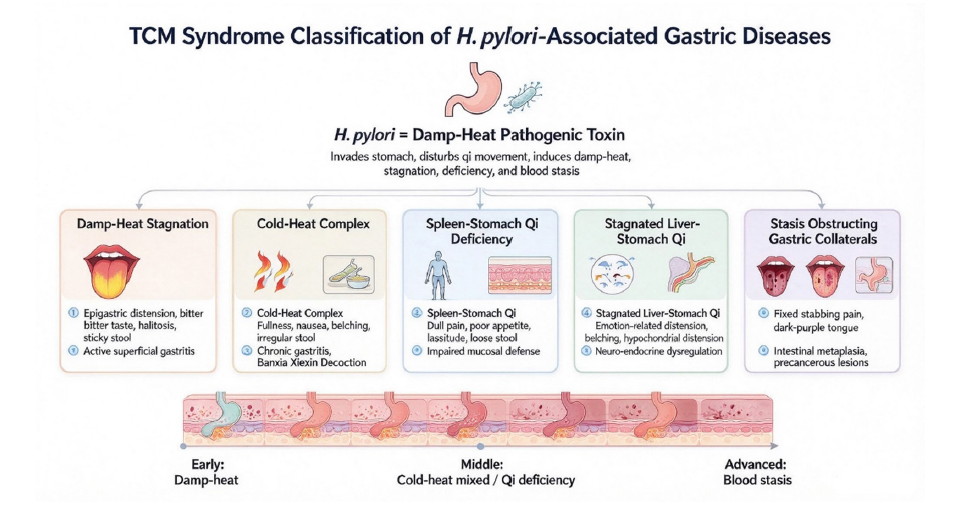
H. pylori is interpreted as “dampheat pathogenic toxin” in TCM theory [33]. Pathogenic toxin invades the stomach, damages spleenstomach qi movement, induces stagnation, dampnessheat accumulation, blood stasis and deficiency syndromes [34]. The main clinical TCM patterns are summarised in Figure 1.
Figure 1:TCM syndrome classification of H. pylori-associated gastric diseases and their correlation with pathological progression.
Dampheat stagnation in spleenstomach
Epigastric distending pain, bitter taste in mouth, halitosis, sticky stool, red tongue with yellowgreasy coating. This pattern corresponds to active H. pyloripositive superficial gastritis with obvious local inflammatory response [35].
Coldheat complex intermingling
Alternating coldheat manifestations, epigastric fullness and stuffiness, nausea, belching, loose stool or constipation. It is the representative syndrome treated by Banxia Xiexin Decoction, frequently observed in H. pyloripositive chronic gastritis [36-39].
Spleenstomach qi deficiency
Dull epigastric ache, poor appetite, lassitude, loose stool, pale tongue with thinwhite coating, reflecting longterm infectioninduced mucosal injury and declining defensive capability [40,41].
Stagnated liverstomach qi
Epigastric distending pain fluctuating with emotional changes, frequent belching, distending hypochondrium, closely related to neuroendocrine dysregulation under chronic H. pyloritriggered inflammation [42].
Stasis obstructing gastric collaterals
Fixed stabbing epigastric pain, darkpurple tongue with ecchymosis, mostly seen in advanced lesions including intestinal metaplasia and precancerous gastric mucosal changes [43]. Syndrome distribution is tightly linked with pathological severity: dampheat pattern dominates at earlystage gastritis; coldheat mixed and qideficiency patterns increase during disease progression; bloodstasis pattern prevails in precancerous and cancerous gastric mucosal lesions.
Classical TCM Prescriptions for Anti H. pylori Therapy
Banxia Xiexin decoction
Banxia Xiexin Decoction originates from Treatise on Febrile Diseases, composed of Pinelliae Rhizoma, Scutellariae Radix, Coptidis Rhizoma, Zingiberis Rhizoma, Ginseng Radix, Glycyrrhizae Radix et Rhizoma Praeparata cum Melle, Jujubae Fructus. The formula harmonises cold and heat, dissipates focal distention. Modern researches demonstrate that it can suppress H. pylori urease activity, disrupt biofilm formation, inhibit PI3K/Akt/NFκB inflammatory signalling pathway, lower proinflammatory factors TNFα, IL6, IL1β and ameliorate gastric mucosal erosion. It achieves dual effects of eliminating pathogenic bacteria and protecting gastric epithelium. Currently multiple studies explore nanoselfassembly modification strategies for Banxia Xiexin Decoction active components to improve gastric stability and bioavailability [44-48].
Qingwei San
Qingwei San clears stomach heat and cools blood, mainly applicable for dampheat accumulation pattern H. pyloripositive gastritis. Coptidis Rhizoma and Rehmanniae Radix in the formula exert direct bacteriostatic effects on H. pylori, relieve gastric mucosal congestion and inflammatory infiltration [49].
Sijunzi decoction combined with heatclearing herbs
Sijunzi Decoction tonifies spleenstomach qi. Combined with heatdetoxifying herbs (Coptidis Rhizoma, Scutellariae Radix, Forsythiae Fructus), it treats spleendeficiency complicated with damptoxin pattern. It does not produce strong direct bactericidal action, but enhances host mucosal immune defence function, improves gastric microenvironment and indirectly inhibits the colonisation of H. pylori and conditional pathogenic bacteria [50- 52].
Modified Chaihu-Shugan-San
Chaihu-Shugan-San soothes liver and regulates stomach qi, suitable for liverstomach qistagnation subtype H. pyloriassociated functional dyspepsia. It mitigates neuroinflammatory response caused by H. pylori infection and improves clinical subjective symptoms [53-55].
Bioactive Herbal Ingredients Against H. pylori and Pharmacological Mechanism
Alkaloids
Berberine extracted from Coptidis Rhizoma: one of the mostinvestigated antiH. pylori natural compounds. It inhibits bacterial urease, damages membrane integrity, suppresses virulence factors such as CagA and VacA. Berberine also modulates gastric and intestinal microbiota, elevates beneficial bacteria abundance and downregulates inflammatory signal transduction. It has been reported to exhibit efficacy against partial antibioticresistant H. pylori strains [56-58].
Flavonoids
Baicalin from Scutellariae Radix: inhibits H. pylori adhesion to gastric epithelial cells, interferes with biofilm maturation, blocks NFκBmediated inflammatory cascade and reduces oxidative stress injury of GES1 gastric epithelial cells. Glycyrrhizic acid from Glycyrrhizae Radix et Rhizoma protects gastric mucosal barrier by elevating mucosal prostaglandin levels, cooperating with other components to counteract H. pyloriinduced damage [59,60].
Other active substances
Volatile oil from Zingiberis Rhizoma: Inhibits H. pylori proliferation and alleviates mucosal inflammatory oedema. Polysaccharides from Jujubae Fructus enhance mucosal immune response. Multiple components often generate synergistic effects within compound prescriptions.
The multitarget characteristics distinguish herbal agents from singletarget antibiotics: TCM components not only act directly on pathogens, but also remodel host microenvironment, restrain the overgrowth of conditional pathogenic bacteria such as Fusobacterium, Prevotella which expand when H. pylori gradually decrease in advanced gastric lesions [61,62].
Modern Progress of TCM Intervening Gastric Microecology under H. pylori Infection
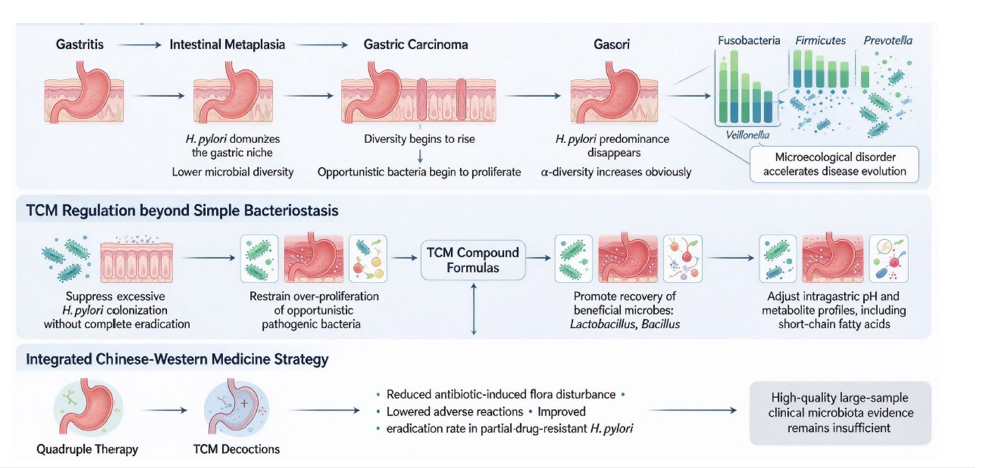
According to 16S rRNA sequencingbased gastric microbiota researches, as gastritis advances to gastric cancer, gastric microbial community undergoes profound reconstruction: αdiversity rises obviously; Fusobacteria, Firmicutes and related genera including Lactobacillus, Prevotella, Veillonella are significantly enriched; Bacillus beneficial genus declines. H. pylori dominate gastric niche at gastritis and intestinal metaplasia phases and lower overall microbial diversity, whereas its predominance disappears in gastric carcinoma tissues. Such microecological disorder further accelerates disease evolution. Traditional Chinese medicine, especially compound formulas, exhibits microecological regulatory effects that go beyond simple bacteriostasis. These effects include suppressing excessive colonization of H. pylori without complete eradication, restraining the over proliferation of gastric opportunistic pathogens, facilitating the recovery of beneficial microbes such as Lactobacillus and Bacillus, and modulating intragastric pH as well as metabolite profiles including short-chain fatty acids [63,64] (Figure 2). Remarkably, integrated Chinesewestern medicine mode combines quadruple therapy with TCM decoctions: TCM mitigates antibioticcaused flora disturbance, lowers adverse reaction incidence and improves eradication rate for partial drugresistant H. pylori. Nevertheless, highquality largesample clinical microbiota evidence remains insufficient.
Figure 2:Modern research progress of TCM intervening gastric microecology under H. pylori infection.
Limitations and Existing Challenges
Notably, several limitations remain in current related investigations. First, the standardisation of TCM syndrome differentiation is insufficient: TCM pattern classification is short of unified objective biomarkers, and the majority of clinical studies are single-centre trials with small sample sizes. Only a handful of studies have established associations between TCM syndromes and gastric microbiota signatures under H. pylori infection. Second, the complex chemical composition of compound prescriptions impedes mechanistic elucidation. These formulas contain hundreds of constituents, making it challenging to dissect the individual contributions of each component to anti-H. pylori, anti-inflammatory and microecology-modulating effects, and most mechanistic explorations are still limited to cellular and animal models. Third, herbal active ingredients face unsatisfactory delivery performance. Many bioactive compounds including baicalin and berberine exhibit poor water solubility, susceptibility to gastric acid degradation, low local gastric retention and inadequate bioavailability, thereby constraining them in vivo therapeutic efficacy. Meanwhile, emerging nanocarrier and self-assembly strategies are still restricted to laboratory research. Finally, long-term cohort observations are lacking. Existing studies predominantly concentrate on short-term H. pylori eradication rates and symptomatic remission, while longterm follow-up data regarding the reversal of precancerous lesions, dynamic shifts of gastric microbiota and gastric cancer preventive effects remain scarce [65,66].
Conclusion
H. pylori-associated gastric disease represents a multifactorial pathological process that integrates pathogenic factors, host inflammatory responses and gastric microecological dysbiosis. Traditional Chinese medicine possesses distinctive advantages in bacteriostasis, mucosal repair and microecological regulation, which can offset the limitations of antibiotic-based quadruple therapy, particularly for drug-resistant H. pylori infection and persistent symptoms after eradication. Accordingly, several directions are recommended for future research: to launch multicentre clinical trials for exploring the correlations between TCM syndromes, gastric microbiota and metabolites and developing objective biomarkers for pattern differentiation; to decipher the synergistic mechanisms of TCM compound formulas using multi-omics, network pharmacology and molecular biology approaches; to design innovative herbal delivery systems (e.g., ion-driven self-assembled nanoparticles and mucoadhesive formulations) for improving the local gastric stability and bioavailability of active constituents; and to advance rational integrated Chinese and Western medicine strategies by investigating optimal administration sequences and dosing regimens, alongside long-term cohort studies to assess the capacity of TCM to reverse precancerous gastric mucosal lesions and prevent gastric carcinogenesis.
Sources of Funding
This work was supported by the Doctoral Startup Fund (No. 2024BSZR035), the Science and Technology Research Project of Jiangxi Provincial Department of Education (NO. GJJ2400825), the Science and Technology Project of Jiangxi Provincial Administration of Traditional Chinese Medicine (NO. 2024B0030).
Conflict of Interest
The authors have declared that no competing interests exist.
References
- Wizenty J, Sigal M (2025) Helicobacter pylori, microbiota and gastric cancer-principles of microorganism-driven carcinogenesis. Nat Rev Gastroenterol Hepatol 22(5): 296-313.
- Ding T, Hu W, Qi X, Zhang Y, Wang H (2026) Advances in Helicobacter pylori-mediated oncogenic signaling pathways in gastric cancer: From pathological evolution to clinical application prospects (Review). Oncol Lett 32: 408.
- Zheng W, He X, Zheng J, Zhu Z, Diya Y, et al. (2026) Effects of Helicobacter pylori infection on gastric mucosal microbiota. World Journal of Pediatrics 22:492-500.
- Zhang Y, Cao R, Yu Q, Ma D, Zhang M, et al. (2026) Comprehensive bioinformatics analysis identifies KYNU as a novel helicobacter pylori-associated biomarker with prognostic and therapeutic potential in gastric cancer. Scientific Reports 16(1): 29576.
- Wang J, Meng W, Zhu J, Tao G, Xia Y, et al. (2026) Cuproplasia-associated LOXL2 cooperates with Helicobacter pylori infection to promote gastric cancer progression via the FAK/Src signaling axis. Journal of Gastrointestinal Onology 17: 4.
- Zhang X, Zhang X, Zeng Q, Guo P, Xu Y, et al. (2026) Patchouli alcohol suppresses Helicobacter pylori-associated gastric cancer by activating PXR to inhibit the Wnt/β-catenin pathway and EMT. Front Pharmacol 17: 1794025.
- Pan Z, Peng L, Ma J, Chen H, Da M, et al. (2026) The carcinogenic role of HMGB1 and NF‑κB in gastric adenocarcinoma. Digestive Diseases and Sciences 71(8): 3700-
- Alissa M (2026) Integrative analysis of Helicobacter pylori driven stomach adenocarcinoma reveals epigenetic deregulation, immune evasion and therapeutic resistance. Hereditas 163(1): 1
- Selvam S, Vairappan B (2026) Tight junction proteins: Gatekeepers turned facilitators in the pathogenesis of gastric adenocarcinoma. World J Gastrointest Oncol 18(1): 114040.
- Huang B, Tian C, Sui Y (2026) Malnutrition in MASLD-related hepatocellular carcinoma: Assessment limitations, multidimensional mechanisms, and microbiome-based interventions. Hepatoma Res 12(1): 114040.
- Peng X, Peng W, Zou Y, Li Z (2026) Cross-organ microbes modulate host upper gastrointestinal health and disease via the oral-gastric microbiome axis. Front Cell Infect Microbiol 16: 1941478.
- Daniela ZC, Jacqueline A, Jorge GP, Marcelo N, Claudio U, et al. (2026) Microbial dynamics in gastric cancer: Insights from full-length 16S rRNA nanopore sequencing in the MAGIC cohort. Front Microbiol 17: 1841026.
- Peng X, Peng W, Zou Y, Li Z (2026) Cross-organ microbes modulate host upper gastrointestinal health and disease via the oral-gastric microbiome axis. Front Cell Infect Microbiol 16: 1941478.
- Han Y, Li J, Zhou Y, Tuo L, Wang G, et al. (2026) Comparative effectiveness and safety of vonoprazan/amoxicillin based dual therapy versus quadruple therapy as second-line treatment for Helicobacter pylori Infection: A retrospective cohort study. Clin Exp Med 26(1): 119.
- Jacobs JA, Greene T, Vanneman ME, Kean J, Carter SJ, et al. (2026) Time to quadruple therapy after initial diagnosis of heart failure with reduced ejection fraction. JAMA Cardiol 11(6): 506-514.
- Gisbert JP, Parra P, Nyssen OP (2026) Review article: Classic bismuth quadruple therapy for helicobacter pylori infection-questions focused on clinical practice. Aliment Pharmacol Ther 63(5): 616-636.
- Paraskevaidis I, Tsougos E, Kourek C (2026) Quadruple therapy in heart failure: Why, when, and in whom? Curr Probl Cardiol 51(8): 103352.
- Hu Y, Zhang Z, Wang F, Zhuang K, Xu X, et al. (2025) Effects of amoxicillin dosage on cure rate, gut microbiota, and antibiotic resistome in vonoprazan and amoxicillin dual therapy for Helicobacter pylori: A multicentre, open-label, non-inferiority randomised controlled. Lancet Microbe 6(3): 100975.
- Gong H, Huang Y, Yang B, Song Z, Xu X, et al. (2026) Advances in research on the genotype-phenotype correspondence of antibiotic resistance in helicobacter pylori and its molecular mechanisms: A narrative review. Gastroenterology Research and Practice 26(1).
- Xue Y, Yan P, Gao C, Zhang Y, Shan D, et al. (2026) Exploration of the interaction between bismuth-containing quadruple anti-H pylori therapy and the gut microbiota. Microorganisms 14(8): 1749.
- Wu L, Chen X, Cui M, Yan S, Wei L, et al. (2026) Potential mechanisms of bifidobacterium-mediated synergistic antibiotic eradication of drug-resistant helicobacter pylori. Front Microbiol 17: 1911939.
- Wang J, Chen G, Zheng D, Ma C (2026) Efficacy and safety of adjunctive Chinese herbal decoction in treating Helicobacter pylori-positive chronic atrophic gastritis: A real-world retrospective study. Front Med 12: 1701915.
- Chen Z, Li J, Huang Z, Zhao G, Hou X, et al. (2026) Wuwei Huanglian Wan inhibits Helicobacter pylori and alleviates associated gastritis: Host metabolic remodeling and altered IL-6/STAT3 signaling. J Ethnopharmacol 374(Pt 1): 122141.
- Huh E, Ju IG, Kim SH, Kang M, Lee S, et al. (2026) Traditional herbal medicine Hyangsapyeongwi-san inhibits alcohol-induced gastric injury in mice by regulating NLRP3 inflammasome signaling. Journal of Ethnopharmacology 369: 121961.
- Ou L, Lu B, Feng Z, Chen H, Zou Y, et al. (2026) Terminalia chebula Retz. aqueous extract exerts anti-adhesive and anti-inflammatory effects against Helicobacter pylori: Insights from lysine metabolism remodeling and fecal metabolomics. Journal of Ethnopharmacology 373: 122318.
- Wang X, Jin D, Pan F, Gui Z (2026) Clinical observation of 52 Cases of Helicobacter pylori -positive chronic atrophic gastritis (spleen-stomach damp-heat syndrome) treated with acupuncture combined with Qinghua Tongjiang decoction. Acupuncture & Electro-Therapeutics Research: International Journal of Integrated Medicine.
- Gong J, Ding W, Xu G (2026) Efficacy of shugan hewei decoction in treating chronic atrophic gastritis and its influence on gastric mucosal pathology. Arab J Gastroenterol 27(2): 167-171.
- Wang H, Li N, Li Y, Huang B, Zhang Y, et al. (2025) Screening of traditional chinese medicine compounds identified the anti-Helicobacter pylori effects of alantolactone, decursin, and phillygenin. J Infect Dis 232(4): S397-S411.
- Yang L, Liu X, Zhu J, Zhang X, Li Y, et al. (2023) Progress in traditional Chinese medicine against chronic gastritis: From chronic non-atrophic gastritis to gastric precancerous lesions. Heliyon 9(6): e16764.
- Li Y, Li X, Tan Z (2021) An overview of traditional Chinese medicine therapy for Helicobacter pylori-related gastritis. Helicobacter 26(3): e12799.
- Xiao M, Zhang L, Zhang B, Bian L, Li Z, et al. (2025) Comparative evaluation of the clinical efficacy of triple therapy and the addition use of TCM in treating Helicobacter pylori-associated gastritis. Journal of Herbal Medicine 52: 101034.
- Zhao M, Jiang Y, Chen Z, Fan Z, Jiang Y (2021) Traditional Chinese medicine for Helicobacter pylori infection: A protocol for a systematic review and meta-analysis. Medicine 100(3): e24282.
- Mergener K, Schoepprier HL, Flaherty M, Klatt G (2006) Pigbel of the stomach - A rare cause of fulminant gastric necrosis. American Journal of Gastroenterology 101(9): S303-S304.
- Zhou F, Sun Y, Zheng H, Xiao J (2025) Mechanism of action of heat-clearing and detoxifying herbs in the treatment of erosive gastritis. World J Gastroenterol 31(29):110133.
- Soureshjani EK, Pourhasan F, Simab PA, Jomehzadeh N, Saeedi‐Boroujeni A (2025) Helicobacter pylori and Inflammatory Bowel Disease: Unraveling the Complex Interactions and Clinical Implications. JGH Open 9(12): e70319.
- Wu T, Wang L, Gong M, Lin Y, Xu Y, et al. (2019) Synergistic effects of nanoparticle heating and amoxicillin on pylori inhibition. Journal of Magnetism and Magnetic Materials 485: 95-104.
- Han M, Clery A, Liu J, Li X, Zhang J, et al. (2019) Banxia Xiexin decoction for patients with peptic ulcer or chronic gastritis infected with Helicobacter pylori. Journal of Traditional Chinese Medical Sciences 6(2): 122-130.
- He C, Zhou J, Zhang W, Zhang T, Pu Y (2024) Study on the bioactive components of Banxia Xiexin Decoction with different decocting methods and its effects on ulcerative colitis rats from the perspective of phase states. J Ethnopharmacol 335: 118626.
- Guo H, Zhao J, Feng W, Tian X, Huang Y (2024) Treatment of abdominal pain due to deficiency syndrome of the spleen and stomach with Bian stone plus TCM iontophoresis: A case report. Medicine 103(17): e37858.
- Hu Q, Chen X, Tang Z, Zhu X, Liu C (2024) Therapeutic effects of Buzhong Yiqi decoction in patients with spleen and stomach qi deficiency after routine surgery and chemotherapy for colorectal cancer. World J Gastrointest Surg 16(7): 2183-2193.
- Jiang X, Cheng H, Zhang N, Xu S, An L (2024) Study on syndrome rules of stagnated heat in liver and stomach of non-erosive reflux disease based on microecology of tongue coating. Medicine 101(44): e31618.
- Lo Y, Wu J, Chiang HC (2023) A pseudo-gastric bubble. Gastroenterology 165(1): e16-e18.
- Li M, Song C, Yu Y, Dai M (2026) Single-cell and machine learning-based analysis of the molecular mechanism of Banxia Xiexin Decoction in the treatment of gastric cancer. Cytotechnology 78(1): 23.
- Wu W, Ren J, Li H, Sun W, Yu Y, et al. (2026) Targeting the IL-17/ERK-C/EBPΒ pathway by Banxia Xiexin decoction attenuates epithelial-mesenchymal-mesenchymal transition in chronic atrophic gastritis. Gastroenterology 170(6): Sa1181.
- Chen S, Liang H, Chen S, Huang Y, Wan S, et al. (2018) Effect of Banxia Xiexin decoction on Helicobacter pylori-related peptic ulcers and its possible mechanism via the TGF-β/Smad signaling pathway. J Tradit Chin Med 38(3): 419-426.
- Zu G, Tang J, Huang H, Han T (2025) Validation and analysis of key factors of Banxia Xiexin decoction against gastric cancer. World J Gastrointest Oncol 17(5): 104737.
- Zhou Z, Liu W, Li X, Li C, An R, et al. (2022) Comparative pharmacokinetics of four major flavonoids in normal and chronic gastritis rats after oral administration of different combinations of Banxia Xiexin decoction. Biomedical Chromatography 36(11): e5458.
- Shi L, An Y, Cheng L, Li Y, Li H, et al. (2022) Qingwei San treats oral ulcer subjected to stomach heat syndrome in db/db mice by targeting TLR4/MyD88/NF-κB pathway. Chin Med 17(1): 1.
- Yang L, Fang Z, Zhu J, Li X, Yang B (2025) The potential of Sijunzi decoction in the fight against gastrointestinal disorders: A review. Front Pharmacol 16:1464498.
- Huang X, Shao S (2024) Meta-analysis of modified Sijunzi decoction for the treatment of chronic atrophic gastritis. Medicine 103(17): e37648.
- Gan D, Xu A, Du H, Ye Y (2017) Chinese classical formula sijunzi decoction and chronic atrophic gastritis: Evidence for treatment approach? Evidence-based complementary and alternative medicine 9012929.
- Qin F, Liu J, Yuan J (2013) Chaihu-Shugan-San, an oriental herbal preparation, for the treatment of chronic gastritis: A meta-analysis of randomized controlled trials. J Ethnopharmacol 146(2): 433-439.
- Song J, Li D, Zhang X, He S, Wang N (2026) Chaihu-Shugan-San ameliorates chronic atrophic gastritis by inhibiting nuclear factor-kappa B-mediated inflammation and apoptosis. World J Gastroenterol 32(10): 115957.
- Shi P, Liu L (2017) Clinical study on treatment of Helicobacter pylori infection related chronic gastritis by modified Chaihu-shugan powder combined with Helicobacter pylori eradication program. Chinese Journal of Experimental and Clinical Infectious Diseases 11(05): 496-499.
- Szymon V, Duda-Madej A, Krzyżek P (2026) Berberine and berberine-derived compounds as promising weapons against Helicobacter pylori: A narrative review. Pharmaceuticals 19(8): 1279.
- Liu Y, Sun Z, Ouyang W, Liu K, Ma C, et al. (2026) Alkaloids mediate multi-level modulation of gastric carcinogenesis: From antibacterial and anti-inflammatory actions to antitumor effects. Int J Mol Sci 27(17): 7579.
- Yousef D, Al-Samydai A, Daghistani HA, Menghini L, Gabriele M, et al. (2006) Preparation, characterization, and biological activity of nanoliposomes co-loaded with capsaicin and gallic acid against Helicobacter pylori. Food Bioscience 80: 109001.
- Anastasia D, Kozlova O, Atuchin V, Milentieva I, Vesnina A, et al. (2023) Study of the effect of baicalin from Scutellaria baicalensis on the gastrointestinal tract normoflora and Helicobacter pylori. International Journal of Molecular Sciences 24(15): 11906.
- Li X, Xu J, Wang X, Liao L, Huang L, et al. (2023) XBanXiaXieXin decoction treating gastritis mice with drug-resistant Helicobacter pylori and its mechanism. World J Gastroenterol 29(18): 2818-2835.
- Liang X, Zhang J, Zhao G, Li Z, Luo Y, et al. (2015) Molecular mechanisms of radix angelicae dahuricae improving the intestinal transport of aaicalin and puerarin. Phytother. Phytotherapy Research 29: 220-227.
- Su S, Hua Y, Duan J, Shang E, Tang Y, et al. (2008) Hypothesis of active components in volatile oil from a Chinese herb formulation, ‘Shao-Fu-Zhu-Yu decoction’, using GC-MS and chemometrics. J Sep Sci 31(6-7): 1085-1091.
- Xu W, Xu L, Xu C (2022) Relationship between Helicobacter pylori infection and gastrointestinal microecology. Front Cell Infect Microbiol 12: 938608.
- Hua H, Tang J, Zhao J, Wang T, Zhang J (2025) From traditional medicine to modern medicine: The importance of TCM regulatory science (TCMRS) as an emerging discipline. Chin Med 20(1): 92.
- Li L, Li Q, Li Y, Gong D, Zhao B (2025) Research progress and challenges of molecular recognition techniques in the screening of active ingredients in traditional Chinese medicine. J Pharm Anal 15(9): 101243.
- Lei S, Gong X, Du Y, Liu R, Liu Y (2026) Traditional Chinese medicine in hyperuricemia: Current advances, mechanistic insights, and clinical challenges. International Journal of General Medicine 19: 619201.
- Yang S, Yang Y, Ding Y, Liu X (2026) Evidence-based precision in TCM: A systematic review and Meta-Analysis of data mining for syndrome-specific acupoint combinations in acute asthma exacerbations. Medicine 105(35): e50394.
© 2026 Dedong Zeng, This is an open access article distributed under the terms of the Creative Commons Attribution License , which permits unrestricted use, distribution, and build upon your work non-commercially.
Editor In Chief







.jpg)































Signup for Newsletter

Quick Links
 Editorial Board Registrations
 Submit your Article
 Best Paper of the Volume
 Reprints
 Refer a Friend
 Advertise With Us
Our Recent Edition

Top Editors




.jpg)

















.bmp)
.jpg)
.png)
.jpg)













.jpg)






.png)

.png)




.png)




Financial Support

Sponsors

Latest e-Books

Latest Video

 a Creative Commons Attribution 4.0 International License. Based on a work at www.crimsonpublishers.com.
Best viewed in

 | Above IE 9.0 version