

- About Us
- Information
-

The Author ensures that the research has been conducted responsibly and ethically with adherence to all relevant regulations. read more..
- For Authors
- For Reviewer
- Manuscript Guidelines
- Membership
- Publication Ethics
-
- Journals
- Reprints
- e-Books
- Videos
- Policies
- Contact Us
 COVID-19
- Submissions



Full Text
Gerontology & Geriatrics Studies
User-device fit of Personal Electric Mobility Devices Among Community-Dwelling Older Adults
Shu Moriyama1,2, Eiko Takano1*, Kenshin Muto1,2, Hiroshi Watanabe3, Hiroshi Yamazaki3, Izumi Kondo1,4 and Hisataka Maruyama1,2
1 Assistive Robotics Center, National Center for Geriatrics and Gerontology, Japan
2 Department of Micro-Nano Mechanical Science and Engineering, Nagoya University, Japan
3 Auto Technic Japan Co., Ltd., Japan
4 Department of Rehabilitation, Tokyo Metropolitan Geriatric Hospital and Institute of Gerontology, Japan
*Corresponding author:Eiko Takano, Assistive Robotics Center, National Center for Geriatrics and Gerontology, 7-430 Morioka-cho, Obu, Aichi 474-8511, Japan
Submission: September 21, 2026; Published: October 05, 2026

ISSN 2578-0093Volume10 Issue 3
Abstract
Purpose: This exploratory study evaluated the usability and acceptability of two personal electric mobility devices with distinct operational characteristics and examined associations between physical and cognitive function and user experience among community-dwelling older adults.
Methods: Ten community-dwelling older adults participated in a municipal mobility demonstration and evaluated one or both of two personal electric mobility devices: the WHILL Model S, a seated non-pedaling mobility device, and the Yuho Liberta, a four-wheel electric-assist bicycle requiring pedaling. Physical and cognitive function were assessed using the Timed Up and Go (TUG) test, handgrip strength, finger-ring test, and Mini-Mental State Examination (MMSE). Usability and acceptability were assessed using a 15-item questionnaire. Between-device differences and associations between participant characteristics and user-experience ratings were explored using the Mann-Whitney U test and effect sizes.
Results: Twelve device evaluations were obtained from 10 participants (WHILL Model S, n = 4, Yuho Liberta, n = 8). Both devices received generally favorable ratings, with no statistically significant between-device differences. Participants with a TUG time < 10 s rated acceleration, speed adjustment, or electric-assist control more favorably than those with a TUG time ≥ 10 s (r = 0.797, p = 0.006), particularly for the Yuho Liberta (r = 0.936, p = 0.008). Conversely, participants with poorer functional mobility tended to report greater future-use intention for the WHILL Model S. Cognitive function, finger-ring test results, and handgrip strength were also associated with specific user-experience ratings.
Conclusion: Both personal electric mobility devices were generally well accepted; however, associations between user characteristics and user experience differed according to functional characteristics and device type. These findings suggest that successful implementation may depend on user-device fit rather than the superiority of a particular device. Assessing individual characteristics and providing opportunities to trial different devices may facilitate appropriate device selection and support continued community mobility and participation.
Keywords:Older adults; Personal electric mobility; Mobility scooter; Assistive technology; Usability; User-device fit and Community mobility
Abbreviations: BMI: Body Mass Index; HGS: Handgrip Strength; MMSE: Mini-Mental State Examination; TUG: Timed Up and Go; QOL: Quality of Life
Introduction
Mobility is fundamental to maintaining independence and participation in community life among older adults. Community mobility enables access to essential destinations, including shops and healthcare services, as well as opportunities for social interaction and engagement in meaningful activities [1-3]. Social participation, in turn, is associated with physical and mental health, well-being, and quality of life (QOL) in later life [4,5]. However, mobility may become increasingly restricted with age because of declines in physical function, health conditions, environmental barriers, and limited access to transportation [4,6]. Transportation and neighborhood accessibility have therefore been identified as important environmental factors influencing community participation among older adults [3,6]. Maintaining opportunities for independent community mobility is consequently an important component of supporting aging in place and continued social participation.
Personal electric mobility devices may provide an alternative means of community mobility when walking or conventional transportation becomes difficult. Powered mobility devices, including mobility scooters, can extend independent travel and facilitate access to everyday activities for people with mobility limitations [7,8]. Previous studies have reported improvements in activity and participation after the provision of powered scooters to older adults, including benefits in domestic life, interpersonal relationships, and community, social and civic participation [8]. Mobility scooter use may also support independence, community engagement, and QOL [9,10]. Nevertheless, the availability of a mobility device does not necessarily ensure its successful adoption. Older adults’ willingness and ability to use assistive technologies may depend on perceived usefulness, ease of use, safety, comfort, and other characteristics of the technology and its use context [11,12]. Thus, evaluation of personal electric mobility should consider not only its potential to expand mobility but also the user experience associated with operating the device.
Older adults are heterogeneous in the physical and cognitive capacities required to operate personal electric mobility devices. The safe and effective use of powered mobility requires multiple cognitive functions, including attention, visuospatial perception, judgment, planning, problem solving, and memory, while physical abilities such as postural stability, upper-extremity function, and muscle strength may also influence device operation [7,13]. Moreover, the function demands placed on users vary according to device characteristics; for example, some devices provide seated, non-pedaling mobility, whereas others require active pedaling, mounting and dismounting, and greater physical interaction with the device.
Previous research on assistive equipment has identified a lack of fit among the person, environment, and equipment as a major reason for device nonuse among older adults [14], and studies of mobility-related assistive technologies further suggest that their acceptance and appropriateness depend on both user characteristics and device-specific features [15,16]. Thus, usability may not be an inherent property of a mobility device alone but may instead reflect the fit between the user’s physical and cognitive characteristics and the operational demands and characteristics of the device. However, limited evidence is available regarding how physical and cognitive characteristics of community-dwelling older adults are associated with their user experience across different types of personal electric mobility devices.
This study evaluated the usability and acceptability of two personal electric mobility devices with distinct operational characteristics - the WHILL Model S, a seated non-pedaling mobility device, and the Yuho Liberta, a four-wheel electricassist bicycle requiring pedaling - among community-dwelling older adults participating in a municipal mobility demonstration program. In addition, we explored associations between physical and cognitive characteristics, including functional mobility, muscle strength, sarcopenia screening, and cognitive function, and user experience with each device. Rather than determining which device was superior, this exploratory study aimed to identify patterns that may contribute to understanding user-device fit and inform the selection and adaptation of personal electric mobility according to the characteristics of individual older adults.
Materials and Methods
Study design and setting
This study used a cross-sectional questionnaire design to evaluate the usability and acceptability of electric mobility among community-dwelling older adults aged 60 years or older. The survey was conducted from July to November 2025 at the Haga Town Council of Social Welfare in Haga Town, Haga District, Tochigi Prefecture, Japan, as part of the “Ikiiki Mobility Support Demonstration” implemented by Haga Town. This municipal demonstration aimed to explore new mobility-support options for older residents and to examine their potential integration with local transportation services. The study was approved by the Medical Ethics Committee of the National Center for Geriatrics and Gerontology (NCGG; approval no. 1928). All participants received written information about the study and provided written informed consent. The study was conducted in accordance with the principles of the Declaration of Helsinki, as revised in Brazil, 2013.
Participants
Participants were recruited from attendees of the “Ikiiki Mobility Support Demonstration” who met the age eligibility criterion and consented to the questionnaire survey. Participants with incomplete questionnaires that precluded analysis were excluded. Participation was voluntary, and participants could withdraw at any time without disadvantage. Because this study was conducted as part of a municipal mobility demonstration with a limited number of eligible participants, the sample size was determined by the number of individuals who participated in the demonstration and completed the required assessments, rather than by an a priori sample size calculation. Accordingly, the study was designed and interpreted as exploratory.
Personal electric mobility devices
Two types of personal electric mobility devices, representing distinct approaches to community mobility, were used in the demonstration. Participants received an explanation of each device and underwent a supervised trial before completing the usability questionnaire.
WHILL Model S: The WHILL Model S (WHILL, Inc., Tokyo, Japan; Figure 1) is a four-wheel, single-seat powered mobility scooter designed for short-distance travel in pedestrian environments. In Japan, it is treated as a pedestrian mobility aid and can be operated without a driver’s license, subject to applicable traffic regulations. It is intended for individuals who have difficulty walking long distances but are able to independently transfer to, sit on, and operate the device.
Figure 1: WHILL Model S. Image provided by WHILL, Inc. and reproduced with permission.
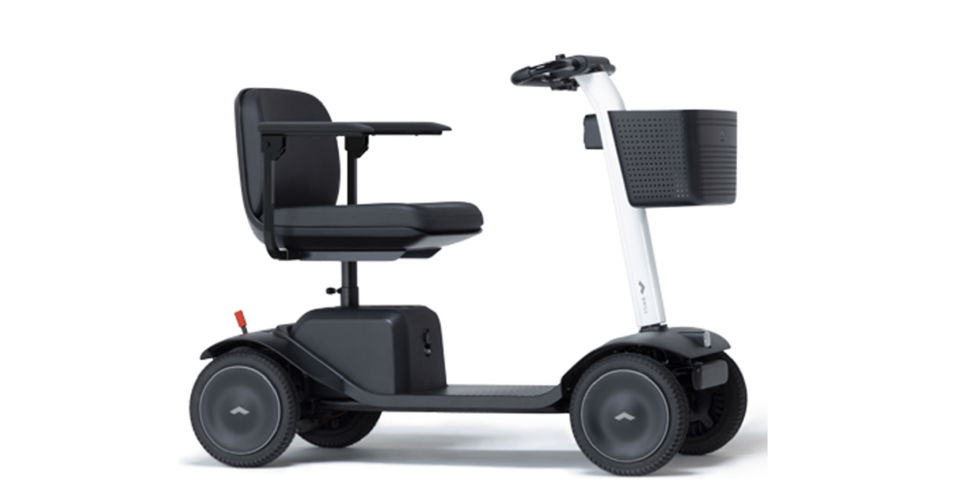
The WHILL Model S measures 1,198mm in length, 551- 640mm in width, and 915mm in height; its width varies according to the armrest position. The device weighs approximately 67kg, including the battery, and has a maximum user weight capacity of 100kg. The seat can be adjusted to three height settings and two fore-aft positions to accommodate differences in body size and transfer ability. The maximum forward and reverse speeds are 6km/h and 2km/h, respectively. The maximum forward speed of 6km/h conforms to the requirements under Japanese road traffic regulations for motorized wheelchairs, which are legally treated as pedestrians and permitted to travel on sidewalks [17]. The device has a minimum turning radius of 1.48m, a maximum climbing ability of 10°, and an obstacle-negotiation capacity of up to 7.5cm.
The WHILL Model S is powered by two 24-V, 12-Ah batteries. The manufacturer-reported maximum travel range is 33km on a full charge under standard test conditions. Full charging requires approximately 9h and 40 min with the standard charger or 6h and 40 min with the rapid charger. Actual travel range may vary according to user weight, terrain, road surface, ambient temperature, battery condition, and driving behavior. These characteristics make the WHILL Model S a seated, non-pedaling option for older adults who require support for longer-distance walking but wish to travel independently to nearby destinations.
Yuho Liberta
The Yuho Liberta (model SC-01; Serio Co., Ltd., Hamamatsu, Japan; Figure 2) is a four-wheel electric-assist bicycle designed to retain the pedaling experience of a bicycle while enhancing stability through a self-standing four-wheel structure. Unlike a conventional two-wheel bicycle, it remains upright when stationary, which may reduce balance-related concerns during mounting, dismounting, and waiting at intersections. The device is equipped with a saddle, handlebars, front and rear baskets, and front and rear disc brakes. The Yuho Liberta measures 1,585mm in length and 590mm in width, has a seat height of 670mm, and weighs 40.5kg including the battery. It is powered by a 250-W direct-current brushless motor and a rechargeable lithium-ion battery (37V, 9.54Ah; 353Wh). Pedal assistance is proportional up to 10km/h and gradually decreases between 10 and 24km/h, in accordance with the Japanese regulatory framework for electrically power-assisted bicycles. The approximate charging time is 4h, and the manufacturer-reported maximum travel distance is 42km under standard test conditions. Actual travel distance may vary according to rider and cargo weight, terrain, road conditions, weather, battery condition, and use of assist functions.
Figure 2: Yuho Liberta. Image provided by Serio Co., Ltd. and reproduced with permission.
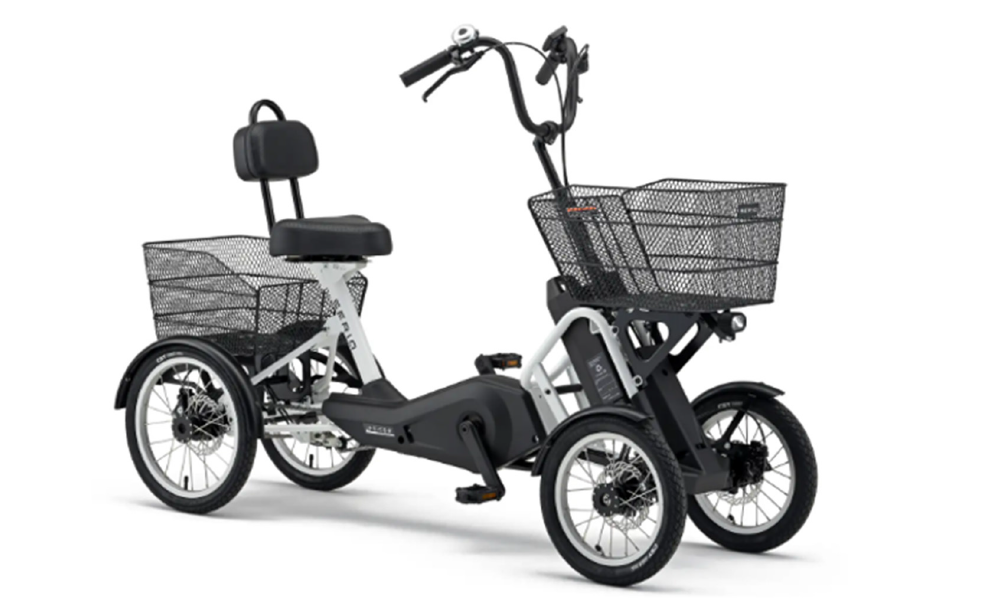
The devices were selected because their operational characteristics and physical demands differ substantially. The WHILL Model S enables seated, non-pedaling travel, whereas the Yuho Liberta requires pedaling but provides bicycle-type mobility with enhanced standing stability. Evaluating both devices allowed assessment of older adults’ perceptions of usability and acceptance across two practically different forms of electric mobility.
Study procedure
Participants underwent physical and cognitive function assessments. They subsequently experienced one or both of the two mobility devices, the WHILL Model S and Yuho Liberta, as part of the “Ikiiki Mobility Support Demonstration” organized by Haga Town. Following use of the mobility device, participants completed an anonymous questionnaire assessing the usability and acceptability of the device they had used.
Quantitative measures
Physical characteristics and function were assessed using height, weight, body mass index (BMI), handgrip strength (HGS), the finger-ring test, and the Timed Up and Go (TUG) test. HGS was used as an indicator of muscle strength, with low muscle strength defined according to the Asian Working Group for Sarcopenia (AWGS) 2019 criteria [18]. The finger-ring test, a simple screening method for sarcopenia in community-dwelling older adults, was performed as previously described [19]. The TUG test was used to assess functional mobility [20]. Cognitive function was assessed using the Mini-Mental State Examination (MMSE) [21].
Usability and acceptability of the electric mobility devices were assessed using a 15-item questionnaire. The questionnaire was conceptually based on the Technology Acceptance Model [11] and was adapted to the context of personal electric mobility for older adults by incorporating device-specific aspects of usability, safety, and comfort. The questionnaire comprised five domains: usefulness (2 items), ease of use (3 items), attitude and satisfaction (2 items), behavioral intention (2 items), and safety and comfort (6 items). Usefulness assessed perceived usefulness for daily mobility and activities such as shopping and medical visits. Ease of use assessed operability, acceleration or electric-assist control, and ease of mounting and dismounting. Attitude and satisfaction assessed device design and comfort, whereas behavioral intention assessed willingness to use the device in the future and to recommend it to family or friends. Safety and comfort assessed stability, speed, maneuverability, ride comfort, size and weight, and cargo capacity. Each item was rated on a five-point scale, with higher scores indicating a more favorable evaluation of the device.
The 15-item questionnaire was developed specifically for this mobility demonstration by the study team, including researchers from NCGG and Auto Technic Japan Co., Ltd., with reference to the Technology Acceptance Model and practical considerations relevant to the use of personal electric mobility devices by older adults. The questionnaire was intended to capture device-specific user experience in this exploratory study and was not designed as a standardized psychometric scale. Formal validation or pilot testing of the questionnaire was not conducted prior to the study
Statistical analysis
Participant characteristics and physical and cognitive function measures were summarized using descriptive statistics. Continuous variables were presented as means and standard deviations, and categorical variables as numbers and percentages. Usability and acceptability ratings were summarized as medians and interquartile ranges because of the small sample size and the ordinal nature of the five-point rating scale.
Usability and acceptability ratings were compared between the WHILL Model S and Yuho Liberta using the Mann-Whitney U test. To explore associations between physical and cognitive function and user experience, participants were categorized according to TUG performance (< 10 vs. ≥ 10s), MMSE score (≥ 27 vs. < 27), finger-ring test result (unable to encircle vs. just encircled/gap), and sex-specific handgrip strength thresholds (≥ 28 vs. < 28kg for men and ≥ 18 vs. < 18kg for women). Differences in each usability and acceptability item between these groups were examined using the Mann-Whitney U test for the overall sample and separately for each mobility device.
Effect size (r) was calculated to quantify the magnitude of between-group differences. Because two participants evaluated both devices, the 12 device evaluations were not fully independent. Given the small sample size and exploratory design, no statistical adjustment for within-participant dependence was performed. Therefore, the Mann-Whitney U test was used as an exploratory analysis of device-level evaluations rather than as a confirmatory test of independent groups. Given the exploratory nature of the study, small sample size, potential dependence between observations, and multiple comparisons without adjustment for multiplicity, individual p values were interpreted cautiously and were considered hypothesis-generating rather than confirmatory. Statistical analyses were performed using IBM SPSS Statistics version 29.0. All statistical tests were two-sided, and p < 0.05 was considered statistically significant.
Results
Participant characteristics
Ten participants were included in the analysis. The mean age was 77.4 ± 9.6 years, and eight participants (80.0%) were women. The mean height, body weight, and BMI were 157.3 ± 8.8cm, 56.0 ± 9.8kg, and 22.8 ± 4.6kg/m2, respectively. The mean TUG time was 10.11 ± 3.45s, and the mean MMSE score was 27.5 ± 2.8. Participant characteristics are summarized in Table 1.
Table 1:Participant characteristics.
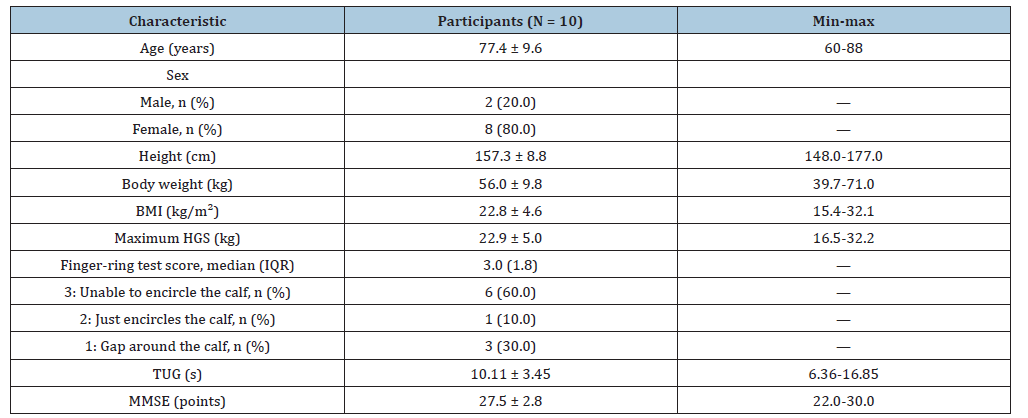
Values are mean ± SD unless otherwise indicated. Categorical variables are presented as n (%). The finger-ring test score
is presented as median (IQR), where IQR is the width of the interquartile range (75th minus 25th percentile).
Finger-ring test coding: 3, unable to encircle the calf; 2, just encircles the calf; 1, a gap remains around the calf.
Abbreviations: BMI: Body Mass Index; HGS: Handgrip Strength; IQR: Interquartile Range; MMSE: Mini-Mental State
Examination; SD: Standard Deviation; TUG: Timed Up and Go. Min-max; minimum–maximum; —: not applicable.
Usability and acceptability of the electric mobility devices
A total of 12 usability and acceptability evaluations were obtained from the 10 participants because two participants evaluated both devices. Four evaluations were obtained for the WHILL Model S and eight for the Yuho Liberta. Overall, both devices received favorable ratings across most of the 15 questionnaire items, with median scores generally ≥ 4. No statistically significant differences in usability and acceptability ratings were observed between the WHILL Model S and Yuho Liberta. The largest betweendevice difference was observed for cargo capacity, for which the median rating was 2.0 for the WHILL Model S and 5.0 for the Yuho Liberta (r = 0.482, p = 0.095). The usability and acceptability ratings for each device are presented in Table 2.
Table 2:Usability and acceptability ratings for each device.
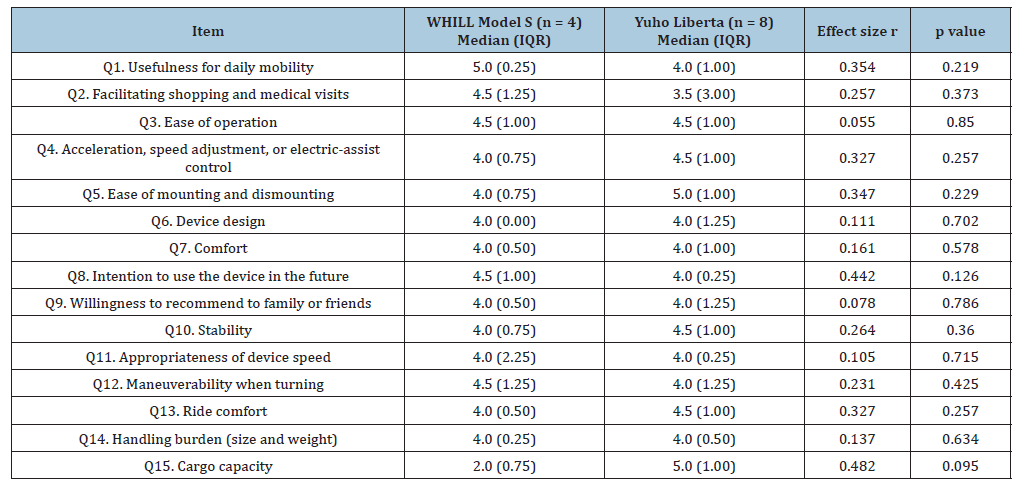
Values are median (IQR), where IQR is the width of the interquartile range (75th minus 25th percentile). Items were rated
on a five-point scale; higher scores indicate more favorable evaluations.
Twelve device evaluations were obtained from 10 participants; two participants evaluated both devices. Thus, n denotes
device evaluations, and the two device groups include overlapping participants.
p values are from two-sided Mann-Whitney U tests. Effect size r quantifies the magnitude of the between-device difference.
Comparisons are exploratory given the small sample, multiple comparisons, and overlapping participants.
Abbreviations: IQR: interquartile range; Q: questionnaire item
Associations between physical and cognitive function and user experience
Selected associations are summarized in Table 3. Participants with a TUG time < 10 s rated acceleration, speed adjustment, or electric-assist control more favorably in the overall sample and for the Yuho Liberta. Higher MMSE scores (≥ 27) were associated with higher ride-comfort ratings in the overall sample. For Yuho Liberta, participants in the “unable to encircle” finger-ring test group rated ease of operation more favorably than those in the “just encircles/gap” group. Participants with low HGS reported greater willingness to recommend the device in the overall sample (all p < 0.05). Other comparisons described in Table 3 did not reach statistical significance: Future use intention by TUG category and speed appropriateness by MMSE category for WHILL Model S, and usefulness for shopping and medical visits by finger-ring test category in the overall sample (reported p = 0.050). These findings should be interpreted as exploratory.
Table 3:Selected associations between physical and cognitive function and user experience.
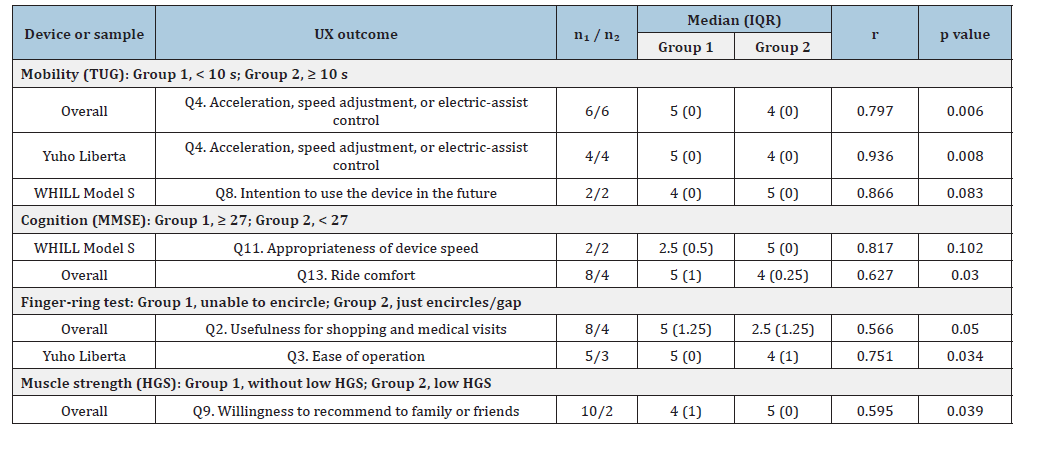
Values are median (IQR); parentheses contain the IQR width. n1 and n2 denote the numbers of device evaluations in
Groups 1 and 2. Overall analyses include 12 evaluations from 10 participants; two participants evaluated both devices
(WHILL Model S, n = 4; Yuho Liberta, n = 8).
Comparisons used the Mann-Whitney U test. Analyses were exploratory, and no adjustment for multiple comparisons
was applied. Low HGS was defined as < 28kg in men and < 18kg in women.
Abbreviations: HGS: Handgrip Strength; IQR: Interquartile Range; MMSE: Mini-Mental State Examination; Q:
Questionnaire Item; TUG: Timed Up and Go; UX: User Experience
Discussion
This exploratory study investigated the usability and acceptability of two personal electric mobility devices with distinct operational characteristics and examined their associations with physical and cognitive function among community-dwelling older adults. Overall, both the WHILL Model S and Yuho Liberta received favorable ratings across most questionnaire items, with no statistically significant differences between the two devices. Previous studies have shown that powered mobility can support independence, community mobility, social participation, and QOL among older adults with mobility limitations [8-10,22-24]. However, these benefits do not necessarily indicate that a particular mobility device is equally suitable for all older adults. In the present study, associations between user characteristics and individual user-experience ratings differed according to physical and cognitive function and, in some cases, according to the device evaluated. In particular, better functional mobility was associated with more favorable ratings of acceleration, speed adjustment, or electricassist control, especially for the Yuho Liberta, whereas participants with poorer functional mobility tended to report greater future-use intention for the WHILL Model S. These findings suggest that the usability and acceptance of personal electric mobility may depend not simply on the device itself, but on the fit between the user’s functional characteristics and the operational demands of the device.
The association between functional mobility and user experience was particularly evident for the Yuho Liberta. Participants with a TUG time < 10 s rated acceleration, speed adjustment, or electricassist control more favorably, with a particularly large effect observed for this device. Unlike the seated, non-pedaling WHILL Model S, the Yuho Liberta requires active pedaling together with steering and interaction with the electric-assist system. Physical abilities, including postural stability, strength, and motor control, have been identified as relevant to the operation of powered mobility devices [13], and previous studies have emphasized that mobility-device performance reflects an interaction between the user’s abilities, device design, activity demands, and the environment [25,26]. Therefore, participants with better functional mobility may have been better able to accommodate the active operational demands of the Yuho Liberta and consequently perceived its control characteristics more favorably. Conversely, this finding suggests that greater physical interaction with a device may become a usability challenge as functional mobility declines. Accordingly, for active electric mobility devices, assessment of functional mobility and adjustment of operating characteristics such as assistance and response may be important for achieving an appropriate match between the user and the device.
In contrast, a different pattern emerged for the WHILL Model S and for associations involving cognitive function and muscle strength. Among participants who evaluated the WHILL Model S, those with a TUG time ≥ 10s showed a strong, although statistically non-significant, tendency toward greater future-use intention. Powered mobility scooters have been reported to enable older adults with mobility limitations to maintain everyday activities, independence, social engagement, and freedom of choice [22- 24,27]. Thus, the seated and non-pedaling characteristics of the WHILL Model S may have been perceived as particularly valuable by participants for whom walking or more physically demanding mobility options were less suitable. Cognitive function was also associated with specific aspects of user experience: participants with higher MMSE scores rated the speed of the WHILL Model S less favorably, whereas higher MMSE scores were associated with greater ride comfort in the overall sample. Previous research has demonstrated that powered-mobility operation involves multiple cognitive processes and that cognitive abilities can influence driving performance [7]. However, the direction of the present associations was not uniform, suggesting that cognitive function should not simply be interpreted as predicting better or poorer acceptance. Similarly, participants with low HGS reported greater willingness to recommend the devices. Taken together, these findings indicate that reduced physical capacity does not necessarily result in poorer user experience; rather, the perceived value of mobility assistance may increase when a device compensates for a functional limitation that is relevant to the user’s everyday mobility needs.
These findings support a user-device fit perspective for the implementation of personal electric mobility among older adults. Assistive-technology research has long emphasized that successful use depends on the interaction among the person, activity, technology, and environment, and that a poor fit can contribute to abandonment or nonuse of assistive devices [14,25,26]. Qualitative research with mobility-scooter users has also highlighted the value of adequate information, opportunities to trial devices, and training before regular use [23]. Therefore, there may be no single optimal personal electric mobility device for older adults. A seated, nonpedaling device may be particularly valuable for some individuals with reduced functional mobility, whereas a pedaling-based electric-assist device may be better suited to individuals who retain sufficient mobility and prefer active operation. These findings should not be interpreted as supporting rigid physical or cognitive eligibility criteria. Instead, functional assessments may provide information that can be combined with the individual’s mobility goals, preferences, intended activities, and environmental context when selecting and configuring a device. In community mobility programs, providing opportunities to trial different devices and, where possible, individualizing characteristics such as acceleration, speed response, and assistance level may therefore facilitate better user-device fit and support continued community mobility and participation.
Study Limitations
Several limitations should be considered when interpreting these findings. First, the sample size was small, with 10 participants providing 12 device evaluations, and two participants evaluated both devices. Therefore, some observations were not fully independent. Although the Mann-Whitney U test was used for exploratory comparisons, the analysis did not account for withinparticipant dependence arising from repeated evaluations by these two participants. Accordingly, the statistical findings should be regarded as exploratory and hypothesis-generating rather than confirmatory. Second, multiple comparisons were conducted without adjustment for multiplicity; consequently, individual statistically significant findings should be interpreted cautiously and considered hypothesis-generating rather than confirmatory. Third, the 15-item questionnaire was developed specifically for this mobility demonstration and had not undergone formal psychometric validation. Therefore, the questionnaire findings should be interpreted as exploratory measures of device-specific user experience. Fourth, the participants were community-dwelling older adults who voluntarily participated in a municipal mobility demonstration and may have been relatively independent and interested in new mobility technologies.
In addition, the study was conducted within a single municipality and demonstration program. Therefore, the present findings should not be generalized to the broader population of older adults, particularly those with substantial physical or cognitive impairment, those who are less interested in mobility technologies, or those living in different geographic and transportation environments. Fifth, user experience was assessed immediately following device use using subjective ratings, and the study did not evaluate longterm adoption, actual community use, or changes in mobility and social participation. Finally, device allocation was not randomized. Larger prospective studies involving more diverse older adults, validated measures of user experience, and longer-term real-world use are needed to clarify how physical and cognitive characteristics interact with specific device characteristics and to establish practical approaches for optimizing user-device fit.
Conclusion
This exploratory study demonstrated that both the WHILL Model S and Yuho Liberta were generally well accepted by community-dwelling older adults, while associations between user characteristics and user experience differed according to physical and cognitive function and device characteristics. Better functional mobility was associated with more favorable perceptions of the active operational characteristics of the Yuho Liberta, whereas the seated, non-pedaling WHILL Model S tended to be more favorably considered for future use among participants with poorer functional mobility. These findings suggest that there may be no single optimal personal electric mobility device for older adults; rather, successful implementation may depend on the fit between individual characteristics, mobility needs, and the operational demands of the device. Assessing user characteristics and providing opportunities to trial different devices may therefore support appropriate device selection and facilitate continued community mobility and participation.
CRediT authorship contribution statement
1. Shu Moriyama: Investigation, Data curation, Project
administration;
2. Eiko Takano: Conceptualization, Methodology, Formal analysis,
Writing - original draft, Writing - review & editing;
3. Kenshin Muto: Investigation;
4. Hiroshi Watanabe: Methodology, Investigation, Resources,
Project administration;
5. Hiroshi Yamazaki: Methodology, Investigation, Resources,
Project administration;
6. Izumi Kondo: Conceptualization, Methodology, Supervision,
Writing - review & editing;
7. Hisataka Maruyama: Supervision, Writing - review & editing.
Acknowledgments
The authors would like to express their sincere gratitude to the community-dwelling older adults in Haga Town who participated in this study and to the staff of Haga Town for their valuable support and cooperation in conducting the mobility demonstration and this study.
Funding
This study was supported by collaborative research funding from Auto Technic Japan Co., Ltd. and by the Research Funding for Longevity Sciences from the National Center for Geriatrics and Gerontology.
Conflict of Interest
Hiroshi Watanabe and Hiroshi Yamazaki are employees of Auto Technic Japan Co., Ltd., which provided collaborative research funding for this study. Auto Technic Japan Co., Ltd. was involved in the preparation of the mobility devices and study site, participant recruitment, and questionnaire development, but was not involved in the data analysis. The other authors declare no conflicts of interest.
References
- Gallo H B, Marshall L W, Levy-Storms L, Wilber K H, Loukaitou-Sideris A (2022) Voices of experience: What do low-income older adults tell us about mobility, technology, and social participation? J Appl Gerontol 41(2): 571-580.
- Hashidate H, Shimada H, Fujisawa Y, Yatsunami M (2021) An overview of social participation in older adults: Concepts and assessments. Phys Ther Res 24(2): 85-97.
- Vaughan M, LaValley M P, Al Heresh R, Keysor JJ (2016) Which features of the environment impact community participation of older adults? A systematic review and meta-analysis. J Aging Health 28(6): 957-978.
- Townsend B G, Chen JT, Wuthrich VM (2021) Barriers and facilitators to social participation in older adults: A systematic literature review. Clin Gerontol 44(4): 359-380.
- Yang Y, Chen S, Wang G, Wang Y, Leung AYM, et al. (2026) Determinants of social participation among community-dwelling older adults: A mixed-methods systematic review. Int J Nurs Stud 181(105574).
- Paulhus L, Bernard K, Bourque C, Guilmette S, Laquerre M, et al. (2025) An updated synthesis of environmental factors influencing mobility and social participation in older adults: Results from a scoping review. BMC Public Health 26(1): 109.
- Pellichero A, Kenyon LK, Best KL, Lamontagne ME, Lavoie MD, et al. (2021) Relationships between cognitive functioning and powered mobility device use: A scoping review. Int J Environ Res Public Health 18(23): 12467.
- Pettersson I, Hagberg L, Fredriksson C, Hermansson LN (2016) The effect of powered scooters on activity, participation and quality of life in elderly users. Disabil Rehabil Assist Technol 11(7): 558-563.
- Thoreau R (2015) The impact of mobility scooters on their users. Does their usage help or hinder?: A state of the art review. J Transp Health 2(2): 269-275.
- Lim P Y, Hui Chia C W, Ong S L, Lim M L, Xu T (2024) The impact of mobility scooter on occupational participation among older adults in singapore: An exploratory study. Disabil Rehabil Assist Technol 19(3): 745-753.
- Davis F (1989) Perceived usefulness, perceived ease of use, and user acceptance of information technology. MIS Quarterly 13(319).
- Heerink M, Kröse B, Evers V, Wielinga B (2010) Assessing acceptance of assistive social agent technology by older adults: The almere model. Int J Soc Robot 2(4): 361-375.
- Toosizadeh N, Bunting M, Howe C, Mohler J, Sprinkle J, et al. (2014) Motorized mobility scooters: The use of training/intervention and technology for improving driving skills in aging adults - A Mini-Review. Gerontology 60(4): 357-365.
- Kraskowsky L H, Finlayson M (2001) Factors affecting older adults' use of adaptive equipment: Review of the literature. Am J Occup Ther 55(3): 303-310.
- Wang R H, Korotchenko A, Hurd Clarke L, Mortenson W B, Mihailidis A (2013) Power mobility with collision avoidance for older adults: User, caregiver, and prescriber perspectives. J Rehabil Res Dev 50(9): 1287-1300.
- Tural E, Lu D, Cole D A (2020) Factors predicting older adults' attitudes toward and intentions to use stair mobility assistive designs at home. Prev Med Rep 18(101082).
- National Police Agency of Japan. Regarding the safe use of electric wheelchairs.
- Chen L K, Woo J, Assantachai P, Auyeung T W, Chou M Y, et al. (2020) Asian working group for sarcopenia: 2019 consensus update on sarcopenia diagnosis and treatment. J Am Med Dir Assoc 21(3): 300-307.
- Tanaka T, Takahashi K, Akishita M, Tsuji T, Iijima K (2018) "Yubi-wakka" (finger-ring) test: A practical self-screening method for sarcopenia, and a predictor of disability and mortality among Japanese community-dwelling older adults. Geriatr Gerontol Int 18(2): 224-232.
- Podsiadlo D, Richardson S (1991) The timed "up & go": A test of basic functional mobility for frail elderly persons. J Am Geriatr Soc 39(2): 142-148.
- Folstein MF, Folstein SE, McHugh PR (1975) "Mini-mental state". A practical method for grading the cognitive state of patients for the clinician. J Psychiatr Res 12(3): 189-198.
- Auger C, Demers L, Gélinas I, Jutai J, Fuhrer M J, et al. (2008) Powered mobility for middle-aged and older adults: Systematic review of outcomes and appraisal of published evidence. Am J Phys Med Rehabil 87(8): 666-680.
- Fomiatti R, Moir L, Richmond J, Millsteed J (2014) The experience of being a motorised mobility scooter user. Disabil Rehabil Assist Technol 9(3): 183-187.
- Sullivan S J, Handcock P, Jackson D S (2020) Does the purchase of a mobility scooter alter physical activity levels in older adults? Disabil Rehabil Assist Technol 15(8): 856-861.
- Fredriksson C, Pettersson I, Hagberg L, Hermansson L (2022) The value of powered mobility scooters from the perspective of elderly spouses of the users - a qualitative study. Disabil Rehabil Assist Technol 17(7): 747-751.
- Salminen A L, Brandt A, Samuelsson K, Töytäri O, Malmivaara A (2009) Mobility devices to promote activity and participation: A systematic review. J Rehabil Med 41(9): 697-706.
- Widehammar C, Lidström Holmqvist K, Pettersson I, Hermansson L N (2020) Attitudes is the most important environmental factor for use of powered mobility devices - users' perspectives. Scand J Occup Ther 27(4): 298-308.
© 2026 Eiko Takano. This is an open access article distributed under the terms of the Creative Commons Attribution License , which permits unrestricted use, distribution, and build upon your work non-commercially.
Editor In Chief







.jpg)































Signup for Newsletter

Quick Links
 Editorial Board Registrations
 Submit your Article
 Best Paper of the Volume
 Reprints
 Refer a Friend
 Advertise With Us
Our Recent Edition

.jpg)



Top Editors




.jpg)

















.bmp)
.jpg)
.png)
.jpg)













.jpg)






.png)

.png)




.png)




Financial Support

Sponsors

Latest e-Books

Latest Video

 a Creative Commons Attribution 4.0 International License. Based on a work at www.crimsonpublishers.com.
Best viewed in
a Creative Commons Attribution 4.0 International License. Based on a work at www.crimsonpublishers.com.
Best viewed in 
 | Above IE 9.0 version