

- About Us
- Information
-

The Author ensures that the research has been conducted responsibly and ethically with adherence to all relevant regulations. read more..
- For Authors
- For Reviewer
- Manuscript Guidelines
- Membership
- Publication Ethics
-
- Journals
- Reprints
- e-Books
- Videos
- Policies
- Contact Us
 COVID-19
- Submissions



Full Text
Gerontology & Geriatrics Studies
Emerging Technologies and Assistive Devices for Fall Prevention in Older Adults: Current Evidence, Clinical Applications, and Future Directions
Praveena Jaidev1*, Sireesha Palkamsetti2 and Nikhil Sood3
1 Banner Estrella Medical Center, USA
2 Saint Agnes Medical Center, USA
3 Banner Gateway Medical Center, USA
*Corresponding author:Praveena Jaidev, Banner Estrella Medical Center, USA
Submission: August 07, 2026; Published: August 17, 2026
ISSN 2578-0093Volume10 Issue 2
Abstract
Falls are a major cause of injury, hospitalization, functional decline, and loss of independence among older adults. Current fall-prevention strategies rely on multifactorial interventions, including exercise, medication optimization, vision assessment, and environmental modification. However, traditional approaches often depend on periodic clinical evaluations and may not capture dynamic changes in mobility and fall risk occurring during daily life. This mini review summarizes emerging technologies and assistive devices for fall prevention, focusing on their clinical applications, current evidence, and implementation challenges.
Keywords:Falls; Older adults; Fall prevention; Digital health; Wearable sensors; Artificial intelligence; Assistive technology; Geriatrics
Introduction
Falls are among the most prevalent and potentially preventable threats to the health and independence of older adults. They contribute significantly to major injuries, emergency department visits, hospitalizations, functional decline, and loss of autonomy. The incidence of falls increases with factors such as frailty, cognitive impairment, multimorbidity, polypharmacy, and advancing age, establishing fall prevention as a central priority in geriatric care [1,2].
The consequences of a fall extend beyond the immediate incident. Even in the absence of serious injury, many older adults develop a fear of falling, restrict daily activities, experience reduced strength and confidence, and face increased social isolation. Fall risk typically arises from multiple interacting factors, including intrinsic vulnerabilities such as impaired balance, muscle weakness, cognitive changes, vision impairment, chronic disease, and medication effects, as well as extrinsic hazards present in the home or community environment. Due to the interplay of these risks, effective prevention generally requires a multifactorial approach that addresses both individual and environmental factors [1,3].
Established strategies such as exercise and balance training, medication review, vision optimization, footwear assessment, and environmental modification remain fundamental to fall prevention. However, conventional fall-risk assessments often rely on brief, clinic-based evaluations, including gait speed testing, balance assessment, and the Timed Up and Go test. While these tools yield valuable information, they may fail to capture daily fluctuations in mobility, fatigue-related instability, near-falls, and environmental barriers encountered outside controlled clinical settings [1,4-9].
Emerging digital health technologies have the potential to address these limitations by extending assessment and intervention into daily life. These technologies generate objective data on movement patterns, activity levels, functional decline, and environmental risk. With appropriate validation and integration into clinical care, such tools may facilitate earlier identification of fall risk and support more individualized prevention strategies [10- 14]. This mini review examines emerging technologies and assistive devices for fall prevention in older adults, with particular emphasis on their clinical applications, current evidence, implementation barriers, and potential roles as complements to comprehensive geriatric assessment.
Emerging Technology Domains in Fall Prevention
Digital mobility monitoring and risk prediction
Wearable sensors are commonly used for digital mobility monitoring in older adults. These devices use motion sensors, such as accelerometers and gyroscopes, to track walking, activity levels, balance changes, and near-falls during daily life. Clinicbased mobility tests provide a snapshot of an individual’s mobility, whereas wearable devices enable longitudinal monitoring. Alterations in gait, decreased activity, or instability may serve as early indicators of functional decline and increased fall risk [10,11]. Artificial intelligence and machine learning algorithms can identify patterns predictive of future falls. These systems integrate movement data with additional risk factors, including age, frailty, medication use, and fall history, to provide individualized fall risk estimates [12,13]. Despite their potential, these technologies have not been widely adopted in routine clinical practice. Barriers include challenges with device adherence and maintenance, data management, algorithm validation, and integration into standard healthcare workflows [10,12,13].
Smart environments and passive monitoring
Passive monitoring may be an effective alternative for individuals who have difficulty using wearable devices, including older adults, those with memory impairments, or individuals with limited technological proficiency. Smart-home systems monitor daily activities through motion sensors, radar systems, pressure sensors, and environmental sensors, without requiring any user intervention [13,14]. These systems can detect changes in gait, transitions from sitting to standing, nighttime movement, and alterations in daily routines. Such changes may signal a decline in functional capacity or an increased risk of falls. Additionally, these systems can facilitate safety enhancements, such as improved nighttime lighting or alerts for hazardous movement patterns [14]. Despite their potential, these technologies are not yet widely adopted. Barriers to implementation include high costs, privacy concerns, the requirement for home installation, and limited evidence demonstrating their effectiveness in reducing falls or other significant health outcomes [3,14].
Technology-Enhanced rehabilitation
Exercise and balance training remain the most effective strategies for fall prevention. Emerging technologies can enhance these programs by offering feedback, modulating difficulty, and incorporating cognitive tasks [1,4,15]. Virtual reality, interactive exercise games, and digital rehab programs enable older adults to practice balance and movement in safe, simulated settings. These tools can improve confidence, reaction time, walking ability, and the ability to move while doing another task [15,16]. Dual-task situations, in which walking is combined with a simultaneous cognitive or attentional demand, can increase instability in older adults. Training both physical and cognitive components may therefore be useful. However, the extent to which these technologies reduce actual falls remains uncertain, and further research is needed [16].
Intelligent assistive devices
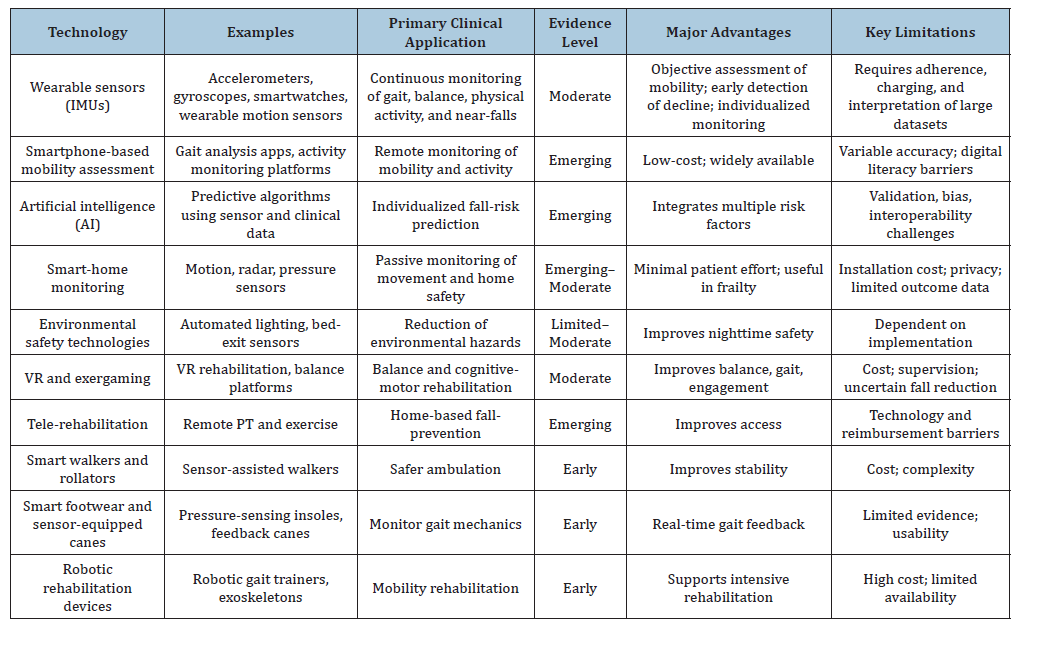
Canes and walkers continue to serve as fundamental tools for fall prevention. Their effectiveness depends on appropriate selection, consistent use, and sufficient training. Recent innovations, including smart walkers and sensor-equipped footwear, integrate advanced sensors and safety features to improve mobility. These technologies can detect obstacles and monitor gait and balance [9,17,18]. Although these devices demonstrate potential in preventing falls, existing research is limited. Common barriers include high cost, complex design, user discomfort, and the need for individualized training. Table 1 summarizes these technologies and outlines their potential applications in clinical care [17,18].
Table 1:Emerging technologies and assistive devices for fall prevention in older adults.
Abbreviations: AI: Artificial Intelligence; IMU: Inertial Measurement Unit; VR: Virtual Reality
Challenges and Barriers to Clinical Implementation
Patient adherence and digital accessibility
Many technology-based interventions require active participation, including device use, charging, maintenance, and interpretation of feedback. These requirements may be challenging for older adults with cognitive impairment, frailty, visual limitations, or limited technological familiarity [3,13,14]. Future technologies should prioritize simplicity, passive monitoring, and user-centered design. Systems requiring minimal patient interaction may be particularly valuable for individuals at highest risk of falls [3,13,14].
Clinical integration and data interpretation
Continuous monitoring generates large volumes of information. However, data collection alone does not improve outcomes unless clinicians can translate information into meaningful interventions [12,13]. Future systems should provide clinically relevant summaries that identify decline in mobility and trigger appropriate responses, such as physical therapy, medication review, or home safety assessment. Integration with electronic health records will be essential [12,13].
Privacy, cost and health equity
Smart-home monitoring and continuous surveillance technologies raise concerns regarding privacy, autonomy, and patient acceptance. Transparent communication regarding data collection and appropriate safeguards will be necessary [3,14]. Cost remains another major barrier. Device expenses, installation requirements, and limited reimbursement may restrict access. Implementation strategies should ensure that technological advances do not worsen disparities among older adults [3,14,18].
Evidence gaps
Although many technologies improve surrogate outcomes such as gait parameters, balance measures, and activity levels, evidence demonstrating reductions in falls, fractures, emergency visits, or hospitalization remains limited. Future research should prioritize clinical trials evaluating patient-centered health outcomes [2,10,12,14,16,18].
Future directions
The future of technology-assisted fall prevention will likely involve the integration of multiple technologies rather than isolated devices. Combining wearable sensors, smart environments, AI analytics, and clinical information may allow for more accurate prediction of fall risk and personalized interventions [12- 14,18]. Future priorities include the development of affordable technologies, validation across diverse older adult populations, improved integration with healthcare systems, and evaluation in real-world clinical settings [12-14,18]. Technology should remain integrated within comprehensive geriatric care models that include exercise, medication optimization, environmental modification, and multidisciplinary management [1,2,4-8,15,19].
Discussion
Emerging technologies have broadened fall-prevention strategies by enabling continuous mobility assessment, remote monitoring, and personalized interventions that surpass traditional clinic-based evaluations. Conventional assessments offer only a limited snapshot of functional status, while digital tools can monitor changes in gait, balance, activity, and environmental interactions throughout daily life. The shift to continuous monitoring may enable earlier identification of individuals at increased risk of falls, potentially before significant decline or injury occurs [10-14].
Wearable sensors are among the most extensively studied technologies for objectively measuring gait, physical activity, and mobility patterns in real-world environments. Virtual reality and exergaming interventions have shown benefits for balance and gait performance; however, their effect on reducing fall rates remains less certain. In contrast, artificial intelligence prediction models, smart-home monitoring systems, and intelligent assistive devices are promising but remain limited by variable validation, feasibilityfocused evidence, or early-stage clinical research. Further prospective studies are necessary to determine whether these technologies improve patient-centered outcomes, such as falls, fractures, hospitalization, and loss of independence [10-14, 16-18].
Successful implementation requires more than technological advancement. Routine adoption in geriatric care depends on usability, patient acceptance, affordability, compatibility with electronic health records, and integration into multidisciplinary care pathways. Older adults with frailty or cognitive impairment, who are at the highest risk of falls, may encounter significant challenges in consistently using wearable or interactive technologies. For these populations, passive monitoring and usercentered designs that minimize patient burden may offer particular benefit [3,13,14,17,18].
Technology should function as an adjunct rather than a replacement for comprehensive fall-prevention strategies. Strength and balance training, medication optimization, vision assessment, chronic disease management, and home safety modifications remain the foundation of prevention. Emerging digital tools may enhance these interventions by providing objective longitudinal data, supporting earlier recognition of mobility decline, and enabling more individualized clinical decision-making [1,2,4- 9,15,19].
As digital health advances, future research should prioritize pragmatic clinical trials, standardized outcome measures, and cost-effectiveness analyses that reflect real-world geriatric care. Collaboration among clinicians, engineers, rehabilitation specialists, and health systems is essential to ensure that these innovations result in measurable improvements in mobility, independence, and quality of life for older adults [2,12,14,16,18].
Conclusion
Emerging technologies and assistive devices provide new opportunities to advance fall prevention among older adults by enabling continuous monitoring, early identification of mobility decline, and individualized intervention. Wearable sensors, AI-based analytics, smart-home systems, virtual rehabilitation, and mobility aids may extend the capabilities of traditional geriatric assessment [10-14,16-18]. However, successful implementation requires careful attention to quality, usability, privacy, affordability, and clinical integration. The greatest benefit will come from combining technological innovation with established multidisciplinary fallprevention strategies to preserve mobility, independence, and quality of life among older adults [1,2,12-14,16-18].
References
- Montero-Odasso M, van der Velde N, Martin FC, Petrovic M, Tan MP, et al. (2022) World guidelines for falls prevention and management for older adults: A global initiative. Age Ageing 51(9): afac205.
- Guirguis-Blake JM, Perdue LA, Coppola EL, Bean SI (2024) Interventions to prevent falls in older adults: Updated evidence report and systematic review for the US Preventive Services Task Force. JAMA 332(1): 58-69.
- Alfaro Hudak KM, Adibah N, Cutroneo E, Liotta M, Sanghera A, et al. (2023) Older adults' knowledge and perception of fall risk and prevention: A scoping review. Age Ageing 52(11): afad220.
- Sherrington C, Michaleff ZA, Fairhall N, Paul SS, Tiedemann A, et al. (2017) Exercise to prevent falls in older adults: An updated systematic review and meta-analysis. Br J Sports Med 51(24): 1750-1758.
- Phelan EA, Mahoney JE, Voit JC, Stevens JA (2015) Assessment and management of fall risk in primary care settings. Med Clin North Am 99(2): 281-293.
- Dautzenberg L, Beglinger S, Tsokani S, Zevgiti S, Raijmann RCMA, et al. (2021) Interventions for preventing falls and fall-related fractures in community-dwelling older adults: A systematic review and network meta-analysis. J Am Geriatr Soc 69(10): 2973-2984.
- Lee J, Negm A, Peters R, Wong EKC, Holbrook A (2021) Deprescribing fall-risk increasing drugs (FRIDs) for the prevention of falls and fall-related complications: A systematic review and meta-analysis. BMJ Open 11(2): e035978.
- Josephson KR, Fabacher DA, Rubenstein LZ (1991) Home safety and fall prevention. Clin Geriatr Med 7(4): 707-731.
- Kim IJ, Hegazy F (2024) Enhancing footwear safety for fall prevention in older adults: A comprehensive review of design features. Ann Geriatr Med Res 28(2): 121-133.
- Bezold J, Krell-Roesch J, Eckert T, Jekauc D, Woll A (2021) Sensor-based fall risk assessment in older adults with or without cognitive impairment: A systematic review. Eur Rev Aging Phys Act 18(1): 15.
- Bet P, Castro PC, Ponti MA (2019) Fall detection and fall risk assessment in older person using wearable sensors: A systematic review. Int J Med Inform 130: 103946.
- Gao Y, Xu D, Li X, Wang J, Wang L, et al. (2026) Machine learning and deep learning models for predicting future falls in community-dwelling older adults: Systematic review and meta-analysis of longitudinal evidence. J Med Internet Res 28: e84844.
- Koh V, Xuan LW, Zhe TK, Singh N, Matchar DB, et al. (2024) Performance of digital technologies in assessing fall risks among older adults with cognitive impairment: A systematic review. Geroscience 46(3): 2951-2975.
- Lui CXY, Yang N, Tang A, Tam WWS (2025) Effectiveness evaluation of smart home technology in preventing and detecting falls in community and residential care settings for older adults: A systematic review and meta-analysis. J Am Med Dir Assoc 26(1): 105347.
- Yang Y, Wang K, Liu H, Qu J, Wang Y, et al. (2022) The impact of Otago exercise programme on the prevention of falls in older adult: A systematic review. Front Public Health 10: 953593.
- Lapierre N, Um Din N, Belmin J, Lafuente-Lafuente C (2023) Exergame-assisted rehabilitation for preventing falls in older adults at risk: A systematic review and meta-analysis. Gerontology 69(6): 757-767.
- Thies SB, Bates A, Costamagna E, Kenney L, Granat M, et al. (2020) Are older people putting themselves at risk when using their walking frames? BMC Geriatr 20(1): 90.
- Sam RY, Lau YFP, Lau Y, Lau ST (2023) Types, functions and mechanisms of robot-assisted intervention for fall prevention: A systematic scoping review. Arch Gerontol Geriatr 115: 105117.
- Elliott S, Leland NE (2018) Occupational therapy fall prevention interventions for community-dwelling older adults: A systematic review. Am J Occup Ther 72(4): 7204190040p1-7204190040p11.
© 2026 Praveena Jaidev. This is an open access article distributed under the terms of the Creative Commons Attribution License , which permits unrestricted use, distribution, and build upon your work non-commercially.
Editor In Chief







.jpg)































Signup for Newsletter

Quick Links
 Editorial Board Registrations
 Submit your Article
 Best Paper of the Volume
 Reprints
 Refer a Friend
 Advertise With Us
Our Recent Edition

.jpg)



Top Editors




.jpg)

















.bmp)
.jpg)
.png)
.jpg)













.jpg)






.png)

.png)




.png)




Financial Support

Sponsors

Latest e-Books

Latest Video

 a Creative Commons Attribution 4.0 International License. Based on a work at www.crimsonpublishers.com.
Best viewed in
a Creative Commons Attribution 4.0 International License. Based on a work at www.crimsonpublishers.com.
Best viewed in 
 | Above IE 9.0 version