

- About Us
- Information
-

The Author ensures that the research has been conducted responsibly and ethically with adherence to all relevant regulations. read more..
- For Authors
- For Reviewer
- Manuscript Guidelines
- Membership
- Publication Ethics
-
- Journals
- Reprints
- e-Books
- Videos
- Policies
- Contact Us
 COVID-19
- Submissions



Full Text
Gerontology & Geriatrics Studies
Reset Circadian Rhythm & Hb%, Before They Lead to Preventable Dementia when you Grow Old!
Suresh K*
*MD, DIH, DF, FIPHA, FIAP, FISCD Family Physician & Freelance Public Health Consultant, India
*Corresponding author:Suresh Kishanrao (Suresh K) MD, DIH, DF, FIPHA, FIAP, FISCD Family Physician & Freelance Public Health Consultant, Yeshwant Bengaluru, India
Submission: April 23, 2026; Published: May 15, 2026

ISSN 2578-0093Volume10 Issue 2
Abstract
Introduction: Dementia is a known predictor of mortality, but little is known about disease duration. Dementia is a significant predictor of mortality (HR=1.7) after adjustment for several covariates like comorbidities. The mean survival time after dementia diagnosis is 4-5 years. More than 2 years were spent in moderate and a year in severe stages. Women with dementia live longer than men, as they survive longer in the severe stage among 75-84-year-old women compared to coetaneous men. The potential years of life lost are 3.4 for dementia, 3.6 for CVD, and 4.4 for cancer. A similar impact of dementia and CVD on survival, is also true but following diagnosis, persons with dementia, and especially women, spent half of their remaining lives in the severe disabling stages of the disease. Circadian rhythm is human body’s internal clock, which follows a 24-hour day’s biological processes. Our circadian rhythm connects to a tiny cluster of cells called “Supra-Chiasmatic Nucleus (SCN)” in the hypothalamus, a part of our brain. This rhythm tells the body when to sleep and when to wake up. It also affects several other body processes, like hormones, digestion and body temperature. Each human body sets circadian rhythm naturally, guided by the brain, which is influenced by some outside factors also like light, darkness, food, stress, temperature, travel, shift works etc. Professionals mentally active, keeping physically active and doing mental task they never did before to challenge the brain may have mild age-related physical changes but retain intact cognitive and social functioning like their status at age 60. Despite occasional memory lapses can retrace steps and remember later, they are Independent in all Activities of Daily Living (ADLs) and Instrumental Activities of Daily Living (IADLs). Still managing personal & family finances, driving and using technology. On the other hand, Individuals with weaker and irregular daily rhythms are at a higher risk of developing dementia compared to those with strong, consistent and well-aligned rhythms. Similarly, individuals with activity peaks later in the day are associated with a 45% increased risk of dementia, suggesting a misalignment with environmental light/dark cues.
Materials & Methods: This article is based on 2 male Dementia cases and one comparison of younger aged Cousin with Dementia of this author with literature review of the causes of disruption in CIRCADIAN RHYTHM leading to dementia and the strategies to reset our internal clock.
Outcomes: Once Dementia sets in the treatment can only delay further damage, therefore, prevention by resetting circadian rhythm in late adulthood after 40 years is the best choice!
Keywords:Circadian rhythm; Dementia; Alzheimer’s disease
Introduction
Dementia is a general term for a decline in mental ability severe enough to interfere with daily life, caused by physical damage to brain cells. Key symptoms include memory loss, confusion, language difficulties and personality changes. Alzheimer’s disease (60-80% of cases) and vascular damage being primary causes [1]. While not a normal part of aging, symptoms are progressive and, although often incurable, some types are manageable. A recent study published in Neurology found that older adults with weaker and more irregular circadian rhythms with low-amplitude (weak) activity rhythms face up to 2.5 times higher risk of dementia, potentially due to impaired brain amyloid clearance and poor sleep quality. The authors emphasize that the findings are just an association rather than causation [2]. Circadian rhythm is human body’s internal clock, which follows a 24-hour day’s biological processes. Circadian {(Circa in Latin means approximately means similar and diem means each a day. Our circadian rhythm connects to a tiny cluster of cells called “Supra-Chiasmatic Nucleus (SCN)” in the hypothalamus, a part of our brain. The internal clock genes in the SCN send signals to control the activities of our body round the clock.
This rhythm tells the body when to sleep and when to wake up. It also affects several other body processes, like hormones, digestion and body temperature. Each human body sets circadian rhythm naturally, guided by the brain, which is influenced by some outside factors also like light, darkness, food, stress, temperature, travel, shift works etc. Individuals with weaker and more fragmented (irregular) daily rhythms are at a higher risk of developing dementia compared to those with strong, consistent, and well-aligned rhythms. Activity peaks occurring later in the day (e.g., 2:15 pm or later) were associated with a 45% increased risk of dementia, suggesting a misalignment with environmental light/ dark cues. A 54% higher risk was identified for every standard deviation decrease in relative amplitude (strength of the rhythm), while increased fragmentation and lower overall, activity levels were also strongly correlated with higher incidence. The link is suspected to be driven by reduced sleep quality, heightened inflammation and reduced clearance of amyloid plaques from the brain, which are associated with cognitive decline. As of now light therapy or lifestyle changes can strengthen circadian rhythms and reduce dementia risk.
This article is based on two dementia cases due to disruption of circadian rhythm and comparison of one of them with a 7-year elder aged professional cousin with normal life at the age of 82 years.
Case Reports
Case 1
Hypertension & diabetic, post stroke circadian rhythm disruption: Mr. Chidambar aged about 75 years, now, priest by profession, joined with his spouse their son in Bengaluru as his wife retired as an Anganwadi worker 8 years ago. As a priest he was busy in gong around few villages around Hospete, Vijayanagar District in Karnataka. Both spouse are known dialects and hypertensive for more than 15 years. They were poor followers of managing both conditions. After moving to Bengaluru, they are under the care of this author and showed better compliance for the treatment. A year after in 2019, Chidambar had a moderate stroke, recovered well in about 4 weeks, but put an end to his routine activities like walking, shopping, priest functions under the garb of stroke and left side hemiparesis. Though he recovered 80% of muscle strengths in about 3 months, he did not venture any physical or even mental activities like meditation Bhajan, puja etc. By end 2020 he went into Bed rotting syndrome as he exhibited signs of dementia like (i) forgetting recent events, names of relatives, finding difficulty in planning for puja, and other small Vedic rituals, started struggling to find words, during conversations, was confused about time, place or person except spouse and son’s family. Exhibited anxiety, depression and inappropriate outbursts like shouting or touching feet of the son seeking an excuse for the inconvenience caused due to his health. Since last 2 years he has lost control on bowel and maturation, to the extend he eases himself on the bed in the night and even daytime if the not reminded every 3 to 4 hrs. His exposure to sunlight has drastically comedown and Circadian Rhythm changed to the extent that he can’t differentiate day & night and spends most of the time on the bed, asks for food in unusual hrs.
Case 2
Hypertension and late onset diabetes led circadian rhythm disruption: Mr. Ramesh aged 86 years now, a highly disciplined elderly individual was hypertensive and had undergone Coronary Artery Bypass Grafting (CABG) in 2003. Since 2003 he was getting regular check-ups and was highly disciplined walking for 5 km and doing Yoga for half an hour every day. Though his mother and 4 siblings had Diabetes, he felt fortunate not to get it. He did not restrict sugar and salt and enjoyed his meals. He lost his 10 teeth in 2022-23 and dentures did not suit him, that led to poor nutrition. In the annual checkup in January 2024, at the age of 84 years he too was diagnosed as border line Diabetic, probably due to factors like age, higher insulin resistance, decreased physical activity, consumption of lots of sugar in Tea/Coffee 4-5 time a day and weight changes. He was prescribed Metformin 500mg after each meal, which he did not comply assuming that he can manage by diet & exercise. But advancing age restricted his activities of going for waking, Yoga, going to market etc. in 2024 and completely stopped in 2025. In-mid 2025 his Circadian Rhythm got disrupted and he kept sitting on a couch or sleeping on the bed most of the day & night. Since mid-2025 signs of dementia like forgetting recent events, names of relatives, finding it difficult to go to market other small Vedic rituals daily Puja which would never forget and skip until end 2024. He started struggling to find words, during conversations, for 6 months now. His Hb1Ac was 8% in January 2026 and 9 % in first week of April 2026. He showed signs of CKD (oedema of both feet) in March 206. Now his treatment focuses on quality of life, avoiding hypoglycemia, managing existing Chronic Kidney disease, Hypertension and other heart issues. He has been advised to revive his regular walking in nearby park, moderate exercise of Yoga and a healthy diet restricting sugar & salt. He is on medication for diabetes (4), Hypertension (2), Cholesterol (1) and Diuretics SOS.
Case report 3-A:
Author normal cognitive aging (82-year-old): This author an 82-year-old retired public health professional mentally active, with mild age-related physical changes (e.g., bilateral cataract surgeries, low in hearing in right year, diabetic for 35 years undergone CABG in August 2005), but intact cognitive and social functioning like his status at age 60.
Detailed check-up indictees:
A. Occasional memory lapses (forgetting names, misplacing
items), but able to retrace steps and remember later
B. Independent in all Activities of Daily Living (ADLs) and
Instrumental Activities of Daily Living (IADLs). Still managing
personal & family finances, driving and using technology.
Same individual comparison at his age 60: Operates with slightly slower processing speed but maintains strong executive function and long-term memory. Conducts PG classes /field exercises standing & moving with scholars aged 22-26yrs for 2-3 hrs. continuously. His ability to learn new things & inferring statistical data is like what it was in his 60s.
Case report 3-B
Author’s cousin with dementia (75-year-old, case 1): A 75-year-old retired individual (Case 1), diagnosed with Alzheimer’stype dementia, presenting with progressive impairment over the last 6 years. His nutritional status particularly Hb% is low around 9g/Dl and losing weight consistently. He has Significant memory loss as evidenced by forgetting recent conversations, persons or events, difficulty with complex mental tasks- analyzing the information of his son-in laws Prostate Cancer and reacting, aphasia and confusion regarding time or location. Requires assistance with complex tasks (IADLs), like managing medications or finances. Early-stage disorientation during night and difficulty using new devices.
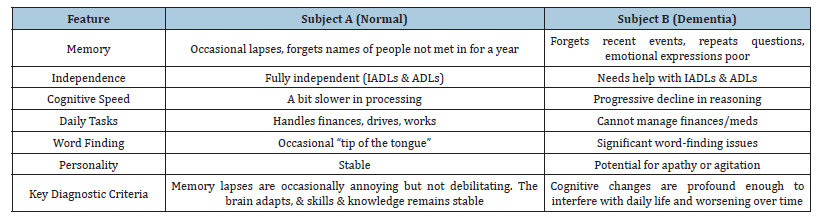
Same individual comparison at his age 60: Subject B has experienced a sharp departure from their functional baseline at 60. He was active in performing pooja and religious ceremonies. Even self-care & discipline and circadian rhythm was almost normal. Executive dysfunction, self-care and reduced social engagement are marked as evidenced by unconcerned reaction about his sonin laws Prostate Cancer diagnosis and the financial and social challenges his daughter’s family is facing in April 2026 (Table 1).
Table 1:Comparison summary.
Discussions
The word ‘dementia’ describes a set of symptoms, experienced depending on the parts of the brain damaged and the underlying conditions. Key symptoms include memory loss, confusion, language difficulties and personality changes. Alzheimer’s disease and vascular damage are the primary causes of dementia. Among the other causes disruption or irregular Circadian Rhythm, that can be reset. This condition is not a normal part of aging, symptoms are progressive, often incurable, but some are manageable [3]. Dementia occurs in about 10% of the people at some point in their lives. As age progresses, there could be a significant increase in the risk of developing the disorder. In people aged 65-74, dementia occurs in about 3%, jumps to 19% in people aged between 75-84 years and about half of the population aged over 85 years suffer from some form of dementia [4,5]. Dementia is one of the most common causes of disability among the old. The number of deaths caused due to dementia has increased significantly, doubling up between the years 1990 and 2025. The severity of dementia could be categorized based on the level of disability caused due to the neurological disorders [1,6-8].
The four main stages of dementia classified based on their severity are:
A. Mild Cognitive Impairment: This is characterized by
general forgetfulness. This occurs as age advances and is not
considered as dementia in all cases. Though this stage does
not necessarily signify dementia, it has symptoms that could
possibly progress into the disorder in certain cases alone.
B. Mild Dementia: This is a stage where a person experiences
symptoms of dementia and cognitive impairments that could
affect daily life. Memory loss, confusion, personality changes,
getting lost, difficulty in planning and executing tasks are
some of the common symptoms seen in individuals with mild
dementia.
C. Moderate Dementia: This stage of dementia is more
challenging, making the affected individual need more help.
Symptoms are like that of mild dementia but are intense and
stronger. Sleep disturbances displaying agitation and suspicion
are also seen. They could require help in performing simple
routine activities like dressing up, combing hair, etc.
D. Severe Dementia: Symptoms of dementia are the worst
in this stage. The affected individual may have a problem with
communication, speech, etc. Tasks such as sitting up, holding
up the head could become impossible. A person may also have
loss of bladder and bowel control as is in our case of Chidambar.
Full-time care is required for patients with severe dementia.
Common symptoms of dementia Symptoms often start subtly, developing into significant challenges with daily tasks include:
a) Memory Loss: Specifically forgetting recent events, names
or appointments
b) Cognitive Decline: Difficulty planning, organizing, solving
problems or handling complex tasks like finances
c) Language Difficulties: Struggling to find words, following
conversations or writing
d) Disorientation: Confusion about time, place or becoming
lost in familiar places
e) Behavioural & Mood Changes: Increased anxiety,
depression, suspicion (paranoia) or inappropriate outbursts
f) Physical Changes: Problems with coordination and
movement
A cross-sectional community-based study carried among in urban slums of Bangalore, 150 elderly individuals aged more than 60 years and who were not previously diagnosed to have any cognitive impairment were screened using Cognitive Assessment tool kit. The prevalence of cognitive impairment among the elderly participants in urban slums using GPCOG indicated that 8% of participants scored between 0-4, suggesting probable cognitive impairment and approximately 14% of participants scored ≤4 in MIS. 13.3% of participants scored below 4 in Mini Cog scale and 16% of participants scored above the critical threshold of 3.38, indicating cognitive concerns. Significant association was found with age and Circadian Rhythm. As age increased or there was disruption in Circadian Rhythm, due illness or continued physical and mental exercises there was a significant reduction in cognitive level and significantly higher prevalence with females compared to males (p<0.05) [9].
Dementia is a growing public health concern in Bengaluru, the author’s resident city. Experts from NIMHANS quoting an international study from 2024 reported the rate of dementia prevalence in Karnataka is approximately 7.61%, with around 50,000 cases in Bengaluru alone as of 2025, precise, city-wide numbers specifically isolating professional women aged over 65 are limited. Studies indicate a high prevalence, particularly among women, driven by an aging population and increasing life expectancy. A 2025 study in Bengaluru found 11.4% of participants aged 50-59 (younger older adults) had cognitive impairment, highlighting a trend towards early onset among active/recently retired individuals. The prevalence increases significantly with age; one study indicated a 7.8% prevalence for those aged 60-70, increasing to over 30% for those aged 71-80 in some Bengaluru urban areas [9]. Two years ago, the govt announced state dementia action plan but not much progress has been made in implementing the plan [10]
Another recent study is based on the Longitudinal Ageing Study in India (LASI) wave 1 (2020) with a sample size of 62,379 of which 33,137 (53.12%) are women reported that a faster decline of cognition among women than men in all age groups. The cognition index among women aged 46-55 years, 56-65 years and more than 65 years fell at a faster rate of 1.07, 1.40 and 1.67 respectively than men in respective age groups. The study further showed the decline in cognitive health occurs in both employed and unemployed women, but such decline is marginally higher among employed women than unemployed in all age groups. Employed women aged 46-55 years, 56-65 years, and more than 65 years, experience a decline in cognitive index by the faster rate of 0.09, 0.02 and 0.16 than unemployed women from the respective age groups. It means employment negatively affects women’s cognitive health. In contrast, the employment slows down the decline of cognition among men. Thus, employment affects the cognitive health of elder men & women differently. Participation of women in unskilled/ manual jobs, low socioeconomic attributes, low physical and mental activities after 60 years and gender discrimination are a few major reasons for the poor cognitive health of elder women [9]. This study found 11.4% of participants aged 50-59 (younger older adults) had cognitive impairment, highlighting a trend towards early onset among active/recently retired individuals. COVID-19 pandemic severely affected dementia care, with increased cases of wandering and challenges in accessing support systems for professionals who may be living alone or with a working spouse [11].
Main Causes and Types of Dementia
Dementia is caused by various diseases that damage brain cells and disrupt communication between them: Irreversible dementia:
a) Alzheimer’s Disease is the most common cause,
characterized by abnormal build-up of tau and amyloid proteins
(plaques and tangles)
b) Vascular Dementia caused by reduced blood flow to the
brain, following a stroke or multiple “mini strokes”
c) Lewy body dementia: Caused by abnormal, balloon-like
clumps of proteins in brain cells
d) Frontotemporal dementia: Characterized by breakdown
of nerve cells in the brain’s frontal and temporal lobes
Mixed dementia: A combination of two or more types reversible causes (dementia-like symptoms):
A. Nutritional Deficiencies: Lack of Vitamin B-12 or B-1
(thiamine)
B. Metabolic/Endocrine Problems like Thyroid issues or
dehydration
C. Infections & Immune Disorders, causing high fever or
inflammation
D. Adverse reactions to certain medications, in older adults
E. Irregular or Disruptions in Circadian Rhythm
F. Lower haemoglobin & anemia are also linked to higher
Alzheimer’s biomarkers & increased long-term dementia risk,
when combined with elevated neurodegenerative markers
[5,6].
Risk Factors
a) Age: Risk increases significantly after age 65
b) Heart Health: High blood pressure, high cholesterol and
smoking
c) Lifestyle: Lack of physical exercise and obesity
d) Family History: Genetics can play a role, particularly in
early-onset cases
Circadian rhythm is the name given to our body’s internal clock, or the pattern that each human body follows based on a 24- hour day’s biological processes. Circadian {(Circa in Latin means approximately means similar (diem) means each a day. Our circadian rhythm connects to an internal clock located in a tiny cluster of cells called “Supra-Chiasmatic Nucleus (SCN)” in the hypothalamus, a part of our brain. The internal clock genes in the SCN send signals to control the activities of our body round the clock [2]. This rhythm tells the body when to sleep and when to wake up. It also affects several other body processes, like hormones, digestion and body temperature. Each human body sets circadian rhythm naturally, guided by the brain, which is influenced by outside factors, like light, darkness, food, stress, temperature, travel, shift works etc. The circadian rhythms closely relate to daylight & night as the SCN is sensitive to light, which influences the signals that the SCN sends.
Circadian rhythm in babies, toddlers and children
Newborns typically don’t develop a circadian rhythm until they’re a few months old, resulting in erratic sleep patterns in the first few days, weeks and months. A baby’s circadian rhythm begins to develop once they start experiencing changes to their bodies from comforts of womb & adapt to new environment. Babies usually start to produce and release melatonin when they’re about 3 months old. Cortisol development occurs between 2 months and 9 months. Once toddlers and children develop a circadian rhythm, they have a regular sleep schedule, getting nine to 10 hours of sleep each night. When they are younger, they have early bedtimes (8:00- 9:00 p.m.).
Circadian rhythm in teenagers
During their teen years, children experience a sleep phase delay, which is a shift in their circadian rhythm, and the teens do not get tired until much later. Their melatonin level may not rise until around 10:00-11:00 p.m. As they go to bed late, they need to sleep late into the morning, as they need 9 to 10 hours of sleep a night.
Circadian rhythm in adults
If adults practice healthy habits and follow a regular schedule to get 7 to 9 hours of sleep at night, they will have a consistent circadian rhythm.
Circadian rhythm in Elderly
People over the age of 60 notice that their circadian rhythm changes as they get older & they go to bed earlier and wake up earlier, too, as part of aging.
External factors that affect circadian rhythm
Light and dark have the biggest effect on our circadian rhythm. Other external things an influence it, include i) Food intake ii) Stress iii) Physical activity iv) Temperature v) Overnight or off-hour work shifts vi) Travel vii) Mental health conditions viii) Certain medications ix) Diseases of the brain x) Poor sleep habits.
Circadian rhythm disorder
Changes to circadian rhythm are a sign of a more serious health
condition and are called circadian rhythm disorders include [2-4].
a) Delayed sleep phase syndrome: This disorder affects
people known as “night owls” who go to bed and wake up two
or more hours later than most people.
b) Advanced sleep phase disorder: These individuals fall
asleep three or more hours before most people and then wake
up very early, mostly seen in elderly patients with cognitive
impairment/dementia.
c) Jet lag: Jet lag is a condition that occurs when individuals
travel over three or more time zones by airplane, and experience
insomnia, extreme tiredness etc.
d) Shift work sleep disorder (SWSD): SWSD occurs when a
person works in a job that has untraditional or unpredictable
hours, causing insomnia, trouble staying asleep and
inappropriate sleepiness.
e) Irregular sleep-wake disorder: In this condition,
individual’s body can’t set a regular wake and sleep schedule.
Outcomes of Circadian Rhythm’s Disruption
Short-term circadian rhythm disruptions result in
i) a delay in healing wounds ii) Changes to hormones iii) Indigestion issues iv) Fluctuations in body temperature v) Lack of energy vi) Memory loss.
Long-term health conditions of circadian rhythm disruptions
i) Cardiovascular system ii) Metabolism iii) Gastrointestinal system iii) Endocrine system iv) Nervous system.
Maintaining or fixing circadian rhythm
To reset circadian rhythm, body needs to follow a healthy 24- hour schedule. following tips help to stay on track: i) Try to stick to a daily routine ii) Go outside when it’s light out to boost your sense of wakefulness iii) Treatment using light occurs in the morning specifically, and is important to avoid chronic sleep deprivation as part of treatment iv) Get some form of daily physical activity v) Foster a restful sleep environment by making sure sleeping on a supportive mattress in a room with a comfortable temperature and proper lighting vi) Avoid caffeine, nicotine and alcohol, especially in the evenings viii) Limit your screen time before bedtime, as the blue light can disrupt your ability to fall asleep. Instead, try meditating or reading a book xi) Don’t take a nap in the late afternoons or evenings.
Seek consultation of a healthcare provider
i) feel difficulty in getting enough sleep every night ii) trouble falling asleep easily iii) waking up throughout the night iv) problems waking up in the morning v) extreme fatigue during the day.
Light therapy
A. Sitting, each day in front of a light box, which produces
bright light like sunlight. Light visors and light glasses may also
be effective. Light therapy helps adjust how much melatonin
your body makes to reset your sleep-wake cycle.
B. To move your sleep and wake earlier, use the light box
when you wake up in the morning which also reduces daytime
sleepiness. This method is used to help treat delayed sleepwake
phase disorder, irregular sleep-wake rhythm disorder,
and jet lag disorder when you travel east.
C. To move your sleep & wake later, use the light box late in
the afternoon or early in the evening. This method is used to
treat advanced sleep-wake phase disorder, shift work disorder,
and jet lag disorder when you travel west. Side effects of light
therapy may include agitation, eye strain, headaches, migraines
and nausea.
Medicines or supplements
Melatonin Receptor Agonists (MRAs) can help treat non-24-hour sleep-wake rhythm disorder. Melatonin supplements (3mg, 5mg, 10mg) and certain specialized prescription drugs like Ramelteon and Agomelatine. These medications are commonly used to treat insomnia, specifically difficulty in falling asleep, as well as jet lag and circadian rhythm disorders. Melatonin is widely available in India, as nutraceuticals or OTC (Some commonly used drugs include- Meloset (Aristo Pharmaceuticals): 3mg, Noctura (Fourrts India Laboratories): 3mg, Movacalm (Mova Pharmaceuticals): 5mg, Cirkedian (Sharing Formulations): 10mg, Somelin (East West Pharma): 3mg, Altonin/ALTonil (Alteus Biogenics): 3mg/5mg, Melarian (Ardent Lifesciences): 5mg, Meladate (Mankind Pharma), GNC Melatonin (Guardian Healthcare): 3mg with Vitamin B6 and Sleeping (1mg) sleep-promoting medicines, such as benzodiazepines and zolpidem, can help you fall asleep faster and stay asleep longer. However, these medicines cause side effects & complications, such as muscle weakness and confusion more severe in older adults & dementia. People. Wake-promoting medicines, such as modafinil and armodafinil, can help you stay alert and improve performance during shift work. The effects last only for a short time, and one can still experience some sleepiness. A recent study published in Neurology demonstrated an association rather than causation that older adults with weaker and more irregular circadian rhythms and individuals whose daily activity peaks later in the day, exhibited increased risk of Dementia after 60 years age. The study enrolled 2,183 adults with a mean age of 79 years, all of whom were free of dementia at baseline. Participants wore chest-mounted monitors for approximately 12 days to record rest– activity patterns and were followed for three years, during which 176 developed dementia. Individuals with the weakest circadian rhythms had nearly 2.5 times risk of dementia compared to those with the strongest rhythms. Those whose activity peaked later in the afternoon also demonstrated increased risk. Researchers infer that disturbed circadian rhythms affects sleep and inflammation, potentially contributing to dementia, and call for further research into light therapy and lifestyle interventions.
Key strategies to reset our internal clock
a) Morning Sunlight Exposure -get 20-30 minutes of sunlight
immediately upon waking to signal wakefulness.
b) Go to bed and wake up at the same time every day,
including weekends.
c) Dim lights in the evening and avoid phones, tablets, or
computers at least 1 hour before bed.
d) Eat breakfast shortly after waking and avoid large meals
close to bedtime
e) Exercise during the day but avoid intense workouts
shortly before sleep
f) Relaxing Bedtime Routine Establish a calming routine,
such as reading or meditating, to help the body prepare for rest.
g) Shifting sleep and wake times by 15-30 minutes earlier or
later each day rather than making abrupt changes
h) Limit Naps: Avoid long or late afternoon naps, which can
disrupt your ability to fall asleep at night.
Haemoglobin and Anaemia in Relation to Dementia Risk
In a study of 2,300 older adults without dementia, anaemia was cross-sectionally associated with higher levels of serum phosphorylated tau 217 (p-tau 217; β=0.22), neurofilament light chain (NfL; β=0.25) and glial fibrillary acidic protein (GFAP; β=0.08). Anaemia was longitudinally associated with a higher risk of incident dementia over a mean follow-up of 9 years (HR 1.66), as reported by the Karolinska Institute in Stockholm and co-authors [6]. Another study among 5,267 participants without dementia with brain MRI, haemoglobin (Hb%) was assessed in relation to vascular brain disease, structural connectivity and global cerebral perfusion. During a mean follow-up of 12.1 years, 1,520 individuals developed dementia, 1,194 of whom had AD and a U-shaped association between haemoglobin levels and dementia (p=0.005), such that both low and high haemoglobin levels were associated with increased dementia risk. While Overall prevalence of anaemia was 6.1%, and anaemia was associated with a 34% increased risk of dementia (95%) and 41% (15%-74%) for AD. Among individuals without dementia with brain MRI, similar U-shaped associations were seen of haemoglobin with white matter hyperintensity volume (p=0.03), and structural connectivity (for mean diffusivity, p<0.0001), but not with presence of cortical and lacunar infarcts. Cerebral microbleeds were more common with anaemia. Haemoglobin levels inversely correlated to cerebral perfusion (p < 0.0001).
“Dementia risk was particularly high when anaemia co-occurred with high levels of blood biomarkers reflecting Alzheimer’s disease pathology, neurodegeneration, and glial activation. This suggests a biological interplay between anaemia and neuropathology, in which low haemoglobin may not only contribute to neuropathology but also reduce the brain’s resilience to it, the researchers opined. It appears that anaemia is a clinically relevant factor in the context of dementia risk stratification and is possibly a modifiable target in dementia prevention strategies. A causal role of anaemia in dementia aetiology could have substantial public health implications [7].
Conclusion
Two recent studies published have drawn global attention to reversible Dementia. The first in Neurology found that older adults with weaker and more irregular circadian rhythms and individuals whose daily activity peaks later in the day exhibited increased risk. The authors emphasized that these findings demonstrate an association rather than causation. Robust circadian rhythms help maintain stable daily routines, whereas weaker rhythms increase vulnerability to disruptions caused by changes in light exposure and daily schedules. Second study has shown association with Hb% and Anaemia. It appears that anaemia is a clinically relevant factor in the context of dementia risk stratification and is possibly a modifiable target in dementia prevention strategies. A causal role of anaemia in dementia aetiology could have substantial public health implications. This article discussed addressing both these preventable challenges.
References
- Rizzuto D, Bellocco R, Kivipelto M, Clerici F, Wimo A, et al. (2012) Dementia after age 75: Survival in different severity stages and years of life lost. Curr Alzheimer Res 9(7): 795-800.
- Circadian rhythm.
- Circadian-rhythm-disorders, treatment.
- (2025) Irregular Circadian Rhythms Linked to Greater Dementia Risks.
- Weaker-and-fragmented-circadian-rhythms-linked-to-higher-dementia-risk.
- Lower haemoglobin & anaemia are associated with increased risk of dementia and higher Alzheimer’s disease blood biomarkers in older adults.
- Wolters FJ, Zonneveld HI, Licher S, Cremers LGM, Ikram MK, et al. (2019) Hemoglobin and anemia in relation to dementia risk and accompanying changes on brain MRI. Neurology 93(9): e917-e926.
- Memory Loss: Dementia vs. Normal Aging.
- Ramakrishna N, Kishore SG, Aswinkumar S, Shanmugapriya D, Karthik C, et al. (2024) Cognitive impairment among elderly in urban slums of Bangalore - A community based cross sectional study. International Journal of Pharmaceutical and Clinical Research 16(10): 1087-1091.
- (2025) 2 years on, not much progress on Karnataka dementia action plan.
- Ahmed S, Shrivastava S, Kumari P (2025) Cognitive health of elder working women in India: evidence from LASI survey. Discov Public Health 22 pp. 76.
© 2026 Suresh K. This is an open access article distributed under the terms of the Creative Commons Attribution License , which permits unrestricted use, distribution, and build upon your work non-commercially.
Editor In Chief







.jpg)































Signup for Newsletter

Quick Links
 Editorial Board Registrations
 Submit your Article
 Best Paper of the Volume
 Reprints
 Refer a Friend
 Advertise With Us
Our Recent Edition

.jpg)



Top Editors




.jpg)

















.bmp)
.jpg)
.png)
.jpg)













.jpg)






.png)

.png)




.png)




Financial Support

Sponsors

Latest e-Books

Latest Video

 a Creative Commons Attribution 4.0 International License. Based on a work at www.crimsonpublishers.com.
Best viewed in
a Creative Commons Attribution 4.0 International License. Based on a work at www.crimsonpublishers.com.
Best viewed in 
 | Above IE 9.0 version