

- About Us
- Information
-

The Author ensures that the research has been conducted responsibly and ethically with adherence to all relevant regulations. read more..
- For Authors
- For Reviewer
- Manuscript Guidelines
- Membership
- Publication Ethics
-
- Journals
- Reprints
- e-Books
- Videos
- Policies
- Contact Us
 COVID-19
- Submissions



Full Text
Gerontology & Geriatrics Studies
Parental Knowledge, Awareness, and Compliance with the Ponseti Method for Clubfoot Management: A Cross-Sectional Study at a Tertiary Care Hospital in Swabi, Pakistan
Amina Minahil* and Natalia Umar Khan
Department of Orthopedics, Bacha Khan Medical Complex (BKMC)/ Gajju Khan Medical College, Pakistan
*Corresponding author:Amina Minahil, Department of Orthopedics, Bacha Khan Medical Complex (BKMC) / Gajju Khan Medical College, Swabi, Pakistan
Submission: April 24, 2026; Published: May 12, 2026
ISSN 2578-0093Volume10 Issue 2
Abstract
Clubfoot (congenital talipes equinovarus) is one of the most common congenital lower limb deformities worldwide, affecting approximately 1-2 per 1,000 live births. In Pakistan, an estimated 6,000-7,000 children are born with clubfoot annually. The Ponseti method, a non-surgical approach involving sequential casting, Achilles tenotomy, and prolonged bracing for up to four to five years, has a success rate of 68-95% when parents adhere fully. However, in low-resource settings like rural Pakistan, treatment outcomes are often compromised by poor parental knowledge, inadequate awareness, and suboptimal compliance. This descriptive cross-sectional study was conducted at Bacha Khan Medical Complex, Swabi, to assess parental knowledge regarding the causes and treatment of clubfoot, evaluate awareness after counseling about the Ponseti method, and determine compliance with casting, bracing, and follow-up visits. Parents of 34 children under five years of age with idiopathic clubfoot were interviewed using a structured, pretested questionnaire. Data were analyzed using SPSS version 25; frequencies, percentages, and chi-square tests were applied. The results showed that 61.8% of affected children were male, and 82.4% lived in rural areas. Overall, 70.6% of parents did not know the cause of clubfoot, and only 23.5% correctly identified it as congenital. Encouragingly, 82.4% believed clubfoot is treatable. Although 79.4% reported receiving full counseling, only 64.7% understood the importance of the brace, and just 29.4% knew the correct brace duration (until age four). Compliance with weekly cast changes was 73.5%, and good brace usage was reported by 64.7%. Major barriers to adherence included financial constraints (11.8%) and work commitments (11.8%). Higher parental education was significantly associated with better knowledge of treatment options (p=0.003) and awareness of brace protocol (p=0.001). In conclusion, despite reasonable access to treatment, significant gaps exist in parental knowledge and compliance, particularly regarding brace duration. Repeated, literacy-sensitive counseling and visual aids are urgently needed to improve long-term adherence and reduce relapse rates..
Background and Introduction
The burden of clubfoot worldwide and in Pakistan
Clubfoot, medically termed congenital talipes equinovarus (CTEV), is a structural deformity of the foot and ankle present at birth. The foot is twisted inward (adduction) and downward (equinus), with the heel turned inward (varus) and a high arch (cavus). If left untreated, the child walks on the side or top of the foot, leading to pain, disability, social stigma, and inability to wear normal shoes. Globally, clubfoot affects 1 to 2 children per 1,000 live births. This translates to approximately 150,000 to 200,000 new cases annually. About 80% of affected children are born in Low- and Middle-Income Countries (LMICs), where access to timely treatment is limited. In Pakistan, the estimated incidence ranges from 1.4 to 1.5 per 1,000 live births, meaning 6,000 to 7,000 children are born with clubfoot each year. A hospital-based study conducted across five major hospitals in Khyber Pakhtunkhwa (KP) province found that among 1,000 patients with lower limb abnormalities, clubfoot accounted for 36.2% (n=362) of cases. Of these, 62.7% were bilateral, and 86.7% were congenital (idiopathic) rather than syndromic or neurogenic. The majority of children presented between 1 and 5 years of age, indicating delayed diagnosis and treatment initiation-a common problem in resource-limited areas.
The ponseti method: principles and challenges
The Ponseti method, developed by Dr. Ignacio Ponseti in the
1950s, revolutionized clubfoot treatment. It consists of two phases:
Corrective phase: Weekly gentle manipulation and longleg
plaster casting for 4 to 6 weeks, gradually correcting the
deformity. In most cases, a percutaneous Achilles tenotomy (a
minor procedure under local anesthesia) is performed to correct
the equinus deformity
Maintenance phase: After correction, the child wears a Foot
Abduction Brace (FAB) for 23 hours per day for the first 3 months,
then during sleep (11-12 hours per night) until 4 to 5 years of age.
This phase prevents relapse.
The Ponseti method has a success rate of 68% to 95% when
followed correctly. It is low- cost, non-surgical, and can be delivered
by trained healthcare workers even in basic facilities. However,
its success depends almost entirely on parental adherence to
the long bracing schedule and regular follow-up visits. In highincome
countries, relapse rates are low (under 10%) because
parents receive clear, repeated instructions and have easy access to
healthcare. In contrast, in Pakistan and other LMICs, relapse rates
range from 20% to 50% due to:
A. Late presentation (children often start treatment after 1
year of age).
B. Dropout from casting or bracing.
C. Misunderstanding of brace duration (parents stop bracing
after a few months).
D. Financial and logistical barriers (transport costs, loss of
daily wages).
E. Low parental literacy and lack of culturally appropriate
counseling.
The knowledge-awareness-compliance gap
Research from Karachi, Peshawar, and rural India has consistently shown that many parents believe clubfoot is caused by supernatural forces, poor maternal nutrition, or the mother’s position during pregnancy. Few know it is a congenital, treatable condition. Even after counseling, parents often forget or misunderstand key instructions, especially the duration of bracing.
Compliance is multi-dimensional:
a) Knowledge: Does the parent understand what clubfoot is
and why treatment is needed?
b) Awareness: Has the parent been told about each step
(casting, tenotomy, bracing, follow-up)?
c) Compliance: Does the parent actually attend appointments
and use the brace as prescribed?
These three elements are linked. A parent who does not know that the brace must be used until age 4 will stop early, leading to relapse. A parent who has not been counseled about the consequences of discontinuation may drop out when the child seems “cured.”
Rationale for this study
Bacha Khan Medical Complex (BKMC) in Swabi is a tertiary care teaching hospital serving a predominantly rural, low-income population in Khyber Pakhtunkhwa. The orthopedics department runs a Ponseti clinic, but no formal assessment of parental knowledge, awareness, and compliance had been conducted before this study. Without such data, interventions to improve adherence are guesswork.
Therefore, this study was designed to answer three specific
questions:
A. What do parents of children with clubfoot in Swabi know
about the cause and treatment of the condition?
B. Have they received adequate counseling about the Ponseti
protocol, and what do they understand about brace use?
C. How compliant are they with casting, bracing, and followup,
and what barriers do they face?
By answering these questions, we aimed to provide evidencebased recommendations for improving counseling and reducing relapse rates in this setting.
Study objectives Primary objectives:
a) To assess parental knowledge regarding the causes of
clubfoot and available treatment options.
b) To evaluate parental awareness regarding the Ponseti
treatment protocol, brace use, and the counseling they received.
c) To determine parental compliance with casting, bracing,
and follow-up visits during Ponseti treatment.
Secondary objective:
To identify associations between demographic variables (parental education, residence) and knowledge/ awareness/ compliance.
Literature Review
Global epidemiology and etiology of clubfoot
Clubfoot has been described in medical literature for centuries.
The exact cause remains unknown in most cases (idiopathic). The
current consensus is that idiopathic clubfoot has a multifactorial
etiology involving both genetic and environmental factors. Evidence
for genetic influence includes:
A. A 30% heritability rate in isolated clubfoot.
B. Higher concordance in monozygotic twins (33%) than
dizygotic twins (3%).
C. Association with variations in genes involved in limb
development, such as PITX1-TBX4 pathway, HOXC genes, and
FLNB.
Environmental risk factors include maternal smoking during pregnancy, oligohydramnios, and possibly folic acid deficiency. However, in most low-income settings, parents are unaware of these factors and often attribute clubfoot to myths.
The ponseti method: Evidence of effectiveness
Multiple systematic reviews have confirmed the Ponseti method as superior to surgical approaches for idiopathic clubfoot. A 2018 global review by Owen et al. reported initial correction rates of over 90% with casting and tenotomy, and long-term relapse rates under15% when bracing adherence is good. However, the same review noted that in LMICs, relapse rates exceed 30% due to poor compliance. In Pakistan, a large retrospective study by Ahmed et al. (2022) reviewed 988 patients (1,458 clubfeet) treated with the Ponseti method over 8 years. They found that 82% achieved initial correction, but brace compliance was the single strongest predictor of relapse. Children whose parents had higher education and received repeated counseling had significantly better outcomes.
Parental knowledge and misconceptions
A qualitative study by Burfat et al [1] in Karachi explored
parental perceptions of clubfoot. The researchers conducted indepth
interviews and found that:
a) Many parents believed clubfoot was caused by “evil eye,” a
curse, or the mother stepping over a rope during pregnancy.
b) Some thought the deformity would correct itself as the
child grew.
c) Few knew that clubfoot is treatable with casting and
bracing.
d) After diagnosis, parents felt guilty and anxious, but proper
counseling alleviated these feelings.
Similarly, a study from Bangladesh (reported in the CMOSHMCJ) found that 90% of parents had no knowledge of clubfoot before their child was born. After counseling, knowledge improved, but only 40% could correctly recall the brace duration. In rural India [2]. conducted focus groups and identified the following barriers: poverty, distance to treatment center, lack of family support, and poor communication from healthcare providers. Parents reported that doctors often spoke too quickly or used technical terms they did not understand.
Compliance and its determinants
Compliance is a behavior influenced by multiple factors. A
cross-sectional study from Peshawar by Manzoor et al [3]. found
that among 100 clubfoot patients, 23% had discontinued treatment.
The main reasons were:
A. Financial problems (32%).
B. Long distance to hospital (28%).
C. Belief that the foot was already corrected (24%).
D. Child discomfort with brace (16%).
Parental education was the only demographic factor significantly associated with dropout (p=0.01). Parents with no formal education were 4 times more likely to discontinue than those with secondary education. Another study from Sindh (published in JRMC, 2022) reported that among 150 patients, 68% were compliant with bracing. Non-compliance was associated with relapse in 82% of cases. The authors recommended that every follow-up visit should include a “brace check” and re-counseling [4].
The role of counseling and health education
Counseling is not a one-time event. Studies from Uganda,
Malawi, and Nepal have shown that repeated, simplified, and
culturally adapted counseling improves adherence. Effective
strategies include:
a) Using local language and simple words (no medical
jargon).
b) Demonstrating brace application and removal.
c) Providing written or pictorial instructions for low-literacy
parents.
d) Involving both parents and grandparents (who often
influence decisions).
e) Using mobile phone reminders (SMS or WhatsApp) for
appointments.
In Pakistan, a pilot study in Lahore tested a “counseling plus calendar” intervention: parents received a large wall calendar showing brace hours per day for each month. Compliance improved from 58% to 81% over 6 months [5].
Gaps in the literature specific to Khyber Pakhtunkhwa
While studies exist from Karachi, Peshawar, and Sindh, no published research has specifically examined parental knowledge, awareness, and compliance in the Swabi district or at BKMC. Given that Swabi is a rural, agricultural area with lower literacy rates than urban centers, findings from Karachi (urban) may not apply. This study fills that geographic and contextual gap [6].
Study Scope and Methodology
Study design and setting
This was a descriptive, cross-sectional study conducted at the Department of Orthopedics, Bacha Khan Medical Complex (BKMC), Swabi. BKMC is a 500-bed tertiary care teaching hospital affiliated with Gajju Khan Medical College. It serves a population of approximately 1.6 million people from Swabi and the surrounding districts (Mardan, Nowshera, Buner). The orthopedics department runs a dedicated Ponseti clubfoot clinic twice per week [7].
Study duration
The study was conducted over 6 months, from [insert start date] to [insert end date]. Data collection took place over 4 months, followed by data entry, analysis, and manuscript writing.
Study population Inclusion criteria:
A. Parents or primary guardians of children diagnosed with
idiopathic clubfoot (no associated syndrome or neurological
condition).
B. Children who had initiated Ponseti treatment (casting,
bracing, or both) at BKMC.
C. Children under 5 years of age at the time of data collection.
D. Parents who gave written informed consent and were
willing to be interviewed.
Exclusion criteria:
a) Children with syndromic clubfoot (e.g., arthrogryposis,
myelomeningocele, Larsen syndrome).
b) Children with neurogenic clubfoot (e.g., spina bifida,
cerebral palsy).
c) Children above 5 years of age.
d) Children who had undergone primary surgical treatment
(e.g., posteromedial release) without prior Ponseti casting.
e) Parents who were unable to communicate in Urdu or
Pashto.
Sample size and sampling technique
The sample size was 34 participants. This was a convenience sample based on the number of eligible children presenting to the Ponseti clinic during the data collection period (approximately 2-3 new or follow-up patients per week). Given the descriptive nature of the study and the absence of previous local data, this sample size was deemed sufficient for preliminary analysis. We used consecutive sampling: every eligible parent who visited the clinic during the study period and consented to participate was enrolled [8].
Variables of interest Independent variables (demographic):
A. Child’s age (months/years)
B. Child’s gender (male/female)
C. Residence (urban/rural)
D. Parental education (none, primary, secondary, higher)
E. Type of clubfoot (unilateral right, unilateral left, bilateral)
F. Current treatment status (ongoing, going to start,
discontinued)
Dependent variables
a) Knowledge: Cause of clubfoot, treatability, prior
knowledge of treatment options.
b) Awareness: Whether counseled about full protocol,
knowledge of brace importance, knowledge of brace duration,
and awareness of consequences of discontinuation.
c) Compliance: Attendance at cast change appointments,
brace usage (regular/partial/none), problems with casting/
brace, and reasons for missed visits.
Data collection tool
A structured, pretested questionnaire was developed in English,
then translated into Urdu and Pashtu by a bilingual translator. Backtranslation
was performed to ensure accuracy. The questionnaire
had 5 sections:
A. Demographics (7 items)
B. Knowledge (3 main questions with sub-items)
C. Awareness and Counseling (4 questions)
D. Compliance (5 questions)
E. Barriers to adherence (1 multiple-response question)
The questionnaire was pretested on 5 parents (not included in the final sample) to check clarity, comprehension, and length. Modifications were made to simplify wording [9].
Data collection procedure
The principal investigator (Amina Minahil) personally interviewed each parent in a private room at the orthopedics outpatient department after their child’s clinic visit. Each interview took 15-20 minutes. Parents were assured that their responses would not affect their child’s treatment. No incentives were provided. Written informed consent was obtained before each interview [10].
Data entry and statistical analysis
Data were entered into Microsoft Excel and then imported
into SPSS version 25 (IBM Corp., Armonk, NY, USA). The following
statistical procedures were performed:
a) Descriptive statistics: Frequencies (n) and percentages
(%) for categorical variables. Means and standard deviations
for continuous variables (e.g., child’s age).
b) Inferential statistics: Chi-square (χ²) tests of
independence to examine associations between categorical
independent variables (parental education, residence) and
categorical dependent variables (knowledge, awareness,
compliance). Fisher’s exact test was used when expected cell
counts were <5.
c) Statistical significance: p-value <0.05 (two-tailed).
Ethical considerations
Ethical approval was obtained from the Research Ethical Committee of Gajju Khan Medical College, Swabi. The study adhered to the Declaration of Helsinki. All participants provided written informed consent after the purpose, procedures, risks (none), and benefits (none direct, but contribution to knowledge) were explained. Parents were informed that they could withdraw at any time without any consequence to their child’s care. Data were anonymized: Each questionnaire was assigned a unique ID number, and no names appeared in the final dataset or manuscript [11].
Operational definitions
A. Successful treatment: Plantigrade (flat), painless,
flexible foot at the end of the casting phase, with a Pirani score
<1.
B. Compliance (good): Attending all weekly cast change
appointments and using the brace regularly as advised (23
hours/day for first 3 months, then night-time).
C. Partial compliance: Missing some appointments or
using brace inconsistently (e.g., only at night from the start).
D. Non-compliance: Discontinuing treatment without
medical advice or never using the brace.
E. Counseled: Parent reported that a doctor, nurse, or
physiotherapist explained the full treatment protocol (casting,
tenotomy, bracing, duration, follow-up) in a language they
understood.
F. Rural residence: Living outside the municipal limits of
Swabi city, typically in a village with unpaved roads and no
public transport.
Results
Demographic characteristics of the study population
A total of 34 parents (one parent per child) participated. No one refused consent. The demographic characteristics are summarized in Table 1.
Table 1:Demographic characteristics of children and parents (N=34).
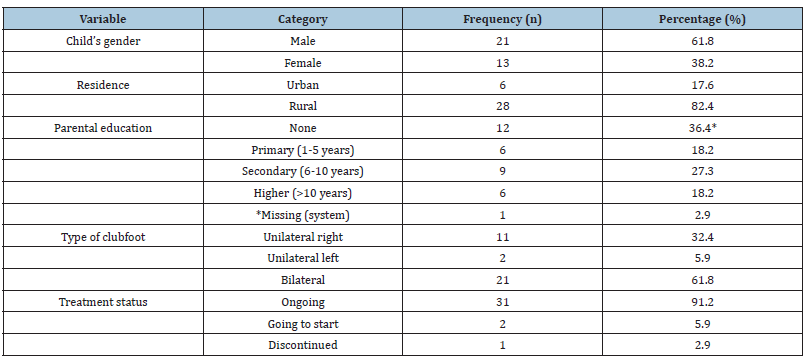
*Percentage calculated on valid cases (n=33 after excluding missing).
Key findings:
a) Male predominance (61.8%) is consistent with the
known 2:1 male-to-female ratio in idiopathic clubfoot.
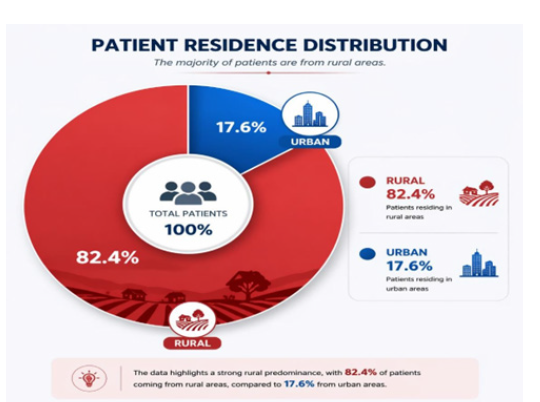
b) Rural majority (82.4%) reflects the catchment area of
BKMC and has important implications for transport and followup.
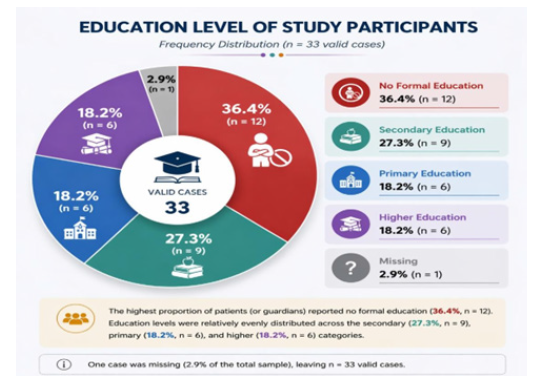
c) Low education: Over one-third of parents (36.4%) had
no formal schooling, and only 18.2% had higher education.
This is a major risk factor for poor understanding of medical
instructions.
d) Bilateral involvement (61.8%) is common and requires
even more intensive parental effort (two braces, double the
monitoring) (Figure 1).
Figure 1:Patient residence distribution.
Parental knowledge about clubfoot
Table 2:Parental knowledge about Clubfoot (N=34).

Table 2 presents parental responses regarding knowledge of cause, treatability, and prior awareness of treatment.
Interpretation
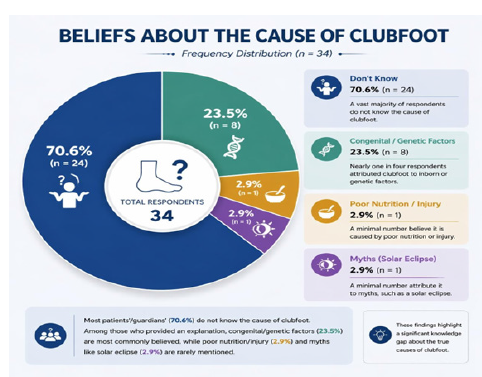
A. Poor knowledge of cause: 70.6% of parents could not
identify any cause. Only 23.5% correctly said, “congenital/
genetic.” This suggests that basic health education about birth
defects is lacking in the community.
B. Hopeful attitude: Despite not knowing the cause, 82.4%
believed clubfoot is treatable. This is an encouraging finding
because belief in treatability is a prerequisite for seeking care
and adhering to treatment.
C. Low prior awareness: 76.5% did not know treatment
options before attending BKMC. Most learned about the Ponseti
method only when they arrived at the hospital. This indicates
poor community-level awareness and the need for outreach.
Parental awareness after counseling
All parents had received at least some counseling at BKMC (since they were attending the clinic). Table 3 shows their awareness of key treatment elements (Figure 2).
Table 3:Parental awareness after counseling (N=34).
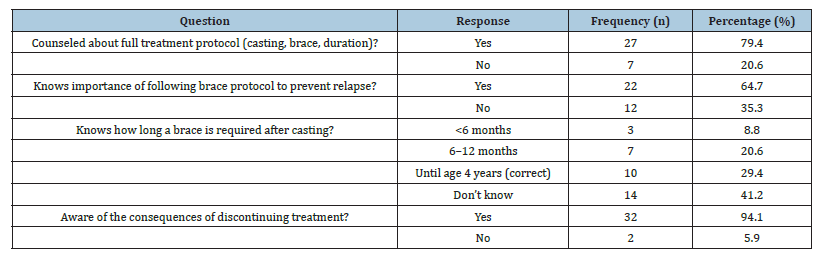
Figure 2:Education level of study participants.
Critical gaps:
a) Counseling not universal: 20.6% reported they were
not counseled about the full protocol. This likely means they
received fragmented instructions (e.g., only about casting, not
about bracing duration). This is a health system failure.
b) The importance was understood by only 64.7%:
Over one-third did not understand why the brace is essential.
Without this understanding, parents may view the brace as
optional or unnecessary.
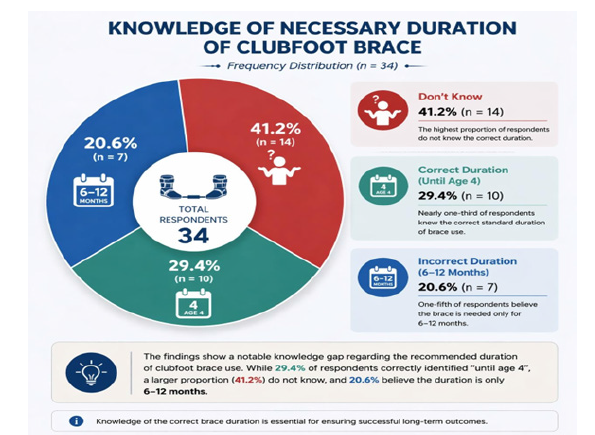
c) Brace duration knowledge is dangerously low: Only
29.4% knew the correct answer (“until age 4”). 41.2% admitted
they did not know, and 29.4% gave incorrect short durations
(6-12 months). This is the single most important knowledge
gap because premature brace discontinuation is the leading
cause of relapse.
d) Good awareness of consequences: 94.1% knew that
stopping treatment would harm their child. This is positive
and suggests that healthcare workers emphasize the risks of
dropout, even if they do not explain the timeline well.
Source of information about treatment services
When asked how they heard about clubfoot services at BKMC, responses were equally split: 50% from doctors (referral from another hospital or doctor) and 50% from relatives/friends. This highlights the importance of word-of-mouth in rural communities. None reported the internet as a source, reflecting limited digital access (Figure 3).
Figure 3:Cause of clubfoot.
Compliance with ponseti treatment
Table 4:Parental compliance (N=34).
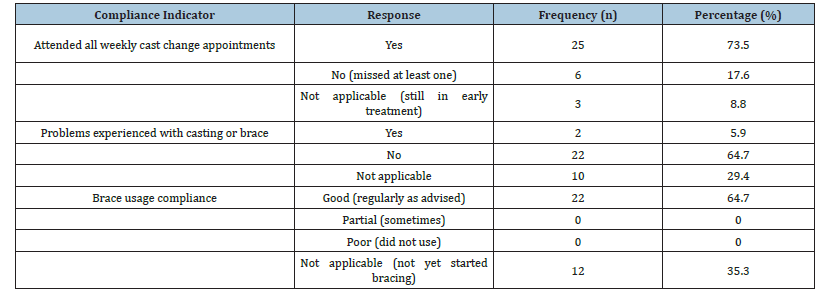
Compliance was assessed separately for casting attendance and brace usage (Table 4).
Interpretation
A. Cast attendance is acceptable but not ideal: 73.5%
attended all weekly appointments. This is higher than many LMIC
studies (where 50-60% attendance is common). However, 17.6%
missed at least one appointment, which can prolong treatment and
increase risk of incomplete correction.
B. Brace compliance is a concern: Among those who had
reached the bracing phase (n=22, since 12 were not yet in bracing),
all reported good compliance. However, this is self-reported and
may be inflated by social desirability bias. The fact that 35.3% of the
total sample were “not applicable” (i.e., had not yet started bracing)
means we cannot assess long-term adherence for the entire cohort.
In clinical experience, parents often comply well with casting but
drop off during the multi- year bracing phase.
C. Few problems with devices: Only 5.9% reported
problems (e.g., blisters, poor fit). This suggests that technical issues
are not the main barrier.
Barriers to adherence
Parents who missed appointments or reported difficulty in compliance were asked to specify reasons (multiple responses allowed). Table 5 shows the distribution.
Table 5:Reasons for missed visits or non-adherence (N=34, multiple responses possible).

Key insight: Among those who were non-adherent (29.4% of the sample), financial constraints and work commitments were equally important (each 11.8%). This reflects the reality of rural poverty: A day lost from farming or daily wage labor means lost income. Even if treatment is free at BKMC, the indirect costs (transport, food, lost wages) are prohibitive for some families (Figure 4).
Figure 4:Duration of clubfoot brace.
No parent cited “child discomfort” or “doctor’s attitude” as a reason, suggesting that these are not major issues at BKMC.
Inferential analysis: Associations with parental education
Table 6:Parental education vs. prior knowledge of treatment options..

We performed chi-square tests to examine whether parental education was associated with key knowledge and awareness outcomes. Table 6 shows the cross-tabulation for “prior knowledge of treatment options.”
Chi-square test result: χ² (3) = 13.83, p = 0.003 (statistically significant).
Interpretation: There is a strong, graded association between education level and prior knowledge. Among parents with no education, only 15.4% knew about treatment options before coming to BKMC. Among those with higher education, 100% knew. This confirms that low literacy is a major barrier to health knowledge and that special efforts are needed for uneducated parents (Table 7).
Table 7:Parental education vs. awareness of brace importance.

Chi-square test: Due to cells with zero counts, Fisher’s exact test was used. p = 0.001 (statistically significant).
Interpretation: Education is again strongly associated with understanding why the brace is important. None of the parents with secondary or higher education lacked this awareness, whereas 76.9% of those with no education did not understand the brace’s role (Figure 5).
Figure 5:Weekly cast change appointments.
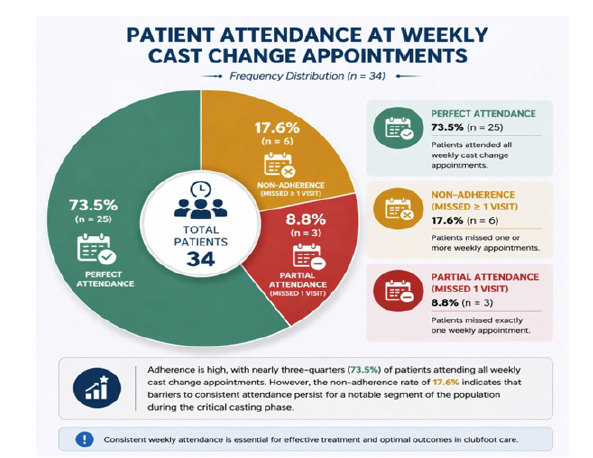
Association between residence and attendance: We also tested whether rural residence was associated with missing cast appointments. Among rural residents (n=28), 6 (21.4%) missed at least one appointment. Among urban residents (n=6), none missed any. However, the chi-square test was not statistically significant (p=0.269), likely due to the small number of urban participants. Descriptively, the trend is meaningful.
Discussion
Summary of key findings
This study provides the first quantitative assessment of
parental knowledge, awareness, and compliance with the Ponseti
method at BKMC, Swabi. The main findings are:
a) Knowledge is poor: 70.6% of parents do not know the
cause of clubfoot. Only 23.5% correctly identify it as congenital.
b) Belief in treatability is high (82.4%) - a foundation for
adherence.
c) Counseling is incomplete: 20.6% reported not
receiving full protocol counseling. Even among those who did,
understanding of brace duration is very low: only 29.4% know
the brace is needed until age 4.
d) Compliance with casting is good (73.5%), but brace
compliance cannot be fully assessed due to many children still
in early treatment.
e) Barriers are primarily socioeconomic: financial issues
and work commitments, not device problems.
f) Parental education is the strongest predictor of
knowledge and awareness (p=0.003 and p=0.001).
Comparison with previous studies
Our finding that 70.6% of parents do not know the cause of clubfoot is consistent with Burfat et al [1] in Karachi, where most parents attributed clubfoot to supernatural or dietary factors. However, our study found fewer parents endorsing myths (only 2.9% mentioned solar eclipse or evil eye) compared to the Karachi study. This may reflect differences in question phrasing or a genuine shift over time. The high belief in treatability (82.4%) is higher than reported in some LMIC studies. For example, a 2019 study in rural Ethiopia found that only 45% of parents believed clubfoot could be treated. The difference may be because BKMC has an established Ponseti clinic, and parents who attend have already overcome initial barriers and witnessed other children improving. Our compliance rate for cast attendance (73.5%) is similar to the 70-80% reported in other Pakistani studies. However, it is lower than high-income countries (over 95%). The reasons are not lack of motivation but practical barriers: a rural parent may need to spend 500-1000 PKR on transport and lose a day’s wage (500-1500 PKR) to attend. For a family living on 200-300 PKR per day, this is impossible. The most alarming finding is the poor knowledge of brace duration. Only 29.4% knew the correct answer. This is even lower than the Bangladesh study (40% correct) and similar to a 2021 study in rural Tanzania (25% correct). This is a modifiable problem: it does not require expensive technology, only clear, repeated, and culturally appropriate education. Our finding that parental education is significantly associated with knowledge and awareness is robust and matches almost every study on this topic. In the Peshawar relapse study, low parental education was a risk factor for relapse (OR 3.2, p=0.01). In Ahmed et al.’s 8-year review of 988 Pakistani patients, head of household education level was independently associated with successful outcomes.
Why do parents not know the brace duration?
There are several possible explanations, and likely all
contribute:
A. Incomplete counseling: 20.6% of parents said they were
not counseled about the full protocol. If a parent is only told
“use the brace at night” without being told “for 4 years,” they
will naturally assume a few months is enough.
B. Information overload: Parents are given a lot of
information at diagnosis (cause, casting, tenotomy, brace,
follow-up). The brain cannot retain all details. The brace
duration (a very long time) is counterintuitive and easily
forgotten.
C. Lack of reinforcement: In many clinics, counseling is
done once at the beginning and never repeated. Studies show
that repetition at every visit improves recall.
D. Literacy barriers: Written instructions are useless for
parents who cannot read. Even verbal instructions may be
misunderstood if medical terms are used.
E. Optimism bias: When the foot looks normal after casting,
parents think “my child is cured.” They do not appreciate that
the foot will relapse without bracing because the soft tissues
are still loose.
The gap between knowledge and compliance
Interestingly, in our study, all parents who had reached the bracing phase reported good compliance. This is likely due to social desirability bias (parents do not want to admit non- compliance to a researcher who is also a medical student). However, the low knowledge of brace duration suggests that even if they are using the brace now, many will stop prematurely. True compliance can only be assessed longitudinally.
Implications for clinical practice
Based on our findings, we recommend the following actionable
changes at BKMC and similar facilities:
a) Repeated, short counseling sessions at every visit. Do
not assume that one session is enough. Spend 2-3 minutes at
each casting or follow-up visit reinforcing the brace duration.
b) Use a visual aid. Create a simple calendar or chart
showing: “Month 1-3: brace 23 hours/day. Month 4 until age
4: brace during sleep.” For illiterate parents, use pictures (a sun
for day, a moon for night).
c) Teach back method. Ask parents: “Can you tell me how
long your child will wear the brace?” If they answer incorrectly,
correct them immediately.
d) Involve multiple family members. Grandparents
often influence childcare decisions. Invite them to counseling
sessions.
e) Address socioeconomic barriers. Explore options:
transport reimbursement, coordination with community
health workers, or fewer visits with longer intervals for stable
patients.
f) Mobile phone reminders. Even basic phones can receive
SMS reminders for appointments. WhatsApp voice notes in
Pashto can reinforce key messages.
Strengths and limitations strengths Strengths:
A. First study on this topic in Swabi district.
B. Used a pretested, culturally adapted questionnaire.
C. Interviewer-administered (minimized missing data).
D. Included inferential statistics to identify associations.
Limitations:
a) Small sample size (n=34): Limits generalizability and
statistical power for some comparisons (e.g., rural vs. urban).
b) Single center: Findings may not apply to other regions of
Pakistan.
c) Self-reported compliance: Overestimation likely. Direct
observation or brace timers would be more accurate.
d) Cross-sectional design: Cannot assess long-term
compliance or actual relapse rates.
e) No Pirani scores: We did not measure initial deformity
severity or final correction objectively.
f) Convenience sampling: May have selected more
motivated parents (those who came to clinic).
Despite these limitations, our findings are consistent with larger studies and provide useful local data for quality improvement.
Suggestions for future research
A. Longitudinal cohort study: Follow a cohort from
diagnosis to age 4 to measure true relapse rates and identify
predictors.
B. Intervention study: Test a low-cost counseling package
(e.g., visual aids + SMS reminders) vs. standard care.
C. Qualitative study: Conduct in-depth interviews with
parents who discontinued treatment to understand their real
reasons.
D. Cost-effectiveness analysis: Calculate the cost of relapse
(re-casting, possible surgery) vs. cost of improved counseling.
E. Community-based survey: Assess knowledge and
awareness among parents of young children who are not yet
attending clinic to understand barriers to presentation.
Conclusion
Clubfoot is a treatable condition, but only if parents understand the treatment protocol and adhere to it for years. This study reveals that at Bacha Khan Medical Complex, Swabi, while most parents believe clubfoot can be treated, there are serious gaps in knowledge about the cause of the condition and, more critically, about the required duration of bracing. Only 29.4% of parents knew that the brace must be worn until the child is 4 years old. This knowledge gap, if not corrected, will lead to premature brace discontinuation and high relapse rates.
Parental education is the strongest modifiable factor associated with good knowledge and awareness. Parents with no formal schooling are at highest risk of misunderstanding instructions. However, this is not a failure of the parents-it is a failure of the health system to communicate effectively.
?We recommend that every Ponseti clinic implement repeated, simplified, and reinforced counseling using teach-back methods and visual aids. Socioeconomic barriers (transport costs, lost wages) must also be addressed through community partnerships. Without these changes, even the best clinical care will result in poor long-term outcomes.
Author Contribution Statement
Amina Minahil: Conceptualization, study design, data collection (interviewer), data entry, statistical analysis, drafting of the original manuscript, revision, and final approval.
Acknowledgments
The authors thank the parents and children who participated in this study, often under difficult socioeconomic circumstances. We also thank the nursing and clerical staff of the Orthopedics Department at Bacha Khan Medical Complex for facilitating data collection. No external funding was received.
References
- Burfat A, Mohammed S, Siddiqi O, Samad L, Khan MA, et al. (2013) Understanding the knowledge and perceptions about clubfoot in Karachi, Pakistan: A qualitative exploration. Iowa Ortho p J 33: 149-152.
- Gadhok K, Belthur MV, Aroojis AJ, Cook T, Oprescu F, et al. (2012) Qualitative assessment of the challenges to the treatment of idiopathic clubfoot by the Ponseti method in urban India. Iowa Orthop J 32: 135-140.
- Manzoor, Zeb A, Ullah U, Shah A (2024) Factors responsible for dropout in the Ponseti method of clubfoot treatment: A cross-sectional study. Qatar Med J (4): 63.
- Cady R, Hennessey TA, Schwend RM (2022) Diagnosis and treatment of idiopathic congenital clubfoot. Pediatrics 149(2): e2021055554.
- Murtaza K, Saleem Z, Malik S (2020) Talipes equinovarus or clubfoot: A review of study approaches, management and trends in Pakistan. Pak J Med Sci 36(6): 1420-1425.
- Muhammad B, Aftab A, Kamran M, Saqlain G (2023) Occurrence and pattern of clubfoot deformity in Khyber Pakhtun Khwa: Hospital based physical rehabilitation center perspective. J Rawalpindi Med Coll 48(1): 4-8.
- Owen RM, Capper B, Lavy C (2018) Clubfoot treatment in 2015: A global perspective. BMJ Glob Health 3(4): e000852.
- Ahmed S, Moosa S, Muhammad AA, Iftikhar S, Khan MA, et al. (2022) Eight-year review of a clubfoot treatment program in Pakistan with assessment of outcomes using the ponseti technique. A retrospective study of 988 patients (1,458 clubfeet) aged 0 to 5 years at enrollment. J Am Acad Orthop Surg Glob Res Rev 6(4): e22.00022.
- Panza R, Albano F, Casto A, Vecchio CD, Laforgia N, et al. (2023) Incidence and prevalence of congenital clubfoot in Apulia: A regional model for future prospective national studies. Ital J Pediatr 49: 151.
- Butt MN, Perveen W, Ciongradi CI, Alexe DL, Marrayam M, et al. (2023) Outcomes of the ponseti technique in different types of clubfoot-a single center retrospective analysis. Children 10(8): 1340.
- Charng WL, Nikolov M, Shrestha I (2024) Exome sequencing of 1190 non- syndromic clubfoot cases reveals HOXD12 as a novel disease gene. J Med Genet 61(7): 621-629.
© 2026 Amina Minahil. This is an open access article distributed under the terms of the Creative Commons Attribution License , which permits unrestricted use, distribution, and build upon your work non-commercially.
Editor In Chief




.jpg)


























Signup for Newsletter

Quick Links
 Editorial Board Registrations
 Submit your Article
 Best Paper of the Volume
 Reprints
 Refer a Friend
 Advertise With Us
Our Recent Edition
.jpg)



Top Editors



.jpg)













.bmp)
.jpg)
.png)
.jpg)






.jpg)




.png)

.png)




.png)


Financial Support

Sponsors

Latest e-Books

Latest Video

 a Creative Commons Attribution 4.0 International License. Based on a work at www.crimsonpublishers.com.
Best viewed in
a Creative Commons Attribution 4.0 International License. Based on a work at www.crimsonpublishers.com.
Best viewed in 
 | Above IE 9.0 version