

- About Us
- Information
-

The Author ensures that the research has been conducted responsibly and ethically with adherence to all relevant regulations. read more..
- For Authors
- For Reviewer
- Manuscript Guidelines
- Membership
- Publication Ethics
-
- Journals
- Reprints
- e-Books
- Videos
- Policies
- Contact Us
 COVID-19
- Submissions



Full Text
Evolutions in Mechanical Engineering
Advances in Wood Surface Coatings: Recent Achievements and the Emerging Potential of Hydrophobin Proteins as Bio-Based Functional Materials
Leila Fathi1, Redzo Hasanagic2, Mostafa Sefidrouh1 and Mohsen Bahmani1*
1 Department of Wood and Furniture Industry Engineering, Faculty of Natural Resources and Earth Sciences, Shahrekord University, Iran
2 Department of Wood Science and Technology, Faculty of Technical Engineering, University of Bihać, Bosnia and Herzegovina
*Corresponding author:Mohsen Bahmani, Faculty of Natural Resources and Earth Sciences, Department of Wood and Furniture Industry Engineering, Shahrekord University, Shahrekord, Iran
Submission: July 14, 2026;Published: August 31, 2026

ISSN 2640-9690 Volume6 Issue5
Abstract
Wood remains one of the most widely used renewable materials for building and decoration, yet it has well-known vulnerabilities: It readily absorbs moisture, swells and shrinks with humidity changes, is susceptible to fungal and insect decay, degrades under Ultraviolet (UV) light and is flammable. These intrinsic weaknesses limit wood’s use in demanding outdoor and industrial applications, which is why surface coatings have long been the primary strategy for improving performance without altering the bulk material. Over the last five years, the field of wood surface coatings has shifted away from traditional petroleum-based film-forming finishes toward multifunctional, biomimetic and increasingly bio-based systems. Contemporary approaches aim to combine super hydrophobicity with additional protective functions-self-healing, fire resistance, UV shielding and antimicrobial activity-and in some cases retain the natural appearance of wood by maintaining transparency. This review synthesizes the recent literature on these advances. We cover sol-gel and silane chemistries, lotus-inspired micro- and nano-structuring methods, nanocellulose and lignin-based systems, flame-retardant nanocomposites and self-healing or “living” finishes such as fungal bio finishes. Each class of technology offers specific advantages and faces particular limitations in durability, cost and scalability. We also examine a less conventional but promising candidate: hydrophobins. These small, amphiphilic fungal proteins spontaneously assemble at hydrophilic–hydrophobic interfaces to form remarkably robust, single-molecule-thick films. Their unique interfacial behaviour makes them a compelling, genuinely bio-based alternative or complement to synthetic low-surface-energy coating agents. We review the mechanistic basis for how hydrophobin films could protect wood, summarize relevant patents and experimental studies to date and identify the practical barriers to commercial adoption: production cost, UV and abrasion resistance and integration with current finishing lines. On balance, hydrophobins are scientifically credible but still at an early stage of development for large-scale wood protection. Their most plausible near-term role is as part of hybrid or multilayer coating systems, where a hydrophobin interlayer or modifier contributes interfacial adhesion and bio-based hydrophobicity while partnered layers deliver abrasion resistance, UV stability and flame retardancy. We conclude that further targeted research on formulation stability, large-scale production and accelerated weathering tests will be pivotal in moving hydrophobin-containing systems from laboratory demonstrations to commercial practice.
Keywords:Wood Coating; Superhydrophobic Surface; Nanocellulose; Self-Healing Coating; Hydrophobin; Surface functionalization
Introduction
Wood is a porous, anisotropic biopolymer composite and its cell-wall chemistry-cellulose, hemicellulose, lignin-leaves the surface covered in hydroxyl groups that readily attract water. That affinity for water is behind most of the problems wood runs into during service: It swells and shrinks as moisture comes and goes, it checks and warps, decay fungi and mold move in, mechanical strength drops and UV exposure combined with moisture turns the surface grey as the lignin photodegrades. Add to that the fact that wood burns and it is easy to see why wood is hard to justify in multi-story or public buildings, however strong the sustainability and carbonstorage case for using more timber might be. Surface coating appeals because it tackles these problems right at the woodenvironment interface, without needing to chemically modify the timber throughout its bulk-so mechanical properties, appearance and workability are all preserved. Unsurprisingly, the coatings and wood-protection literature have grown quickly and the last three to five years show a fairly clear shift in emphasis:
A. Coatings that once did one job-repelling water-are
increasingly expected to do several: Multifunctional combined
with flame retardancy, antimicrobial activity, UV stability and
mechanical durability, all in a single system.
B. Regulatory and environmental pressure on Per- and
Polyfluoroalkyl Substances (PFAS) is pushing formulators
away from purely synthetic fluorochemical or long-chain silane
hydrophobizing agents and toward bio-based and biomimetic
alternatives-nanocellulose, lignin nanoparticles, waxes,
tannins, plant oils.
C. Static, apply-once coatings are giving way to self-healing
and even living systems that can restore hydrophobicity or
barrier function after mechanical or biological damage.
D. And alongside opaque protective coatings, there is real
commercial demand for finishes that keep wood’s natural
aesthetic and grain transparency visible-important for
furniture, flooring and façade markets.
This review sets out to do two things. The first is straightforward: summarize where wood surface coating technology currently stands, organized by chemistry and function, with the emphasis on work published since 2022. The second is where we think this review adds something new-a close look at hydrophobin proteins, a class of fungal amphiphilic proteins already well established in surface science for glass, polymers and some cellulosic substrates, as a candidate material for wood surface engineering specifically. As far as we can tell, hydrophobins have received only limited attention in the wood-coating literature, mostly through patents and we think this gap-between protein surface science and wood technology-is worth taking seriously.
Wood-Water Interaction and the Rationale for Surface Engineering
Untreated wood surfaces are covered in exposed hydroxyl groups from cellulose and hemicellulose, which is why water contact angles typically sit well below 90° and why water moves quickly into the wood through the lumen and pit structures of tracheid’s and vessels. There are two complementary ways to change that:
a) Bulk (impregnation) modification: Which chemically
alters the cell-wall polymers themselves-acetylation,
furfurylation, thermal modification-to cut down the number of
accessible hydroxyl groups and improve dimensional stability
all the way through the cross-section.
b) Surface (coating) modification: Which applies a thin
functional layer, film, or engineered micro/nanostructure at
the wood-air interface-and this is what the rest of this review is
about.
Wood coating strategies borrow heavily from the broader superhydrophobic-surface literature, where combining low surface energy chemistry and hierarchical micro/nano roughness -the same mechanism behind the lotus leaf’s Cassie-Baxter wetting state-pushes water contact angles above 150° and keeps rolloff angles low. On wood specifically, super hydrophobicity is generally attributed to this same interaction between micro/nano hierarchical structure and low-surface-energy substances at the surface and that combination remains the standard route to making wood superhydrophobic [1].
Recent Achievements in Wood Surface Coating
Sol-gel and silane-based superhydrophobic coatings
Sol-gel chemistry is still one of the most widely used routes to superhydrophobic wood, largely because it lets silica or metal-oxide nanoparticles form in situ directly on the lignocellulosic surface, after which low-surface-energy silanes can be grafted on. Recent reviews describe lotus-leaf-inspired superhydrophobic coatings on modified wood surfaces that combine strong mechanical properties with good durability and extra functions like oil-water separation and self-cleaning [2]. A comparable siloxane-based approach published in 2025 took a different angle: nano- and sub-micro lignin isolated from beech wood through a tailored organosolv process was incorporated into a commercial water-borne silane system and the resulting coating’s hydrophobicity and color-change behaviour were tested on chestnut and oak. The result shows that lignin-silane composite coatings can be made through a fairly straightforward, wood-compatible process aimed at heritage and structural timber protection [3].
Biomimetic micro/nanostructuring and etching-based approaches
A different strategy works with wood’s own cellular architecture rather than adding a separate rough layer on top. A 2025 study on wood tangential surfaces used alkali etching to build controlled micro-roughness and the resulting microcracks and voids turned out to help anchor nanoparticles-working together with wood’s underlying cellular structure to give unusually durable coatings [4]. That anchoring effect matters because it tackles one of the most persistent problems with superhydrophobic coatings generally: The delicate nanostructure tends to wear off under abrasion or weathering. Locking the nanoparticles mechanically into a roughened substrate, rather than relying on adhesion alone, is a meaningful step toward fixing that.
Nanocellulose- and lignin-based bio-coatings
Since both nanocellulose and lignin come from wood in the first place, they fit naturally into wood coatings on both compatibility and sustainability grounds. Studies point out that organic nanomaterials such as nanocellulose bring reinforcement, thermal stability and biodegradability to outdoor wood-protection coatings, complementing the UV resistance, transparency and mechanical strength that inorganic nanoparticles usually supply [5] though dispersion, long-term outdoor durability and cost are still open problems. On the flame-retardant side, lignin- and cellulose-based systems have been built specifically as bio-based alternatives to the usual halogenated retardants. One example: A phytate-based curing agent, synthesized from phytic acid and imidazole and cocross- linked with a bio-based epoxy resin derived from itaconic acid, gave rubber-wood coatings a V-0 UL-94 rating and a limiting oxygen index of 30.1%, along with substantially lower peak and total heat release than untreated wood [6]. A separate, biomimetic effort takes its cue from the fire-resistant bark of Canary Island pine and is developing multilayer nanocellulose/inorganic coatings meant to combine flame retardancy with weather resistance, for indoor and outdoor timber alike.
Self-healing and “living” coatings
Durability under real service conditions, not just initial contact angle, has become the thing researchers actually care about. Selfhealing superhydrophobic coatings have drawn a lot of interest because they can recover function after damage, which in principle extends wood’s service life and improves abrasion resistance. The two main design routes are combining hydrophobic lowsurface- energy components with rough micro/nano structures, or embedding reservoirs of hydrophobic agent that migrate back to the surface after wear [1]. A genuinely different idea is the “living coating,” and the Biofinish system tested on European larch façade timber is a good example: oil treatment gives the wood hydrophobicity and better dimensional stability, while living cells of the fungus Aureobasidium pullulans occupy the surface and keep decay fungi out. The melanin the fungus produces as it grows also darkens the surface and offers some UV protection and unlike conventional finishes, the system can genuinely heal itself [7]. This sits at the boundary between classical coating chemistry and biologically active, self-maintaining protection and it connects directly to the hydrophobin both approaches put fungal biology to work on the wood surface.
Multifunctional nanocomposite and organic-inorganic hybrid coatings
Several studies go after flame retardancy, antimicrobial activity and hydrophobicity all in one coating layer-which makes sense given that industry doesn’t want to run wood through multiple sequential treatments if it can avoid it. Polyhedral oligomeric silsesquioxane (POSS)-based organic-inorganic hybrids have been used to fold flame retardancy, antimicrobial performance and water repellence from biomass-derived precursors into a single formulation. Along similar lines, MXene-bio-composite systems-two-dimensional MXene nanosheets paired with bio-derived additives like lignin, cellulose and proteins-have cut peak and total heat release substantially when applied to wood and wood-adjacent substrates. Both examples point the same direction: hybridizing inorganic 2D materials with renewable biopolymers to get properties that neither class delivers on its own.
Durability under mechanical wear
A 2025 study on high-performance wood composites reported a superhydrophobic coating that kept its performance-and its microstructure, reinforced by a resin adhesive layer-after 150 wear cycles [8]. That is meaningful progress on the abrasion-resistance problem that has historically kept superhydrophobic wood coatings from being commercially viable.
Summary of current state of the art
Put together, the 2022-2025 literature converges on a handful of design principles: hierarchical roughness, whether generated by etching the wood itself or depositing nanoparticles, paired with a low-surface-energy chemical layer; a steady move away from fluorochemicals and toward bio-based hydrophobizing agents such as waxes, lignin, fatty acids and renewable-compatible silanes; deliberate engineering for multifunctionality -fire, water, UV, microbes-rather than optimizing one property at a time; and growing weight given to real-world durability metrics like wear cycles, weathering and self-healing, instead of initial contact angle alone. That is the backdrop against which hydrophobin proteins deserve to be judged: Not as a challenger to some single dominant technology, but as one more bio-based hydrophobizing and functionalizing agent entering a field that is already moving toward renewable chemistries on its own.
Hydrophobins: An Innovative Bio-Based Material for Wood Surface Functionalization
What hydrophobins are and why they are relevant
Hydrophobins are small, cysteine-rich proteins-roughly 100 to 150 amino acids-secreted by filamentous fungi. Four intramolecular disulfide bridges hold their structure together and depending on features like the length of the loop between cysteine residues, they are grouped into Class I and Class II, though some proteins do not fit neatly into either category [9]. Fungi secrete them for practical biological reasons: To lower surface tension and support hyphal growth and to make spores, aerial hyphae and fruiting bodies more water-repellent [9]. What makes hydrophobins interesting to surface scientists comes down to one property: Through self-assembly, they can flip the character of a surface entirely-hydrophobic becomes hydrophilic, hydrophilic becomes hydrophobic-which is why they keep coming up in technical and medical applications [10]. More precisely, they are small amphiphilic proteins that self-assemble into monolayers at hydrophobic-hydrophilic interfaces and can be applied directly as surface coatings [9]. Class I hydrophobins are the ones worth watching for durable coatings, since they tend to form layers stable enough to survive detergents and elevated temperatures [9]-unusual durability for a protein and it comes down to their amyloid-like assembly behaviour at interfaces.
Precedent for hydrophobin use on cellulosic and wood substrates
Most of the hydrophobin surface-coating literature is about glass, polymer films and biosensor interfaces, but there is direct precedent -patented, in fact-for using them on cellulosic and wood substrates specifically. One patent on treating cellulosic materials states plainly that materials like paper, cardboard and especially wood-based products-solid wood, glued wood products, particle board-can be effectively protected against water and moisture uptake by hydrophobin treatment, cutting down soiling, microbial attack, moisture-driven rot and unwanted dimensional change [11]. What stands out is how little hydrophobin it takes: The same patent reports that a composition containing just 0.01% hydrophobin by weight already produces an effective change in the cellulosic material [11]. The method described involves bringing wood into contact with a solution or dispersion of at least one hydrophobin in a solvent that is at least 50% water, so that it penetrates beneath the surface and coats the pore and capillary system with at least a single molecular layer of hydrophobin-hydrophobizing and preserving the wood in one step [11]. Two things about this matter for wood coating engineering. First, treatment does not have to stay purely superficial-because hydrophobins can migrate into and coat wood’s internal capillary network, they offer a route to throughthickness water resistance that surface-only nanostructured coatings generally can’t manage, which could help at cut ends, joints and machining defects where conventional film coatings tend to fail first. Second, the very low effective loading-hundredths of a percent by weight -is appealing on both cost and environmental grounds, assuming production costs can eventually come down.
Functional versatility: Beyond simple water repellency
Hydrophobins are worth taking seriously for another reason: They do more than just repel water. Recent protein-engineering work shows they can act as fusion scaffolds, carrying extra functionality onto a surface while still self-assembling normally. In one study, the fungal hydrophobin Vmh2-already known for sticking well to surfaces-was fused with the antimicrobial peptide GKY20 to make a chimeric protein that could functionalize both polystyrene and bacterial cellulose. Coating polystyrene with the Vmh2-GKY20 chimera cut biofilm formation and killed Staphylococcus epidermidis and the chimera kept its antimicrobial activity once immobilized on the cellulosic substrate [12]. As far as we know, this is the first time a hydrophobin has been shown to adhere to a cellulosic material while carrying a genetically fused bioactive payload-exactly the hydrophobicity-plus-antimicrobial combination where the conventional wood-coatings field is heading. Nobody has yet tried extending this fusion-protein approach to actual wood surfaces rather than isolated bacterial cellulose, which seems like an obvious next step. Separately, work on the Class I hydrophobins EASΔ15 and DewY found that these proteins can coat or emulsify a wide range of substrates- oils, hydrophobic drugs, nanodiamonds-changing how they behave in solution and at surfaces. But only some of the resulting coatings held up to hot detergent [13]. which is a useful reminder that hydrophobin variants are not interchangeable and that picking a candidate for outdoor wood protection means screening at the class and species level rather than assuming one will work like another.
Technical and practical barriers to adoption
The mechanism is appealing, but several barriers still stand between hydrophobin technology and practical use as a mainstream wood coating:
A. Production cost and scale: Hydrophobins are still mostly produced either by extracting them from native fungal sources or by recombinant expression in hosts like Escherichia coli; comparative work has worked out recombinant production methods for several of them, including DewA, DewC, DewD and DewE from Aspergillus nidulans and HFBI from Trichoderma reesei [9]. Per kilogram, recombinant protein production still costs far more than the silanes, waxes, or nanoparticle precursors used in conventional wood coatings and nobody has yet publicly demonstrated a production route that would work at wood-industry scale.
B. Variable film durability: As mentioned, only certain hydrophobins, under certain assembly conditions, give coatings that can take harsh treatment. Among the variants tested, the classical Class I hydrophobin DewA formed the most stable coating on glass, while the intermediate-class hydrophobins DewD and DewE worked better as emulsion stabilizers than as durable films [9]. Getting the right hydrophobin for outdoor wood exposure-UV, rain, freeze-thaw cycling, abrasion -will need dedicated screening rather than a one-size-fits-all pick.
C. UV and weathering stability of the protein layer itself: Being proteinaceous, hydrophobin films are inherently more vulnerable to UV-induced photo-oxidation and disulfide-bond disruption than inorganic nanoparticle or fluorosilane coatings. Nobody has yet published long-term, multi-year outdoor weathering data for hydrophobin-treated wood comparable to the accelerated and natural weathering studies that are now routine for nanocellulose or silane coatings-arguably the single biggest experimental gap in this whole area.
D. Regulatory and consumer-acceptance questions: Because it is a fermentation-derived protein rather than a conventional industrial chemical, hydrophobin-based wood treatment would need its own regulatory pathway-especially for indoor or consumer furniture use-and would probably face new questions about allergenicity from residual fungal protein, even though the finished, cross-linked coating should be largely non-bioavailable.
E. Integration with existing finishing lines: Conventional wood coatings go on via spray, roller, vacuum, or dip-coating lines built around solvent- or water-borne lacquers and resins. Hydrophobin solutions are dilute aqueous protein systems whose interfacial assembly kinetics are quite different from ordinary polymer film formation and nobody has yet shown, at pilot scale, that they fit existing industrial application equipment and cure/dry cycles for wood [14-20].
A Proposed framework for hydrophobin deployment in wood coatings
Given all that, we think hydrophobins are more realistically used in one of three supporting roles, rather than as a stand-alone replacement for existing superhydrophobic wood coatings:
a) As a primer or interfacial adhesion layer: Since hydrophobins self-assemble specifically at hydrophobic– hydrophilic interfaces and can get into porous cellulosic structures, a thin hydrophobin primer could help a subsequently applied nanoparticle or wax topcoat anchor more evenlydirectly addressing the delamination and nanostructure-loss problems.
b) As a functional carrier via genetic fusion: Following the Vmh2-GKY20 precedent, hydrophobin fusion constructs could be designed to deliver antimicrobial, anti-mold, or UVabsorbing peptide or enzyme activity to the wood surface in one bio-based application step-directly answering the multifunctionality trend.
c) As a component of a hybrid bio-based finishing system: Paired with lignin nanoparticles, nanocellulose, or plant waxes-where the hydrophobin handles interfacial coupling at very low loading, while the other components supply bulk hydrophobicity, mechanical robustness and UV protection. This mirrors the multi-component nanocellulose/ inorganic and MXene-bio hybrid systems already appearing in the mainstream wood-coatings literature.
d) That puts hydrophobins in an interesting spot: A genuinely novel addition to the wood-coating toolbox, but still at a low technology-readiness level. Their near-term value probably lies in hybrid formulations and specialty or heritageconservation work and silane-based systems working well with historic timber, which suggests a receptive niche-rather than in replacing commodity superhydrophobic wood finishes outright any time soon.
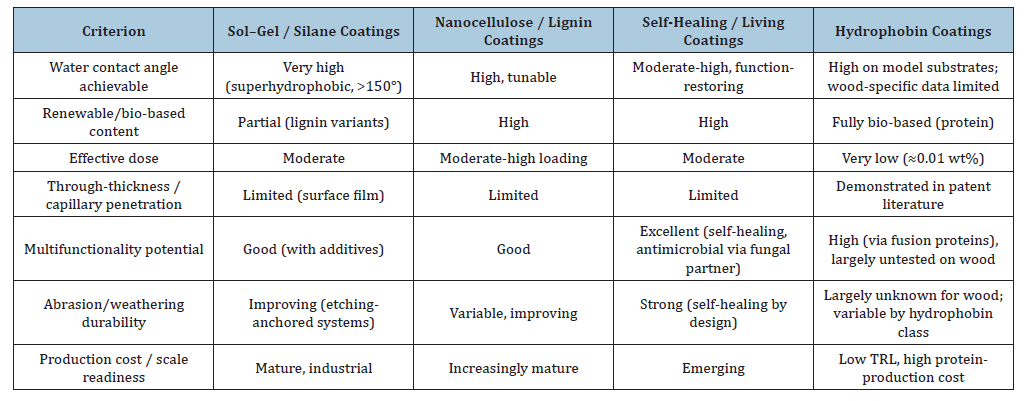
Comparative Assessment
(Table 1)
Table 1:
Conclusion
Wood surface coating research has come a long way in the past five years, moving from simple superhydrophobic demonstrations toward durable, multifunctional, increasingly bio-based systems that combine water repellency with flame retardancy, UV protection, antimicrobial activity and, in the case of living coatings, genuine self-healing. Etching-anchored nanostructures, ligninand nanocellulose-based hybrids and biomimetic fire-resistant multilayers all illustrate this shift and several are now approaching performance and durability levels that would hold up to real outdoor use. Hydrophobin proteins are a scientifically solid but still very early addition to this landscape. Their demonstrated ability to self-assemble into robust, low-loading monomolecular films on cellulosic substrates, their ability to get into and hydrophobize wood’s internal capillary network and their emerging use as genetically fusable scaffolds for antimicrobial and other bioactive functions all add up to a strong conceptual case for using them in next-generation wood coatings. That said, there is no long-term outdoor weathering data specific to wood, recombinant protein production is still expensive and no industrial application protocol has been established-so hydrophobins are not yet a drop-in competitor to silane- or nanocellulose-based superhydrophobic systems. The most useful direction for now is hybridization: using hydrophobins as an interfacial primer, adhesion promoter, or functional-fusion carrier within multi-component bio-based coating systems, rather than trying to make them a stand-alone hydrophobizing technology. What is actually needed next is woodspecific weathering data, a realistic look at production cost and pilot-scale application studies-the things that would tell us whether this genuinely interesting protein material can move out of the surface-science lab and into commercial wood protection.
References
- Wei X, Niu X (2023) Recent advances in superhydrophobic surfaces and applications on wood. Polymers 15(7): 1682.
- Yudong Wang, Shangjie Ge Zhang, Pingxuan Mu, Xueqing Wang, Shaoyi Li, et al. (2023) Advances in sol-gel-based superhydrophobic coatings for wood: A review. Int J Mol Sci 24(11): 9675.
- Mariana MM Ramos, Christina P Pappa, Panagiotis N Manoudis, Vasiliki Kamperidou, Eleni Pavlidou, et al. (2025) A highly hydrophobic siloxane-nanolignin coating for the protection of wood. Coatings 15(3): 293.
- Jiayun Su, Minfeng Huang, Linxin Zhang, Yang Liu, Xinxiang Zhang, et al. (2025) Achieving durable superhydrophobicity on wood tangential surfaces through alkali-etching-induced roughness. Cellulose 32: 10293-10305.
- Amin Jorbandian, Alireza Ashori, Mehdi Jonoobi (2025) High-performance and sustainable clear water-based coatings for outdoor wood protection: A review. Progress in Organic Coatings 208: 109452.
- Yuqing Liang, Junxian Xu, Numan Ahmed, Junyou Shi, Mingyu Wen, et al. (2024) Construction of biomass-based flame-retardant, antimicrobial and hydrophobic wood coatings with POSS organic-inorganic nanoparticles. European Polymer Journal 219: 113370.
- Faksawat Poohphajai, Ana Gubenšek, Anja Černoša, Karen Butina Ogorelec, Lauri Rautkari, et al. (2024) Bioinspired living coating system for wood protection: Exploring fungal species on wood surfaces coated with biofinish during Its service life. Coatings 14(4): 430.
- Aprilia Kartikawati, Efrida Basri, Jamaludin Malik, Adi Santoso, Muhammad Iqbal Maulana, et al. (2025) Technological advancement in development of super-hydrophobic coatings for high-performance wood composites: A review. Progress in Organic Coatings 203: 109160.
- Lex Winandy, Felix Hilpert, Oleksandra Schlebusch, Reinhard Fischer (2018) Comparative analysis of surface coating properties of five hydrophobins from Aspergillus nidulans and Trichoderma reesei. Scientific Reports 8: 12293.
- Hydrophobin-an overview (2005) Pharmacology, Toxicology and Pharmaceutical Science.
- Method of treating cellulosic materials with hydrophobins. European Patent.
- Rossana Pitocchi, Anna Pennacchio, Flavia Zuber, Qun Ren, Eugenio Notomista, et al. (2024) Antimicrobial functionalization of surfaces by a chimeric adhesive protein. ACS Applied Bio Materials 7(10): 6594-6602.
- Rezwan Siddiquee, Victor Lo, Caitlin L Johnston, Aston W Buffier, Sarah R Ball, et al. (2023) Surface-induced hydrophobin assemblies with versatile properties and distinct underlying structures. Biomacromolecules 24(11): 4783-4797.
- Gao X, Wang M, He Z (2023) Superhydrophobic wood surfaces: Recent developments and future perspectives. Coatings 13(5): 877.
- Siyu Chang, Lihong Yao, Lei Wang, Yueqi Wu (2025) Research progress in the construction strategy and application of superhydrophobic wood. Molecules 30(3): 719.
- Kolya H, Kang CW (2024) Eco-friendly polymer nanocomposite coatings for next-generation fire retardants for building materials. Polymers 16(14): 2045.
- Massimo Calovi, Alessia Zanardi, Stefano Rossi (2024) Recent advances in bio-based wood protective systems: A comprehensive review. Appl Sci 14(2): 736.
- Faezeh Ghorbanizamani, Hichem Moulahoum (2026) MXene-bio composite coatings for advanced sustainable fire retardancy at surfaces and interfaces. Journal of Coatings Technology and Research 23: 21-54.
- Markus B Linder (2009) Hydrophobins: Proteins that self-assemble at interfaces. Current Opinion in Colloid & Interface Science 14(5): 356-363.
- Chi L L Pham, Anthony Rey, Victor Lo, Margaux Soulès, Qin Ren, et al. (2016) Self-assembly of MPG1, a hydrophobin protein from the rice blast fungus that forms functional amyloid coatings, occurs by a surface-driven mechanism. Sci Rep 6: 25288.
© 2026 Mohsen Bahmani. This is an open access article distributed under the terms of the Creative Commons Attribution License , which permits unrestricted use, distribution, and build upon your work non-commercially.
Editor In Chief







.jpg)






























Signup for Newsletter

Quick Links
 Editorial Board Registrations
 Submit your Article
 Best Paper of the Volume
 Reprints
 Refer a Friend
 Advertise With Us
Our Recent Edition
.jpg)

Top Editors




.jpg)

















.bmp)
.jpg)
.png)
.jpg)













.jpg)






.png)

.png)




.png)




Financial Support

Sponsors

Latest e-Books

Latest Video

 a Creative Commons Attribution 4.0 International License. Based on a work at www.crimsonpublishers.com.
Best viewed in
a Creative Commons Attribution 4.0 International License. Based on a work at www.crimsonpublishers.com.
Best viewed in 
 | Above IE 9.0 version