

- About Us
- Information
-

The Author ensures that the research has been conducted responsibly and ethically with adherence to all relevant regulations. read more..
- For Authors
- For Reviewer
- Manuscript Guidelines
- Membership
- Publication Ethics
-
- Journals
- Reprints
- e-Books
- Videos
- Policies
- Contact Us
 COVID-19
- Submissions



Full Text
Evolutions in Mechanical Engineering
Application of Fourier’s Law in Sustainable Building Envelope Design: Beyond Physics Toward Climate- Responsive Architecture
Diana Patricia Zuleta Mediavilla*
Faculty of Architecture and Urbanism, Department of Architecture, LL Liminal Lab Research Group, UTE University, Ecuador
*Corresponding author:Diana Patricia Zuleta Mediavilla, Faculty of Architecture and Urbanism, Department of Architecture, LL Liminal Lab Research Group, UTE University, 170527 Quito, Ecuador
Submission: May 19, 2026;Published: August 26, 2026

ISSN 2640-9690 Volume6 Issue5
Abstract
The thermal performance of building envelopes plays a fundamental role in sustainable architecture and energy efficiency. Among the governing principles of heat transfer, Fourier’s Law remains one of the most important physical models for understanding conductive heat flow through construction materials. However, its relevance today extends beyond engineering calculations and contributes to broader discussions concerning climate-responsive design, environmental adaptation and energy consumption reduction. This conceptual mini review examines the application of Fourier’s Law in sustainable building envelope design, emphasizing the relationship between thermal conductivity, insulation performance and passive architectural strategies. The discussion also critiques contemporary envelope trends that prioritize aesthetics over environmental performance. The study argues that conductive heat transfer analysis should be considered not only as a technical operation but also as an essential principle in sustainable architectural thinking.
Introduction
The building sector represents a significant percentage of global energy consumption due to heating and cooling demands. According to the International Energy Agency, improving thermal efficiency in buildings is essential for reducing carbon emissions and achieving sustainability goals [1]. One of the most critical components influencing thermal performance is the building envelope, which acts as the interface between exterior climatic conditions and interior comfort. Walls, roofs, façades and insulation systems regulate heat transfer processes that directly affect indoor environmental quality and operational energy demand. For decades, Fourier’s Law has provided the scientific basis for understanding conductive heat transfer in construction materials. According to Incropera et al. [2], conductive heat transfer through solid materials depends directly on temperature gradients and thermal conductivity.
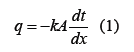
Where:
q = heat transfer rate; k = thermal conductivity; A = area;  = temperature gradient
The equation demonstrates that heat naturally flows from regions of higher temperature toward regions of lower temperature. In architectural applications, this principle explains how heat propagates through walls, roofs and envelope systems.
Fourier’s Law as an Architectural Principle
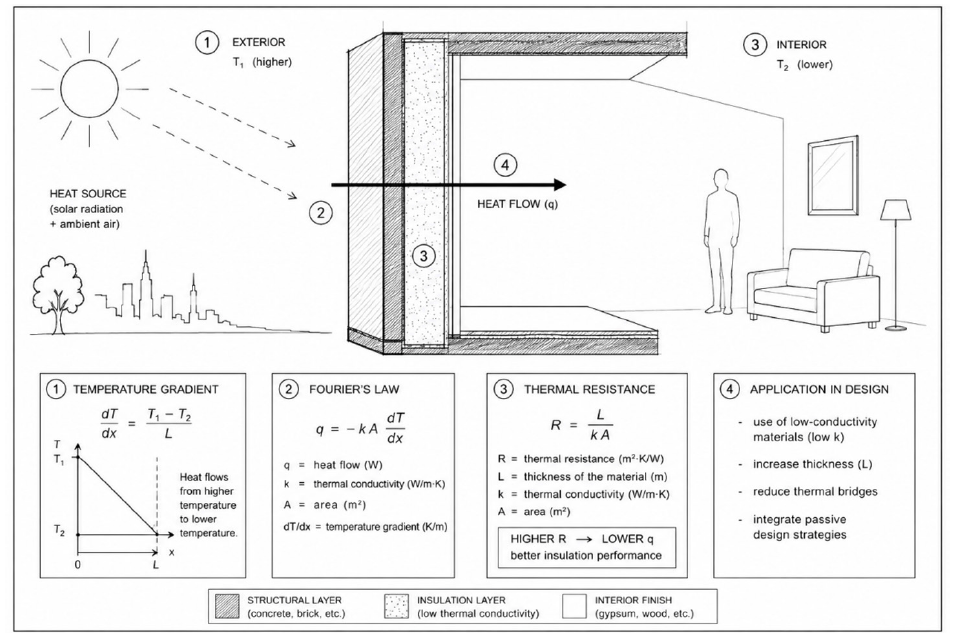
Fourier’s Law should not be interpreted solely as a thermodynamic equation. Conceptually, it reflects the relationship between architecture, climate and energy exchange. Every envelope system functions as a thermal mediator between exterior environmental conditions and interior human comfort. In sustainable architecture, the objective is not to eliminate heat transfer entirely but rather to regulate it efficiently through material selection and passive design strategies. Materials with high thermal conductivity transfer heat rapidly, while low-conductivity materials improve insulation performance and indoor thermal stability [3]. This issue becomes especially relevant in contemporary urbanization processes where many buildings replicate global architectural aesthetics regardless of climatic suitability. Glass curtain-wall façades, for example, frequently increase solar heat gains in warm regions, intensifying cooling demand and operational energy consumption. Olgyay [4] emphasized that climate-responsive architecture should emerge from environmental adaptation rather than stylistic replication. Nevertheless, many contemporary urban development’s continue prioritizing visual identity over thermal efficiency optimization (Figure 1).
Figure 1:Conceptual application of Fourier’s Law in sustainable building envelope design.
Source: Author’s elaboration based on heat conduction principles.
Thermal Conductivity and Envelope Performance
Thermal conductivity is one of the most important physical properties influencing envelope behavior. Sustainable building design seeks to minimize conductive heat transfer through the integration of low-conductivity materials and optimized wall assemblies.
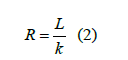
Where:
R = thermal resistance; L = material thickness; k = thermal
conductivity
Higher thermal resistance values improve insulation performance and reduce heat flow through the envelope.
According to Straube and Burnett [5], effective insulation systems significantly reduce conductive heat transfer and improve indoor thermal stability. Likewise, Kibert [6] argued that sustainable envelope systems contribute substantially to operational energy reduction and environmental performance. Asdrubali et al. [7] highlighted that unconventional insulation materials can further improve energy efficiency while reducing environmental impact associated with construction systems (Table 1).
Table 1:Thermal conductivity of common building materials.

Critique of contemporary envelope design
One of the most problematic tendencies in contemporary architecture is the globalization of envelope aesthetics. Reflective glass façades and highly conductive materials are frequently associated with modernization and economic prestige despite their questionable thermal efficiency in many climatic regions. In warm climates, excessive solar radiation entering through glazed surfaces increases conductive and radiative heat transfer, resulting in greater dependence on mechanical cooling systems. Although advanced glazing technologies partially reduce these effects, many contemporary buildings remain thermally inefficient when compared with traditional passive architecture [8]. This contradiction demonstrates that architecture cannot be separated from physical and environmental realities. Fourier’s Law reminds designers that all buildings inevitably participate in continuous thermal exchange with the surrounding environment. Traditional vernacular systems frequently achieved efficient thermal performance through passive mechanisms such as thick walls, courtyards, shading devices and natural ventilation strategies. In many cases, these passive solutions performed better environmentally than technologically complex contemporary envelopes.
Conclusion
Fourier’s Law continues to play a fundamental role in sustainable building envelope design and thermal analysis. Beyond its mathematical application, the equation represents a broader architectural principle connecting climate adaptation, material selection and energy efficiency. Contemporary architecture must move beyond purely aesthetic envelope solutions toward environmentally responsive strategies grounded in thermal physics and climatic context. Conductive heat transfer analysis should therefore be considered not only as an engineering calculation but also as an essential component of sustainable architectural thinking.
References
- International Energy Agency, South Africa.
- Incropera FP, DeWitt DP, Bergman TL, Lavine AS (2017) Fundamentals of Heat and Mass Transfer (8th Edition.), Wiley.
- Çengel YA, Ghajar AJ (2020) Heat and mass transfer: Fundamentals and applications (6th Edition.), McGraw-Hill, USA.
- Olgyay V (2015) Design with climate: Bioclimatic approach to architectural regionalism. Princeton University, USA.
- Straube J, Burnett E (2005) Building science for building enclosures. Building Science, USA.
- Kibert CJ (2022) Sustainable construction: Green building design and delivery (5th Edition.), Wiley.
- Francesco Asdrubali, Francesco D Alessandro, Samuele Schiavoni (2015) A review of unconventional sustainable building insulation materials. Sustainable Materials and Technologies 4: 1-17.
- Yeang K (2006) Ecodesign: A manual for ecological design. Wiley Academy.
© 2026 Diana Patricia Zuleta Mediavilla. This is an open access article distributed under the terms of the Creative Commons Attribution License , which permits unrestricted use, distribution, and build upon your work non-commercially.
Editor In Chief







.jpg)































Signup for Newsletter

Quick Links
 Editorial Board Registrations
 Submit your Article
 Best Paper of the Volume
 Reprints
 Refer a Friend
 Advertise With Us
Our Recent Edition

.jpg)



Top Editors




.jpg)

















.bmp)
.jpg)
.png)
.jpg)













.jpg)






.png)

.png)




.png)




Financial Support

Sponsors

Latest e-Books

Latest Video

 a Creative Commons Attribution 4.0 International License. Based on a work at www.crimsonpublishers.com.
Best viewed in
a Creative Commons Attribution 4.0 International License. Based on a work at www.crimsonpublishers.com.
Best viewed in 
 | Above IE 9.0 version