

- About Us
- Information
-

The Author ensures that the research has been conducted responsibly and ethically with adherence to all relevant regulations. read more..
- For Authors
- For Reviewer
- Manuscript Guidelines
- Membership
- Publication Ethics
-
- Journals
- Reprints
- e-Books
- Videos
- Policies
- Contact Us
 COVID-19
- Submissions



Full Text
Evolutions in Mechanical Engineering
4.0 Sustainable Industry with a Nature-Inspired Human-Mimetic Intelligent Swarm Powered Digital Twin Maintenance Adaptation
Ebrahim Ali Alzalab1,2*, Umar Suleiman Abubakar3,4, AL-marhabi Zaid Ali 5 and Mutahar Abdulhakim Hanash6
1 Department of Information Technology, Faculty of Computer, Al-Razi University, Sana’a, Yemen
2 Department of Information Technology, Faculty of Engineering, Al-Yemenia University, Sana’a, Yemen
3 School of Electrical and Electronic Engineering Campus 14300, Universiti Sains Malaysia, Malaysia
4 Department of Electrical and Electronics Engineering, Kaduna Polytechnic, Kaduna, Nigeria/p>
5 Department of Information Technology, Faculty of Computer, Al-Razi University, Sana’a, Yemen
6 Department of Artificial Intelligence, Amran University, Amran, Yemen
*Corresponding author:Ebrahim Ali Alzalab, Department of Information Technology, Faculty of Computer, Al-Razi University, Sana’a, Yemen
Submission: April 09, 2026;Published: May 05, 2026
ISSN 2640-9690 Volume6 Issue5
Abstract
This paper presents a nature-inspired artificial Swarm Intelligence (SI) powered Digital Twin (DT)-based Bioscience-Inspired Maintenance Adaptation System (ABIMS) for improving resilience, sustainability and adaptability of Industry 4.0 environments. To enable decentralized, predictive and efficient maintenance processes, the proposed framework takes inspiration from collective intelligence and self-organization of biological systems in terms of power consumption. A digital twin of each physical asset is operating via an Internet-of-Things (IoT) connection and sensor data to synchronize the digital twin for estimation of residual lifetime, performance and fault prediction. Simultaneously, a biogenic-inspired hybrid optimization algorithm used by the intelligent swarm layer merges the Ant Colony Optimization (ACO) and Particle Swarm Optimization (PSO) techniques for distributed resource allocation and maintenance task coordination. The trade-off between local optimization and global exploration that can be achieved by the hybrid approach, allows the system to provide high performance under uncertain industrial conditions. The results of the information system and decision theory predictions are integrated by an adaptive decision- making layer, that based on current operating conditions allows for on-the-fly tuning of maintenance strategies. The proposed system, based on what has been demonstrated by a simulation-based validation approach, shows significant improvements in the maintenance performance in terms of increased fault detection accuracy, reduced downtime and improved energy efficiency..
Keywords:Industry 4.0; Digital twin; Predictive maintenance; Artificial intelligence swarm; Bioscience-inspired optimization; Sustainability
Introduction
The fourth industrial revolution has optimised modern manufacturing towards diversified, interconnected, and autonomous processes, thanks to the digital twins, the Internet of Things (IoT) and the Artificial Intelligence (AI) [1,2]. Nevertheless, the difficulties in operating such complicated cyber-physical systems are still challenging due to the conventional, centralised or reactive maintenance approaches, resulting in uncertain downtimes, inefficiencies and higher operational expenses [3]. The rapid developments in predictive maintenance and cyber-physical integration are demonstrating the importance of digital technologies for simulation, real-time monitoring and decision support [4-8]. Many previous research studies, recent case studies, and real-world applications in manufacturing and transportation fields have advocated the benefits of these technologies for operation and maintenance [9-12]. Fault detection and diagnosis is a technique for detecting, locating and correcting process and equipment faults that may compromise the continuity and reliability of industrial automation systems [13-15].
The detection and diagnosis of faults in contemporary Industry 4.0 environments increasingly relies on a hybrid approach that utilizes signal processing and machine learning model-based techniques to detect, classify and locate anomalies in real-time while addressing issues relating to response time, data quality and interpretability [16,17]. When these diagnosis techniques are integrated with fault detection and diagnosis systems, they provide simultaneous use of high-fidelity simulation and contextual data for model training and validation. This improves predictive repair decisions, fault diagnosis accuracy and reliability of automated manufacturing systems [14,15]. Moreover, these systems can independently coordinate distributed fault tolerance in swarm intelligence technology and quickly reconfigure and recover the system, thereby improving efficiency and sustainability to industrial processes [18,19].
Nature-inspired techniques (for example, social organisms like ants, birds and bees) based on collective behavior, known as Mirage intelligence, provide scalable, adaptive and decentralized technique to enhance dynamic industrial processes [19]. The effectiveness of these techniques for decentralized optimization and adaptive control, particularly for sustainability-oriented processes, has been demonstrated in the literature [20]. Digital analytics methods might also be employed to reduce downtime and justify fault diagnosis and decision making with analytics [4]. Together with these techniques, the nature-inspired algorithms and artificial intelligence hold the promise of providing self-sustaining systems and a new synergy for the Fourth Industrial Revolution [3,4]. The swarm intelligence methods were also demonstrated to be useful in resource allocation, process scheduling and fault diagnosis for decentralized industrial systems [20-25].
Many traditional AI-based techniques such as Particle Swarm Optimization (PSO), Ant Colony Optimization (ACO), Firefly Optimization (FA), Artificial Bee Colony Optimization (ABC) and also immune-inspired algorithms have been successfully applied for decision making, prediction and fault scheduling with an aim of energy efficiency [24-25]. For instance, biologically inspired intelligence was employed in designing condition monitoring of hydroelectric power generation units and the proposed system was found to be highly adaptive in an uncertain environment [23] and hybrid prediction models have been developed using AI- based approaches for dynamic manufacturing systems [26,27].
The integration of SI and Dt in predictive maintenance has been recently studied to address the adaptation gap. Nguyen et al. [28] proposed a hybrid framework using swarm-DT for coordinated autonomous robots. Similarly, Wu Chen et al. [29] and Li et al. [30] implemented swarm-based scheduling algorithms in the Dt framework. Paul et al. [31] implemented a hierarchical DT architecture for mirage systems and for the optimization of PSO-driven expander for flexible workshop scheduling. However, rather than continuous improvement of flexibility and adaptive maintenance, the current integration process is primarily aimed at production optimization.
The same time, distributed and sustainability-driven DT frameworks have been developed. Abdulwahab et al. [32] and Tao et al. [4] proposed a DT architecture for environmentally efficient and self-aware manufacturing. In [33] they implemented an interpretable model of DT using adaptive PSO for industrial machinery and in [34] they developed a distributed DT architecture based on fuzzy computing for wind turbine maintenance. Zhang et al. [35] and Meyer et al. [8] demonstrated that environmental performance and energy performance optimization can be achieved with the help of DT and instead of nature-inspired and adaptive decision making, the focus is primarily directed towards monitoring.
Complementary studies recently have used AI-enabled digital twins and unsupervised learning to combine adaptive DT with swarm autonomy [35,36]. Sustainable-oriented research has instead devised a distributed and eco-friendly DT architecture, such as the fuzzy computation-enabled framework for DT to assess the faults of wind turbines [35] and [36] proposed an interpretable DT model for autonomous machines based on Particle Swarm Optimization (PSO).
However, the existing centralized maintenance structure and reliability models still lack the decentralized and adaptive intelligence that will be required in the future sustainable manufacturing. Accordingly, the integration of SI with DT technologies showcases a promising, flexible, predictive and energy-efficient maintenance scheme to meet the sustain- ability demands of the Fourth Industrial Revolution. This study fills the above gaps by proposing a hybrid framework integrating DT and SI to achieve adaptive and sustainable maintenance. The key contributions of this study are
A. A unified architecture for integrating DT and Si to support
predictive and decentralized maintenance decisions;
B. Enhanced adaptability, fault tolerance and energy
efficiency by biologically inspired evolutionary optimization
algorithms; and
C. Reliability, overall sustainability and energy consumption
improvements demonstrated by simulation-based validation of
the proposed framework.
This proposed framework improves the adaptability, reliability and environmental performance of intelligent manufacturing systems, thus providing a contribution to the sustainability of the industrial revolution.
System Architecture
The adaptive maintenance system that incorporates swarm intelligence with digital twins and inspired by bio-science are introduced in this section to facilitate flexible and sustainable predictive maintenance in the context of Industry 4.0 environments. As an adaptive architecture, this multi-layered framework in which the bio-science inspired agents interact with the digital models constantly to ensure that decisions are self-organization, decentralized and energy-aware.
Overview of the proposed framework
The proposed framework consists of five layers that are all interrelated as shown in Figure 1. Each of these layers plays a specific role with a view to the overall resilience and sustainability of the system.
Figure 1:Five-layer architecture of the proposed adaptive bio-inspired maintenance system.
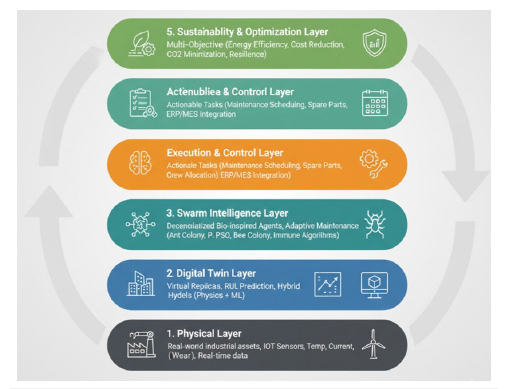
a) The physical layer: The real industrial assets such as
turbines, machines, robots and transporters that are fitted
with IoT sensors such as temperature, corrosion, vibration
and current sensors. These devices are continuously collecting
environmental and operational data in real- time or on-the-fly.
b) Digital twin layer: It is a virtual model of the physical
assets designed to emulate the operating conditions and
estimate the remaining useful life as well as predict the pattern
of faults. Hybrid models are used to combine the machine
learning methods with the physical methods to achieve high
prediction accuracy.
c) Swarm intelligence layer: This is a layer of decentralized
agents that are inspired by nature, that dynamically adapt
their maintenance strategies. Each agent evolves based on the
feedback from the digital twin layer and represents current
maintenance policy. Swarm algorithms such as Particle Swarm
Optimization (PSO), Ant Colony Optimization (ACO), Immune
Algorithms (IA) and Artificial Bee Colony (ABC) algorithms
are used to schedule tasks and distribute them, as well as to
intelligently identify anomalies.
d) Control and execution layer: Tasks that are executable are
in this layer which is translation of swarm-inspired maintenance
strategy to actual implementation, also including the execution
of maintenance scheduling, work-force distribution and spare
part procurement. Enterprise systems are integrated with
this layer such as Manufacturing Execution System (MES) and
Enterprise Resource Planning System (ERP).
e) Optimization and Sustainability layer: This layer oversees
the overall optimization with multiple objectives that
include system resilience, cost reduction, power efficiency and
also the reduction of CO2 emissions. Coordinating maintenance
decision with these higher- level objectives ensure sustainable
industrial operations.
Adaptive digital twin feedback loop
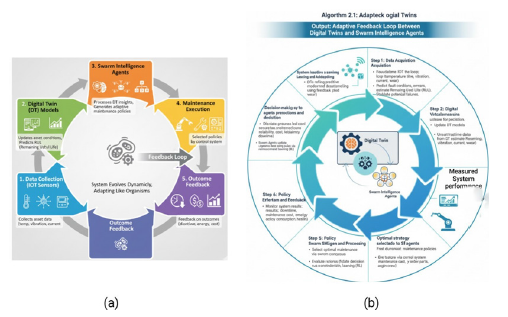
Adaptive digital twin feedback loop, our proposed framework, at its core, enables the real-time interaction and co- evolution between swarm intelligence elements and digital twins, ensuring the system is
A. Data collection: IoT-enabled sensor devices collect asset
data in real time, including vibration and temperature and
current measurements.
B. Digital twin update: Existing digital twin models are
updated with virtual imaging on each asset, and how they
function and how long they will keep functioning.
C. Collective decision: Swarm intelligence elements use
information derived from digital twins to develop optimal and
adaptive maintenance strategies.
D. Execution: Control system enacts selected maintenance
strategies through task allocation, spare parts requests and
allocation of personnel teams.
E. Feedback and adaptation: Digital systems and swarm
elements receive feedback on the performance of the processes,
e.g., downtime, energy consumption and maintenance costs.
This information is used to refine the predictive models and
improve the accuracy of future decisions.
This closed loop process enables the entire system to adapt and transform dynamically, just as living entities adapt to changing environments, as shown in Figure 2a. The detailed steps in this process are described in the adaptive digital twin feedback loop algorithm (Algorithm 1: Adaptive digital twin feedback loop framework), illustrated in Figure 2b.
Figure 2:(a) Adaptive feedback loop between DTs and swarm agents. (b) Algorithm 2.1: Adaptive bio-inspired maintenance framework..
Maintenance decision making based on swarm intelligence
The content of maintenance decision-making process is under the scope of the adaptive feedback dynamics as explained in the previous section and based on it; the maintenance decision-making process is determined by swarm intelligence. It allows distributed and collaborative improvement of the industrial processes through collective behavioural patterns of the inspiration from naturebased creatures. The swarm intelligence is a critical component of improving the predictive maintenance by harnessing the behaviours derived from nature-based algorithms. Each algorithm has its own
Algorithm 1 Adaptive Digital Twin-Swarmck Loop
Framework
Input: DIoT: Real-time data from IoT sensors (temperature,
vibration, current, wear).
Output: PM: Adaptive maintenance policy; OS: Optimized system
performance.
Adaptive Maintenance Framework DIoT
0: while System.isOperating() do
1: Step 1: Data Acquisition (Physical Layer)
2 : Dnew ←CollectData(DIoT )
3: Step 2: Digital Twin Update (Digital Twin Layer)
4: DT.UpdateState(Dnew)
5 : Fpred ←DT.PredictFaults()
6 : RULest ←DT.EstimateRUL()
7: Step 3: Swarm Intelligence Processing (Swarm
Intelligence Layer)
7: for each agent ai in Swarm do
8: ai.ReceiveInsights(Fpred, RULest)
9 : Pi←ai.GenerateCandidatePolicy()
10 : Fi ← EvaluatePolicyFitness(Pi , reliability, cost, downtime)
10: end for
11: Step 4: Policy Selection and Execution (Execution &
Control Layer)
12 : PM ←Swarm.AchieveConsensus(Fi )
13: ControlSystem.ExecuteActions(PM)
14: Step 5: Performance Feedback (Sustainability &
Optimization Layer)
15 : R←MonitorResults(downtime, cost, energy, health)
16: Step 6: Continuous Learning and Adaptation
17: DT.RefineModels(R)
18: Swarm.UpdateDecisionRules(R)
19 : OS ← System.CurrentPerformance()
19: end while
20: Return PM, OS =0
Unique set of adaptive mechanisms, designed for different
maintenance needs:
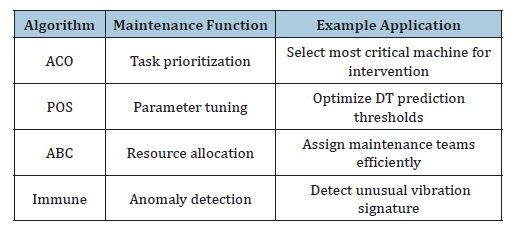
A. The emphasis is on improve equipment that requires rapid
maintenance management based on Ant Colony Optimization
(ACO).
B. Maintenance Decision making Based on Swarm
Intelligence Particle Swarm Optimisation (PSO): optimises
the predictive model metrics inside the search algorithms to
improve the accuracy of the diagnostic process.
C. Artificial Bee Colony (ABC): distributes the human and
robotics maintenance teams in a dynamic manner to ensure
balanced workload and improve response efficiency.
D. Immune Algorithms (IA): identifies the irregular cases
and separates the abnormal cases and generates early alerts for
the possibility of failure.
The combination of these collective behaviours ensures the robustness of the maintenance decision-making process and its scalability and adaptability in volatile industrial environments. Table 1 summarises the limited relationships between maintenance functions and nature-inspired algorithms.
Table 1:Mapping of bio-inspired algorithms to maintenance functions.
Multi-objective sustainability optimization
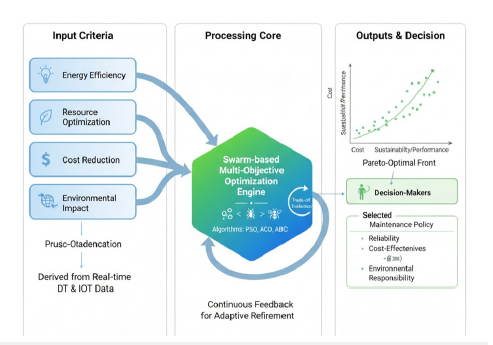
The proposed framework incorporates sustainability objectives in the decision-making process of the maintenance, different from the predictive maintenance methods, ensuring improved operational efficiency and performance simultaneously. The sustainability optimisation layer focuses on several objectives represented by four major ones:
A. Energy consumption efficiency: minimising the operating
time of the machines that are not needed for reducing energy
consumption.
B. Resource utilisation optimisation: minimising resource
waste, e.g., the waste of spare parts, by implementing adaptive
maintenance scheduling.
C. Cost minimisation: minimising maintenance costs and
production downtime.
D. Environmental impact: minimising carbon emissions
through efficient energy utilisation and adopting more
sustainable operation strategies.
In order to achieve these objectives, a multi-objective
optimisation mechanism has been implemented. The swarm
intelligence algorithms are employed to optimise these objectives,
balancing the conflicting objectives. By generating Pareto optimal
solutions, the framework allows decision makers to select the most
sustainable maintenance strategy among the available ones, within
the given operational constraints.
Figure 3 shows the relationship between the sustainability objectives and their integration into the swarm intelligence based decision-making process. The multi-objective sustainability optimisation process in the proposed framework is depicted. Figure 3 illustrates the relationships between sustainability goals and their integration within the swarm intelligence-based maintenance decision-making process. The multi-objective sustainability improvement process and its implementation in the proposed framework.
Figure 3:Multi-objective sustainability optimization process in the proposed adaptive maintenance framework.
Scalability and decentralization
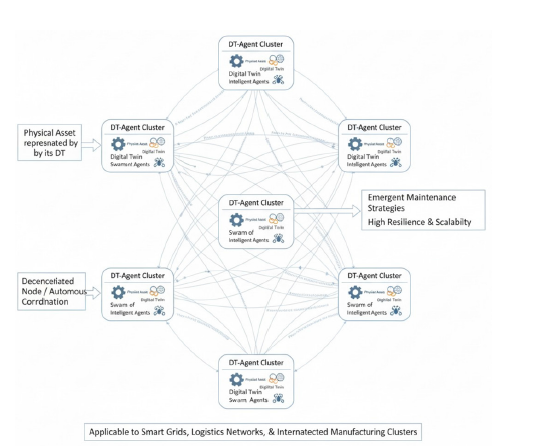
The proposed architecture exhibits inherent scalability and decentralization characteristics due to its distributed architecture. Each physical asset is represented by a unique digital twin that can interact with a set of local smart agents. The agents independently manage the maintenance activities without the help of a central supervisory server.
Figure 4 illustrates the formation of multiple groups of digital twin agents, where each group acts as an independent decision node with local optimisation capability as well as the ability to chat directly with each other. This decentralised interaction facilitates the development of collective maintenance strategies using agent coordination instead of centralised commands, which can reduce computational bottlenecks and individual points of failure. The proposed architecture provides high resilience, fault tolerance and scalability, making the system adaptable not only to individual manufacturing environments but also to large-scale distributed industrial ecosystems such as smart grids, supply chains and interactive industrial clusters.
Figure 4:Conceptual schematic of an adaptive and scalable maintenance network, illustrating the interconnected digital twin agent nodes, the cluster of agents and the cooperative data substitution paths that underpin the adaptive intelligence of the system.
Methodology
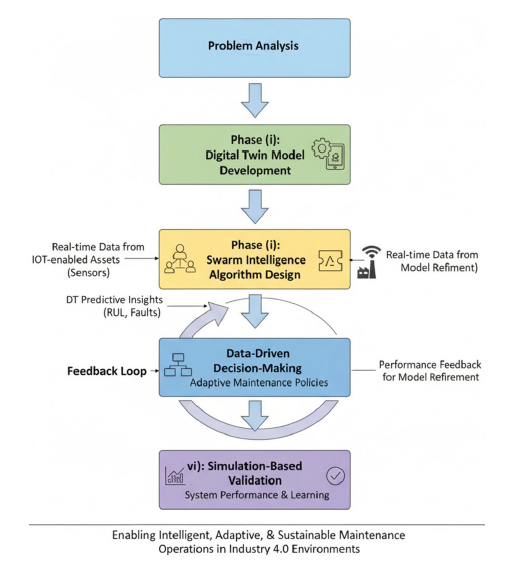
The development of the biology-based adaptive maintenance system is achieved by means of an integrated methodological framework consisting of the development of digital twin models, biology-based optimisation and predictive decision- making. This methodology follows a multi-step approach that consists of system modelling and algorithm design, data collection, decision-making and verification.
Proposed framework
The general research framework consists of five subsequent
stages:
a) situational analysis,
b) digital twin model development,
c) stroboscopic intelligence algorithm design,
d) information-based decision issuance and
e) verification by simulation.
This integrated approach brings together digital twins and team intelligence in Industry 4 environments, enabling smart, adaptive and sustainable maintenance operations. As depicted in Figure 5, the overall diagram shows the information flows from IoT-enabled assets to the decision-making layer, illustrating how data is converted into actionable maintenance information. To operationalise the framework, a progressive procedure was designed and organised in the form of an algorithm workflow. Algorithm 2 shows the comprehensive scientific process that comprises set-up, optimisation, digital twin modelling and adaptive feedback, where the logical sequence of steps required to implement and optimise the proposed system is identified.
Figure 5:Overall research framework for the adaptive bio- inspired maintenance system.
Digital twin development
The initial stage involves the development of digital twins for
a selected number of industrial assets. Two levels of twins are
developed:
A. Asset-specific twins, representing the core equipment
such as wind turbines, engines and transmission systems; and
B. Operational-level twins, which are designed to trace
relationships and interactions on the production line.
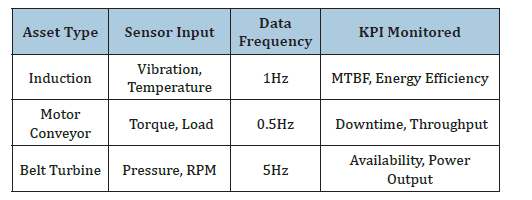
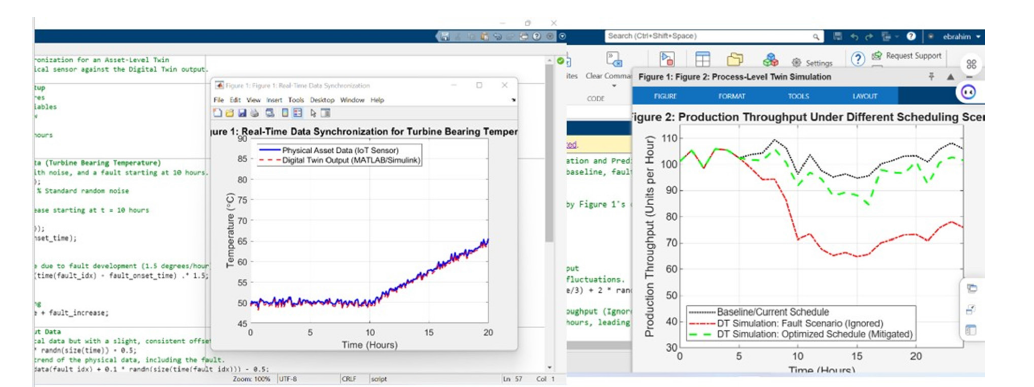
Data streaming from IoT sensors (e.g. current, temperature, power consumption, vibration) syncs with virtual models via edge computing platforms, ensuring low latency and reliable data transfer. Any Logic and MATLAB/Simulink platforms were used for simulating the computational infrastructure of the digital twins for model calibration and verification, as well as performance assessment. The operational-level functionality of the digital twin is shown in Figure 6a, where live sensor readings from TWCmounted sensors are compared to the virtual model outputs; and the operational-level capability is shown in Figure 6b, where the impact of a single asset failure on overall productivity, as well as the effectiveness of the proposed scheduling strategy is illustrated. The key integrated metrics in the digital twin models are shown in Table 2, where each performance indicator is correlated with its physical counterpart, allowing accurate representation of operational dynamics.
Figure 6:Coordinated operation of the swarm algorithms inspired by biology, within the adaptive maintenance framework.
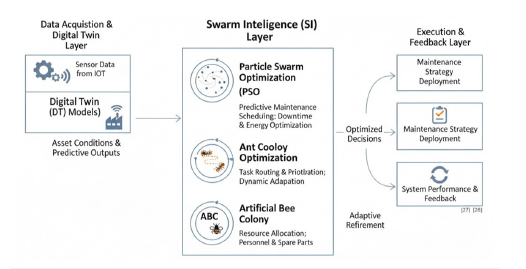
Table 2:Key parameters for Digital Twin (DT) models.
Design of bio-inspired algorithms
The core of decision-making in the proposed adaptive maintenance system is that of swarm intelligence that is inspired by the distributed behaviour and self-organised nature of natural biological systems. In order to achieve the additional optimisation objectives, four bio-inspired algorithms have been integrated into the maintenance structure.
algorithm enhances the predictive maintenance schedule
via finding a balance between downtime minimisation and
energy efficiency. The hybrid (PSO)- and digital twin-driven
maintenance model developed by Cha et al. [29], shows
comparable optimisation abilities to flexible workshop
scheduling, which provides a ground for dynamic predictive
maintenance scheduling [29].
b) ANT COLONY OPTIMISATION (ACO) algorithm: ACO
provides a decentralised and self-regulated prioritisation of
maintenance tasks, with a rapid reactivity towards changes
in the system status. Li et al. [30] applied swarm intelligence
to organise the scheduling of the digital twin, to enable the
adaptability and the instant coordination of the distributed
tasks in the industrial network.
c) Artificial Bee Colony (ABC) algorithm: ABC manages
the distribution of resources to the maintenance personnel,
equipment and spare parts that are required to per- form the
maintenance tasks efficiently. Based on recent works such
as Zhang et al. [37] article, which proposes a framework for
resource distribution in digital twin shops’ distributed systems,
the ABC mechanism in this paper is also used to organise the
maintenance resources in a distributed manner to improve the
responsiveness and scalability.
Figure 7:Hierarchical structure of Digital Twin development: (a) Asset-level twin and (b) Process-level twin.
Continuously, the adaptive mechanism improves the decisionmaking rules by incorporating the feedback from the digital twin models. This recursive integration between the swarm algorithms enables them to evolve over time, demonstrating the capability for natural-inspired adaptiveness, which improves the resilience and robustness of the system in highly uncertain industrial settings [29,30,32]. As illustrated in Figure 7, three swarm intelligence algorithms work seamlessly in the maintenance process flow. They collectively organise the predictive analysis, adaptiveness and resource management throughout the system to achieve a concurrent and continuous maintenance strategy.
The procedural framework for this approach is presented in Algorithm 3 that outlines a step-by-step implementation of the bioinspired decision-making for the adaptive maintenance strategy. The algorithm integrates decision-based theory predictions and the IoT sensor data to optimise and direct the maintenance schedule and resources in a dynamic and real-time manner.
Data collection and processing
The methodology proposed involves the integration of both historical and live data for the purpose of conducting a comprehensive system analysis and enhancing the overall prediction accuracy. Historical data includes machine fault logs, operation logs and maintenance logs. Live data is ingested from the IoT sensor streams that monitor the key operating indicators such as voltage, temperature and vibration.
For compatibility with the analyses and to ensure data reliability, various preprocessing techniques such as the application of a Kalman filter for noise reduction, feature extraction (i.e. the extraction of frequency domain indicators from vibration signals) and dimensionality reduction via Principal Component Analysis (PCA) are employed. These steps enhance the overall signal clarity, reduce data redundancy and provide an improved performance for the subsequent predictive modelling and optimisation.
As depicted in Figure 8, data collection and processing is initiated by the IoT network-connected sensors from the industrial assets that are receiving raw data. Subsequently, the collected data undergoes preprocessing, signal analysis, feature extraction and PCA to remove noise and extract the most relevant components. The processed features are then transmitted to the digital twin and decision layers to perform the predictive analysis and maintenance scheduling.
Figure 8:Data collection, flow and processing for the predictive adaptive maintenance.
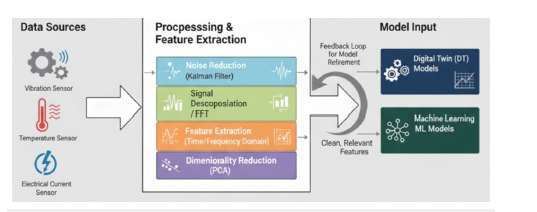
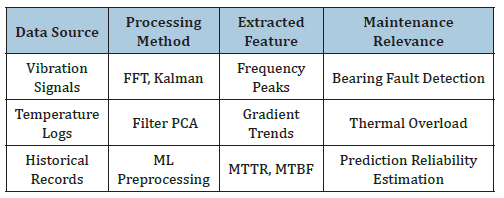
Table 3 provides a detailed mapping between the sources of data, the processing techniques and the extracted features. Each feature is then indicated by its contribution level to im- proving the predictive maintenance and the overall reliability of the system.
Table 3:Data types and processing techniques applied in the predictive maintenance framework.
Decision-making layer
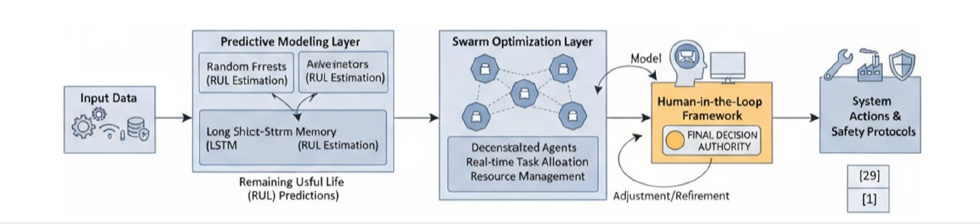
The decision-making layer constitutes the intersection between predictive modelling and swarm algorithm-driven development in the proposed maintenance framework. Predicted ageing of industrial assets (RUL) is obtained with predictive models developed by machine learning algorithms such as random forests and Long Short-Term Memory (LSTM) networks. Age predictions are used as inputs for the swarm algorithm-based optimisation, where decentralised agents allocate maintenance activities and resources in real-time, based on changing operational conditions.
As shown in Figure 9, this layer is embedded within a framework that allows human interactions and ensures human operators maintain ultimate decision control when required. This hybrid architecture offers an optimal balance between self-optimisation, industrial safety and operational reliability and ensures system decisions are aligned with the safety protocol [1,29]. In addition, recent studies have shown that integrating swarm intelligence with digital twin scheduling can greatly improve the self-adaptability and resource coordination capabilities within complex manufacturing settings [30]. Therefore, the decision-making layer offers a level of robustness and comprehensiveness that allows for continuous optimisation under supervision.
Figure 9:Decision-making workflow in the adaptive bio-inspired maintenance system.
Verification strategy
The efficacy of the biocompatible maintenance methodology is verified by a two-stage assessment. In the first stage, a DT-based simulation test is performed in order to verify the effectiveness of the framework under various operating conditions such as workload variations, sensor noise and fault scenarios. The DT environment provides a controlled setting for sensitivity analysis and fine-tuning of the algorithm before the physical implementation [4].
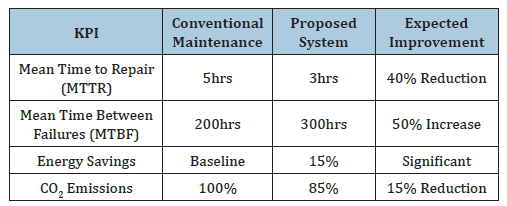
In the second stage, a case study is implemented in a smart manufacturing context such as an automated assembly line or the distributed wind farm network. In this case study, the proposed framework is compared with a conventional predictive maintenance system and performance optimisation approaches, in line with condition-based reliability methods [38,39]. System performance is evaluated by comparing key performance indicators such as Mean Time to Repair (MTTR), Mean Time Between Failures (MTBF), average power consumption and reduction in CO2 emissions. As shown in Table 4, the results demonstrate significant.
Table 4:Evaluation metrics and benchmarks comparing conventional and proposed systems.
Algorithm 2 Adaptive Bio-Inspired Maintenance Framework
Input:
• DIoT: IoT sensor data (real-time measurements, operational
parameters)
• DHist: Historical maintenance and failure data
Output:
• SOpt: Optimal maintenance schedule and predictive
decisions
• PMetrics: Performance metrics (e.g., downtime reduction,
cost savings)
1: Step 1: Initialization
2: Preprocess DIoT and DHist
3: Initialize Digital Twin (DT) models for all monitored assets
4: Configure Swarm Intelligence (SI) algorithm parameters (PSI)
5:
6: Step 2: Digital Twin Modeling and Prediction
7: Create virtual representation DT of the physical system
8: Update DT states continuously using DIoT
9: Execute DT simulations to predict Remaining Useful Life
(RUL) and potential failure scenarios (FSim)
10:
11: Step 3: Bio-Inspired Optimization
12: Define multi-objective function FObj (Minimize cost, downtime,
energy; Maximize reliability)
13: Search for optimal strategy SCand ←SI(RUL ,FObj )
14: Evaluate fitness of SCand and update solutions based on
swarm behavior rules
15: Converge to the Pareto-optimal front SOpt
16:
17: Step 4: Predictive Decision-Making
18: Prioritize maintenance tasks based on SOpt, criticality, and
risk assessment
19: Generate actionable decisions DAct (component replacement,
inspection schedule)
20:
21: Step 5: Validation and Adaptive Feedback
22: Simulate chosen policy SOpt using DT to evaluate effectiveness
23: Calculate performance metrics PMetrics
24: Update DT models and PSI parameters based on PMetrics
(adaptive learning)
25:
26: Step 6: Deployment and Continuous Monitoring
27: Execute recommended actions DAct in the physical system
28: Loop back to Step 1 for continuous, adaptive maintenance
=0
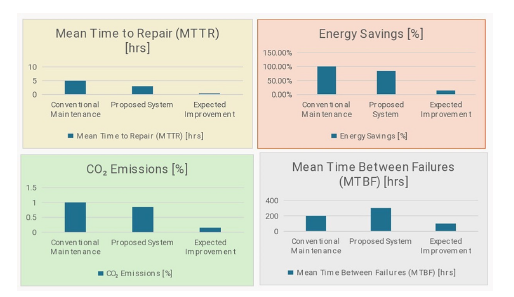
improvements in operational reliability, energy efficiency and environmental sustainability. The proposed adaptive and decentralised design improves fault recovery time, asset ageing and environmental impact. Figure 10 depicts a comparison of the above performance metrics between the conventional and proposed systems.
Figure 10:Metrics and criteria used to compare the proposed biocompatible maintenance system with the conventional maintenance system.
Algorithm 3 Bio-Inspired Decision-Making Process for
Adaptive Maintenance
Input: DIoT: Sensor data from IoT devices; DPT: Digital Twin
predictive outputs (Fpred, RULest).
Output: PM: Optimized maintenance scheduling, routing and
resource allocation.
BIO_INSPIRED_DECISION_MAKING (DIoT, DPT)
1: Swarm←InitializeAgents(random parameters)
2: while MaintenanceCycle.isActive() do
3: Step 2: Acquire updated asset conditions
4 : CAsset ←DT.GetUpdatedConditions(DIoT )
5:
6: Step 3: Evaluate Agent Fitness
7: for each agent ai in Swarm do
8 : Pi ←ai.GeneratePolicy(CAsset)
9 : Fi ←EvaluatePolicyFitness(P i) :
10 : FT i ← Minimize(downtime)
11: FE i ←Reduce(energy consumption)
12 : FR i ← Optimize(resource utilization)
13: end for
14:
15: Step 4: Apply Specific Algorithmic Behaviors
16: if AlgorithmType == PSO then
17: Swarm.UpdateVelocityPosition(PBest, GBest)
18: else if AlgorithmType == ACO then
19: Swarm.UpdatePheromoneTrails(TrailEfficiency,
RouteSuccess)
20: else if AlgorithmType == ABC then
21: Swarm.RecruitWorkerBees(ExploreSolutions)
22: end if
23:
24: Step 5: Exchange Solutions
25: PM Swarm.AchieveCooperativeAdaptation({Fi})
26:
27: Step 6: Update Decision Rules
28: RF eedback GetPerformanceFeedback()
29: Swarm.UpdateRules(RF eedback)
30: E.g., via Reinforcement Learning
31:
32: Step 7: Deploy Optimized Strategy
33: ExecutionLayer.DeployStrategy(PM)
34: end while
35: return PM
=0
Results and Discussion
The proposed nature-inspired adaptive maintenance system is validated through the simulation-experimentation process by combining the Digital Twin (DT) simulation with the comparison against the conventional predictive maintenance framework. The DT simulation environment is designed to represent the manufacturing process line in smart manufacturing, including multiple robotic stations, sensor and interconnected assets. This DT environment enabled realistic modelling of the machine degradation and failure propagation and the decision-making process in maintenance.
Simulation results
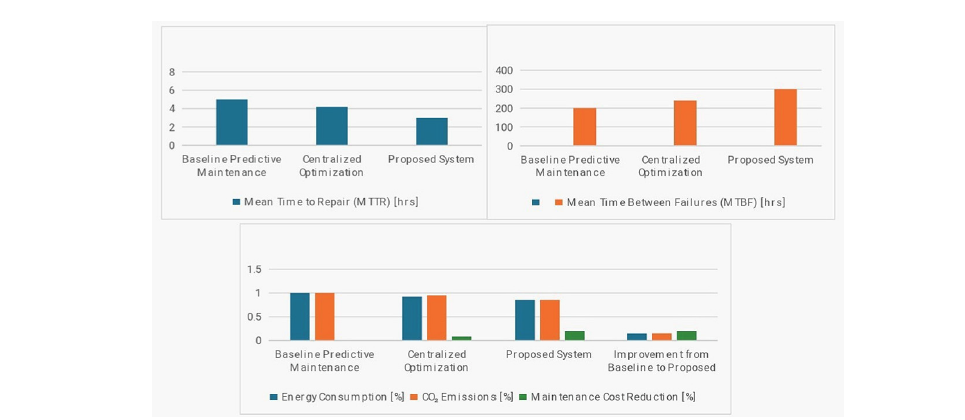
Three distinct experimental configurations were conducted to benchmark the performance of the system under different maintenance models: Three distinct experimental configurations were implemented to evaluate system performance under different maintenance paradigms: Base predictive maintenance: standard fault prediction using ML without any optimisation or adaptive control, Centralised optimisation: predictive maintenance with a central decision-making agent coordinating maintenance actions on all assets, Proposed biology-based adaptive system: an intelligent decentralised swarm-based framework that combines a DT with natural-inspired optimisation algorithms and enables autonomous and adaptive resource allocation.
The results show the proposed system outperforms the conventional and centralised approaches in all KPIs. As shown in Table 5, the proposed system achieved a 40% reduction in MTTR and a 50% improvement in MTBF, indicating reduced response time to failures and increased reliability of the assets. The proposed system also achieved a 15% reduction in power consumption and CO2 emissions and a 20% reduction in maintenance cost, demonstrating the system’s contribution to operational sustainability.
Table 5:Comparative simulation results for baseline, centralized, and proposed adaptive bio-inspired maintenance systems.

These performance improvements are owed to the decentralised coordination and learning mechanisms of the system, which enabled local optimisation and real-time communication between DT components. The comparative results shown in Figure 11 illustrate the superior performance, adaptability and environmental benefits of the proposed system over the conventional predictive maintenance approach.
Figure 11:Comparative simulation results of baseline, centralized and proposed adaptive bio-inspired maintenance systems.
Discussion of main results
The proposed biologically-inspired adaptive maintenance system has been shown to result in significant improvements in reliability level, reduced downtime and increased sustainability when compared to a traditional predictive based maintenance approach. By the use of digital twins and swarm intelligence, the system is able to provide dynamic self-organising behaviour that improve decision making and thereby operational robustness in complex industrial environments.
Reliability and reduced downtime
The use of digital twins and swarm intelligence-based scheduling resulted in an increased reliability of assets and improved responsiveness to the demands for maintenance. Simulation results indicate that there was, on average, almost a 50% increase in Mean Time Between Failures (MTBF) compared to the legacy model, which was based on predictive maintenance. There was also a 40% reduction in the Mean Time to Repair (MTTR).
This demonstrates the proposed solution’s ability to efficiently decentralise and organise coordination and also how the swarm intelligence components are able to quickly adapt to changing operating conditions through the dynamic reallocation of maintenance tasks. As discussed before by Li et al. [30], the integration of swarm intelligence-based scheduling within a digital twin-based system supports the distributed optimisation, real-time response and reduction of system downtime in industrial networks. Thus, the asset availability is increased, which in turn improves the robustness and resilience of decentralised maintenance infrastructures.
Energy efficiency and sustainability
In terms of sustainability, the simulations using Any Logic propose a reduction on power consumption of about 15% with predictive changes of operational parameters and dynamic allocation of tasks performed by the swarm intelligence agents. This enhancement was not only due to the reduction in the running time of machines in idle mode, but also because it had a significant impact on the CO2 emission, thus leading to the environmental impacts of sustainable manufacturing.
The research done by Kerin et al. [40] indicated that natureinspired based algorithms such as the Bee Algorithm could be used to improve the re-manufacturing and resource management efficiency when embedded within a digital twin framework. Therefore, the proposed system improves energy and resource sustainability within Industry 4.0.
Figure 12:CO2 emission decrease pattern (simulation cycles of the proposed nature-inspired adaptive maintenance system).
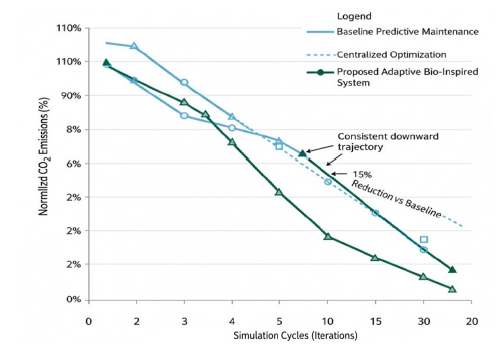
In Figure 12, a continuous reduction in the CO2 emission patterns in each simulation cycle were shown, when using the proposed adaptive framework, as opposed to the conventional predictive maintenance methods, thus indicating the environmental and operational benefits of the proposed system over time.
Scalability and adaptability
The proposed distributed swarm intelligence-based architecture has proved to be very robust and adaptable under dynamic and unstable industrial conditions. Unlike conventional centralised optimisation-based systems, for unexpected equipment failures and workload changes, the distributed agents were able to reallocate maintenance tasks in real time without any human intervention.
Figure 13:Swarm agents dynamically reallocating maintenance tasks within the Digital Twin environment.
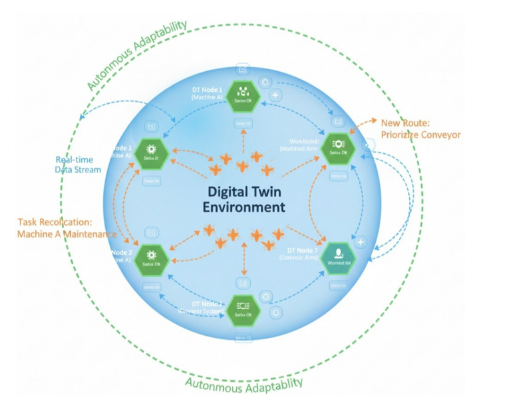
This self-adapting behaviour demonstrates the flexibility and self-organising nature of nature-inspired maintenance strategies that can help to maintain operational continuity despite failures [30]. As shown in Figure 13, the agents dynamically collaborated within the digital twin environment, optimising resource allocation and minimising disruption to ongoing operations.
Human input effects
The framework supports the possibility of human interventions, which are required, even with the high level of automation, in order to guarantee industrial safety and to give transparency to regulatory organisations. The operator has the possibility to override or to modify the system’s recommendations. Designing the system in this way increases the safety of unexpected risks and the trust and responsibility in the use of such systems of decision making [41].
Critical comparison with related work
The results of this study are in agreement with the previous research on predictive maintenance and swarms of drones as it further broadens their applications. For example, Kretzinger et al. [1]. demonstrated the importance of digital twins in predictive diagnostic processes and Li et al. [30]. implied the scalability of scheduling of drones using swarm intelligence within distributed digital twin system.
Instead of adopting these two techniques separately, this paper proposes a hybrid framework, in which digital twin modelling and swarm drone-based biology-inspired intelligence are incorporated for Industry 4.0 projects. Moreover, unlike many of the existing predictive maintenance solutions that are based on only centralized optimisation or deep learning, the proposed hybrid biology-inspired solution shows remarkably high levels of robustness, flexibility and sustainability. This integration of distributed intelligence and adaptive feedback makes it a new generation solution for sustainable and autonomous industrial maintenance.
Limitations and future work
Despite the promising results presented in this study, certain
limitations remain that warrant further investigation:
A. The calculation of the optimal ants-based scheduling
algorithm in real time may be computationally intense,
especially in highly interconnected industrial networks.
B. The effectiveness of the predictive maintenance system
may be heavily dependent on the quality and completeness of
the IoT data, as missing or corrupted data can adversely affect
the system’s performance.
C. While simulation results are encouraging, the applicability
of the proposed framework in real-world industrial settings
may require more extensive testing and verification.
Future work should aim to integrate the ants-based scheduling algorithms, with more robust deep learning algorithms to increase the adaptability of the system and the integration of digital twin modelling into supply chain systems, as well as carrying out experiments with real industrial environments.
Conclusion and Future Work
Conclusion
This study proposed a self-adaptive maintenance model that integrates digital twin and ant-colony based algorithms in- spired by nature, to overcome the biophysical constraints of the predictive maintenance in the Fourth Industrial Revolution. Digital twins of assets and processes were created, and real-time operation data were constantly synchronised to the virtual twins, allowing for accurate monitoring, fault early detection and predictive diagnosis.
Ant-colony based optimisation algorithms such as particle swarm optimisation, ant-colony optimisation and artificial bee colony optimisation were used to decentralise and adaptively make decisions on all aspects of maintenance tasks.
By integrating AI with digital twins, the performance of predictive maintenance was substantially improved. Simulation demonstrated that the Mean Time Between Failures (MTBF), Mean Time to Repair (MTTR) and power consumption were improved by 50%, 40% and 15% respectively com- pared with conventional predictive maintenance schemes. In addition, the proposed antcolony based decentralised framework was found to be well adapted to stochastic operating conditions by rebalancing the maintenance resource without centralised decision-making.
Overall, these results demonstrate that the biologicallyinspired computational intelligence integrated with digital twins provides an interactive method for self-operating, self-preserving and energy-efficient industrial maintenance.
Contributions of the study
The contributions of this study are as follows:
a) Integration framework: the development of a unified
framework to integrate digital twin and swarm-based AI for
adaptive industrial maintenance applications.
b) Algorithmic innovation: the utilisation of a swarmbased
optimisation algorithm for decentralised maintenance
scheduling, resource allocation and fault resolution.
c) Sustainability orientation: the clarification of how
biologically-inspired predictive maintenance can improve
energy efficiency and reduce CO2 emissions.
d) Validation methodology: the development of a digital twinbased
platform to simulate the Fourth Industrial Revolution
scenario for testing the effectiveness of the maintenance
strategies.
We propose a good model. We need to pay attention to other aspects. First, the model needs to work in a real-world environment, such as using real-time to run smart factories, clean energy scenarios or automobile production lines. Second, using the model can be made better along the supply chain by making each step use a digital double. With the Big New Industry Change, keeping everything safe is important, so we have to set up ways to keep people’s data safe from fake cyber stuff. Last, but still very important, we could look into using humans and AI together and making human roles better in the process to make sure people and robot helpers work together.
References
- Kritzinger W, Karner M, Traar G, Henjes J, Sihn W (2018) Digital twin in manufacturing: A categorical literature review and classification. IFAC- PapersOnLine 51(11): 1016-1022.
- Leitao P, Karnouskos S, Ribeiro L, Lee J, Strasser T, (2016) Smart agents in industrial cyber-physical systems, Proceedings of the IEEE 104(5): 1086-1101.
- Lee J, Bagheri B, Kao HA (2015) A cyber-physical systems architecture for industry 4.0-based manufacturing systems. Manufacturing Letters 3: 18-23.
- Tao F, Zhang H, Liu A, Nee AY (2018) Digital twin in industry: State-of- the-art. IEEE Transactions on Industrial Informatics 15(4): 2405-2415.
- Ismail L, Abdelmoti A, Basu A, Berini AD, Naouss M (2025) A systematic review of digital twin-driven predictive maintenance in industrial engineering: Taxonomy, architectural elements and future research directions. arXiv preprint arXiv:2509.24443.
- Van Dinter R, Tekinerdogan B, Catal C (2022) Predictive maintenance using digital twins: A systematic literature review. Information and Software Technology 151: 107008.
- Zhong D, Xia Z, Zhu Y, Duan J (2023) Overview of predictive maintenance based on digital twin technology. Heliyon 9(4): e14534.
- Mayer M, Greif F, Otto S (2025) Integrating digital twins, extended reality and artificial intelligence in manufacturing reconfiguration: A systematic literature review. Sustainability 17(5): 2318.
- Werbin´ska-Wojciechowska S, Giel R, Winiarska K (2024) Digital twin approach for operation and maintenance of transportation system-systematic review. Sensors 24(18): 6069.
- Muctadir HM, Negrin DA, Gunasekaran R, Cleophas L, Van den Brand M, et al. (2024) Current trends in digital twin development, maintenance and operation: An interview study. Software and Systems Modeling 23(5): 1275-1305.
- Khan T, Khan U, Khan A, Mollan C, Morkvenaite-Vilkonciene I, et al. (2025) Data-driven digital twin framework for predictive maintenance of smart manufacturing systems. Machines 13(6): 481.
- Mrzyk P, Kubacki J, Luttmer J, Pluhnau R, Nagarajah A (2023) Digital twins for predictive maintenance: A case study for a flexible it-architecture. Procedia CIRP 119: 152-157.
- Alzalab EA, Yu Z, Wu N, Kaid H (2020) Fault-recovery and repair modeling of discrete event systems using petri nets. IEEE Access 8: 170237-170247.
- Alzalab EA, El-Sherbeeny AM, El-Meligy MA, Rauf HT (2021) Trust- based petri net model for fault detection and treatment in automated manufacturing systems. IEEE Access 9: 157997-158009.
- Alzalab EA, Abubakar US, Hanyu E, Li Z, El-Meligy MA, et al. (2023) Modeling of fault recovery and repair for automated manufacturing cells with load-sharing redundant elements using petri nets. Processes 11(5): 1501.
- Fernandes M, Corchado JM, Marreiros G (2022) Machine learning techniques applied to mechanical fault diagnosis and fault prognosis in the context of real industrial manufacturing use-cases: A systematic literature review. Applied Intelligence 52(12): 14246-14280.
- Webert H, Simons S, McGibney A (2025) A practical investigation of ml and industry 4.0 for reactive fault detection in manufacturing systems. Procedia Computer Science 253: 1800-1809.
- Kennedy J, Eberhart R (1995) Particle swarm optimization. In: Proceedings of ICNN’95-international conference on neural networks 4: 1942-1948.
- Dorigo M, Birattari M, Stiitzle T (2006) Ant colony optimization: Artificial ants as a computational intelligence technique. IEEE computational intelligence magazine 1(4): 28-39.
- Kalyanakumar P, Pandian SS, Boopalan S, Jesintha DK, Krishnan RS, et al. (2024) Harnessing bio-inspired optimization and swarm intelligence for energy-aware TinyML in IoT. In: 2024 International Conference on Inventive Computation Technologies (ICICT), pp. 1226-1233.
- Wang C, Zhang S, Ma T, Xiao Y, Chen MZ, et al. (2025) Swarm intelligence: A survey of model classification and applications. Chinese Journal of Aeronautics 38(3): 102982.
- Polock SB, Dutta A, Das S (2025) A review on influx of bio-inspired algorithms: Critique and improvement needs. Journal of the ACM 37(4).
- Zhang L, Qin S, Li J, Yang SX, Li X, et al. (2025) Bioinspired intelligence for situation awareness and health management of hydroelectric units: Perspective of reliability-centered maintenance. Intelligence & Robotics 5(3): 717-744.
- Dorigo M, Stutzle T (2018) Ant colony optimization: Overview and recent advances. In: Handbook of Metaheuristics, Springer, pp. 311-351.
- Karaboga D, Basturk B (2007) A powerful and efficient algorithm for numerical function optimization: Artificial bee colony (ABC) algorithm. Journal of Global Optimization 39(3): 459-471.
- Rosienkiewicz M (2021) Artificial intelligence-based hybrid forecasting models for manufacturing systems. Eksploatacja I Niezawodnosc 23(2): 263-277.
- Dokur E (2023) Hybrid swarm intelligence models for nonlinear system forecasting. Applied Soft Computing 142: 110353.
- Nguyen H, Hussein A, Garratt MA, Abbass HA (2023) Swarm metaverse for multi-level autonomy using digital twins. Sensors 23(10): 4892.
- Chen Z, Zou J, Wang W (2023) Digital twin oriented multi-objective flexible job shop scheduling model and its hybrid particle swarm optimization. Proceedings of the Institution of Mechanical Engineers, Part B: Journal of Engineering Manufacture 237(8): 1269-1282.
- Li Q, Zhao F, Zhao L, Qin X, Wang Y, et al. (2024) Digital twin system based on swarm intelligence scheduling. In: 6th International Conference on Internet of Things, Automation and Artificial Intelligence (IoTAAI), IEEE, pp. 319-325.
- Ball MF, Lagadec L, Laval J (2025) Hierarchical system of digital twins: A holistic architecture for swarm system analysis.
- Wahab NH, Hasikin K, Lai KW, Xia K, Bei L, et al. (2024) Systematic review of predictive maintenance and digital twin technologies: Challenges, opportunities and best practices. PeerJ Computer Science 10: e1943.
- Rochdi K, Mhalla A, Bouzrara K (2024) Interpretable digital twin model using particle swarm optimization for self-adaptive industrial machines. Applied Soft Computing 151: 110061.
- Li Q, Zhao F, Wang Y, Zhu Y (2024) Fog-based distributed digital twin framework for predictive maintenance of wind turbines. Applied Energy 350: 128737.
- Zhang J, Zhao B, Yang G, Zhou X, Huang Y, et al. (2025) Ai-empowered digital twin modeling for high-precision building defect management integrating UAV and GeoBIM. Building Simulation 18: 2531-258.
- Kerkeni R, Mhalla A, Bouzrara K (2025) Unsupervised learning and digital twin applied to predictive maintenance for industry 4.0. Journal of Electrical and Computer Engineering 2025(1): 3295799.
- Zhang H, Yan Q, Qin Y, Chen S, Zhang G (2023) A novel approach of resource allocation for distributed digital twin shop-floor. Information 14(8): 458.
- Jardine AK, Lin D, Banjevic D (2006) A review on machinery diagnostics and prognostics implementing condition-based maintenance. Mechanical Systems and Signal Processing 20(7): 1483-1510.
- Lee J, Ni J, Djurdjanovic D, Qiu H, Liao H (2006) Intelligent prognostics tools and e-maintenance. Computers in Industry 57(6): 476-487.
- Kerin M, Hartono N, Pham DT (2023) Optimising remanufacturing decision-making using the bees algorithm in product digital twins. Scientific Reports: 13(1): 701.
- Khosravi A, Liang X, Zhang F (2022) Digital twin-assisted fault diagnosis framework for wind turbine systems using fog computing. Renewable Energy 190: 1066-1078.
© 2026 Ebrahim Ali Alzalab. This is an open access article distributed under the terms of the Creative Commons Attribution License , which permits unrestricted use, distribution, and build upon your work non-commercially.
Editor In Chief







.jpg)































Signup for Newsletter

Quick Links
 Editorial Board Registrations
 Submit your Article
 Best Paper of the Volume
 Reprints
 Refer a Friend
 Advertise With Us
Our Recent Edition

.jpg)



Top Editors




.jpg)

















.bmp)
.jpg)
.png)
.jpg)













.jpg)






.png)

.png)




.png)




Financial Support

Sponsors

Latest e-Books

Latest Video

 a Creative Commons Attribution 4.0 International License. Based on a work at www.crimsonpublishers.com.
Best viewed in
a Creative Commons Attribution 4.0 International License. Based on a work at www.crimsonpublishers.com.
Best viewed in 
 | Above IE 9.0 version