

- About Us
- Information
-

The Author ensures that the research has been conducted responsibly and ethically with adherence to all relevant regulations. read more..
- For Authors
- For Reviewer
- Manuscript Guidelines
- Membership
- Publication Ethics
-
- Journals
- Reprints
- e-Books
- Videos
- Policies
- Contact Us
 COVID-19
- Submissions



Full Text
Evolutions in Mechanical Engineering
Finite Element Analysis of Beam Bending Moments in a Reinforced Concrete Frame
Huu Dien Nguyen*
Department of Technology, Long An University of Economics and Industry, Vietnam
*Corresponding author:Huu Dien Nguyen, Department of Technology, Long An University of Economics and Industry, Vietnam
Submission: March 10, 2026;Published: April 06, 2026

ISSN 2640-9690 Volume6 Issue4
Abstract
This paper presents the finite element analysis of bending moments in reinforced concrete beams of a multi-story building using ETABS software. The methodology includes global structural modeling, load assignment and internal force extraction based on finite element analysis. The bending moment envelopes were obtained for critical beams in the structural frame, serving as the basis for reinforcement design. Results demonstrate that the computed bending moments are within the acceptable range for structural safety and serviceability according to TCVN 5574:2018..
Keywords:Finite element method; Bending moment; Reinforced concrete beam; Structural analysis; TCVN 5574:2018
Introduction
Accurate determination of internal forces is essential for the design of reinforced concrete members. Finite Element Method (FEM) software such as ETABS enables engineers to model complex structures and obtain reliable bending moment distributions under various loading conditions. This study focuses on the FEM-based moment analysis of a reinforced concrete frame, which forms the basis for reinforcement detailing in beams [1-5].
Methodology
The building model was developed in ETABS 19, including beams, columns, slabs and load-bearing walls. Dead loads, live loads, finishing loads, wind loads and seismic loads were applied according to Vietnamese standards. FEM analysis was conducted to compute internal forces [6-10].
A. Beam frame under study: Axis 2 frame of the Gia Định 2 building.
B. Analysis output: Bending moment envelopes at mid-span and supports of beams B116-B122 across different stories.
C. Design standard: TCVN 5574:2018 for reinforced concrete structures.
Results and Discussion
Moment distribution
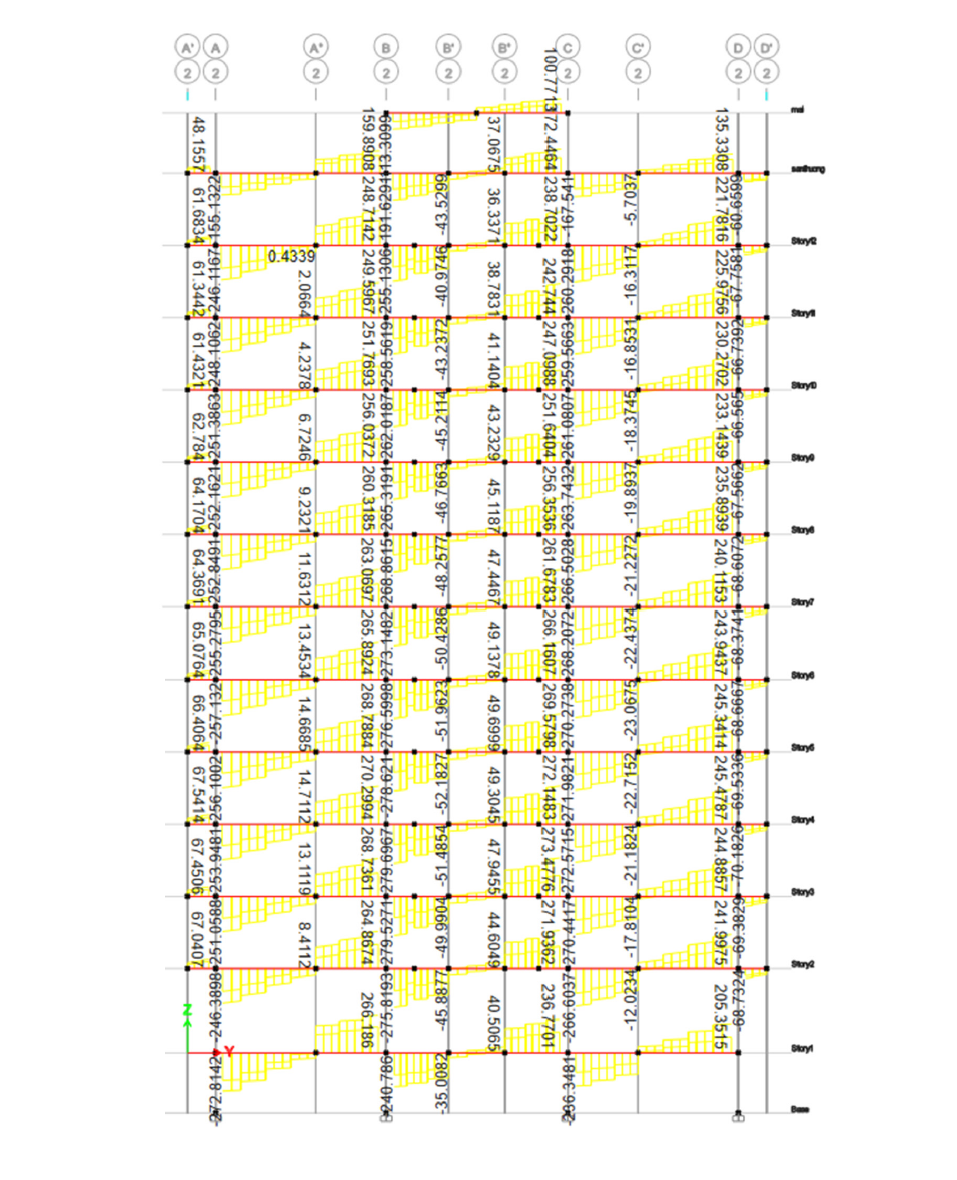
The bending moment envelopes extracted from ETABS are illustrated in Figures 1 & 2. Negative support moments and positive span moments were clearly identified, reflecting the flexural behavior of continuous beams under gravity and lateral loads [11-15].
Figure 1:Moment envelope diagram of the frame beam at axis 2 (kNm).
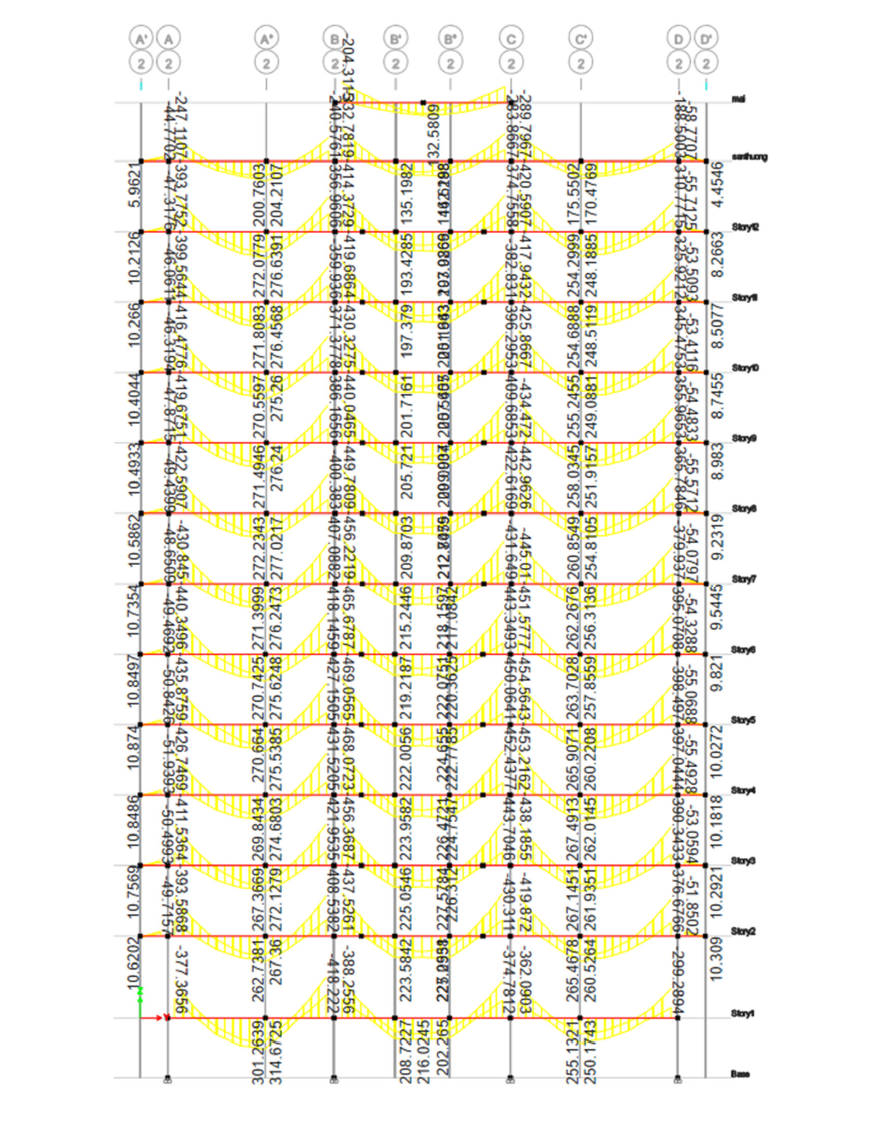
Figure 2:Bending moment envelope for the beam on axis 2 (kNm).
Example (Story 1, Beam B116-B117):
a) Support moment: –299.29kNm
b) Span moment: +255.13kNm
Example (Story 2, Beam B118-B120):
A. Support moment: –430.31kNm
B. Span moment: +227.09kNm
These values indicate that beams are primarily subjected to flexure, confirming their function as bending-dominated members [16-20].
Structural implications
The calculated bending moments were used to design longitudinal reinforcement. Comparison with code-based design resistance confirmed that all beams satisfy the strength requirements. The FEM moment distribution also ensures rational detailing, with higher reinforcement demands at supports where negative moments are critical [21-34].
Conclusion
Finite element analysis using ETABS provides reliable bending moment distributions for reinforced concrete beams in multi-story frames. The results confirmed that the beams satisfy both strength and serviceability criteria under the applied loading conditions. The FEM-based approach is essential for accurate reinforcement design and can be extended to nonlinear and dynamic analyses in future studies.
References
- Computers and structures, Inc. (2020) ETABS 19-Integrated building design software. CSI, Berkeley, California, USA.
- TCVN 5574 (2018) Concrete and reinforced concrete structures-design standard. Ministry of Science and Technology, Vietnam.
- ACI committee 318 (2019) Building code requirements for structural concrete (ACI 318-19) and commentary. American Concrete Institute.
- EN 1992-1-1 (2004) Eurocode 2: Design of concrete structures-Part 1-1: General rules and rules for buildings. European Committee for Standardization.
- CSI (2020) SAFE-Slab analysis and design software. Computers and Structures, Inc., Berkeley, California, USA.
- EN 1990 (2002) Eurocode: Basis of structural design. European Committee for Standardization.
- Nguyen HD (2025) XFEM simulation of functionally graded plates with arbitrary openings. VNUHCM Journal of Science and Technology Development 28(4): 3870-3877.
- Nguyen HD (2025) Extended finite element approach for simulating arbitrary openings in functionally graded plates. Int J Mech Energy Eng Appl Sci 3(3):
- Nguyen HD, Huang SC (2021) Extend finite element method for a plate with two holes and multiple cracks. In Proceedings of the Taiwan International Conference on Ocean Governance, Kaohsiung, China.
- Nguyen HD, Huang SC (2020) Extended finite element method for modeling arbitrary discontinuities with center edge crack in finite dimensional plate under tension and shear. In Proceedings of the International Conference on Advanced Technology Innovation, Okinawa, Japan.
- Nguyen HD, Huang SC (2023) Use of XTFEM based on the consecutive interpolation procedure of quadrilateral element to calculate J-integral and SIFs of an FGM plate. Theor Appl Fract Mech 127: 103985.
- Nguyen HD (2025) Using finite element method to calculate strain energy release rate, stress intensity factor and crack propagation of an FGM plate based on energy methods. Int J Mech Energy Eng Appl Sci 3(2): 14-21.
- Bai X, Guo L, Wang Z, Zhong S (2013) A dynamic piecewise-exponential model for transient crack problems of functionally graded materials with arbitrary mechanical properties. Theor Appl Fract Mech 66: 41-61.
- Nguyen HD (2025) Using the eXtended Finite Element Method (XFEM) to simulate own frequency under external influences of a closed system based on dynamic compensation method. J Int Multidiscip Res 27: 985.
- Ding S, Li X (2013) The fracture analysis of an arbitrarily orientated crack in the functionally graded material under in-plane impact loading. Theor Appl Fract Mech 66: 26-32.
- Nguyen HD, Huang SC (2022) Using the extended finite element method to integrate the level-set method to simulate the stress concentration factor at the circular holes near the material boundary of a functionally-graded material plate. J Mater Res Technol 21: 4658-4673.
- Praveen GN, Reddy JN (1998) Stress analysis of functionally graded plates using the first-order shear deformation theory. Composite Structures 43: 333-349.
- Erdogan F, Kaya AC (1985) A new boundary element method for elastostatic problems with arbitrary internal cracks. Journal of Applied Mechanics 52: 1.
- Raju IS (1987) Calculation of strain-energy release rates with higher order and singular finite elements. Engineering Fracture Mechanics 28(3): 251-274.
- Kim JH, Paulino GH (2002) Finite element evaluation of mixed-mode stress intensity factors in functionally graded materials. International Journal for Numerical Methods in Engineering 53(8): 1903-1935.
- Nguyen HD, Huang SC (2022) Designing and calculating the nonlinear elastic characteristic of longitudinal-transverse transducers of an ultrasonic medical instrument based on the method of successive loadings. Materials 15(11): 4002.
- Nguyen HD (2025) Extended finite element approach for simulating arbitrary openings in functionally graded plates. Int J Mech Energy Eng Appl Sci 17: 885.
- Nguyen HD (2025) Application of the Extended Finite Element Method (X-FEM) for simulating random holes in functionally graded plates. International Journal of All Research Writing 6(12).
- Dai MJ, Xie MY (2025) A novel inverse extended finite element method for structural health monitoring of cracked structures. Ocean Eng 325: 120786.
- Irwin GR, Krafft JM, Paris PC, Wells AA (1967) Basic concepts of crack growth and fracture. NRL Report 6598, Naval Research Laboratory, Washington, DC, USA.
- Bayesteh H, Mohammadi S (2013) XFEM fracture analysis of orthotropic functionally graded materials. Composites Part B: Engineering 44(1): 8-25.
- Nguyen HD, Huang SC (2025) Calculating strain energy release rate, stress intensity factor and crack propagation of an FGM Plate by finite element method based on energy methods. Materials 18(12): 2698.
- Singh IV, Mishra BK, Bhattacharya S (2011) XFEM simulation of cracks, holes and inclusions in functionally graded materials. Int J Mech Mater Des 7: 199-218.
- Nguyen HD (2025) Analysis for stress concentration factor at the circular holes near materials border by extended finite element method. In Proceedings of the 4th International Online Conference on Materials.
- Nguyen HD, Huang SC (2021) The uniaxial stress strain relationship of hyperelastic material models of rubber cracks in the platens of papermaking machines based on nonlinear strain and stress measurements with the finite element method. Materials 14(24): 7534.
- Nguyen HD (2025) Using matlab to study of the response of the system to oscillatory influences be an oscillatory effect on the resting antenna. Int J Multidiscip Res Growth Eval 27: 885.
- Rice JR (1968) A path independent integral and the approximate analysis of strain concentration by notches and cracks. J Appl Mech 35: 379-386.
- Eshelby JD (1974) Calculation of energy release rate. In: Sih GC, Von Elst HC, Broek D (Eds.), Prospects of Fracture Mechanics. Noordhoff, Groningen, The Netherlands, pp. 69-84.
- Riveros GA, Gopalaratnam VS (2005) Post-cracking behavior of reinforced concrete deep beams: A numerical fracture investigation of concrete strength and beam size. ASCE Struct J 47: 3885.
© 2026 Huu Dien Nguyen. This is an open access article distributed under the terms of the Creative Commons Attribution License , which permits unrestricted use, distribution, and build upon your work non-commercially.
Editor In Chief







.jpg)































Signup for Newsletter

Quick Links
 Editorial Board Registrations
 Submit your Article
 Best Paper of the Volume
 Reprints
 Refer a Friend
 Advertise With Us
Our Recent Edition

.jpg)



Top Editors




.jpg)

















.bmp)
.jpg)
.png)
.jpg)













.jpg)






.png)

.png)




.png)




Financial Support

Sponsors

Latest e-Books

Latest Video

 a Creative Commons Attribution 4.0 International License. Based on a work at www.crimsonpublishers.com.
Best viewed in
a Creative Commons Attribution 4.0 International License. Based on a work at www.crimsonpublishers.com.
Best viewed in 
 | Above IE 9.0 version