

- About Us
- Information
-

The Author ensures that the research has been conducted responsibly and ethically with adherence to all relevant regulations. read more..
- For Authors
- For Reviewer
- Manuscript Guidelines
- Membership
- Publication Ethics
-
- Journals
- Reprints
- e-Books
- Videos
- Policies
- Contact Us
 COVID-19
- Submissions



Full Text
Evolutions in Mechanical Engineering
A Review of Studies Conducted on Pressure Swirl Atomizer (PSA)
Ali Kamranpey*
Department of Mathematics, University of Guilan, Iran
*Corresponding author:Ali Kamranpey, Department of Mathematics, University of Guilan, Rasht, Iran
Submission: 10 February, 2026;Published: 24 February, 2026

ISSN 2640-9690 Volume6 Issue4
Abstract
Pressure Swirl Atomizers (PSAs) are indispensable devices in various industries due to their ability to generate fine sprays that enhance atomization efficiency, fuel-air mixing, and combustion processes. Their widespread use in aerospace propulsion, power generation and agricultural spraying underscores the importance of understanding and optimizing their performance. This review comprehensively examines the extensive body of research on PSAs, focusing on key aspects including design innovations, experimental characterizations, numerical simulations, the influence of geometric and fuel properties on spray characteristics, and the role of high-velocity airflow in improving atomization. By synthesizing findings from both foundational and recent studies, this review identifies critical advancements and outlines gaps where further research is necessary to advance PSA technology.
Keywords:Pressure swirl atomizer; Design; Experimental; Simulation; Geometric parameters; Fuel; High-velocity air flow
Introduction
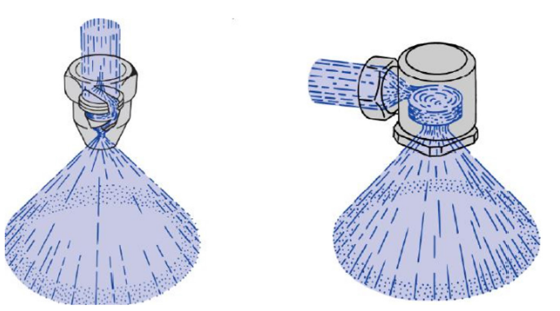
Pressure Swirl Atomizers (PSAs) are vital components in systems where efficient fuel atomization and spray generation are critical to performance. In schematic Figure 1, two main types of this type of atomizer can be seen. Their applications are particularly prominent in aerospace and aviation engines, where precise fuel delivery and fine atomization directly influence combustion efficiency, thrust generation and emissions control [1,2]. In gas turbine engines, PSAs enable effective fuel-air mixing, which is essential for achieving stable combustion and optimizing thermal efficiency [3,4]. Furthermore, PSAs are integral in advanced propulsion systems such as turbofan and turbojet engines, where atomizer design impacts thrust and specific fuel consumption [5,6]. The working principle of a PSA involves injecting liquid fuel tangentially or through a spiral path into a swirl chamber, generating a rapidly rotating flow. This swirl creates centrifugal forces that propel the liquid outward against the chamber wall, forming a thin, conical liquid sheet which subsequently breaks up into fine droplets [7,8]. The resulting hollow cone spray pattern, characterized by a large spray angle, promotes enhanced fuel-air mixing, critical for efficient combustion in aerospace applications [9]. A distinctive feature of PSAs is the central air core within the swirl chamber, which influences droplet breakup dynamics and spray dispersion, affecting flame stability and emissions [10]. Research efforts have focused on characterizing and optimizing PSA designs for aviation and gas turbine applications to maximize atomization efficiency and minimize pollutants [11,12]. Numerical simulations and experimental studies have provided insights into internal flow structures and near-nozzle spray behavior, informing improvements in atomizer geometry and operating conditions to meet the stringent performance demands of modern aerospace propulsion [2,8].
Figure 1:Pressure swirl atomizers, (a): with spiral paths, (b): with tangential inputs [1].
Objective of the Present Review
This review consolidates and synthesizes research on pressure swirl atomizers with several objectives. First, it evaluates design methodologies and innovations that have been instrumental in improving PSA performance. Second, it reviews experimental studies that provide empirical insights into internal flow structures and spray characteristics. Third, it analyzes numerical and simulation approaches that model PSA fluid dynamics and atomization processes. Fourth, it examines how geometric parameters and fuel properties influence spray behavior. Lastly, it explores how integrating high-velocity airflow enhances atomization. By organizing the literature into these thematic areas, the review aims to highlight trends, identify knowledge gaps and suggest pathways for future PSA development.
Classification of Studies on Pressure Swirl Atomizer (PSA)
In this section, the studies conducted on pressure swirl atomizers are systematically categorized and reviewed across several key areas. These include the design methodologies that influence atomizer performance, experimental investigations that provide empirical data on spray behavior and numerical simulation studies that offer detailed insights into the internal flow and atomization processes. Additionally, the review covers the effects of geometric parameters such as swirl chamber dimensions and orifice shape on spray characteristics, as well as the influence of fuel properties like viscosity and temperature. Finally, it examines how the addition of high-velocity airflow can enhance atomization quality. This structured and comprehensive review aims to serve as a valuable resource for researchers, facilitating a deeper understanding of pressure swirl atomizers and guiding future innovations in their design and application.
Design
Design optimization remains a primary focus in PSA research, as the device geometry directly impacts spray performance. Dumouchel et al. [13] provided seminal work establishing the fundamental design principles of PSAs, emphasizing the critical role of swirl chamber shape and inlet configurations to control the internal flow and spray characteristics. Building on this foundation, Hu et al. [14] developed a multi-fluid swirling mixing atomizer tailored for agriculture, demonstrating that introducing multiple swirling fluid streams enhances the generation of ozonated droplets, improving disinfection efficiency in crop applications. Modarres- Razavi et al. [15] utilized the Volume of Fluid (VOF) numerical method to optimize PSA design, highlighting the importance of accurately capturing fluid interfaces to predict spray breakup and droplet formation. Mazaheri et al. [16] conducted a parametric study comparing pressure jet and swirl injector designs, identifying key geometric factors such as swirl chamber diameter and nozzle orifice size that influence spray pattern and atomization quality. Aminjan K et al. [17] integrated experimental measurements with numerical simulations to investigate the effects of inlet pressure and Reynolds number on flow stability in tangential input PSAs, showing that optimized flow parameters lead to enhanced spray uniformity. Earlier works by Aminjan K et al. [18,19] explored the impacts of tangential and spiral path designs on internal flow and spray performance, revealing that spiral paths can improve atomization by stabilizing the swirling flow and reducing droplet size. Lacava et al. [20] proposed a systematic design procedure combining theoretical modeling with experimental validation, which has been widely adopted in PSA engineering for achieving predictable spray characteristics.
Experimental studies
Experimental investigations provide essential validation of design concepts and insights into real-world PSA performance. Belhadef et al. [21] combined numerical modeling and experiments to study atomization dynamics, particularly focusing on droplet size distribution and the breakup mechanisms within PSAs. Hansen et al. [22] utilized a combination of computational fluid dynamics and experimental flow visualization to uncover complex internal vortical structures that influence spray formation. da Silva Couto et al. [23] experimentally evaluated a low-pressure swirl atomizer, confirming the reliability of engineering design procedures under practical operating conditions. Zhou et al. [24] investigated atomization processes and dust reduction capabilities of swirl pressure nozzles, demonstrating their efficacy in lowering particulate emissions in industrial applications. Bian et al. [25] focused on spray characteristics within nuclear power plant containment, emphasizing the importance of precise spray control for safety-critical environments. Laurila et al. [26] combined experiments and computations to study viscous fluid sprays, revealing that non-Newtonian fluid properties significantly affect atomization and flow patterns. Santangelo et al. [27] analyzed water-mist sprays generated by PSAs, integrating experimental data with modeling to understand discharge characteristics and spray distribution. Choudhury [28] performed theoretical and experimental work on cascading atomization, elucidating multistage droplet breakup and highlighting its effect on spray uniformity and droplet size distribution.
Numerical and simulation studies
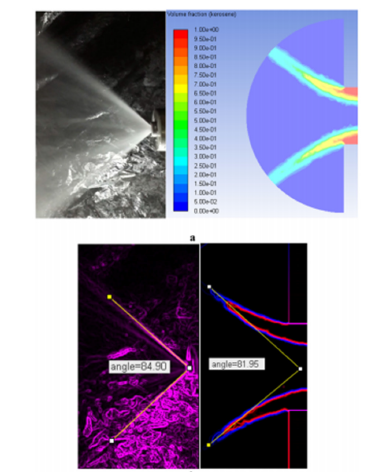
Numerical simulations have become indispensable for investigating PSA internal flows and atomization phenomena, enabling detailed visualization and parametric studies. Nouri- Borujerdi et al. [29] simulated laminar and turbulent two-phase flows within PSAs, capturing complex interactions between liquid and gas phases and providing insight into flow regimes that affect spray quality. Galbiati et al. [8] modeled internal flow dynamics specific to aircraft engine PSAs, contributing to design improvements for aviation fuel injectors. Aminjan et al. [6] conducted 3D simulations of flow in swirl injectors with spiral paths, showing that spiral configurations enhance flow uniformity and atomization efficiency. Salem et al. [30] utilized the InterFoam solver to simulate 2D axisymmetric flows, offering insights into flow stability and spray formation under various operating conditions. Han et al. [31] validated numerical models of pressure-swirl circuits for aviation atomizers, supporting their predictive capability for performance optimization. Gurakov et al. (2020) verified the applicability of the VOF method for simulating liquid spray processes, confirming its accuracy in predicting spray breakup and droplet size distributions. Chen et al. [32] applied large eddy simulation combined with VOF for multi-objective optimization of nozzle flow fields, advancing understanding of turbulent spray behavior. Shi et al. [33] integrated VOF and Discrete Phase Methods (DPM) to simulate atomization in gas-liquid pintle injectors under periodic flow conditions, providing detailed atomization mechanisms. Chen et al. [34] combined VOFDPM simulations with experimental validation to study near-nozzle atomization in air-assisted spraying, improving the predictive capability of air-assisted spray models. In Figure 2, the spray angle obtained from the simulation with VOF method is compared with the experimental test, which indicates the high accuracy of the numerical solution methods.
Figure 2:Comparing simulated spray angles with experimental tests (a) and using image processing techniques (b) to accurately locate edges [29].
Effect of atomizer geometric parameters on spray characteristics
The geometry of the atomizer strongly affects spray properties such as cone angle, droplet size and spray uniformity. Aminjan K et al. [19] analyzed the influence of spiral path angle in PSAs, showing how varying the angle modifies internal flow patterns, resulting in changes to spray dispersion and droplet size distribution. Rashad et al. [35] investigated multiple geometric parameters including orifice diameter and swirl chamber dimensions, finding that these have a direct impact on spray angle and atomization quality. Broniarz-Press et al. [36] studied orifice shape and injection pressure, concluding that optimized orifice geometry enhances atomization by promoting more efficient liquid sheet breakup. Xue et al. [37] examined simplex atomizer performance relative to geometric variations, contributing to design optimization for targeted spray characteristics. Ronceros et al. [38] compared open-end and closed-end PSAs, demonstrating how variations in geometry affect internal flow stability and spray pattern consistency. Dafsari et al. [39] highlighted the critical role of swirl chamber length, showing that longer chambers alter the centrifugal forces and thus the atomization behavior. Zheng et al. [40] found that orifice geometry significantly influences the breakup process and spray droplet sizes. Liu et al. [41] demonstrated that precise control of geometric parameters allows manipulation of spray cone angles, which is critical for effective spray coverage. Gurakov et al. (2021) studied three-way PSAs and revealed how geometric characteristics influence liquid fuel flow distribution, thus affecting atomization uniformity.
Effect of fuel and its characteristics on spray characteristics
Fuel properties such as viscosity, density and temperature substantially influence PSA atomization behavior. Laurila et al. [42] used large-eddy simulation to study viscous fluid flows inside PSAs, showing that increased viscosity dampens atomization and results in larger droplet sizes. Reddy KU et al. [43] examined spray behavior in the transition regime, noting that fuel properties significantly affect spray cone angle and droplet size distribution. Dafsari et al. [44] experimentally assessed aviation fuels with varying viscosities, confirming that higher viscosity fuels produce coarser sprays with larger droplet sizes. Aminjan K et al. [45] numerically studied the impact of fuel temperature on spray characteristics, demonstrating that temperature-induced viscosity changes alter spray breakup and droplet size. Further studies by Aminjan K et al. [46,47] explored the combined effects of inlet pressure, Reynolds number and acoustic dynamics on spray formation, providing a comprehensive understanding of fuel behavior in PSAs. Wimmer et al. [48] investigated viscous flow through swirl chambers, establishing that fluid properties affect internal flow stability and atomization efficiency. Dafsari et al. [49] also evaluated alternative aviation fuels, showing how viscosity variations influence atomization quality and spray characteristics.
Using high-velocity air flow to improve the atomization process
Incorporating high-velocity airflow into PSAs is a promising approach to enhance atomization by producing finer droplets and more uniform spray patterns. Zang et al. [50] conducted numerical investigations of internal mixing air interactions with different fluids, demonstrating that airflow significantly improves atomization efficiency by promoting liquid breakup. Liu et al. [51] studied the effects of internal mixing air mass flow rate and temperature, finding that increased airflow and temperature lead to better atomization and spray quality. Gad et al. [52] examined geometric parameters in air-assisted PSAs, confirming that optimized geometry combined with airflow enhances spray uniformity and coverage. Doustdar et al. [5] combined numerical and experimental methods to characterize air-blast atomizers, introducing a new non-dimensional number (K) to predict spray performance under various airflow conditions. Ma et al. [53,54] focused on biodiesel sprays in industrial furnaces, revealing how airflow rate and temperature influence droplet velocity and size, thus affecting combustion efficiency. Wang et al. [55] investigated air-assisted atomizers used in snow-makers, highlighting the sensitivity of atomization characteristics to operating conditions. Zhang et al. [56] studied air-assisted atomizer structures, showing improved ignition and flame propagation stability in combustion chambers [57-60].
Conclusion
This review has consolidated extensive research on pressure swirl atomizers, illustrating how optimized design supported by experimental and numerical studies significantly enhances atomization and spray performance. Geometric parameters and fuel properties are shown to critically influence spray characteristics, with precise control enabling targeted atomization outcomes. The integration of high-velocity airflow presents a compelling advancement for further improving spray quality, offering finer droplets and more uniform distribution. Continued interdisciplinary research and innovation in design, experimental methods, simulation techniques and airflow integration are essential for advancing PSA applications across aerospace, power generation, agriculture and other sectors.
References
- Dikshit SB, Kulshreshtha DB, Channiwala SA (2017) Numerical simulation of pressure swirl atomizer for small scale gas turbine combustion chamber. 13th International Conference on Heat Transfer, Fluid Mechanics and Thermodynamics, Portoroz, Slovenia.
- Han A, Karmarkar A, Sforzo BA, Powell CF, Nocivelli L (2025) Numerical study and validation of the near-nozzle spray behavior of a non-proprietary pressure-swirl atomizer for aviation applications. ASME Turbo Expo 88780.
- Alajmi AE, Adam NM, Hairuddin AA, Abdullah LC (2019) Fuel atomization in gas turbines: A review of novel technology. International Journal of Energy Research 43(8): 3166-3181.
- Aminjan KK, Rahmanivahid P, Heidari M (2020) Effects of thermodynamic parameters on performance of gas turbine cycle with regenerator. International Journal of Mechanical and Production Engineering Research and Development (IJMPERD) 10(3): 7954-7964.
- Doustdar MM, Aminjan KK (2019) Modeling the thrust and specific fuel consumption for a hypothetical turbojet engine. International Journal of IC Engines and Gas Turbines 5(1): 45-52.
- Zarepour G, Aminjan KK (2018) Modeling the thrust and specific fuel consumption for a hypothetical turbofan engine. International Journal of IC Engines and Gas Turbines 4(1): 1-10.
- Durdina L, Jedelsky J, Jicha M (2012) Spray structure of a pressure-swirl atomizer for combustion applications. EPJ web of conferences 25: 10.
- Galbiati C, Tonini S, Conti P, Cossali GE (2016) Numerical simulations of internal flow in an aircraft engine pressure swirl atomizer. Journal of Propulsion and Power 32(6): 1433-1441.
- Durdina L, Jedelsky J, Jicha M (2014) Investigation and comparison of spray characteristics of pressure-swirl atomizers for a small-sized aircraft turbine engine. International Journal of Heat and Mass Transfer 78: 892-900.
- Mahmoodi M, Aminjan KK (2017) Numerical simulation of flow through sukhoi 24 air inlet. Computational Research Progress in Applied Science & Engineering 3(1): 35-41.
- Gao R, Aminjan KK, Heidari M, Rahmanivahid P, Salahinezhad M, et al. (2025) High-bypass ratio, separate-exhaust turbofan engine: Study on flight mach number and inlet temperature. Journal of the Chinese Society of Mechanical Engineers 46(2): 185-193.
- Dafsari RA, Lee HJ, Han J, Lee J (2019) Evaluation of the atomization characteristics of aviation fuels with different viscosities using a pressure swirl atomizer. International Journal of Heat and Mass Transfer 145: 118704.
- Dumouchel C (1990) The design of pressure swirl atomizers. Proc. 23rd Symp. (Int) on Comb/The Comb. Isnt.
- Hu X, Zhang B, Xu X, Chang Z, Wang X, et al. (2025) Design and performance evaluation of a multi-fluid swirling mixing atomizer for efficient generation of ozonated droplets in agricultural applications. Agronomy 15(5): 1082.
- Modarres-Razavi MR, Moghaddam MR, Elahi R (2010) Designing an optimized pressure-swirl atomizer by using VOF method. Iran Aerosp Soc Conf.
- Mazaheri K, Morad MR, Shakeri AR (2012) A parametric study using two design methodologies for pressure jet and swirl injectors. IEEE Aerospace Conference.
- Khani Aminjan Kiumars, Davood Domiri Ganji (2025) Experimental and numerical study on inlet pressure and Reynolds number in tangential input pressure-swirl atomizer. Arabian Journal for Science and Engineering (2025): 1-20.
- Aminjan KK, Kundu B, Ganji DD (2020) Study of pressure swirl atomizer with tangential input at design point and outside of design point. Physics of Fluids 32(12): 127113.
- Aminjan KK, Heidari M, Ganji DD, Aliakbari M, Salehi F, et al. (2021) Study of pressure-swirl atomizer with spiral path at design point and outside of design point. Physics of Fluids 33(9): 093305.
- Lacava PT, Bastos-Netto D, Pimenta AP (2004) Design procedure and experimental evaluation of pressure-swirl atomizers. 24th International Congress of the Aeronautical Sciences.
- Belhadef A, Vallet A, Amielh M, Anselmet F (2012) Pressure-swirl atomization: Modeling and experimental approaches. International Journal of Multiphase Flow 39: 13-20.
- Hansen KG, Madsen J, Trinh CM, Ibsen CH, Solberg T, et al. (2002) A computational and experimental study of the internal flow in a scaled pressure-swirl atomizer. Zaragoza 9(11).
- da Silva Couto H, Lacava PT, Bastos-Netto D, Pimenta AP (2009) Experimental evaluation of a low pressure-swirl atomizer applied engineering design procedure. Journal of Propulsion and Power 25(2): 358-364.
- Zhou G, Wang J, Song R, Yang W, Xu C (2022) Experimental research on atomization process and dust reduction performance of swirl pressure nozzle. Environmental Science and Pollution Research 29(59): 88540-88556.
- Bian J, Zhang D, Sun R, Wu Y, Tian W, et al. (2019) Experimental study on spray characteristics of pressure-swirl nozzle in China advanced PWR containment. Nuclear Engineering and Design 350: 158-175.
- Laurila E, Koivisto S, Kankkunen A, Saari K, Maakala V, et al. (2020) Computational and experimental investigation of a swirl nozzle for viscous fluids. International Journal of Multiphase Flow 128: 103278.
- Santangelo PE (2012) Experiments and modeling of discharge characteristics in water-mist sprays generated by pressure-swirl atomizers. Journal of Thermal Science 21(6): 539-548.
- Choudhury P (2015) Theoretical and experimental investigation of the cascading nature of pressure-swirl atomization.
- Nouri-Borujerdi A, Kebriaee A (2012) Numerical simulation of laminar and turbulent two-phase flow in pressure-swirl atomizers. AIAA journal 50(10): 2091-2101.
- Salem A, Aqila A, Hamdan M (2026) Numerical simulation of 2D axisymmetric flow within pressure swirl atomizer using interfoam. Wadi Alshatti University Journal of Pure and Applied Sciences 4(1): 25-33.
- Han A, Karmarkar A, Sforzo B, Powell C, Nocivelli L (2026) Numerical investigation and validation of the pressure-swirl circuit of an aviation non-proprietary atomizer. AIAA SCITECH 2026 Forum.
- Chen Y, Luo J, Wu F, Zhang Z, Zhao Z, et al. (2022) Multi-objective optimization on flow characteristics of pressure swirl nozzle: A LES-VOF simulation. International Communications in Heat and Mass Transfer 133: 105926.
- Shi P, Zhu G, Cheng J, Li J, Hou X (2023) Simulation on atomization process of gas-liquid pintle injector in LRE under periodic conditions based on the VOF to DPM method. Aerospace Science and Technology 136: 108222.
- Chen S, Zhang Y, Wu Z, Fang G, Chen Y, et al. (2025) Near-nozzle atomization characteristics in air-assisted spraying: Integrated VOF-DPM modeling and experimental validation. Coatings 15(8): 939.
- Rahad M, Yong H, Zekun Z (2016) Effect of geometric parameters on spray characteristics of pressure swirl atomizers. International Journal of Hydrogen Energy 41(35): 15790-15799.
- Broniarz-Press L, Włodarczak S, Matuszak M, Ochowiak M, Idziak R, et al. (2016) The effect of orifice shape and the injection pressure on enhancement of the atomization process for pressure-swirl atomizers. Crop Protection 82: 65-74.
- Xue J, Jog MA, Jeng SM, Steinthorsson E, Benjamin MA (2004) Effect of geometric parameters on simplex atomizer performance. AIAA journal 42(12): 2408-2415.
- Ronceros J, Raymundo C, Ayala E, Rivera D, Vinces L, et al. (2023) Study of internal flow in open-end and closed pressure-swirl atomizers with variation of geometrical parameters. Aerospace 10(11): 930.
- Dafsari RA, Vashahi F, Lee J (2017) Effect of swirl chamber length on the atomization characteristics of a pressure-swirl nozzle. Atomization and Sprays 9(10): 859-874.
- Zheng H, Liu Z, Wang K, Lin J, Li Z (2020) Influence of orifice geometry on atomization characteristics of pressure swirl atomizer. Science Progress 103(3): 0036850420950182.
- Liu J, Zhang XQ, Li QL, Wang ZG (2013) Effect of geometric parameters on the spray cone angle in the pressure swirl injector. Proceedings of the Institution of Mechanical Engineers, Part G: Journal of Aerospace Engineering 227(2): 342-353.
- Laurila E, Roenby J, Maakala V, Peltonen P, Kahila H, et al. (2019) Analysis of viscous fluid flow in a pressure-swirl atomizer using large-eddy simulation. International Journal of Multiphase Flow 113: 371-388.
- Reddy KU, Mishra DP (2008) Studies on spray behavior of a pressure swirl atomizer in transition regime. Journal of propulsion and power 24(1): 74-80.
- Dafsari RA, Lee HJ, Han J, Lee J (2019) Evaluation of the atomization characteristics of aviation fuels with different viscosities using a pressure swirl atomizer. International Journal of Heat and Mass Transfer 145: 118704.
- Aminjan KK, Sedaghat M, Heidari M, Khashehchi M, Mohammadzadeh K, et al. (2024) Numerical investigation of the impact of fuel temperature on spray characteristics in a pressure-swirl atomizer with spiral path. Experimental and Computational Multiphase Flow 6(4): 428-445.
- Aminjan KK, Ghodrat M, Escobedo-diaz JP, Heidari M, Chitt M, et al. (2022) Study on inlet pressure and Reynolds number in pressure-swirl atomizer with spiral path. International Communications in Heat and Mass Transfer 137: 106231.
- Aminjan KK, Escobedo-Diaz JP, Heidari M, Rahmanivahid P, Khashehchi M, et al. (2023) Comment on “DPM-LES investigation on flow field dynamic and acoustic characteristics of a twin-fluid nozzle by multi-field coupling method”. International Journal of Heat and Mass Transfer 217: 124678.
- Wimmer E, Brenn G (2013) Viscous flow through the swirl chamber of a pressure-swirl atomizer. International Journal of Multiphase Flow 53: 100-113.
- Dafsari RA, Lee HJ, Han J, Park DC, Lee J (2019) Viscosity effect on the pressure swirl atomization of an alternative aviation fuel. Fuel 240: 179-191.
- Zang Z, Xiang S, Aminjan KK, Milani SM, Zuorro A (2025) Numerical investigation of interaction between internal mixing air and spray of three kinds of fluids. Thermal Science, pp. 139-139.
- Liu Z, Aminjan KK, Zuorro A, Milani SM, Zang Z, et al. (2025) Pressure swirl atomizer: Study on the effects of internal mixing air, its mass flow rate and temperature on spray key characteristics. Physics of Fluids 37(7): 073340.
- Gad HM, Baraya EA, Farag TM, Ibrahim IA (2022) Effect of geometric parameters on spray characteristics of air assisted pressure swirl atomizer. Alexandria Engineering Journal 61(7): 5557-5571.
- Ma X, Li F, Wang S (2025) Droplet velocity and size characteristics of biodiesel in an air-assisted pressure swirl atomizer during industrial furnace. Fuel 388: 134446.
- Ma X, Wang S, Li F, Zhang H, Jiang S, et al. (2022) Effect of air flow rate and temperature on the atomization characteristics of biodiesel in internal and external flow fields of the pressure swirl nozzle. Energy 253: 124112.
- Wang R, Zhang B, Xu R, Xing M, Zhang H, et al. (2023) Sensitivity of atomization characteristic to operation conditions for air-assisted atomizers in snow-makers. International Journal of Refrigeration 149: 146-154.
- Zhang Y, He X (2022) Influence of air-assisted atomizer structure on ignition and flame propagation in a trapped-vortex cavity. Case Studies in Thermal Engineering 39: 102416.
- Ali K (2021) Review on main equations for measuring spray properties in centrifugal injectors. Journal of Industrial Safety Engineering 8(3): 17-23.
- Aminjan KK (2019) Thermodynamic analysis of ramjet engines and its optimal functional conditions. The Splendid Journals 2(4): 1-9.
- Tonini S, Conti P, Cossali GE (2016) Numerical simulations of internal flow in an aircraft engine pressure swirl atomizer. Journal of Propulsion and Power 32(6): 1433-1441.
- Aminjan KK, Heidari M, Rahmanivahid P (2021) Study of spiral path angle in pressure-swirl atomizer with spiral path. Archive of Applied Mechanics 91(1): 33-46.
© 2026 Ali Kamranpey. This is an open access article distributed under the terms of the Creative Commons Attribution License , which permits unrestricted use, distribution, and build upon your work non-commercially.
Editor In Chief







.jpg)































Signup for Newsletter

Quick Links
 Editorial Board Registrations
 Submit your Article
 Best Paper of the Volume
 Reprints
 Refer a Friend
 Advertise With Us
Our Recent Edition

.jpg)



Top Editors




.jpg)

















.bmp)
.jpg)
.png)
.jpg)













.jpg)






.png)

.png)




.png)




Financial Support

Sponsors

Latest e-Books

Latest Video

 a Creative Commons Attribution 4.0 International License. Based on a work at www.crimsonpublishers.com.
Best viewed in
a Creative Commons Attribution 4.0 International License. Based on a work at www.crimsonpublishers.com.
Best viewed in 
 | Above IE 9.0 version