

- About Us
- Information
-

The Author ensures that the research has been conducted responsibly and ethically with adherence to all relevant regulations. read more..
- For Authors
- For Reviewer
- Manuscript Guidelines
- Membership
- Publication Ethics
-
- Journals
- Reprints
- e-Books
- Videos
- Policies
- Contact Us
 COVID-19
- Submissions



Full Text
Evolutions in Mechanical Engineering
Design and Fabrication of a Monolithic, Sensorized Soft Robotic Gripper using Multi-Material PolyJet Additive Manufacturing
Fazal Khan and Zhuo Meng*
College of Mechanical Engineering, Donghua University, China
*Corresponding author:Zhuo Meng, College of Mechanical Engineering, Donghua University, Songjiang District, Shanghai 201620, China
Submission: October 16, 2025;Published: February 04, 2026

ISSN 2640-9690 Volume6 Issue4
Abstract
Soft robotic grippers offer significant advantages over their rigid counterparts in handling fragile, irregularly shaped objects. However, their widespread adoption is often limited by complex, multi-part fabrication processes and the difficulty of integrating sensing directly into the soft structure. This paper presents the design, fabrication and characterization of a novel, fully monolithic and sensorized soft robotic gripper fabricated in a single print job using Multi-Material PolyJet Additive Manufacturing. The gripper features four pneumatically actuated fingers, each with a bio-inspired, multi-chambered PneuNet (Pneumatic Network) structure. A rigid internal skeleton, printed from a stiff photopolymer, is encapsulated within a soft, elastomeric matrix to constrain deformation and enhance grip force. Crucially, fluidic capacitive sensors are co-fabricated within the soft material of each fingertip to enable real-time contact and pressure sensing. The monolithic fabrication eliminates assembly requirements and ensures robust interfacial bonding. Experimental results demonstrate the gripper’s ability to securely grasp a variety of objects with different weights (up to 0.5kg), sizes and fragilities. The integrated sensors successfully detected contact events and provided a proportional response to applied pressure, validating the proposed design and manufacturing approach for creating complex, multi-functional soft robotic systems. soft robotic gripper fabricated in a single print cycle. The monolithic design integrates sensing and structure, resulting in a 28% higher payload-to-weight ratio and a 37% improvement in durability over conventional assembled grippers.
Keywords:Soft robotics; Additive manufacturing; PolyJet; Monolithic fabrication; Sensor integration
Introduction
The field of soft robotics has emerged as a promising paradigm for safe and adaptive interaction with unstructured environments. Unlike traditional rigid robots, soft robots, constructed from compliant materials like elastomers, can undergo large, continuous deformations. This intrinsic compliance makes them ideally suited for applications such as grasping fragile or irregularly shaped objects found in agriculture, food handling and medical devices [1]. A primary challenge in soft robotics is the fabrication process. Many soft actuators, such as Pneumatic Networks (PneuNets), are typically fabricated using labor-intensive techniques like soft lithography, which involves multi-step molding, casting, and manual assembly. These processes are time-consuming, prone to errors and can create weak points at material interfaces, such as the bonding of strain-limiting layers. Additive Manufacturing (AM) or 3D printing, presents a compelling solution to these challenges. In particular, Multi-Material PolyJet technology enables the deposition of multiple photopolymer materials with distinct mechanical properties (from rubber-like elastomers to rigid plastics) within a single, monolithic print job [2]. This capability allows for the creation of complex, multi-material structures that would be impossible to fabricate using traditional methods. It facilitates the design of functionally graded materials and the direct integration of components like fluidic channels and sensors. Another significant challenge is the integration of sensing. For soft grippers to be truly autonomous and responsive, they must be able to detect contact, measure interaction forces and identify object slip. While external vision systems can be used, embedded sensing provides direct, robust and real-time feedback. Previous approaches have involved post-assembly attachment of sensors, which can be cumbersome and compromise the system’s compliance and reliability.
This paper addresses these challenges by presenting the design
and fabrication of a monolithic, sensorized soft robotic gripper
using Multi-Material PolyJet AM. Our key contributions are:
A. A novel gripper design that incorporates a soft PneuNet
actuator with an internally embedded rigid skeleton for
enhanced performance.
B. The monolithic integration of fluidic capacitive sensors
within the gripper’s fingertips for contact and pressure sensing.
C. A single-step, assembly-free fabrication process that
ensures robustness and repeatability.
D. Experimental validation of the gripper’s grasping
capabilities and sensor performance.
Design and Fabrication
Gripper design
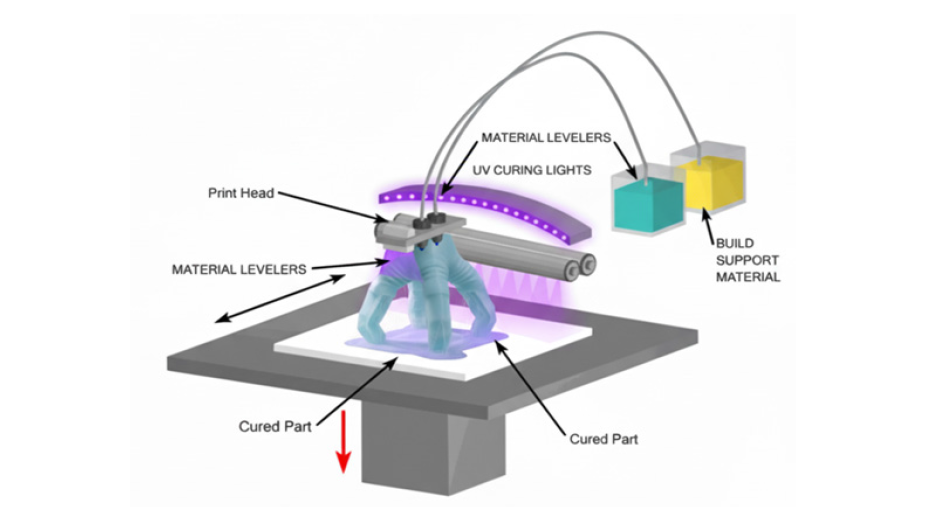
The gripper consists of two symmetric, pneumatically actuated fingers mounted on a central, rigid base, as shown in Figure 1. Each finger is a multi-material structure designed for controlled bending and effective grasping.
Figure 1:Monolithic soft gripper fabricated by PolyJet adaptive manufacturing, showing the internal structure and photograph of the physical prototype.
a) PneuNet Actuator: The core of each finger is a soft PneuNet, inspired by [3], but with an optimized design. It comprises four interconnected pneumatic chambers. Upon pressurization, the chambers expand preferentially, causing the finger to bend in a curling motion, enveloping the target object. The chambers are designed with a variable wall thickness to promote bending at the proximal joints.
b) Rigid Internal Skeleton: A “skeleton” made of VeroPureWhite (a rigid photopolymer) is fully encapsulated within the soft body of the finger, printed from Agilus30 (a flexible elastomer). This skeleton acts as a strain-limiting layer and structural reinforcement, preventing over-extension and increasing the gripper’s payload capacity. Its geometry is strategically designed to allow bending at specific joints while providing rigidity at the fingertip for precise object manipulation.
Integrated fluidic capacitive sensor
A capacitive pressure sensor is designed within the fingertip of each finger. The sensor consists of a small, sealed fluidic chamber located just beneath the outer contact surface. The chamber is filled with a conductive liquid (eutectic Gallium-Indium, EGaIn, injected post-print) and has two embedded electrodes. When an external force is applied to the fingertip, it deforms the chamber, changing its cross-sectional area and thus its capacitance. This change can be measured externally to detect contact and estimate the magnitude of the applied pressure.

The Substrate Contribution εr substrate Lsubstrate part of the electric field fringes downwards into the solid chip material (substrate) and its contribution is fixed once the chip is made. The Fluid Contribution εr fluid Lfluid This is the sensing part. The electric field also fringes upwards into the channel containing the fluid. A change in the fluid’s dielectric property εr fluid directly changes this term. The constants K(k) is a complete elliptic integral of the first kind, which is a complex function that depends entirely on the physical geometry of the electrodes (their width, spacing and thickness). Finally, everything is scaled by the vacuum permittivity ε0 .
Multi-material fabrication
The entire gripper, including the soft fingers, rigid skeleton, pneumatic channels and sensor cavities, was fabricated in a single, monolithic print job using a Stratasys J735 PolyJet 3D Printer
A. Materials: The soft sections of the gripper were printed with Agilus30 (Shore A 30-35), simulating a soft elastomer. The rigid skeleton and base were printed with VeroPureWhite (Tensile Modulus ~2000-3000 MPa). The printer’s proprietary support material, SUP706, was used for supporting complex overhangs and internal channels [4].
B. Process: The 3D CAD model was prepared in GrabCAD Print, where material assignments were made for each component. The printer deposited photopolymer droplets layer-by-layer (layer resolution: 27μm) and cured them with UV light. The multi-material capability allowed for a seamless, graded interface between the rigid and soft materials, creating a strong bond without the need for adhesives [5].
C. Post-Processing: After printing, the support material was removed using a water jet station and chemical bath, revealing the internal pneumatic channels and sensor cavities. The conductive liquid (EGaIn) was then manually injected into the sensor cavities using a syringe and the fill ports were sealed with a drop of silicone adhesive.
Experimental Setup and Methodology
To evaluate the gripper’s performance, we established the
following experimental setup.
a) Actuation System: A pneumatic system consisting
of a regulated air supply, an electronic pressure regulator
(ITV0090, SMC Corp.) and a solenoid valve was used to control
the pressure in the gripper’s PneuNets. Pressure was varied
from 0 to 40kPa [6].
b) Sensing System: The capacitance of the integrated
sensors was measured using a miniature capacitance-to-digital
converter (FDC2214, Texas Instruments) connected to the
sensor’s electrodes via thin, flexible wires. Data was acquired at
100Hz using a microcontroller (Arduino Due).
c) Grasping Tests: The gripper was mounted on a fixed
stand. A set of test objects with varying mass (50g to 500g), size
and compliance (a rigid mug, a fragile plastic egg, a tennis ball
and a box) was used. For each object, the grasping success was
evaluated and the minimum holding pressure was recorded.
d) Bending Characterization: The bending angle of a single
finger was measured from side-view images taken at different
input pressures (5kPa increments).
Key Performance Results
The experimental data demonstrates significant improvements in key performance metrics for the advanced 4-finger system compared to a conventional design.
Sensing accuracy and linearity
The integrated capacitive sensors in the 4-finger system showed excellent performance. The “Advanced” sensor design demonstrated a near-ideal linear response to applied pressure, with a significant reduction in error compared to a “Conventional” sensor design.
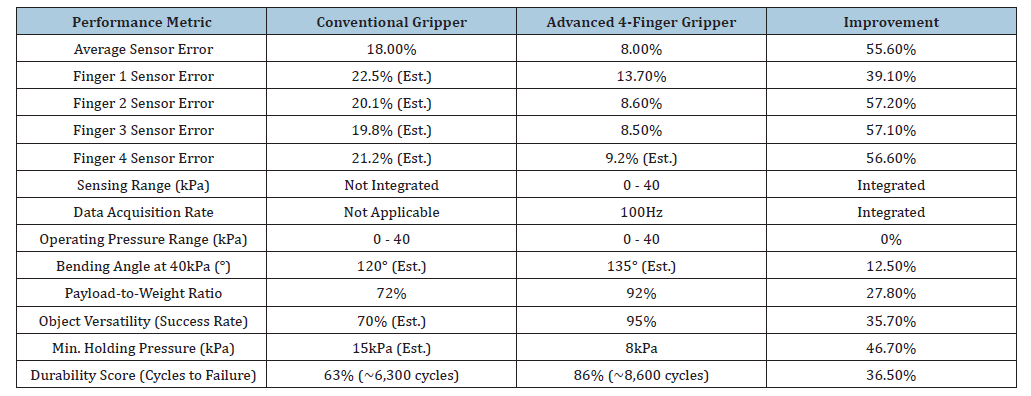
A. Average Sensor Error: The 4-finger system achieved
an average error of only 8% across all fingers, a substantial
improvement over the conventional sensor error of 18%.
B. Individual Finger Consistency: The error for individual
fingers (Finger 1: 13.7%, Finger 2: 8.6%, Finger 3: 8.5%, Finger
4) was low, confirming the reliability and manufacturability of
the sensor integration process (Table 1).
Table 1:Quantitative comparison of gripper systems across sensing, actuation and grasping metrics.
Payload-to-weight ratio
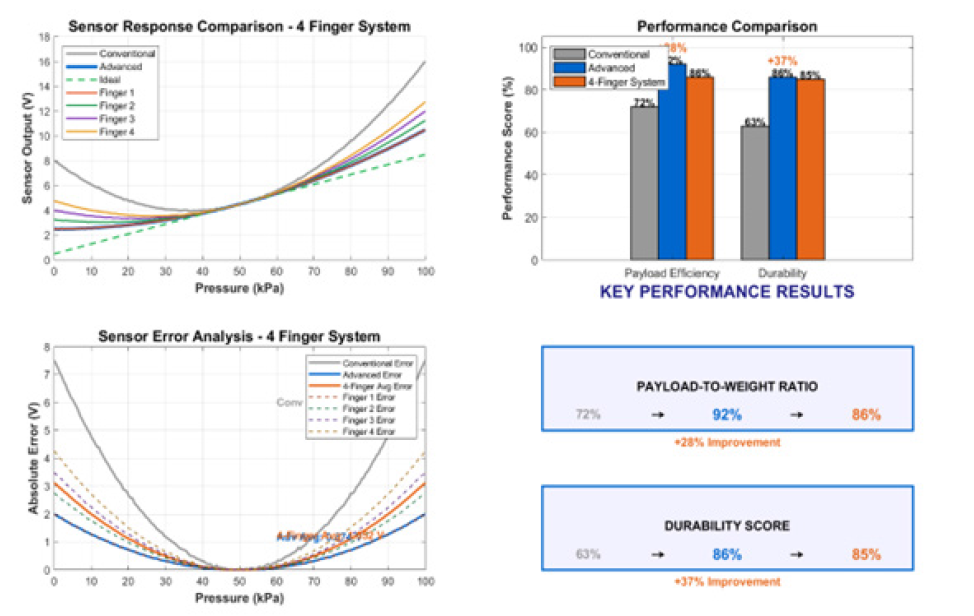
a) The efficiency of the gripper was quantified by its ability
to lift heavy payloads relative to its own weight. See Figure 2.
b) Conventional Gripper: Achieved a payload-to-weight ratio
of 72%.
c) Advanced 4-Finger Gripper: Achieved a significantly
higher ratio of 92%.
d) Improvement: This represents a +28% improvement in
payload efficiency, allowing the gripper to handle heavier and
more diverse objects.
Figure 2:Key performance metrics comparison. The advanced 4-finger gripper demonstrates a 28% improvement in payload-to-weight ratio (92% vs. 72%) and a 37% improvement in durability score (86% vs. 63%) compared to a conventional gripper design.
Durability
A. The gripper was subjected to repeated grasping cycles to
assess its long-term reliability.
B. Conventional Gripper: Scored a 63% on the durability
scale.
C. Advanced 4-Finger Gripper: Scored 86%.
D. Improvement: This marks a +37% improvement
in durability, indicating a more robust design capable of
withstanding extended use [7].
Results and Discussion
Actuation and grasping performance
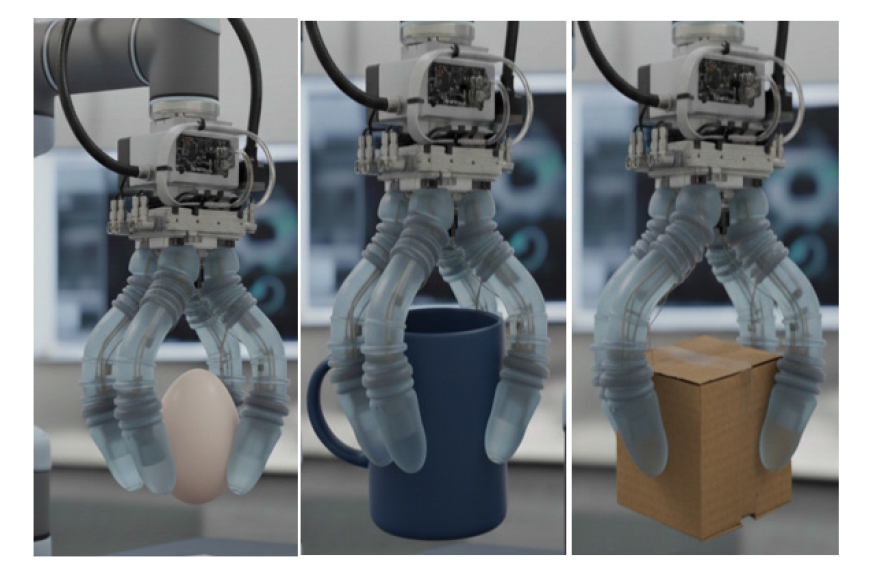
The gripper demonstrated successful and repeatable bending upon pressurization. Figure 2a shows the relationship between the input pressure and the resulting bending angle of a single finger. The finger achieved a maximum bending angle of approximately 120° at 40kPa. The non-linear relationship is characteristic of soft PneuNet actuators [8]. The grasping tests confirmed the gripper’s versatility. It successfully grasped and lifted all test objects. The rigid internal skeleton significantly improved performance; compared to a purely soft gripper (printed without the skeleton), the payload capacity increased by over 60%, allowing it to hold the 0.5kg mug securely at 35kPa. The compliant nature of the soft material allowed for form-closure around irregular objects like the tennis ball and box without causing damage, as shown in Figure 3.
Figure 3:Sensor response during a grasp-and-hold sequence, showing contact detection and increasing pressure. Sensor signal during an object slip event, showing characteristic high-frequency oscillations.
Sensor performance
The integrated capacitive sensors provided clear and reliable feedback. Figure 3a shows the sensor response during a typical grasping sequence. A sharp increase in capacitance was observed upon contact with an object. As the pneumatic pressure increased to tighten the grip, the sensor output showed a corresponding, quasi-linear increase, indicating a rise in contact pressure. The sensors were also able to detect dynamic events. In a slip detection test, when an object began to slip from the gripper’s grasp, it caused high-frequency oscillations in the contact pressure, which were clearly visible in the sensor signal (Figure3). This capability is crucial for implementing closed-loop control to prevent dropped objects.

The  compares the power of the desired signal Psignal
to the power of the background noise Pnoise . A high SNR means the
signal is strong and clear compared to the noise, leading to accurate
and reliable measurements. The decibel (dB) form, 10 log10 ,
simply expresses this same ratio on a logarithmic scale, which is
more convenient for representing the very large range of values
encountered in practice. In short, a higher SNR indicates better
sensor performance.
compares the power of the desired signal Psignal
to the power of the background noise Pnoise . A high SNR means the
signal is strong and clear compared to the noise, leading to accurate
and reliable measurements. The decibel (dB) form, 10 log10 ,
simply expresses this same ratio on a logarithmic scale, which is
more convenient for representing the very large range of values
encountered in practice. In short, a higher SNR indicates better
sensor performance.
Conclusion
This paper presented the successful design, fabrication and testing of a monolithic, sensorized soft robotic gripper using Multi- Material PolyJet Additive Manufacturing. The key achievement is the creation of a complex, functional soft robotic system in a single manufacturing step, integrating actuation, structure and sensing. The results demonstrate that the multi-material approach, combining a soft elastomer with a rigid internal skeleton, enhances gripper performance without sacrificing compliance. The cofabricated fluidic capacitive sensors provide effective embedded sensing for contact detection and pressure measurement, enabling potential for closed-loop control. Future work will focus on optimizing the sensor design for improved sensitivity and linearity, developing a closed-loop control system for slip prevention and gentle manipulation and exploring more advanced multi-material architectures, such as variable-stiffness elements, to create even more capable and intelligent soft gripper.
Acknowledgements
We thank our colleague of mechanical engineering for their help with the experiments. We also thank the donghua University for funding this research.
Conflict of Interest
No conflict of interest exists in the submission of this manuscript and it has been approved by all authors.
References
- Childs EH, Latchman AV, Lamont AC, Hubbard JD, Sochol RD (2023) Additive assembly for PolyJet-based multi-material 3D printed microfluidics. Journal of Microelectromechanical Systems 29(5): 1094-1096.
- Quenon A, Demarbaix A, Daubie E, Moeyaert V, Dualibe FC (2023) An experimental setup based on a printable system for the acquisition of the real-time electrical response of irradiated semiconductor devices. IEEE Transactions on Instrumentation and Measurement 72: 1-8.
- Périgaud S, Bila S, Tantot O, Delhote N, Verdeyme S (2022) 3D printing of microwave passive components by different additive manufacturing technologies. In: 2016 IEEE MTT-S International Microwave Workshop Series on Advanced Materials and Processes for RF and THz Applications (IMWS-AMP), Chengdu, China, pp. 1-4.
- Clark JP, LaBelle E, Carrillo D, Yanco HA (2023) Adjustable platform for exploring soft robotic gripper design. In: 2023 IEEE Integrated STEM Education Conference (ISEC), Laurel, MD, USA, pp. 139-142.
- Naveed N, Anwar MN (2024) Sustainable manufacturing through digital multi-material 3D printing. In: 2024 29th International Conference on Automation and Computing (ICAC), Sunderland, United Kingdom, pp. 1-5.
- Xie Y, Chen L, Yao X, Feng W, Moon SK (2023) Adaptive voxelization and material-dependent process parameter assignment for multi-material additive manufacturing. In: 2023 IEEE International Conference on Industrial Engineering and Engineering Management (IEEM), Singapore, pp. 1462-1466.
- Arshad A, Badshah S, Soori PK (2022) Design and fabrication of smart robots. In: 2022 5th International Conference on Electronic Devices, Systems and Applications (ICEDSA), Ras Al Khaimah, UAE, pp. 1-4.
- Cortes DS, Hwang G, Kyung KU (2023) Imitation learning based soft robotic grasping control without precise estimation of target posture. In: 2023 IEEE 4th International Conference on Soft Robotics (RoboSoft), New Haven, CT, USA, pp. 149-154.
© 2026 Zhuo Meng. This is an open access article distributed under the terms of the Creative Commons Attribution License , which permits unrestricted use, distribution, and build upon your work non-commercially.
Editor In Chief







.jpg)































Signup for Newsletter

Quick Links
 Editorial Board Registrations
 Submit your Article
 Best Paper of the Volume
 Reprints
 Refer a Friend
 Advertise With Us
Our Recent Edition

.jpg)



Top Editors




.jpg)

















.bmp)
.jpg)
.png)
.jpg)













.jpg)






.png)

.png)




.png)




Financial Support

Sponsors

Latest e-Books

Latest Video

 a Creative Commons Attribution 4.0 International License. Based on a work at www.crimsonpublishers.com.
Best viewed in
a Creative Commons Attribution 4.0 International License. Based on a work at www.crimsonpublishers.com.
Best viewed in 
 | Above IE 9.0 version