
- About Us
- Information
-

The Author ensures that the research has been conducted responsibly and ethically with adherence to all relevant regulations. read more..
- For Authors
- For Reviewer
- Manuscript Guidelines
- Membership
- Publication Ethics
-
- Journals
- Reprints
- e-Books
- Videos
- Policies
- Contact Us
 COVID-19
- Submissions



Full Text
Examines in Marine Biology & Oceanography
Every Cloud has a Silver Lining: when the Hunter’s Blind becomes a Nesting Platform for the Mediterranean Gull
Roberto G Valle*
Independent Researcher, Italy
*Corresponding author: Roberto G Valle, Independent Researcher, Rialto, San Polo 571, 30125 Venice, Italy
Submission: July 10, 2026;Published: July 22, 2026
ISSN 2578-031X Volume 8 Issue 3
The Species
The Mediterranean Gull Ichthyaetus melanocephalus (Temminck 1820) is a medium-sized larid whose historical breeding range was largely confined to the Black Sea basin, with core populations along its northern shores. During the second half of the twentieth century the species underwent a marked westward expansion, colonizing much of central, northern and western Europe as well as several Mediterranean countries. The European population is currently estimated at 118,000–328,000 breeding pairs, with the global winter contingent concentrated along the Mediterranean and eastern Atlantic coasts of Iberia [1,2]. Despite its predominantly coastal-wetland breeding habitat, the species has a genuinely marine dimension outside the nesting season. Iberian wintering aggregations, which hold a substantial fraction of the global population, are structured along coastal waters, estuaries and fishing harbors, organised as a metapopulation of largely independent regional units [3]. Off central Portugal, wintering birds appear to forage several tens of kilometers offshore, possibly at night [4]. Recent GPS tracking of breeders from an Adriatic saltpan colony has shown that even during reproduction ~16% of foraging locations fall on the open sea, with marine use increasing significantly from egg incubation to chick-rearing [5]. The Mediterranean Gull is therefore, in a non-trivial sense, a marine bird that happens to nest on the coast.
An Adriatic Paradox
Against this background, the recent expansion of the species in the northern Adriatic has followed an unusual axis. From a single pair that settled in the Venice Lagoon in 1996, the breeding population in the Lagoon–northern Po Delta area reached 5,601 pairs in 2024, corresponding to approximately 8% of the EU28 total and the majority of the Italian contingent [6]. The expansion has taken place largely within infrastructures originally designed for productive and hunting purposes: the fish farms of the upper Adriatic, with their embankments, ponds and fixed hunting blinds. Conservation science likes clean narratives: The threatened species, the protected habitat, the decisive intervention. Here the plot is more oblique, and the old proverb — every cloud has a silver lining - comes out of it, if not promoted to an ecological theory, at least reinstated as a useful methodological caveat.
The Problem: The Rising Tide
Like many colonial larids, the Mediterranean Gull nests just above the high-tide line, on saltmarshes, islets and small emergent patches [2]. This strategy, functional over millennia, is becoming increasingly maladaptive under current climatic conditions. In the Venice Lagoon, sea level rose by approximately 10cm between 1996 and 2022 [6]; exceptional spring and summer tides, once rare, have become frequent [7,8]. The demographic outcome is stark: 0.15 fledglings per pair over a ten-year study in open-lagoon colonies, with catastrophic losses in 2016 (2,512 nests flooded, all lost), 2019 and 2022 [9]. Productivity of this magnitude is insufficient to sustain the population. The species thus faces a recurrent ecological constraint: nesting at low elevation, adaptive under stable hydrological conditions, entails a high and increasing probability of reproductive failure.
The “Clinical Case”: The High and Dry Solution
The fish farms of the upper Adriatic constitute a mosaic of level-regulated water bodies, embankments, raised mounds and fixed hunting blinds (locally botti) - structures elevated above the water surface and used during the winter hunting season to shoot ducks. In the summer breeding season these same structures, together with embankments and small internal mounds, provide what saltmarshes no longer reliably offer: a stable nesting platform, elevated several tens of centimeters above the water surface and structurally protected from tidal flooding.
Empirical evidence is consistent. Between 2020 and 2024 the fish farms hosted on average 89% of the breeding pairs in the study area, with peaks of 100% in two seasons. In the northern Po Delta, breeding occurs exclusively within fish farms in the absence of suitable saltmarshes [6]. Within these environments, individuals preferentially select the small embankments and elevated structures highest above the water surface, a preference already reported in other breeding areas of the species [10], with breeding success in monitored seasons markedly higher than in the open lagoon [9]. The same fixed hunting blinds are re-occupied as breeding sites year after year, indicating a stable pattern of use rather than an opportunistic, one-off occupation. Together with the reduced human disturbance due to restricted access, this accounts for the effectiveness of the hunting blind as a breeding refuge.
In clinical-case terms: the species has adopted a structural response to a hydrological problem, and that response coincides, materially, with the infrastructure of a hunting activity.
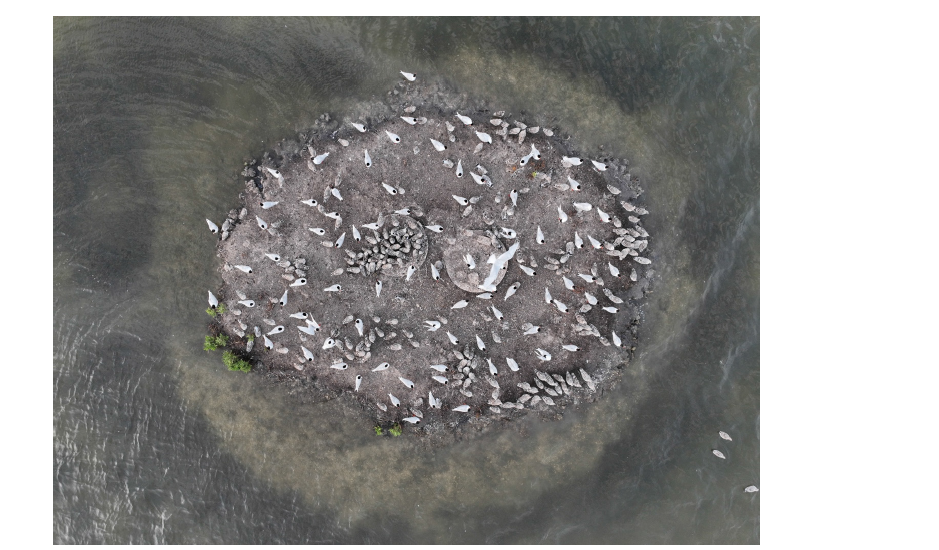
Figures 1 & 2 document a single, illustrative case. Figure 1, taken on 16 May 2026, shows the colony established on a fixed hunting blind within a fish farm of the northern Po Delta, with 217 incubating pairs occupying the upper surface of the structure. Figure 2, taken on the same blind on 7 July 2026, shows 224 fledglings close to leaving the nest. The resulting local productivity of ~1.03 fledglings per pair (224/217) is nearly seven times the ten-year mean of 0.15 fledglings per pair reported by Valle & Scarton [6] for the openlagoon colonies of the same study area. Even allowing for the limits of a single-site, single-season estimate, possible immigration of near-fledged juveniles from adjacent structures, uncertainty on the number of pairs that ultimately laid a full clutch, and the intrinsic variability of a colonial larid, the order of magnitude is remarkable and internally consistent with the mechanism outlined above: an elevated, dry substrate suppresses the dominant source of nest failure (tidal flooding) that constrains productivity in open-lagoon colonies. The elevated structure, in other words, does not merely prevent catastrophic flooding losses: it delivers to the following season a demographic contribution one order of magnitude above that expected in the open lagoon, and it does so on structures that are consistently re-occupied across successive breeding seasons.
Figure 1:Fixed hunting blind in a fish farm of the Northern Po Delta, 16 May 2026. The upper surface of the blind is occupied by a colony of Mediterranean Gull (Ichthyaetus melanocephalus), with 217 incubating pairs censused on the structure.
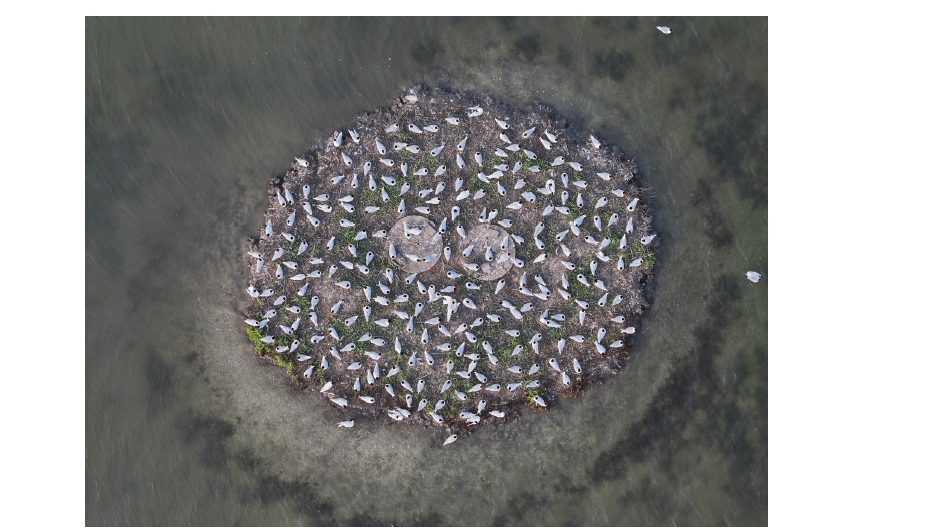
Figure 2:Same fixed hunting blind of Figure 1, 7 July 2026. The upper surface of the blind is occupied by 224 fledglings close to leaving the nest. The resulting local productivity (~1.03 fledglings/pair) is approximately seven times the ten-year mean reported for the open-lagoon colonies of the study area (0.15 fledglings/pair; [9].
An Editorial that Takes No Side
This note does not intend to express a value judgement on hunting in the lagoon: It is neither its purpose nor methodologically justified from a single case study. We limit ourselves to three observations:
a) The fish farms of the upper Adriatic are hydraulically managed
environments, maintained over time for private productive
and hunting purposes [6].
b) This management - stable water levels during the breeding
season, elevated structures such as embankments and blinds,
regulated access - generates, as an unplanned side-effect,
a high-quality breeding habitat for a species of Community
interest.
c) Under the current scenario of sea-level rise and intensifying
spring-summer extreme tides, this side-effect has plausibly
become the critical factor for the persistence of the breeding
Mediterranean Gull population in the northern Adriatic.
Three questions follow, which we leave open. If an activity traditionally considered a source of pressure on wildlife today produces a documentable structural benefit for a species of conservation concern, how should it be weighed in management assessments? Can the effect be replicated by removing the cause - that is, can equivalent dry elevated platforms be obtained without the blinds, or without the fish farms themselves? And, no less relevantly, to what extent are analogous side-effects of other controversial anthropogenic activities being overlooked for essentially narrative reasons?
A Proverbial Coda
Twentieth-century conservation operated on relatively clean categories: Natural vs. artificial habitats, compatible vs. incompatible activities, pressures vs. protections. The case described here suggests that such categories require updating. Saltmarshes, the historically preferred habitat of the Mediterranean Gull, currently act as ecological traps; the fish farms, heavily anthropized environments, function as breeding refugia; and the fixed hunting blinds, in spring, host the chicks of a species of Community interest. This is neither an endorsement nor an indictment, but an invitation to attend to the unexpected geometries of human–wildlife coexistence. When the elevated platform has been designed for purposes unrelated to conservation, the ecological outcome remains as documented: every cloud has a silver lining.
References
- Bekhuis J, Meininger PL, Rudenko AG (1997) Mediterranean gull larus melanocephalus. In: Hagemeijer EJM, Blair MJ (Eds.) The EBCC Atlas of European breeding birds: Their distribution and abundance. T & AD Poyser Publishers, UK, pp. 324-325.
- BirdLife International (2024) Species factsheet: Mediterranean Gull Ichthyaetus melanocephalus.
- Carboneras C, Aymí R, Cama A, Duponcheel C, Ferrer J, et al. (2010) Mediterranean gulls larus melanocephalus wintering in Spain and Portugal: One population or several? Airo 20: 3-11.
- Poot M (2003) Offshore foraging of Mediterranean Gulls Larus melanocephalus in Portugal during the winter. Airo 13: 1-40.
- Kalaitzakis I, Pascalis F, Cecere J, Pirrello S, Meneghini G, et al. (2026) Time for seafood? Factors affecting land vs. sea foraging choice in breeding Mediterranean gulls. Behavioral Ecology and Sociobiology 80.
- Valle RG, Sartori A, Scarton F, Verza E (2025) Settlement and population increase of the Mediterranean Gull Larus melanocephalus, breeding in the northwestern Adriatic coastal wetlands. A thirty-year study. Rivista Italiana di Ornitologia - Research in Ornithology 95(1): 51-58.
- Ferrarin C, Lionello P, Orlić M, Raicich F, Salvadori G (2022) Venice as a paradigm of coastal flooding under multiple compound drivers. Scientific Reports 12: 5754.
- Baldan D, Coraci E, Crosato F, Cornello M, Ferla M, et al. (2023) Return periods of extreme sea levels: From magnitude to frequency, duration and seasonality. Implications in a regulated coastal lagoon. Science of the Total Environment 866: 161326.
- Valle RG, Scarton F (2023) The effects of tidal flooding on colonisation of the Venice Lagoon, Italy, by Mediterranean Gulls. British Birds 116: 720-726.
- Fasola M, Canova L (1991) Colony site selection by eight species of gulls and terns breeding in the Valli di Comacchio (Italy). Bollettino di Zoologia 58(3): 261-266.
© 2026 Roberto G Valle. This is an open access article distributed under the terms of the Creative Commons Attribution License , which permits unrestricted use, distribution, and build upon your work non-commercially.
Editor In Chief







.jpg)































Signup for Newsletter

Quick Links
 Editorial Board Registrations
 Submit your Article
 Best Paper of the Volume
 Reprints
 Refer a Friend
 Advertise With Us
Our Recent Edition

.jpg)



Top Editors




.jpg)

















.bmp)
.jpg)
.png)
.jpg)













.jpg)






.png)

.png)




.png)




Financial Support

Sponsors

Latest e-Books

Latest Video