

- About Us
- Information
-

The Author ensures that the research has been conducted responsibly and ethically with adherence to all relevant regulations. read more..
- For Authors
- For Reviewer
- Manuscript Guidelines
- Membership
- Publication Ethics
-
- Journals
- Reprints
- e-Books
- Videos
- Policies
- Contact Us
 COVID-19
- Submissions



Full Text
Examines in Marine Biology & Oceanography
There is No Evidence that the Northern Gulf of California Has Ever Been Brackish or Estuarine During the Holocene
Richard C Brusca*
Department of Zoologist, Marine Biologist, And Conservation Ecologist, University of Arizona is a Public Land-Grant Research, USA
*Corresponding author: Richard C Brusca, Department of Zoologist, Marine Biologist, and Conservation Ecologist, University of Arizona is a Public Land-Grant Research University in Tucson, Arizona, USA
Submission: January 29, 2026;Published: February 19, 2025

ISSN 2578-031X Volume 8 Issue 1
Abstract
There is a long-standing belief that the Colorado River once created brackish-water estuarine conditions in the Northern Gulf of California, and that this affected the ecosystem of the Upper Gulf. However, a thorough review of the literature reveals this not to be the case. There has never been published documentation of brackish water in the Northern Gulf south of the river’s mouth, at Isla Montague. (Data from multiple independent investigations have never shown brackish or estuarine conditions south of Isla Montague.) Furthermore, the average daily tidal exchange in the Upper Gulf exceeds the highest annual river discharge ever estimated, suggesting the impossibility of brackish conditions in the Northern Gulf. Species such as vaquita (Phocoena sinus), totoaba (Totoaba macdonaldi), corvina (Cynoscion othonopterus), and others have always lived in marine conditions
Keywords:Colorado river; Colorado delta; Upper gulf of California; Northern gulf of California; Totoab, Corvina; Vaquita; Shrimp
Introduction
A two key archives of the Colorado River’s history are Holocene tree-ring reconstructions of precipitation and the late Miocene-early Pliocene Bouse Formation, which outcrops and is also present in the subsurface along the lower Colorado River Valley of western Arizona, southern Nevada, southeastern California, and northeastern Baja California. The Bouse formation ranges from less than 10m thick in some outcrops to over 250m in subsurface drill sites. Based largely on analyses of the Bouse Formation, the Colorado River is thought to have reached the Gulf of California (far to the north of its present location) sometime between 5.3 and 4.8 million years ago [1-3]. A long chronicle of tree-ring research shows an historic mean Colorado River flow (past Lees Ferry) of ~13.5 X 10⁹m3 (~11 million acre-feet) annually. The amount reaching the U.S.-Mexico border, even with the Gila River flow included, would have been far less than that, perhaps as little as half that amount or ~6.5 X 10⁹m3 (~5.5 maf) annually. The Mississippi River discharges 554 X 109m3 annually to the Gulf of Mexico, and the Columbia and Fraser Rivers discharge 236 X 109m3 and 110 X 109m3 annually to the Pacific, respectively. Even Niagara River discharges 183 X 109m3 annually to Lake Ontario. In comparison, the Colorado’s flow to its delta is almost trivial, and the concept of a “Mighty Colorado” south of the Utah-Arizona border, is no more than folklore. Exactly how much river water actually ever entered the Gulf in the past is unknown. Based on published research, the idea that, during the Holocene, the Colorado River has ever delivered enough freshwater to the Upper Gulf to create brackish or estuarine conditions appears to be a myth. The modern Delta of the Colorado River is restricted to that region north of Isla Montague (the sand island at the mouth of the river), which means species such as vaquita (Phocoena sinus), totoaba (Totoaba macdonaldi), corvina (Cynoscion othonopterus), penaeid shrimps, and others have always lived in marine conditions, not in estuarine/brackish waters.
Importantly, there are no empirical records of how much Colorado River water ever reached the Upper Gulf. Publications have usually used flow meter data from Lees Ferry (on the Arizona- Utah border), occasionally from a Yuma flow meter, or rarely from the Morelos Diversion Dam, built in 1950 (providing the only data on how much river water ever flowed across the border into Mexico, but not how much water actually reached the Gulf of California). Note that Morelos Dam is not a true dam; it is simply a switching station for water crossing into Mexico, diverting it to various agricultural and urban areas in the Mexicali Basin. Lees Ferry marks the legal transition from the Upper Colorado River Basin to the Lower River Basin. The river flows more than 1000km south from Lees Ferry, through the hottest and driest landscapes in the U.S., before crossing the border into Mexico. Research has shown that even the small flow crossing the border into Mexico rarely reached the Upper Gulf. Instead, it was trapped on the huge delta (8,612km2/3,225mi2), which is mostly below sea level and where many low basins have always held most of the river’s water and prevented it from reaching the sea (e.g., Salton Basin, Laguna Salada Basin, Volcano Lake, Pescadero Basin, Santa Clara Basin, etc.). When filled, Laguna Salada alone covers ~1000 km2. The reason most of the Colorado River Delta is below sea level is because the San Andreas Rift System is spreading at a rate of 4-5cm/yr (1.5-2in/yr), creating tectonic pull-apart basins (grabens) and causing the rift valley to continually subside (at a rate of 1-3mm/yr). The mean rate of subsidence has been greater than the mean rate of river sediment infill. The Salton Trough is 73m (240ft) below sea level and Laguna Salada are 11m (36ft) below sea level. Both are filled with primarily Colorado River sediments to 6,000m (19,685ft) thick, testimony to their capture of the Colorado River’s water over the past few million years.
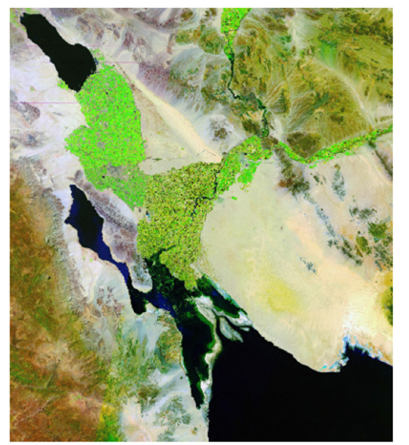
Since the 1970s, it has been only in the “flood years” that any water could have reached the Gulf (1978, 1982-1988, 1993, 1997- 1999). 1983 to 1989 were unusually wet years in the Southwest. Extreme flood flows occurred 1984-1988 when great amounts of river water reached the Delta. However, even then most of this discharge ended up in Laguna Salada where it was lost to evaporation. During flood years the lower delta (that area north of Isla Montague) can be covered by 2,500km2 of trapped, standing, fresh or brackish water (see photo). There has never been a single oceanographic measurement of brackish water (i.e., <30 ppt) in the Upper Gulf. The actual estuary is basically just the delta, north of Montague Island (i.e., only north of the island could brackish water ever occurred).
The Published Research
There is no record of pre-dam brackish water in the upper gulf
Nineteenth century (pre-dam) oceanographic data show the upper gulf to be fully marine, never brackish [4].
Even flood years do not create brackish conditions
Lavı́n & Sánchez [5] took advantage of a natural experiment to assess pre-dam Colorado river influence on salinity in the upper gulf by measuring the effects of the enormous 1993 flood release on the river. An estimated maximum 550m3 per second of river water crossed the border into Mexico at Morelos Dam during a March- April pulse release, for a total 2-month discharge of about 2.9 X 10⁹m3, or an average daily flow of 47.5 X ~106m3, and during this period salinities off San Felipe remained oceanic, averaging 35.4 ppt.
Pre-dam clam shells show no record of low-salinity water in the upper gulf
Based on oxygen isotopes in shell layers, estimates of pre- 1935 natal salinities of “delta clam” shells (Mulinia modesta) show no evidence of pre-dam brackish water environment south of Isla Montague Cintra-Buenrostro et al. [6].
Long -term satellite data show no record of low-salinity water in upper gulf
John All (2006, 2007) used remote-sensing imagery to show that no water flowed beyond Morelos Dam (into Mexico) from 1958 to 1983, as Lakes Mead and Powell filled. During this time, all downstream riparian areas on the Delta disappeared and Lake Maquata (Laguna Salada, today) dried up. Laguna Salada/Lake Maquata was historically a large lake fished by locals (especially the Cucupá People). All (2006, 2007) used the same techniques to show that no water reached the Sea of Cortez from 1989 to 2000, even during flood years (when much of the fresh water was diverted into Laguna Salada).
Average annual salinity of the upper gulf does not change significantly between wet and dry periods
Rodríguez-Pérez et al. [7] found Upper Gulf salinity to range around 34.5ppt throughout the 1980s and 1990s, based on satellite data (i.e., no signs of hypo salinity or brackish water even during flood years).
The history of upper gulf oceanography provides no records of brackish conditions and indicates river water is mostly impounded on the delta
Brusca et al. [8] reviewed the history of oceanographic research in the Northern Gulf (~350 papers), concluding that: (1) the Upper Gulf has never been brackish; (2) the amount of river water reaching the Upper Gulf has rarely been large, often absent altogether (the river instead emptying into the Salton Basin, Laguna Salada, and other basins on the delta), and never enough to create brackish or estuarine conditions below Isla Montague; (3) primary productivity has always been very high in the Upper Gulf and there is no evidence it has decreased subsequent to building of the dams on the Colorado River. Older published work that tried to make a case for reduction in shrimp, finfish, or vaquita (Phocoena sinus) population size or production due to diminished Colorado River flow has been shown to be flawed (reviewed in Brusca, Ramírez- León et al. [5,9-11].
Mean daily tidal flushing of the upper gulf exchanges more water than an entire year of river flow
Rojas-Bracho et al. [12,13] calculated the amount of oceanic water exchanged in the Upper Gulf due to the area’s extreme tides. They found that the amount of river water reaching the Upper Gulf has historically been far too small to have any significant impact on the salinity of the region, and the size of the daily tidal exchange makes it physically impossible for the Upper Gulf to become brackish. Given the average 3.87-meter tidal range in the Upper Gulf, and the semidiurnal nature of its tides, a mean of over 25.5 X 10⁹m3 of oceanic tidal water flushes into and out of the region daily, which is more than the highest estimates of Colorado river water reaching the Upper Gulf in an entire year. Thus, the influence of the river’s discharge on salinity in the Upper Gulf has always been trivial, pre-dam and post-dam.
Conclusion
There has never been a single record of estuarine conditions or brackish waters in the upper gulf of California south of Isla Montague (at the river’s mouth). Nor has there ever been a recorded measurement of how much river water actually entered the gulf. Despite this, there persists in the minds of some the idea that the river formerly poured millions of acre-feet of freshwater into the Gulf to affect its ecology. This idea, it appears, is myth. An analysis of the published research reveals no support for the idea of the upper or Northern gulf of California ever being brackish-water or estuarine below the mouth of the Colorado river (the sand island of Isla Montague). Nor is there any evidence that loss of Colorado river water due to dams or drought has affected the salinity or primary productivity of the Upper/Northern Gulf of California. The 1983- 84 El Niño event led to “flood year” excess water releases into the Colorado river channel, filling Laguna Salada Basin and connecting it to Ciénega de Santa Clara as the delta flooded from April to June. Laguna Salada covers ~1,000 km2 and the total flooded area of the delta is ~2,500 km2. In this image, one can see that essentially all of the river’s water is trapped on the lower delta behind bermbarriers to the Upper gulf. The water eventually evaporates or infiltrates into the delta’s sediments. LANDSAT images courtesy of Alejandro-Hinojosa-Corona (CICESE, Ensenada) (Figure 1).
Figure 1:“The river was nowhere and everywhere.” Aldo Leopold, A sand county almanac.
References
- Bright J (2023) A re-evaluation of Amphistegina gibbosa (d’Orbigny) and the 5.3 ma integration of the Colorado River and Gulf of California. Lethaia 56(2): 1-13.
- Dorsey RJ, O’Connell B, McDougal K, Horman M (2018) Punctuated sediment discharge during early Pliocene birth of the Colorado River: Evidence from regional stratigraphy, sedimentology, and paleontology. Sedimentary Geology 363: 1-33.
- O’Connell B, Dorsey RJ, Humphreys ED (2017) Tidal rhythmites in the southern bouse formation as evidence for post-Miocene uplift of the Lower Colorado river Corridor. Geology 45(2): 99-102.
- Roden GI (1958) Oceanographic and meteorological aspects of the Gulf of California. Pacific Science 12(1): 21-45.
- Lavín MF, Sánchez S (1999) On how the Colorado river affected the hydrography of the upper Gulf of California. Continental Shelf Research 19(12): 1545-1560.
- Buenrostro CCE, Flessa KW, Dettman DL (2012) Restoration flows for the Colorado river estuary, México: Estimates from oxygen isotopes in the bivalve mollusk Mulinia coloradoensis (Mactridae: Bivalvia). Wetlands Ecology Management 20: 313-327.
- Pérez MYR, Velasco LS, Hernández MPR, Camacho CJH, Cervantes FA, et al. (2024) Stable isotopes of carbon (δ13C) and oxygen (δ18O) from vaquita (Phocoena sinus) bones as indicators of habitat use in the upper Gulf of California. Frontiers in Conservation Science 5:
- Brusca RC, Borrego SA, Hastings PA, Findley LT (2017) Colorado river flow and biological productivity in the Northern Gulf of California, Mexico. Earth-Science Reviews 164: 1-30.
- León MRR, Borrego AS, Thompson CT, Castro GG, Dziendzielewski GH (2015) Nutrient input from the Colorado River water to the northern Gulf of California is not required to maintain its pelagic ecosystem productivity. Ciencias Marina 41(2): 169-188.
- All JD (2006) Colorado River floods, droughts, and shrimp fishing in the upper Gulf of California, Mexico. Environmental Management 37(1): 111-125.
- All JD (2007) Sound and fury signifying nothing: Using geoinformatics to inform resource policy in the Gulf of California, Mexico. Environmental Management 40(1): 7-11.
- Bracho LR, Brusca RC, Borrego SA, Brownell RL, Ibar GVC, et al. (2019) Unsubstantiated scientific claims can lead to tragic conservation outcomes. Bioscience 69(1): 12-14.
- Bracho LRR, Brusca SC, Borrego RLA, Brownell, Ibar GVC, et al. (2019) Bioscience 69(5): 322-323.
© 2026 Richard C Brusca. This is an open access article distributed under the terms of the Creative Commons Attribution License , which permits unrestricted use, distribution, and build upon your work non-commercially.
Editor In Chief







.jpg)































Signup for Newsletter

Quick Links
 Editorial Board Registrations
 Submit your Article
 Best Paper of the Volume
 Reprints
 Refer a Friend
 Advertise With Us
Our Recent Edition

.jpg)



Top Editors




.jpg)

















.bmp)
.jpg)
.png)
.jpg)













.jpg)






.png)

.png)




.png)




Financial Support

Sponsors

Latest e-Books

Latest Video

 a Creative Commons Attribution 4.0 International License. Based on a work at www.crimsonpublishers.com.
Best viewed in
a Creative Commons Attribution 4.0 International License. Based on a work at www.crimsonpublishers.com.
Best viewed in 
 | Above IE 9.0 version