

- About Us
- Information
-

The Author ensures that the research has been conducted responsibly and ethically with adherence to all relevant regulations. read more..
- For Authors
- For Reviewer
- Manuscript Guidelines
- Membership
- Publication Ethics
-
- Journals
- Reprints
- e-Books
- Videos
- Policies
- Contact Us
 COVID-19
- Submissions



Full Text
Environmental Analysis & Ecology Studies
Climate-Smart Irrigation Strategies for Peach Orchard: Impacts of Regulated Deficit and Partial Root-zone Drying on Water Relations, Productivity, and Fruit Quality
Hoda A Khalil1*, Hassan A Kassem1, Hend A Marzouk1 and Diaa O Elansary2
1Department of Pomology, Faculty of Agriculture, Alexandria University, Egypt
2Precision Agriculture Laboratory, Department of Pomology, Faculty of Agriculture, Alexandria University, Egypt
*Corresponding author:Hoda A Khalil, Department of Pomology, Faculty of Agriculture, Alexandria University, Alexandria, Egypt
Submission: May 15, 2026; Published: September 10, 2026

ISSN 2578-0336 Volume13 Issue 5
Abstract
Effective irrigation strategies are crucial in the production of peach (Prunus persica L. Batsch) due to its highwater demand and increasing water scarcity. This study investigated the impact of two Deficit Irrigation (DI) regimes, which are Regulated Deficit Irrigation (RDI) and Partial Root-Zone Drying (PRD), on the water relations, yield, fruit quality, and Irrigation Water Productivity (IWP) of the ‘Early Swelling’ peach trees. Six irrigation treatments were compared: standard irrigation (SI, 100% evapotranspiration, ETc), PRD at three levels (PRD100, PRD80, PRD60), and RDI at two levels (RDI80, RDI60), representing 80% and 60% of the water applied under SI, respectively. The use of strategies of DI was found to enhance the IWP, with the most effective treatment (PRD80) showing an enhancement of up to 40% of the 2-year study. Compared to the control and PRD treatments, the RDI treatment resulted in a significant reduction in Leaf Water Potential (LWP) and Stem Water Potential (SWP). PRD80, SI, and PRD100 had higher yields, whereas the yields of RDI80, RDI60, and PRD60 were significantly lower. All the DI treatments except PRD80 reduced fruit firmness. The RDI system and the PRD system also reduced the acidity of the fruit juice and tended to increase the Total Soluble Solids (TSS). The various irrigation treatments also affected root spread, with the PRD treatments promoting higher fine root density. Overall, RDI positively affected the quality of fruits (reduced acidity, increased TSS), but not yield, whereas PRD, particularly PRD80, had no effect on yield but positively affected the quality of the fruits, suggesting it as a promising strategy for sustainable peach production in water-limited environments.
Keywords:Peach; Water saving; Water relations; Quality; Tree productivity
Introduction
High water scarcity is a growing global challenge due to the dual pressures of climatic changes and increasing demands of water in various sectors, especially agriculture. In most of the Mediterranean Basin, this has been a particularly serious problem because, in addition to experiencing large seasonal variations in water supply, the region also experiences frequent and long-term droughts. These trends are largely attributed to the effects of climate change. In the Mediterranean, agricultural activities are the primary water consumers and use between 50% and 90% of the available water [1]. In that context, fruit orchards face unique challenges, as the trees in semi-arid regions have a high evapotranspiration rate and may be limited by a lack of water in the soil. These crops face a threat to their sustainability without proper management of water. It is therefore necessary to develop and implement innovative water-saving techniques to be able to guarantee sustainable production of agriculture in these vulnerable regions and increase the productivity of the irrigation water.
Among the most effective strategies of countering these challenges are Regulated Deficit Irrigation (RDI) and Partial Root-Zone Drying (PRD), which are two of the advanced approaches of countering deficit irrigation. Regulated deficit irrigation is the deliberate reduction of irrigation amounts to less than the full water needs of the crop at development stages that are not as sensitive to water stress. The strategy conserves water and reduces vegetation growth, and in most instances, the quality of the fruit is enhanced without a major reduction in yield [2]. It has been demonstrated that a 20-30% reduction of irrigation results in negligible yield impacts while maintaining fruit quality [3].
As an example, RDI studies on olive trees (Olea europaea) have demonstrated improved water usage efficiency and higher fruit oil content than fully irrigated olive trees [4,5]. Similarly, the water uptake of peach trees was also reduced by 33.6% when RDI was applied in the post-harvest seasons without any negative effect on fruit growth and quality, which is a positive indicator that RDI could be applied to achieve sustainable water management in fruit orchards [6]. Also, RDI encourages the growth of deeper roots whereby the plants access the deeper part of water in the soil, which encourages their resistance to the condition of drought. However, the most benefits of RDI will be achieved only when the physiological responses of specific crops to water stress are known and the developmental stages resistant to water deficit are determined [7].
Partial Root-Zone Drying (PRD) is another innovative irrigation technique, which is an irrigation method that alternates watering one half of the root zone of a plant and the other half to enable one half of the root zone to dry and the other half to become irrigated. The resulting alternating cycle enhances the efficiency of water use and activates root-to-shoot signaling that results in greater drought tolerance [8]. For example, in grapevines (Vitis vinifera), PRD has been demonstrated to maintain similar yields to fully irrigated vines while reducing the amount of water used by up to 50% and has also been shown to increase grape quality by raising anthocyanin and phenolic levels in the fruit [9,10].
Similarly, PRD has been shown to increase the size of fruits and sugar content in citrus trees, demonstrating its potential to increase the yield and quality of fruits in an efficient use of water [11]. PRD also promotes the even distribution of fine roots in the soil, which improves nutrient uptake and results in the overall health of soil in the long term [12]. Although it has several advantages, effective implementation of PRD means accurate scheduling and monitoring of irrigation programs so that the alternate periods of dry and wet soil do not expose the plants to excessive stress.
Peach (Prunus Persica) cultivation, particularly for early-maturing cultivars like ‘Early Swelling,’ requires advanced irrigation strategies that both address the conservation of water demands and maintain the optimum crop production and fruit quality indices [13]. It has been established that the quality of peach fruits and their productivity can be improved by applying RDI and PRD. For instance, RDI applied during the late fruit maturation stage has been observed to enhance sugar content and firmness of the fruit, which are highly desirable attributes to the consumers. On the other hand, PRD has also been known to enhance the flavor and aroma of peach fruits through an improvement in the level of volatile compounds, while decreasing the amount of irrigation water used by 40% [14].
This study examines the impact of deficit irrigation on ‘Early Swelling’ peach trees, exploring intricate relationships between water relations, tree productivity, and fruit quality parameters. The results of our study are relevant to the base of knowledge concerning specific findings that are applicable in the implementation of plausible plans for managing orchard water resources in a more sustainable and precise manner through quantifying physiological responses, yield characteristics, and fruit properties under varying levels of irrigation. In addition, our research addresses critical knowledge gaps by focusing on the adaptive behavior of early-maturing peach cultivars in water-stressful environments with the potential implication of developing climate-resistant crop production systems. The comprehensive approach incorporates detailed physiological measurements, yield factors, and quality assessment to generate an integrated production system. Importantly, we also add a PRD100 treatment (100% ETC applied through the PRD mechanism) to serve as a control for the PRD technique itself, allowing us to isolate the impact of the alternating wetting/drying cycle on root architecture and physiological signaling from the effect of water deficit.
Material and Methods
Experiment site and plant material
The current study was conducted during the growing seasons of 2023 and 2024 in a private orchard located in the Marriott region (40km on the Alexandria-Cairo desert road (latitude 30.93°N, longitude 29.78°E), Egypt) on four-year-old peach trees (Prunus persica (L.) Batsch, cv. ‘Early Swelling’ grafted on Nemaguard rootstock). The trees were trained using the open-center training systems. Trees were grown in sandy soil, with a spacing of 1.5m between trees and 4.5m between rows. Trees were drip-irrigated using a separate two-line system with 4L per hour discharge drippers spaced at 50cm, and they were fertigated once per week using a complete fertilizer combination. Fertilizer rates were adjusted and timed based on the tree requirements and the reduced water availability. Management of pesticides followed accepted commercial practices.
Experimental design and treatments
A Randomized Complete Block Design (RCBD) experiment was used to examine the effects of various deficit irrigation treatments, Regulated Deficit Irrigation (RDI) and Partial Root-Zone Drying (PRD) practices, on peach tree productivity (tree yield and fruit quality) in semi-arid environments. Each treatment in the experimental plot received its water and fertilizer requirements through a separate irrigation drip network, and weekly fertilization was injected at the plot during the irrigation event. The experiment consisted of six treatments, with three replication blocks per treatment and three trees per replicate plot, totaling 54 experimental trees.
A. Standard irrigation (SI): 100% of evapotranspiration (ETc).
B. RDI80: 80% of the water applied in SI.
C. RDI60: 60% of the water applied in SI.
D. PRD100: 100% of the water applied in SI by practicing partial
root-zone drying. This treatment was included to isolate
the effect of the alternating wetting/drying cycle on root development
and physiological signaling from the effect of water
deficit.
A. PRD80: 80% of the water applied in SI by practicing partial
root-zone drying.
B. PRD60: 60% of the water applied in SI by practicing partial
root-zone drying.
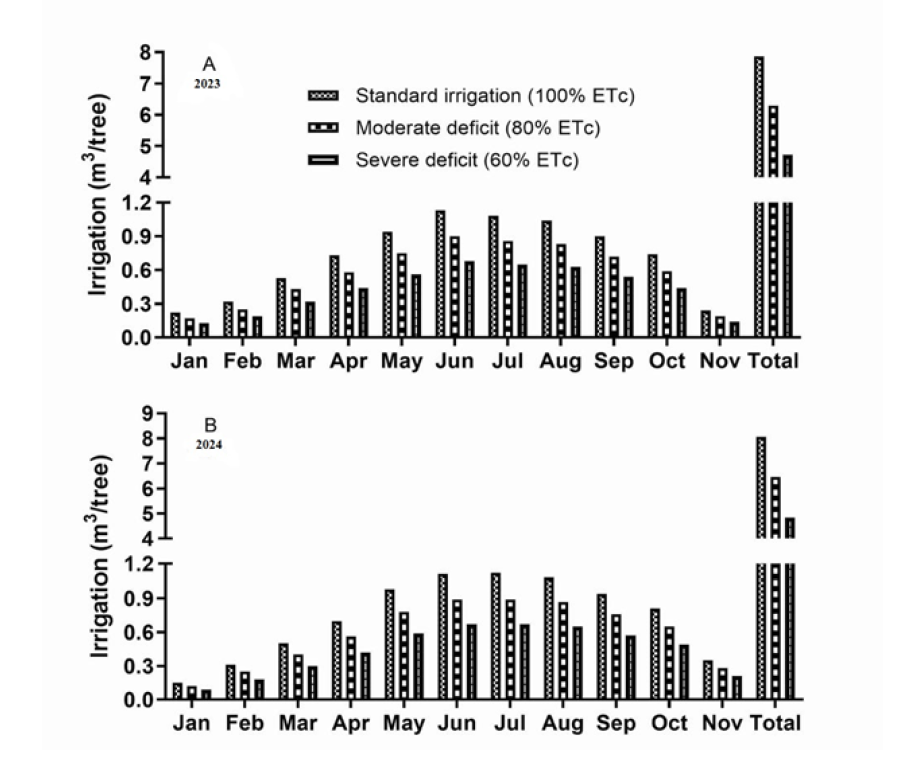
Real Crop Evapotranspiration (ETc) was calculated according to Allen et al. (1998) using the equation ETC = ETo X KC, where Kc is the peach crop coefficient and ETo is the reference evapotranspiration (Figure 1A) (Figure 1B). Environmental measurements were obtained from a weather station near the testing site. Irrigation treatments were applied from bud opening on 3 January 2023 and 11 January 2024 until leaf fall on 16 November 2023 and 21 November 2024. Trees were given the seasonal irrigation treatments shown in Figure 1C & 1D: Standard irrigation (100% of ETc), moderate deficit irrigation (80% of ETc), and severe deficit irrigation (60% of ETc). Pipelines were run alternately every thirty days using the PRD approach. Figure 2A & 2B show the monthly and overall seasonal quantities of applied water data (m³/tree) for the seasons of 2023 and 2024.
Figure 1:Reference evapotranspiration (ETo) data (A), FAO Table peach crop factors (Kc) data (B), and crop evapotranspiration (ETc) data for peach trees (C and D) during the 2023 and 2024 seasons.
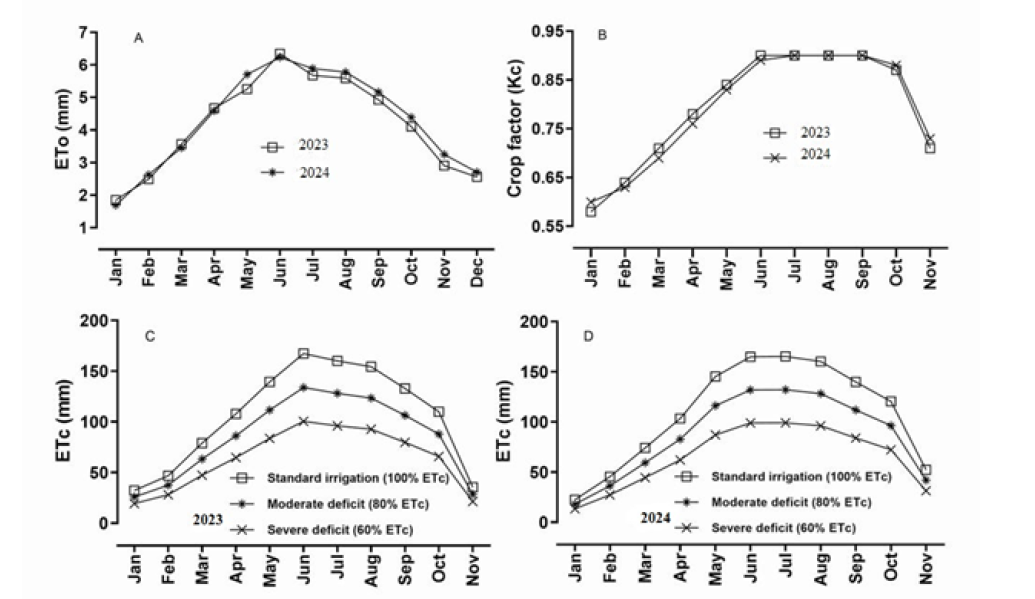
Figure 2:Monthly and total seasonal applied irrigation water (m³/tree) of standard irrigation (100% ETc), moderate deficit irrigation (80% ETc), and severe deficit irrigation (60% ETc) treatments for peach trees during the 2023 (A) and 2024 (B) seasons.
Soil classification was sandy, with a field capacity of approximately 8% volumetric soil water content. Irrigation scheduling was assisted by using a Time Domain Reflectometer (TDR 300, Spectrum Technologies, Inc., USA) to adjust and tune the timing of irrigation that was once per week in Jan, Feb, March, November, and December, while it was twice a week in the remainder of the year. Measurements were taken at a radial distance from the tree trunk at a depth of approximately 30 centimeters, as it represents a critical depth for water availability to the roots. Three replicates were taken at the same depth and position around the tree. Irrigation was initiated when soil volumetric soil water content reached about 10% based on evapotranspiration data. Harvest was conducted on May 3, 2023, and May 11, 2024, for all treatments. Data collection and analytical procedures were conducted at the Faculty of Agriculture at Alexandria University.
Sampling and measured parameters
Tree water relations: Leaf Water Potential (LWP) and Stem Water Potential (SWP) were measured using pressure chambers. Midday leaf and stem water potential was measured once during the experimental period, specifically at the beginning of April. Measurements were conducted from 11:00a.m. to 12:00p.m. One leaf from each tree was chosen and tested shortly after leaf detachment using Turner and Long’s technique for assessing leaf water potential (1980). Additionally, another leaf close to the trunk was chosen, wrapped with aluminum foil, and placed in a clear plastic bag for at least two hours to achieve equilibrium. The stem water potential of this leaf was then determined in accordance with Naor et al. [15]. Leaf Relative Water Content (RWC) was calculated according to Jones & Turner [16]. Fresh leaves were weighed separately, immersed in water for three hours until saturated, and their Turgid Weight (TW) was recorded. Following this, leaf samples were dried for 24 hours at 80 °C in a drier oven, and their Dry Weight (DW g) was noted. The percentage of the RWC is therefore equal to:
RWC = (FW - DW) / (TW - DW) X 100
Root development: Following harvest at the conclusion of the trial in 2021, root samples were collected from both sides of each tree using a cylindrical tube 25cm long with an inner diameter of 25cm. The cylindrical tube was inserted into the soil to a depth of 25cm, and the roots within that volume were sampled. Root samples were cleaned of dirt, and the length and density of the new secondary roots were measured. Samples were collected from the center tree at 20cm away from the drip line and at the edges of the tree canopy projection on the ground. At the end of May, which marked the completion of a one-month irrigation switching cycle, root samples were taken. This irrigation switching cycle followed a Partial Root Zone Drying (PRD) technique implemented throughout the year. Root length and density (number of branching × average length of individual roots/100cm³ of soil volume) were measured in the soil volume sampled. Each wet and dry side was alternated once per month to ensure the health and integrity of the root system.
Crop yield and irrigation water productivity: Experimental trees were harvested in mid-May of both seasons, and yield was measured in kg per tree. Additionally, Irrigation Effectiveness (IE) was measured by dividing tree total yield (kg) by irrigation water received (m³).
Fruit physico-chemical quality: Twenty fruits per replicate were picked and taken to the pomology lab at the Alexandria University Faculty of Agriculture. Average fruit weight, fruit diameter, fruit firmness, and fruit color were recorded. Fruits were weighed using a digital scale, and fruit diameter was measured using a handheld caliper. Fruit firmness was measured using an Effigy pressure tester with an 11mm probe (Effigy, 48011 Alfonsine, Italy) after removing the fruit skin, and two readings on various sides of each fruit were taken. Additionally, the Minolta Chroma Meter CR-200 (Minolta Co. Ltd., Osaka, Japan) was used to quantify fruit exterior color using the CIELAB co-ordinates L* a* b* color scheme (International Commission on Illumination) (CR-200, Japan). The color index shows the effect of different treatments on the peel color of a certain fruit. The L*, a*, and b* values represent the lightness, red-green axis, and yellow-blue axis of the color, respectively. The a* value varies from -60 (greenness) to +60 (redness), the b* value ranges from -60 (blueness) to +60, and the lightness (L*) value ranges from 0 (black) to 100 (white) (yellowness).
Three measurements per fruit, at equidistant points around the equator of the fruit, to obtain representative color measurements. Total Soluble Solids (TSS) in fruit juice were measured using a digital refractometer with temperature compensation (ATAGO, mod. ATC-1, Japan), and Titratable Acidity (TA) presented as malic acid equivalent was determined by diluting the juice with distilled water and titrating to the phenolphthalein endpoint with 0.1 N sodium hydroxide (NaOH), and the percentage of TA was calculated.
Data statistic
One-way analysis of variance (ANOVA) was carried out, and obtained data were analyzed using the GLM procedures of IBM SPSS software version 21.0. The differences among the means were compared for significance at P<0.05 using Duncan’s Multiple Range Test.
Result
Tree water relations
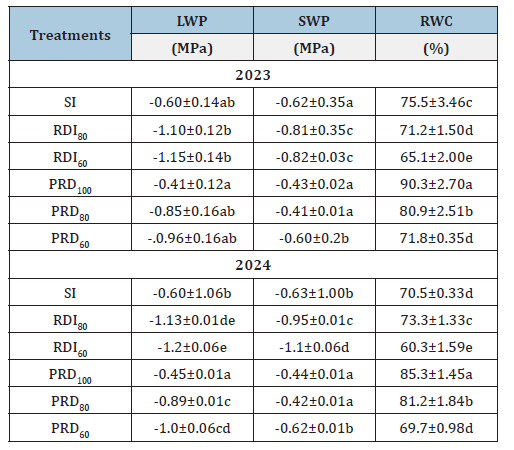
There were clear differences between the Regulated Deficit Irrigation (RDI) and Partial Root Drying (PRD) regimes. In 2023 and 2024, it was demonstrated that trees watered by PRD had higher values of Leaf Water Potential (LWP). The PRD100 treatment generated significantly higher values of LWP than RDI80 and RDI60 in 2023, and in 2024, it was followed by the Standard Irrigation (SI) and PRD80 treatments. Similarly, PRD treatments possessed better values of Stem Water Potential (SWP) than RDI. The data of both seasons indicated that PRD100 and PRD80 caused significant enhancement of SWP as compared to all other treatments (except SI in 2023). The PRD treatments varied considerably, with PRD100 and PRD80 giving higher values of SWP as compared to PRD60 during both seasons. In both seasons, RDI60 was found to give the lowest LWP and SWP values, followed by RDI80 and PRD60. The data of both seasons indicated that PRD100 had the highest Relative Water Content (RWC) value compared to any other treatment, whereas the RDI60 treatment had the lowest Relative Water Content (RWC) value (Table 1).
Table 1:Effects of the irrigation practices, Regulated Deficit Irrigation (RDI) and partial Root-Zone Drying (PRD) at different levels on Leaf Water Potential (LWP) and Relative Water Content (RWC) of the ‘Early Swelling’ peach cultivar during the 2023 and 2024 growing seasons.
Means followed by the same letter(s) in the same column are not significantly different according to Duncan’s Multiple Range Test at P ≤ 0.05.
Root development
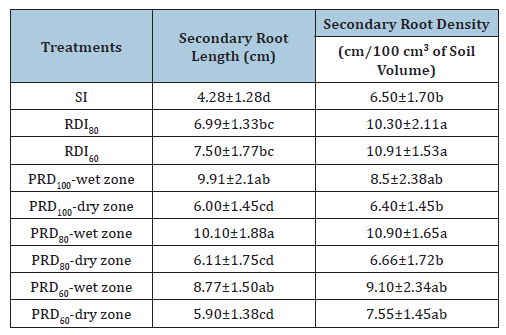
Although none of the treatments exhibited obvious symptoms of root death, the growth of secondary roots on the dry side was significantly reduced. Meanwhile, there was no difference in root distribution between the roots in the dry zone of all PRD levels and those of conventionally watered plants. In contrast to typical irrigated trees, plants receiving both levels of RDI and on the wet side of all PRD levels were encouraged to form additional secondary roots. Except for 2020, when PRD80 wet showed greater root length and density than RDI80 and RDI60, trees exposed to RDI80, RDI60, PRD100 wet, PRD80 wet, and PRD60 wet did not significantly differ in root length and density (Table 2).
Table 2:Effects of the irrigation strategies, Regulated Deficit Irrigation (RDI) and Partial Root-Zone Drying (PRD) at different levels on secondary root length (cm) and density after harvest of ‘Early Swelling’ trees in the second season.
Means followed by the same letter(s) in the same column are not significantly different according to Duncan’s Multiple Range Test at P ≤ 0.05.
Yield and irrigation water productivity
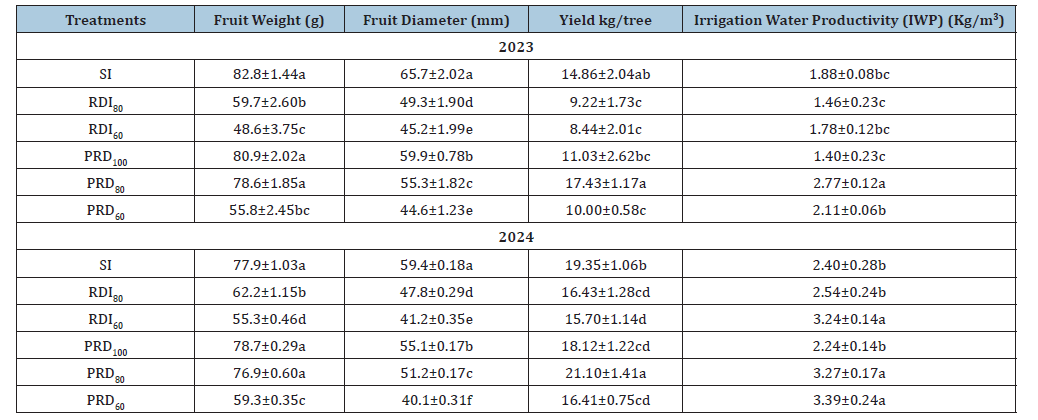
The results of both years, presented in Table 3, reveal a declining trend in crop production for all deficit irrigation treatments except for PRD80, which produced the highest yield. PRD80 showed a considerably greater yield than the control and all other deficit irrigation treatments in the second season but did not significantly differ from the control in the first season. Additionally, data from both years demonstrated that both deficit irrigation options increased Irrigation Water Productivity (IWP) compared to regular irrigation. Over the two years of the research, PRD and RDI showed a 40% improvement in irrigation water productivity. Compared to conventional irrigation, PRD80 improved water usage efficiency by 36.25%, and RDI60 by 41.25%, demonstrating the positive effects of RDI and PRD on irrigation water productivity (Table 3). Moreover, the data clearly demonstrate that PRD80 offers the best compromise, maximizing IWP while maintaining high productivity and enhancing fruit quality, which is a critical finding for sustainable peach production in water-limited regions (Table 4).
Table 3:Effects of the irrigation strategies, Regulated Deficit Irrigation (RDI) and Partial Root-Zone Drying (PRD) at different levels on the fruit weight, fruit diameter, yield, and Irrigation Water Productivity (IWP) of the ‘Early Swelling’ peach cultivar during the 2023 and 2024 growing seasons.
Means followed by the same letter(s) in the same column are not significantly different according to Duncan’s Multiple Range Test at P ≤ 0.05.
Table 4:Comparative Summary of Key Parameters for Optimal Irrigation Strategies (Mean of Two Seasons).

Fruit physiochemical quality
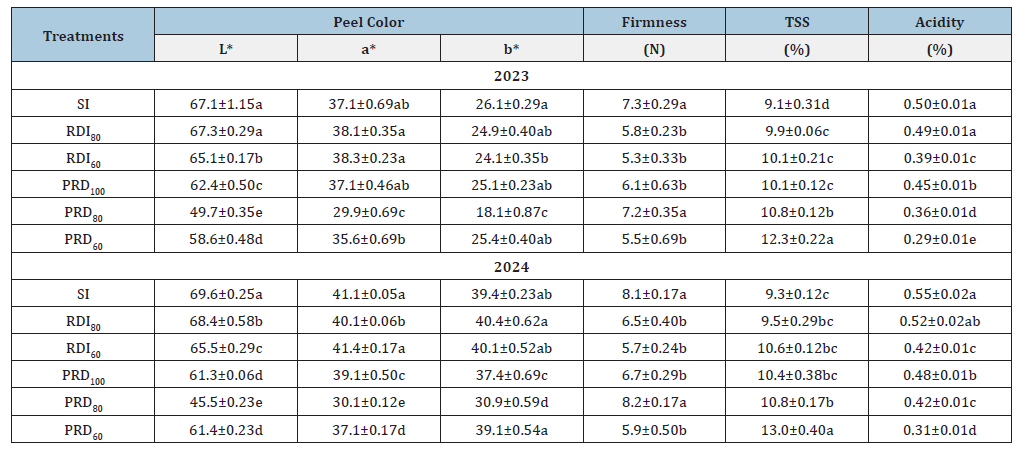
In dry and semi-arid areas, water is crucial for maintaining photosynthesis and subsequently, fruit output, as well as for influencing fruit quality features. The data provided in Table 3 demonstrated that the application of PRD100 and PRD80 had no effect on fruit weight; however, raising water stress to 60% ETc (PRD60) significantly reduced fruit weight. On the other hand, the RDI regime resulted in a decrease in fruit weight, with RDI60 showing statistically lower fruit weight than the RDI80 treatment in both seasons compared to the full irrigation treatment. In comparison to conventional irrigation, both deficit irrigation regimes reduced fruit diameter. However, when compared to PRD60, RDI80, and RDI60, PRD100, followed by PRD80, produced the highest fruit weight. Nevertheless, data from both years provided in Table 5 revealed that all deficit irrigation treatments except for PRD80, which preserved fruit firmness, caused a decrease in fruit firmness. Both the RDI and PRD regimes had a general trend of increasing fruit total soluble solids content and reducing juice acidity. By increasing water stress to 60% ETc through the application of partial root drying, fruit TSS content increased, and juice acidity decreased.
Table 5:Effects of the irrigation strategies, Regulated Deficit Irrigation (RDI) and Partial Root-Zone Drying (PRD) at different levels on peel color, firmness, TSS, and acidity of the ‘Early Swelling’ peach cultivar during the 2023 and 2024 growing seasons.
Means followed by the same letter(s) in the same column are not significantly different according to Duncan’s Multiple Range Test at P ≤ 0.05.
PRD60 showed significantly the highest TSS and lowest acidity values in both seasons compared to all other treatments. In 2020, the standard irrigation treatment resulted in the highest L* value (67.1), indicating a lighter peel color compared to other treatments. The RDI80 treatment had the highest a* value (38.1), indicating a more reddish color, while the PRD80 treatment had the lowest a* value (29.9), indicating a less reddish color. The PRD80 treatment also had the lowest L* and b* values, indicating a darker and less yellowish peel color. In 2021, the standard irrigation treatment again resulted in the highest L* value (69.6), while the RDI60 treatment had the lowest L* value (65.5). The PRD100 treatment had the lowest b* value (37.4), indicating a less yellowish color, while the PRD80 treatment had the lowest overall color values with very low L*, a*, and b* values. Overall, these results suggest that different irrigation regimes can affect fruit peel color, with some treatments resulting in lighter or darker colors or more or less reddish or yellowish hues. In the 2020 season, RDI80 provided the best cover color, while standard irrigation gave the best ground color. However, in 2022, standard irrigation produced the best cover color, whereas RDI60 and RDI80 resulted in the best ground color.
Discussion
The parameters of tree water status, including Relative Water Content (RWC), Stem Water Potential (SWP), and Leaf Water Potential (LWP), provide critical insights into whole-plant water relations under the conditions of deficit irrigation [17]. Partial root-zone drying treatments, namely, PRD100 and PRD80, which maintained the water status of plants at relatively high rates similar to the Standard Irrigation (SI), have obviously performed better compared to the controlled deficit irrigation treatments in the present study. This enhanced performance is explained by the fact that the advanced dual-signaling system of PRD involves chemical signals of increasingly drying roots that coordinate the stomata regulation when the roots in wetted soil areas maintain an adequate water supply to the canopy [18,19].
Favorable water relations maintained in PRD100 and PRD80 trees indicate an active balance between hydraulic and non-hydraulic signaling pathways. In PRD, gradual dehydration of one of the root zones induces the synthesis and root-to-shoot movement of abscisic acid (ABA) that regulates stomatal aperture, as well as reduces transpirational water loss [20]. At the same time, roots in the irrigated zone compensate by increasing water uptake capacity, thereby maintaining shoot water potential within an optimal range [21]. The expression of aquaporins is increased in wetted roots, which makes roots more hydraulically conductive and efficient in water transport [22]. The periodic alternation of wet and dry conditions helps in avoiding excessive dehydration of the roots and maintains uninterrupted chemical signaling, which is also unique to PRD compared to conventional RDI strategies.
In contrast, the trees treated with PRD60, RDI80, and RDI60 had stronger stomata closure and reduced water potentials, which showed a lack of water to sustain the evaporative demands. Under RDI, when water shortage is common to the complete root system, the plants do not have the compensatory water uptake by well-oriented roots, resulting in more severe hydraulic limitations [23]. ABA-mediated chemical signaling is the primary pathway of control over stomatal conductance at intermediate levels of stress, but under the conditions of severe water deficiency that are enforced by PRD60 and RDI60, hydraulic and chemical signals both play a central role in controlling stress responses [24]. These signals interact to increase stomatal closure and decrease photosynthetic capacity, leading to a decrease in the productivity of plants.
The threshold at which PRD transitions from beneficial to detrimental seems to be between 20% and 40% of water deficit in peach (early swelling) under semi-arid conditions. This observation is in line with the previous studies of stone fruits, which indicate that cultivar specificity to water deficit changes significantly depending on rootstock interactions, environment, and management practices of orchards [19,25]. Leaf ABA accumulation during deficit irrigation is directly related to low stomatal conductance [26], and it is the main way of how plants reduce transpirational water loss. Nevertheless, extreme stomatal closing imposes limits on the uptake of CO₂ in the form of diffusive processes, slower carbon assimilation, and ultimately impacts crop productivity [27].
The treatment of all the deficit irrigation programs in the current study stimulated more secondary root growth than full irrigation, and PRD treatments exhibited especially strong root growth. This response represents a fundamental adaptive strategy in which plants preferentially allocate photosynthate in organs below the ground in water-limited environments, which increases access to water and nutrients by root volume and improves nutrient and water accessibility [28]. The PRD-induced stimulation of root growth could be attributed to the spatial heterogeneity of soil moisture that establishes local areas of high water content to cause root extension, and dry zones induce root growth through the ABA-mediated signaling [29].
The mechanistic basis of the increased root development observed under PRD is the redistribution of carbon resources by vegetative shoot growth to the root biomass accumulation. Partially dried roots produce chemical signals, mostly ABA and cytokinins, that are transported to the shoot to reduce cell division and expansion and lead to reduced vegetative vigor [18,30]. This regulated shoot growth prevents the excessive distribution of carbon to the structures above the ground, hence preserving photosynthate for the root development and fruit production [31]. The increased hydraulic conductivity of deficit-irrigated trees as reported by Poni et al. [32] in the case of apple, grape, and peach can be attributed to the increase in the fine roots with high surface area-volume ratios and may also be due to the changes in the anatomy of the root, including improvement of xylem development and increase in the aquaporin-mediated membrane permeability.
The enhanced root system architecture, which grows with PRD treatments, has a variety of benefits, other than direct acquisition of water. Enhanced root length density increases the spatial distribution of roots in the soil profile that enhances accessibility of deep soil moisture during times of water scarcity [33]. Moreover, alternating wetting and drying cycles of PRD can increase the nutrient movement within the rhizosphere, specifically in nutrients that are poorly mobile such as phosphorus, phosphorus, and phosphorus, and thus the nutrient acquisition process is more efficient [34]. The development of a more extensive root system in the presence of moderate deficit irrigation is one of the legacy effects which could improve tree resistance to future drought incidences.
Among all treatments evaluated, only PRD80 maintained fruit yield at levels statistically comparable to standard irrigation with a 20% decrease in water application, giving the highest Irrigation Water Productivity (IWP). This finding demonstrates that moderate deficit irrigation through PRD can achieve the dual objectives of water conservation and sustained productivity in ‘Early Swelling’ peach under semi-arid Mediterranean conditions. The high performance of PRD80 compared to the RDI80 at the same rate of water application highlights the significance of irrigation strategy, other than the overall water supply. Spatial water distribution in PRD maintains a sufficient amount of soil moisture to support further photosynthesis and, at the same time, triggers stress-signaling mechanisms, which improve water use efficiency [35].
This effect of yield maintenance at PRD80 is explained by the maintenance of desirable carbon balance during the critical development. PRD80 trees ensured sufficient carbohydrate contents to support fruit growth and development by having higher CO₂ absorption and photosynthetic rates by keeping stomatal conductance higher compared to the RDI treatments with the same amount of water deficits [36]. Also, the increased development of the root system in PRD80 may have facilitated nutrient uptake, which sustained further division and growth of fruit cells in the essential post-bloom period. The resultant effect was an efficient use of water combined with a preserved level of photosynthetic capacity, which enabled PRD80 trees to produce yield levels comparable to those of fully irrigated controls despite reduced water availability.
In contrast, more severe deficit treatments (PRD60 and RDI60) resulted in unacceptable yield reductions, and the production was reduced by about 15-25% compared to standard irrigation. These results indicate that a 40% water deficit exceeds the compensatory capacity of ‘Early Swelling’ peach under the environmental conditions of this study, which causes chronic carbon limitation and inadequate resource allocation to reproductive sinks. The yield reductions observed under severe deficit are in line with earlier studies in stone fruits, which show that deficit irrigation at critical phenological periods, especially during fruit cell division and early expansion, can have long-term adverse effects on eventual fruit size and overall production [37-39].
The time dynamics of PRD effects on yield are worth a special consideration. PRD80 showed yield improvements in our two-year study, mainly in the second year, which indicates the possibility of a cumulative effect of continued PRD management. This observation is similar to the three-year experiment of grapevines by De la Hera et al. [19], which had no significant yield effects during the first two years but had an increase in yield of 43% and an increase in water usage efficiency of 40% during the third year. These temporal patterns are possible indicators of progressive adaptations in root system structure, hydraulic properties, and overall plant carbon distribution that require multiple growing seasons to fully manifest. Similarly, Behboudian & Zegbe [40] have reported that PRD enhanced water productivity in apple production by 120% without any loss in fruit qualities, and Wahbi et al. [41] have reported 60- 70% improvement in water use efficiency in olives with only 15- 20% yield reductions. Collectively, these studies point to the fact that the complete effects of PRD might not be immediate, and multiyear experimental methods should be used.
The economic feasibility of deficit irrigation strategies is not limited to mere comparisons of yield but to water productivity, which combines both efficiency of production and resource conservation. The irrigation water productivity, which is the ratio of total crop yield to the total irrigation water applied, provides a more comprehensive assessment of the system’s performance compared to yield. In the current study, all deficit irrigation treatments increased IWP relative to standard irrigation, with PRD80 achieving the optimal balance between water savings and yield maintenance. Nevertheless, the economic feasibility must also consider the cost of infrastructure in the implementation of PRD, such as split irrigation systems and automated control technologies. In areas experiencing great water shortage or excessive water prices, the initial cost of PRD infrastructure can be considered reasonable when contrasted with long-term water savings and long-term productivity, particularly when combined with precision agriculture technology, which maximizes irrigation scheduling based on real-time plant water status monitoring.
The quality parameters in the fruit, such as firmness, Total Soluble Solids (TSS), and titratable acidity, were generally maintained or improved with moderate deficit irrigation conditions and no significant reduction in quality in PRD80 and PRD100 fruits compared to standard irrigation. These results are consistent with extensive previous studies that have found that controlled water deficit can positively affect the quality of fruits in Peach [42], Grape [25], Apple [43], Pomegranate [44], and Orange [45]. Recent physiological processes are shown in the maintenance or enhancement of fruit quality by deficit irrigation, including the rise of carbohydrate concentration during deficit irrigation due to reduced fruit water content, enhanced secondary metabolite biosynthesis in response to mild stress, and altered source-sink relationships that favor quality over quantity in fruit development [46].
The slight increases in TSS content and firmness, which were observed in some deficit irrigation treatments, are minor yield reductions by premium pricing in markets that have fruit quality as a reward. The accumulation of sugars, organic acids, and secondary metabolites in fruit under deficit irrigation indicates the direct osmotic adjustment in the tissues of the fruit and the overall changes in the pattern of carbon allocation in the plants [27]. Importantly, the quality improvements observed in the present study were achieved without excessive fruit size reduction, a common concern in severe deficit irrigation scenarios that can diminish marketability despite improved internal quality.
The quality of fruits maintained by PRD80 contrasts with the previous results, including Soliman et al. [47], who found reduced fruit firmness in deficit-irrigated Anna apples. These variations are most probably cultivar-specific differences, variations in the timing and severity of deficit, and the interaction with the environmental conditions and rootstock properties. The timing of water deficit in relation to the developmental stages of fruit is especially important in stone fruit because deficits enforced on fruit during early stages of cell division may cause irreversible adverse effects on both fruit size and quality, whereas deficits enforced at late stages of maturation can result in positive quality improvements with minimal size penalties [42]. The success of PRD80 in maintaining both yield and quality in the present study suggests that moderate, continuously applied deficit through partial root-zone drying represents an effective strategy for ‘Early Swelling’ peach production under semi-arid conditions.
Conclusion
In the current experiment, we assessed the effects of three different irrigation techniques: standard irrigation, DI, and PRD on an early-maturing peach variety grown in a Mediterranean environment in terms of tree water relations, yield, fruit quality, and irrigation water productivity. The findings showed that relative leaf and stem water potential values were greater with the PRD treatments than with RDI. In comparison to full irrigation, all RDI and PRD treatments enhanced root length and density. Compared to ordinary irrigation, an increase in irrigation water productivity was equivalent to 36.25% by PRD80 and 41.25% by RDI60. Applying the RDI method improved fruit quality, as indicated by lower juice acidity and higher juice TSS, but it reduced yield. The PRD technique enhanced fruit quality while maintaining yield. Thus, it may be inferred that early-ripening peach varieties produced in dry and semi-arid environments will benefit from adopting PRD80 as a water-saving technique [48]. Finally, it should be remembered that the use of RDI or PRD practices depends on several critical variables, including the physiochemical composition of the soil, the quantity and duration of water deficit practices, the type of crop being grown, and its stage of development. Future research could investigate the long-term effects of these irrigation techniques on tree growth and fruit production, as well as their economic feasibility for farmers. Additionally, exploring the potential benefits of combining these techniques with other sustainable practices, such as mulching or cover cropping, could provide a more holistic approach to water management in peach orchards.
References
- Rouault P, Sohounhloué CK, Flamain F, Debolini M (2024) Unravelling the heterogeneity of farms irrigation practices on Mediterranean perennial agricultural systems for the optimization of water resource management.
- Abouabdillah A, Radi S, Asfers A, Brouziyne Y, El Bergui O, et al. (2022) Advancing knowledge about restricted irrigation strategies on commercial peach plantation under Mediterranean condition. E3S Web of Conferences 337: 04002.
- Zhang FC, Kjelgren R, Xiang YZ (2017) Peach yield and fruit quality is maintained under mild deficit irrigation in semi-arid China. Journal of Integrative Agriculture 16(5): 1173-1183.
- Gholami R, Zahedi SM (2021) Young olive trees responses (Olea europaea cv. Mission) to regulated deficit irrigation regime. Erwerbs Obstbau 63(3): 255-261.
- Noč M, Pečan U, Pintar M, Podgornik M (2024) Soil water dynamics and olive yield (Olea europaea L.) under drip irrigation treatments in northern Mediterranean. Acta Agriculturae Slovenica 120(2): 1-17.
- Temnani A, Berríos P, Zapata García S, Pérez Pastor A (2023) Deficit irrigation strategies of flat peach trees under semi-arid conditions. Agricultural Water Management 287: 108464.
- Fernández JE (2017) Plant-based methods for irrigation scheduling of woody crops. Horticulture 3(2): 35.
- Khairo AM (2024) Effect of partial root-zone drying irrigation and potassium fertilizer Water use Efficiency, Growth and Yield of Cowpea (Vigna Unguiculata L.) in Gypsiferous Soil. International Journal of Life Science and Agriculture Research 3(9): 724-732.
- Pérez Álvarez EP, Intrigliolo DS, Almajano MP, Rubio Bretón P, Garde Cerdán T (2021) Effects of water deficit irrigation on phenolic composition of grapes. Antioxidants 10(8): 1301.
- El-Sayed MEA, Hammam A, Fayed A, Rebouh NY, Badr Eldin RM (2024) Improving water use efficiency, yield, and fruit quality of Crimson Seedless grapevines under drought stress. Horticulturae 10(6): 576.
- Du T, Kang S, Zhang J, Davies WJ (2015) Deficit irrigation and sustainable water-resource strategies in agriculture for China’s food security. Journal of Experimental Botany 66(8): 2253-2269.
- Mossad A, Farina V, Lo Bianco R (2020) Fruit yield and quality of ‘Valencia’ orange under long-term partial rootzone drying. Agronomy 10(2): 164.
- Abrisqueta I, Tapia LM, Conejero W, Sanchez TMI, Abrisqueta JM, et al. (2010) Response of early peach [Prunus persica (L.)] trees to deficit irrigation. Spanish Journal of Agricultural Research 8(S2): 30-39.
- Kirda C, Topcu S, Kaman H, Ulger AC, Yazici A, et al. (2004) Yield response of greenhouse-grown tomato to partial root drying. Agricultural Water Management 69(3): 191-201.
- Naor A, Klein I, Doron I (1995) Stem water potential and apple size. Journal of the American Society for Horticultural Science 120(4): 577-582.
- Jones HG, Turner NC (1978) Osmotic adjustment in leaves of sorghum in response to water deficits. Plant Physiology 61: 122-126.
- Mahajan S, Tuteja N (2006) Cold, salinity and drought stresses: An overview. Archives of Biochemistry and Biophysics 444(2): 139-158.
- Dodd IC, Theobald JC, Bacon MA, Davies WJ (2006) Alternation of wet and dry sides during partial rootzone drying irrigation alters root-to-shoot signaling of abscisic acid. Functional Plant Biology 33(12): 1081-1089.
- De la Hera ML, Romero P, Gomez Plaza E, Martinez A (2007) Is partial root-zone drying an effective irrigation technique to improve water use efficiency and fruit quality in field-grown wine grapes under semiarid conditions? Agricultural Water Management 87(3): 261-274.
- Sepaskhah AR, Ahmadi SH (2010) A review on partial root-zone drying irrigation. International Journal of Plant Production 4(4): 241-258.
- Dodd IC (2013) Abscisic acid and stomatal closure: A hydraulic conductance conundrum? New Phytologist 197(1): 6-8.
- Vandeleur RK, Mayo G, Shelden MC, Gilliham M, Kaiser BN, et al. (2014) Aquaporins and water transport in grapevine roots. Plant Physiology 164(1): 245-264.
- Fereres E, Soriano MA (2007) Deficit irrigation for reducing agricultural water use. Journal of Experimental Botany 58(2): 147-159.
- Iqbal R, Raza MAS, Toleikiene M, Ayaz M, Hashemi F, et al. (2020) Partial Root-Zone Drying (PRD): effects and agricultural significance. Bulletin of the National Research Centre 44: 159.
- Chaves MM, Zarrouk O, Francisco R, Costa JM, Santos T, et al. (2010) Grapevine under deficit irrigation: Hints from physiological and molecular data. Annals of Botany 105(5): 661-676.
- Valerio M, Lovelli S, Sofo A, Perniola M, Scopa A, et al. (2017) ABA concentration and gas exchange in tomato under PRD. Italian Journal of Agronomy 11: 12.
- Flexas J, Bota J, Galmés J, Medrano H, Ribas Carbó M (2006) Keeping a positive carbon balance under adverse conditions: responses of photosynthesis and respiration to water stress. Physiologia Plantarum 127(3): 343-352.
- Wang H, Liu F, Andersen MN, Jensen CR (2009) Partial root-zone drying and nitrogen uptake in potato. Irrigation Science 27: 443-449.
- Kang SZ, Zhang JH (2004) Controlled alternate partial root-zone irrigation: its physiological consequences and impact on water use efficiency. Journal of Experimental Botany 55(407): 2437-2446.
- Beis A, Patakas A (2015) Differential physiological and biochemical responses to drought in grapevines subjected to partial root drying and deficit irrigation. European Journal of Agronomy 62: 90-97.
- Taiz L, Zeiger E (2006) Plant Physiology, 4th (edn), Sinauer Associates, Sunderland, MA, USA.
- Poni S, Tagliavini M, Neri D, Scudellari D, Toselli M (1992) Influence of root pruning and water stress on growth and physiological factors of potted apple, grape, peach and pear trees. Scientia Horticulturae 52(3): 223-236.
- Ahmadi SH, Plauborg F, Andersen MN, Sepaskhah AR, Jensen CR, et al. (2011) Effects of irrigation strategies and soils on field grown potatoes: Root distribution. Agricultural Water Management 98(8): 1280-1290.
- Yan F, Sun Y, Song F, Liu F (2012) Stomatal morphology responses to PRD. Scientia Horticulturae 145: 76-83.
- Pérez Pérez JG, Dodd I, Botía P (2012) Partial rootzone drying increases water-use efficiency of lemon trees Fino 49 trees independently of root-to-shoot ABA signalling. Functional Plant Biology 39(5): 366-378.
- de Lima RSN, de Assis FAMM, Martins AO, de Deus BCDS, Ferraz TM, et al. (2015) Partial Rootzone Drying (PRD) and Regulated Deficit Irrigation (RDI) effects on stomatal conductance, growth, photosynthetic capacity, and water-use efficiency of papaya. Scientia Horticulturae 183: 13-22.
- Naor A, Stern R, Peres M, Greenblat Y, Gal Y, et al. (2005) Timing and severity of postharvest water stress affect nectarine productivity and Fruit Quality of Field-grown `Snow Queen' Nectarine. Journal of the American Society for Horticultural Science 130(6): 806-812.
- Goldhamer DA, Viveros M, Salinas M (2006) Regulated deficit irrigation in almonds. Irrigation Science 24(2): 101-114.
- Vera J, Abrisqueta I, Abrisqueta JM, Ruiz Sánchez MC (2013) Effect of deficit irrigation on early-maturing peach. Irrigation Science 31(4): 747-757.
- Behboudian MH, Zegbe JA (2008) Plant water status, CO₂ assimilation, yield, and fruit quality of ‘Pacific Rose™’ apple under partial rootzone drying. Advances in Horticultural Science 22(1): 27-32.
- Wahbi S, Wakrim R, Aganchich B, Tahi H, Serraj R (2005) Effects of partial rootzone drying (PRD) on adult olive tree (Olea europaea) in field conditions under arid climate: I. Physiological and agronomic responses. Agriculture, Ecosystems & Environment 106(2-3): 289-301.
- Faci JM, Medina ET, Martínez Cob A, Alonso JM (2014) Fruit yield and quality response of a late season peach orchard to different irrigation regimes in a semi-arid environment. Agricultural Water Management 143: 102-112.
- Fallahi E, Neilsen D, Neilsen GH, Fallahi B, Shafii B (2010) Efficient irrigation for optimum fruit quality and yield in apples. HortScience 45(11): 1616-1625.
- Nasrabadi M, Ramezanian A, Valero D (2024) Sustained deficit irrigation improves pomegranate fruit quality during storage. BMC Plant Biology 24: 880.
- Consoli S, Stagno F, Vanella D, Boaga J, Cassiani G, et al. (2017) Partial root-zone drying irrigation in orange orchards: Effects on water use and crop production characteristics. European Journal of Agronomy 82: 190-202.
- Falagán N, Artés F, Gómez PA, Artés Hernández F, Conejero W, et al. (2016) Deficit irrigation strategies enhance health-promoting compounds in early peaches. Journal of the Science of Food and Agriculture 96(5): 1803-1813.
- Soliman MAM, Ennab HA, Mikhael GB (2018) Periodic deficit irrigation effects on yield and fruit quality. Journal of Plant Production 9(1): 13-19.
- Chen Y, Zhang JH, Chen MX, Zhu FY, Song T (2023) Optimizing water conservation and utilization with a regulated deficit irrigation strategy in woody crops: A Review. Agricultural Water Management 289: 108523.
© 2026 © Hoda A Khalil This is an open access article distributed under the terms of the Creative Commons Attribution License , which permits unrestricted use, distribution, and build upon your work non-commercially.
Editor In Chief







.jpg)































Signup for Newsletter

Quick Links
 Editorial Board Registrations
 Submit your Article
 Best Paper of the Volume
 Reprints
 Refer a Friend
 Advertise With Us
Our Recent Edition
.jpg)


Top Editors




.jpg)

















.bmp)
.jpg)
.png)
.jpg)













.jpg)






.png)

.png)




.png)




Financial Support

Sponsors

Latest e-Books

Latest Video

 a Creative Commons Attribution 4.0 International License. Based on a work at www.crimsonpublishers.com.
Best viewed in
a Creative Commons Attribution 4.0 International License. Based on a work at www.crimsonpublishers.com.
Best viewed in 
 | Above IE 9.0 version