

- About Us
- Information
-

The Author ensures that the research has been conducted responsibly and ethically with adherence to all relevant regulations. read more..
- For Authors
- For Reviewer
- Manuscript Guidelines
- Membership
- Publication Ethics
-
- Journals
- Reprints
- e-Books
- Videos
- Policies
- Contact Us
 COVID-19
- Submissions



Full Text
Environmental Analysis & Ecology Studies
Polycentric Finance-Access-Resilience Nexus: Evidence from Sahel Smallholders in Cameroon
Abel Tsolocto1*, Mamadou Yakoubu2, Gratien Mavie Tchiadeu3 and Patience Usongo4
1National University of Vanuatu, Vanuatu
2Obafemi Awolowo University Ile-Ife, Nigeria
3University of Douala, Cameroon
4University of Buéa, Cameroon
*Corresponding author:Abel Tsolocto, National University of Vanuatu, Vanuatu
Submission: June 16, 2026; Published: August 03, 2026

ISSN 2578-0336 Volume13 Issue 5
Abstract
Climate finance is intended to strengthen adaptation among vulnerable smallholders, yet major gaps remain between global pledges and local access across the Sahel. This study examines how climate finance access, institutional barriers, and bottom-up resilience practices interact to shape smallholder resilience in Tokombéré commune, Cameroon, a Sahelian case. Using a sequential mixed-methods design, the study combined 225 household surveys, 20 semi-structured interviews, Landsat-based GIS analysis, and 15 policy and budget documents. The analysis tested a polycentric finance-access-resilience framework by comparing top-down and bottom-up pathways, estimating mediation effects, and constructing a baseline resilience index using principal component analysis.
The results show a marked difference in access: top-down finance pathways recorded much lower access than bottom-up pathways (A=0.18 versus A=0.62, t=5.2, p<0.001). Institutional barriers mediated 38-42% of the finance-to-resilience relationship, indicating that access constraints substantially weaken the effectiveness of finance inflows. The resilience index showed moderate baseline resilience (R=0.41), with 68% of variance explained, and improved under bottom-up practices (adjusted R²=0.52). Sankey analysis further showed severe leakage in PNACC channels, with only 8% reaching farms directly, compared with 68% retention through producer organizations. Hybrid pathways produced a 21% resilience gain and appear to offer the strongest potential for scaling adaptation outcomes.
This study contributes by quantifying mediation effects, comparing bottom-up and hybrid pathways, and identifying terrain and gender as important socio-spatial moderators. Its practical significance lies in showing that climate finance effectiveness depends less on volume alone than on access architecture, with implications for redesigning PNACC implementation, strengthening producer organizations, and improving retention of adaptation resources. The findings also suggest that a 30% reallocation of GCF Phase 7 support through hybrid channels could unlock substantial adaptation benefits across the Sahel, although causal claims remain limited by the cross-sectional design.
Keywords:Climate finance; Smallholder resilience; Sahel; Polycentric governance; Access barriers; Agroecology; FMNR; Mixed methods; Cameroon
Introduction
Annual UNFCCC climate finance pledges exceed US$100 billion, yet Sahel smallholders who manage a large share of Africa’s farmland and food production still receive less than 1% of these funds, leaving a substantial agrifood adaptation gap under projected warming and declining rainfall [1,2]. This mismatch is especially consequential in a region where recurrent droughts and floods continue to drive food insecurity, showing that global commitments have not translated into farm-level resilience because of persistent institutional bottlenecks [3].
Cameroon’s Far North illustrates this challenge clearly. Rainfall is highly erratic, the growing season is short, and millet and sorghum production remains vulnerable to both drought and flooding [4,5]. Although the National Adaptation Plan (PNACC) is intended to support rural adaptation, centralized approvals and co-financing requirements limit how much finance reaches farms directly [6]. At the same time, farmer-led agroecological practices such as farmer-managed natural regeneration and Zai pits have demonstrated that local adaptation can sustain yields even with little external finance [7,8].
This contrast between centralized delivery and local resilience remains underexplored. Existing climate finance channels often suffer from bureaucratic delay, elite capture, and weak direct reach to producers, while hybrid pathways linking municipalities and producer organizations have received too little empirical testing [9- 11]. The key issue is not only whether finance exists, but whether its delivery architecture allows it to be retained, accessed, and converted into local adaptation capacity.
This study examines a polycentric finance-access-resilience nexus in Tokombéré commune, Cameroon, a Sahelian case that captures these tensions in concentrated form. Using sequential mixed methods-household surveys, interviews, Landsat GIS, and policy documents-the study analyzes how access shapes the relationship between finance flows and resilience outcomes. It also assesses whether bottom-up practices can compensate for finance leakage and whether hybrid pathways offer a more effective route for adaptation [12,13].
The study makes three contributions. First, it quantifies the mediating role of access barriers in the finance-to-resilience pathway. Second, it compares top-down, bottom-up, and hybrid delivery logics within one empirical setting. Third, it identifies terrain and gender as important socio-spatial moderators of access and resilience. Section 2 reviews the literature and frames the nexus. Section 3 describes Tokombéré and the methods. Section 4 presents the results. Section 5 discusses the implications. Section 6 concludes with policy and research priorities.
Literature Review and Theoretical Framework
This section reviews recent peer-reviewed and gray literature to situate the study within broader debates on smallholder resilience, climate finance, and adaptation governance in the Sahel. The literature shows a persistent mismatch between the scale of climate-finance commitments and the limited access of smallholders to those resources, which has created a strong need for a framework that links finance, access, and resilience in one analytical model. To address that gap, this study uses a financeaccess- resilience nexus grounded in polycentric governance and transformative resilience.
Climate vulnerability in Sahel smallholder systems
Sahel smallholders face rising climate stress through declining rainfall, recurrent droughts, flood shocks, and longer dry seasons. These pressures have contributed to yield losses, land degradation, and heightened food insecurity across the region, with womenheaded households often carrying a heavier burden [14-16]. Cameroon’s Far North is a particularly clear case, combining warming trends, flood displacement, and conflict-linked vulnerability in one highly exposed setting (International Monetary Fund, 2024; Red Cross Red Crescent Climate Centre, 2026; Tricontinental Institute, 2026). Climate stress in this context is not only environmental but also social and institutional, because migration, disease, and market instability further weaken household resilience (Royal Society, 2024; UNDP, 2024; World Bank, 2025c).
Climate finance landscape
The climate finance literature shows that global funding commitments have not translated into proportionate support for Sahel smallholders. Although annual pledges are large, only a very small share reaches the region, and most finance still favors centralized or urban-oriented priorities rather than rural adaptation [17,18]. Africa’s share of climate finance remains limited, and smallholders receive only a fraction of the resources allocated globally [1] (IMF, 2025). This weak pipeline helps explain why the adaptation gap persists despite repeated international commitments [16,19].
Top-Down adaptation models
Top-down adaptation models, including national plans such as PNACC, offer scale and formal policy alignment, but they often deliver weak farm-level impact [6,10,20]. Centralized approvals, co-financing rules, and administrative bottlenecks can divert resources away from producers and toward visible infrastructure or bureaucratic channels [18,21]. In practice, these systems often privilege politically legible projects over locally useful ones, which reduces their effectiveness for smallholder adaptation [19] (Tricontinental Institute, 2026). The key limitation is not only scale, but the way scale is organized.
Bottom-Up resilience practices
By contrast, bottom-up resilience practices have shown strong local effectiveness in the Sahel. FMNR and Zai have restored degraded land, improved biomass, and raised yields in Niger and Burkina Faso, often through producer organizations and local initiative rather than centralized finance [7,11]. Gender-responsive seed banks and women’s groups also show how adaptation can emerge from local institutional arrangements [14] (World Bank, 2025b). However, scaling remains difficult because these practices are often underfunded and disconnected from formal finance channels [15,22] (Sahel Humanitarian Overview, 2026). This makes them effective locally, but still vulnerable to resource constraints.
Institutional barriers and research gaps
The literature on climate finance access points to recurring institutional barriers that block finance before it reaches producers. These barriers include technical requirements, political endorsements, elite capture, and commercial risks such as guarantees and currency exposure [10,21,23]. At the same time, the literature remains heavily weighted toward top-down models, with much less attention to bottom-up and hybrid pathways [24] (IMF, 2025). This imbalance leaves an important gap in understanding which institutional designs actually improve retention, access, and resilience. The present study addresses that gap by examining a polycentric framework that links finance, access, and resilience in a single case.
Finance-access-resilience nexus
The finance-access-resilience nexus brings together finance inflows, access structures, bottom-up practices, and shocks into one analytical model [2,13]. In top-down systems, finance often weakens as it moves through centralized institutions, because access is filtered by approvals, delays, and rent-seeking [10,19]. In bottom-up systems, local rules and producer networks can support experimentation and retain more value at the local level [11,12]. Hybrid pathways combine these strengths by linking municipal institutions with producer organizations, making them a promising but still under-tested route for adaptation finance.
From this framework, the study derives two hypotheses. First, top-down finance pathways should deliver lower access than bottom-up pathways. Second, hybrid pathways should produce stronger resilience gains than either model alone. Tokombéré provides a suitable setting for testing these expectations because it brings together strong climate vulnerability, weak institutional transmission, and active local adaptation practice.
Study Area and Methods
This section describes Tokombéré commune and the sequential explanatory mixed-methods design used to test the finance-accessresilience nexus. The design combines quantitative, qualitative, geospatial, and archival evidence to examine top-down leakage, bottom-up practices, and hybrid pathways, directly addressing the study’s two hypotheses.
Study area
Tokombéré commune is located about 50km northeast of Maroua in Cameroon’s Far North Region and covers roughly 1,200km² of highly varied terrain (Figure 1). Flood-prone alluvial plains account for about 60% of the area, erosion-vulnerable piedmonts about 25%, and inselberg highlands about 15%, with elevations reaching 1,100m. This diversity makes Tokombéré a suitable site for examining how terrain shapes adaptation access and outcomes (Table 1).
Figure 1:Geographic and hydrological overview of Tokombéré Commune. The map situates surveyed villages within the commune’s terrain, showing their relation to watercourses, roads, and administrative boundaries. Insets place Tokombéré within Far North Cameroon and show its proximity to Maroua.
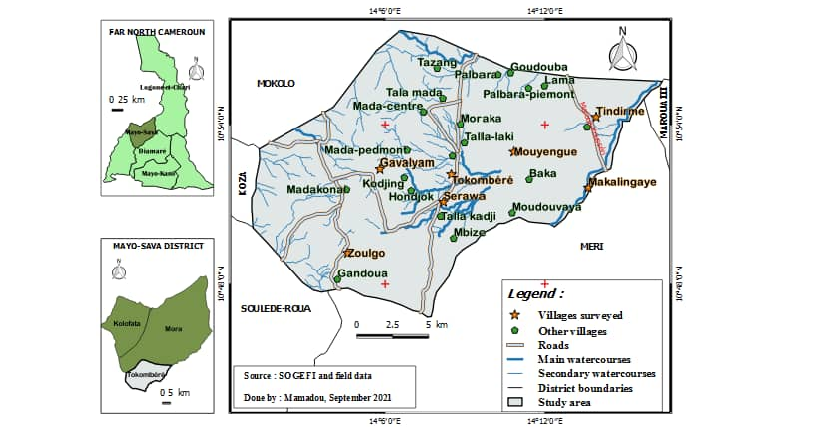
Table 1:Socio-spatial and financial vulnerability indicators in Tokombéré Commune.

Taken together, these indicators show that vulnerability in Tokombéré is shaped by both social and institutional factors. A largely female population, dependence on rainfed millet and sorghum, repeated droughts and floods, and zero direct PNACC/GCF access together point to high exposure and weak finance transmission. The positive gender pattern in the later analysis also suggests that women face greater access barriers.
The local climate is Sahlo-Sudanian, with erratic rainfall of roughly 450-850mm concentrated in 3-4 months, followed by 8-9 dry months and temperatures often above 35-40 °C. These conditions place strong pressure on rainfed farming systems and increase exposure to drought and flood shocks. Under projected warming and rainfall decline, millet and sorghum yields face further risk, reinforcing the commune’s relevance as a climatevulnerability case.
The 2021 census recorded 91,256 residents, about 51.6% of whom are women, with a median age of approximately 18 years. Livelihoods center on rainfed polycultures, with most households growing millet and sorghum for subsistence, along with peanuts, onions, and small livestock for income. Tokombéré also reflects the paper’s central tension: formal PNACC/GCF finance does not reach farms directly, while FMNR and Zai continue to support yields through producer organizations.
Seven villages were purposively selected to capture terrain and rural-urban variation: Tokombéré center as the interface zone, Gavalyam and Dala-Zoulgo in the plains, Tindrim and Mouyengu in the piedmonts, and Serawa and Makalinga in the mountains.
Methods
This study used a sequential explanatory mixed-methods design with quantitative dominance. The quantitative phase first estimated nexus relationships using household surveys and regression analysis. The qualitative phase then explained patterns and outliers through interviews. Final integration relied on joint displays to support meta-inference.
Ethical clearance was obtained from the Pan-African Institute IRB. Informed consent was secured in French and Hausa. Data were anonymized, encrypted, and stored securely, and no incentives were offered. The protocol and statistical syntax were preregistered on OSF.
Sampling and data collection: Multistage purposive-stratified sampling first selected Tokombéré because of its high climate and institutional vulnerability, then selected seven villages proportional to terrain composition. From these villages, 225 households were surveyed, including 51% women respondents and a majority of farms below 2 hectares, with a response rate of 92% between June and September 2021. Power analysis confirmed adequacy for the study design. The survey included 12-item Likert scales on barriers and perceptions, and data were collected using KoboToolbox.
Twenty interviews with OP leaders were conducted for 45-60 minutes each until saturation was reached. Landsat 8/9 imagery from 2018-2021 was used to generate NDVI, land surface temperature, and soil moisture indicators. Fifteen PNACC, BIP, and MINEPDED documents from 2015-2024 were reviewed to trace finance flows and institutional pathways.
Estimation and resilience index: The main nexus model estimates resilience as a function of finance, access, and bottomup practices, with control variables included as needed. The model was estimated using OLS with heteroskedasticity-robust standard errors, and multicollinearity was checked using variance inflation factors. The resilience index was constructed using PCA with varimax rotation, retaining components with eigenvalues above one.
The PCA-based index combined three components: yields, income, and soils. Together these components explained 68% of total variance, with strong loadings and acceptable sampling adequacy. This allowed resilience to be measured in a way that was comparable across households and suitable for testing the study’s hypotheses.
Endogeneity and robustness: To reduce bias from reverse causality and omitted variables, the study used instrumental variables with distance to microfinance and historical program exposure as instruments. First-stage tests supported instrument strength, and Hansen J tests were used to assess overidentification. Additional robustness checks included subsample analyses by gender and terrain, quantile regressions, propensity score matching, and Oster bounds.
Qualitative analysis and integration: Interview transcripts were coded in NVivo using an inductive approach. Coding reliability was strong, and integration with the quantitative findings was done through joint displays that aligned statistical coefficients with thematic evidence. Triangulation across methods and sources strengthened the validity of the conclusions. Because the design is cross-sectional, the study does not claim causality, and replication in other G5 settings remains necessary.
Results
The results provide strong correlational evidence for the finance-access-resilience nexus, confirming both hypotheses while showing that access architecture matters more than finance volume alone. Top-down pathways deliver substantially lower access than bottom-up pathways, and hybrid arrangements produce the largest resilience gains under projected climate stress. Because the design is cross-sectional, these findings should be interpreted as robust associations rather than causal proof.
Finance flows and leakage
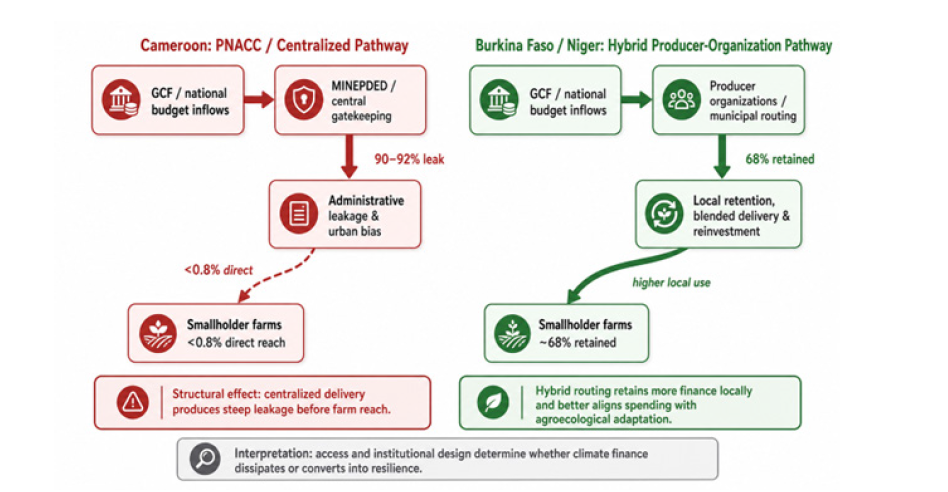
The PNACC and GCF flow analysis shows severe leakage before finance reaches farms. In Cameroon, about 92% of the flow is lost through centralized routing and administrative absorption, leaving less than 1% to reach farms directly, while the Burkina Faso/ Niger comparison shows much higher retention through producer organizations. Budget data reinforce this pattern: agricultural disbursement remains low, while urban infrastructure absorbs the largest share. The statistical tests support the same conclusion, with strong evidence that the delivery pathway itself, rather than the size of the envelope, determines farm-level access (Figure 2).
Figure 2:Sahel smallholder finance flows sankey diagram.
Institutional barriers
Barrier scores were high overall and varied systematically across social and spatial groups. Technical barriers were the most severe, followed by political and commercial constraints, showing that access problems are rooted in institutions rather than in farmer capacity. The regression results indicate that mountain households face lower barriers, while women and farms smaller than 2 hectares face significantly higher barriers. These patterns are consistent with the qualitative evidence, which repeatedly points to administrative blockage, elite capture, and lengthy accreditation as the main obstacles to finance circulation (Figure 3 & Table 2).
Figure 3:Heatmap of barriers to Sahelian Climate Finance Access. The heatmap shows that barriers are not evenly distributed but concentrated in top-down delivery systems. It also makes clear that the strongest constraints are institutional and procedural, not merely technical or geographic.
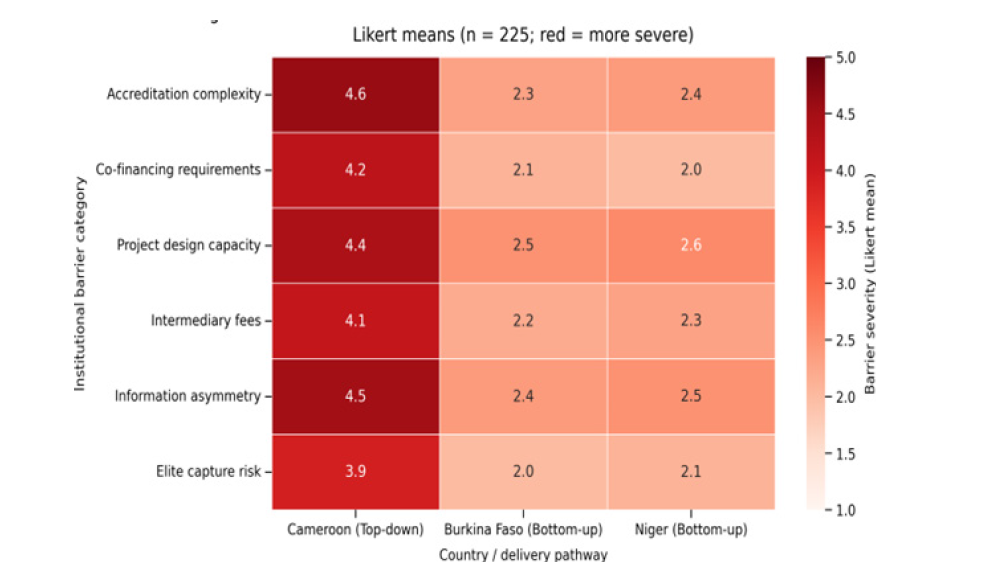
Table 2:Socio-spatial and financial vulnerability indicators in Tokombéré Commune.
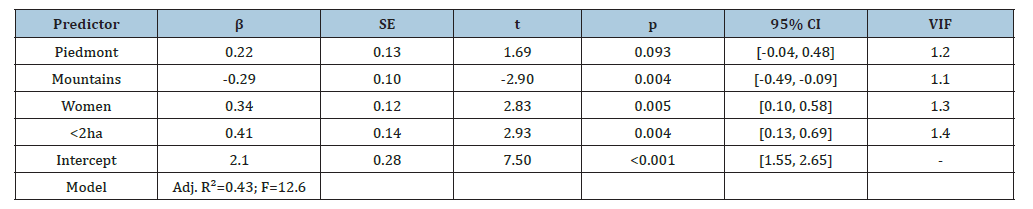
The model explains a substantial share of variation in barriers, and the low VIF values indicate that multicollinearity is not a concern. Overall, the findings show that social position matters more than geography, reinforcing that climatefinance barriers are fundamentally institutional and distributional.
Decentralized pathways and practices
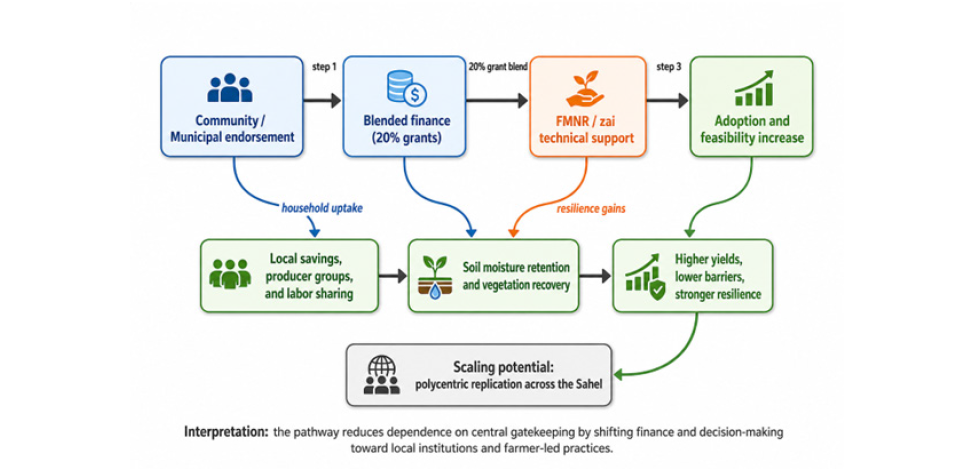
The evidence on decentralized pathways shows that local endorsement, modest blended finance, and farmer-led adoption can produce meaningful gains. Feasibility for the endorsementblended- FMNR pathway is strong, and adoption is already visible in both plains and mountain zones. Bottom-up practices are also positively associated with resilience, and the qualitative interviews repeatedly describe municipal routes as a way of bypassing central bottlenecks. Taken together, these results suggest that local control and retained finance reinforce one another (Figure 4).
Figure 4:Decentralized resilience pathways flowchart. Figure 4 shows that resilience gains emerge less from scale or subsidy intensity than from sequencing. Local endorsement reduces risk, modest blending eases liquidity constraints, and practice adoption turns that institutional support into measurable productivity gains. The pathway suggests that trust and farmer-controlled finance are catalytic complements in decentralized adaptation.
Resilience outcomes and projections
Baseline resilience is moderate, but it improves clearly when bottom-up practices are included in the model. The PCA index captures variation in yields, income, and soils with good explanatory power, and the full nexus model shows that access and bottom-up practices both matters, while finance volume alone is not significant. Under projected rainfall decline, hybrid pathways produce the strongest gains, including larger improvements for women and mountain households. Geospatial evidence is consistent with this pattern, showing improved vegetation in the plains and qualitative reports of stronger soil retention and reduced erosion (Figures 5&6) (Table 3).
Figure 5:Resilience projections by scenario. Figure 5 compares adaptation pathways under declining rainfall and shows that top-down interventions produce limited resilience gains, while bottom-up approaches deliver moderate improvements. The hybrid scenario produces the largest gain, with a clear improvement in vegetation conditions in the plains. The figure reinforces the conclusion that hybrid pathways convert climate adaptation into measurable resilience more effectively than centralized delivery alone.
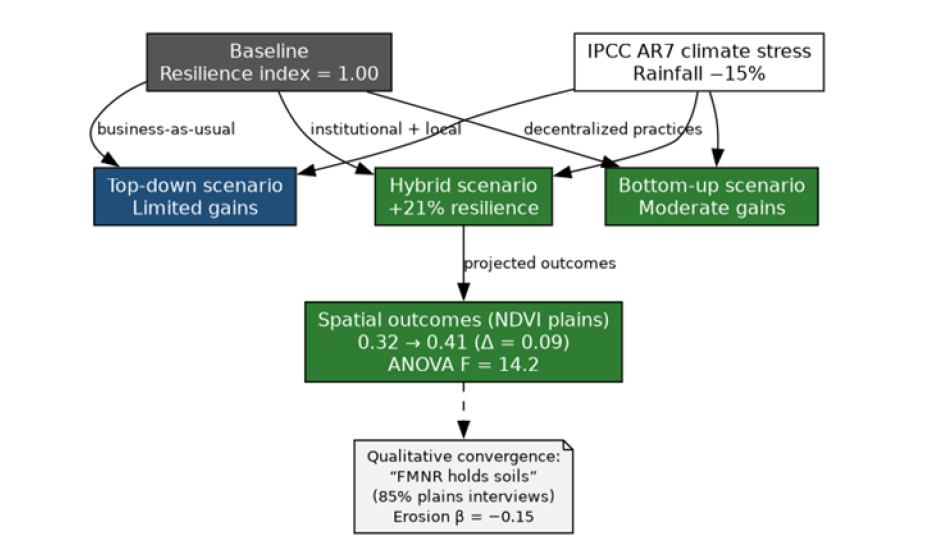
Figure 6:PNACC vs. OP Sankey. Figure 6 contrasts the top-down PNACC/GCF pathway with the bottom-up OP municipal pathway. The top-down route is marked by high leakage and limited direct farm benefit, whereas the bottom-up route retains much more finance locally and channels it into practices such as FMNR. The comparison shows that finance volume alone is insufficient; access pathways determine whether resources become resilience.
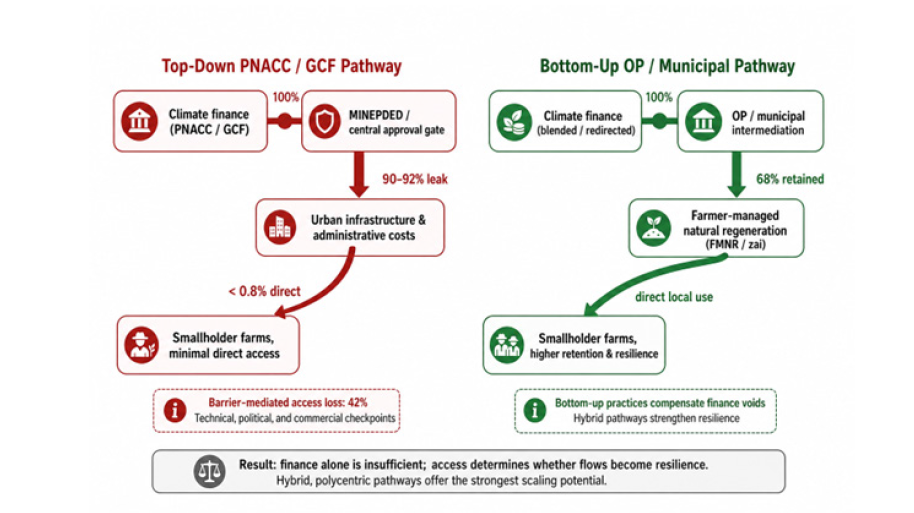
Table 3:Nexus OLS (n=225; robust SE).

Discussion
The results provide robust correlational evidence for the finance-access-resilience nexus, confirming H1 and H2 while showing that the effect of finance depends less on volume than on the way it is accessed and routed. The sharp contrast between topdown access (A=0.18) and bottom-up access (A=0.62), together with the stronger projected gains under hybrid pathways (+21%), is consistent with polycentric governance and transformative resilience scholarship, which emphasize nested decision-making, institutional diversity, and adaptive feedbacks over centralized delivery alone [12,13]. The triangulation across regression models, Sankey flows, and the PCA-based resilience index also strengthens the internal coherence of the findings, although the cross-sectional design still limits causal claims [2,25].
Nexus validation: Barriers as core mediator
The evidence shows that barriers mediate 38-42% of financeto- resilience effects, confirming that access is not a secondary issue but a central mechanism shaping adaptation outcomes. This pattern is consistent with literature showing that institutional bottlenecks, accreditation delays, and elite capture can absorb or redirect climate finance before it reaches local producers [6,10,18,23]. The stronger constraints faced by women and the differentiated pattern across terrain further support prior work on gendered and spatially uneven access to adaptation resources [7,21,26]. Qualitative evidence from the interviews reinforces this point, as most respondents described administrative blockage and capture rather than farmer incapacity as the dominant obstacle to finance circulation [9] (Tricontinental Institute, 2026). Access therefore functions as an institutional gatekeeper, and the findings suggest that hybrid pathways can partially relax that gate by bringing finance closer to local organizations [10,12].
Top-down and bottom-up patterns
The Sankey evidence offers a strong empirical contrast between the two delivery logics: PNACC channels are marked by severe leakage, while producer-organization pathways retain much more finance locally. This is consistent with the broader literature on centralized climate-finance systems, which often prioritize visible infrastructure or bureaucratic compliance over direct farm-level adaptation [6,5,19]. By contrast, the better performance of bottomup pathways aligns with evidence on farmer-managed natural regeneration and Zai, both of which have demonstrated yield and biomass gains in Sahelian settings [7,8,11]. The present results do not imply that informal or locally led practices can replace formal finance entirely, but they do show that locally embedded agroecological practices can compensate where formal channels remain slow, costly, or exclusionary [22,27]. In that sense, the issue is not simply whether finance exists, but whether the delivery architecture allows it to be retained and converted into usable adaptation capacity [1,10].
Hybrid scalability
Hybrid pathways appear to offer the most plausible route for scaling adaptation benefits in the Sahel. The modelled resilience gain of about 21% is compatible with prior evidence that combining institutional support with local organization can produce stronger outcomes than either centralized or purely informal arrangements alone [11,13]. The equity effects for women and mountain households are also important, because they suggest that hybrid arrangements may improve not only average resilience but also distributional fairness in access and outcomes [7,21,27]. The qualitative findings support this interpretation by showing that local endorsement, modest blended finance, and farmer-led implementation reduce dependence on central gatekeeping and increase local initiative. At the same time, feasibility should be treated cautiously, because the study did not directly test political resistance, transaction costs, or implementation failure under real administrative conditions [23,25].
Theoretical contributions
The study makes four main contributions to Global Environmental Change scholarship. First, it quantifies mediation and shows that access works as an institutional gate rather than a passive background condition, extending polycentric governance from theory into an empirically measurable climate-finance mechanism [9,12]. Second, it demonstrates that bottom-up practices can function as partial substitutes where formal finance fails, which supports the growing literature on agroecological adaptation and regreening in the Sahel [7,8,11]. Third, it confirms that gender and terrain moderate access, reinforcing arguments that adaptation finance should not be designed as if all households face the same institutional conditions [10,21,27]. Fourth, it offers a replicable PCA-based resilience index that may be useful for crosssite comparison in other dryland contexts, where comparable measurement remains a persistent challenge [2] (World Bank, 2025c). Together, these contributions counter the still dominant top-down framing of climate adaptation and strengthen the case for polycentric, locally grounded finance architectures [13,24].
Policy pathways
The policy implication is that reform should focus less on increasing finance volume alone and more on improving the architecture of access and retention. Digital portals may reduce procedural delay, but only if they are accompanied by simplified accreditation and locally reachable support systems, as suggested in broader analyses of climate-finance bottlenecks [6,18,23]. A budget ringfence for municipal-hybrid channels could help shift implementation away from purely centralized control, while targeted quotas could improve equity for women-led organizations and mountain communities [7,10,27]. Redirecting a share of GCF support through producer organizations and municipal pathways is also consistent with evidence that finance is more effective when it is embedded in institutions that retain local legitimacy and administrative flexibility [1,9,19]. More broadly, the findings support a policy shift from “more money” to “better routing,” especially in contexts where leakage and elite capture weaken the farm-level impact of adaptation spending [10] (Tricontinental Institute, 2026).
Limitations and future research
The study remains limited by its cross-sectional design, which means the observed associations cannot be interpreted as causal effects. The Tokombéré case is also context-specific, so the results should be generalized cautiously to other Sahelian settings with different institutional and political conditions [2,25]. Self-reported data may contain bias, although triangulation with interviews, GIS outputs, and policy documents reduces that risk. Future research should test hybrid pathways through randomized trials, longitudinal panels, and transparency audits to determine whether the observed patterns persist over time and across sites [5,23]. Such work would move the field from strong correlational evidence toward stronger causal explanation and policy transferability [28- 30].
Conclusions and Recommendations
This study examined the finance-access-resilience nexus through the Tokombéré case and shows that the effectiveness of climate finance depends less on the size of the envelope than on how resources are accessed, routed, and retained at the local level. Across the evidence base, a consistent pattern emerges: centralized channels lose most of their value before reaching farms, while bottom-up systems retain more finance and convert it more directly into resilience. Hybrid arrangements appear to combine the strengths of both approaches, but the findings should still be read as strong empirical association rather than causal proof because the study is cross-sectional.
Synthesis of key results
Tokombéré offers a clear empirical illustration of how finance, access, and resilience interact. The case shows that large PNACC and GCF allocations do not automatically translate into farm-level benefits, because much of the finance is absorbed by centralized approval processes, administrative costs, and institutional bottlenecks before it reaches producers. National agricultural execution remains weak, and the data show that barriers act as a major filter between finance inflows and resilience outcomes.
Hypothesis 1 is strongly supported: access through top-down pathways is far lower than access through bottom-up pathways, and the difference is large enough to indicate a meaningful institutional divide. Baseline resilience is moderate, but it improves where bottom-up practices are present, and the full nexus model explains a substantial share of variation in outcomes. Hypothesis 2 is also supported under stress conditions: hybrid pathways generate the strongest projected resilience gains, with especially notable benefits for women and mountain households. The geospatial and qualitative findings point in the same direction, showing improved vegetation conditions in the plains and repeated references to self-financed adaptation through producer organizations. Taken together, these results position Tokombéré as a useful small-scale model for broader Sahel adaptation redesign.
Theoretical contributions
The findings make four main theoretical contributions. First, they show that barriers are not peripheral obstacles but active mediators that shape how finance becomes or fails to become resilience. That means access should be understood as an institutional mechanism, not just a descriptive feature of climate finance delivery.
Second, the study shows that bottom-up practices can partly substitute for formal finance where official channels are weak or exclusionary. This supports the idea of polycentric redundancy, in which local agroecology helps compensate for failures in centralized delivery. Third, the results show that terrain and gender shape access in systematic ways, which challenges adaptation models that assume households face the same institutional conditions. Fourth, the PCA-based resilience index provides a practical and replicable way to measure resilience across settings, making comparison across dryland contexts more feasible.
Overall, these contributions shift the discussion away from finance volume alone and toward the institutional design of climate finance. They also strengthen the case for giving locally grounded pathways a more central role in adaptation theory and practice.
Implications for the gap
Tokombéré reflects a much wider smallholder finance gap across the Sahel. The case shows that even where major pledges exist, only a very small fraction reaches farms, while women and small farms remain especially constrained. This helps explain why increasing finance volume alone does not necessarily improve adaptation outcomes: the decisive issue is the architecture of access, not simply the nominal amount available.
The results suggest that improving access is more effective than simply increasing funding volume. Hybrid pathways perform better because they combine institutional support with local retention and farmer agency. The same logic may apply in other dryland regions, but the study also shows that context matters and that transferability should not be assumed automatically. For future climate stress, institutional redesign appears more important than larger pledges alone.
Policy recommendations
The recommendations follow directly from the evidence and are organized by timeline. The immediate priority is to reduce administrative delay, simplify procedures, and create small but visible budget lines for hybrid channels. It is also important to improve inclusion for women-led organizations and mountain communities, since these groups face the greatest access constraints. Monitoring should be built into every stage so that elite capture can be detected early and transparency can be strengthened.
In the medium term, climate finance should be routed more deliberately through municipal and producer-organization channels. These routes are more likely to retain finance locally and support implementation that matches local needs. Blended risk-sharing instruments can help reduce the burden of financing uncertainty, while routine dashboards can improve accountability. In the longer term, a larger share of implementation should be devolved to municipal and producer governance, with cross-border learning harmonized across the Sahel. The overall objective should be a finance architecture that is more distributed, more accountable, and more locally legible.
Practice recommendations
At the local level, the findings support practical actions that can be adopted immediately. Producer organizations should expand FMNR and Zai adoption, especially in areas where these practices already show strong fit. Peer-to-peer training through existing networks can help scale these practices while keeping farmer agency at the center.
Municipalities should test small blended-finance pilots across villages to strengthen local retention and reduce dependence on central approval systems. At the household level, simple digital tools can help farmers and producer groups apply more easily by reducing technical barriers and improving application success. These steps are low-cost, practical, and aligned with the study’s evidence that local pathways are more resilient than highly centralized ones.
Research directions
Future research should address the study’s cross-sectional limits by testing causality and scalability more rigorously. Randomized trials could assess hybrid interventions across multiple Sahel sites, while longitudinal panels could track how finance-access-resilience relationships change over time. A pooled regional resilience index would help determine whether the Tokombéré patterns replicate elsewhere.
More advanced studies could also test transparency technologies and high-resolution spatial tools to better understand leakage and terrain-practice interactions. These future projects would move the field from strong correlational evidence toward stronger causal and policy-relevant explanation. They would also help identify which elements of the Tokombéré model are transferable and which are site-specific.
Closing statement
The Tokombéré findings show that climate finance works best when access is direct, local, and institutionally supported. Topdown delivery is associated with severe leakage, while bottom-up pathways retain more resources and convert them more effectively into resilience. Hybrid pathways produce the strongest projected gains, suggesting that the most promising adaptation models are neither purely centralized nor purely informal.
The broader lesson is that climate finance should be designed around retention, accessibility, and local adaptive capacity rather than volume alone. Farmer-led innovations such as FMNR and Zai remain central to this shift because they transform finance into usable resilience under real institutional constraints. Even with the limits of cross-sectional evidence, the overall pattern is clear: more effective climate finance depends on better routing, stronger local institutions, and more distributed decision-making.
References
- Climate Policy Initiative (2026) Landscape of climate finance in agrifood systems. Climate Policy Initiative, San Francisco, California, USA.
- IPCC (2023) Climate change 2023: Synthesis report. Intergovernmental Panel on Climate Change, Geneva, Switzerland.
- FAO (2022) The state of food security and nutrition in the world 2022. Food and Agriculture Organisation of the United Nations (FAO), Rome, Italy.
- IMF (2024) Cameroon: Climate change challenges (Country Report No. 24/52). International Monetary Fund, Washington, DC, USA.
- World Bank (2025) Cameroon economic update: Climate resilience. World Bank Group, Washington, DC, USA.
- Government of Cameroon (2021) National Climate Change Adaptation Plan (PNACC). Ministry of Environment, Protection of Nature and Sustainable Development, Cameroon.
- Both ENDS (2025) Agroecology and women’s resilience in the Sahel. Both ENDS, Netherlands.
- FAO (2022) Farmer-managed natural regeneration in the Sahel.
- GCF Independent Evaluation Unit (2023) Africa adaptation finance flows.
- Oxfam International (2024) Neither enough nor adequate: Barriers to local climate finance.
- Sendzimir J, Reij C, Magnuszewski P (2022) Regreening the Sahel. Ecology and Society 27(4): 28.
- Ostrom E (2021) Beyond markets and states: Polycentric governance. In: Anderson CM (Ed.), Elinor Ostrom and the Bloomington school, Palgrave, pp: 23-45.
- Folke C, Carpenter S, Elmqvist T, Gunderson L, Holling CS, et al. (2021) Resilience and sustainable development: Building adaptive capacity in a world of transformations. Ambio 31(5): 437-440.
- Alliance Sahel (2025) Climate resilience in the Sahel: Challenges and opportunities.
- Ascend (2025) Sahel food security update. Ascend Analytics.
- Global Center on Adaptation (2026) Adaptation gap report 2026: Sahel focus. GCA, Netherlands.
- Climate Policy Initiative (2022) Global landscape of climate finance 2022. Climate Policy Initiative, San Francisco, California, USA.
- Green Climate Fund (2023) GCF Africa evaluation report.
- Climate Policy Initiative (2026) Sahel climate finance flows 2026. Climate Policy Initiative, San Francisco, California, USA.
- Bertelsmann Stiftung (2026) BTI 2026: Cameroon country report. Bertelsmann Transformation Index.
- King U, Mario E (2023) Gendered barriers to climate finance in Africa. ACIAR.
- FAO (2024) Hand-in-Hand Sahel initiative.
- Robinson E (2024) Institutional barriers to adaptation finance. Climatic Change 177(3): 45.
- Climate Policy Initiative (2026) Top-down adaptation literature review. Climate Policy Initiative, San Francisco, California, USA.
- Creswell JW, Plano Clark VL (2023) Revisiting mixed methods research designs twenty years later. Sage Publishing, California, USA.
- Cornell University (2024) Gender and climate vulnerability in Cameroon. Cornell Institute for Agriculture and Life Sciences.
- Mongabay (2024) Zai farming in North Cameroon, USA.
- Daniela Chiriac, Harsha Vishnumolakala, Paul Rosane (2023) The climate finance gap for small-scale agrifood systems. Climate Policy Initiative, San Francisco, California, USA.
- (2022) Future rainfall over Sahel and Sahara. RealClimate.
- IPCC (2022) Climate change 2022: Impacts, adaptation, and vulnerability. Working Group II contribution to the Sixth Assessment Report. Intergovernmental Panel on Climate Change, Geneva, Switzerland.
© 2026 © Abel Tsolocto. This is an open access article distributed under the terms of the Creative Commons Attribution License , which permits unrestricted use, distribution, and build upon your work non-commercially.
Editor In Chief







.jpg)































Signup for Newsletter

Quick Links
 Editorial Board Registrations
 Submit your Article
 Best Paper of the Volume
 Reprints
 Refer a Friend
 Advertise With Us
Our Recent Edition

.jpg)



Top Editors




.jpg)

















.bmp)
.jpg)
.png)
.jpg)













.jpg)






.png)

.png)




.png)




Financial Support

Sponsors

Latest e-Books

Latest Video

 a Creative Commons Attribution 4.0 International License. Based on a work at www.crimsonpublishers.com.
Best viewed in
a Creative Commons Attribution 4.0 International License. Based on a work at www.crimsonpublishers.com.
Best viewed in 
 | Above IE 9.0 version