

- About Us
- Information
-

The Author ensures that the research has been conducted responsibly and ethically with adherence to all relevant regulations. read more..
- For Authors
- For Reviewer
- Manuscript Guidelines
- Membership
- Publication Ethics
-
- Journals
- Reprints
- e-Books
- Videos
- Policies
- Contact Us
 COVID-19
- Submissions



Full Text
Environmental Analysis & Ecology Studies
Issue of Property Right Assignment and Natural Resource Overuse
Soumyendra Kishore Datta1* and Piali Bandyopadhyay Datta2
1Retd Professor of Economics, University of Burdwan, India
2Associate Professor of Economics, Burdwan Raj College, India
*Corresponding author:Soumyendra Kishore Datta, Retd Professor of Economics, University of Burdwan, India
Submission: February 27, 2026; Published: April 30, 2026

ISSN 2578-0336 Volume13 Issue 4
Abstract
Granting of property rights involve socio-institutional issues which have an impact on the proper management of exhaustible/renewable type resources. The attribute of property in an object involves right to use by somebody and duties of others not to contravene that right. Market failure is considered as a sequel to absence of property right and this often leads to the emergence of open access condition. Weak property right, ill managed property right or non-operational property right have in many cases been functionally equivalent to open access regime. Weakly institutionalised economies with abundant natural resources are often observed susceptible to plundering of underground resource and channelizing the rent for unlawful purposes. This is evidenced by improper regulation on gold mine resources in several parts in Latin America. Again, in many African/Latin American economies, despite the traditional knowledge base of forested people, the state authorities have consistently turned down acknowledgement of the traditional right of forest dwellers. This uncertainty has resulted in ill preservation of the forested region by local people. Further, because of the fluid feature of irrigation water, fishery resources etc, it is very difficult to impose property right on such resources which are associated with externality issues. In the absence of strong institutional mechanism to defend usufructuary rights to use the irrigation/fishery resources, there may arise opportunism and temptations in the form of free riding. Hence comprehensive assignment of property right and market efficiency are considered important for ascertaining optimal use of natural resources.
Keywords:Institution; Entitlement; Management; Sustainable; Local
Introduction
Socio institutional issues involved in the granting of property rights have a bearing on the level of extraction/depletion of natural resources- be it exhaustible or renewable in nature. Property’s existence in an object ensures granting of a bundle of user rights to the owner of the resource and entails duties or responsibilities to the non-owner, not to transgress the user right of the owner. According to Common and Ostrom (1972) the inverse of one’s property right is the duty of others not to contravene that right, rather to uphold it. Others refer to persons who are legally bound by the institutions to espouse a right. The granting of property rights can broadly be divided into different types: public good, private good and common property resource. But absence of either of these rights leads to the problem associated with open access resources which is somewhat equivalent to the notion of incomplete assignment of property right. While open access may be dubbed as total absence of any kind of property right, its incomplete assignment indicates that it is riddled with several non-functional institutional rules which are supposed to shield the resource under question from being plundered. It is often observed in developing countries that in many cases the institutional restrictions are subject to flagrant violation by trespassers and the office bearers who are supposed to implement the rules and regulations are often a party to the accomplices. Again, in many cases the property right is not properly assigned to the right type of stakeholders who lack concern for preservation of the resource and this often exacerbate the depletion of the resource. Market failure or incomplete market is often interrelated with the absence of a well-defined property right system. A well delineated property right system characterises a set of entitlements that describe the owners’ entitlements and responsibilities for using a resource in a conservative manner. These can be classified as follows:
Context and problem statement
In the West Region’s Hauts-Plateaux Division created by the 1992 fragmentation of Mifi [5] proximity to Bafoussam catalyzed peri-urban growth, with built-up cover rising from roughly 5-10% in 1987 to some 40-50% by 2005 in Bandjoun, in the absence of effective regulatory frameworks; built-up-to-population ratios fell below 1.0, signaling densification rather than spatial expansion [6]. This decentralization paradox reflects broader national patterns: councils in Buea and Limbe contend with overlapping competences that spur ecologically risky expansion affecting large poor populations [7,8]. The 2025 FAO multi-stakeholder platform is drafting a VGGT-aligned National Land Policy, yet operational silos persist: MINDCAF’s titling incentives favor elite allocations, MINHDU zoning remains weakly enforced, councils lack functional capacity (only ~20% of commissions are operational), and chiefs control an estimated 80% of peri-urban allocations [1,9]. These governance vacuums drive informal sprawl, evictions, wetland encroachment and associated health inequities.
A. The right should be comprehensively assigned. In other
words, all resources and assets designed to be bought and sold
in the market, must be individually or collectively owned and all
claims must be enforced effectively.
B. There should be exclusive right for the resources/assets
possessed by an individual in other words the benefits and costs
should belong to the person or group of persons collectively
having the property right.
C. There should be transferability of the property right
from person to person in an exchange. Under this condition
of transferability, the person having the property right would
be motivated to conserve the resource with the expectation of
making use of it in future.
D. There should be security of property right. This is because
if at some time there emerge the possibility of trespassing on the
right of some person or forceful seizure of that property, then
the concerned person would not feel motivated to conserve the
resource.
Weak property right, ill managed property right or nonoperational property right have in many cases been functionally equivalent to open access regime. And what is more interesting is that this kind of weak or ill-managed property right have been pervasive in different types of resource extending from non-renewable resource like coal/gold or mineral to renewable resource like ground water, forest, irrigation, fishery and so on. It is demonstrated by Rodriguez et al. [1] that while weak property right is virtually taken to be synonymous with over-plundering of the resource base, its management may also be affected by the insecure right over the revenues generated from exploitation of such resources. Weak institutional regime in the form of laxity in granting and operation of property right exacerbate not only the denudation of underground resource stock but also affect the revenue re-use for exploration or scientific developmental activity. Thus, weakly institutionalised economies fall prey to the problem of resource curse because of siphoning of underground resource rent for illegal/unproductive purposes. As an instance of the impact of weakly enforced property right over gold mine resources in several parts in Latin America, it has been observed that [2-4], there has been rampant illegal mining of gold across the region. According to Wagner, (2016) “about 28% of gold mined in Peru, 30% of gold mined in Bolivia, 77% of gold mined in Ecuador, 80% of gold mined in Colombia and 80%-90% of Venezuelan gold is produced illegally”. Further due to fragile property right scenario, widespread prevalence of extortion, theft and hostility have accompanied the illegal and legal mining operation in the region and resulted in significant revenue loss [5-7]. Cases are not rare when it is observed that with the gradual weakening of institutional laws and regulations and corresponding slackness in the enforcement of property rights, foreign firms leave the country in which they were hitherto conducting mining operations and the mining space quickly goes into the hands of illegal armed groups. Thus, absence of complete property rights introduces inefficiency in the extraction process when group infighting may emerge across rival illegitimate outfits and there occurs overexploitation of the resource.
The criminal gangs impose their own rules regarding entry and exit into the mining region and exploit the mineral rent generated from the mines while exposing mine workers to a pattern of labour exploitation. As an example, allusion may be made to the infamous operation prevalent in the Orinoco Mining region in Venezuela. The vast expanse of rich mineral endowment in this area was earmarked by the government as a special zone for the development of mining projects, with the hope to find substitutes for its dwindling oil revenues [7]. But the dismal and miserable economic and political condition that has perturbed the country during the last two decades, left it totter under very weak imposition of the rules of law [8]. The regulations and rules regarding property right administration have also been lax and flimsy. This acted as an incentive for the emergence of illegal mining operations, at the helm of control of which are large criminal gangs that have spread across the length and breadth of the Orinoco Mining region [9]. The inter-gang rivalry has left the mining resources rapidly dwindling due to improper monitoring of property rights. Further the mineral rents that could be earned under a strongly managed and efficiently enforced public/private property right scenario, had to be forgone due to the wasteful and profligate activities of armed criminal groups.
Property right accompanied by secured access to land and other natural resources provide impetus to sustainable management and conservation of such resources. Control over and access to land and other natural resources may be viewed as constituting a bundle of rights which enable the right holder to exercise them for using, managing and transferring the resources as and when required. These rights are embedded in social relationships involving the principles of fairness, justice and equity.
The tacit right accorded to indigenous people to maintain and use water resources was recognised in the indigenous declaration on water held in Kyoto in 2003. It recognised the special right and relationship that indigenous people have with regard to water resources and accepted their right to make conservative decision of water system at all levels.
The tacit right accorded to indigenous people to maintain and use water resources was recognised in the indigenous declaration on water held in Kyoto in 2003. It recognised the special right and relationship that indigenous people have with regard to water resources and accepted their right to make conservative decision of water system at all levels. devices ended in a fiasco in many cases because of lack of adequate funding and skilled personnel to look after the management. The deleterious impact of nationalising forest by denying traditional right of local user group has been well documented in countries like Thailand, India and Nepal. In such countries it has been observed that common pool resources that were converted to de jure govt. property, were subsequently converted to de facto open access property, with the fallout that the tight institutional regime that were operative under the stewardship of local stakeholders, got broadly relaxed and the locals were denied access by the govt. of their long-standing customary rights to use the forest resource.
This kind of weak imposition of property right is often most prominently visible in case of renewable resources like forest, water, irrigation resources and fishery. These resources often hold the key to livelihood sustainability of many rural people. Forests are considered to be sources of various kinds of timber and nontimber products that have intense impact on the livelihood of people inhabiting inside and across the fringes of forests. Apart from providing multiple ecological benefits life storm protection, protection of soil erosion, flood control, carbon sequestration, habitat of animals and plants, forests also provide food, fruits, fuel, fodder, fencing material, medicine etc that serve human beings. For instance, in case of Mozambique 85% of livelihood benefits was provided from wood biomass. (2004) while in parts of Namibia wild food provided up to 50% of livelihood resources for nonagricultural workers. Obviously, the people residing in forest and enjoying tradable right are supposed to better and sustainably manage such forest resources as it provided a good chunk of their livelihood. The impact of fragile land tenure in areas with high biodiversity and threats of eviction from forest land often led to rampant deforestation. It is depicted in a model [10] that even with small probabilities of eviction, settlers in forested region are likely to pursue unsustainable practices such as degradation of long-lasting natural capital like forests. It is mooted that a properly structured property right regime targeted to be delivered to economically and politically marginalized class of people dependent for their wherewithal on forest resources, can safeguard the forest from wanton open access denudation. In case of Brazil, it is said that conversion of forests to pasture or farming land has led to increasing deforestation since 2014, reaching more than 10000sq km in 2021 with further rise in 2022. There is evidence galore that unregistered land with unassigned property right is mostly prone to deforestation as these are treated as a speculative asset. Around 50 to 100 million hectares of land in Brazil fall in this category, and so the menace of rising deforestation here in coming days still looms ominously large. What seems most important here is the documentation of policies based on clearly defined property right and responsibilities and designed for the security of forest and related communities along with creation of a legal and institutional rules for enforcing the legislation. This is similar to the case of Cameroon, one of the intensely endowed forest-based country in Africa, where sustainable management of natural resources has been possible through proper identification and allocation of property rights that have strengthened the joint management of forest resources.
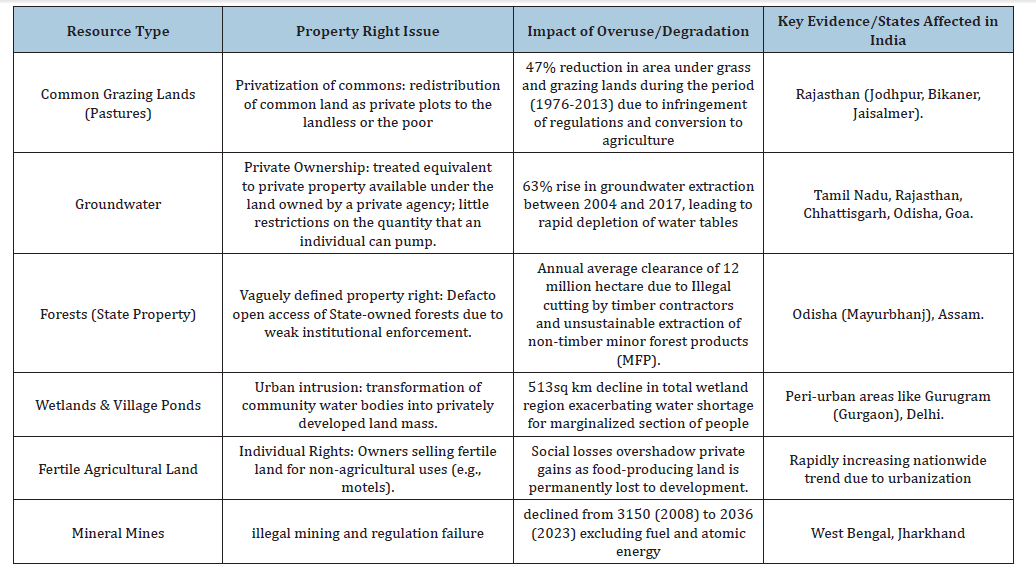
The following Table 1 provides a glimpse of natural resource overuse in India due to improper changes in property right system.
Table 1:Property right change and natural resource overuse in India.
Studies around Latin America and Africa have converged on the view that community managed forest based on customary rights have been more effective in reducing deforestation than Protected Area (PA) acts. Communities enjoying customary rights over forests have been observed to invest in sustainable forest management including fire protection, patrolling and cataloguing biodiversity in terms of labour and money [11]. Unfortunately, despite the traditional knowledge base of forested people, many state controlled protected area authorities have consistently refused to acknowledge the traditional right of forest dwellers with denied justice and equity. Prudent management calls for shifting funds to local communities with due respect for their tenurial rights meant for a long term sustainable strategic focus. In India the Govt issued the forest right act (2006) in favour of the STs (scheduled tribe) and other traditional forest dwellers when it recognised the symbiotic relationship of the STs with the forests, their dependence on it for their livelihood, habitation and diverse socio-cultural needs together with traditional wisdom regarding upkeep of the forests. Both individual rights to habitation, self-cultivation and community right to grazing, fishing and access in water bodies in forests and biodiversity, traditional resource access by nomadic and pastoral community as well as traditional customary right to protect, manage, use and regenerate any community forest for sustainable practice were given prominence in the act.
Again, the current water problems arise from the fact that right in water often overlook to assess the benefits flowing from the right holder to others in the form of positive externalities or the burden of costs a water right holder may inflict on others in the form of negative externality. The genesis of these problems lies in the fact that it is often hard to identify the affected agents and quantify the loss and devise a mechanism for assigning the legal accountability for external costs and/or assess the magnitude of the external benefits. Because of the fluid character of water, there may be manifold problems with assignment of property right in water. Hence the property right in water may be better stated as usufructuary in nature (meaning there by right to access and use of water) rather than full ownership of property to the corpus of water. As water escapes from space to space, use at one point may impinge on the welfare of other users at some other point. Further since water often involves multiple types of uses, there may be heterogeneous group of users with conflicting interests. The presence of a multiple group of stakeholders often renders the rules and regulations of water use hazy, resulting in overuse and degradation of water quality. In this context it is important to note that in the presence of a fragile legal machinery, unlawful pollution of water courses, unbridled access and use of publicly provided water (as in case of tap water), discriminatory practice with regard to grant of usufructuary right, pilferage of irrigation water resources etc, there is likely to be over-use of the water resources.
Govt. management apparatus has often been instrumental in developing irrigation system in developing countries. However, its functional efficiency has often belied the expectations due to lack of adequate funding and fiscal crisis. On the contrary often it has been found from ground reality that farmers manage the irrigation system rather efficiently compared to the state, since the farmers as direct stakeholders and beneficiary of irrigation are supposed to undertake sincere maintenance and upkeep of the irrigation system together with the tacit support of state staff. The importance of property right contributing to better maintenance of the irrigation system can be accounted for by three reasons [12].
A. Authority: Without the recognition of management rights
over the infrastructure and water system, farmers are unlikely
to have the requisite authority to maintain and improve the
irrigation system.
B. Incentives: Property rights in the form of use and
usufructuary right can provide impetus to farmers to better
manage and nurture the irrigation system, as by this they
can ascertain themselves of the realisation of future flow of
benefits and avoid potential suffering arising from misdirected
resources.
C. Resources: Enjoying control over land, water and
infrastructure together with usufructuary right over the
derived earning can help engender necessary resources to well
manage the irrigation system.
In the absence of strong institutional mechanism to defend usufructuary rights to use the irrigation resources, there may arise opportunism and temptations in the form of free riding, rent seeking and filching of water. Monitoring and sanctioning may serve to reduce such opportunistic behaviour. Lack of monitoring and sanctioning, corrupt practices, inequitable monitoring and cost sharing and costly system for conflict resolution can all weaken the structure leading to overuse of such resources [13].
Conclusion
Secure property right assigned to land and natural resources are some of the crucial components of right based approach to development which is organically related to sustainability of the resource base. This necessitates ensuring of clear and unambiguous title to property, encouragement to free transferability, internalisation of environmental costs, market-based incentives as well security of tenure. The right based approach is embedded in the welfare orientation of an economy in which the authorities at different stages provide genuine recognition to women, minorities, indigenous and marginalised group of people by offering them right based opportunities to get involved in the development process. This is also congenial to enhancing rural empowerment potential and sustainable livelihood and income generation. Further in the absence of proper and complete assignment of property right, there is likely to occur market failure for natural resources which often leads to unsustainable outcome and their untimely and unbridled depletion. Hence comprehensive assignment of property right, Pareto optimality and market efficiency are considered to be important elements for ensuring optimal utilization of natural resources.
References
- Rodriguez M, Smulders S (2022) Dynamic resource management under weak property rights: A tale of thieves and trespassers. Journal of Environmental Economics and Management 112: 102622.
- Banchirigah SM (2008) Challenges with eradicating illegal mining in Ghana: A perspective from the grassroots. Resource Policy 33(1): 3-29.
- Hilson G (2002) Small-scale mining and its socio-economic impact in developing countries. Natural resources forum 26(1): 3-13.
- Hilson G, Potter C (2004) Why is illegal gold mining activity so ubiquitous in rural Ghana? African Development Review 15 (2-3): 237-270.
- Clough Christine (2017) Transnational crime and the developing world. Global Financial Integrity, Washington DC, USA.
- Idrobo N, Mejía D, Tribin AM (2014) Illegal gold mining and violence in Colombia, peace economics, peace science and public policy. De Gruyter 20(1): 83-111.
- Rosales A (2019) Radical rentierism: Gold mining, cryptocurrency and commodity collateralization in Venezuela. Review of International Political Economy 26(5): 1-22.
- Bull B, Rosales A (2020) Into the shadows: Sanctions, rentierism, and economic informalization in Venezuela. European Review of Latin American and Caribbean Studies 109: 107-133.
- Soud D (2019) The gold rush in Venezuela could destabilize Latin America and the Caribbean. The Payne Institute for Public Policy, Colorado School of Mines, Colorado, USA.
- Mendelsohn R (1994) Property right and tropical deforestation, Oxford Economic Papers 46(1994): 750-756.
- Tauli-Corpuz V, Alcorn J, Molnar A, Healy C, Barrow E (2020) Cornered by PAs: Adopting rights-based approaches to enable cost-effective conservation and climate action. World Development 130: 104923.
- Meinzen Dick, Ruth (2002) Property rights and maintenance of irrigation systems. Journal of Applied Irrigation Science 37(2): 219-236
- Global Financial Integrity, Monthly Newsletter, Washington DC, USA.
© 2026 © Soumyendra Kishore Datta. This is an open access article distributed under the terms of the Creative Commons Attribution License , which permits unrestricted use, distribution, and build upon your work non-commercially.
Editor In Chief







.jpg)































Signup for Newsletter

Quick Links
 Editorial Board Registrations
 Submit your Article
 Best Paper of the Volume
 Reprints
 Refer a Friend
 Advertise With Us
Our Recent Edition

.jpg)



Top Editors




.jpg)

















.bmp)
.jpg)
.png)
.jpg)













.jpg)






.png)

.png)




.png)




Financial Support

Sponsors

Latest e-Books

Latest Video

 a Creative Commons Attribution 4.0 International License. Based on a work at www.crimsonpublishers.com.
Best viewed in
a Creative Commons Attribution 4.0 International License. Based on a work at www.crimsonpublishers.com.
Best viewed in 
 | Above IE 9.0 version