

- About Us
- Information
-

The Author ensures that the research has been conducted responsibly and ethically with adherence to all relevant regulations. read more..
- For Authors
- For Reviewer
- Manuscript Guidelines
- Membership
- Publication Ethics
-
- Journals
- Reprints
- e-Books
- Videos
- Policies
- Contact Us
 COVID-19
- Submissions



Full Text
Environmental Analysis & Ecology Studies
Beyond Administrative Boundaries: Land Governance, Jurisdictional Complexity and Informal Urban Settlement Dynamics in Cameroon
Suzanne Nadia Mache Foukou1, Abel Tsolocto2* and Jean-Marie Fotsing3
1University of Dschang, Cameroon
2University of TELUQ, Montreal, Canada
3University of New Caledonia, New Caledonia
*Corresponding author:Abel Tsolocto, University of TELUQ, Montreal, Canada
Submission: March 4, 2026; Published: April 16, 2026

ISSN 2578-0336 Volume13 Issue 4
Abstract
Cameroon’s land governance is marked by deep institutional fragmentation: an estimated 85-90% of national territory remains under customary tenure, exposing land to overlapping statutory claims and widespread insecurity. This study examines how jurisdictional fragmentation among central agencies (the Ministry of State Property and Land Tenure (MINDCAF)), decentralized councils (374 decentralized communes), and traditional authorities undermines urban land regulation and fuels the expansion of informal settlements, now housing 47-60% of urban residents without secure tenure or basic services. Using a mixed-methods design anchored in the Hauts-Plateaux “natural experiment” created by the 1992 administrative partition of Mifi Division, the study integrates 382 stratified household surveys, 40 elite and community interviews, Landsat-based land-use/land-cover analysis (1987-2024; 82-88% accuracy), and comparative cases from Bafoussam, Douala, and Yaoundé. Multivariate logistic models and interrupted time-series analyses show that proximity to Divisional capitals significantly accelerated peri-urban expansion from 5-15% built-up in 1987 to 42-55% in 2024 producing built-up-to-population ratios below 1.0, a clear indicator of regulatory-deficient densification (p<0.01).
Institutional voids sustain widespread informality: approximately 80% of peri-urban land transactions occur outside statutory frameworks (72% via chiefs, 18% via brokers), generating nearly 70% of urban land disputes. Spatial analysis further reveals 15,800 hectares of wetland loss, intensifying flood exposure for 35-40% of residents. Fragmentation thus transforms decentralization into a mechanism of speculative sprawl in the absence of coordinated governance. The emerging FAO-supported national land policy platform (2025) offers reform potential, contingent on reconciling hybrid tenure systems, establishing interoperable digital cadastral systems, and strengthening local land commissions with inclusive representation. Overall, the study provides causal evidence linking Divisional fragmentation to informality trajectories and contributes policy-relevant insights for managing rapid urbanization in hybrid governance contexts.
Keywords:Jurisdictional fragmentation; Peri-urban expansion; Customary tenure; Institutional voids; Administrative territoriality; Decentralization; Hybrid tenure systems; Elite capture
Introduction
Cameroon’s rapid urbanization from 56% in 2025 to a projected 70% by 2050 intersects with a fragmented land-governance architecture in which some 85-90% of territory remains under customary tenure and therefore vulnerable to overlapping statutory claims and tenure insecurity [1]. In Douala and Yaoundé, roughly 47-60% of residents live in informal settlements characterized by insecure tenure, regulatory vacuums, and deficient services, reflecting systemic failures across state, local and customary authorities [2]. Jurisdictional fragmentation overlapping mandates among MINDCAF (Ministry of State Property and Land Tenure) for titling, MINHDU (Ministry of Housing and Urban Development) for zoning, 374 decentralized councils [3], and traditional chiefs produces parallel land systems [4].
Context and problem statement
In the West Region’s Hauts-Plateaux Division created by the 1992 fragmentation of Mifi [5] proximity to Bafoussam catalyzed peri-urban growth, with built-up cover rising from roughly 5-10% in 1987 to some 40-50% by 2005 in Bandjoun, in the absence of effective regulatory frameworks; built-up-to-population ratios fell below 1.0, signaling densification rather than spatial expansion [6]. This decentralization paradox reflects broader national patterns: councils in Buea and Limbe contend with overlapping competences that spur ecologically risky expansion affecting large poor populations [7,8]. The 2025 FAO multi-stakeholder platform is drafting a VGGT-aligned National Land Policy, yet operational silos persist: MINDCAF’s titling incentives favor elite allocations, MINHDU zoning remains weakly enforced, councils lack functional capacity (only ~20% of commissions are operational), and chiefs control an estimated 80% of peri-urban allocations [1,9]. These governance vacuums drive informal sprawl, evictions, wetland encroachment and associated health inequities.
Research objectives and questions
Primary objective: Assess how jurisdictional fragmentation among state, local and customary authorities undermine land governance and drives informal settlement formation.
Specific objectives: (1) Map institutional overlaps; (2) Analyze spatial drivers and patterns; (3) Propose reforms to reconcile customary and statutory systems.
Primary question: How does fragmentation across state, local and customary actors impede urban planning and sustain informality?
Sub-questions: (1) What spatial patterns link informal urbanization to administrative boundaries? (2) How do elites exploit institutional ambiguities? (3) Which institutional innovations enable inclusive formalization?
These questions are motivated by the Hauts-Plateaux “natural experiment” following the Mifi split into four Divisions; fieldwork across Baham, Bangou, Batié and Bamendjou revealed infrastructure-led speculation and governance voids.
Scientific justification and contributions
This study moves beyond prevalence descriptions to causally link territorial fragmentation to informality, addressing a gap left by many cross-sectional studies [4,7] and reform critiques [1]. By combining longitudinal data (1987-2024) with mixed methods, it supports stronger causal inference. In the context of ~3.6% urban growth and an anticipated 10 million additional urban residents by 2035, the findings inform 2025 reform efforts and upgrading strategies potentially affecting 250,000+ households (World Bank, 2019/2025) [10]. Key contributions: (1) advancing multi-level governance theory for hybrid systems; (2) documenting the “decentralization paradox”; and (3) empirically validating mechanisms of elite capture.
Conceptual Framework and Literature Review
Land governance encompasses the policies, institutions and practices that shape access, use, transfer and dispute resolution for land [11]. Scholarly debates have increasingly moved beyond describing tenure systems to analysing how institutional architecture-the configuration of actors, mandates and authoritydetermines whether governance produces security or insecurity [12,13]. Cameroon’s dualistic regime-statutory law [14] alongside customary usufruct covering the vast majority of territoryexemplifies a persistent tension documented across sub-Saharan Africa, where legal pluralism generates overlapping claims, speculative behavior and widespread tenure insecurity [1,15,16].
Core concepts and definitions
Jurisdictional fragmentation denotes both vertical splits (ministries versus councils) and horizontal functional overlaps (e.g., MINDCAF titling vs. MINHDU zoning) that erode coordination [6]. Unlike mere administrative complexity, fragmentation produces operational dysfunction through unclear mandates and asymmetric authority-a distinction theorized by Ostrom [17] in her analysis of institutional misfit and more recently applied to African urban land governance by Rakodi [18] and Lund [19], who show that overlapping jurisdictions generate “twilight institutions” that neither state nor customary actors fully control. Studies of Nigerian, Ghanaian and Tanzanian cities similarly document how ministerial proliferation-without inter-agency data-sharing or unified cadastral systems-systematically generates double allocations and dispute cascades [20-22].
Informal settlements are unauthorized and unplanned residential areas lacking formal tenure and services; they house roughly 47-60% of urban residents in Cameroon and include a mix of squatter zones, grey areas and hybrid tenures (verbal chief allocations, broker “tickets”) [2,4]. The literature distinguishes between de facto and de jure informality: de facto informal settlers occupy land without statutory title but with recognized social legitimacy, while de jure informality involves active regulatory violations [23,24]. This distinction is important because it shapes which upgrading pathways are feasible. Tenure forms thus lie on a continuum from customary verbal deals to direct, undocumented occupation-a spectrum that Durand-Lasserve and Royston [25] argue must be recognized in any formalization policy if it is to avoid displacing the most vulnerable.
Theoretical frameworks
Multi-level governance emphasizes negotiated authority across scales and exposes Cameroon’s mismatches between central ordinances and devolved, often customary, local governance [26]. Hooghe and Marks [27] distinguish between Type I multilevel governance (general-purpose, nested jurisdictions) and Type II (task-specific, overlapping arrangements); Cameroon’s post-2004 decentralization architecture exhibits a dysfunctional hybrid of both, producing what Smoke [28] calls “incomplete decentralization”-authority transferred without commensurate fiscal capacity or coordination mechanisms. Without vertical integration, coherent policy implementation and resource transfer gaps persist [29]. African scholarship has extended this framework to show that decentralization can paradoxically intensify urban informality when councils lack planning capacity, as documented in Côte d’Ivoire [30], Kenya [31] and Cameroon itself [32].
Resilience perspectives highlight informal adaptive strategies (self-help, incremental housing) but also critique the neoliberal framing that tends to celebrate informality as entrepreneurial resourcefulness while masking structural vulnerability [1,8]. Parnell and Pieterse [33] argue that African urban resilience frameworks must center political economy-recognizing that informal settlements persist not because residents prefer them, but because formal land markets systematically exclude low-income populations through cost, bureaucracy and elite capture. Livabilityfocused resilience research in Cameroon [6,34] confirms that periurban communities develop sophisticated coping strategies under governance vacuum but remain structurally exposed to eviction, flooding and infrastructure deficits.
Political ecology illuminates elite capture under decentralization, showing how power geometries disadvantage women, youth and migrants [6,35]. Blaikie and Brookfield’s [36] foundational framework for linking political power to resource access has been applied extensively to African urban land by Lebert and Rohde [37] and Benjaminsen et al. [38], who demonstrate that decentralization reforms routinely create new rent-seeking opportunities for local elites rather than redistributing access. In the Cameroonian context, customary chiefs’ control over roughly 80% of peri-urban allocations (Section 4.3) constitutes precisely the “authority re-concentration” that political ecology predicts under weakly monitored decentralization [39]. Gendered dimensions are equally well documented: women face systematically greater barriers to land access under both customary and statutory systems in Central and West Africa [40,41], a pattern confirmed in this study’s household data (Section 4.3).
Cameroon’s legal framework: Scholarly critiques and governance gaps
Cameroon’s statutory land regime-anchored in Land Ordinance No. 74/1 (1974) [14]-places all unregistered land under state domain while nominally recognizing customary rights of occupation and use. Scholars have consistently criticized this ordinance as a colonial inheritance that institutionalized dispossession: by defining unregistered land as state property, it rendered customary tenure legally precarious and created systematic incentives for elite titling rather than broad-based tenure security [15,42,43]. Mvondo [44] and Ngomba [45] document how the titling process itselfrequiring surveys, notarial acts and ministerial approval-effectively excludes rural and peri-urban smallholders while privileging politically connected actors with the resources to navigate bureaucratic channels.
Subsequent legal instruments have deepened rather than resolved these tensions. Decree No. 76/166 granted MINHDU zoning authority, but without coordination with MINDCAF’s titling function; Law No. 2004/018 introduced tenure reform measures that remained largely unimplemented [4]; and Law No. 2019/024 [3] transferred development permitting authority to 374 communes, yet without corresponding fiscal transfers, technical capacity-building or interoperability with MINDCAF’s registry [46]. Tiani et al. [32] and Ngang and Besong [6] argue that this layering of unrealized reforms has produced what they term “legislative sedimentation”-successive laws that add actors and mandates without resolving underlying coordination failures. Internationally, the Voluntary Guidelines on the Responsible Governance of Tenure [47] offer an evidence-based framework for reconciling statutory and customary systems, and the 2025 FAO multi-stakeholder platform in Cameroon is attempting to operationalize these principles-yet, as Nhantumbo and Salomão [48] caution from comparable Mozambican reforms, political will and elite resistance remain the binding constraints on legal harmonization.
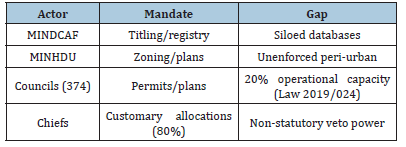
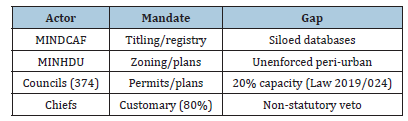
These layered rules, combined with weak implementation and parallel customary systems, produce the governance gaps analyzed empirically in this study. Table 1 below synthesizes the resulting institutional architecture across four key actors.
Table 1:Institutional mandates and coordination gaps in Cameroon land governance.
Source: Elite interviews (N=25) and legislative review.
Table 1 reveals fragmentation across four institutional layers with no unified cadastral coordination. Traditional chiefs control 80% of peri-urban allocations through non-statutory customary systems, creating de facto veto power over formal plans, while only 20% of councils possess operational capacity following Law No. 2019/024 decentralization. MINDCAF and MINHDU operate parallel, siloed systems without data-sharing, enabling double concessions-where the same parcel receives both customary allocations and statutory titles-the primary driver of approximately 70% of urban land disputes. The 2025 FAO platform seeks to establish unified cadastral systems, hybrid tenure procedures and coordinated land commissions; however, as the scholarly literature on similar reform processes in Africa warns, institutional silos are deeply path-dependent and resistant to change without strong monitoring mechanisms and inclusive stakeholder representation [9,43,39].
Methodology
This multi-site comparative case study examines Bafoussam (West hybrid, ~500,000), Douala (sprawl, ~3.5M, 60% informal), and Yaoundé (policy, ~4M), selected for contextual diversity and 47-60% informality [2].
Study area selection and justification
The study adopts a multi-site comparative design framed as a
natural experiment produced by Decree No. 92/187 (1 Sept 1992)
[5], which split the original Mifi division into four distinct divisions.
A pre-fragmentation baseline (1987 census) [49] compared with
post-1992 observations (2005, 2017 censuses; 2022-24 fieldwork)
[50,51] forms the identification strategy, allowing fragmentation
effects to be isolated from broader secular urbanization trends.
A proximity gradient uses five Hauts-Plateaux administrative
subdivisions at increasing distances from the new divisional capital,
Bafoussam (Bandjoun 12km; Bamendjou 25km; Baham 30km;
Bangou 40km; Batié 45km). Greater distance is hypothesized to
reduce infrastructure concentration and elite speculation. The
regression specification is:
Y −β0 +β1 Distance +β2 Post1992 +β3 (Distance×Post1992) + yX +ε
Where a significant β3(p<0,001) signals a fragmentationamplified distance-decay, controlling for population, market access and chieftaincy strength
Micro-scale variation across sites ensures representativeness on ecological (highland Bafoussam ≈1,400m vs. coastal lowlands), ethnic (Bamiléké homogeneity vs. migrant hubs), governance (strong customary authority vs. bureaucratic urbanism) and informality dimensions (prevalence ≈47-60%; growth ≈3.6-4.2% per UN-Habitat 2022 [2]). Comparative cases in Bafoussam, Douala and Yaoundé extend external validity across urban form and policy contexts.
Figure 1 Establishes the multi-scale study framework anchoring fragmentation analysis in Cameroon’s West Region. The main Figure 1 highlights three archetypal sites Bafoussam (fragmentation proxy), Douala (sprawl) and Yaoundé (policy reform testbed) with the western region shaded as the primary geographic focus. An inset details the Hauts-Plateaux “natural experiment,” showing Bafoussam’s centrality, the proximity gradient (Bandjoun 12km→Batié 45km) used to test distance-decay effects (p<0.01), the post-1992 divisional boundaries, and the RN5 corridor.
Figure 1:Study area map: Cameroon and Hatus-Plateaux department detail.
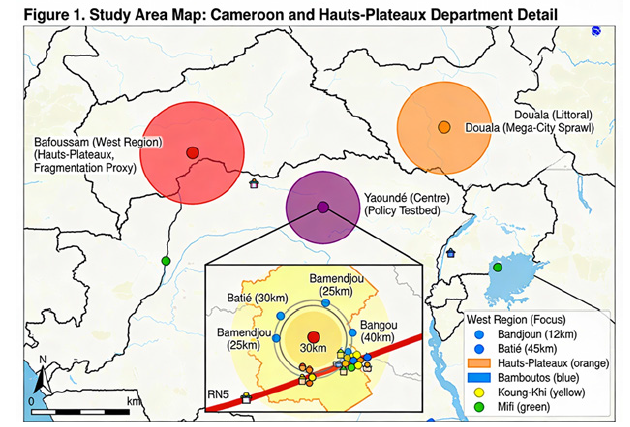
This spatial design supports rigorous causal inference across ecological, ethnic and governance contexts, while allowing findings to be related to broader national urban dynamics (see the generated image above).
Data sources and collection
Data collection used a triangulated, multi-phase design
combining fieldwork (2017-2022), targeted urban follow-up
(2024-2025), and secondary spatial and policy sources.
A. Household surveys (N=382) stratified random sampling
across five Hauts-Plateaux administrative subdivisions
(Baham, Bandjoun, Bamendjou, Bangou, Batié), disaggregated
by urban core, peri-urban, and rural zones; data captured landaccess
modes, tenure documentation, service access, and sociodemographic
characteristics; data entry conducted in CSPro
with 2% double-entry verification.
B. Interviews (N=40 total) 25 elite interviews (prefects,
mayors, traditional chiefs, MINDCAF/MINHDU delegates, and
civil society actors) and 15 follow-up interviews (2024-2025)
in Douala and Yaoundé; semi-structured, audio-recorded,
transcribed, and thematically coded in NVivo.
C. Field observation and inventories systematic transects
and GPS mapping of 1,247 structures; infrastructure inventories
documenting expansion of schools (115→235), health centers
(33→61), and markets (from dispersed stalls to 12 permanent
sites).
D. Secondary data national census and administrative
datasets (BUCREP), communal development plans, MINDCAF
records, Landsat imagery (1987-2024), OpenStreetMap
validation, and policy reports (FAO, UN-Habitat, World Bank).
Together, the 382 household surveys, 40 interviews, and spatial analyses provide a robust empirical basis for examining landtenure fragmentation and urban informality.
Analytical methods
A. Quantitative summary (R v4.2.3): Descriptive metrics
for urbanization (built-up growth, density, primacy), tenure
(documentation shares, dispute incidenc92/187 e) and
infrastructure access. Built-up/population density ratios
derived from Landsat×BUCREP flag densification (<1) vs.
sprawl (>1).
B. Logistic regressions (informality): Key fit: McFadden R2- 0.42, hosmer-Lemeshow X2=7.2
(p=0.52), classification= 78%. Significant distance-decay (β1,
p<0.01).
Key fit: McFadden R2- 0.42, hosmer-Lemeshow X2=7.2
(p=0.52), classification= 78%. Significant distance-decay (β1,
p<0.01).
C. Interrupted time series (ITS): Β3 (p<0.01) tests structural break following Decree 92/187.
D. Qualitative analysis (NVivo v12): Thematic coding
combined deductive (fragmentation, elite capture, customarystatutory
tension) and inductive codes (gendered barriers,
youth exclusion). Inter-coder κ=0.78; process tracing used to
link institutional actions to spatial outcomes.
E. Spatial analysis (ArcGIS Pro): Supervised Landsat LULC
classification (6 classes) trained on 1,247 GPS points; overall
accuracy 82-88% (Kappa 0.79-0.85). Post-classification change
detection, kernel density (2km radius) for informal clustering,
UTM Zone 32N for metric precision.
F. Integration & triangulation: Comparative case logic
(Bafoussam, Douala, Yaoundé) and cross-method checks:
survey, interview and Landsat signals converge on peri-urban
expansion and chief dominance; divergences (elite framing
vs. household reports; census undercount vs. field density)
resolved through process tracing and GIS adjustment.
Case integration and triangulation
The analysis uses a comparative logic across three archetypal sites: Bafoussam/Hauts-Plateaux as the natural-experiment core (pre/post-1992 fragmentation and proximity gradients), Douala as the mega-city sprawl proxy (highly speculative markets; ~60% informal), and Yaoundé as a policy-testbed for institutional responses.
Triangulation follows Denzin’s fourfold validation (methods,
sources, investigators, theories):
a) Methods: surveys (N=382) show ~70% informal
transactions; interviews (N=40) indicate chief dominance
(~72%); GIS kernel-density maps reveal peri-urban clustering.
Divergence elite “technical capacity” narratives vs. household
reports of speculation were reconciled through process tracing
(lobbying→infrastructure siting→land speculation).
b) Sources: BUCREP census trends, Landsat change
detection (≈88% new built-up from cropland) and policy
reports collectively confirm fragmentation and institutional
siloing; field-GIS adjustments correct official undercounts
(+22% informal adjustment).
c) Investigators: primary NVivo coding (κ=0.78) was crosschecked
with supplementary team coding (2024-25) to reduce
sampling/elite bias.
d) Theories: statistical tests show proximity effects (p<0.01)
consistent with elite-capture and distance-decay mechanisms;
qualitative evidence refines theory (e.g. gendered exclusion
women face ~2.3×greater barriers).
Together, these cross-checks convert case contrasts into coherent evidence linking administrative fragmentation, elite mechanisms and peri-urban informality, supporting transferability to similar African urban contexts.
Limitations and ethics
Study limitations include temporal cutoffs (main fieldwork ended 2022, partially mitigated by Landsat 2012-2024 and 2024-25 follow-ups), zone-varying response rates (≈70% in dense urban cores to 85% in rural areas) and access challenges that may under-represent the most precarious informal settlers. Geographic concentration in the West Region (Hauts-Plateaux/Mifi corridor; N=382 households) limits strict national generalizability, and bilingual/multilingual administration (French with local interpretation and back-translation) may have attenuated subtle customary-law nuances. Ethically, the project followed informed consent, confidentiality and non-maleficence (verbal consent for households, written for elites; anonymized reporting; avoidance of probing traumatic events), received university of Dschang ethics approval, and used participatory validation workshops with local stakeholders to correct factual issues and strengthen accountability.
Results
This section demonstrates how institutional fragmentation drives informal urbanization through longitudinal and mixedmethods evidence from Hauts-Plateaux division and comparative cases. The analysis proceeds from institutional structures (Section 4.1) to their spatial manifestations (Sections 4.2-4.3) and socioenvironmental consequences (Section 4.4).
Institutional fragmentation and jurisdictional overlaps
Figure 2:Study area map: Cameroon and Hatus-Plateaux department detail.
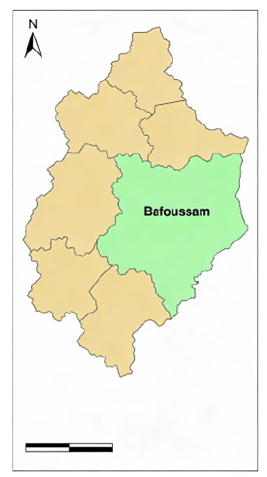
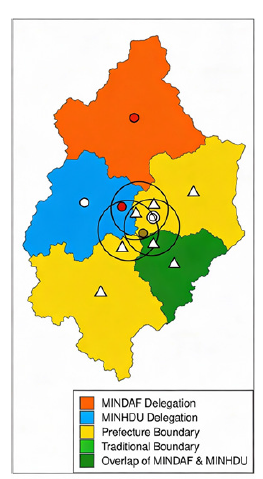
The 1992 Mifi restructuring: Administrative proliferation: Before 1992, Mifi division (3,490km²; ≈850,000 inhabitants in 1987) operated through unified governance structures centered in Bafoussam a single prefecture, coordinated cadastre, and operational divisional land commission. Figure 2 illustrates this pre-fragmentation configuration, serving as the baseline for interrupted-time analysis. Decree No. 92/187 of September 1992 subdivided Mifi into four divisions Hauts-Plateaux (Bafoussam), Bamboutos (Mbouda), Koung-Khi (Bandjoun), and a reduced Mifi proliferating administrative actors without corresponding coordination mechanisms. Figure 3 maps this post-1992 reconfiguration, highlighting how new divisional boundaries produced overlapping jurisdictions and fragmented previously unified customary territories.
Figures 2&3 illustrate the 1992 restructuring of Mifi Division (Decree No. 92/187), which transformed a formerly unified administrative system into four separate entities. Prior to the split, Mifi (3,490km²; ~850,000 inhabitants) was governed centrally from Bafoussam, allowing relatively coherent land administration. The post-1992 fragmentation into Hauts-Plateaux, Bamboutos, Koung-Khi and a reduced Mifi created overlapping jurisdictions and regulatory gaps that accelerated peri-urban expansion (3.7-4.3×growth between 1987 and 2024).
Figure 3:New departments created from Mifi split (postdecree 92/187).
The immediate institutional consequence was governance proliferation without capacity: roughly 75% of land commissions became inactive, and only ~20% of councils developed operational planning capacity [1,46]. Bafoussam’s dual status as regional capital and residual divisional seat exemplifies coordination failures when administrative boundaries cut across established chieftaincy territories. Competing MINDCAF (titling) and MINHDU (zoning) directives now operate in the absence of unified cadastral systems, creating regulatory voids exploited by informal land markets. Table 1 documents this administrative complexity, synthesizing how the 1992 reform multiplied authorities and created overlapping competencies. Elite interviews (N=25) conducted between 2017-2022 reveal that 80% of respondents report persistent jurisdictional conflicts, while only 15% judge existing coordination mechanisms functional. No national unified cadastre exists; formal land registration remains below 10% nationwide [52].
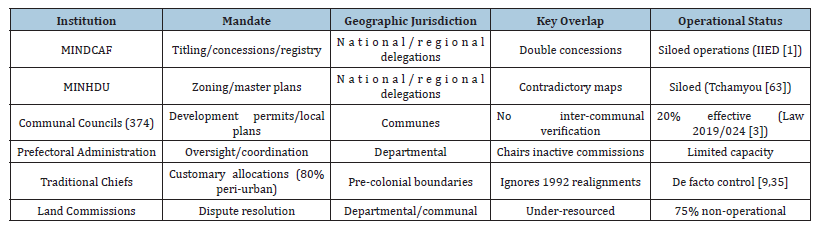
This Table 2 document the institutional multiplication following Decree No. 92/187, revealing how a single unified Mifi prefecture fragmented into four divisions with parallel authorities at national (MINDCAF, MINHDU), divisional (prefectures, delegations), communal (374 councils), and customary (traditional chiefs) levels. The result is jurisdictional overlap without coordination mechanisms approximately 75% of land commissions became inactive, only 20% of councils possess operational capacity, and no unified cadastre exists to prevent double allocations.
Table 2:Administrative and institutional fragmentation following the 1992 Reform.
Source: Legislative analysis and elite interviews (N=25, 2017-2022).
Competence fragmentation and coordination deficits: Beyond territorial proliferation, Cameroon’s land governance exhibits profound functional fragmentation across vertical and horizontal dimensions. Table 3 maps these institutional overlaps systematically, documenting six governance layers with contradictory mandates, geographic jurisdictions, and operational constraints.
Six overlapping authorities operate with contradictory geographic jurisdictions and no data-sharing protocols. MINDCAF and MINHDU maintain parallel national systems generating double concessions (same parcel allocated by both customary chiefs and statutory titles) that drive 70% of urban land disputes. Traditional chiefs exercise de facto control through pre-colonial boundaries that ignore 1992 administrative realignments, exemplifying scalar mismatches in multi-level governance. Only 25% of mandated land commissions are operational due to budget constraints, political interference, and inadequate staffing, leaving dispute resolution to customary mechanisms that reinforce gender and migrant exclusions. Vertical fragmentation persists despite Law No. 2019/024’s decentralization mandate: central ministries (MINDCAF, MINHDU) retain veto power over titling and zoning, while regional and divisional delegations lack monitoring capacity and independent budgets. Communal councils remain fiscally dependent on central transfers, with few possessing trained urban planners (interviews: Bafoussam, Bandjoun, Mbouda councils, 2018-2021).
Horizontal mismatches pit MINDCAF’s revenue-oriented titling system against MINHDU’s unenforced zoning regulations. MINDCAF prioritizes fee collection through individual title issuance, operating independently from MINHDU’s master plans. Meanwhile, traditional chiefs administer a parallel customary system controlling an estimated 80% of peri-urban land allocations operating through pre-colonial chieftaincy boundaries that ignore the 1992 administrative realignments mapped in Figure 3. This triple-track governance (MINDCAF statutory/MINHDU planning/ customary allocation) generates systemic contradictions: the same parcel may simultaneously hold customary allocation, MINDCAF concession, and violate MINHDU zoning, creating the “double concessions” and “contradictory maps” documented in Table 3. These coordination deficits shift dispute resolution into informal customary channels (Section 4.4), reinforcing gender and migrant exclusions. Women’s customary land access rates are markedly lower than men’s (Section 4.3), while migrants concentrate in precarious rental markets lacking statutory protection.
Table 3:Institutional mandates, jurisdictions, and operational Gaps.
Source: Legislative framework analysis, elite interviews (N=25), and field observations.
Spatial dynamics of informal urbanization
Having established institutional fragmentation, we now trace its spatial manifestations through urbanization acceleration, landuse conversion, and densification morphologies.
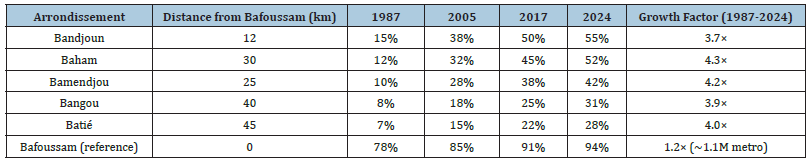
Urbanization patterns: The administrative proximity gradient: Table 4 quantifies the central empirical finding: administrative proximity to Bafoussam (the new departmental capital created in 1992) drives post-fragmentation urbanization acceleration through an infrastructure-mediated proximity gradient. This table synthesizes census baselines [49-51] with field estimates (2024), demonstrating dramatic growth differentials by distance from the administrative center.
Table 4:Urbanization dynamics by distance from Bafoussam (1987-2024).
Source: BUCREP census data (1987, 2005, 2017) [40-51] and author field estimates (2024).
Statistical evidence of the administrative proximity gradient effect arrondissements closer to Bafoussam experienced dramatic urbanization acceleration post-1992 fragmentation, with Bandjoun (12km) growing 3.7×and Baham (30km) growing 4.3×from 1987 baseline. Regression analysis confirms each 10km distance from Bafoussam correlates with 5-7 percentage points lower urbanization (β₃ interaction term, p<0.01), controlling for 1987 population, market access, and chieftaincy strength. This proximity gradient was absent in pre-1992 data, validating administrative fragmentation as causal mechanism. The effect operates through infrastructure concentration road paving prioritized departmental capital connections, electricity grid extensions followed administrative hierarchies, schools/health facilities clustered near prefectures creating focal points for elite land speculation. Bafoussam’s modest 1.2×growth reflects its already-high 1987 baseline (78%), now expanded into a metropolitan area of approximately 1.1 million including peri-urban communes.
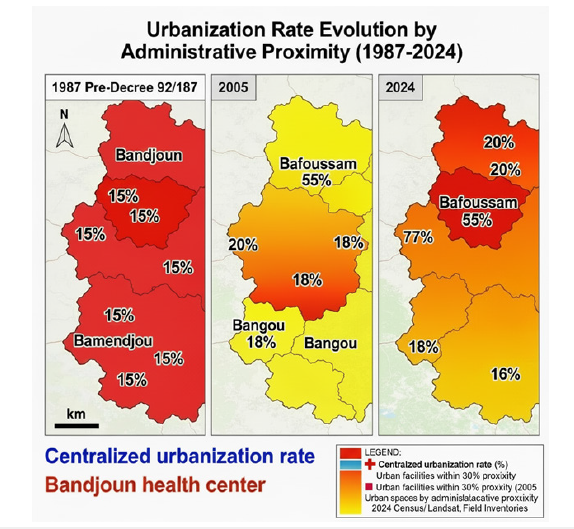
Figure 4 visualizes this proximity gradient, mapping built-up change (1987→2024) across subdivisions. The distance-decay effect from Bafoussam is evident: nearer subdivisions (Bandjoun 12km, Bamendjou 25km) show far larger built-up increases than distant divisions (Bangou 40km, Batié 45km). Regression models confirm a statistically significant post-1992 distance interaction (β₃, p<0.01), demonstrating that fragmentation amplified spatial inequality through infrastructure allocation following administrative hierarchies rather than population needs or market logic.
Figure 4:Urbanization rate evaluation by administrative proximity (1987-2024).
Infrastructure concentration mediates this process and creates
speculation hotspots. Elite interviews (N=25) and property
transaction analysis reveal how:
a. Road infrastructure: RN5 corridor upgrades prioritized
connections between Bafoussam (new departmental capital) and
other divisional seats, bypassing rural zones
b. Electricity grid: Extensions followed administrative
boundaries, leaving peripheral arrondissements under-served
c. Public facilities: Schools increased from 115 to 235 and
health centers from 33 to 61 in Hauts-Plateaux division (2017-
2022 inventories), concentrated within 15km of Bafoussam
d. Elite land speculation: Officials and businesspeople
positioned properties along predicted infrastructure corridors,
driving informal land markets documented in Section 4.3
Land-use/land-cover change: Peri-urban conversion hotspots: Table 5 quantifies environmental consequences of this fragmentation-driven urbanization through multi-temporal Landsat analysis (1980-2024). The table documents dramatic periurban land transformations concentrated in 5-15km rings around administrative centers where regulatory enforcement is weakest.
Table 5:Land use and land cover change in Hauts-plateaux (1980-2024).

Source: Landsat supervised classification (1987, 2002, 2012, 2024); overall accuracy 82-88%, validated with 1,247 GPS training points and infrastructure inventories
Built-up areas increased 146% (1980-2024) while wetlands declined 57%, threatening critical hydrological functions and amplifying seasonal flooding that now affects 35-40% of periurban residents. Most concerning is agricultural displacement 34,000 hectares of cropland converted to urban uses without compensatory agricultural intensification, jeopardizing food security as peri-urban populations increasingly depend on market purchases rather than subsistence production. Transition matrices reveal 88% of new built-up areas derived from cropland conversion (9% from forest clearing, 3% from wetland infilling), concentrated in 5-15km peri-urban rings around Bafoussam, Bandjoun, and Baham where customary-statutory jurisdictional overlaps create enforcement voids. Forest loss (-47%) includes sacred groves traditionally protected under customary systems but vulnerable when administrative boundaries fragment chieftaincy territories. Major wetland losses occurred in Baham (3,200ha), Bandjoun (2,800ha), and peri-urban Bafoussam (4,500ha) approximately 15,800 ha total wetland conversion.
Figure 5:LULC Evaluation in Hauts-Plateaux Department (1980-2024).
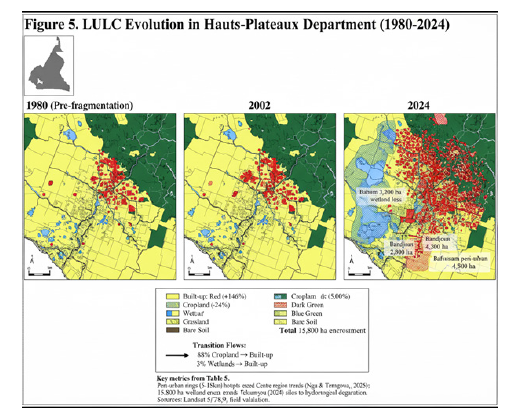
Figure 5 presents a three-date LULC status sequence (1980, 2002, 2024) for Hauts-Plateaux Department, enabling visual tracking of land-cover transitions across the pre-fragmentation baseline, the intermediate post-reform period, and the contemporary situation. Supervised Landsat classification (six classes; 1,247 GPS training points; overall accuracy 82-88%; Kappa 0.79-0.85) identifies built-up growth (+146%) and wetland loss (~15,800ha total) as the two dominant transformations, with approximately 88% of new built-up area derived from cropland conversion and 3% from direct wetland infill. The 2024 panel makes spatially explicit what Table 5 quantifies: expansion hotspots are strongly concentrated in 5-15km peri-urban rings around Bafoussam, precisely the zones of maximum institutional ambiguity where MINDCAF lacks cadastral coverage, MINHDU zoning remains unenforced, councils lack permit-verification capacity, and traditional chiefs operate allocation systems outside statutory frameworks (Table 2).
The environmental consequences of these transitions are
severe across three interconnected dimensions:
a) Hydrological degradation: The ~15,800ha of wetland
loss - most acute in peri-urban Bafoussam (4,500ha), Baham
(3,200ha) and Bandjoun (2,800ha)-has critically undermined
natural flood regulation. As a direct result, approximately 40% of
Baham and 35% of Bandjoun peri-urban residents now experience
seasonal flooding at water levels of 0.5-1.2m, disproportionately
affecting the lowest-income households settled in drainage
corridors due to their exclusion from regulated land markets.
b) Food security risks: The conversion of 34,000ha of
cropland to built-up uses-without compensatory agricultural
intensification or spatial planning for peri-urban food productionthreatens
regional food provisioning and deepens the dependence
of rapidly growing peri-urban populations on distant market supply
chains.
c) Ecosystem services and cultural heritage loss: Forest
cover declined by 47% (-14,500ha), including sacred groves that
customary systems had traditionally protected. The fragmentation
of chieftaincy territories by the 1992 administrative boundary
realignments (Figure 3) has weakened the customary enforcement
mechanisms that historically preserved these ecologically and
culturally significant areas, accelerating their conversion to
residential and agricultural uses.
Densification morphologies: Unplanned infill patterns: Unlike classic sprawl models, Hauts-Plateaux exhibits densification rather than extensive spatial expansion. Built-up/population ratios below 1.0 indicate population growth outpacing spatial footprint growth through compound subdivisions, incremental multi-story construction, and room rentals within existing parcels. Urban cores show ratios of 0.55-0.65, peri-urban zones 0.85-0.95, with variation by locality: Bandjoun 0.62, Baham 0.68, Bamendjou 0.74, Bangou 0.81, Batié 0.89.
Figure 6 illustrates morphological diversity through satellite imagery comparison (2008-2025):
Figure 6:Densinication morphologies by settement type (2008-2025 satellite comparisons).
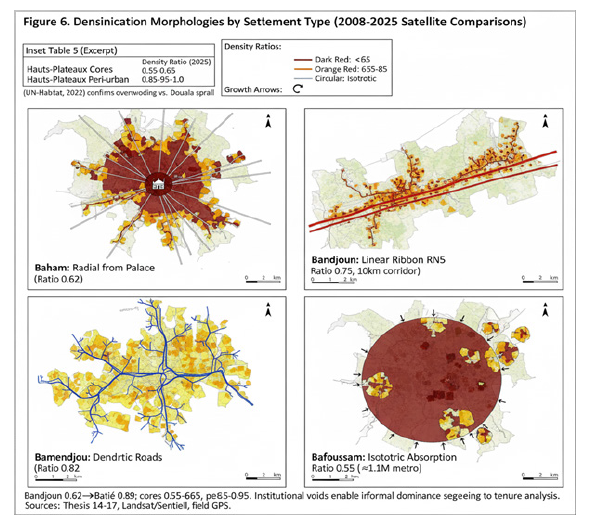
a. Radial patterns (Baham): Expansion from historic
chieftaincy center
b. Linear ribbon development (Bandjoun): Growth along
RN5 highway corridor
c. Dendritic networks (Bamendjou): Following road
infrastructure
d. Isotropic infill (Bafoussam core): Dense compound
subdivisions
These morphologies reflect transport infrastructure and customary land-parceling logic rather than planned zoning, confirming absence of effective statutory planning (Table 2: MINHDU “contradictory maps,” councils “no verification”). Densification generates overcrowding (4-6 persons/room in informal areas), infrastructure stress (15% waste collection coverage), and public health risks (cholera incidence 4×higher than formal neighborhoods).
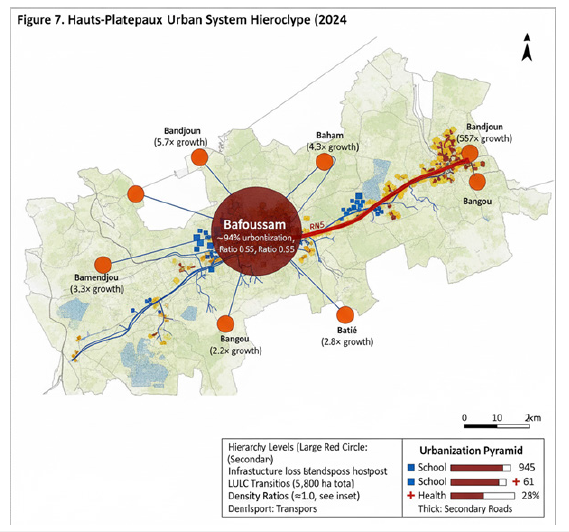
Figure 7 synthesizes the post-fragmentation urban hierarchy, showing Bafoussam’s administrative primacy, secondary growth nodes (Bandjoun, Baham), RN5 corridor linkages, and spatial concentration of infrastructure versus wetland loss. The pattern is polycentric but weakly coordinated multiple centers emerge following administrative boundaries, yet without integrated regional planning.
Figure 7:Hauts-Plateaux urban system hieroclype (2024).
Informal land management and tenure insecurity
Institutional fragmentation manifests at household level through informal land access mechanisms and tenure insecurity. Table 6 documents stark spatial differentiation in how households acquire land, revealing peri-urban zones as hybrid tenure frontiers dominated by non-statutory transactions.
Table 6:Land access modalities by spatial zone.

Source: Household surveys (N=382) stratified by urban core, peri-urban transition, and rural zones (2017-2022).
Peri-urban zones exhibit 72% customary chief allocations
and 18% speculative broker transactions, contrasting sharply
with urban cores (45% statutory titles) and rural areas (80%
inheritance-based tenure). Only 3% of peri-urban residents hold
formal MINDCAF titles, validating the “informality concentration”
hypothesis regulatory voids at administrative frontiers enable
informal land markets operating outside statutory frameworks.
Documentation status reinforces precarity: 85% of peri-urban
landholders lack written agreements, relying on verbal customary
allocations or broker “tickets” with no statutory validity. Gender and
generational inequities are pronounced: women access customary
land 2.3× less frequently than men (34% vs 78% among household
heads), relegated to rental arrangements (62% of female-headed
households) or informal sharecropping (58%). Youth (18-35 years)
comprise only 12% of landholders despite representing 60% of
the population, reflecting customary inheritance delays and chief
allocations prioritizing married males. Migrants (35% of periurban
residents, predominantly from Centre, North, and Adamawa
regions) obtain only 8% of customary allocations, relegated to
precarious broker purchases (72% of migrant landholders) where
autochthony discourses privilege “indigenous” Bamiléké families,
perpetuating spatial and social segregation. Household surveys
(N=382, stratified by urban/peri-urban/rural zones, 2017-2022)
reveal:
Acquisition mechanisms:
1. Peri-urban zones: 72% customary chief allocations, 18%
broker-mediated speculation, 7% inheritance, 3% statutory
titles
2. Urban cores: 45% statutory titles, 35% customary, 15%
inheritance, 5% brokers
3. Rural areas: 80% inheritance, 15% customary, 2%
brokers, 1% titles
Documentation status: Predominantly verbal agreements
(85% peri-urban); broker “tickets” are non-statutory instruments
lacking legal recognition; written customary allocations remain
unregistered with MINDCAF. Gender inequities: Women landholders
significantly under-represented (34% female household heads
access customary land vs 78% male heads); 62% of femaleheaded
households are renters, 58% engage in sharecropping
arrangements. Patrilineal customary norms exclude women from
direct chief allocations, routing access through male relatives (68%
of women acquire land through sons/brothers). Generational
exclusions: Youth (18-35 years) comprise only 12% of landholders
despite 60% of population. Customary systems delay inheritance
until marriage/seniority; chiefs allocate to established household
heads, excluding unmarried youth. Migrant marginalization:
Migrants (35% peri-urban residents, predominantly from Centre/
North/Adamawa regions) obtain only 8% of customary allocations.
Autochthony discourses privilege “indigenous” Bamiléké families;
migrants relegated to broker purchases (72%) or rental markets
(18%). Tenure insecurity manifestations: 28% of peri-urban
households experienced tenure challenges in preceding 5 years:
I. Boundary encroachment: 42% of disputes
II. Overlapping claims: 31% (double allocations by chiefs
and MINDCAF)
III. Eviction notices: 18%
IV. Forced demolitions: 9%
These informal practices operate in regulatory voids created by institutional fragmentation (Table 2): councils lack verification capacity to cross-check chief allocations against MINDCAF concessions; MINHDU zoning goes unenforced; land commissions are 75% non-operational. The result is parallel, contradictory land markets vulnerable to elite capture and speculation.
Land conflicts and environmental impacts
Institutional fragmentation generates dual crises: escalating
land disputes and environmental degradation.
Land conflicts and dispute resolution: Land disputes
constitute approximately 70% of civil caseloads in Bafoussam
tribunal, 65% in Douala and Yaoundé courts (judicial statistics
2020-2024). Dispute typologies reflect jurisdictional overlaps
documented in Table 2: Boundary disputes (45% of cases): Between
neighbours, often arising from unclear verbal customary allocations
or broker subdivisions lacking survey. Chiefs mediate approximately
65% through customary mechanisms; formal adjudication averages
3+ years. Overlapping authority claims (35%): Same parcel
allocated by traditional chief and subsequently titled by MINDCAF,
or covered by contradictory MINHDU zoning. Elite interviews
(N=25) confirm these “double concessions” as primary conflict
source. Eviction/demolition conflicts (20%): Municipal authorities
demolishing informal constructions on wetlands or road reserves,
often without prior notice or compensation. Outcomes: 12% receive
compensation, 8% alternative plots, 80% experience permanent
dispossession. Resolution mechanisms: Land commissions largely
non-operational (75%, per Table 2); only 8% of respondents
approached commissions, 62% sought customary mediation,
30% filed formal courts. Reasons for commission avoidance:
72% unaware commissions exist, inadequate staffing, political
interference, 88% lack operating budgets.
Environmental degradation: Wetland encroachment:
~15,800ha total loss (Table 4), concentrated in Baham (3,200ha),
Bandjoun (2,800ha), peri-urban Bafoussam (4,500ha). Informal
settlements preferentially target wetlands due to lower land costs,
weak enforcement, and desperate housing need. Consequences:
40% of Baham and 35% of Bandjoun peri-urban residents
experience seasonal flooding (0.5-1.2m water levels, September-
November), destroying property and contaminating water sources.
Slope settlements: 25-40% gradients in Bamendzi (peri-urban
Bafoussam), landslide-prone. March 2024 incident: 8 deaths, 42
dwellings destroyed following heavy rains saturating destabilized
slopes. Engineering safeguards absent; customary allocations
ignore topographic constraints. Sanitation failures: Peri-urban
areas show 15% waste collection coverage (vs 78% urban cores).
Household coping: 72% burn waste, 48% bury on-site, 18%
dispose in wetlands/streams (contributing 34% pollution). Cholera
outbreaks correlate: Douala 2023 (850 cases), Yaoundé Mvog-Ada
2024 (420 cases) in zones with 80% lacking improved toilets,
65% using unprotected wells/springs. Cropland conversion and
food security: -24% cropland extent (Table 4, -34,000ha) without
compensatory agricultural intensification. Peri-urban populations
increasingly market-dependent; local provisioning declines. Elite
interviews cite rising food prices (30-45% 2017-2024) and import
reliance.
Discussion
The empirical findings demonstrate that administrative fragmentation causally drives peri-urban informality through three interlinked mechanisms regulatory voids, elite capture, and customary-statutory disconnects producing measurable spatial, environmental, and social harms. This section synthesizes theoretical contributions, policy implications, and methodological reflections.
Fragmentation as driver of informality: Three mechanisms
The 1992 Mifi partition created a natural experiment validating
how territorial restructuring generates informal urbanization:
Mechanism 1: Regulatory Voids Administrative multiplication
(1 unified prefecture→4 divisions, Table 1) created coordination
vacuums where no authority exercises effective control. MINDCAF
and MINHDU operate parallel systems without data-sharing
(Table 2: “siloed operations,” “contradictory maps”); councils lack
verification capacity; land commissions are 75% non-operational.
These voids enable jurisdiction-shopping: developers seek
favorable rulings across multiple authorities, landholders claim
ignorance of conflicting regulations, elites exploit inter-ministerial
disputes. Evidence: 80% peri-urban transactions operate outside
statutory frameworks (Table 5: 72% customary+18% broker
speculation); 70% of urban land disputes stem from overlapping
claims (Table 2: “double concessions”); zero unified cadastre exists
nationally.
Mechanism 2: Elite Capture Fragmentation multiplies access
points for influence. Rather than coordinating with a single
unified Mifi prefecture, elites now position across four divisional
administrations, selectively engaging MINDCAF delegates,
MINHDU planners, council permits, or customary chiefs depending
on economic interests. Evidence: Infrastructure concentration
follows administrative hierarchies (Table 3: proximity gradient,
p<0.01; Figure 4), not population density or market logic, revealing
political allocation. Elite interviews (N=25) document officials and
businesspeople acquiring peri-urban parcels along predicted road
corridors before public announcement, profiting from speculative
appreciation. The proximity gradient itself urbanization declining
5-7% per 10km from Bafoussam reflects administrative capture of
infrastructure budgets.
Mechanism 3: Customary-Statutory Disconnect The 1992
boundaries ignored pre-colonial chieftaincy territories (Figure
3; Table 2: “ignores 1992 lines”). Chiefs continue allocating land
following customary boundaries, now intersecting multiple
divisions and contradicting MINDCAF/MINHDU jurisdictions.
Result: parallel tenure systems without reconciliation, enabling
double allocations (same parcel customarily allocated and
statutorily titled). Evidence: Chiefs control 80% of peri-urban
allocations (Table 5) yet operate outside statutory frameworks
(“non-statutory veto,” Table 2); 85% of peri-urban landholders lack
written documentation; overlapping claims constitute 35% of land
disputes.
Theoretical implications: These findings advance multilevel governance theory by empirically demonstrating the “decentralization paradox” devolving authority amid fragmented institutions worsens rather than improves coordination. Cameroon’s experience validates political ecology insights: administrative reforms are not neutral technical adjustments but embed power relations, favoring urban elites through infrastructure concentration and speculation opportunities. The proximity gradient (Table 3&Figure 4) provides quantitative evidence that territoriality shapes space through political allocation, not market efficiency.
Spatial and environmental implications
Fragmentation produces distinctive spatial outcomes:
Compact unplanned densification (not sprawl): Built-up/
population ratios <1.0 (Figure 6) indicate population growth
outpacing spatial expansion through compound subdivisions,
incremental multi-story construction, and room rentals.
Consequences: overcrowding (4-6 persons/room), infrastructure
stress (15% waste collection), public health risks (cholera 4×
higher). Concentrated ecological impacts: Wetland loss (-57%,
Table 4) preferentially targets peri-urban zones where enforcement
is weakest, amplifying flood risk (35-40% residents affected).
Cropland conversion (-24%, -34,000ha) without agricultural
intensification threatens food security. These environmental harms
concentrate in 5-15km peri-urban rings the same zones exhibiting
maximum jurisdictional overlap (Figure 5).
Socio-spatial exclusion: Informal tenure mechanisms reinforce inequalities. Women access customary land 2.3×less than men; youth comprise 12% of landholders despite 60% population; migrants relegated to precarious broker markets (Table 5). Fragmentation thus perpetuates marginalization through gendered, generational, and autochthonous customary norms operating in regulatory voids. Theoretical contribution: These patterns validate resilience frameworks emphasizing system-level vulnerabilities. Informal adaptations (customary allocations, broker transactions) provide short-term housing access but create long-term risks tenure insecurity, disaster exposure, infrastructure deficits that fragmentation exacerbates through coordination failures.
Hybrid governance: Pragmatic potentials and limits
Despite pathologies, customary systems demonstrate adaptive
capacity:
Strengths: Chiefs process 72% of peri-urban transactions (Table
5), resolve 65% of boundary disputes through mediation, provide
social safety nets (widows, returnees). Household surveys (N=382)
show 68% trust customary allocation more than statutory titling
(perceived as corrupt, expensive, inaccessible). Limits: Customary
systems embed exclusions patriarchal norms disadvantage women
(2.3×less access), autochthony discourses marginalize migrants
(8% allocations despite 35% population), gerontocratic structures
exclude youth (12% holders, 60% population).
Hybrid formalization pathways: Pilots offer instructive models:
A. Douala New-Bell (since 2022): Participatory mapping
validates 15,000 customary claims, introduces 30% gender/youth
quotas, and provides incremental tenure security (occupancy
certificates → provisional titles → full titles over 5-10 years).
Results: 20% informal areas upgraded without mass evictions.
B. Rwanda One-Stop Centres: Unified cadastre reduced
land disputes 60% through digitization and inter-ministerial
coordination directly addressing coordination deficits documented
in Table 2.
Design principles: (1) Formal recognition of traditional authorities with women/youth representation requirements, (2) Digital cadastre unification linking MINDCAF/MINHDU/ councils to eliminate double allocations, (3) Participatory mapping engaging communities, (4) Incremental formalization avoiding mass evictions, (5) Climate-adaptive zoning integrating wetland protection and slope restrictions. Theoretical framing: Hybrid approaches recognize legal pluralism multiple normative orders coexist requiring reconciliation rather than replacement. Effective reforms must negotiate customary-statutory interfaces, validate local practices while introduce accountability mechanisms (quotas, grievance procedures) addressing exclusions.
Policy implications and windows for reform
The empirical evidence presented in Sections 4.1-4.4 collectively points to a structural diagnosis: informality in Cameroon’s periurban zones is not primarily a product of poverty or housing market failure, but of deliberate and sustained institutional dysfunctionoverlapping mandates, absent coordination mechanisms, and elite-captured decentralization that converts regulatory ambiguity into speculative rent. This distinction carries fundamental implications for reform design. As Lund [19] and Rakodi [18] argue, interventions that treat informality as a technical titling problem-without addressing the political economy of institutional fragmentation-invariably reproduce the conditions they seek to remedy. The findings of this study affirm this warning: with 80% of peri-urban allocations controlled by traditional chiefs operating outside statutory frameworks, and only 20% of councils possessing operational planning capacity (Table 2), formalization programmes that bypass institutional reform will simply create new layers of contested claims rather than tenure security.
Institutional integration as a precondition for reform. The most direct policy implication of the jurisdictional fragmentation documented in Section 4.1 is that MINDCAF’s siloed titling function and MINHDU’s unenforced zoning authority must be brought into interoperable coordination before formalization can succeed at scale. The scholarly literature on unified land administration supports this sequencing: Deininger et al. [53] demonstrate from Ethiopia’s land certification experience, and Augustinus [54] from broader African cases, that data interoperability and inter-agency coordination reduce double allocations and dispute rates more decisively than individual titling programmes. Rwanda’s One-Stop Centre model-which achieved approximately 60% reductions in land disputes through centralized, digitized administration-offers a contextually relevant benchmark, though Kinzer [55] and Campeau [56] caution that Rwanda’s political centralization is not directly replicable in more pluralistic governance environments like Cameroon’s. The 2025 FAO multi-stakeholder platform represents a genuinely rare institutional opening-a coincidence of donor commitment, civil society mobilization following the Mvog-Ada evictions (Yaoundé, 2024), and Law No. 2019/024 implementationthat Ribot et al. [39] would recognize as a “political opportunity structure” for reform. However, as those authors also warn, such windows close quickly when elite interests reassert themselves; sustaining reform therefore requires binding inter-ministerial coordination mechanisms, not consultative platforms alone.
Decentralization reform: Completing the unfinished transfer. Section 4.1 documents what Smoke [28] and Faguet [29] term “incomplete decentralization”-the transfer of formal mandates to 374 councils without corresponding fiscal capacity, technical staff or legal authority over titling. The policy implication is not to reverse decentralization, but to complete it. This means devolving genuine titling powers to operationally ready councils, ensuring that land commission activation is financially resourced through dedicated shares of decentralization transfers rather than discretionary central allocations, and clarifying mandate boundaries to eliminate the jurisdictional ambiguities that currently enable double concessions. The literature on African decentralization consistently shows that fiscal autonomy is the binding constraint: councils that retain a share of land registration revenues develop stronger incentives to formalize transactions and maintain registries [57,58]. The specific operational parameters for such a reform - staffing targets, revenue-sharing ratios, phased implementation timelines-are detailed in Appendix B, but the scholarly principle is clear: accountability follows resources.
Hybrid formalization and the customary-statutory interface. The finding that approximately 72% of peri-urban land transactions are mediated by traditional chiefs (Section 4.3) is consistent with a large body of African land tenure literature showing that customary systems are not vestigial-they remain the primary governance mechanism for the majority of the population [15,43,20]. The policy implication is not to supplant customary tenure with statutory titling, but to build hybrid formalization pathways that recognize and document customary claims incrementally. Fernandes [23] and Durand-Lasserve & Royston [25] demonstrate that graduated tenure security-moving from community-recognized occupancy certificates through provisional titles to full freehold over a 5–10- year period-achieves higher coverage and lower displacement than direct titling programmes, precisely because it works with existing social legitimacy rather than against it. Communityled participatory mapping, of the kind piloted in Douala’s New- Bell neighbourhood, offers a scalable mechanism for validating and digitally documenting customary claims while creating the evidence base for subsequent statutory recognition. The key design requirement, as Roy [24] and Obeng-Odoom [21] emphasize, is that formalization must include enforceable gender and migrant protections-since household survey data (Section 4.3) show that women face approximately 2.3 times greater barriers to land access under existing customary and statutory systems, and migrants concentrate in the most precarious, eviction-prone rental markets.
Climate-adaptive governance and the wetland crisis: The documentation of ~15,800ha of wetland loss in Section 4.2-concentrated in zones of maximum institutional ambiguityconnects directly to the resilience and political ecology frameworks outlined in Section 2.2. Parnell and Pieterse [33] argue that urban climate vulnerability in African cities is fundamentally a governance problem: wetland encroachment occurs not because residents are unaware of flood risk, but because the poorest households are systematically excluded from regulated land markets and forced into hazard-exposed peri-urban drainage zones. The implication is that designating the documented loss areas as no-build zones, while necessary, is insufficient without simultaneous provision of affordable alternative land in accessible, infrastructure-served locations-otherwise prohibition simply displaces the most vulnerable populations further into risk. Strategic densification along existing transport corridors and infrastructure hubs, supported by expedited permitting for multi-story construction, offers a spatial planning complement that reduces pressure on ecologically sensitive zones without generating forced eviction. The detailed budget parameters and implementation phasing for these measures are set out in Appendix B.
Social inclusion as a structural reform condition: Elite capturedocumented through interview evidence in Section 4.1 and household survey data in Section 4.3- is not a peripheral concern but a central mechanism explaining why prior reform efforts have failed. Ribot et al. [39] and Benjaminsen et al. [38] demonstrate that decentralization reforms in sub-Saharan Africa systematically reproduce elite capture when accountability mechanisms are absent. The evidence from this study-that MINDCAF defends titling revenue monopoly, chiefs demand constitutional recognition without transparency obligations, and political elites benefit directly from regulatory ambiguity through land speculationconfirms this dynamic precisely. Reforms that guarantee women’s independent land rights through amendments to the 1974 Land Ordinance, enforce anti-discrimination provisions for migrants in customary allocations, and embed civil society oversight into land commission governance are therefore not supplementary social policy but structural prerequisites for making any institutional reform durable. Rwanda and Ghana’s documented precedents suggest that high-level political commitment, sequenced piloting (beginning in the West Region before national rollout), and monitoring committees with genuine investigative authority are the institutional conditions under which elite resistance can be managed rather than simply deplored [59-63].
Methodological reflections and limitations Strengths:
a) Longitudinal causal leverage: 1992 Mifi fragmentation
provides natural experiment; 37-year temporal depth (1987-2024)
enables interrupted-time analysis validating causality
b) Mixed-methods triangulation: Convergence across
household surveys (N=382), elite interviews (N=40), GIS analysis
(1,247 GPS points) validates findings-72% informal peri-urban
transactions align across data sources; proximity gradient
significant in both regression models and interview narratives
c) Spatial precision: GPS-validated Landsat classification
(accuracy 82-88%) provides robust LULC evidence (Table 4 &
Figure 5)
Limitations:
A. Geographic concentration: West Region focus limits
generalization to Anglophone regions (Northwest/Southwest),
coastal zones (Littoral), or northern savanna (Adamawa/North/
Far North) with distinct customary systems and ecological contexts
B. Temporal scope: Doctoral fieldwork concluded 2022;
supplementary 2024-2025 interviews (N=15) provide updates but
incomplete post-2022 household tracking
C. Sample size: N=382 household surveys adequate for
arrondissement-level analysis but insufficient for disaggregated
migrant/youth subgroup modelling
D. Elite sampling: Snowball recruitment (N=25) may
introduce bias toward well-connected respondents; supplemental
purposive sampling (N=15) partially mitigates but does not
eliminate
Future research priorities:
a. Longitudinal panels: Track households through reform
implementation (2025-2030) for causal inference on formalization
impacts
b. Multi-site comparative:
I. Within Cameroon: Francophone West vs Anglophone
Northwest customary systems; Littoral coastal vs Adamawa
savanna ecological contexts
II. Regional comparative: Francophone Africa (Senegal,
Côte d’Ivoire, Benin), Anglophone Africa (Ghana, Nigeria, Kenya),
island SIDS (Comoros, Cabo Verde, Mauritius)
c. Household multilevel modeling: Partition variance
across individual, community, departmental, and provincial scales
to isolate fragmentation effects from other governance failures
d. Climate projection integration: Model urbanization
trajectories under 1.5-2 °C warming scenarios to anticipate future
wetland pressures and displacement risks
e. Intersectional analyses: Focused studies on:
I. Gender: Women’s land access mechanisms, resistance
strategies, impacts of legal reforms
II. Youth: Inheritance delays, informal markets, housing
cooperatives
III. Migrants: Autochthony politics, rental market dynamics,
integration pathways
f. Participatory action research: Co-design formalization
strategies with affected communities to ensure culturallyappropriate,
locally-legitimate interventions
Conclusion
This study provides causal evidence that administrative fragmentation-operationalized through the 1992 Mifi partition (Decree No. 92/187)-constitutes a primary driver of informal urbanization in Cameroon’s rapidly growing regions. Analysis combining natural experimental design, household surveys (N=382), elite interviews (N=40), and 37-year Landsat timeseries yields robust findings across institutional, spatial, and social dimensions that advance theoretical understanding while identifying urgent policy interventions.
Key empirical findings demonstrate how fragmentation multiplies authorities without coordination: MINDCAF and MINHDU operate parallel siloed systems generating “double concessions” driving 70% of urban land disputes; traditional chiefs control 80% of peri-urban allocations through pre-colonial boundaries ignoring 1992 realignments; only 20% of councils possess operational capacity; 75% of land commissions remain non-functional. The administrative proximity gradient provides quantitative evidence of elite capture-each 10km from Bafoussam correlates with 5-7% lower urbanization (p<0.01)-reflecting infrastructure concentration following political hierarchies, not population needs. Environmental consequences concentrate in governance voids: 146% built-up growth, 57% wetland loss (15,800ha), and 24% cropland conversion expose 35-40% of peri-urban residents to flooding while undermining food security. Informal tenure mechanisms reinforce exclusions: women access land 2.3×less than men; youth comprise 12% of holders despite 60% of population; migrants obtain only 8% of customary allocations.
Theoretical contributions validate three frameworks. First, the study demonstrates the “decentralization paradox”-devolving authority without coordination worsens governance outcomes, extending multi-level governance theory by showing effectiveness requires horizontal integration across ministries and diagonal negotiation with customary authorities. Second, quantifying the proximity gradient advances political ecology by operationalizing elite capture: the 5-7% urbanization differential per 10km represents capitalized value of political access. Third, findings reframe informality from individual adaptation to systemic outcome of fragmented governance, clarifying why resilience celebrating informal agency risks masking structural vulnerabilities embedded in customary systems (gender exclusion, environmental risk concentration, tenure precarity).
Priority reforms exploit Cameroon’s 2025 policy window- FAO-backed National Land Policy platform and Law No. 2019/024 implementation-through sequenced interventions: (1) Short-term (2025-2027): Establish Unified National Land Registry Agency consolidating MINDCAF/MINHDU/council databases into digital cadastre eliminating double concessions (Rwanda model achieved 60% dispute reduction); operationalize land commissions through targeted funding (5% decentralization transfers), capacitybuilding (300 trained officers), and inclusive representation (30% women, 25% youth); (2) Medium-term (2026-2030): Legislative amendments to Law No. 2019/024 clarifying mandate boundaries, devolving titling authority to operational councils with 50% revenue retention, and establishing accountability mechanisms; constitutional recognition of customary authorities within statutory frameworks subject to non-discrimination safeguards; legal reforms guaranteeing women’s independent land rights, accelerating youth inheritance, prohibiting migrant discrimination; (3) Long-term (2026-2035): Scale Douala New-Bell hybrid formalization to 100,000 households through community-led participatory mapping, incremental tenure pathways (occupancy certificates→provisional→full titles), and gender quotas (30% female allocation); climate-adaptive planning designating 15,800 ha wetlands as no-build zones with negotiated relocation and green infrastructure investment ($50M/10 years); youth land banks (10% municipal lands) and migrant integration programs.
Implementation architecture requires political commitment, adequate financing, and sequenced pilots: West Region demonstration (2025-2026, $8-10M) establishing unified cadastre and operationalized commissions; five-region expansion (2027- 2029, $40-50M) adapting to Anglophone/coastal contexts; national consolidation (2030-2035, $60-80M) achieving 80% urban coverage. Financing through domestic resources (2% decentralization transfer increase, land registration fee retention), development finance (World Bank, AfDB), climate finance (Green Climate Fund, Adaptation Fund), and innovative mechanisms (land value capture, municipal bonds) totalling $150-200M over 10 years. Success factors include presidential championing, civil society oversight preventing elite capture, performance-based incentives managing MINDCAF/MINHDU resistance, and high-visibility pilot successes building political momentum.
The stakes are existential: Cameroon’s urbanization trajectoryfrom 56% (2025) to 70% (2050) with 10 million additional urban residents-intersects with climate intensification (15-25% precipitation increase projections) threatening populations already concentrated in flood-vulnerable wetlands (35-40% exposed) and landslide-prone slopes. Continued fragmentation risks cascading crises amplifying women’s, youth’s, and migrants’ marginalization through customary systems operating in regulatory voids. Yet institutional integration is achievable within a decade through evidence-based reforms presented here. Rwanda’s One-Stop Centres, Douala’s participatory mapping, and Nairobi’s land value capture demonstrate replicable pathways. The 2025 FAO platform presents a rare opening. This study provides policymakers with causal evidence, theoretical framing, and operational blueprints for transforming fragmented governance into integrated systems producing inclusive, climate-resilient cities rather than deepening vulnerabilities. Political will, sustained investment, and accountability determine whether Cameroon’s urban future embeds justice or perpetuates exclusion.
References
- International Institute for Environment and Development (IIED) (2023) Land governance in Cameroon: Tenure insecurity, institutional fragmentation and pathways to reform. IIED, London, UK.
- United Nations Human Settlements Programme (UN-Habitat) (2022) World cities report 2022: Envisaging the future of cities. UN-Habitat, Nairobi, Kenya.
- Republic of Cameroon (2019) Law No. 2019/024 of December 24, 2019, Enacting the General Code of Decentralized Territorial Collectivities. Official Journal, Yaoundé, Cameroon.
- Nkafu Policy Institute (2021) Land governance reform in Cameroon: Challenges and opportunities. Denis & Lenora Foretia Foundation, Yaoundé, Cameroon
- Republic of Cameroon (1992) Decree No. 92/187 of September 1, 1992, Establishing New Arrondissements and Districts, Official Journal, Yaoundé, Cameroon.
- Ngang C, Besong B (2025) Administrative fragmentation and peri-urban informality in Cameroon's Hauts-Plateaux. Habitat International 148: 103-119.
- United Nations Human Settlements Programme (UN-Habitat) (2020) The challenge of local government financing in developing countries. UN-Habitat, Nairobi, Kenya.
- Kenmegne H, Tchuisseu A, Ngo Bilong F (2025) Peri-urban resilience and governance failure in Cameroonian secondary cities. Urban Studies 62(3): 541-560.
- Food and Agriculture Organization of the United Nations (2025) Cameroon launches its multi-stakeholder platform for inclusive land reform. FAO.
- World Bank (2019) Cameroon urbanization review: Harnessing urbanization for growth and poverty alleviation. World Bank Group, Washington DC, USA.
- Food and Agriculture Organization of the United Nations (2021) Land governance and the 2030 agenda. FAO.
- Cotula L (2007) Legal empowerment for local resource control: Securing local resource rights within foreign investment projects in Africa. IIED.
- Deininger K, Feder G (2009) Land registration, governance, and development: Evidence and implications for policy. The World Bank Research Observer 24(2): 233-266.
- Republic of Cameroon (1974) Ordinance No. 74-1 of July 6, 1974, Establishing the Land Tenure Regime. Official Journal/National Printing Office, Yaoundé, Cameroon.
- Lavigne Delville P (2010) Competing conceptions of customary land rights registration: Free-market vs. embedded approaches. European Journal of Development Research 22(3): 413-428.
- Benjaminsen TA, Lund C (2003) Securing land rights in Africa: An introduction. In: TA Benjaminsen, C Lund (Eds.), Securing land rights in Africa, Frank Cass, London, UK, pp: 1-7.
- Ostrom E (1990) Governing the commons: The evolution of institutions for collective action. Cambridge University Press, Cambridge, England, UK.
- Rakodi C (2006) State-society relations in land delivery in Lusaka and Dar es Salaam. International Development Planning Review 28(1): 1-33.
- Lund C (2008) Local politics and the dynamics of property in Africa. Cambridge University Press, Cambridge, England, UK.
- Payne G, Durand-Lasserve A, Rakodi C (2009) The limits of land titling and home ownership. Environment and Urbanization 21(2): 443-462.
- Obeng-Odoom F (2012) Beyond the property titling debate: The case of Kumasi, Ghana. Cityscape 14(3): 281-286.
- Kironde JML (2009) Improving land sector governance in Africa: The case of Tanzania. Workshop on land governance in support of the MDGs, World Bank, Washington DC, USA, pp: 1-37.
- Fernandes E (2011) Regularization of informal settlements in Latin America. Lincoln Institute of Land Policy.
- Roy A (2005) Urban informality: Toward an epistemology of planning. Journal of the American Planning Association 71(2): 147-158.
- Durand-Lasserve A, Royston L (2002) Holding their ground: Secure land tenure for the urban poor in developing countries, Earthscan Publications Ltd, London, UK.
- Roman-Cuesta RM, Herold M, De Sy V (2025) Multi-level governance and land-use monitoring in tropical deforestation hotspots. Global Environmental Change 87: 102-118.
- Hooghe, L, Marks G (2003) Unraveling the central state, but how? Types of multi-level governance. American Political Science Review 97(2): 233-243.
- Smoke P (2003) Decentralisation in Africa: Goals, dimensions, myths and challenges. Public Administration and Development 23(1): 7-16.
- Faguet JP (2014) Decentralization and governance. World Development 53: 2-13.
- Zoro Bi JA (2008) Decentralization and local governance in Ivory Coast. Africa and Development 33(1): 45-68.
- Syagga P (2011) Land tenure in slum upgrading projects. The East African Notebooks/The East African Review 44: 71-86.
- Tiani AM, Porro R, Tiani N (2016) Decentralization and community-based management: The Cameroon paradox. Society & Natural Resources 29(7): 834-848.
- Parnell S, Pieterse E (2010) The 'right to the city': Institutional imperatives of a developmental state. International Journal of Urban and Regional Research 34(1): 146-162.
- Fotsing JM, Tsolocto A, Mache Foukou SN (2022) Periurban dynamics and livability in Cameroon's West Region: Governance, tenure and environmental change. University of New Caledonia / University of Dschang.
- Food and Agriculture Organization of the United Nations (2025) Cameroon makes significant strides toward inclusive land governance. FAO.
- Blaikie P, Brookfield H (1987) Land degradation and society.
- Lebert T, Rohde R (2007) Land reform and the new pastoral commons in South Africa's Namaqualand. In J. de Wit & M. Zérah (Eds.), Governance of large cities in the developing world (pp. 86-103). Sage.
- Benjaminsen TA, Alinon K, Buhaug H, Buseth JT (2009) Does climate change drive land-use conflicts in the Sahel? Journal of Peace Research 49(1): 97-111.
- Ribot JC, Agrawal A, Larson AM (2006) Recentralizing while decentralizing: How national governments reappropriate forest resources. World Development 34(11): 1864-1886.
- Giovarelli R, Wamalwa B, Hannay L (2005) Land tenure, property rights, and gender: Challenges and approaches for strengthening women's land tenure and property rights. USAID.
- Daley E, Osorio M, Park CMY (2013) The gender and equity implications of land-related investments: The case of study of large-scale land acquisition in Ghana. FAO.
- Nguiffo S, Schwartz B (2012) Herakles' 13th labour? A study of SGSOC's land concession in South West Cameroon. Centre for Environment and Development (CED), Yaoundé, Cameroon.
- Cotula L, Vermeulen S, Leonard R, Keeley J (2009) Land grab or development opportunity? Agricultural investment and international land deals in Africa. FAO/IIED/IFAD.
- Mvondo SA (2006) Decentralization and community forestry in Cameroon: Solving the puzzle of boundary disputes and institutional failures. International Forestry Review 8(2): 174-184.
- Ngomba T (2015) Land title registration and customary law in Cameroon: Tensions and paradoxes. Journal of African Law, 59(2): 197-218.
- Ministry of State Property, Surveys and Land Tenure (MINDCAF) (2025) Strengthening land governance in Cameroon, MINDCAF.
- Food and Agriculture Organization of the United Nations (2012) Voluntary guidelines on the responsible governance of tenure of land, fisheries and forests in the context of national food security (FAO VGGT), FAO, Quebec City, Canada.
- Nhantumbo I, Salomão A (2010) Biofuels, land access and rural livelihoods in Mozambique. IIED, London, UK.
- Central Bureau of Censuses and Populations Studies (BUCREP) (1987) Third general population and housing census (RGPH III). BUCREP, Yaoundé, Cameroon.
- Central Bureau of Censuses and Populations Studies (BUCREP) (2005) General Census of Population and Housing (RGPH 2005). BUCREP, Yaoundé, Cameroon.
- Central Bureau of Censuses and Populations Studies (BUCREP) (2017) National Report on the State of the Population (RNEP 2017). BUCREP, Yaoundé, Cameroon.
- Sone PE (2020) Land titling and tenure security in Cameroon: Institutional barriers and reform pathways. African Journal of Land Policy and Geospatial Sciences 3(2): 1-18.
- Deininger K, Ali DA, Holden S, Zevenbergen J (2012) Rural land certification in Ethiopia: Process, initial impact, and implications for other African countries. World Development 36(10): 1786-1812.
- Augustinus C (2010) Improving urban land governance in Africa. In: Home R (Ed.), Essays in African land law. Pretoria University Law Press, pp: 141-166.
- Kinzer S (2010) A thousand hills: Rwanda's rebirth and the man who dreamed it. John Wiley & Sons, USA.
- Campeau A (2018) Rwanda's land reform: Lessons learned and transferability to sub-Saharan Africa. Canadian Journal of Development Studies 39(3): 426-441
- Bahl RW, Bird R (2008) Subnational taxes in developing countries: The way forward. Public Budgeting & Finance 28(4): 1-25.
- Yatta FP (2009) Fiscal decentralization in Africa: challenges and prospects. Karthala.
- United Nations Human Settlements Programme (UN-Habitat) (2024) Douala spatial profile (Cameroon). UN-Habitat, Nairobi, Kenya.
- World Bank (2021) Technical assistance on leveraging urban land for development in Cameroon: Overall summary note. World Bank, Washington DC, USA.
- International Institute for Environment and Development (IIED) (2020) Securing land rights in Cameroon: What hasn't worked and what should be done (IIED briefing). IIED, London, UK.
- Lund C (2011) Fragmented sovereignty: Authority and local politics in northern Ghana. Journal of Modern African Studies. 44(4): 635-659.
- Tchamyou V (2024) Institutional fragmentation and urban planning failures in Cameroon: The case of Douala's peri-urban fringe. Journal of Urban Affairs 46(1): 88-107.
© 2026 © Abel Tsolocto. This is an open access article distributed under the terms of the Creative Commons Attribution License , which permits unrestricted use, distribution, and build upon your work non-commercially.
Editor In Chief







.jpg)































Signup for Newsletter

Quick Links
 Editorial Board Registrations
 Submit your Article
 Best Paper of the Volume
 Reprints
 Refer a Friend
 Advertise With Us
Our Recent Edition

.jpg)



Top Editors




.jpg)

















.bmp)
.jpg)
.png)
.jpg)













.jpg)






.png)

.png)




.png)




Financial Support

Sponsors

Latest e-Books

Latest Video

 a Creative Commons Attribution 4.0 International License. Based on a work at www.crimsonpublishers.com.
Best viewed in
a Creative Commons Attribution 4.0 International License. Based on a work at www.crimsonpublishers.com.
Best viewed in 
 | Above IE 9.0 version