
- About Us
- Information
-

The Author ensures that the research has been conducted responsibly and ethically with adherence to all relevant regulations. read more..
- For Authors
- For Reviewer
- Manuscript Guidelines
- Membership
- Publication Ethics
-
- Journals
- Reprints
- e-Books
- Videos
- Policies
- Contact Us
 COVID-19
- Submissions



Full Text
Determinations in Nanomedicine & Nanotechnology
Iron Oxide Nanoparticles for Biomedical Applications: Synthesis Strategies, Structure-Function Insights, and the Road to Clinical Translation
Naveed Ahmad¹*, Muhammad Naeem Tabassam², Muhammad Shahbaz1 and Amir Shahzad3
1 College of Civil and Transportation Engineering, Shenzhen University, China
2 College of Physics and Optoelectronics Engineering, Shenzhen University, China
3 School of Integrated Circuits, Shenzhen University, China
*Corresponding author:Naveed Ahmad, College of Civil and Transportation Engineering, Shenzhen University, China
Submission: September 04, 2026;Published: October 02, 2026
ISSN: 2832-4439 Volume3 Issue 5
Iron Oxide Nanoparticles (IONPs) - Chiefly Magnetite (Fe₃O₄) and Maghemite (γ-Fe₂O₃) - remain among the most clinically advanced inorganic nanomaterials owing to their tunable superparamagnetism, low intrinsic toxicity relative to other metal oxides, and amenability to surface functionalization. This mini-review synthesizes current understanding of IONP synthesis routes (co-precipitation, thermal decomposition, hydrothermal, and green/biogenic methods), the structure–property relationships that govern their magnetic and catalytic behaviour, and their principal biomedical applications in drug delivery, antimicrobial therapy, Magnetic Resonance Imaging (MRI), and magnetic hyperthermia. Persistent translational bottlenecks - colloidal instability, batch-to-batch variability, and an incomplete biosafety picture at the sub-10nm scale - are critically examined. We conclude by outlining a forwardlooking research agenda centred on green-synthesized, multi-functional, stimuli-responsive IONP platforms designed to close the gap between laboratory promise and regulatory approval.
Keywords:Iron oxide nanoparticles; Magnetite; Superparamagnetism; Drug delivery; Antimicrobial resistance; Magnetic hyperthermia and Theranostics
Introduction
Nanomedicine has matured from a conceptual promise into a field with several clinically approved inorganic platforms, and iron oxide nanoparticles occupy a privileged position within it [1,2]. Their superparamagnetic behaviour below approximately 20nm allows IONPs to be magnetized only in the presence of an external field, avoiding the permanent agglomeration that limits ferromagnetic carriers, while their iron-based composition offers a biodegradation pathway that converges with the body’s native iron-handling machinery [3]. This combination has already yielded FDA- and EMA-cleared products for iron-deficiency anaemia and MRI contrast, and has driven exploratory clinical use in magnetic hyperthermia for recurrent glioblastoma [4]. Yet the same physicochemical features that make IONPs attractive-high surface-to-volume ratio, catalytic (peroxidase-mimetic) reactivity, and magnetic responsiveness-also introduce a size-and coating-dependent toxicity profile that has stalled several candidates in preclinical stages [5]. This mini-review consolidates the most recent (2022-2026) literature on IONP synthesis, characterization, and biomedical deployment, building on the comprehensive 2024 synthesis of preparation methods and biomedical applications by Meng et al. [6], with an emphasis on identifying the specific engineering gaps that a doctoral research programme is best positioned to close.
Synthesis Strategies
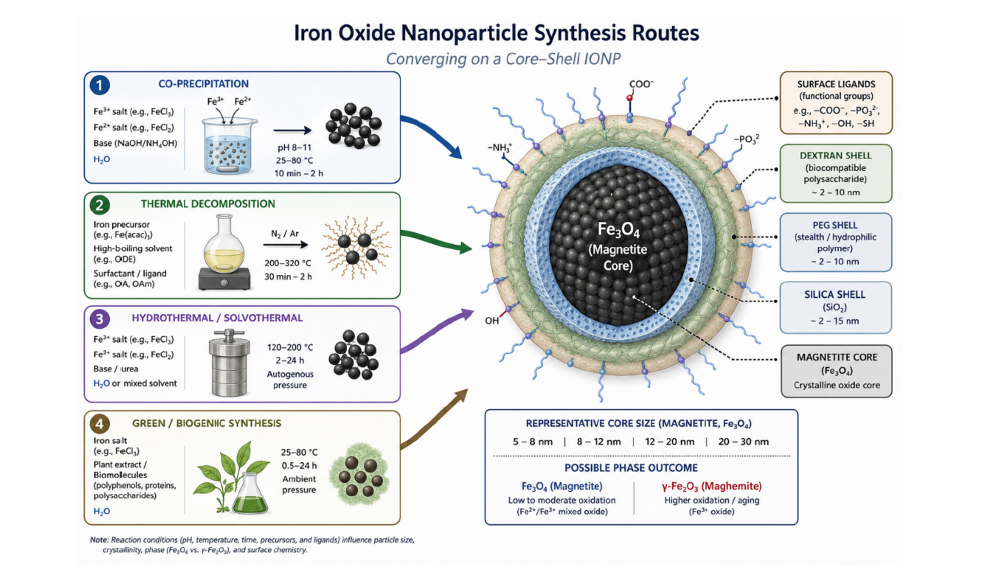
IONP synthesis routes are broadly grouped into physical, chemical (co-precipitation, thermal decomposition, hydrothermal/ solvothermal, sol-gel, sonochemical) and biological (green/biogenic) methods, each imposing a distinct trade-off between size control, crystallinity, scalability, and biocompatibility [3,7]. Co-precipitation of Fe²⁺/Fe³⁺ salts under alkaline conditions remains the most widely used route for biomedical IONPs because it is aqueous, lowcost, and readily scaled, though it yields comparatively broad size distributions [3]. Thermal decomposition of Iron Precursors (e.g., Fe(acac)₃, Iron Oleate) in high-boiling organic solvents produces highly monodisperse, crystalline nanoparticles but requires postsynthetic ligand exchange for aqueous dispersibility [3,7]. Green synthesis using plant extracts (e.g., Eucalyptus globulus, Thevetia peruviana, Iris kashmiriana) or microbial systems has expanded rapidly since 2023, exploiting phytochemical reducing agents to yield IONPs with intrinsic antioxidant and antibacterial character while avoiding hazardous reagents [8-11], though reproducibility across plant batches remains an unresolved limitation of this route [8]. Table 1 summarizes the comparative performance of these approaches against the criteria most relevant to biomedical translation.
Table 1:Comparative overview of principal synthesis strategies for iron oxide nanoparticles.

Structure-Property Relationships and Characterization
Biomedical performance of IONPs is dictated by a small set of interlinked physicochemical parameters: core size and crystallinity (governing saturation magnetization and superparamagnetic threshold), phase purity (magnetite vs. maghemite vs. hematite, each with different magnetic and catalytic character), and surface chemistry (governing colloidal stability, protein corona formation, and circulation half-life) [2,12]. X-ray diffraction and Raman spectroscopy remain the primary tools for phase identification, FTIR and XPS for surface functional group and coating verification, TEM/ HRTEM for core morphology, and vibrating-sample magnetometry for quantifying saturation magnetization and coercivity [3,12]. A recurring finding across recent reports is that IONPs below roughly 5nm exhibit disproportionately elevated Reactive-Oxygen-Species (ROS) generation relative to their 10-20nm counterparts, a sizedependency with direct implications for both antimicrobial efficacy and off-target toxicity [5,13].
Biomedical Applications
Drug delivery and theranostics
Surface-functionalized IONPs (dextran, PEG, silica, or polymeric shells) serve as magnetically guided carriers capable of image-guided drug delivery, combining diagnostic and therapeutic functions in a single theranostic platform [2,14]. Ligand-modified systems - folate-, dopamine/HSA-, and heparin-conjugated IONPs - have shown enhanced tumour accumulation via the enhanced permeability and retention effect and receptor-mediated targeting in preclinical models [4], although only ferumoxytolclass formulations have progressed to routine clinical use, and current approvals remain restricted to anaemia and off-label MRI indications rather than oncologic drug delivery [4]. Nanocomposite IONP architectures extend this platform further, improving dual/ multimodal MRI diagnostic accuracy and enabling exogenous- and endogenous-stimuli-triggered (pH-, redox-, or field-responsive) drug release from a single carrier [15].
Antimicrobial applications
Against the backdrop of accelerating antimicrobial resistance, IONPs have emerged as a metal-oxide alternative to conventional antibiotics, acting primarily through ROS generation, membrane disruption, and interference with bacterial iron homeostasis [5,16]. Antibacterial potency is modulated by particle size, shape, surface charge and superparamagnetism, and can be further enhanced through external magnetic-field application or doping with secondary metals (Ag, Zn, Cu) [5]. Green-synthesized IONPs from Streptomyces sp., Thevetia peruviana, and related biological sources have independently reproduced this antibacterial activity while adding antibiofilm and enzyme-inhibitory properties, suggesting a multifunctional route toward wound-care and anti-infective formulations [10,11,13]. Nonetheless, a 2025 comprehensive review notes that comparative head-to-head data against standardof- care antibiotics on multidrug-resistant clinical isolates remains scarce - precisely the translational gap this field must close [17].
Magnetic resonance imaging
As T2/T2*-weighted contrast agents, superparamagnetic IONPs (SPIONs) shorten transverse relaxation times to generate negative (dark) contrast in liver, lymph node, vascular and inflammatory imaging, and are increasingly combined with magnetic particle imaging for improved quantitative sensitivity [2,18]. Brain-targeted formulations exploiting transferrin- or RVGpeptide functionalization have extended SPION-based imaging toward blood-brain-barrier-crossing diagnostic and drug-delivery applications [19].
Magnetic hyperthermia
Under an alternating magnetic field, SPIONs dissipate heat via Néel and Brownian relaxation, enabling localized tumour ablation; this mechanism underlies the only IONP formulation (Nanotherm®) currently approved as a class III device for recurrent glioblastoma in Europe, with prostate- and pancreatic-cancer trials advancing under FDA guidance [4,20]. Specific absorption rate - the key figure of merit for heating efficiency - depends strongly on core size, size distribution and coating, and remains the principal engineering lever for improving clinical performance [20,21] (Figure 1).
Figure 1:illustrates the four principal synthesis families discussed in Section 2 and their convergence on a functionalized core-shell architecture.
Toxicity, Biosafety, and Translational Challenges
Biosafety data remain the principal rate-limiting factor for clinical translation. Ultrasmall IONPs (<5nm) have been shown to induce acute oxidative stress and hydroxyl-radical generation in multiple organs, particularly the heart, in a size- and dosedependent manner [5,22], while several formerly marketed SPION agents have been withdrawn over toxicity and hypersensitivity concerns, underscoring that biocompatibility cannot be assumed from iron’s status as an essential nutrient [18]. Coating chemistry substantially modulates this risk profile: dextran- and PEG-coated particles generally show improved biocompatibility over bare or citrate-stabilized cores, and antioxidant-functionalized IONPs have been reported to actively mitigate oxidative injury while retaining diagnostic utility [13]. This principle extends to vascular safety specifically: hydroxyethyl starch-coated IONPs were recently shown to avoid cytotoxicity, inflammatory activation, autophagic stress, and ferroptotic injury in human microvascular endothelial cells under both basal and inflammatory (LPS-challenged) conditions, reinforcing coating selection as a primary, tunable safety lever ahead of in vivo testing [23]. A parallel translational barrier is manufacturing reproducibility - green-synthesized batches in particular show extract-to-extract variability in size, yield and surface chemistry that complicates regulatory characterization [9,17].
Future Perspective
Three converging research directions are, in our assessment, best positioned to move IONPs from bench to bedside over the next research cycle.
1. Standardized green synthesis: systematic, statistically
designed studies correlating specific phytochemical classes
(not merely plant species) with resulting IONP size, phase
purity, and antimicrobial potency, to convert an empirically
reproducible but mechanistically opaque route into a
controllable one [8,10].
2. Multidrug-resistance-targeted antimicrobial platforms:
head-to-head evaluation of doped and green-synthesized
IONPs against clinical multidrug-resistant isolates under
standardized MIC/MBC protocols, directly addressing the
comparative-data gap identified in Section 4.2 [24].
3. Stimuli-responsive theranostic integration: pH- or redoxresponsive
coatings that couple MRI/hyperthermia readout
with on-demand drug release, extending the single-modality
platforms currently in preclinical use toward genuinely closedloop
image-guided therapy [14,19].
Pursued together, these directions would directly address the two bottlenecks - reproducibility and biosafety characterization - that most reviews identify as the proximate cause of the persistent gap between IONP publication volume and clinical approval [18,24] (Figure 2) (Table 2).
Figure 2:Maps each application in Section 4 to its principal translational bottleneck discussed in Section 5, providing a visual summary of the future-perspective priorities in Section 6.
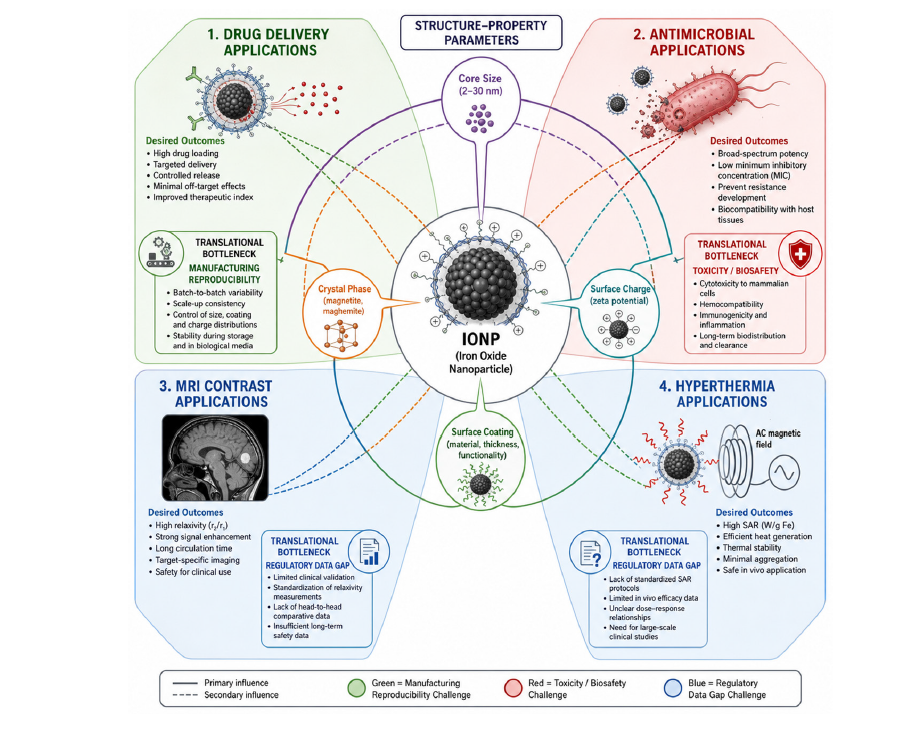
Table 2:Summary of principal biomedical applications, underlying mechanism, key advantage, and dominant translational challenge for iron oxide nanoparticles.

Conclusion
Iron oxide nanoparticles combine clinical precedent with substantial unrealized potential across drug delivery, antimicrobial therapy, MRI, and hyperthermia. The literature reviewed here indicates that further gains will come less from discovering new applications and more from disciplined engineering of existing platforms - standardizing green synthesis, generating comparative antimicrobial-resistance data, and building stimuli-responsive multifunctionality - to resolve the reproducibility and biosafety gaps that currently separate promising preclinical results from regulatory approval.
References
- Arias LS, Pessan JP, Vieira APM, Lima TMT, Delbem ACB, et al. (2018) Iron oxide nanoparticles for biomedical applications: A perspective on synthesis, drugs, antimicrobial activity, and toxicity. Antibiotics 7(2): 46.
- Dadfar SM, Roemhild K, Drude NI, Von Stillfried S, Knüchel R, et al. (2019) Iron oxide nanoparticles: Diagnostic, therapeutic and theranostic applications. Adv Drug Deliv Rev 138: 302-325.
- Salehirozveh M, Dehghani P, Mijakovic I (2024) Synthesis, functionalization, and biomedical applications of iron oxide nanoparticles (IONPs). J Funct Biomater 15(11): 340.
- Kalber TL, Ordidge KL, Southern P, Loebinger MR, Kyrtatos PG, et al. (2016) Hyperthermia treatment of tumors by mesenchymal stem cell-delivered superparamagnetic iron oxide nanoparticles. Int J Nanomedicine 11: 1973-1983.
- Zhang TG, Miao CY (2024) Iron oxide nanoparticles as promising antibacterial agents of new generation. Nanomaterials 14(15): 1311.
- Meng YQ, Shi YN, Zhu YP, Liu YQ, Gu LW, et al. (2024) Recent trends in preparation and biomedical applications of iron oxide nanoparticles. J Nanobiotechnology 22: 24.
- Jijo H, Shamlath A, Abraham A, Xavier PAF, Chahal S, et al. (2025) Harnessing the potential of iron oxide nanoparticles: A comprehensive review on their synthesis, functionalization and pharmaceutical innovations. Next Nanotechnol 8: 100270.
- Hasan YR, Wong FWF, Ashari SE, Halim M, Mohamad R (2025) Iron oxide nanoparticles: Biosynthesis, peroxidase-like activity, and biosafety. Appl Microbiol Biotechnol 109(1): 202.
- Attea SA, Ghareeb MA, Kelany AK, Elhakim HKA, Allemailem KS, et al. (2024) Biosynthesis of iron oxide nanoparticles by marine Streptomyces sp. SMGL39 with antibiofilm activity: In vitro and in silico study. Molecules 29(19): 4784.
- Rauf A, Ahmad Z, Ajaj R, Haiyuan Zhang, Muhammad Ibrahim, et al. (2025) Green synthesis: An eco-friendly route for the synthesis of iron oxide nanoparticles using aqueous extract of Thevetia peruviana and their biological activities. Sci Rep 15: 18316.
- AL-Salman HNK, Qasim QA, Abbas BA, Hussein AJ, Jabir MS (2025) Insights into the pharmaceutical properties of green fabricated iron oxide nanoparticles. Sci Rep 15: 27621.
- Lee J, Lee JH, Lee SY, Park SA, Kim JH, et al. (2023) Antioxidant iron oxide nanoparticles: their biocompatibility and bioactive properties. Int J Mol Sci 24(21): 15901.
- Wu L, Wen W, Wang X, Huang D, Cao J, et al. (2022) Ultrasmall iron oxide nanoparticles cause significant toxicity by specifically inducing acute oxidative stress to multiple organs. Part Fibre Toxicol 19(1): 24.
- Nughwal A, Bharti R, Thakur A, Monika Verma, Renu Sharma, et al. (2025) Green synthesis of iron oxide nanoparticles from Mexican prickly poppy (Argemone mexicana): Assessing antioxidant activity for potential therapeutic use. RSC Adv 15(13): 10287-10297.
- Yang Y, Liu Y, Song L, Cui X, Zhou J et al. (2023) Iron oxide nanoparticle-based nanocomposites in biomedical application. Trends Biotechnol 41(12): 1471-1487.
- Saba I, Batoo KM, Wani K, Verma R, Hameed S (2024) Exploration of metal-doped iron oxide nanoparticles as an antimicrobial agent: A comprehensive review. Cureus 16(9): e69556.
- Ghazi R, Ibrahim TK, Nasir JA, Gai S, Ali G, et al. (2025) Iron oxide based magnetic nanoparticles for hyperthermia, MRI and drug delivery applications: A review. RSC Adv 15(15): 11587-11616.
- Zhao Z, Muyao Li, Jie Zeng, Linlin Huo, Kun Liu, et al. (2021) Recent advances in engineering iron oxide nanoparticles for effective magnetic resonance imaging. Bioact Mater 12: 214-245.
- Qiao R, Changkui Fu, Helen Forgham, Ibrahim Javed, Xumin Huang, et al. (2023) Magnetic iron oxide nanoparticles for brain imaging and drug delivery. Adv Drug Deliv Rev 197: 114822.
- Pucci C, Degl'Innocenti A, Belenli Gümüş M, Ciofani G (2022) Superparamagnetic iron oxide nanoparticles for magnetic hyperthermia: Recent advancements, molecular effects, and future directions in the omics era. Biomater Sci 10(9): 2103-2121.
- Mao Z, Li X, Wang P, Yan H (2022) Iron oxide nanoparticles for biomedical applications: An updated patent review (2015-2021). Expert Opin Ther Pat 32(9): 939-952.
- Rukhsar M, Zubair Ahmad, Abdur Rauf, Hassan Zeb, Mujeeb Ur-Rehman, et al. (2022) An overview of iron oxide (Fe3O4) nanoparticles: From synthetic strategies, characterization to antibacterial and anticancer applications. Crystals 12(12): 1809.
- Ali A, Hira Zafar, Muhammad Zia, Ihsan Ul Haq, Abdul Rehman Phull, et al. (2016) Synthesis, characterization, applications, and challenges of iron oxide nanoparticles. Nanotechnol Sci Appl 9: 49-67.
- Thrapsanioti LN, Kuskov AN, Berdiaki A, Luss AL, Vlaskina ER, et al. (2026) Tailored iron oxide nanoparticles for biomedical applications: hydroxyethyl starch coating enhances endothelial biocompatibility. Nanomedicine 71: 102880.
- Yang Y, Liu Y, Song L, Cui X, Zhou J et al. (2023) Iron oxide nanoparticle-based nanocomposites in biomedical application. Trends Biotechnol 41(12): 1471-1487.
© 2026 Naveed Ahmad. This is an open access article distributed under the terms of the Creative Commons Attribution License , which permits unrestricted use, distribution, and build upon your work non-commercially.
Editor In Chief







.jpg)































Signup for Newsletter

Quick Links
 Editorial Board Registrations
 Submit your Article
 Best Paper of the Volume
 Reprints
 Refer a Friend
 Advertise With Us
Our Recent Edition
.jpg)



Top Editors




.jpg)

















.bmp)
.jpg)
.png)
.jpg)













.jpg)






.png)

.png)




.png)




Financial Support

Sponsors

Latest e-Books

Latest Video