
- About Us
- Information
-

The Author ensures that the research has been conducted responsibly and ethically with adherence to all relevant regulations. read more..
- For Authors
- For Reviewer
- Manuscript Guidelines
- Membership
- Publication Ethics
-
- Journals
- Reprints
- e-Books
- Videos
- Policies
- Contact Us
 COVID-19
- Submissions



Full Text
Determinations in Nanomedicine & Nanotechnology
Charge Neutralization Process (CNP) as a Foundational Physical Principle of Neural Evolution and Consciousness
Pavle Vesić*
Independent researcher, Serbia
*Corresponding author:Pavle Vesić, Independent Researcher, Serbia
Submission: February 04, 2026;Published: February 19, 2026

ISSN: 2832-4439 Volume3 Issue 4
This paper proposes the Charge Neutralization Process (CNP) [1] as a foundational physical principle governing dynamic equilibrium across physical and biological scales. Rather than treating charge neutrality as a passive electrostatic consequence, CNP is formulated as an active boundary-driven stabilization process operating under continuous energetic perturbation. A minimal variational framework is introduced in which global boundary neutrality emerges as the dominant dynamical tendency of bounded systems. The formulation is extended from atomic systems to biological membranes and neural architectures. Within this framework, biological evolution is interpreted as progressive structural optimization of large-scale charge stabilization under persistent environmental forcing. Neurons [2] are proposed as evolutionary realizations of recursive stabilization architectures. Consciousness is defined as a physically necessary, globally integrated metastable equilibrium state arising in sufficiently complex recursive charge-regulating systems.
Keywords:Biological evolution; Charge; Architectures; Electromagnetic; Nuclear interactions
Introduction
Modern physics explains the stability of matter through electromagnetic and nuclear interactions. However, charge neutrality is typically treated as a resulting condition rather than as a primary organizing dynamical principle. All bounded systems-from atoms to organismsexist under continuous energetic interaction with their environment. Photons, radiation and electromagnetic fluctuations perturb internal charge distributions. Stability therefore cannot be understood as static balance; it must be understood as an active dynamical process. We propose that charge neutralization is not merely an outcome but a boundary-driven stabilization principle governing structural organization across scales. In this framework, neutrality is defined not as local charge cancellation but as preservation of global boundary equilibrium under persistent energetic forcing. In this work, global boundary neutrality is treated as the dominant dynamical tendency of bounded physical systems. This shift-from local cancellation to global stabilization-allows a unified description of atomic structure, biological membrane regulation, neural integration, evolutionary optimization and conscious awareness within a single dynamical formalism. The Charge Neutralization Process (CNP) is introduced as this universal boundary-integrated stabilization mechanism.
Variational Formulation of Boundary-Driven CNP
Let ρ (x,t) denote the local charge density within a bounded domain Ω, with boundary ∂Ω . CNP does not require local neutrality ρ(x)=0 throughout the domain. Internal charge separation and structured distributions are permitted. What CNP enforces is global boundary neutrality.
Net system charge:
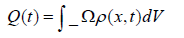
CNP requires:

Stabilization functional:

Dynamical equation:

Boundary condition:

Stability (Lyapunov functional):

Thus, in the absence of forcing, the system converges toward Q(t) → 0. Under persistent forcing, the system approaches a metastable attractor corresponding to dynamically maintained global boundary neutrality.
Cross-Scale Applicability
Atomic systems maintain external neutrality despite internal charge separation. Cellular systems regulate membrane-level perturbations through distributed charge redistribution. Multicellular systems require recursive integration of distributed imbalances. Neural networks represent high-order stabilization architectures enabling large-scale coordination of boundary equilibrium restoration. CNP thus operates continuously across scales, with increasing structural complexity enabling increasingly efficient global stabilization.
Evolution as Structural Optimization Under CNP Constraint
Biological systems exist in continuous energetic exchange with their environment. Persistent perturbation imposes physical stabilization constraints. Within the CNP framework, evolution can be interpreted as progressive reconfiguration of structural geometry Ω and optimization of stabilization parameters γ and κ , enhancing large-scale equilibrium efficiency. This description does not invoke teleology. Evolution is understood as dynamical selection operating under physical stabilization constraints. Neurons are interpreted as evolutionary realizations of recursive charge-stabilization architecture. Sensory systems function as specialized interfaces detecting boundary perturbations.
Consciousness as Boundary-Integrated Stabilization
Continuous environmental forcing generates perturbations at system boundaries. In sufficiently complex systems, recursive charge redistribution integrates boundary disturbances across the entire domain. Consciousness is defined as a globally integrated metastable stabilization state arising from recursive restoration of boundary neutrality under persistent energetic perturbation. The term physically necessary denotes dynamical inevitability within the governing equations: given persistent boundary forcing and sufficient recursive integration capacity, the system necessarily converges toward a globally coordinated metastable equilibrium configuration. Neural electrical activity corresponds to the stabilization trajectory through which boundary neutrality is restored. We are continuously conscious because we are continuously subject to energetic boundary perturbation. Consciousness is therefore the macroscopic manifestation of recursive boundary-driven equilibrium maintenance.
Distinction from Homeostasis
Homeostasis describes biological regulation within organisms. CNP is proposed as a cross-scale physical principle operating from atomic to biological domains. Homeostasis can be interpreted as a biological realization of global boundary neutrality.
Implications
CNP provides a unified framework linking atomic neutrality, membrane regulation, neural integration, evolutionary optimization, and conscious awareness. By treating global boundary neutrality as foundational rather than derivative, structural complexity is interpreted as progressive stabilization under persistent perturbation.
Conclusion
The Charge Neutralization Process is proposed as a foundational physical principle governing dynamic equilibrium across physical and biological systems. Biological evolution may be interpreted as structural optimization under CNP constraint. Neural systems represent recursive stabilization architectures. Consciousness corresponds to a physically necessary globally integrated metastable equilibrium state arising under continuous energetic perturbation. From atomic structure to conscious awareness, stability and complexity emerge through recursive global boundary-neutrality dynamics.
References
- Pavle V (2025) Charge neutralization process (CNP) as a foundational principle of physical and biological creativity. Global Journal of Science Frontier Research: A Physics & Space Science 25(2): 35-39.
- Pavle V (2025) What is neuron? GRS Journal of Multidisciplinary Research and Studies 2(4): 9-11.
© 2026 Pavle Vesić. This is an open access article distributed under the terms of the Creative Commons Attribution License , which permits unrestricted use, distribution, and build upon your work non-commercially.
Editor In Chief






.jpg)






























Signup for Newsletter

Quick Links
 Editorial Board Registrations
 Submit your Article
 Best Paper of the Volume
 Reprints
 Refer a Friend
 Advertise With Us
Our Recent Edition
.jpg)



Top Editors




.jpg)

















.bmp)
.jpg)
.png)
.jpg)











.jpg)






.png)

.png)




.png)




Financial Support

Sponsors

Latest e-Books

Latest Video