

- About Us
- Information
-

The Author ensures that the research has been conducted responsibly and ethically with adherence to all relevant regulations. read more..
- For Authors
- For Reviewer
- Manuscript Guidelines
- Membership
- Publication Ethics
-
- Journals
- Reprints
- e-Books
- Videos
- Policies
- Contact Us
 COVID-19
- Submissions



Full Text
Degenerative Intellectual & Developmental Disabilities
How Time Heals: The 4 Stages of Transformation and Emotional Resiliency
Kathryn L Rossi*
Psychosocial Genomics Institute of the California Central Coast, USA
*Corresponding author: Psychosocial Genomics Institute of the California Central Coast, USA
Submission: January 27, 2026; Published: March 05, 2026
Volume2 Issue2 March 05, 2026
Abstract
There is an adage that says, “Time heals all things.” We are asked to accept this on faith rather than using science as a guide. We live in ever vacillating internal waves of consciousness from before birth until our last breath. These waves are facilitated by the science of time, Chronobiology [1,2], the biological rhythms underlying oscillating chains of events which recur in a regular temporal sequence and persist internally in the absence of environmental input [3]. We review how the 4-stage Creative Cycle imbedded within the Chronobiology of ultradian rhythms can effectively harness these robust biological healing rhythms. Through understanding natural chronobiological ultradian rhythms and applying the 4-Stage Creative Cycle [1,2,4-11] a balance emerges between excitation/arousal and rest/rejuvenation that can facilitate health and happiness and open new abilities for adapting, learning and developing creative zests for life. These inner states of peace and clarity allow the brain to cope more effectively with intellectual disabilities to mitigate trauma, loss and grief. When signals for arousal or rest are ignored, stress, disruption and malfunction can result making it difficult or impossible to adapt to new incoming stimuli to create effective and resilient change. Is it possible to harness time for optimal healing for transformation and emotional resiliency? The answer lies within How Time Heals.
Keywords:Insensibly working; Underlying oscillating; Nicotinamide adenine dinucleotide; Ultradian rhythms; Longevity gene
Daily and Hourly Ultradian Healing Rhythms
[12] saw evolution not only as occuring over eons of time but also noted daily and hourly opportunities for growth with each variation and adaptation leading to healing. “It may be said that natural selection is a daily and hourly scrutinizing, throughout the world, every variation, even the slightest; rejecting that which is bad, preserving and adding up all that is good; silently and insensibly working, wherever and whenever opportunity offers, at the improvement of each organic being in relation to its organic and inorganic conditions of life” [12]. Ultradian rhythms are a subset of oscillating chains of events which recur in a regular temporal sequence and persist internally in the absence of environmental input within the circadian 24-hour biological clock cycle [3]. Each robust ultradian lasts between 45 minutes to 3 hours but are typically ~90-120 minutes throughout the day and night. When creative genius, Albert Einstein, was asked how he would save the world in one hour (one ultradian rhythm), he replied, “I would spend 55 minutes defining the problem and five minutes solving it!” [13]. After this robust work of saving the world, certainly Einstein must have had a welldeserved rest for at least 20 minutes. Contained within ultradian rhythms are stages of arousal and relaxation that signal the body/mind to go to work to get something done and then have a well-deserved rest. All of this is experienced through the 4-Stage Creative Cycle, noted by [14] as the Basic-Rest-Activity Cycle. Much has been discovered post Kleitman about what underlies these cycles all the way down to quantum and genomic levels [15,16].
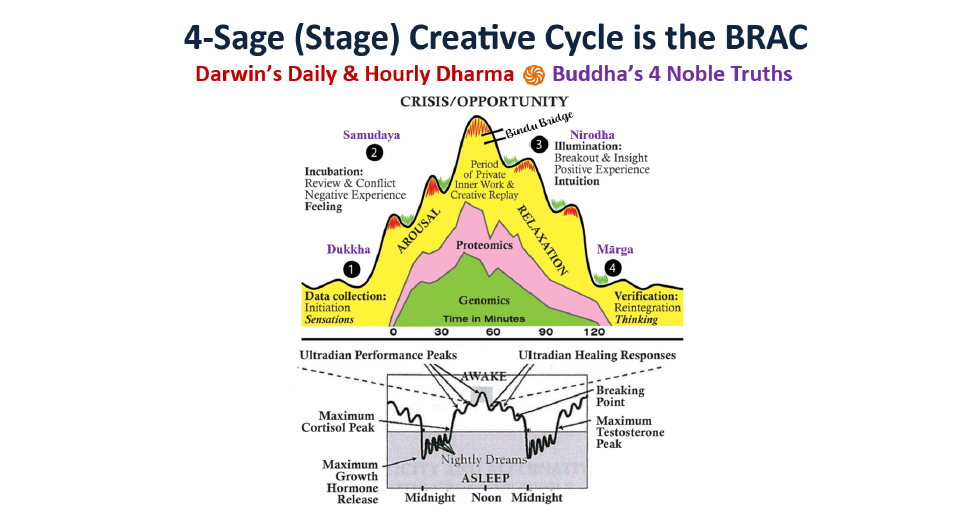
Interestingly, a set of genes spurs on longevity through metabolism. Sirtuin 1 (SIRT1), or silent information regulator sirtuin 1, is a Nicotinamide Adenine Dinucleotide (NAD+)- dependent deacetylase that acts as a key metabolic sensor regulating cellular stress, aging, inflammation and metabolism. It is often referred to as a “longevity gene” due to its role in extending lifespan, promoting DNA repair and protecting against diseases like cancer, diabetes and neurodegeneration [17]. This is one of many genes that may be turned on in the 4-Stege Creative Process. Figure 1 illustrates the wave nature of the 4-Stage (Sage) Creative cycle. During the course of each ultradian there is an arousal followed by a relaxation phase in everyday life 12 times a day, 84 times a week. Individual genes are turned on and off creating the building blocks of proteins to sustain life. All remains in homeostasis unless there is a perterbation: a spark of creativity or a stressful event. We can thank the sage mathematician, Henri Poincaré for his research to differentiate between the problem of determinism and the problem of predictability being distinct problems and distinct conditions. In his research on the three-body problem he became the first person to discover a chaotic deterministic system and subsequently Poincaré found that the evolution of such a system is often chaotic in the sense that a small perturbation in the initial state, such as a slight change in one body’s initial position, might lead to a radically different later state than would be produced by the unperturbed system [18]. It is these shifts within the 4-stage Creative Cycle that give opportunity for new learning and discoveries to become a better functioning person as a result of initial small perturbations that open opportunity to resolve physical and psychological problems. This is particularly important for those with intellectual disabilities to gain confidence to learn and overcome obstacles life sets before them.
Figure 1: ©Kathryn Rossi shows the peaks and valleys of the Ultradian cycle throughout the day and night that can be characterized by Darwin’s daily and hourly dharma. It is fascinating to learn that Charles Darwin saw evolution not only through many lifetimes but that it is daily and hourly too. A profile of the 4-stage creative process attributed to Henri Poincaré [17] as a basic paradigm of our RNA/DNA psychosocial genomic theory of mind/body stress experienced in the 90-120-minute basic-rest-activity-cycle during everyday life, sleep, dreams and psychotherapy [4,5,33,34].
The Science Underlying Ultradian Rhythms
Definition of disability
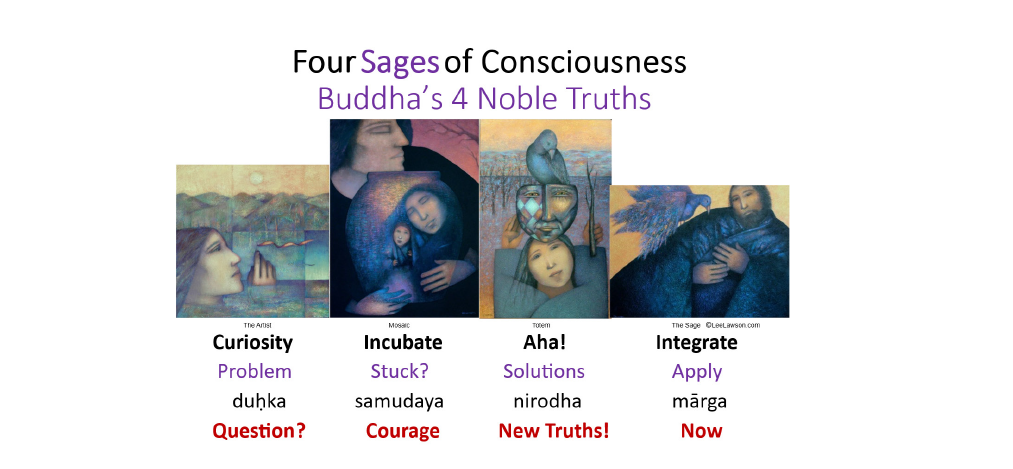
Psychosocial genomics, a branch of epigenomics, explains how nurture (memory and learning) modulates the expression of biological heredity in our DNA [7-9,18,19] within the 4-Stage Creative Cycle. Epigenomics is the natural life process that supplements the limitations of early “natural selection theory” [20]. Psychosocial genomics, in particular, is an approach to answering the Penrose quandary about natural selection and the algorithmic nature of mind [10,11,21,22]. The RNA/DNA psychosocial epigenomic research underpins the molecular loop of information transduction between mind, neurons, genomics, brain plasticity and experiences of new consciousness and cognition as occurs within each ultradian cycle initiating change and adaptivity. When genes turn on or off molecular changes happen throughout the brain and body. Initial research [23-25] found in the Mind Body Therapy Transformation study that antioxidants, anti-inflammatories and stem cells were turned on as a result of one ultradian psychotherapy session. As this genomic research continues, discoveries of many more genes have been found [26-30]. Clearly, something is happening within the physical body where the mind (thoughts) produce change. Embedded within each ultradian is the 4-Sage (Stage) Creative Cycle shown in Figure 2 that begins with (1) asking a question, (2) puzzling and reviewing the depth of the question before (3) having an insight or direction and then (4) putting this new realization into action in everyday life. Buddha, Siddhārta Guatma, who lived from 563-480 BCE, discovered how time heals within the 4 Noble Truths [31]: (1) being ill-at-ease/suffering, duḥkha (2) review the causes of suffering, samudāya (3) suffering ceases/become calm, nirodha and (4) apply these new truths to make a better life, mārga.
Figure 2: ©Kathryn Rossi. The 4 Sages (Stages) of consciousness are imbedded in Buddha’s 4 Noble Truths. Stage 1: Curiosity/problem (duhkha) asks a pertinent question. Stage 2: Being stuck and incubating on the problem (samudāya) requires courage to face fear and difficulty. Stage 3: Possible solutions, directions, the Aha! (nirodha) brings new truths! Stage 4: Integrating and applying fresh solutions (mārga) into present day life.
This is what we apply to help people to triumph over intellectual difficulties, trauma, loss and grief. It may not be the first ultradian cycle that creates a solution to the problem, but in time much can be accomplished. Each of these 4 stages and sage truths have an active time-frame action of approximately 20 minutes shown in Figure 1, although this can be shorter or longer depending on circumstance. While it might not be difficult to enjoy a 20-minute break [32-34], the arousal phase can be very painful exploring how to resolve a problem, loss, or emotional trauma. Resistance and fear may enter the equation causing a truncated experience. If a problem is not faced it cannot be solved and this avoidance can result in endless cycles of suffering and confusion. When there is an understanding that the wave nature of consciousness will not keep you in perpetual misery a newfound courage to directly face the problem for possible resolution begins. This depth of inquiry generally lasts about 20 minutes. All of us already have a lifetime of experience doing miserable things for 20 minutes at a time. Procrastination stems from fear and the anticipation of pain. It is fear we need to conquer 20 minutes at a time.
Applying the Super-Power of 20: Face your Fears and then Relax
“No one ever solved a problem without facing it.” Kathryn Rossi
The 20-minute rule is amazingly simple. The next time you
dread doing something, set a timer for 20 minutes and start working
on whatever it is you’ve been putting off. It doesn’t matter if you’re
slow at first, the important thing is that you work on your task for
just 20 minutes. Simply experience with an open mind to discover
if this is helpful and that you find some peace and resolution [35].
Could this now become your personal superpower for change
using this awareness to let your fear go and to face your problems
directly and efficiently? Today is a good day to test out how time
can heal to help you become more resilient as you transform your
life from loss, grief and trauma into peace to live a more satisfying
and resilient life.
Conclusion
Learning to apply the chronobiological sciences of ultradian rhythms, all the way from mind to gene, are imbedded in the 4-Stage Creative Cycle and can bring inner states of peace and clarity that allow the brain/body to cope more effectively with intellectual disabilities to mitigate trauma, loss and grief with newfound consciousness. When these signals for arousal or rest are ignored, then stress, disruption and malfunction can result making it difficult or impossible to adapt to new incoming stimuli for creating effective and resilient change. We can use time to naturally enhance healing 12 times a day and offering 84 chances each week to solve a problem to come to peace, clarity, transformation and emotional resiliency.
References
- UNESCO (2020) Global education monitoring report 2020: Inclusion and education-All means all. UNESCO, Paris, France.
- Fiorati RC, Elui VMC (2015) Social determinants of health, inequality and social inclusion among people with disabilities. Revista Latino-Americana De Enfermagem 23(2): 329-336.
- Walton E, McIntyre J, Awidi SJ, De Wet-Billings N, Dixon K, et al. (2020) Compounded exclusion: Education for disabled refugees in Sub-Saharan Africa. In Frontiers in Education. Frontiers Media SA 5: 7.
- Shaw A (2024) Inclusion of disabled higher education students: Why are we not there yet? International Journal of Inclusive Education 28(6): 820-838.
- Mitchell RJ, Ryder T, Matar K, Lystad RP, Williams RC, et al. (2022) An overview of systematic reviews to determine the impact of socio-environmental factors on health outcomes of people with disabilities. Health & Social Care in the Community 30(4): 1254-1274.
- Veerabathiran R, Thomas SM (2025) socioeconomic challenges faced by people with disabilities in Asia and Africa. In disability across continents: Evolving policies and cultural shifts in Asia and Africa. Singapore: Springer Nature Singapore (pp. 47-68).
- World Bank (2024) Disability Inclusion Overview.
- National Center for Education Statistics (2024) College students with disabilities: Facts and statistics.
- World Health Organization (2021) Disability and health in Asia.
- Bernick P, Takahashi T, Takahashi K (2023) Chapter 4: Overview of disability services in higher education in Japan. Handbook of Higher Education and Disability. Edward Elgar Publishing, Cheltenham, UK, Pp. 37-51.
- UNICEF (2021) Mapping of disability-Inclusive education practices in South Asia.
- Haq Z, Afaq S, Ibrahim M, Zala, Asim M (2025) Prevalence of communicable, non-communicable diseases, disabilities and related risk factors in Khyber Pakhtunkhwa Pakistan: Findings from the Khyber Pakhtunkhwa integrated population and health survey (2016-17). PloS One 20(2): e0308209.
- Hussain S, Shahzadi U, Itbar Khan (2020) Challenges to learners with disabilities in the higher education institutions in Pakistan: A Review. Research Journal of Social Sciences and Economics Review 1(3): 12-19.
- Zahid G, Khan AS, Keshf Z (2018) Services for students with disabilities at higher education of Pakistan. European Journal of Education Studies 5(5): 260-273.
- Mohsin MR, Aamir RH, Khan S (2024) Barriers to inclusion: Challenges faced by physically impaired students in higher education institutions of Bahawalpur, Pakistan. Sociological Research and Innovation 2(2): 43-60.
- Gilani N, Waheed SA, Lakhvi MZ (2020) Prevalence of disability categories in special education: A potential barrier to inclusive education and Islamic perspective. AL-Qalam 25(1): 83-95.
- Kamran M, Siddiqui S, Adil MS (2023) Breaking barriers: The influence of teachers’ attitudes on inclusive education for students with mild learning disabilities (MLDs). Education Sciences 13(6): 606.
- Kumari N (2019) Karmic philosophy and the model of disability in ancient India. Shanlax International Journal of Arts Science and Humanities 7(1): 39-43.
- Hari KC (2016) Disability discourse in South Asia and global disability governance. Canadian Journal of Disability Studies 5(4): 25-62.
- Kamenopoulou L, Dukpa D (2018) Karma and human rights: Bhutanese teachers’ perspectives on inclusion and disability. International Journal of Inclusive Education 22(3): 323-338.
- Bethge M, Von Groote P, Giustini A, Gutenbrunner C (2014) The world report on disability: A challenge for rehabilitation medicine. American Journal of Physical Medicine & Rehabilitation 93(1Suppl 1): 4-11.
- Grönvik L (2007) Defining disability: Effect of disability concept on research outcomes. International Journal of Social Research Methodology 12(1): 1-18.
- Baart J, Elbers W, Schippers A (2023) Who is disabled? On whether the functional definition of disability targets the same individuals as the subjective definition. Frontiers in Sustainability 4: 1163128.
- Ministry of education government of Pakistan (2009) National Education Policy.
- Rashid M, Fatima M, Azmat M, Mahmood T (2025) Early Childhood Education in Punjab, Pakistan: Navigating challenges and exploring solutions-A narrative review. The Critical Review of Social Sciences Studies 3(1): 2214-2228.
- Pakistan country commercial guide (2026) Education: Overview.
- US Department of Commerce (2023) Pakistan education and training services: Industry snapshot. International Trade Administration.
- Government of Pakistan (2026) Adult literacy.
- UNICEF (2026) Education: Giving every child the right to education.
- PIDE (2025) Educational exclusion of children with special needs in Pakistan.
- Schools 2030 (2023) Learning differences report: Pakistan.
- Ayub S (2022) Obstacles faced by students with disabilities in colleges due to the lack of inclusive educational frameworks in Pakistan doctoral dissertation, College of Education, Phycology and Social Work, Flinders University, Australia.
- Smith SA, Woodhead E, Newman CC (2021) Disclosing accommodation needs: Exploring experiences of higher education students with disabilities. International Journal of Inclusive Education 25(12): 1358-1374.
- Mendoza M, Heymann J (2024) Implementation of inclusive education: A systematic review of studies of inclusive education interventions in low-and lower-middle-income countries. International Journal of Disability, Development and Education 71(3): 299-316.
- UNESCO (2024) Breaking barriers in higher education for and with students with disabilities.
- Carrillo-Sierra SM, Pinzón-Ochoa M, Rangel-Pico AN, Paris-Pineda OM, Gómez Vásquez MF (2025) Perceptions of barriers to inclusion in students with disabilities in higher education institutions. Societies 15(2): 37.
- Kearney A (2009) Barriers to school inclusion: An investigation into the exclusion of disabled students from and within New Zealand schools: A thesis presented in partial fulfilment of the requirements for the degree of Doctor of Philosophy in Education at Massey University, Palmerston North, New Zealand.
- Alhusban AA, Almshaqbeh SN (2024) Delivering an inclusive built environment for physically disabled people in public universities (Jordan as a case study). Journal of Engineering, Design and Technology 22(6): 1980-1998.
- Banks J, Shevlin M, Ryan JB, Randall KN, Walters E (2025) Challenges, successes and transformative practices: An overview of a university programme for students with intellectual disabilities in Ireland. How to Create an Inclusive Post-Secondary Education Program (1st edn), p. 214.
- Lopez-Gavira R, Morina A, Morgado B (2021) Challenges to inclusive education at the university: The perspective of students and disability support service staff. Innovation: The European Journal of Social Science Research 34(3): 292-304.
- Bishop D, Rhind DJ (2011) Barriers and enablers for visually impaired students at a UK higher education institution. British Journal of Visual Impairment 29(3): 177-195.
- Torgbenu EL, Oginni OS, Opoku MP, Nketsia W, Agyei-Okyere E (2021) Inclusive education in Nigeria: Exploring parental attitude, knowledge and perceived social norms influencing implementation. International Journal of Inclusive Education 25(3): 377-393.
- Shpigelman CN, Mor S, Sachs D, Schreuer N (2022) Supporting the development of students with disabilities in higher education: Access, stigma, identity and power. Studies in Higher Education 47(9): 1776-1791.
- Sánchez-Díaz MDLN, Morgado B (2022) Moving toward the inclusion of university students with disabilities: Barriers, facilitators and recommendations identified by inclusive faculty. The Journal of Continuing Higher Education 70(3): 175-191.
- Myronova S, Dokuchyna T, Rudzevych I, Smotrova O, Platash L (2021) Current problems of teachers' readiness of higher educational institutions for implementing inclusive education. Revista Romaneasca Pentru Educatie Multidimensionala 13(3): 151-165.
- García-González JM, Gómez-Calcerrada SG, Solera Hernández E, Ríos-Aguilar S (2021) Barriers in higher education: Perceptions and discourse analysis of students with disabilities in Spain. Disability & Society 36(4): 579-595.
- Fitri A (2022) Inclusive education curriculum management with modification humanistic design. Journal of Social Studies Education Research 13(3): 150-173.
- Qu X (2022) Structural barriers to inclusive education for children with special educational needs and disabilities in China. Journal of Educational Change 23(2): 253-276.
- Waisath W, Mc Cormack M, Stek P, Heymann J (2024) Dismantling barriers and advancing disability-inclusive education: An examination of national laws and policies across 193 countries. International Journal of Inclusive Education 28(10): 2088-2103.
- Jardinez MJ, Natividad LR (2024) The advantages and challenges of inclusive education: Striving for equity in the classroom. Shanlax International Journal of Education 12(2): 57-65.
- Beyene WM, Mekonnen AT, Giannoumis GA (2023) Inclusion, access and accessibility of educational resources in higher education institutions: Exploring the Ethiopian context. International Journal of Inclusive Education 27(1): 18-34.
- Majoro NE (2021) Challenges of using sign language interpreting to facilitate teaching and learning for learners with hearing impairment. An Unpublished Doctoral dissertation, National University of Lesotho, South Africa
- Candia Roa NA, Niño Rodriguez KD (2023) Examining braille material and its support in the academic process. Enletawa Journal 16(2): 1- 31.
- Cologon K (2022) Is inclusive education really for everyone? Family stories of children and young people labelled with ‘severe and multiple’or ‘profound’‘disabilities’. Research Papers in Education 37(3): 395-417.
- Sijuola R, Davidova J (2022) Challenges of implementing inclusive education: Evidence from selected developing countries. Rural Environment Education Personality 15: 140-147.
- Almoghyrah H (2023) The challenges of implementing individualized education plans with children with Down syndrome at mainstream schools in Riyadh, Saudi Arabia: Teachers’ perspectives. International Journal of Disability, Development and Education 70(3): 291-313.
- Lopatynska N, Deka I, Dobrovolska N, Omelchenko M, Protas O (2023) The role of inclusive education in the social integration of children with special educational needs. Brazilian Journal of Education, Technology and Society 16(1): 135-142.
- Reeves P, Ng SL, Harris M, Phelan SK (2022) The exclusionary effects of inclusion today: (Re) production of disability in inclusive education settings. Disability & Society 37(4): 612-637.
- Xie Z, Zhang LF (2025) Attitudes towards inclusive education and organizational commitment: Comparing three types of teachers in Chinese inclusive education schools. Asia Pacific Journal of Education 45(2): 353-366.
- Bartolo PA, Borg M, Callus AM, De Gaetano A, Mangiafico M, et al. (2023) Aspirations and accommodations for students with disability to equitably access higher education: A systematic scoping review. Frontiers in Education 8: 1218120.
- Fuller M, Healey M, Bradley A, Hall T (2004) Barriers to learning: A systematic study of the experience of disabled students in one university. Studies in higher education 29(3): 303-318.
- Ahmad W (2012) Barriers of inclusive education for children with intellectual disability. Indian Streams Research Journal 2(2): 1-6.
- Hersh M, Mouroutsou S (2019) Learning technology and disability-Overcoming barriers to inclusion: Evidence from a multicountry study. British Journal of Educational Technology 50(6): 3329-3344.
- Lindsay S, Cagliostro E, Carafa G (2018) A systematic review of barriers and facilitators of disability disclosure and accommodations for youth in post-secondary education. International Journal of Disability, Development and Education 65(5): 526-556.
- Hendry G, Hendry A, Ige H, McGrath N (2021) I was isolated and this was difficult”: Investigating the communication barriers to inclusive further/higher education for deaf Scottish students. Deafness & Education International 23(4): 295-312.
- Salmi J, D’Addio A (2021) Policies for achieving inclusion in higher education. Policy Reviews in Higher Education 5(1): 47-72.
- Priyanka S, Samia K (2018) Barriers to inclusive education for children with special needs in schools of Jammu. The International Journal of Indian Psychology 6(1): 93-105.
- Moriña A (2022) Inclusive education in higher education: Students with disabilities’ experiences and challenges. International Journal of Educational Research 113: 101977.
- Fuller M, Healey M, Bradley A, Hall T (2023) Barriers to learning: A systematic review of disability disclosure and support in higher education. Studies in Higher Education 48(6): 1152-1171.
- Ahmed N, Malik S (2021) Social stigma and the invisibility of disability in Pakistan’s higher education institutions. Disability & Society 36(8): 1302-1320.
- Riddell S, Weedon E (2020) Disability, disclosure and inclusion in higher education: Barriers and drivers to participation. British Journal of Sociology of Education 41(7): 1001-1016.
- Toyon MAS (2021) Explanatory sequential design of mixed methods research: Phases and challenges. International Journal of Research in Business and Social Science (2147-4478) 10(5): 253-260.
- Kaehne A, O'Connell C (2010) Focus groups with people with learning disabilities. Journal of Intellectual Disabilities 14(2): 133-145.
- Kroll T, Barbour R, Harris J (2007) Using focus groups in disability research. Qualitative Health Research 17(5): 690-698.
- Krueger RA, Casey MA (2009) Focus groups: A practical guide for applied research. (2nd edn), SAGE, Thousand Oaks, California, USA.
- Custodio ZU (2025) Mind the gap: Bridging the divide between designing and implementing inclusion policies in the Philippines. Australian Journal of Asian Law 26(1): 73-88.
- Bjørnerås AB, Langørgen E, Witsø AE, Kvam L, Myhr D, et al. (2025) Disabled student ambassadors promote inclusion in Norwegian higher education: Building competencies and strategies for the future. Disability & Society 40(2): 354-378.
- Kaur R, Salian RH (2025) Teacher perspectives and barriers in implementing inclusive education for Indian children with special needs: A pilot study. British Journal of Special Education 52(1): 4-17.
- Egan R, Wilson R, Robertson M, Scandiffio J, White AR, et al. (2022) Barriers and facilitators to education experienced by students with disabilities in low-and middle-income African countries: A systematic review of qualitative evidence. JBI Evidence Synthesis 20(10): 2475-2511.
- Spiers MC, Harris M (2015) Challenges to student transition in allied health undergraduate education in the Australian rural and remote context: A synthesis of barriers and enablers. Rural and Remote Health 15(2): 3069.
- Usher K, Fagan A, Brown JA, Mather C, Marlow A, et al. (2022) The financial challenges for Australian nursing students attending placement-based work-integrated learning. Collegian 29(2): 154-160.
- Alemu A (2025) Breaking down biases: Exploring implementation of affirmative action programs in Ethiopian universities from the eyes of female students and Faculty at Madda Walabu University. High Education Policy.
- Hanreddy A (2020) Alternate curricula as a barrier to inclusive education for students with intellectual disabilities. International Electronic Journal of Elementary Education 12(3): 235-247.
- Ahmed MS, Rabiu MS, Igyuve AT (2024) Evaluating public relations strategies of ministry of education on inclusive education for people with special needs in select states of Nigeria. International Journal of Information Technology & Innovation in Africa 12(7): 65-84.
- Moswela E, Mukhopadhyay S (2025) Exploring the experience of inclusion of students with disabilities in Botswana’s institutions of higher education. Disability & Society.
© 2026 Muhammad Qasim Rana. This is an open access article distributed under the terms of the Creative Commons Attribution License , which permits unrestricted use, distribution, and build upon your work non-commercially.
Editor In Chief







.jpg)































Signup for Newsletter

Quick Links
 Editorial Board Registrations
 Submit your Article
 Best Paper of the Volume
 Reprints
 Refer a Friend
 Advertise With Us
Our Recent Edition

.jpg)



Top Editors




.jpg)

















.bmp)
.jpg)
.png)
.jpg)













.jpg)






.png)

.png)




.png)




Financial Support

Sponsors

Latest e-Books

Latest Video

 a Creative Commons Attribution 4.0 International License. Based on a work at www.crimsonpublishers.com.
Best viewed in
a Creative Commons Attribution 4.0 International License. Based on a work at www.crimsonpublishers.com.
Best viewed in 
 | Above IE 9.0 version