

- About Us
- Information
-

The Author ensures that the research has been conducted responsibly and ethically with adherence to all relevant regulations. read more..
- For Authors
- For Reviewer
- Manuscript Guidelines
- Membership
- Publication Ethics
-
- Journals
- Reprints
- e-Books
- Videos
- Policies
- Contact Us
 COVID-19
- Submissions



Full Text
Degenerative Intellectual & Developmental Disabilities
A Case of Art Therapy with LBD: Creative Neurostimulation Lowers Depression and Anxiety Levels
Irina Katz-Mazilu*
Artist, Art Therapist, France
*Corresponding author: Irina Katz- Mazilu, Artist, Art Therapist, France
Submission: December 22, 2025; Published: January 29, 2026
Volume2 Issue2 January 29, 2026
Abstract
This article presents a case of art therapy for a 78 years client with Lewy Body Disease. The selected illustrations show a spectacular progress in the client’s art therapeutic process. The empathic creativity at the core of art therapy has a powerful impact for neurostimulation. In parallel, the client experiences significantly lower levels of depression and anxiety, as well as shows better compliance to daily caregiving routine. Similar results are found in specialized literature. More implementation of art therapy and research in the field are recommended.
Keywords:Art therapy; Empathic creativity; Degenerative disease; Dementia; Lewy body disease; Depression; Anxiety; Compliance; Caregivers
Introduction
This article reports an art therapy case with a Lewy Body Disease client. The art therapy is provided at home for 6 months, on a weekly basis. The process is significant for its positive outcomes. Similar findings are showed in specialized publications on the benefit of creative and art therapeutic methods for clients with LBD and other dementia syndromes [1]. Lowering depression and anxiety levels is a main benefit improving both clients’ psychosomatic/mental status and their relationships with the professional and familial caregivers. Art therapy also proves its effectiveness for other degenerative disabilities with elder [2] and in chronic neurologic diseases [3].
Case Report
J. is a 78 years old man. He is an educated, gentle and nice person. He is living with his wife in a beautiful flat filled with books and art and could benefit of a quiet aging-but he is ill. The Lewy Body Disease progressively deprives him of his capabilities. He is more and more disorganised, depressive and anxious. He has panic attacks when his wife has to go outside, is not anymore able to stay alone at home and has difficulty to go outdoors even for an accompanied short walk…It is previsible that in a short delay it will not be possible to maintain him in a domestic environment. But his wife finds it hard to place him in a specialized home where obviously he would not find the same familiar surroundings, comfort and emotional security…I am asked to offer him art therapy sessions of one-and-a-half hour once per week. I propose a pallet of simple materials-pencils, charcoal, pastels and gouache and big paper sheets placed on an easel. I invite him to draw and paint as it comes, just moving his hands and looking at the resulting traces. He is already familiar with this work frame as a family friend who is an artist previously tried to involve him in a creative expressive activityquite unsuccessfully. He has some difficulty to start touching materials and sheets. But, little by little, offered the possibility of a free choice of materials within non-directive therapeutic management, he starts to trace something on a paper… From one session to the next one, it looks like he is gradually climbing a ladder, each step bringing more concentration, complexity in compositions, colours, forms and storytelling. He figures his favorite themes, music, nature, people walking in the city and enjoys sharing. I am talking to him and progressively he responds to my requests of explanations as a translator-interpreter of his own creating and reflexion.
The cohesion of his verbal expression greatly varies from one day to another but his wish to make art and share about it goes growing. Our relationship is empathic, in these sessions he is quiet and positive, his wife can leave while he is busy with me. She also testifies of a better compliance to daily routine in caregiving and less anxiety about being dependent. The art therapy sessions are a space-time for secure attachment. The art therapeutic process is based on the principle of the empathic creativity as the core active factor in art therapy [4]. A selection of the client’s productions created in these 6 months cure (Figure 1-6) shows a process of psychosomatic and neural stimulation visible in the growing complexity of the compositions and colors. J. talks more and more and even if his verbalizing is often difficult to decode, he is happy to share while I am listening and «feeding» the dialogue, both creative and verbal, through an authentic creative human encounter.
Discussion
Figure 1: Human figure, ink on paper, October 2014.
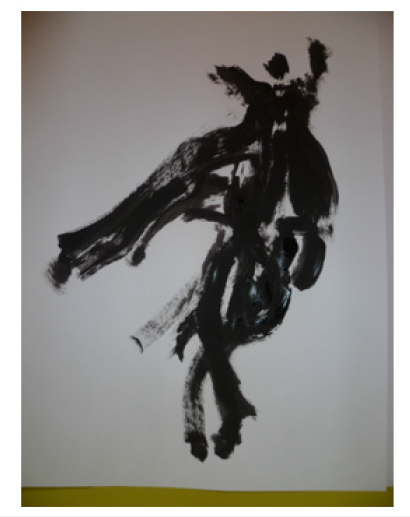
J.’s first art work is a black-and-white ink painting (Figure 1). When asked a title, J. says «someone/human figure». As for me I see a double figure, a human caring another one on his shoulders. I share this, I also share my feeling on the powerful expressivity of the created image. J. aproves, moreover he looks emotional about me «reading» in the image the signification of his dependence and need for care. As he has difficulty in verbalizing, I am building a question/answer modality of discussion, which I often use in my art therapy practice with disabled. Figure 2 shows a «landscape». J. looks satisfied about painting with gouaches, he likes colors and nuances and progressively starts using mixed techniques, charcoal and ink, charcoal and gouaches, sometimes shows me an art book or a magazine as a source of inspiration. It is relevant to point that he never uses collage in spite of me suggesting it. It is like he chooses a personal, unique way of sensual art making and not pre-existing images created by others. Meanwhile our dialogue evolves, he is speaking more and more and even if I do not always understand his words, I share my emotions with him and encourage him to make art. He is obviously eager to create in my presence and share with me. He is active, often smiling and joyful. «The Clarinette Player» (Figure 3) is a surprisingly complex figurative drawing after only 3 months of art therapy sessions. Listening to music is one of J.’s favorite hobbies and he spontaneously figures it in many of his art works.
Figure 2: Landscape, gouaches on paper, October 2014.
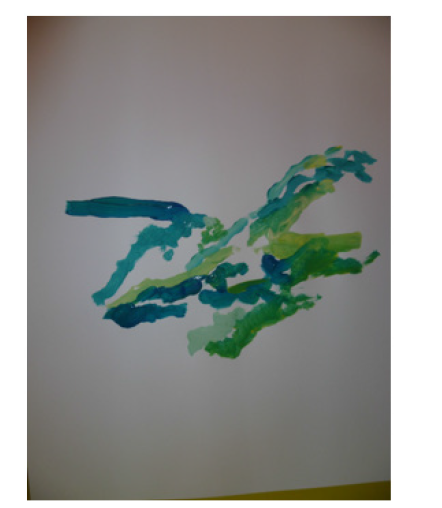
Figure 3:The clarinette player, ink on paper, January 2015.
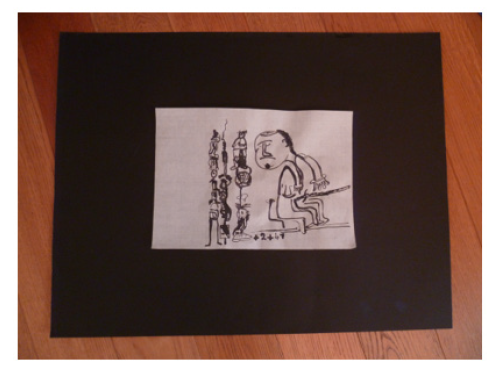
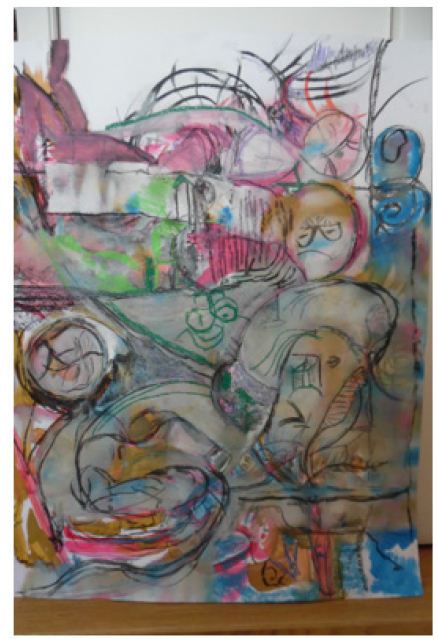
Figure 4 shows a series of colorful and joyful art works. J. talks with me trying to explain/describe every piece and is happy to have them exhibited in the living room/art therapy space for a while between sessions. He is less anxious and depressive. Figure 5 shows a complex, dynamic and balanced composition. The big (A2 format) paper sheet is entirely covered with mixed media: gouache painting with brushes, sponges and paint rollers, charcoal and ink drawing integrated to the painting. This time I proposed him a colored paper sheet and he was able to use the colored background to create a harmonic color range. Figure 6 shows another art work of this last period in our art therapy work. While he is still happy to paint and draw, unfortunately his health condition is increasingly worse. The art therapy process stops while I say good bye to J. This case shows how art therapy can improve mental well-being even for heavily impacted clients, as well as the compliance for every day care routine and the relationships with the caregivers.
Figure 4: Paintings and drawings, January 2015.
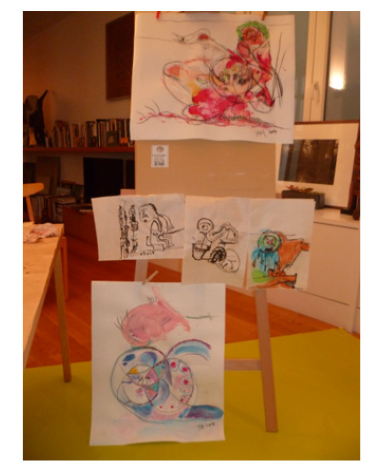
Figure 5: In the City, gouaches and charcoal on paper, May 2015.
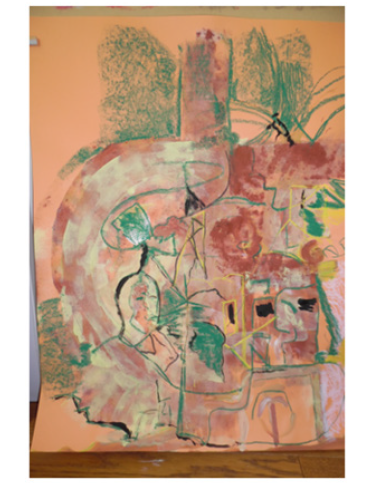
Figure 6: Human relationship? mixed media, May 2015.
Conclusion
Art therapy brings important neural stimulation and, in many cases, offers the possibility to diminish/avoid medication and its secondary effects. Recent research shows that merging medicine with art/creative complementary methods in healing and care offers interesting results for heavily dependent clients. Art therapy also improves the relationships with the caregivers, which are often at risk of burn-out and depression. Broader implementation of art therapy and more evidence-based research are needed to be helpful for clients as well as for caregivers.
References
- Benjamin R, Jeon J, Benjamin S (2025) Neuroanatomical basis of art therapy and dementia: A correlative review and implications. World Journal of Neuroscience 15: 222-239.
- Katz-Mazilu I (2023) Art therapy: A powerful lever for recovery with depression, stroke and hemiplegia. J Psychol Neurosci 5(4):1-3.
- Chardon F, Livoti M (2025) Art-thérapie moderne et maladies chroniques/Modern art therapy and chronic illnesses, Elsevier.
- Katz-Mazilu I (2025) Aesthetics and ethics in art and art therapy, Intech Open.
© 2026 LIrina Katz-Mazilu. This is an open access article distributed under the terms of the Creative Commons Attribution License , which permits unrestricted use, distribution, and build upon your work non-commercially.
Editor In Chief







.jpg)































Signup for Newsletter

Quick Links
 Editorial Board Registrations
 Submit your Article
 Best Paper of the Volume
 Reprints
 Refer a Friend
 Advertise With Us
Our Recent Edition

.jpg)



Top Editors




.jpg)

















.bmp)
.jpg)
.png)
.jpg)













.jpg)






.png)

.png)




.png)




Financial Support

Sponsors

Latest e-Books

Latest Video

 a Creative Commons Attribution 4.0 International License. Based on a work at www.crimsonpublishers.com.
Best viewed in
a Creative Commons Attribution 4.0 International License. Based on a work at www.crimsonpublishers.com.
Best viewed in 
 | Above IE 9.0 version