

- About Us
- Information
-

The Author ensures that the research has been conducted responsibly and ethically with adherence to all relevant regulations. read more..
- For Authors
- For Reviewer
- Manuscript Guidelines
- Membership
- Publication Ethics
-
- Journals
- Reprints
- e-Books
- Videos
- Policies
- Contact Us
 COVID-19
- Submissions



Full Text
Developments in Anaesthetics & Pain Management
Blood Flow Restriction Training for Pain Reduction and Functional Recovery after Sports Injury
Kishore MK1 Mohammed Sheeba Kauser2* and Tabandeh Saghar3
1 Principal, Sri Chamundeshwari College of Physiotherapy, Channapatna, Karnataka, India
2 Associate Professor, Sri Chamundeshwari College of Physiotherapy, Channapatna, Karnataka, India
3 PHD scholar, Nmims University, Mumbai, India
*Corresponding author:Mohammed Sheeba Kauser, Sri Chamundeshwari College of Physiotherapy, Channapatna, Karnataka, India
Submission:May 08, 2026;Published: July 03, 2026

ISSN: 2640-9399 Volume3 Issue1
Abstract
Background: Pain, muscle atrophy, and delayed functional recovery are common challenges following
sports injuries, often limiting early rehabilitation. Blood Flow Restriction Training (BFRT) has emerged as
a promising intervention that enables low-load exercise to produce adaptations similar to high-intensity
training, potentially reducing pain while accelerating functional recovery.
Objective: To investigate the effectiveness of Blood Flow Restriction Training in reducing pain and
improving functional outcomes in individuals undergoing rehabilitation after sports injury.
Methods: A prospective experimental study was conducted on athletes with lower-limb sports injuries.
Participants were randomly allocated into two groups: a conventional rehabilitation group (CR) and a
BFRT plus conventional rehabilitation group (BFRT+CR). The intervention was carried out for 6-8 weeks,
three sessions per week. The BFRT protocol involved low-load resistance exercises performed at 20-30%
of one-repetition maximum with controlled limb occlusion using pneumatic cuffs. Outcome measures
included pain intensity (Visual Analog Scale), muscle strength (hand-held dynamometry), limb girth,
and functional performance (single-leg hop test and sports-specific functional scale). Assessments were
conducted at baseline and post-intervention.
Results: The BFRT+CR group demonstrated significantly greater reduction in pain scores compared to
the CR group (p < 0.05). Significant improvements were observed in muscle strength, limb circumference,
and functional performance tests in the BFRT group compared to conventional rehabilitation alone.
Participants receiving BFRT also showed earlier return-to-sport readiness.
Conclusion: Blood Flow Restriction Training combined with conventional rehabilitation is an effective
and safe adjunct intervention for reducing pain, preventing muscle atrophy, and enhancing functional
recovery following sports injury. BFRT may facilitate early rehabilitation and accelerate return to sport
while minimizing mechanical stress on healing tissues.
Keywords:Blood Flow Restriction Training, Sports Injury Rehabilitation, Pain Reduction, Muscle Strength, Functional Recovery, Low-Load Resistance Training
Introduction
Sports injuries are a major concern among athletes and physically active individuals, often leading to pain, muscle atrophy, reduced strength, and prolonged absentablece from sports participation [1]. Early and effective rehabilitation is essential not only to restore physical function but also to prevent long-term disability and recurrent injuries. However, traditional rehabilitation programs frequently rely on moderate-to-high load resistance training to regain muscle strength and function, which may not be feasible during the early stages of tissue healing due to pain, surgical precautions, or risk of re-injury [2]. One of the primary challenges in sports rehabilitation is balancing tissue protection with the need to maintain muscle mass and neuromuscular function. Immobilization, reduced loading, and inactivity following injury can rapidly lead to muscle atrophy, strength loss, and impaired functional performance [3]. These deficits may delay return to sport and increase the risk of secondary complications. Therefore, rehabilitation strategies that allow safe strengthening with minimal mechanical stress on healing tissues are of great clinical interest [4]. Blood Flow Restriction Training (BFRT) has emerged as an innovative rehabilitation approach that allows individuals to perform low-load resistance exercises while achieving physiological adaptations similar to high-intensity training [5]. BFRT involves the application of a pneumatic cuff or elastic band around the proximal portion of a limb to partially restrict arterial inflow and fully restrict venous outflow during exercise. This controlled vascular occlusion creates a hypoxic environment within the working muscles, stimulating metabolic stress, muscle fiber recruitment, and anabolic hormonal responses even at low exercise intensities (20-30% of one-repetition maximum) [6]. Recent research suggests that BFRT can play a crucial role in reducing pain, preventing disuse muscle atrophy, improving muscle strength, and enhancing functional recovery after sports injuries and orthopedic surgeries [7]. The technique is particularly valuable during the early and mid-stages of rehabilitation, when high-load resistance training is contraindicated. Additionally, BFRT has been associated with improved patient tolerance to exercise, increased adherence to rehabilitation programs, and accelerated return-tosport timelines [8]. Despite growing clinical interest and emerging evidence, the integration of BFRT into routine sports rehabilitation remains limited, particularly in developing clinical settings [9]. Further research is required to evaluate its effectiveness in reducing pain and improving functional outcomes when combined with conventional rehabilitation protocols [10]. Therefore, the purpose of this study is to investigate the effectiveness of Blood Flow Restriction Training in reducing pain and improving functional recovery following sports injury [11]. The findings of this study may help inform evidence-based rehabilitation strategies and support the safe implementation of BFRT in sports physiotherapy practice [12].
Methodology
Study design
A prospective randomized controlled experimental study was conducted to evaluate the effectiveness of Blood Flow Restriction Training (BFRT) in reducing pain and improving functional recovery following sports injury.
Study setting
The study was carried out in the Department of Sports Physiotherapy and Rehabilitation at a tertiary care physiotherapy center over a period of 6–8 weeks.
Participants
A total of 30–40 athletes diagnosed with unilateral lower-limb sports injuries were recruited using convenience sampling and randomly allocated into two groups:
A. Group A: Conventional Rehabilitation (CR).
B. Group B: Blood Flow Restriction Training + Conventional
Rehabilitation (BFRT+CR).
Inclusion criteria
A. Athletes aged 18–35 years.
B. History of lower-limb sports injury (ligament, muscle, or
tendon injury) in sub-acute stage (2–6 weeks post-injury or
post-surgery).
C. Presence of pain and measurable reduction in muscle
strength.
D. Ability to follow exercise instructions and provide
informed consent.
Exclusion criteria
A. Cardiovascular or vascular disorders.
B. Uncontrolled hypertension.
C. Deep vein thrombosis or history of thrombo embolism.
D. Neurological disorders affecting lower limb function.
E. Open wounds or skin infections at cuff application site.
F. Contraindications to resistance training.
Randomization
Participants were randomly assigned to either group using a computer-generated randomization method. Allocation concealment was ensured using sealed opaque envelopes.
Intervention protocol
Group A: Conventional Rehabilitation (CR): Participants
received a standardized rehabilitation program including:
a. Range of motion exercises
b. Progressive resistance training (moderate intensity)
c. Proprioceptive and balance training
d. Functional and sport-specific exercises
Sessions were conducted 3 times per week for 6–8 weeks, each session lasting 45–60 minutes.
Group B: BFRT + conventional rehabilitation: Participants received the same conventional rehabilitation program plus Blood Flow Restriction Training.
BFRT protocol:
A. Pneumatic cuff applied to proximal thigh of injured limb
B. Occlusion pressure: 50–80% of limb occlusion pressure
(LOP)
C. Exercise intensity: 20–30% of one-repetition maximum
(1RM)
D. Exercise format: 4 sets (30-15-15-15 repetitions)
E. Rest interval: 30 seconds between sets
F. Cuff inflated during exercise and deflated after completion
Exercises performed under BFRT:
A. Quadriceps strengthening (leg extension, mini squat)
B. Hamstring strengthening (leg curl)
C. Calf raises
BFRT sessions were performed 3 times per week for 6–8 weeks under physiotherapist supervision.
Outcome measures
Assessments were performed at baseline (Week 0) and postintervention (Week 6–8).
Primary outcome
a. Pain intensity: Visual Analog Scale (VAS)
Secondary outcomes
a. Muscle strength: Hand-held dynamometer
b. Muscle girth: Circumference measurement (tape
measure)
c. Functional performance: Single-leg hop test
d. Patient-reported function: Sports-Specific Functional
Scale (SSFS)
Results
A total of 36 participants completed the study (CR = 18, BFRT+CR = 18). No adverse events related to Blood Flow Restriction Training were reported, and all participants demonstrated good adherence to the intervention protocol.
Baseline characteristics
Both groups were comparable at baseline with no statistically significant differences in age, duration of injury, pain scores, muscle strength, or functional performance (p > 0.05).
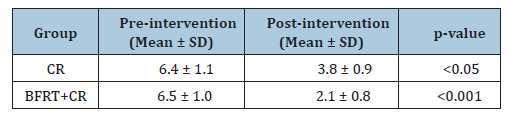
Pain intensity (VAS)
Both groups showed a reduction in pain following the intervention; however, the BFRT+CR group demonstrated significantly greater pain reduction (Table 1).
Table 1:Between-group comparison: Significant difference in post-intervention pain reduction (p < 0.01).
Muscle strength
Significant improvement in quadriceps strength was observed in both groups, with greater gains in the BFRT group (Table 2).
Table 2:Between-group difference: Statistically significant (p < 0.001).

Muscle girth
The BFRT group showed significantly greater increase in thigh circumference, indicating reduced muscle atrophy and hypertrophy (Table 3).
Table 3:Between-group comparison: Significant improvement in BFRT group (p < 0.01).

Functional performance (Single-Leg Hop Test)
Participants in the BFRT group showed superior improvement in functional performance (Table 4).
Table 4:Between-group comparison: Highly significant improvement (p < 0.001).

Sports-Specific Functional Scale (SSFS)
Patient-reported functional outcomes improved significantly in both groups, with greater improvement in the BFRT group (Table 5).
Table 5:Between-group comparison: Significant difference (p < 0.001).

Discussion
The present study investigated the effectiveness of Blood Flow Restriction Training (BFRT) combined with conventional rehabilitation in reducing pain and improving functional recovery following sports injury [12]. The findings demonstrated that participants who received BFRT alongside standard rehabilitation showed significantly greater improvements in pain reduction, muscle strength, muscle girth, and functional performance compared to those who received conventional rehabilitation alone [13]. These results support the growing evidence that BFRT is a valuable adjunct intervention during the early and mid-stages of sports injury rehabilitation [14].
Pain reduction
One of the most important findings of this study was the significant reduction in pain observed in the BFRT group. Pain often limits exercise intensity during rehabilitation, which can delay recovery and prolong return-to-sport timelines [15]. The greater reduction in pain observed in the BFRT group may be explained by several physiological mechanisms. BFRT induces metabolic stress and stimulates the release of endogenous analgesic substances, such as endorphins, which contribute to pain modulation [16]. Additionally, the low-load nature of BFRT reduces mechanical stress on healing tissues, allowing patients to perform strengthening exercises without exacerbating symptoms. Improved circulation and reduced inflammatory responses associated with BFRT may further contribute to pain relief [17].
Muscle strength and hypertrophy
Muscle weakness and atrophy are common consequences of sports injuries due to immobilization and reduced activity levels. In the present study, the BFRT group demonstrated significantly greater gains in muscle strength and thigh circumference compared to the conventional rehabilitation group [18]. These findings align with previous research suggesting that low-load resistance training combined with vascular occlusion can stimulate muscle hypertrophy similar to high-load resistance training. The hypoxic environment created during BFRT enhances recruitment of fasttwitch muscle fibers, increases growth hormone release, and activates muscle protein synthesis pathways [19]. This allows meaningful strength improvements while protecting healing tissues from excessive mechanical load [20].
Functional recovery
Functional performance, assessed through the single-leg hop test and sports-specific functional scale, improved significantly in both groups but showed superior gains in the BFRT group [21]. Functional recovery is a critical outcome in sports rehabilitation because it reflects the athlete’s readiness to return to sport [22]. Enhanced neuromuscular activation, improved muscle strength, and better movement confidence likely contributed to the superior functional outcomes observed in the BFRT group. Early restoration of functional ability may help reduce the risk of re injury and improve long-term athletic performance.
Clinical implications
The results of this study highlight the clinical value of incorporating BFRT into sports rehabilitation programs [23]. Traditional high-load resistance training is often contraindicated in the early stages of rehabilitation, creating a gap in effective strengthening strategies [24]. BFRT provides a safe and effective alternative that allows clinicians to initiate strengthening earlier without compromising tissue healing. This approach may shorten rehabilitation duration, enhance patient motivation, and facilitate earlier return to sport [25].
Limitations
Despite promising findings, several limitations should be considered. The sample size was relatively small, and the study focused only on lower-limb sports injuries. Long-term follow-up was not conducted to assess re injury rates or long-term functional outcomes. Future studies with larger sample sizes, diverse injury populations, and extended follow-up periods are recommended.
Future Directions
Further research is needed to establish standardized BFRT protocols, determine optimal occlusion pressures, and explore its effectiveness in different types of sports injuries and postoperative rehabilitation. Investigating long-term outcomes and return-tosport rates will also help strengthen the evidence base for BFRT.
References
- Lisee C, Lepley AS, Birchmeier T, O'Hagan K, Kuenze C (2019) Quadriceps strength and volitional activation after anterior cruciate ligament reconstruction: A systematic review and meta-analysis. Sports Health 11(2): 163-179.
- Ratamess N, Alvar BA, Evetoch TK, Housh TJ (2009) Progression models in resistance training for healthy adults. Med Sci Sports Exerc 41(3): 687-708.
- Schoenfeld BJ, Grgic J, Ogborn D, Krieger JW (2017) Strength and hypertrophy adaptations between low- vs. high-load resistance training: A systematic review and meta-analysis. J Strength Cond Res 31(12): 3508-3523.
- Barber-Westin S, Noyes FR (2019) Blood flow-restricted training for lower extremity muscle weakness due to knee pathology: A systematic review. Sports Health 11(1): 69-83.
- Hughes L, Paton B, Rosenblatt B, Gissane C, Patterson SD (2017) Blood flow restriction training in clinical musculoskeletal rehabilitation: A systematic review and meta-analysis. Br J Sports Med 51(13): 1003-1011.
- Hughes L, Rosenblatt B, Haddad F, Gissane C, McCarthy D, et al. (2019) Comparing the effectiveness of blood flow restriction and traditional heavy load resistance training in the post-surgery rehabilitation of anterior cruciate ligament reconstruction patients: A UK National Health Service randomised controlled trial. Sports Med 49(11): 1787-1805.
- Ferraz RB, Gualano B, Rodrigues R, Kurimori CO, Fuller R, et al. (2018) Benefits of resistance training with blood flow restriction in knee osteoarthritis. Med Sci Sports Exerc 50(5): 897-905.
- Slysz J, Stultz J, Burr JF (2016) The efficacy of blood flow restricted exercise: A systematic review & meta-analysis. J Sci Med Sport 19(8): 669-675.
- Patterson SD, Hughes L, Warmington S, Burr J, Scott BR, et al. (2019) Blood flow restriction exercise position stand: considerations of methodology, application, and safety. Front Physiol 10: 533.
- DePhillipo NN, Kennedy MI, Aman ZS, Bernhardson AS, O'Brien LT, et al. (2018) The role of blood flow restriction therapy following knee surgery: Expert opinion. Arthroscopy 34(8): 2506-2510.
- Ebell MH, Siwek J, Weiss BD, Woolf SH, Susman J, et al. (2004) Strength of Recommendation Taxonomy (SORT): A patient-centered approach to grading evidence in the medical literature. Am Fam Physician 69(3): 548-556.
- Schoenfeld BJ (2010) The mechanisms of muscle hypertrophy and their application to resistance training. J Strength Cond Res 24(10): 2857-2872.
- Pearson SJ, Hussain SR (2015) A review on the mechanisms of blood-flow restriction resistance training-induced muscle hypertrophy. Sports Med 45(2): 187-200.
- Rossi FE, Freitas MC, Zanchi NE, Lira FS, Cholewa JM (2018) The role of inflammation and immune cells in blood flow restriction training adaptation: A review. Front Physiol 9: 1376.
- Jessee MB, Mattocks KT, Buckner SL, Dankel SJ, Mouser JG, et al. (2018) Mechanisms of blood flow restriction: The new testament. Tech Orthop 33(2): 72-79.
- Lecker SH, Jagoe RT, Gilbert A, Gomes M, Baracos V, et al. (2004) Multiple types of skeletal muscle atrophy involve a common program of changes in gene expression. FASEB J 18(1): 39-51.
- Amann M (2012) Significance of group III and IV muscle afferents for the endurance exercising human. Clin Exp Pharmacol Physiol 39(9): 831-835.
- Reis JF, Fatela P, Mendonca GV, Vaz JR, Valamatos MJ, et al. (2019) Tissue oxygenation in response to different relative levels of blood-flow restricted exercise. Front Physiol 10: 407.
- Anderson AB, Owens JG, Patterson SD, Dickens JF, LeClere LE (2019) Blood flow restriction therapy: from development to applications. Sports Med Arthrosc Rev 27(3): 119-123.
- Tennent DJ, Hylden CM, Johnson AE, Burns TC, Wilken JM, et al. (2017) Blood flow restriction training after knee arthroscopy: A randomized controlled pilot study. Clin J Sport Med 27(3): 245-252.
- Iversen E, Rostad V, Larmo A (2016) Intermittent blood flow restriction does not reduce atrophy following anterior cruciate ligament reconstruction. J Sport Health Sci 5(1): 115-118.
- Loenneke JP, Wilson JM, Wilson GJ, Pujol TJ, Bemben MG (2011) Potential safety issues with blood flow restriction training. Scand J Med Sci Sports 21(4): 510-518.
- Cancio JM, Sgromolo NM, Rhee PC (2019) Blood flow restriction therapy after closed treatment of distal radius fractures. J Wrist Surg 8(4): 288-294.
- Noordin S, McEwen JA, Kragh JF, Eisen A, Masri BA (2009) Surgical tourniquets in orthopaedics. J Bone Joint Surg Am 91(12): 2958-2967.
- Laurentino GC, Loenneke JP, Teixeira EL, Nakajima E, Iared W, et al. (2016) The effect of cuff width on muscle adaptations after blood flow restriction training. Med Sci Sports Exerc 48(5): 920-925.
© 2025 Mohammed Sheeba Kauser. This is an open access article distributed under the terms of the Creative Commons Attribution License , which permits unrestricted use, distribution, and build upon your work non-commercially.
Editor In Chief







.jpg)































Signup for Newsletter

Quick Links
 Editorial Board Registrations
 Submit your Article
 Best Paper of the Volume
 Reprints
 Refer a Friend
 Advertise With Us
Our Recent Edition
.jpg)



Top Editors




.jpg)

















.bmp)
.jpg)
.png)
.jpg)













.jpg)






.png)

.png)




.png)




Financial Support

Sponsors

Latest e-Books

Latest Video

 a Creative Commons Attribution 4.0 International License. Based on a work at www.crimsonpublishers.com.
Best viewed in
a Creative Commons Attribution 4.0 International License. Based on a work at www.crimsonpublishers.com.
Best viewed in 
 | Above IE 9.0 version