

- About Us
- Information
-

The Author ensures that the research has been conducted responsibly and ethically with adherence to all relevant regulations. read more..
- For Authors
- For Reviewer
- Manuscript Guidelines
- Membership
- Publication Ethics
-
- Journals
- Reprints
- e-Books
- Videos
- Policies
- Contact Us
 COVID-19
- Submissions



Full Text
Clinical Research in Animal Science
Are Bovine Calves in India Safe from Industrial Fluoride Pollution? More Epidemiological Studies are Needed
Shanti Lal Choubisa1,2*
1Department of Advanced Science and Technology, National Institute of Medical Science and Research, NIMS University Rajasthan, Jaipur, Rajasthan 303121, India
2Former Department of Zoology, Government Meera Girls College, MLS University, Udaipur, Rajasthan 303002, India
*Corresponding author:Shanti Lal Choubisa, Department of Advanced Science and Technology, National Institute of Medical Science and Research, NIMS University Rajasthan, Jaipur, Rajasthan 303121, India
Submission: January 30, 2026;Published: February 09, 2026

ISSN: 2770-6729Volume4 - Issue 1
Opinion
Fluorine ranks seventeenth in the order of abundance in the Earth’s crust [1] and is varyingly distributed in air, sea water, freshwater, groundwater, soil, dust, and in mineral deposits of sallaite (MgF2), villiaumite (NF), fluorspar (CaF2), cryolite (Na3 Al F6), bastnaesite (CeLaY) (CO3)F, fluorapatite [Ca5 (PO4)3 F] etc., with concentrations (%) of 61, 55, 49, 45, 9, and 3.5, respectively. Fluoride concentration in the atmosphere in unpolluted areas usually varies between 0.02 and 2.0prg/m3 [2]. Atmospheric fluoride can be in gaseous or particulate forms. Most common gaseous forms include hydrogen fluoride (HF), sulphur hexafluoride (SF6), silicon tetrafluoride (SiF4), hexafluorosilic acid (H2 SiF6), and carbon tetrafluoride (CF4). Particulate forms include sodium aluminum fluoride (NaAlF3), calcium phosphate fluoride (CaFO4 P), sodium hexa fluorosilicate (F6Na2Si), aluminum fluoride (AlF2), calcium fluoride (CaF2), and lead fluoride (PbF2). However, hydrogen fluoride and inorganic fluoride particulates (sodium and calcium fluoride) are major inorganic fluorides present in the atmosphere, accounting for nearly 75 and 25%, respectively [1]. Although small amounts of fluoride are essential for dental health or the proper mineralization of developing and growing teeth, excessive fluoride intake, especially from drinking water or prolonged inhalation, is hazardous to the health of humans and animals and can lead to a serious disease called fluorosis [1,3-10].
The main source of long-term fluoride exposure for humans is drinking fluoridated water. Therefore, the World Health Organization (WHO) recommends an upper limit of fluoride of 1.5mg/L [1]. In India, the Indian Council of Medical Research (ICMR) and the Bureau of Indian Standards (BIS) have set the desirable limit of fluoride in drinking water at 1.0mg/L, with the permissible limit going up to 1.5mg/L [11,12]. However, no universally established maximum acceptable limit for air fluoride has yet been determined. Therefore, it is not possible to state the threshold at which excess fluoride in the air is harmful to human health. Generally, fluoride is naturally present in low concentrations in the air, typically ranging from 0.1 to 0.6μg/L [13]. Environmental fluoride pollution is one of the biggest health problems worldwide today because of its harmful effects on humans [14-18], animals [19-22] and agricultural crops or plants [23-26]. In most cases, fluoride is primarily released into the atmosphere by human activities. Natural sources such as volcanic eruptions, rock dust, and marine environments contribute only slightly to the global atmospheric emissions of this compound [27-29]. Major anthropogenic sources for industrial fluoride pollution include coal-fired brick kilns and thermal power plants, zinc and aluminum smelters, phosphate fertilizer factories, and industrial activities such as tile, pottery, and cement works, ceramic industries, and glass manufacturing [30]. Due to government regulations, most fluoride emitters have recently been equipped with effective filters. But in India, no special attention is still paid to controlling such industrial fluoride pollution. That is why the owners of most of the factories spreading fluoride pollution are still careless about it. However, atmospheric fluoride compounds emissions remain a problem all over the world [31]. Anthropogenic fluorine emitted into the atmosphere is highly reactive and readily hydrolyses to form Hydrogen Fluoride (HF) which is highly toxic to humans, animals, and plants. Other fluoride containing gases, SiF4, and CF4 are also released from coal-burning brick kilns and thermal power plants which are also highly toxic for bio-communities. These toxic gases react with many materials (both in the vapor phase and in aerosols), typically forming non-volatile, stable fluorides [15]. Alternatively, anthropogenic fluoride emissions include HF, SiF4, CF4, and particulate fluoride [32]. However, the distribution and concentration of airborne fluoride depend on various factors, such as emission levels [33], particulate particle size [34], and chemical reactivity of the species [35]. They also depend on meteorological conditions such as temperature, wind direction and speed, turbulence, and rainfall [36-38].
In India, many coal-fired brick kilns and thermal power plants and units producing steel, iron, aluminium, zinc, phosphorus, chemical fertilizers, cement, glass, hydrofluoric acid, etc. are generally located near urban and rural areas, where most people or villagers also rear their cows (Bos taurus) and female water buffaloes (Bubalus bubalis) and their calves (age <3.0 or 3.5 years). From these industrial activities, fluoride is emitted in the gaseous or particulate forms in surrounding environment which creates industrial fluoride pollution. An industrially emitted fluoride not only contaminates the surrounding diverse ecosystems or environments including soil, air, and freshwater reservoirs, but also contaminates vegetation, agricultural crops and many other biological communities on which these domesticated animals generally survive [1,13,39-45]. In the country, most livestock owners are unaware that continued exposure to industrial fluoride emissions from these industrial operations can adversely affect the health of their livestock. In fact, long-term exposure to industrial fluoride pollution can cause a serious disease called industrial fluorosis not only in livestock owners but also in their domesticated animals. Interestingly, studies show that among various domestic animal species, bovines are the most sensitive to fluoride poisoning [46-48]. However, their calves have been found to be more sensitive and susceptible to fluoride toxicity [49-51]. Therefore, calves are not immune or safe to the toxic effects of industrial fluoride pollution and may be affected by fluoride toxicity earlier than adult and older bovines. Therefore, bovine calves are ideal bio-indicators for chronic fluoride poisoning [50,51]. When these calves are severely affected by fluoride toxicity, they become physically weak and lame, which is the worst-case scenario of fluoride toxicosis [52-55].
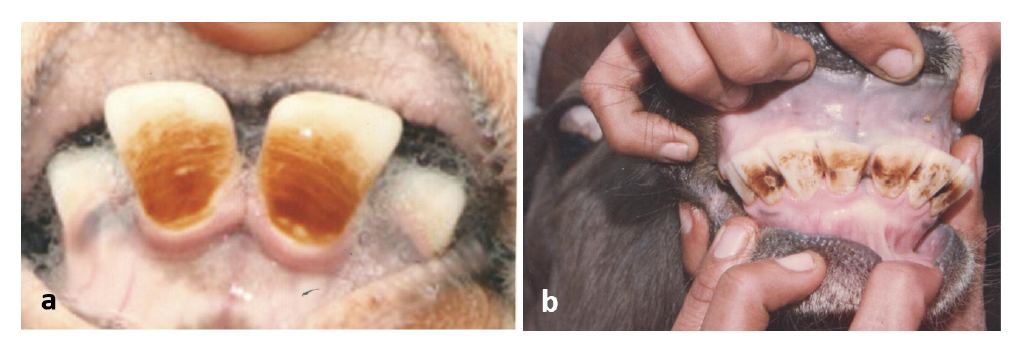
Livestock farmers can easily identify whether their cow calves are suffering from fluoride poisoning by looking at their teeth. If their teeth show light to dark brownish-yellow horizontal striated stripes or spots (Figure 1), the calves are suffering from fluoride toxicity, also known as dental fluorosis. This is the first visible clinical sign of industrial fluoride poisoning in both animals [56] and humans [57]. In India, studies conducted in rural areas showed a high prevalence of dental (89.9%) and skeletal (78.5%) fluorosis in cattle under 4 years of age in areas with industrial fluoride pollution due to the presence of numerous phosphate fertilizer processing units, coal-burning brick kilns and rock phosphate mines [58,59]. These results suggest that immature animals or calves are more sensitive to industrial fluoride emissions than their adult and older counterparts. The most serious aspect of dental fluorosis is that it shortens the lifespan of bovine calves. When these dental lesions become so severe that grazing and chewing become difficult, calves can die from starvation and cachexia at an early age [1,60]. Nevertheless, calf deaths result in economic losses for animal owners. If calves are repeatedly exposed to fluoride pollution over a long period of time, their bones and ligaments are severely affected and various pathological changes develop in the bones, commonly known as skeletal fluorosis. Bone changes, such as periosteal exostosis, osteosclerosis, osteoporosis, and osteophytosis also occur [61,62].
Figure 1:Cattle (a) and buffalo (b) calves with severe dental fluorosis, characterized by deep brownish staining (b) with striated and horizontal stripes on the anterior teeth.
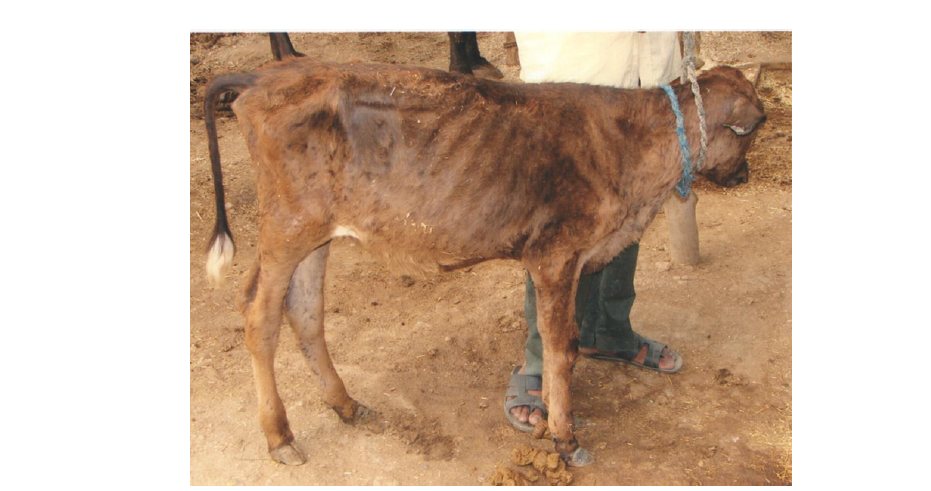
Excessive fluoride accumulation in the muscles also reduces or restricts bone movement, leading to lameness in calves (Figure 2). Although intermittent lameness, swollen joints, debility, mortality, wasting of body muscles, and bony exostosis or lesions in the mandibles, ribs, metacarpus, and metatarsus regions (Figure 2) are well recognized in the calves exposed to industrial fluoride emissions [56]. In fact, skeletal fluorosis in calves is a cause of economic loss to livestock farmers [63]. However, the prevalence and severity in industrial animals is very much dependent on several determinants, such as fluoride concentration in air, duration of industrial fluoride exposure, environmental factors, genetics, fluoride susceptibility or tolerance, etc. [64-68]. Apart from dental and skeletal fluorosis, fluoride poisoning in calves also causes other health problems, such as gastro-intestinal problems (bloating, abdominal pain, constipation, and intermittent diarrhoea), excessive thirst (polydipsia), frequent urination (polyurea), body weakness, etc. [56]. These health problems can make the cattle owner suspect that their cow calves are suffering from fluoride poisoning or fluorosis. However, the status of fluorosis or chronic fluoride poisoning in bovine calves can be determined by estimating the fluoride content in their fresh urine and blood serum which is the ideal and authentic way [56]. Estimation of fluoride content in the environmental samples like forage and fodder indicates the persistence of fluoride contamination in the environment [69,70].
Figure 2:Cattle calves suffer from severe skeletal fluorosis, characterized by weak body, lethargy, loss of body muscles, raised lesions on the legs and ribs, and lameness in the hind legs.
Conclusion
India also has many industries/factories, such as coal-fired brick kilns and thermal power stations, steel, iron, aluminum, zinc, phosphorus, chemical fertilizers, glass, plastics, cement, and hydrofluoric acid manufacturing units, which typically release fluoride into the surrounding environment in the form of both toxic gases and particulate/dust, leading to widespread industrial fluoride pollution. Many people living near these factories also rear livestock. However, they are unaware that repeated exposure to this fluoride-laden air not only harms their own health but also the health of their livestock, such as cows, buffaloes, and their calves, and can lead to a disease called fluorosis. Sometimes, this fluoride poisoning can even cause lameness in calves. Therefore, livestock farmers should avoid raising cows, buffaloes, and their calves in areas where industrial fluoride pollution is found, as it is hazardous and unsafe for their health and increases their risk of developing fluorosis. There is a great need for epidemiological research studies on calves of different ages living in different regions of the country and exposed to various sources of fluoride from industrial emissions. The results of these studies will not only be useful in understanding industrial fluorosis in calves but will also help in formulating a national policy for the prevention of this disease in livestock in the country.
Acknowledgement
The author thanks to Dr. Darshana Choubisa, Professor, Department of Prosthodontics, Geetanjali Dental and Research Institute, Udaipur, Rajasthan 313002, India and Dr. Pallavi Choubisa, Assistant Professor, Department of Obstetrics and Gynaecology, RNT Medical College and Pannadhay Zanana Hospital, Udaipur, Rajasthan 313002, India for cooperation.
References
- Adler P, Armstrong WD, Bell ME, Bhussry BR, Büttner W, et al. (1970) Fluorides and human health. World Health Organization Monograph Series No. 59, World Health Organization, Geneva, Switzerland.
- USEPA (1980) Reviews of the environmental effects of pollutants: IX. Fluoride. Environmental Protection Agency, Cincinnati, Ohio, USA.
- Choubisa SL (2001) Endemic fluorosis in southern Rajasthan (India). Fluoride 34(1): 61-70.
- Choubisa SL, Choubisa L, Choubisa DK (2001) Endemic fluorosis in Rajasthan. Indian J Environ Health 43(4): 177-189.
- Choubisa SL (2018) A brief and critical review of endemic hydro fluorosis in Rajasthan, India. Fluoride 51(1): 13-33.
- Choubisa SL (2007) Fluoridated ground water and its toxic effects on domesticated animals residing in rural tribal areas of Rajasthan (India). Intl J Environ Stud 64(2): 151-159.
- Swarup D, Dwivedi SK (2002) Environmental pollution and effect of lead and fluoride on animal health. Indian Council of Agricultural Research, New Delhi, India.
- Ranjan R, Ranjan A (2015) Fluoride toxicity in animals. Springer, Germany.
- Choubisa SL, Choubisa D (2016) Status of industrial fluoride pollution and its diverse adverse health effects in man and domestic animals in India. Environ Sci Poll Res 23(8): 7244-7254.
- Choubisa SL (2018) A brief and critical review on hydro fluorosis in diverse species of domestic animals in India. Environ Geochem Health 40(1): 99-114.
- ICMR (1974) Manual of standards of quality for drinking water supplies. Special Report Series No. 44, Indian Council of Medical Research, New Delhi, India.
- BIS (2012) Indian standard drinking water-specification. (2nd edn), Bureau of Indian Standards, New Delhi, India, p. 2.
- Singh G, Kumari B, Sinam G, Kriti Kumar N, et al. (2018) Fluoride distribution and contamination in the water, soil and plants continuum and its remedial technologies, an Indian perspective: A review. Environ Poll 239: 95-108.
- WHO (2002) Environmental health criteria: 227 Fluoride. World Health Organization, Geneva, Switzerland.
- ATSDR (2003) Toxicological profile for fluorides, hydrogen fluoride, and fluorine. US Department of Health and Human Services, Public Health Service Agency for Toxic Substances and Disease Registry, Atlanta, Georgia.
- Choubisa SL, Choubisa D (2015) Neighborhood fluorosis in people residing in the vicinity of superphosphate fertilizer plants near Udaipur city of Rajasthan (India). Environ Monit Assess 187(8): 497.
- Choubisa SL (2025) Risk of fluorosis and other health hazards in humans from coal-fired brick kilns in India: People need to be aware. Clinic Med Rev Rep 7(1): 1-7.
- Choubisa SL (2025) Are coal-based thermal power plants safe for human health in case of fluoride poisoning in India? people need to be careful and alert. Clinic Med Rev Rep 7(3): 1-7.
- Choubisa SL (2015) Industrial fluorosis in domestic goats (Capra hircus), Rajasthan, India. Fluoride 48(2): 105-115.
- Choubisa SL (2025) Can smoke from coal-fired brick kilns in India cause fluorosis in domestic animals? If yes, then livestock owners need to be made aware. Biomed Clinic Research J 1(2): 1-7.
- Choubisa SL (2025) Can coal-fired thermal power plants in India cause industrial fluorosis in domestic animals? Livestock owners are unaware. J Vet Health Sci 6(1): 1-7.
- Choubisa SL (2025) Is wildlife safe from coal-burning thermal power plants in India in the context of fluorosis? J Vet Sci Res 12(1): 1-9.
- Weinstein LH, Davison A (2004) Fluorides in the environment: Effects on plants and animals. CABI Publishing, Oxon, UK.
- Divan AM, Jr Oliva MA, Ferreira FA (2008) Dispersal fluoride accumulation in eight plant species. Eco Indica 8: 454-461.
- Choubisa SL (2023) Is industrial fluoride pollution harmful to agricultural crops? Farmers need to know. Environ Anal Eco Stud 11(3): 1261-1266.
- Choubisa SL (2025) Can emissions from coal-fired brick kilns harm agricultural crops in India? Intl J Food Sci Agric 9(4): 266-271.
- Barnard WR, Nordstrom DK (1982) Fluoride in precipitation-II. Implications for the geochemical cycling of fluorine. Atmos Environ 16(1): 105-111.
- Friend JP (1989) Natural chlorine and fluorine in the atmosphere, water and precipitation. In Scientific Assessment of Stratospheric Ozone. NASA, Washington, USA, pp. 433-448.
- Saether O, Reimann C, Hilmo BO, Taushani E (1995) Chemical composition of hard-and soft rock groundwaters from central Norway with special consideration of fluoride and Norwegian drinking water limits. Environ Geo 26: 147-156.
- Cape JN, Fowler D, Davison A (2003) Ecological effects of sulfur dioxide, fluorides, and minor air pollutants: Recent trends and research needs. Environ Intl 29(2-3): 201-211.
- Franzaring J, Hrenn H, Schumm C, Klumpp A, Fangmeier A (2006) Environmental monitoring of fluoride emissions using precipitation, dust, plant and soil samples. Environ Poll 144(1): 158-165.
- Kirk PWW, Lester JN (1986) Halogen compounds. In: RM Harrison, R Perry (Eds.), (2nd edn), Handbook of Air Pollution Analysis, London, UK, pp. 425-462.
- Yanchenko NI, Baranov AN (2010) Parameters of the distribution of fluorine, sulfur, and sodium in the Baikal Region with the production of primary aluminum. Russian Journal of Non-Ferrous Metal 51: 144-149.
- Sloof W, Eeren H, Janus J, Ros J (1989) Integrated criteria document: Fluorides. National Institute of Public Health and Environmental Protection, Bilthoven, Netherlands.
- Hara H, Yabuuchi K, Higashida M, Ogawa M (1998) Determination of free and total fluoride in rainwater using a continuous-flow system equipped with a fluoride ion-selective electrode detector. Analy Chimica Acta 364(1-3): 117-123.
- Gasic B, MacLeod M, Scheringer M, Hungerbuhler K (2010) Assessing the impact of weather events at mid latitudes on the atmospheric transport of chemical pollutants using a 2-dimentional multimedia meteorological model. Atmos Environ 44(35): 4489-4496.
- Scheringer M (2009) Long-range transport of organic chemicals in the environment. Environ Texico Chem 28(4): 677-690.
- Walna B, Kurzyca I, Bednorz E, Kolendowicz L (2013) Fluoride pollution of atmospheric precipitation and its relationship with air circulation and weather patterns (Wielkopolski National Park, Poland). Environ Monit Assess 185(7): 5497-5514.
- Choubisa SL (2012) Fluoride in drinking water and its toxicosis in tribals, Rajasthan, India. Proc Natl Acad Sci India Sect B: Biol Sci 82(2): 325-330.
- Choubisa SL (2012) Status of fluorosis in animals. Proc Natl Acad Sci India Sect B: Biol Sci 82(3): 331-339.
- Choubisa SL (2018) Fluoride distribution in drinking groundwater in Rajasthan, India. Curr Sci 114(9): 1851-1857.
- Choubisa SL (2023) Industrial fluoride emissions are dangerous to animal health, but most ranchers are unaware of it. Austin Environ Sci 8(1): 1089.
- Choubisa SL (2023) A brief review of industrial fluorosis in domesticated bovines in India: Focus on its socio-economic impacts on livestock farmers. J Biomed Res 4(1): 8-15.
- Choubisa SL, Choubisa D, Choubisa A (2023) Fluoride contamination of groundwater and its threat to health of villagers and their domestic animals and agriculture crops in rural Rajasthan, India. Environ Geochem Health 45(3): 607-628.
- Choubisa SL (2023) Is naturally fluoride contaminated groundwater irrigation safe for the health of agricultural crops in India? Poll Commun Health Effects 1(2): 1-8.
- Choubisa SL (2022) A brief and critical review of chronic fluoride poisoning (fluorosis) in domesticated water buffaloes (Bubalus bubalis) in India: focus on its impact on rural economy. J Biomed Res Environ Sci 3(1): 96-104.
- Choubisa SL (2023) Endemic hydro fluorosis in cattle (Bos taurus) in India: An epitomized review. Intl J Vet Sci Technol 8(1): 1-7.
- Choubisa SL, Mishra GV (2013) Fluoride toxicosis in bovines and flocks of desert environment. Intl J Pharmacol Biol Sci 7(3): 35-40.
- Choubisa SL (2021) Chronic fluoride exposure and its diverse adverse health effects in bovine calves in India: An epitomized review. Global J Biol Agric Health Sci 10(3): 1-6.
- Choubisa SL (2014) Bovine calves ideal bio-indicators for fluoridated drinking water and endemic osteo-dental fluorosis. Environ Monit Assess 186(7): 4493-4498.
- Choubisa SL (2024) Are bovine calves ideal bio-indicators for endemic fluorosis? Open Assess J Vet Sci Res 9(1): 1-8.
- Choubisa SL, Modasiya V, Bahura CK, Sheikh Z (2012) Toxicity of fluoride in cattle of the Indian Thar Desert, Rajasthan, India. Fluoride 45(4): 371-376.
- Choubisa SL (2013) Fluorotoxicosis in diverse species of domestic animals inhabiting areas with high fluoride in drinking waters of Rajasthan, India. Proc Natl Acad Sci India Sect B: Biol Sci 83(3): 317-321.
- Choubisa SL (2013) Fluoride toxicosis in immature herbivorous domestic animals living in low fluoride water endemic areas of Rajasthan, India: An observational survey. Fluoride 46(1): 19-24.
- Choubisa SL (2026) Are bovine calves safe in India from drinking water in case of fluoride poisoning? J Toxicol Res 15(1): 1-6.
- Choubisa SL (2022) How can fluorosis in animals be diagnosed and prevented? Austin J Vet Sci Anim Husb 9(3): 1-5.
- Choubisa SL (2022) The diagnosis and prevention of fluorosis in humans. J Biomed Res Environ Sci 3(3): 264-267.
- Panchal L, Sheikh Z (2017) Dental fluorosis in domesticated animals in and around Umarda village of Udaipur, Rajasthan, India. Haya: Saudi J Life Sci 2(7): 248-254.
- Sheikh Z, Panchal L (2018) Anthropogenic fluoride contamination and osteo-fluorosis in bovines inhabiting Umarda, Jhamarkotra and Lakkadwas villages of Udaipur, Rajasthan, India. Intl J Innov Res Rev 6 (1): 12-20.
- Wang JD, Zhan CW, Chen YF, Li J, Hong JP, et al. (1992) A study of damage to hard tissue of goats due to industrial fluoride pollution. Fluoride 25(3): 123-128.
- Choubisa SL (1996) Radiological skeletal changes due to chronic fluoride intoxication in Udaipur district (Rajasthan). Poll Res 15(3): 227-229.
- Choubisa SL (2022) Radiological findings more important and reliable in the diagnosis of skeletal fluorosis. Austin Med Sci 7(2): 1069.
- Choubisa SL (2023) A brief and critical review of endemic fluorosis in domestic animals of scheduled area of Rajasthan, India: Focus on its impact on tribal economy. Clinic Res Anim Sci 3(1): 1-11.
- Choubisa SL (2010) Natural amelioration of fluoride toxicity (fluorosis) in goats and sheep. Curr Sci 99(10): 1331-1332.
- Choubisa SL, Mishra GV, Sheikh Z, Bhardwaj B, Mali P, et al. (2011) Food, fluoride, and fluorosis in domestic ruminants in the Dungarpur district of Rajasthan, India. Fluoride 44(2): 70-76.
- Choubisa SL (2013) Why desert camels are least afflicted with osteo-dental fluorosis? Curr Sci 105(12): 1671-1672.
- Choubisa SL (2024) Are sheep and goat animals relatively more tolerant to fluorosis? J Vet Med Res 11(1): 1261.
- Choubisa SL (2024) Is the water buffalo species (Bubalus bubalis) relatively more sensitive to fluorosis than other species of domestic animals? Still, there is a need for more in-depth research on this. J Vet Med Anim Sci 7(1): 1139.
- Dwivedi SK, Dey S, Swarup D (1997) Hydro fluorosis in water buffalo (Bubalus bubalis) in India. Sci Total Environ 207(2-3): 105-159.
- Trangadia BJ, Kaul PL, Patel BJ, Joshi DV, Kaul L (2015) Chronic fluorosis in buffaloes: Clinic pathological studies. Indian J Vet Pathol 39(4): 354-357.
© 2026 Shanti Lal Choubisa. This is an open access article distributed under the terms of the Creative Commons Attribution License , which permits unrestricted use, distribution, and build upon your work non-commercially.
Editor In Chief






.jpg)































Signup for Newsletter

Quick Links
 Editorial Board Registrations
 Submit your Article
 Best Paper of the Volume
 Reprints
 Refer a Friend
 Advertise With Us
Our Recent Edition

.jpg)



Top Editors




.jpg)

















.bmp)
.jpg)
.png)
.jpg)













.jpg)






.png)

.png)




.png)




Financial Support

Sponsors

Latest e-Books

Latest Video

 a Creative Commons Attribution 4.0 International License. Based on a work at www.crimsonpublishers.com.
Best viewed in
a Creative Commons Attribution 4.0 International License. Based on a work at www.crimsonpublishers.com.
Best viewed in 
 | Above IE 9.0 version