

- About Us
- Information
-

The Author ensures that the research has been conducted responsibly and ethically with adherence to all relevant regulations. read more..
- For Authors
- For Reviewer
- Manuscript Guidelines
- Membership
- Publication Ethics
-
- Journals
- Reprints
- e-Books
- Videos
- Policies
- Contact Us
 COVID-19
- Submissions



Full Text
COJ Technical & Scientific Research
Influence of Geometrical Parameters on Part Distortion in FDM Printing of Polypropylene (Semi-Crystalline Polymer)
Anto Antony Samy*, Luke Gilmour, Edward Archer and Alistair McIlhagger
School of Engineering, Ulster University, UK
*Corresponding author:Anto Antony Samy, School of Engineering, Ulster University, York St, Belfast BT15 1ED, UK
Submission: May 27, 2026:Published: July 03, 2026

Volume6 Issue2July 03, 2026
Abstract
Fused Deposition Modelling (FDM) of semi-crystalline polymers is widely affected by residual stress build-up and warpage due to the crystallisation-driven volumetric shrinkage and the non-homogeneous thermal history experienced during layer-by-layer deposition. Although the influence of processing parameters such as raster pattern, ambient temperature and nozzle speed on part distortion has been extensively investigated, the influence of geometrical parameters particularly increasing component height on the distortion behaviour in both amorphous and semi-crystalline polymers has received limited attention. In this study, a coupled thermo-mechanical finite element model incorporating crystallisation kinetics was employed to investigate the influence of increasing build height on the development of thermal residual stresses and warpage in the bottom layer of PP (semi-crystalline) and ABS P400 (amorphous) samples. Samples comprising 4 layers (PP-4, ABS-4) and 8 layers (PP-8, ABS- 8) with constant in-plane dimensions of 50×50mm were simulated and experimentally validated using 3D scanning of FDM-printed specimens. The results show that doubling the number of layers increases the accumulated residual stress in the bottom layer by 19.9 % in PP and by 34.9 % in ABS. In contrast, the bottom-layer warpage exhibited a different response between the two polymers: PP showed a counterintuitive decrease of 14 %, whereas ABS showed a significant increase of 98.7 %. The reduction in PP warpage with increasing height is attributed to the in-situ annealing effect of repeated reheating from successive layer depositions combined with the mechanical constraint imposed by overlying layers, which outweighs the additional crystallisation induced shrinkage. The simulated warpage results were in good agreement with the experimentally measured values. These findings demonstrate that build height should be considered alongside processing parameters when optimising dimensional accuracy in FDMprinted semi-crystalline polymer components..
Keywords:Part distortion; Semi-crystalline polymers; Amorphous polymers; Crystallisation; FDM; Simulation; Residual stress
Abbreviations: PP: Polypropylene; ABS: Acrylonitrile Butadiene Styrene; FDM: Fused Deposition Modelling; FEA: Finite Element Analysis
Introduction
Fused Deposition Modelling (FDM) is one of the most widely used additive manufacturing techniques for the fabrication of thermoplastic polymer components due to its relatively low manufacturing costs, material efficiency and ability to produce parts with complex geometries [1]. In FDM, the material is deposited layer by layer in the form of molten filaments, where each deposited road undergoes cooling and solidification before the subsequent layer is introduced [1]. Among the wide range of polymers processed using FDM, increasing attention has been directed towards semi-crystalline polymers such as Polypropylene (PP), due to their favourable mechanical properties, chemical resistance and industrial relevance [2]. However, compared to amorphous polymers, semi-crystalline materials exhibit considerably more complex thermal behaviour during cooling due to crystallization occurring within the polymer matrix [2-4]. This behaviour results in additional volumetric shrinkage during cooling and makes semi-crystalline polymers considerably more susceptible to residual stress accumulation and part distortion when fabricated [2]. Due to this, achieving dimensional accuracy in FDM using semi-crystalline components remains a significant challenge. During the FDM process, the deposited material experiences repeated heating and cooling cycles, resulting in non-uniform temperature distribution throughout the printed component [2,5]. As the deposited roads cool and subsequently solidify, thermal contraction occurs within the material. This contraction behaviour becomes restricted due to the constraint imposed by the build platform and previously deposited layers, leading to the development of thermal residual stresses within the structure. Due to the poor thermal conductivity of polymers, non-uniform cooling behaviour develops between deposited roads and layers, eventually contributing towards part distortion and warpage during fabrication [1,5]. These effects become increasingly significant in components with larger geometrical dimensions or increased deposition time where repeated thermal cycling continues throughout the fabrication process [1].
In semi-crystalline polymers, these effects become more severe due to crystallisation induced shrinkage occurring simultaneously with thermal contraction [2-4]. Since crystallisation behaviour is strongly dependent on the thermal condition experienced during deposition, the dimensional stability of semi-crystalline FDM components remain closely linked to the cooling behaviour developed throughout fabrication. Compared to amorphous polymers such as ABS, semi-crystalline materials therefore exhibit considerably greater susceptibility to warpage and dimensional instability during printing [2]. Several studies have shown that both processing conditions and geometrical parameters can significantly influence residual stress development and distortion behaviour during FDM fabrication [1,5]. Parameters such as raster pattern, ambient temperature, build orientation and deposition conditions have been widely reported to influence thermal contraction and stress accumulation within the printed structures [5,6]. In addition to processing conditions, overall component geometry may also strongly influence the thermal and mechanical behaviour developed throughout fabrication [1]. As additional layers are deposited, the lower regions of the component continue to experience repeated reheating cycles while remaining mechanically constrained by the build platform. As a result, residual stresses may continue to accumulate within the lower sections of the structure as fabrication progresses [5]. This effect may become increasingly significant in semi-crystalline polymer parts due to the additional shrinkage behaviour associated with crystallisation during cooling [2]. A considerable amount of numerical and experimental work has been carried out in order to understand residual stress development and distortion during FDM processing of polymers [1-3,5,6].
Thermo-mechanical, finite element models have been widely used to simulate heat transfer, stress evolution and cooling behaviour during deposition, allowing the influence of different fabrication conditions on part distortion to be evaluated. Previous simulation studies have focused primarily on investigating processing conditions such as raster pattern, ambient temperature, print bed temperature and deposition parameters. These investigations have shown that thermal history and mechanical constraints during cooling strongly influences residual stress development and resulting warpage behaviour within the printed structure [5,6]. However, comparatively limited work has focused specifically on the influence of increasing overall component height and deposited layer count on bottom layer distortion behaviour in both amorphous and semi-crystalline FDM polymers. The present study therefore investigates the influence of increasing overall component height on part distortion behaviour during FDM fabrication of amorphous and semi-crystalline polymers, using thermo-mechanical numerical simulation. Focus is placed on investigating bottom layer distortion in ABS and PP structures, fabricated using different deposition layer counts. It should be noted that part height (overall height of a printed part) is a parameter that cannot be varied. However, it can provide insight into understanding influence of part height through built-in thermal residual stresses on distortion particularly in semicrystalline polymers. The study aims to investigate how repeated thermal cycling throughout fabrication influences residual stress accumulation and distortion development within the constrained lower regions of the printed component. The findings of this work are expected to provide further understanding towards distortion development in amorphous and semi-crystalline FDM polymers and support future optimisation of dimensional stability in FDM fabricated structures.
Materials and Methods
Table 1:Material properties of ABS P400 [13-17].
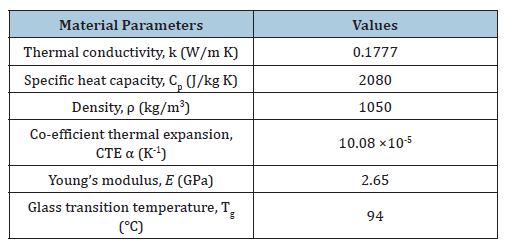
To investigate the influence of part height, isotactic Polypropylene (PP) (3D Fila, Essex, UK) and Acrylonitrile Butadiene Styrene (ABS P400) (UL Prospector, Overland Park, KS, USA) were selected as the material of study. PP was selected to investigate influence of increase geometry in the Z-axis and the results were compared with the results obtained from ABS P400. Furthermore, ABS P400 and PP are the highly used commercial feedstocks [7-17]. The samples were printed and simulated under the following conditions: PP was printed under bed temperature 100℃, line (90,90) raster pattern, extrusion temperature 210℃, ambient temperature 25℃, nozzle speed of 30mm/s and layer thickness of 0.5mm using a nozzle diameter of 0.8mm with an infill of 100% in order to assess the resulting warpage from the printed samples. ABS P400 was printed under similar printing conditions as PP, while extruded under 270 ℃. The samples were sliced using Cura version 4.8 (Ultimaker Cura, Framingham, MA, USA), then printed using the modified Ultimaker 2 and simulated on COMSOL Multiphysics software (COMSOL, Cambridge, UK). The warpage from the printed samples was measured using a RS6 scanner for higher accuracy. The material properties of ABS P400 and PP are presented in Table 1&2.
Table 2:Material properties of PP [3].
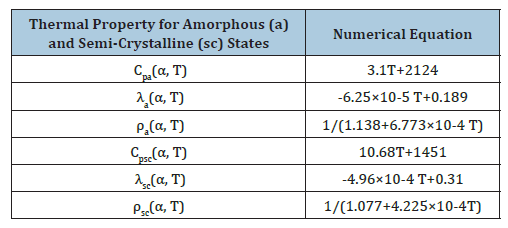
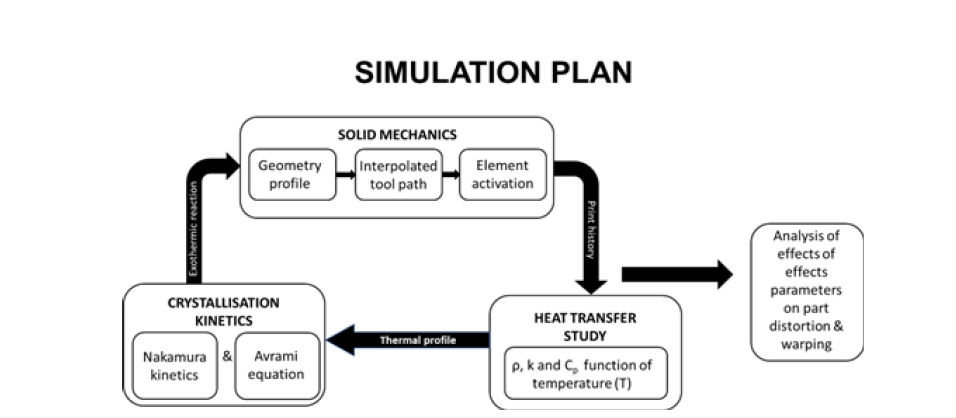
In Table 2, Cp, λ and ρ for both amorphous and crystalline region are considered with respect to the simple mixing rule [8]. Here, the terms a and sc illustrate the amorphous and crystalline regions in the semi-crystalline polymer. The simulation method presented here is a multi-physics model consisting of solid mechanics, heat transfer and polymer crystallisation kinetics as shown in Figure 1. Owing to the coupled nature of the model, the governing physics implemented in the simulation is primarily temperature dependent. The model accounted for several phenomena relevant to the FDM process, including liquid-to-solid phase transformation, inter-road and inter-layer heat transfer, raster deposition strategy, buildplate temperature, ambient conditions, viscoelastic response and the thermo-mechanical behaviour of the semi-crystalline polymer. Owing to the complexity associated with incorporating these coupled physical mechanisms, printed and simulated specimens with dimensions of 50×50mm with a layer thickness of 0.5mm (overall thickness of 2mm for 4 layers and 4mm for 8 layers) were considered in this study.
Figure 1:Illustration of simulation plan designed to predict part distortion in semi-crystalline polymer.
Solid mechanics
Figure 2:Representation of element activation in (a) ABS P400 and (b) PP with respect to material deposition process.
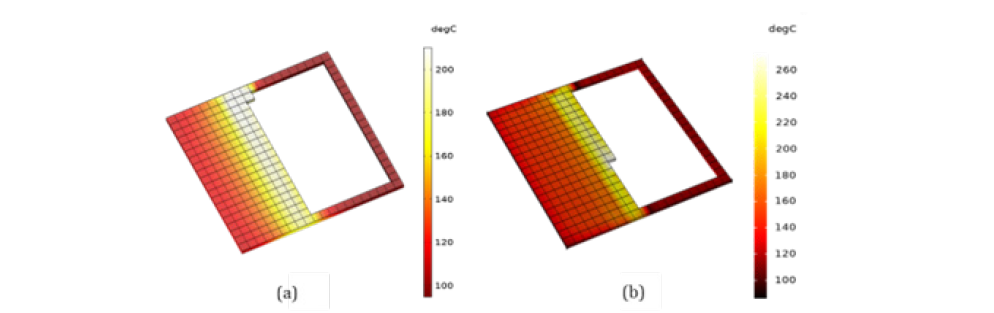
To reproduce the material deposition sequence of the FDM process, an element activation technique was employed, which is widely used for simulating layer-by-layer additive manufacturing processes [8,18,19]. In the present model, elements were activated progressively to represent the deposition of molten filament during printing, as illustrated in Figure 2. The computational domain was initially discretised according to the deposited filament size, which was 0.5mm in this study. Following meshing, elements were activated sequentially based on the selected raster path. Consistent with the physical FDM process, material activation was performed successively along the x and y directions within each layer. After completion of a layer, activation proceeded in the z-direction to simulate the deposition of subsequent layers. After deposition, the printed component undergoes cooling, during which warpage may develop depending on the imposed processing conditions. To capture this behaviour, a spring foundation boundary condition was applied between the build plate and the numerical model. This approach permits the part to deform and warp during cooling while still representing the interaction between the printed sample and the print bed [6,8,9]. During the simulation, the build-plate temperature was prescribed according to the corresponding processing condition and maintained constant throughout the analysis.
Heat transfer
Thermal behaviour plays a critical role in FDM, as cooling directly influences interlayer bonding, crystallinity and part distortion. Therefore, heat transfer was incorporated in the model with temperature-dependent material properties, as supported by previous studies [4,20]. The thermal field evolves due to processing conditions such as ambient and bed temperatures, which in turn affect residual stresses and deformation. The governing heat transfer equation is:

Where ρ is the density, Cp is the specific heat capacity and λ represents the thermal conductivity of the polymer and Q denotes the heat source.
Crystallisation kinetics
Crystallisation in semi-crystalline polymers is strongly temperature dependent and significantly affects final material properties. To capture this behaviour, crystallisation kinetics was incorporated into the polypropylene model using a modified framework based on Levy [21-23]. The material properties were defined as functions of both temperature and crystallinity. The evolution of crystallinity under non-isothermal conditions was described using the Nakamura extension of the Avrami model:

n is the Avrami index and K(T) represents the Nakamura crystallisation kinetics function derived from Avrami’s isothermal kinetics. Koscher et al. has performed DSC experiments for isothermal and non-iso thermal conditions and proposed K(T) as [4,20-23]:

The Nakamura model was selected due to its ability to account for both time and temperature effects during non-isothermal processing [23-25]. Further details on boundary conditions and property formulations are available in our previous work [7- 11]. For ABS and PP, similar thermal and mechanical boundary conditions were applied. However, crystallisation kinetics was only included in the PP model and coupled through temperaturedependent behaviour.
Results and Discussion
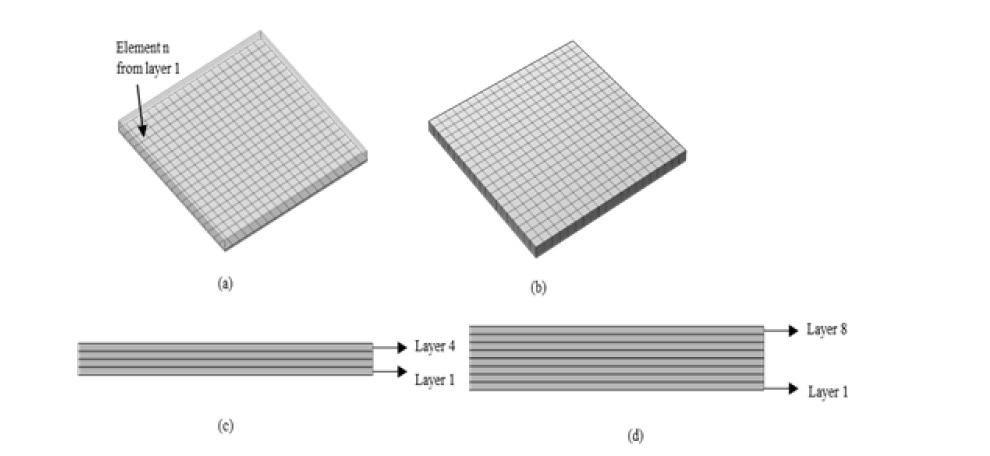
The influence of part height on part distortion was analysed by selecting an element located in the lower layer from the coordinates 7.8, 2.1, 0.5mm (layer 1) of each specimen. This was due to the element’s exposure to continuous deposition of subsequent layers above it, leading to continuous accumulation and releasing of thermal residual stresses influencing part distortion. This element will be referred to as element n in this study as shown in Figure 3.
Figure 3:(a) Location of element n from layer 1, (b) iso-metric view of the sample, (c) side view of sample with 4 layers and (d) side view of sample with 8 layers.
Thermal analysis and temperature effect on part height
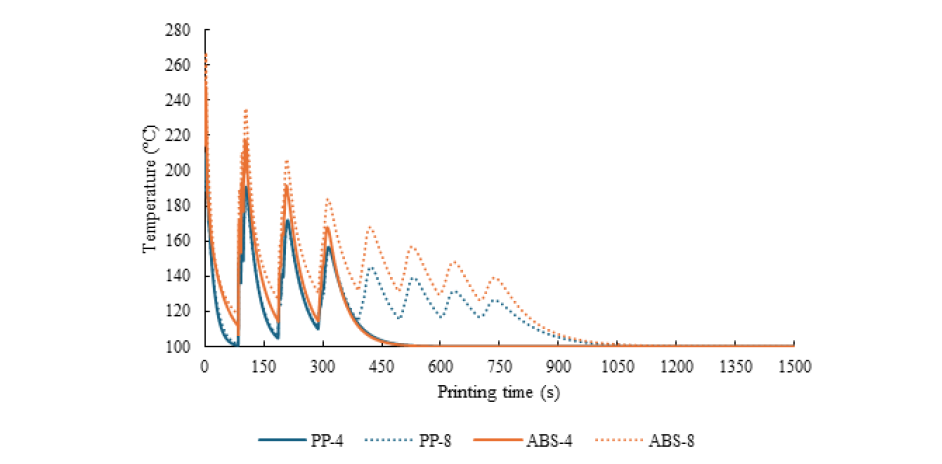
Figure 4 presents the simulated thermal history of element n over the full printing time for PP-4, PP-8, ABS-4 and ABS-8. In all samples, the temperature profile begins with the initial deposition peak at element n, followed by a sequence of secondary peaks corresponding to the thermal energy transferred from neighbouring roads and from each subsequently deposited layer. For PP, the deposition peak of element n reached approximately 209℃ in both PP-4 and PP-8, consistent with the imposed extrusion temperature of 210℃. For ABS, the deposition peak was substantially higher (~251°C for ABS-4 and ~266°C for ABS-8), reflecting the higher extrusion temperature of 270℃ used for ABS P400. Following the initial deposition, all samples cooled towards the print-bed temperature of 100℃, with PP-4 and ABS-4 reaching steady state at approximately 539s and 529s respectively, while PP-8 and ABS- 8 reached steady state at approximately 1115s and 1140s. This near-doubling of cooling time is a direct consequence of doubling the number of deposited layers. A clear trend can be observed from Figure 4 in the number and amplitude of the reheating peaks recorded at element n. The increase in the number of reheating events with increasing part height is due to the additional layers being deposited above element n, with each new layer transferring thermal energy down through the previously solidified layers. Importantly, the amplitude of these reheating peaks progressively decreases as the distance between the newly deposited layer and element n increases. For example, in PP-8 the reheating peak associated with the second layer reaches approximately 167℃ above the crystallisation temperature of PP (~160℃) and therefore capable of inducing re-crystallisation whereas the peak associated with layer 8 deposition reaches only approximately 126℃, which lies well below the crystallisation temperature and can contribute only to cold crystallisation or thermal stress relaxation, rather than to melting and re-crystallisation of the polymer chains. The progressive decrease in reheating amplitude is a consequence of the inherently poor thermal conductivity of thermoplastic polymers, which severely limits the propagation of heat through previously deposited layers [23]. Comparison between the PP and ABS samples shows that, although ABS exhibits higher initial deposition temperature, the reheating peaks at element n in ABS- 8 also progressively decrease (from approximately 210℃ for the second layer down to 139℃ for the eighth layer). This indicates that, regardless of polymer type, the bottom layer of taller components experiences a much wider range of thermal cycles than that of shorter components, with the upper layers contributing increasingly limited reheating.
Figure 4:Thermal history of element n plotted against printing time for PP-4, PP-8, ABS-4, and ABS-8.
Residual stress development with increase in part height
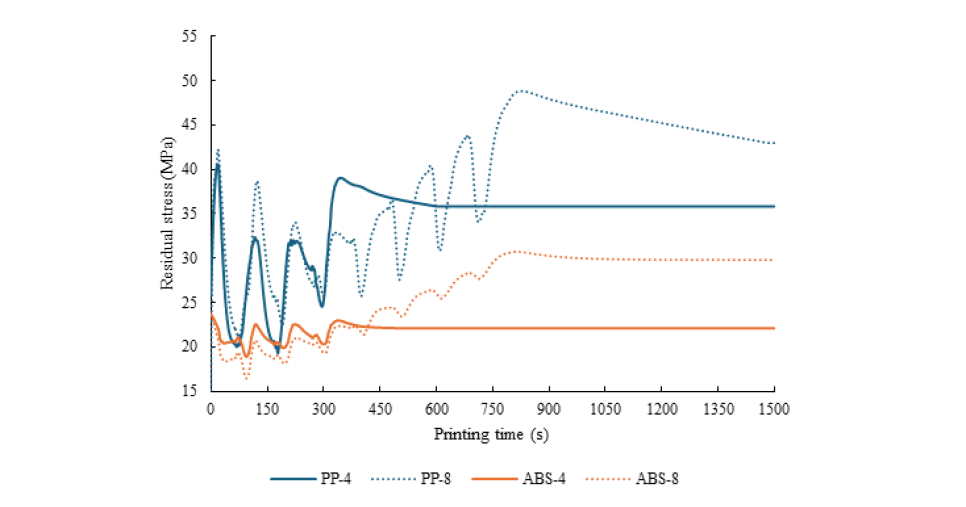
Figure 5 presents the evolution of residual stress at element n against the overall printing time for PP-4, PP-8, ABS-4 and ABS- 8. In all samples, a prominent initial peak is observed during the initial deposition phase, followed by a gradual decay as element n equilibrates and subsequently by a series of further peaks each corresponding to the deposition and cooling of subsequent layers. The initial steep increase in residual stress at the onset of deposition is attributed to the large temperature gradient between the molten polymer and the print bed, which gives rise to non-homogeneous cooling and the build-up of trapped thermal residual stresses [26]. Each subsequent layer deposition causes a temporary release of the accumulated stress through reheating, followed by a re-accumulation as the layer cools and contracts. The final residual stress values at steady state depict a consistent trend with increasing part height. For PP, the residual stress at element n increased from 35.83MPa in PP-4 to 42.97MPa in PP- 8, corresponding to an increase of 19.9 %. For ABS, the increase was even more pronounced, from 22.09MPa in ABS-4 to 29.80MPa in ABS-8, corresponding to an increase of 34.9%. These results confirm that increasing the number of deposited layers leads to an accumulation of thermal residual stress in the bottom layer of FDMprinted parts, irrespective of polymer type. Comparison between the two polymers further shows that PP develops considerably higher residual stress than ABS at the same build height: PP-4 exhibited 62% higher residual stress than ABS-4, while PP-8 exhibited 44% higher stress than ABS-8. This elevated stress in PP is attributed to the additional contribution of crystallisation-induced volumetric shrinkage, which leads to accumulation of thermal residual stress and is absent in the amorphous ABS [27]. Furthermore, the partial relaxation of stress observed after each reheating event is more limited in PP, since the reheating temperatures associated with the upper layers fall close to or below the crystallisation temperature, restricting the ability of the polymer chains to mobilise and dissipate trapped stress through relaxation.
Figure 5:Residual stress values of element n plotted against printing time for PP-4, PP-8, ABS-4, and ABS-8.
Warpage evolution with increase in part height
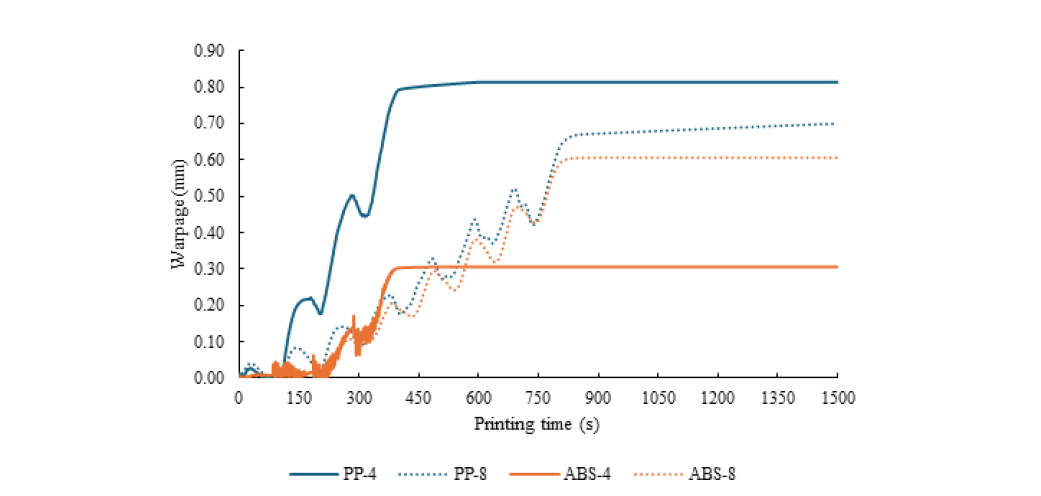
Figure 6 presents the warpage of element n plotted against the overall printing time for all four samples. The warpage profiles exhibit a stepwise increase associated with each layer deposition event, with the increase becoming gradual as the printed sample approaches ambient conditions and eventually plateauing once the sample has cooled to the bed temperature. The final warpage values show a strong difference between the semi-crystalline PP and the amorphous ABS to an increase in part height. For PP, the bottom-layer warpage decreased from 0.813mm in PP-4 to 0.699mm in PP-8, a reduction of approximately 14% despite the corresponding to approximately 20% increase in residual stress reported in Figure 5. For ABS, the opposite trend was observed, with the bottom-layer warpage almost doubling from 0.305mm in ABS-4 to 0.606mm in ABS-8, corresponding to an increase of 98.7%. The decrease in PP warpage with increasing part height can be explained by considering the combined effects of repeated reheating and mechanical constraint. As shown in Figure 4, element n in PP-8 experiences a larger number of reheating cycles than in PP-4. Although the amplitude of the later reheating peaks falls below the crystallisation temperature, these cycles still provide sufficient thermal energy to allow partial relaxation of the polymer chains and the release of part of the trapped residual stress, behaving as an in-situ annealing process [25]. In parallel, the additional layers deposited above element n impose an increasing mechanical constraint that restricts the freedom of the bottom layer to deform and detach from the build platform during cooling. The combined effect of in-situ annealing-like stress relaxation and the mechanical constraint imposed by the overlying layers dominates over the additional crystallisation-induced shrinkage associated with the increased thermal history, resulting in a net decrease in the bottom-layer warpage. This finding is consistent with the observation that, although residual stress accumulates with height, not all accumulated stress translates into geometric distortion once the part is mechanically constrained [28].
Figure 6:Warpage values of element n plotted against printing time for PP-4, PP-8, ABS-4, and ABS-8.
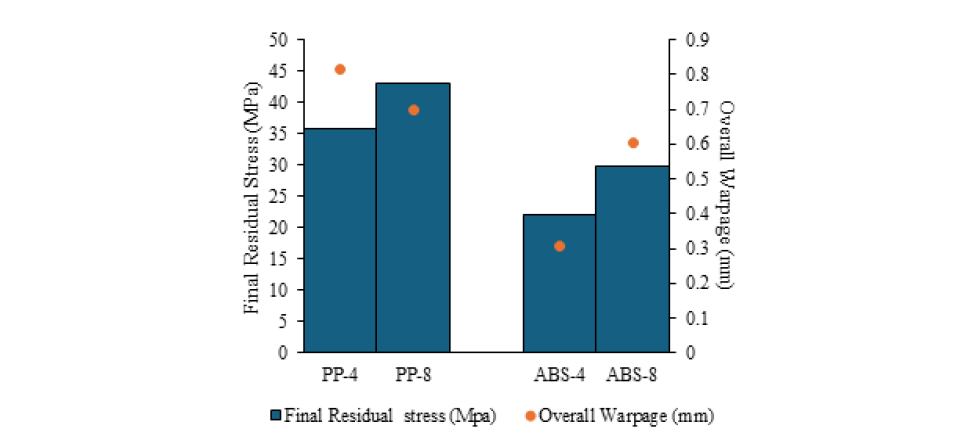
In contrast, the warpage behaviour of ABS is governed almost exclusively by the build-up of trapped thermal residual stress, since no crystallisation occurs to contribute to volumetric change or to provide a mechanism for time-dependent relaxation. Consequently, the higher number of layers in ABS-8 leads to a larger cumulative thermal mismatch and a wider distribution of cooling rates across the part, which translates directly into a near-doubling of warpage. The relatively low absolute warpage of ABS at both builds heights compared with PP further corroborates the well-established finding that amorphous polymers are inherently less susceptible to part distortion in FDM than semi-crystalline polymers [29,30]. A direct comparison of the final residual stress and overall warpage for all four samples is presented in Figure 7. The figure highlights that PP exhibits significantly higher warpage than ABS at both build heights by approximately 167% at 4 layers and 15% at 8 layers but also shows that this gap narrows considerably as part height increases, owing to the opposing trends observed for the two polymers. This convergence suggests that, although semicrystalline polymers remain more susceptible to bottom-layer warpage than amorphous polymers, the difference becomes less pronounced in taller components where in-situ thermal cycling and mechanical constraint become significant.
Figure 7:Comparison of final residual stress and overall warpage value of element n of PP-4, PP-8, ABS-4, and ABS-8 from the simulated models.
Simulation and experimental validation
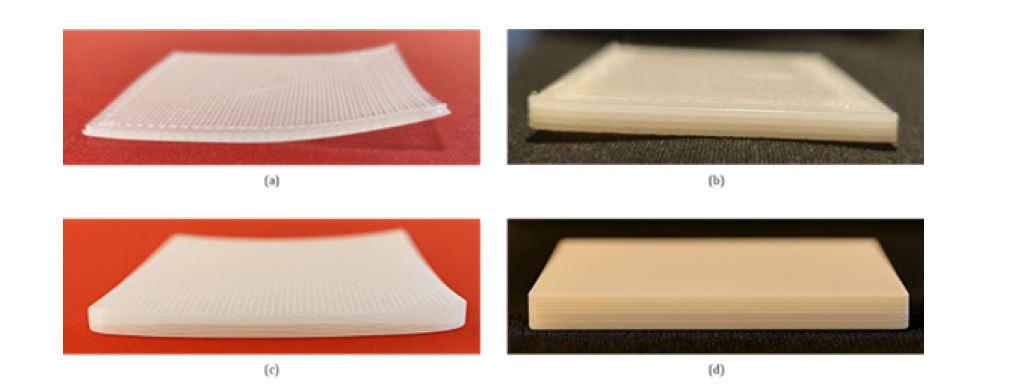
Figure 8 presents the iso-metric and side views of the simulated warpage fields for PP-4, PP-8, ABS-4 and ABS-8. The simulated warpage is concentrated at the corners of the printed samples, which is consistent with previously reported observations that the corners of FDM-printed parts are most prone to detachment from the build platform due to the cumulative stress field [31]. The side views illustrate the magnitude of corner lifting and confirm the trends quantified in Figure 7, with PP-4 showing the most pronounced corner lifting and ABS-4 the least. Figure 9 presents the corresponding FDM-printed warpage results for the four experimentally fabricated samples. The experimental warpage profiles show qualitative agreement with the simulated results: PP-4 exhibits the most severe corner lifting, ABS-4 displays minimal distortion and the warpage of PP-8 and ABS-8 lies between these extremes, with PP-8 showing reduced corner lifting compared with PP-4 and ABS-8 showing increased corner lifting compared with ABS-4. The quantitative agreement in Table 3 between the simulated and the 3D-scanned warpage values further confirms the validity of the coupled thermo-mechanical-crystallisation model developed in this work and supports the conclusion that build height has a significant and polymer-dependent influence on FDM part distortion.
Table 3:Comparison of simulated and printed warpage values of samples PP-4, PP-8, ABS-4, and ABS-8.
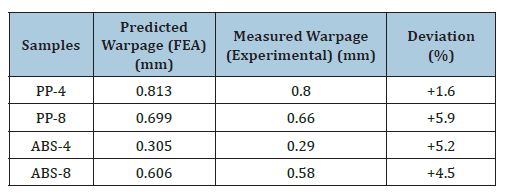
Figure 8:Comparison of simulated warpage results – iso-metric view of (a) PP-4, (e) PP-8, (b) ABS-4, and (f) ABS-8 and side view of (c) PP-4, (d) PP-8, (g) ABS-4, and (h) ABS-8.
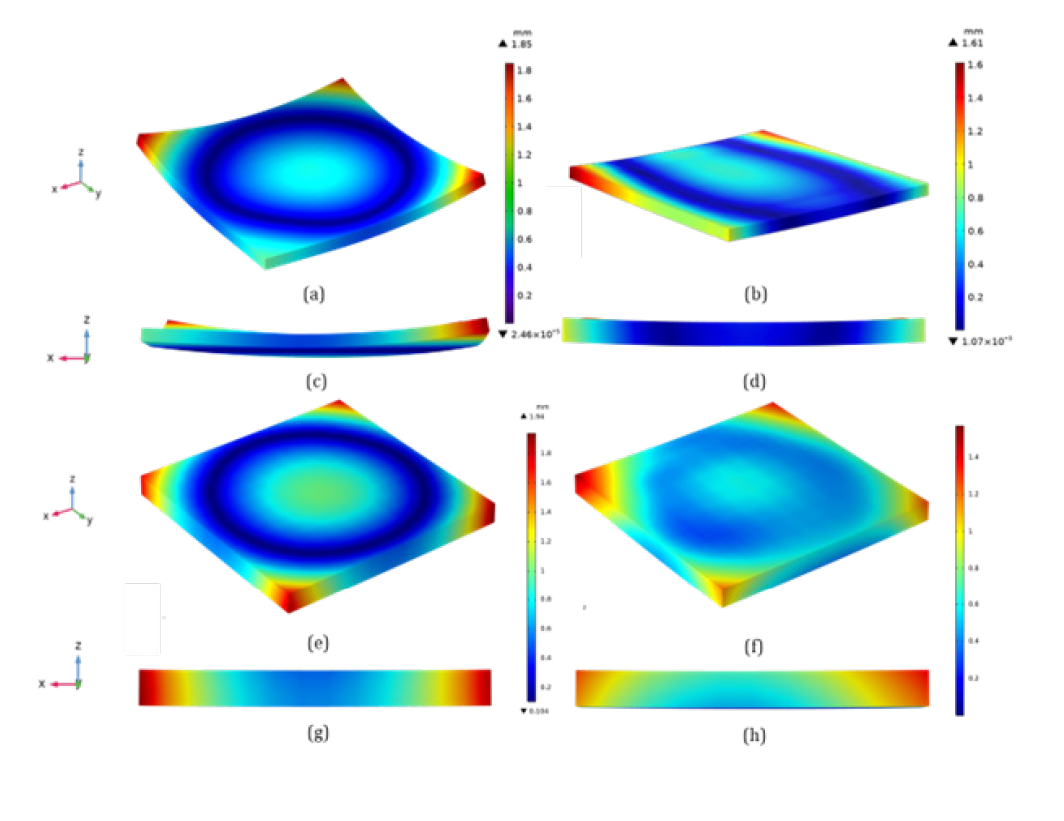
Figure 9:Comparison of warpage results of FDM printed samples of (a) PP-4 (c) PP-8 (b) ABS-4 and (d) ABS-8.
Conclusion
In this study, a coupled thermo-mechanical finite element model incorporating element activation, temperature-dependent thermomechanical properties and Nakamura-based crystallisation kinetics was used to investigate the influence of build height on the bottomlayer residual stress and warpage of FDM-printed polypropylene (semi-crystalline) and ABS P400 (amorphous) components. Samples of 4 and 8 deposited layers were simulated and validated experimentally through 3D scanning of FDM-printed parts.
The main findings of this work can be summarised as follows:
A. Increasing the number of deposited layers from 4 to 8
leads to a substantial increase in the residual stress accumulated
in the bottom layer of both polymers, with a 19.9 % increase
observed in PP (from 35.83 to 42.97MPa) and a 34.9 % increase
in ABS (from 22.09 to 29.80MPa). This trend is consistent
across both polymer types and is driven by the thermal nonuniformity
arising from the deposition of successive layers.
B. The warpage behaviour exhibited a different response
between the two polymers. In PP, the bottom-layer warpage
decreased by approximately 14% (from 0.813 to 0.699mm) as
the build height was doubled, despite the increase in residual
stress. In ABS, the warpage almost doubled (from 0.305 to
0.606mm), consistent with the increase in residual stress.
C. The counterintuitive reduction in PP warpage with
increasing build height is attributed to two coupled mechanisms:
the in-situ annealing effect of repeated reheating from
successive layer depositions, which promotes partial stress
relaxation in the bottom layer and the mechanical constraint
imposed by the increasing number of overlying layers, which
restricts the freedom of the bottom layer to deform during
cooling. Together, these effects dominate over the additional
crystallisation-induced shrinkage associated with the extended
thermal history.
D. ABS, being amorphous, does not benefit from
crystallisation-related effects and its warpage is governed
almost exclusively by the cumulative build-up of thermal
residual stress. As a result, both residual stress and warpage
increase steadily with build height in ABS.
E. PP exhibited considerably higher warpage than ABS at both
build heights, confirming the well-established susceptibility of
semi-crystalline polymers to part distortion in FDM. However,
the gap between the two polymers narrowed substantially from
4 layers to 8 layers, indicating that the influence of build height
is particularly significant for semi-crystalline polymers.
F. The simulated warpage results were in good agreement
with the experimentally measured 3D-scanned warpage values
for all four samples, supporting the validity of the developed
model and its ability to capture the coupled influence of
geometrical and crystallisation effects on FDM part distortion.
Acknowledgement
Anto Antony Samy: Writing-original draft, Investigation, Visualisation, Methodology, Formal analysis, Validation, Project administration, Luke Gilmour: Investigation, Writing-original draft, Visualisation, Edward Archer: Funding acquisition, Supervision, Resources, Alistair McIlhagger: Funding acquisition, Supervision, Resources.
References
- Armillotta A, Bellotti M, Cavallaro M (2018) Warpage of FDM parts: Experimental tests and analytic model. Robot Comput Integr Manuf 50: 140-52.
- Spoerk M, Holzer C, Gonzalez Gutierrez J (2020) Material extrusion-based additive manufacturing of polypropylene: A review on how to improve dimensional inaccuracy and warpage. J Appl Polym Sci 137(12): 48545.
- Le Goff R, Poutot G, Delaunay D, Fulchiron R, Koscher E, et al. (2005) Study and modelling of heat transfer during the solidification of semi-crystalline polymers. Int J Heat Mass Transf 48(25-26): 5417-30.
- Koscher E, Fulchiron R (2002) Influence of shear on polypropylene crystallization: Morphology development and kinetics. Polymer (Guildf) 43(2): 6931-6942.
- Yang H, Zhang S (2018) Numerical simulation of temperature field and stress field in fused deposition modeling. Journal of Mechanical Science and Technology 32: 3337-3344.
- Courter B, Savane V, Bi J, Dev S, Hansen CJ, et al. (2017) Finite element simulation of the fused deposition modelling process. NAFEMS World Congress, Sweden.
- Antony Samy A, Golbang A, Archer E, McIlhagger A (2021) Simulation on influence of environmental conditions on part distortion in Fused Deposition Modelling (FDM). Conference proceeding Tokyo, Japan 16: 863-867.
- Antony Samy A, Golbang A, Harkin Jones E, Archer E, McIlhagger A, et al. (2021) Prediction of part distortion in Fused Deposition Modelling (FDM) of semi-crystalline polymers via COMSOL: Effect of printing conditions. CIRP J Manuf Sci Technol 33: 443-53.
- Samy AA, Golbang A, Harkin Jones E, Archer E, Tormey D, et al. (2021) Finite element analysis of residual stress and warpage in a 3D printed semi-crystalline polymer: Effect of ambient temperature and nozzle speed. J Manuf Process 70: 389-399.
- Samy AA, Golbang A, Harkin Jones E, Archer E, Dahale M, et al. (2022) Influence of ambient temperature on part distortion: a simulation study on amorphous and semi-crystalline polymer. Polymers (Basel) 14(5): 879.
- Antony Samy A, Golbang A, Harkin Jones E, Archer E, Dahale M, et al. (2022) Influence of raster pattern on residual stress and part distortion in FDM of semi-crystalline polymers: A simulation study. Polymers (Basel) 14(13): 2746.
- Antony Samy A, Golbang A, Archer E, Mcilhagger A (2021) A comparative study on the 3D printing process of semi-crystalline and amorphous polymers using simulation, pp. 1-5.
- Broekens MR (2017) Mechanics of fused filament fabricated thermoplastics. Delft University of Technology, Netherlands.
- Rodríguez JF, Thomas JP, Renaud JE (2003) Mechanical behaviour of acrylonitrile butadiene styrene fused deposition materials modelling. Rapid Prototyping J 9(4): 219-30.
- Rodriguez JF, Thomas JP, Renaud JE (2001) Mechanical behaviour of Acrylonitrile Butadiene Styrene (ABS) fused deposition materials. Experimental Investigation 7: 148-58.
- Li L, Sun Q, Bellehumeur C, Gu P (2019) Investigation of bond formation in FDM process. Transactions of the North American Manufacturing Research Institution of SME 31: 400-407.
- Sun Q, Rizvi GM, Bellehumeur CT, Gu P (2008) Effect of processing conditions on the bonding quality of FDM polymer filaments. Rapid Prototyping Journal 14: 72-80.
- Zhang Y, Chou K (2008) A parametric study of part distortions in fused deposition modelling using three-dimensional finite element analysis. Proc Inst Mech Eng B J Eng Manufacture 222:959-67.
- Brenken B, Barocio E, Favaloro AJ, Pipes RB (2017) Simulation of semi-crystalline composites in the extrusion deposition additive manufacturing process. Science In the Age of Experience, pp. 90-102.
- Brahmia N, Bourgin P, Boutaous M, Garcia D (2006) Numerical simulation with “Comsol Multiphysics” of crystallization kinetics of semi-crystalline polymer during cooling: application to injection moulding. Comsol Users Conference, pp. 1-7.
- Levy A (2017) Robust numerical resolution of Nakamura crystallization kinetics. International Journal of Theoretical and Applied Mathematics 3: 143
- Levy A, Le Corre S, Sobotka V (2016) Heat transfer and crystallization kinetics in thermoplastic composite processing. a coupled modelling framework. AIP Conf Proc 1769(1).
- Levy A (2016) A novel physics node for Nakamura crystallization kinetics. Int J Numer Methods Eng.
- Boyard N (2016) Heat transfer in polymer composite materials: Forming Processes.
- Pignon B, Tardif X, Lefèvre N, Sobotka V, Boyard N, et al. (2015) A new PvT device for high performance thermoplastics: Heat transfer analysis and crystallization kinetics identification. Polym Test 45: 152-60.
- Wolszczak P, Lygas K, Paszko M, Wach RA (2018) Heat distribution in material during fused deposition modelling. Rapid Prototyp J 24: 615-22.
- Popescu D, Zapciu A, Amza C, Baciu F, Marinescu R, et al. (2018) FDM process parameters influence over the mechanical properties of polymer specimens: A review. Polym Test 69: 157-66.
- Lu X, Cervera M, Chiumenti M, Lin X (2021) Residual stresses control in additive manufacturing. Journal of Manufacturing and Materials Processing 5(4): 138.
- Spoerk M, Sapkota J, Weingrill G, Fischinger T, Arbeiter F, et al. (2017) Shrinkage and warpage optimization of expanded-perlite-filled polypropylene composites in extrusion-based additive manufacturing. Macromol Mater Eng 302: 1-13.
- Diederichs EV, Picard MC, Chang BP, Misra M, Mielewski DF, et al. (2019) Strategy to improve printability of renewable resource-based engineering plastic tailored for FDM applications. ACS Omega 4(23): 20297-20307.
- Shanmugam V, Rajendran DJJ, Babu K, Rajendran S, Veerasimman A, Marimuthu U, et al. (2021) The mechanical testing and performance analysis of polymer-fibre composites prepared through the additive manufacturing. Polym Test 93: 106925.
© 2026 Anto Antony Samy. This is an open access article distributed under the terms of the Creative Commons Attribution License , which permits unrestricted use, distribution, and build upon your work non-commercially.
Editor In Chief







.jpg)































Signup for Newsletter

Quick Links
 Editorial Board Registrations
 Submit your Article
 Best Paper of the Volume
 Reprints
 Refer a Friend
 Advertise With Us
Our Recent Edition

.jpg)



Top Editors




.jpg)

















.bmp)
.jpg)
.png)
.jpg)













.jpg)






.png)

.png)




.png)




Financial Support

Sponsors

Latest e-Books

Latest Video

 a Creative Commons Attribution 4.0 International License. Based on a work at www.crimsonpublishers.com.
Best viewed in
a Creative Commons Attribution 4.0 International License. Based on a work at www.crimsonpublishers.com.
Best viewed in 
 | Above IE 9.0 version