

- About Us
- Information
-

The Author ensures that the research has been conducted responsibly and ethically with adherence to all relevant regulations. read more..
- For Authors
- For Reviewer
- Manuscript Guidelines
- Membership
- Publication Ethics
-
- Journals
- Reprints
- e-Books
- Videos
- Policies
- Contact Us
 COVID-19
- Submissions



Full Text
COJ Technical & Scientific Research
Recent Advances and Future Prospects in Bionic Impregnated Diamond Bit
Dakang Fu, Liang Xu and Shaotao Xu*
State Key Laboratory of Deep Earth Exploration and Imaging, School of Engineering and Technology, China University of Geosciences, China
*Corresponding author:Shaotao Xu, State Key Laboratory of Deep Earth Exploration and Imaging, School of Engineering and Technology, China University of Geosciences, Beijing 100083, China
Submission: April 20, 2026:Published: May 19, 2026

Volume6 Issue1May 19, 2026
Abstract
Drilling in complex structure faces challenges like low efficiency and rapid wear. The bionic impregnated diamond bit presents an effective solution, developed through a closed-loop process of simulation-driven bionic design, advanced manufacturing and rigorous field validation. This review synthesizes recent advances of bionic impregnated diamond bit, demonstrating that it significantly outperforms conventional bits in challenging structures, achieving substantial improvements in both rate of penetration and service life. Future development should focus on broadening biological inspiration, advancing manufacturing and integrating real-time monitoring for intelligent drilling systems.
Introduction
Figure 1:Closed-loop optimization system of BIDB.
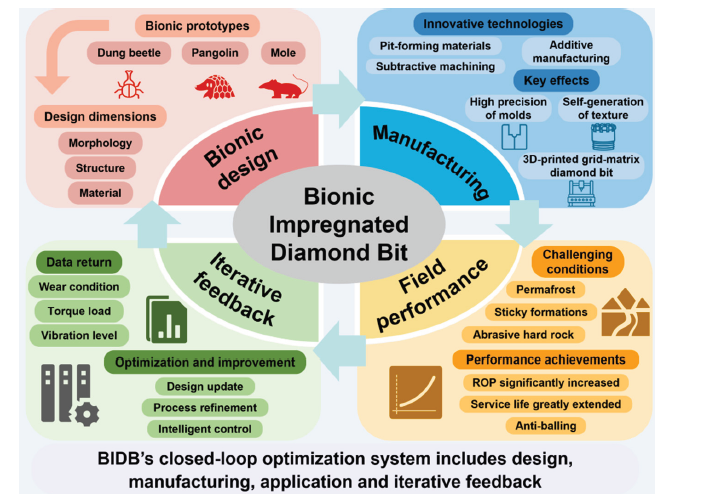
The escalating demand for energy and resources makes their extraction ever more dependent on advances in drilling technology, which serves as an essential enabler in this domain. In recent years, drilling operations has been persistently challenged by complex conditions, including high temperatures, abrasive hard rocks and sticky structure [1]. As one of the core rock-breaking tools commonly used in drilling operations, the Impregnated Diamond Bit (IDB) plays a critical role. However, the IDB also exhibits drawbacks such as bit balling, a limited-service life and a low Rate of Penetration (ROP) [2]. Inspired by the exceptional anti-adhesion, wear resistance and digging efficiency of animals like dung beetle, pangolin and mole, Bionic Impregnated Diamond Bit (BIDB) was pioneered by Prof. Sun Youhong’s team as an effective solution to above drilling challenges [3]. The BIDB has so far undergone experimental validation [4], progressively developed into a mature product and found broad use [5]. This review systematically presents recent advances in the design, manufacturing and performance of BIDB, while also providing an outlook on future development directions (Figure 1).
Bionic Design Optimization Driven by Numerical Simulation
The design of BIDB primarily encompasses three aspects: Morphology, structure and material. From a morphological standpoint, the introduction of non-smooth surfaces inspired by animals is a key strategy based on bionic non-smooth theory to improve anti adhesion and wear resistance [6]. In terms of structure, macro-scale advances that resemble animal claws include integrated “one-body” reinforcement structures that greatly increase the overall strength of high-matrix bits [7] and stepped/heterogeneous cutters that boost rock-breaking efficiency [2]. Regarding material composition, examples include sea urchin teeth-inspired self-sharpening composites [2,8] and shell inspired surface texturing of PDC for reduced friction and thermal wear [9]. Furthermore, numerical simulation especially Finite Element Analysis (FEA) is crucial in the structural design of BIDB. For instance, the development of BIDB has incorporated FEA for optimizing bionic structures, such as the reverse rotary torque selfbalancing dual drill bit and the annular-grooved bit [10,11]. This simulation-driven approach enables the transition from intuitive biomimicry to the rational design of coupled systems. Subsequently, field operational data inform its iterative optimization.
Advanced Manufacturing of Complex Bionic Architectures
The fabrication of BIDB requires advanced manufacturing processes to translate intricate bionic designs into functional tools. Beyond conventional hot-pressing sintering, early innovation involved embedding specially formulated “pit-forming” materials within the matrix. During drilling, the preferential wear of these materials enables the self-generation and maintenance of nonsmooth surface textures [6]. For structurally complex bits, several key manufacturing techniques have been developed. To produce molds with intricate features such as stepped cutters, integrated reinforcement ribs and gradually opening waterways, threedimensional subtractive machining of graphite is employed to ensure high precision [12]. Additive manufacturing has also been explored to enable the fabrication of complex bionic bits, including a 3D printed grid matrix diamond bit and a functionally gradient diamond composite [13,14]. Furthermore, a uniform temperature sintering process tailored for large and complex bits improves matrix homogeneity and reduces energy consumption by more than 50% [15]. Complementing these fabrication methods, the uniform arrangement of diamond grits within the matrix further enhances bit stability and service life by ensuring consistent protrusion and even wear [16,17].
Field Application and performance Evaluation
The performance of BIDB has been rigorously validated through extensive field applications across diverse and challenging geological structures in China. Significant improvements in both service life and drilling efficiency have been consistently documented [18]. For instance, field tests conducted in drilling through granite at the Linglong gold mine in Shandong Province showed that BIDB increased ROP by 44% and extended service life by 74% compared to conventional bits [3,19]. In extremely cold and abrasive permafrost regions of Mohe, Heilongjiang Province, where the lithology is characterized by mudstone sandstone interbeds, bionic bits achieved a 22% higher ROP and a 73% longer service life compared to conventional bits [20]. Furthermore, the unique surface structures of BIDBs effectively mitigate bit-balling issues in soft, sticky structure by enhancing debris removal and maintaining cleaner cutting surfaces, a key factor in sustaining stable drilling parameters. These field results not only validate the potential of BIDB for challenging structures but also supply critical field data to guide iterative optimization.
Summary and Prospects
Above all, BIDB has established a mature, closed-loop development cycle of iterative optimization [1], encompassing bio-inspired design, advanced manufacturing and rigorous field validation [3,5,15]. Furthermore, BIDB has been successfully applied in extreme and complex geological settings, including hard rocks, permafrost regions and adhesive structure such as mudstone and shale, achieving significant performance improvements [19,20]. The future development of BIDBs should focus on three cuttingedge areas. First, inspiration should be drawn from a broader range of biological structures, such as claws, toes and carapaces, to develop innovative designs for new cutting teeth, integrated fluid channels and composite drill bit structures [21]. Second, advanced manufacturing technologies, particularly 3D printing and precision subtractive manufacturing processes [22], should be advanced to enable the low-cost, rapid and precise fabrication of complex BIDBs. Third, measurement technologies near the drill bit should be integrated into BIDBs to monitor real-time drilling parameters, thereby enabling adaptive control and further developing intelligent closed-loop drilling systems.
Acknowledgment
This work was supported by the Fundamental Research Funds for the Central Universities New Teacher Basic Scientific Research Ability Improvement, China (No.2652025021), Natural Science Foundation of Beijing, China (No.2252052), National Natural Science Foundation of China (U23A2025, U25B20122) and open foundation project of the Key Laboratory of Polar Geology and Marine Mineral Resources, Ministry of Education and Hainan Institute of China University of Geosciences, Beijing (HNPY- 202510).
References
- Gao K, Sun YH, Gao RF, Xu L, Wang CL, et al. (2009) Application and prospect of bionic non-smooth theory in drilling engineering. Petroleum Exploration and Development 36(4): 519-541.
- Sun YH, Gao K, Zhang LJ, Li SS, Xu L, et al. (2012) High efficiency and wear resistance mechanism of coupled bionic impregnated diamond bits. Journal of Jilin University 42(S3): 220-225.
- Gao K, Sun YH, Ren LQ, Cao PL, Li WT, et al. (2008) Design and analysis of ternary coupling bionic bits. Journal of Bionic Engineering 5(1): 53-59.
- Gao K, Sun YH, Ren LQ, Wang WL, Xie XB, et al. (2009) Optimization design and experiment of non-smooth degree of bionic impregnated diamond bit. Journal of Jilin University Engineering and Technology Edition 39(3): 721-725.
- Wang ZZ, Zhang ZZ, Sun YH, Gao K, Liang YH, et al. (2016) Wear behaviour of bionic impregnated diamond bits. Tribology International 94: 217-222.
- Wang ZZ, Gao K, Sun YH, Zhang ZZ, Zhang SY, et al. (2016) Effects of bionic units in different scales on the wear behaviour of bionic impregnated diamond bits. Journal of Bionic Engineering 13(4): 659-668.
- Gao K (2022) Research on bionic self-compensating integrated high-matrix impregnated diamond core bit. Exploration Engineering Rock & Soil Drilling and Tunneling 49(1): 16-24.
- Killian CE, Metzler RA, Gong YT, Churchill TH, Olson IC, et al. (2011) Self-sharpening mechanism of the sea urchin tooth. Advanced Functional Materials 21(4): 682-690.
- Yun JQ, Liu BC, Zhai LH, Qi B, Huang F (2025) Bionic surface texturing of polycrystalline diamond compact for enhanced tribological performance: A seashell-inspired strategy. Journal of Materials Research and Technology 38: 3039-3051.
- Zhang C, Gao K, Zhao Y, Xie XB, Zhang CS, et al. (2023) Simulation and experimental study on rock-breaking mechanism of the reverse rotary torque self-balancing dual drill bit. Arabian Journal for Science and Engineering 48(12): 16571-16586.
- Zhang C, Gao K, Lv XS, Liu ZH, Xie XB, et al. (2025) Experimental study on the rock-breaking mechanism of annular-grooved structure and rotary direction for impregnated diamond bits. Geoenergy Science and Engineering 249: 213812.
- Zhang YX, Zhang ZB, Guo XC (2005) CAD/CAM technology for PDC bit mold processing based on Pro/E. Petroleum Machinery 34(5): 52-54.
- Wu JJ, Zhang SH, Liu LL, Qu FL, Zhou H, et al. (2020) Rock breaking characteristics of a 3D printing grid-matrix impregnated diamond bit. International Journal of Refractory Metals and Hard Materials 89: 105212.
- Kong XW, Wu JJ, Wu DY, Rong LR, Zhang SH (2024) Manufacturing and characterization of functionally gradient material from cemented carbide to diamond via filament-based material extrusion 3D printing. Additive Manufacturing 91: 104325.
- Wang JL, Gao K, Li PS, Zhao Y (2023) Research on low-carbon, energy-saving sintering process with uniform temperature for drill bits. Energies 16(17): 6205.
- Zhang DY (2017) Dispensing method enables orderly arrangement of diamonds and improves bit performance. Diamond & Abrasives Engineering 37(4): 11-14.
- Sun YH, Wu HD, Li M, Meng QN, Gao K, et al. (2016) The effect of ZrO2 nanoparticles on the microstructure and properties of sintered WC–bronze-based diamond composites. Materials 9(5): 343-350.
- Wang CL, Sun YH, Liu BC, Wang YX (2011) Experiment and rock fragmentation mechanism analysis of bionic coupled impregnated diamond bit. Journal of Central South University Science and Technology 42(5): 1321-1325.
- Xu L, Sun YH, Li ZW, Wang CL, Sun BL, et al. (2008) Experiment of bionic impregnated diamond bit in Shandong Linglong gold mine. Geology and Exploration: 79-82.
- Cao Y, Liu BC, Ji SL, Li SS, Li XY (2012) Application of bionic impregnated diamond bit in gas hydrate exploration drilling in Mohe permafrost region. Exploration Engineering Rock & Soil Drilling and Tunneling 39: 77-81.
- Zhao Y, Wen YM, Gao K, Wang JL, Zhang CS, et al. (2024) Study on rock-breaking mechanism and bit adaptive characteristics under the action of claw-toe impregnated diamond bit. Geoenergy Science and Engineering 236: 212752.
- Wu JJ, Wang ZH, Zhang HT, Yang W, Zhang SH, et al. (2026) Additive manufacturing of diamond tools: A comprehensive review of technologies, materials, structures and challenges. Diamond and Related Materials 125: 113654.
© 2026 Shaotao Xu. This is an open access article distributed under the terms of the Creative Commons Attribution License , which permits unrestricted use, distribution, and build upon your work non-commercially.
Editor In Chief







.jpg)































Signup for Newsletter

Quick Links
 Editorial Board Registrations
 Submit your Article
 Best Paper of the Volume
 Reprints
 Refer a Friend
 Advertise With Us
Our Recent Edition

.jpg)



Top Editors




.jpg)

















.bmp)
.jpg)
.png)
.jpg)













.jpg)






.png)

.png)




.png)




Financial Support

Sponsors

Latest e-Books

Latest Video

 a Creative Commons Attribution 4.0 International License. Based on a work at www.crimsonpublishers.com.
Best viewed in
a Creative Commons Attribution 4.0 International License. Based on a work at www.crimsonpublishers.com.
Best viewed in 
 | Above IE 9.0 version