

- About Us
- Information
-

The Author ensures that the research has been conducted responsibly and ethically with adherence to all relevant regulations. read more..
- For Authors
- For Reviewer
- Manuscript Guidelines
- Membership
- Publication Ethics
-
- Journals
- Reprints
- e-Books
- Videos
- Policies
- Contact Us
 COVID-19
- Submissions



Full Text
COJ Technical & Scientific Research
Neural Network Technologies and Deep Learning as a Tool for Making Management Decisions
Anara Akmoldina* and Darkhan Abdrahmanov
Department of Information Systems and Technologies, ESIL University, Kazakhstan
*Corresponding author:Anara Akmoldina, Department of Information Systems and Technologies, ESIL University, Astana, Kazakhstan
Submission: February 24, 2026:Published: April 08, 2026

Volume6 Issue1April 08, 2026
Abstract
This article examines modern neural network technologies and deep learning methods as tools for supporting and optimizing management decisions in the context of digital transformation. Based on an analysis of scientific reviews on Bayesian deep learning, multivariate time series processing, image segmentation and 3D reconstruction, it is shown that deep learning methods can significantly improve forecasting accuracy, reduce uncertainty and enable comprehensive data analysis for strategic planning. Particular attention is paid to the application of intelligent data analysis methods in risk management, monitoring and evaluating the effectiveness of management decisions.
Keywords:Deep learning; Neural networks; Management decisions; Bayesian approach; Big Data; Data mining
Opinion
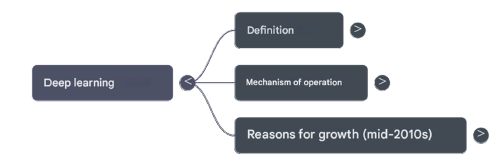
Deep learning is a subset of machine learning based on the use of multilayer neural networks to automatically extract hierarchical features from data. By the mid-2010s, the field experienced rapid growth due to increasing data volumes, the availability of computing power (GPUs) and breakthrough architectures. Figure 1 is a mind map illustrating the key aspects of deep learning: Its definition, how it works and the reasons for its exponential growth in the mid-2010s.
Diagram 1:Deep learning mind map.
Modern management decisions are made in conditions of high uncertainty, a dynamic external environment and exponential growth in data volumes. Traditional analytical methods are increasingly proving insufficient for processing heterogeneous, multidimensional and incomplete information. In these conditions, neural network technologies and deep learning methods are becoming key tools for supporting management decision-making. Deep learning makes it possible to identify hidden patterns in large data sets, predict the development of complex systems and generate intelligent recommendations for decisionmakers. The application of these technologies is relevant for strategic planning, risk management, monitoring socioeconomic processes and evaluating the effectiveness of government and corporate programs. One promising area is Bayesian deep learning, which combines neural networks with probabilistic models. Unlike classical neural network approaches, Bayesian models not only allow for forecasting but also for quantifying the level of uncertainty in the results obtained. As noted in the review by Wang H and Yeung DY [1] a Bayesian approach is particularly important for making management decisions in critical areas where errors can have significant social or economic consequences. The ability to estimate forecast confidence intervals improves the validity of management decisions and reduces the risks associated with making decisions based on incomplete information [1]. Multivariate time series are widely used in the management of socio-economic systems, financial analysis and monitoring of infrastructure and environmental processes. However, real-world data often contain missing values, noise and anomalies.
According to the review by Hayati M et al. [2] deep learning methods demonstrate high efficiency in missing value imputation and forecasting time series dynamics. The use of recurrent neural networks, autoencoders and transformer architectures enables more accurate forecasts, which directly impacts the quality of management decisions in resource planning and management problems [2]. Deep learning methods in computer vision are widely used in the management of territories, industrial facilities and infrastructure. Reviews by F. Porikli and Yu Jin et al. [3] demonstrate the effectiveness of neural network methods in image segmentation and 3D reconstruction [3]. Image segmentation enables the automatic identification of objects of interest in satellite and aerial images, which is used in monitoring the urban environment, land use and environmental risks. 3D reconstruction, in turn, facilitates the creation of digital twins of objects and territories, providing a basis for scenario analysis and strategic planning.
The integration of neural network models into decision support systems enables the transition from intuitive management to data-driven management. Deep learning enables the automation of analysis, the identification of complex relationships and the generation of predictive scenarios.
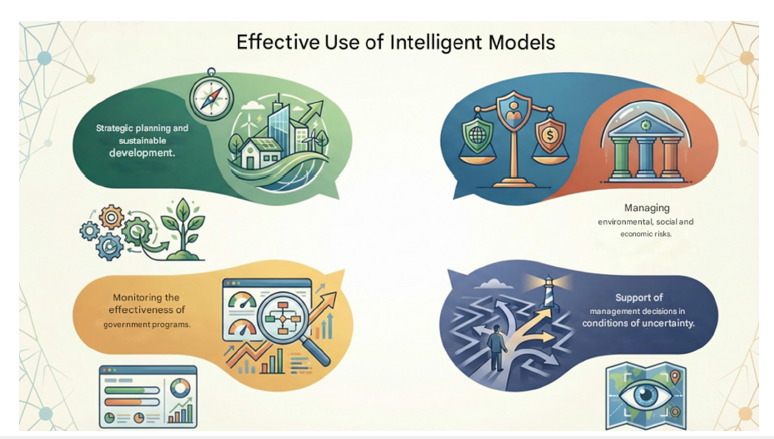
The use of intelligent models is particularly effective in the
following tasks:
a) strategic planning and sustainable development
assessment.
b) environmental, social and economic risk management.
c) monitoring the effectiveness of government programs.
d) Supporting management decisions under uncertainty.
The structure of the effective application of intelligent models in management decision-making is presented in Figure 1.
Figure 1:Effective application of intelligent models in management decision-making.
Thus, neural network technologies are becoming an integral element of digital management systems. The analysis shows that neural network technologies and deep learning methods offer significant potential for improving the quality of management decisions. Bayesian models, time series analysis, computer vision and 3D reconstruction methods form the intellectual foundation for modern strategic management systems. Further development of these technologies and their integration into management processes will facilitate the development of sustainable, adaptive and scientifically sound decisions in the digital economy.
References
- Wang H, Yeung DY (2020) A Survey on bayesian deep learning. ACM Computing Surveys 53(5): 1-37.
- Khayati M (2020) A review of deep learning methods for missing data imputation in multivariate time series.
- Porikli F (2020) Deep learning for image segmentation: A Survey.
© 2026 Anara Akmoldina. This is an open access article distributed under the terms of the Creative Commons Attribution License , which permits unrestricted use, distribution, and build upon your work non-commercially.
Editor In Chief







.jpg)































Signup for Newsletter

Quick Links
 Editorial Board Registrations
 Submit your Article
 Best Paper of the Volume
 Reprints
 Refer a Friend
 Advertise With Us
Our Recent Edition

.jpg)



Top Editors




.jpg)

















.bmp)
.jpg)
.png)
.jpg)













.jpg)






.png)

.png)




.png)




Financial Support

Sponsors

Latest e-Books

Latest Video

 a Creative Commons Attribution 4.0 International License. Based on a work at www.crimsonpublishers.com.
Best viewed in
a Creative Commons Attribution 4.0 International License. Based on a work at www.crimsonpublishers.com.
Best viewed in 
 | Above IE 9.0 version