

- About Us
- Information
-

The Author ensures that the research has been conducted responsibly and ethically with adherence to all relevant regulations. read more..
- For Authors
- For Reviewer
- Manuscript Guidelines
- Membership
- Publication Ethics
-
- Journals
- Reprints
- e-Books
- Videos
- Policies
- Contact Us
 COVID-19
- Submissions



Full Text
COJ Robotics & Artificial Intelligence
Solar-Aware Robotic Stone Machining with Mixed-Case Palletizing and AIBased Condition Monitoring: A Case Study and Reference Architecture
Thien-Trang Nguyen-Ngoc1 and Khuong Nguyen-Vinh2*
1 Bosch BGSV, Ho Chi Minh City, Vietnam
2 School of Science, Engineering and Technology, RMIT University, Ho Chi Minh City, Vietnam
*Corresponding author: Khuong Nguyen- Vinh, School of Science, Engineering and Technology, RMIT University, Ho Chi Minh City, Vietnam
Submission: July 27, 2026;Published: September 25, 2026

ISSN:2832-4463 Volume5 Issue4
Abstract
Robotic machining cells are commonly engineered independently from material-flow optimization, renewable-energy supervision, and condition-monitoring functions, which limits factory-level coordination and makes system claims difficult to verify. This case study consolidates two implemented foundations-an ABB IRB 6700 stone-machining cell and ABBP, a mixed-case palletizing decision-support prototype-and defines a safety-separated reference architecture for their future integration with photovoltaic metering and advisory artificial-intelligence-based condition monitoring. ABBP combines a height-guided anchor-point heuristic with a hybrid genetic algorithm subject to pallet boundaries, non-overlap, weight, and a 70% base-support constraint. A Python optimization service exchanges JSON records with a C++/Qt interface for real-time three-dimensional inspection and slicing. The reported benchmark used 120 boxes from 12 types, a population of 50 and 20 generations. One recorded run required 10.86 min and obtained 79.39% pallet-volume utilization, placing 58 boxes with a mass of 278.05kg, an air-exposure score of 0.84, a centre-of-gravity score of 0.78 and a composite fitness of 0.8055. These results verify the palletization prototype and supervisory visualization for the documented case; they do not validate physical robot palletizing, solar contribution, or condition-monitoring accuracy. The proposed architecture therefore keeps deterministic robot and safety control independent while using AI only for anomaly scoring, maintenance prioritization and energy-aware scheduling advice. A reproducibility protocol, evidence-status matrix, explicit results section, limitations, conclusions and staged future-validation plan are provided.
Keywords:Industrial robot; Robotic machining; Mixed-case palletizing; Genetic algorithm; 3D visualization; Photovoltaic energy; Condition monitoring; Reference architecture
Introduction
Industrial robots provide a flexible alternative to dedicated machine tools for large or geometrically complex components, including stone, composite and lightweight structures. Their larger workspaces and reconfigurability are attractive for low-volume manufacturing, but machining accuracy remains sensitive to pose-dependent stiffness, joint compliance, tool-centre-point error and process vibration. The previously reported ABB IRB 6700 stonemachining cell addressed the physical process through an external rotary table, spindle, tool magazine, CAD/CAM toolpath generation and RobotStudio verification [1]. Recent reviews and experimental studies continue to identify compliance compensation, workpiece placement, posture optimization, chatter detection, and process monitoring as central requirements for dependable robot-assisted machining [2-6].
A machining cell is nevertheless only one part of a manufacturing system. Tools, consumables, inspection items, and packaged output must be sequenced and handled; electrical demand must be coordinated with available generation; and process degradation must be detected before it causes quality loss or unplanned downtime. The ABBP mixed-case palletizing prototype used in this case provides the logistics decisionsupport foundation [7]. Mixed-case palletizing is a constrained three-dimensional packing problem in which feasible solutions must satisfy pallet boundaries, non-overlap, support, weight, and stability requirements; established and recent approaches include constructive heuristics and hybrid or online optimization methods [8,9]. At the same time, photovoltaic and manufacturing-system research has moved toward resource assessment, maximumpower- point tracking, fault monitoring, predictive maintenance, digital twins, and energy-aware decision support [10-17].
The gap addressed in this report is not the invention of another isolated robot, packing, photovoltaic, or anomaly-detection algorithm. It is the disciplined integration of these functions at the supervisory level while keeping the evidence boundary explicit. The two implemented foundations were developed separately and have not yet been operated as one physical system. Consequently, the paper distinguishes: (i) implemented and documented functions; (ii) results verified from the recorded ABBP benchmark; and (iii) proposed functions that require future experimental validation.
The objectives are to: (1) document the implemented palletization workflow and its reproducible benchmark configuration; (2) specify the proposed architecture, data flows, interfaces, safety separation, and decision responsibilities in sufficient detail for implementation; (3) present the available benchmark results before interpreting them; and (4) define a staged validation plan for robot execution, energy performance, and condition-monitoring accuracy. Section 2 reviews the relevant literature. Section 3 describes the case evidence and methods. Section 4 specifies the integrated architecture. Section 5 reports the benchmark results, followed by discussion, conclusions, future work, and data/code availability.
Related Work
Robotic machining, compensation, and monitoring
Robot-assisted machining trades some structural rigidity for workspace and flexibility. Compensation methods therefore target geometric calibration, force- or stiffness-aware path correction, posture selection and vibration suppression [2-4]. A 2025 multidomain study demonstrated that chatter monitoring must account for changes in robot pose because the dynamic response of a serial manipulator varies across its workspace [5]. Non-intrusive monitoring with vibration and acoustic-emission sensing has also been used to estimate machining-product health with uncertainty information [6]. In 2026, combined workpiece-placement and posture optimization was reported to reduce vibration energy across representative machining features while preserving kinematic quality [18]. These studies support the sensor and advisory functions proposed here, but their trained models and experimental results cannot be transferred directly to stone machining without a new dataset and validation campaign.
Mixed-case palletizing and human-verifiable optimization
Pallet loading has long been studied using constructive heuristics and metaheuristics. The G4 heuristic is an established reference for pallet loading [8], while hybrid genetic approaches can combine deterministic construction rules with global search [7- 9]. For industrial deployment, however, a numerical objective alone is insufficient: each proposed stack must remain geometrically feasible, supported, stable, and inspectable by an operator before execution. Recent online palletization research for varying box dimensions reported average pallet-space utilization between 75.63% and 82.88% across common pallet types, illustrating both the feasibility of adaptive algorithms and the dependence of reported utilization on the dataset, pallet, arrival model, and physical assumptions [9]. The ABBP prototype contributes a human-in-the-loop 3D interface and slicing function in addition to optimization [7].
Solar-aware supervision and predictive maintenance
For a solar-assisted factory, photovoltaic generation should be treated as a measured and uncertain resource rather than a constant offset. Metered generation, inverter state, irradiance, module temperature, and load demand are required before buffer size or energy contribution can be quantified. Physical-neural-network maximum-power-point tracking can improve energy extraction under changing irradiance [11], whereas photovoltaic faultdiagnosis and reliability studies emphasize continuous monitoring, fault taxonomy, and predictive maintenance for modules, wiring, inverters, and grid interfaces [12,13]. At the manufacturing-system level, a digital-twin-based learning framework has shown that robot decisions can be evaluated virtually before delayed deployment to the physical controller, reducing the risks of direct online learning [14]. Broader photovoltaic resource and deployment studies provide additional context for the proposed energy layer [10,15- 17]. These findings motivate a supervisory architecture in which optimization and AI generate advice, while certified execution and safety functions remain deterministic and independent.
Case Context and Methods
Evidence base and system boundary
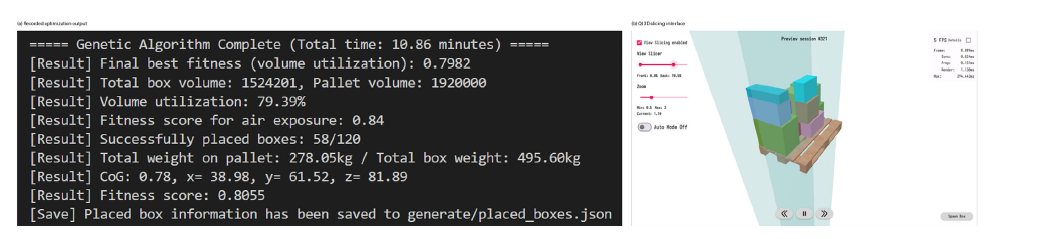
The case combines two evidence sources. The first is the published ABB IRB 6700 stone-machining system, which establishes the robot, spindle, external axis, CAD/CAM, and RobotStudio foundation [1]. The second is the 2025 Smart Mixed Case Palletizing capstone report developed with ABB, referred to as ABBP [7]. The capstone provides the recorded optimization output, software-interface description, benchmark configuration, and 3D visualization reproduced in Figure 1. No physical link between ABBP and an ABB robot, no photovoltaic installation on the cell, and no trained condition-monitoring model were included in the supplied case evidence. Those elements are therefore specified as proposed extensions rather than reported results.
Figure 1:Recorded ABBP optimization output and Qt 3D slicing interface. The exact input/output files and sourcecode package are addressed in the Data and Code Availability section. Source: ABBP capstone project [7].
ABBP input, optimization, and interface
ABBP accepts box dimensions, box mass, load capacity, box quantity and pallet selection through manual entry or JSON input. The Python backend generates candidate placement sequences. A C++/Qt-QML client communicates through an applicationprogramming interface, renders the stack in real time and supports Euro, industrial, and Asian pallet types, automatic or stepwise playback, camera control and a movable slicing plane for manual verification [7]. The output log records the packed volume, pallet volume, volume utilization, number and mass of placed boxes, airexposure score, centre-of-gravity score and coordinates, composite fitness, runtime, and the location of the generated placed_boxes. json file.
The constructive stage sorts boxes by non-increasing height and tests dynamically generated anchor points. A candidate placement is rejected when it exceeds a pallet boundary, overlaps an existing box, violates a weight check, or provides less than 70% support under its base. The hybrid genetic stage encodes box order, seeds part of the population with heuristic sequences and evaluates objectives related to occupied volume, centre of gravity, and air exposure or compactness. Tournament selection, one-point crossover, mutation and adaptive probability changes are applied when the population stagnates [7-9].
Benchmark configuration and evaluation measures
(Table 1) Volume utilization is reported by ABBP as packed box volume divided by pallet volume. Box-completion ratio and massloading ratio were calculated in this revision as the number and mass placed divided by their respective totals. Because only one run is available, the paper reports no mean, standard deviation, confidence interval, or statistical comparison. The runtime must likewise be interpreted as a case record rather than a hardwareindependent algorithmic benchmark.
Table 1:Recorded ABBP benchmark configuration.

Source: Compiled by authors from [7].
Reproducibility protocol
A complete reproduction package should contain:
1) The exact 120-box input JSON file, including box
identifiers, dimensions, masses, quantities, pallet dimensions, load
limit, and unit conventions;
2) The Python optimization source and dependency
versions;
3) The C++/Qt interface source and build instructions;
4) The random seed and command used for the displayed
run;
5) The generated placed_boxes.json file and console log; and
6) A README that defines the objective components and
coordinate system. Table 2 summarizes the algorithmic sequence
reconstructed from the documented ABBP implementation [7-9]
(Table 2 & Figure 1).
Table 2:Case-level pseudocode reconstructed from the ABBP description [7-9].

Source: by authors.
Proposed Integrated Architecture
Design principles and evidence status
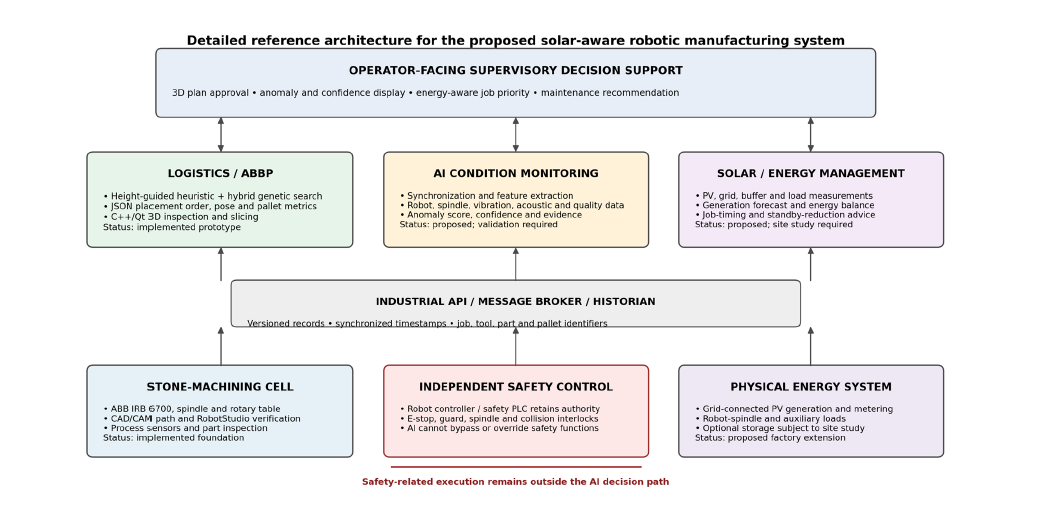
The proposed system is a supervisory integration rather than a replacement for the robot controller, spindle controller, or safety system. Its design follows four principles. First, every data record is traceable to a timestamp, job, part, tool, robot program and pallet. Second, AI outputs are advisory and include an anomaly score, confidence and supporting features rather than an opaque stop command. Third, a human operator approves maintenance and production changes until sufficient validation exists for limited automation. Fourth, independent interlocks retain authority over motion, guarding, emergency stops, spindle enable, collision checks and dust-control status. Figure 2 presents the proposed supervisory architecture and the separation between implemented foundations, proposed supervisory functions and independent safety control (Figure 2).
Figure 2:Detailed reference architecture. Green/blue blocks represent implemented foundations; yellow/purple supervisory functions are proposed and require validation. Source: by authors.
Physical machining and safety layer
The physical machining layer contains the ABB IRB 6700, spindle, external rotary table, tool magazine, work holding, and dustmanagement equipment. Validated CAD/CAM paths are checked in RobotStudio before transfer to the robot controller. The proposed data interface reads cycle state, joint position, motor current or estimated torque, spindle speed and power, tool identifier, alarm state and part identifier. Accelerometers or acoustic sensors may be installed on the spindle housing, tool holder, work holding, or robot structure, but their mounting, sampling rate, bandwidth and environmental protection must be documented. The safety controller remains electrically and logically separate from the AI service. A lost network connection, invalid AI output, or unavailable historian must not disable a safety function or change an approved robot path.
Logistics decision layer
ABBP supplies a pallet sequence and placement record for boxed consumables, tools, inspection items, or packaged products. Each placement record should include box ID, dimensions, mass, orientation, position, placement order, support ratio, pallet ID and solution metrics. Before physical robot execution, the record must be converted into robot targets and validated for gripper access, approach/retreat clearance, singularity avoidance, payload and centre-of-gravity limits and collision-free motion. The 3D slicing interface provides a human verification gate. Direct execution of ABBP coordinates was not implemented in the documented capstone; the first deployment should therefore use RobotStudio or another digital twin before any physical palletizing trial.
Solar and energy-management layer
The energy layer comprises a grid-connected photovoltaic array, inverter, revenue- or research-grade meters and an optional electrical buffer. Required measurements are photovoltaic DC and AC power, inverter status, irradiance, module temperature, grid import/export and robot-spindle plus auxiliary load. A simple supervisory energy balance can be evaluated at each timestamp as net grid demand equal to manufacturing load minus photovoltaic output and permitted buffer discharge. The system may recommend shifting non-urgent machining or palletizing jobs toward periods of higher expected generation, but it should not interrupt an active cut or compromise process quality. Buffer capacity and photovoltaic contribution cannot be reported until a representative load profile and site-generation profile are measured.
AI-based condition-monitoring layer
The monitoring pipeline consists of data validation, synchronization, preprocessing, feature generation, model inference, thresholding, visualization and feedback. Candidate inputs include spindle power, robot current or torque, vibration, acoustic emission, tool age, programmed feed and speed, robot pose and post-process dimensional or surface-quality measurements. A baseline model is trained only on labelled or carefully screened normal cycles; predefined fault or degradation cases are then used to assess sensitivity, specificity, false-alarm rate, detection delay, calibration and uncertainty. Suitable initial methods include statistical control limits, one-class anomaly detection, autoencoders, or probabilistic regression. Model selection is a future experimental decision; no architecture-level claim of diagnostic accuracy is made in this report.
Communication, storage, and operator workflow
The Python optimizer, Qt interface, robot data collector, photovoltaic meter, and monitoring service exchange versioned records through an industrial API or message broker. A historian stores raw and processed data with synchronized clocks and immutable identifiers. The operator workflow is: select job and pallet; generate and inspect the ABBP plan; verify robot-path conversion in the digital twin; confirm energy availability and production priority; execute under existing safety controls; review anomaly and quality indicators; and record maintenance or falsealarm feedback. This feedback closes the learning loop without allowing the learning service to bypass the approved controller. Table 3 summarizes the responsibilities, inputs, outputs and evidence status of each architecture layer (Table 3).
Table 3:Case-level pseudocode reconstructed from the ABBP description [7-9].

Source: by authors.
Result
Recorded ABBP benchmark results
The recorded and derived benchmark results are reported in Table 4.
Table 4:Recorded and derived ABBP benchmark results. Source: authors’ calculations based on [7].

The displayed run produced a geometrically feasible pallet plan under the implemented checks and achieved 79.39% use of the recorded pallet volume. The box-count and mass ratios show that high volume utilization did not imply that most input items were accepted: 48.33% of the boxes and 56.10% of the available mass were placed. This distinction is important when the operational objective is order completion rather than single-pallet utilization. The air-exposure and centre-of-gravity components were both positive contributors to the composite fitness of 0.8055, but the source report did not provide their exact weighting or a baseline solution for comparison.
The Qt interface rendered the stack and allowed the user to move a slicing plane through the packed volume. This result verifies the transfer of the generated plan to the supervisory visualization and provides an operator-inspection mechanism. It does not verify gripper accessibility, robot path feasibility, load movement during acceleration, packaging deformation, or execution time on an industrial robot.
Results available for the integrated architecture
No quantitative result is available for the complete architecture because the photovoltaic system, robot-linked palletizing, synchronized historian and condition-monitoring model were not implemented as one testbed. Accordingly, this paper reports architecture requirements and a validation protocol rather than simulated energy savings or diagnostic accuracy. This boundary prevents the case report from treating proposed functionality as experimentally demonstrated performance.
Discussion
The main verified contribution is the combination of a constrained optimizer and a human-verifiable 3D interface. The 79.39% utilization value lies within the 75.63-82.88% average range reported by a recent online palletization study [9], but the comparison is only contextual: the algorithms, datasets, pallet sizes, arrival assumptions, stability criteria and computation platforms differ. A fair comparison would require identical public instances, repeated seeds, the same feasibility rules, and reporting of solution quality against runtime.
The result also exposes a practical trade-off. A 10.86-min calculation may be acceptable for offline planning of a stable batch, but it is too slow for rapid replanning after frequent order or sensor changes. The next implementation should measure heuristiconly time, genetic improvement over the heuristic seed, fitness convergence by generation and the effect of population size. Multipallet objectives should additionally penalize unplaced order lines and consider downstream picking sequence, rather than optimizing only the occupied volume of one pallet.
For stone machining, condition monitoring should be pose- and process-aware. Recent studies show that robot dynamics, stiffness, and chatter signatures vary with posture [5,18], while nonintrusive vibration and acoustic signals can support product-health estimation when uncertainty is reported [6]. A model trained on another robot, material, or process cannot be assumed valid. The proposed layer therefore stores robot pose, tool, program, feed, spindle speed and quality labels with every signal window and requires controlled degradation tests before deployment.
The solar-aware extension is technically plausible but presently unquantified. Photovoltaic output is intermittent and machining quality should not be compromised to follow short-term generation. The highest-value supervisory use is likely to be schedule advice for flexible jobs, standby reduction and measured energy accounting. The architecture also separates photovoltaic condition monitoring from machining condition monitoring because their sensors, failure modes, and validation datasets differ [10-13,15-17].
The case has several limitations. Only one ABBP run was available; box-level input data, code, hardware specifications, random seed, convergence history and repeated trials were not included in the submitted source material. The stone cell and ABBP were developed separately. No physical palletizing, moving-load test, irregular packaging test, sensor calibration, seasonal photovoltaic study, cybersecurity assessment, or AI faultclassification experiment has been completed. These limitations constrain the conclusion to feasibility of the documented optimization and supervisory concept.
Conclusion and Future Work
This case study documents an implementable route from two separate foundations toward a solar-aware robotic manufacturing system. The ABB IRB 6700 cell establishes the robotic stonemachining process, while ABBP demonstrates constrained mixedcase pallet optimization and real-time 3D plan inspection. In the recorded 120-box case, ABBP achieved 79.39% pallet-volume utilization, placed 58 boxes weighing 278.05kg, and produced a composite fitness of 0.8055 in 10.86min. These results support the feasibility of offline pallet-plan generation and operator verification for the documented instance. They do not demonstrate physical robot palletizing, energy savings, photovoltaic contribution, or AI condition-monitoring accuracy. The reference architecture therefore preserves independent robot and safety control and limits AI to traceable advisory functions until each subsystem has been validated.
Future validation will proceed in five stages. First, the exact dataset, source code, dependency versions, hardware specification, random seed and expected output will be released and the benchmark repeated across multiple seeds and public pallet instances. Second, the height heuristic, hybrid genetic algorithm and recent online palletizing methods will be compared using utilization, order completion, stability, runtime and robustness metrics. Third, placement records will be imported into RobotStudio, gripper and collision models added, and instrumented low-speed physical trials performed with shifting-load and packaging-variation tests. Fourth, representative robot, spindle, auxiliary-load, photovoltaic, irradiance and temperature data will be collected to size the energy layer and calculate energy per accepted part. Fifth, labelled normal, tool-wear, chatter, imbalance, sensor-fault and part-quality cases will be created to evaluate anomaly detection under heldout operating conditions, while human approval and independent safety interlocks are retained during deployment.
Acknowledgements and Data Contribution
The ABBP results originated from the RMIT capstone project Smart Mixed Case Palletizing by Nguyen Gia Khanh, Pham Trang Phi, Sanghwa Jung, Nguyen Quoc Hung and Potemkin Pavel [7], supervised by Dr. Khuong Nguyen Vinh with ABB industry supervision by Dr. Ninh Ho Nguyen.
Data and Code Availability
According to the NDA with ABB, the code will be available upon reasonable request.
Conflict of Interest
The authors declare no conflict of interest.
References
- Nguyen-Vinh K, Hattotuwa DD, Dewasurendra H (2023) Design and implementation of a robotic stone machining system. IEEE IAS Global Conference on Emerging Technologies, UK, pp: 1-8.
- Pedroso AFV, Sebbe NPV, Silva FJG, Campilho RDSG, Sales-Contini RCM, et al. (2025) An overview on the recent advances in robot-assisted compensation methods used in machining lightweight materials. Robotics and Computer-Integrated Manufacturing 91: 102844.
- Hahn F, Weigold M (2020) Hybrid compliance compensation for path accuracy enhancement in robot machining. Production Engineering 14: 425-433.
- Kim TH, Noe SH, Choi YM, Lee HJ (2023) Vibration-damped tool holders in industrial robotic machining systems. International Journal of Precision Engineering and Manufacturing 24: 1535-1548.
- Zhang X, Zheng L, Fan W, Mao L, Li Z, et al. (2025) Multi-domain data-driven chatter detection in robotic milling under varied robot poses based on directional attention mechanism. Mechanical Systems and Signal Processing 227: 112406.
- Papananias M (2025) Bayesian monitoring of machining processes using non-intrusive sensing and on-machine comparator measurement. International Journal of Advanced Manufacturing Technology 137: 1929-1942.
- Nguyen GK, Pham TP, Jung S, Nguyen QH, Potemkin P (2025) Smart mixed case palletizing. Engineering & IT Capstone Final Report, RMIT University, prepared with ABB.
- Scheithauer G, Terno J (1996) The G4-Heuristic for the pallet loading problem. Journal of the Operational Research Society 47(4): 511-522.
- Kaczmarek M, Okunski P, Debinski R, Kryzel S, Mikulevich T, et al. (2026) Multi-layer vertex refinement algorithm for online palletization of boxes with varying dimensions. IEEE Access 14: 10623-10634.
- Nguyen-Vinh K, Nguyen-Quang N, Leonowicz Z, Novak T, Gono R, et al. (2024) Comparing potential energy from the sun during a year in Czechia and Vietnam. 2024 24th International Scientific Conference on Electric Power Engineering (EPE), Czech Republic, pp: 1-5.
- Nguyen-Vinh K, Rangaraju S, Jasinski M (2025) Mod Tanh-activated physical neural network MPPT control algorithm for varying irradiance conditions. Energy Science & Engineering 13(6): 2606-2619.
- Nguyen-Vinh K, Vo-Huynh QN, Nguyen-Minh K, Hoang M, Rangaraju S (2023) Case study: Utilising of deep learning models for fault detection and diagnosis of photovoltaic modules to improve solar energy constructions’ O&M activities quality. Information Systems Research in Vietnam, Springer, Singapore, 2: 53-67.
- Kull K, Asad B, Khan MA, Naseer MU, Kallaste A, et al. (2025) Faults, failures, reliability, and predictive maintenance of grid-connected solar systems: A comprehensive review. Applied Sciences 15(21): 11461.
- Mo F, Rehman HU, Chaplin JC, Sanderson D, Ratchev S (2025) Digital twin-based self-learning decision-making framework for industrial robots in manufacturing. The International Journal of Advanced Manufacturing Technology 139: 221-240.
- Nguyen KV, Nguyen-Quang N (2015) Design and simulation of a photovoltaic-based energy system for mobile device chargers at public place. International Journal of Electrical and Electronics Engineering Research 5(1): 111-118.
- Le VD, Le TT, Rangaraju S, Vo PL, Nguyen KV (2023) The potential for solar energy in Vietnam in 2023. International Journal of Management and Technology for Research Studies 5: 1-5.
- Rangaraju S, Isaac O, Nguyen K, Vo P, Arjun A (2021) Guaranteed O&M for solar plants in Vietnam-a review & proposal on guaranteed O&M service to foster sustainable energy generation by maximizing solar energy production and safeguarding investment. International Journal of Engineering and Applied Sciences 8(7): 24-27.
- Souflas T, Gerontas C, Stavropoulos P (2026) Combined workpiece placement and posture optimization in robot machining considering stiffness and kinematic performance. The International Journal of Advanced Manufacturing Technology 143: 6573-6599.
© 2026 Khuong Nguyen-Vinh. This is an open access article distributed under the terms of the Creative Commons Attribution License , which permits unrestricted use, distribution, and build upon your work non-commercially.
Editor In Chief







.jpg)































Signup for Newsletter

Quick Links
 Editorial Board Registrations
 Submit your Article
 Best Paper of the Volume
 Reprints
 Refer a Friend
 Advertise With Us
Our Recent Edition

.jpg)



Top Editors




.jpg)

















.bmp)
.jpg)
.png)
.jpg)













.jpg)






.png)

.png)




.png)




Financial Support

Sponsors

Latest e-Books

Latest Video

 a Creative Commons Attribution 4.0 International License. Based on a work at www.crimsonpublishers.com.
Best viewed in
a Creative Commons Attribution 4.0 International License. Based on a work at www.crimsonpublishers.com.
Best viewed in 
 | Above IE 9.0 version