

- About Us
- Information
-

The Author ensures that the research has been conducted responsibly and ethically with adherence to all relevant regulations. read more..
- For Authors
- For Reviewer
- Manuscript Guidelines
- Membership
- Publication Ethics
-
- Journals
- Reprints
- e-Books
- Videos
- Policies
- Contact Us
 COVID-19
- Submissions



Full Text
COJ Robotics & Artificial Intelligence
Cyborg Concrete as an Engineered Convergence of Living Systems and Machine Intelligence
Zeenat Khan1*, Mahin Jamil2 and Daud Khan3
1Department of Bioinformatics and Biosciences, Capital University of Science & Technology, Islamabad, Pakistan
2Department of Civil Engineering, University of Engineering and Technology (UET), Taxila, Pakistan
3Department of Civil Engineering, Capital University of Science & Technology, Islamabad, Pakistan
*Corresponding author: Zeenat Khan, Department of Bioinformatics and Biosciences, Capital University of Science & Technology, Islamabad, Pakistan
Submission: February 12, 2026;Published: March 24, 2026

ISSN:2832-4463 Volume5 Issue2
Abstract
Rapid urban growth, climate-related stress and aging infrastructure are revealing the limitations of traditional construction materials, which rely on periodic inspection and reactive maintenance, prompting the development of cyborg concrete as a bio-cyber-physical construction material system that integrates biologically mediated self-healing, embedded sensing and AI-supported robotic intervention within a closed feedback loop. Unlike conventional smart concrete, which primarily relies on passive sensing, cyborg concrete establishes multi-scale interactions between biological repair, digital analytics and physical maintenance, enabling structures to autonomously detect, assess and respond to damage in real time. Biological components, including microbial biosensors and self-healing bacteria, provide internal awareness by detecting environmental changes and sealing microcracks through mineral precipitation, while robotic platforms such as drones, soft robotic repair systems and robotic bioprinting enable precise inspection and intervention on complex structures. AI algorithms analyze continuous data streams to predict deterioration, guide maintenance decisions and coordinate robotic actions, forming an integrated framework for adaptive infrastructure management. Experimental studies report crack sealing of 0.2-0.8 mm, partial compressive strength recovery of 15-40%, AI-based crack detection accuracies of 92-98% and drone-assisted inspections reducing assessment time by approximately 60% relative to manual methods. Despite these advances, challenges remain, including bacterial stability under high pH, long-term sensor durability, AI generalizability, robotic localization precision, biosafety, cybersecurity, and the need for regulatory frameworks. While individual technologies are approaching high technology readiness levels, full triadic integration remains at an early experimental stage. Cyborg concrete provides a conceptual framework for next-generation adaptive infrastructure, requiring material-level validation, system integration research and interdisciplinary collaboration to realize resilient, adaptive, and self-sustaining infrastructure in complex urban environments.
Keywords:Cyborg concrete; Bio-hybrid materials; Robotic construction; Artificial intelligence; Self-healing infrastructure
Highlights
a) Combines biological systems, robotics, and AI to enable infrastructure that can monitor and repair itself.
b) Integrates microbial self-healing with robotic inspection and data-driven maintenance strategies.
c) Highlights emerging technologies and future research pathways for adaptive and resilient smart infrastructure.
Introduction
Infrastructure around the world is under growing strain as cities expand, populations increase, and environmental pressures intensify [1]. Much of the existing built environment was not designed to withstand the combined effects of climate change, heavy usage and long service lifespans [2]. Traditional construction materials remain largely passive, requiring manual inspection and reactive repair only after visible damage has occurred [3]. This approach is increasingly unsustainable, as delayed maintenance can lead to higher costs, reduced structural safety and shortened infrastructure life cycles [4]. As a result, researchers and engineers are now exploring ways to transform infrastructure into systems that can actively sense their own condition and respond to emerging risks in real time.
One promising response to these challenges is the concept of cyborg concrete, which combines biological materials, robotic technologies and artificial intelligence within a single integrated framework [5]. Rather than functioning as inert structural components, cyborg concrete systems incorporate living microorganisms capable of initiating self-healing processes and embedded biosensors that monitor internal environmental changes [6]. Robotic inspection tools provide detailed, continuous assessments of structural surfaces and hard-to-access regions, while artificial intelligence analyzes large volumes of data to identify patterns of deterioration [7]. Together, these technologies enable infrastructure to shift from a reactive maintenance model toward a more adaptive and predictive system.
A key feature of cyborg concrete lies in the interaction between biological sensing mechanisms and robotic monitoring platforms. Engineered microbial biosensors can detect early signs of damage such as chemical imbalance, moisture intrusion, or corrosion before visible cracks appear [8]. Autonomous drones and ground robots collect structural data efficiently and safely, particularly in hazardous or complex environments [9]. Artificial intelligence integrates biological signals with robotic sensor outputs to generate predictive maintenance insights, enabling timely intervention and reducing the likelihood of catastrophic failure [10]. Furthermore, microbial self-healing processes combined with robotic repair systems create hybrid solutions capable of addressing both microlevel and macro-level structural damage.
Despite its potential, cyborg concrete also introduces important technical, ethical and practical considerations that must be addressed to ensure safe implementation [11]. Questions remain regarding the long-term stability of embedded biological components, the reliability of AI-driven decision-making and the cybersecurity of interconnected infrastructure systems [12]. At the same time, rapid advances in synthetic biology, soft robotics, digital twin technology, and automated construction methods continue to expand the possibilities of intelligent infrastructure [13]. This mini-review examines the emerging foundations, technological advancements, challenges, and future research directions of cyborg concrete, highlighting its promise as a pathway toward more resilient, adaptive, and sustainable smart infrastructure.
Conventional reinforced concrete structures are passive systems that rely on periodic inspection and reactive maintenance [14]. Micro-cracking, chloride ingress, reinforcement corrosion, and fatigue damage accumulate before detection, leading to costly rehabilitation and reduced service life [15]. Structural Health Monitoring (SHM), self-healing materials, and robotic inspection technologies have emerged independently to address these limitations [16]. However, these domains remain largely fragmented. This review formalizes the concept of cyborg concrete as an integrated bio-cyber-physical construction material system in which biological repair, sensing technologies, computational intelligence, and robotic maintenance operate within a unified adaptive framework.
Cyborg Concrete
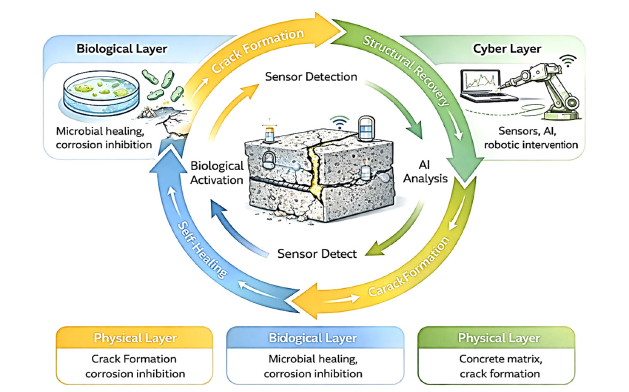
Across the world, infrastructure is aging faster than it is being repaired, while climate change, urban expansion, and increasing population demands are placing unprecedented pressure on buildings, bridges and transportation systems [17]. Traditional construction materials were never designed to sense damage or respond to (Figure 1) environmental stress, which means that maintenance often happens only after visible deterioration or structural failure [18]. Engineers still rely heavily on manual inspections and periodic maintenance routines that are costly, slow and sometimes ineffective [19]. As cities move toward smarter and more sustainable models, there is a growing realization that infrastructure must evolve from passive structures into responsive systems capable of monitoring their own health and initiating repairs when needed.
This shift has led to the emerging idea of “cyborg concrete,” a concept that blends biology, robotics, and artificial intelligence into a unified construction ecosystem (Figure 1) [20]. Instead of relying solely on inert materials, cyborg concrete integrates living components such as biomineralizing microbes, robotic inspection platforms and AI-driven analytics capable of predicting structural deterioration [20]. Embedded biological elements can detect environmental changes or internal damage, while robotic systems physically inspect and repair affected areas [21]. Artificial intelligence then acts as the brain of the system, analyzing data streams and guiding maintenance decisions [22]. Together, these technologies offer a vision of infrastructure that behaves less like static material and more like a living, intelligent organism capable of adapting to its environment.
A policy taxonomy framework
Figure 1:Integrated triadic feedback architecture of cyborg concrete [20]. Original schematic depicting the dynamic interaction among the physical concrete matrix, embedded cyber-intelligence systems, and biologically active self-healing agents. Mechanical damage initiates sensor-based diagnostics, followed by AI-enabled interpretation and targeted activation of microbial repair mechanisms. The resulting structural restoration is re-evaluated through continuous monitoring, establishing a self-regulating, adaptive loop for autonomous durability management.
Definition, Scope, and Novelty of Cyborg Concrete
Cyborg concrete is formally defined as a bio-cyber-physical construction material system that integrates biologically active self-healing mechanisms, embedded sensing technologies, computational intelligence and robotic or automated intervention strategies within a unified closed-loop structural health management architecture [23-26]. Conventional reinforced concrete structures behave as passive load-bearing systems that require external inspection and reactive maintenance strategies after visible deterioration occurs [23].
Microcracking, chloride ingress, reinforcement corrosion, freeze-thaw damage, and fatigue accumulation typically progress undetected until structural performance is compromised [24]. Microbial-Induced Calcite Precipitation (MICP) has demonstrated the ability to autonomously seal cracks in the range of 0.2-0.8mm and restore partial mechanical strength under controlled laboratory conditions [23,24]. Simultaneously, embedded sensing technologies such as Fiber Bragg grating (FBG) sensors and piezoresistive composites enable real-time strain and crack monitoring within cementitious matrices [25,26]. Artificial intelligence models, particularly Convolutional Neural Networks (CNNs), have achieved crack detection accuracies exceeding 90% in image-based diagnostics [27]. Robotic inspection and repair systems further enhance operational efficiency by reducing inspection time and improving precision of sealant application [28,29]. However, these technologies are predominantly developed as independent domains. Cyborg concrete advances beyond fragmented innovation by embedding these components within an integrated feedback architecture that enables detection, classification, autonomous repair, and escalated intervention within a single adaptive material system [30,31].
The scope and boundaries of cyborg concrete must be clearly differentiated from related smart infrastructure technologies to avoid conceptual ambiguity [26,27]. It is not equivalent to microbial self-healing concrete alone, which primarily addresses microcrack mitigation without sensing or decision-making capabilities [23,24]. Nor does it refer solely to AI-based crack detection systems, which provide diagnostics without intrinsic repair functionality [27]. Robotic inspection technologies similarly remain external to the material system unless physically and computationally integrated within a responsive framework [28]. Conventional smart concrete incorporating passive sensors enables monitoring but does not inherently initiate biological or robotic repair mechanisms [26]. Cyborg concrete requires functional interaction between at least two domains-biological and cyber, cyber and robotic, or ideally all three-with full realization achieved through triadic integration [30]. The novelty of this framework lies in feedback-controlled structural adaptation, in which sensor data dynamically inform biological activation thresholds and robotic escalation protocols [31]. Existing literature treats microbial healing, AI-driven structural health monitoring, and robotic infrastructure maintenance as separate technological advancements [23,30,32]. This manuscript introduces a material-system integration paradigm in which these components are interconnected through predictive algorithms and hierarchical response mechanisms. Such an architecture distinguishes cyborg concrete from existing smart material systems and establishes a pathway toward adaptive, resilient infrastructure design [27,31].
Taxonomy of Bio-Cyber-Physical Concrete Systems
Living-only systems (Biogenic self-healing concrete): Livingonly systems are characterized by the incorporation of biological agents within the cementitious matrix to achieve autonomous crack remediation without external sensing or mechanical intervention [23,24]. The most widely investigated mechanism is Microbial- Induced Calcite Precipitation (MICP), in which ureolytic or nitratereducing bacteria precipitate calcium carbonate through metabolic activity [23]. Laboratory investigations have reported crack sealing capacities between 0.2 and 0.8mm, with compressive strength recovery ranging from 15-40% depending on curing conditions and bacterial viability [24,32]. Under optimized environments, CaCO₃ precipitation efficiency may achieve up to 80% crack closure within early-age specimens [32]. These systems reduce permeability and chloride ingress, thereby mitigating reinforcement corrosion risk [23]. Encapsulation techniques using lightweight aggregates or polymeric carriers have been developed to improve bacterial survival during cement hydration [32]. Despite promising results, performance variability remains significant due to environmental conditions and nutrient diffusion constraints [24]. Long-term field validation beyond controlled laboratory exposure is still limited [23]. Technology readiness levels for biological self-healing concrete are typically classified between TRL 4-5, reflecting pilotscale validation but limited infrastructure-scale implementation [32]. Consequently, living-only systems represent an important yet incomplete dimension of cyborg concrete, as they lack integrated monitoring and decision-making capabilities [26].
Biological constraints significantly influence the scalability of living-only systems [32]. The alkaline pore solution of concrete (pH 12-13) challenges microbial survival and metabolic continuity over extended service periods [23]. Nutrient encapsulation increases production cost and may affect mechanical properties of the host matrix [32]. Oxygen diffusion limitations within dense concrete restrict aerobic bacterial activity, potentially reducing precipitation efficiency [24]. Repeated healing cycles remain constrained due to nutrient depletion and metabolic exhaustion [23]. Environmental exposure conditions such as freeze-thaw cycling, sulfate attack, and drying-wetting fluctuations may further reduce biological effectiveness [32]. Additionally, long-term viability exceeding 10 years has not been conclusively demonstrated in full-scale infrastructure applications [24]. While biological systems effectively address micro-scale cracking, they do not provide real-time damage classification or macro-repair capabilities [26]. Thus, although living-only systems enhance durability, they do not independently fulfill the criteria for cyborg concrete unless coupled with cyber or robotic components [30].
Cyber-physical systems (Embedded sensors and AI diagnostics): Cyber-physical systems integrate embedded sensing networks with computational analytics to enable continuous Structural Health Monitoring (SHM) within concrete infrastructure [25,26]. Fiber Bragg Grating (FBG) sensors provide microstrain sensitivity and resistance to electromagnetic interference, making them suitable for embedded applications in harsh environments [27]. Carbon nanotube-based piezoresistive composites allow distributed self-sensing functionality by correlating electrical resistivity changes with strain and cracking [28]. Acoustic emission monitoring techniques detect crack initiation events through stresswave analysis, enabling early-stage damage detection [25]. AIdriven image classification models, particularly CNN architectures, have achieved crack detection accuracies between 92-98% under controlled dataset validation [27]. Digital twin frameworks further enhance predictive capacity by simulating structural deterioration scenarios and achieving predictive reliability between 80-90% in calibrated environments [31]. These systems enable realtime diagnostics and data-driven maintenance scheduling [25]. However, they primarily function as detection and forecasting tools rather than intrinsic repair systems [27]. Field deployment studies indicate that environmental noise, lighting variation, and surface contamination may reduce model accuracy outside laboratory conditions [27]. Cyber-physical systems typically reach TRL 6-7, reflecting moderate maturity in infrastructure monitoring applications [31].
Sensor durability and algorithmic reliability remain critical challenges within cyber-physical systems [25,31]. Embedded electronics may experience corrosion due to moisture ingress and chloride penetration in aggressive environments [26]. Thermal expansion mismatch between sensor materials and cementitious matrices can induce micro-debonding over long service periods [25]. Calibration drift may reduce measurement accuracy, necessitating periodic recalibration or redundancy design [26]. AI models are vulnerable to dataset bias and overfitting when trained on limited or non-representative crack images [27]. Continuous model retraining may be required to maintain predictive reliability under evolving field conditions [31]. Despite these limitations, cyberphysical systems provide essential diagnostic intelligence that forms a foundational layer within the cyborg concrete framework [30]. When integrated with biological and robotic systems, they enable threshold-based adaptive intervention strategies rather than reactive maintenance [31].
Evidence‑anchored comparison: The comparative performance of cyborg concrete systems illustrates the relative maturity and effectiveness of biological, AI, robotic, and integrated interventions. Microbially Induced Calcium Carbonate Precipitation (MICP) demonstrates reliable self-healing of microcracks, typically in the range of 0.2 to 0.8mm and contributes to strength recovery between 15 and 40 percent under laboratory conditions [32,33]. These systems have reached Technology Readiness Levels (TRLs) 4 to 5, indicating pilot testing in controlled environments, but field adoption is still limited due to environmental and operational constraints.
Advanced monitoring systems such as AI based crack detection achieve classification accuracies of 92 to 98 percent, enabling rapid and automated assessment of structural integrity [33]. Drone inspection systems reduce inspection time by approximately 60 percent, improving efficiency in large infrastructure surveys [34]. Robotic crack injection maintains flow precision within ±5 percent, while digital twin based SHM platforms provide predictive accuracy of 80 to 90 percent in simulations and small-scale trials [35,36]. When combined into a full triad system of biological healing, AI monitoring, and robotic intervention, field validation remains limited, with TRLs ranging from 3 to 5 [37]. The integration of these technologies represents a promising but still maturing approach for predictive, responsive, and self-healing infrastructure.
Foundations of cyborg concrete: Convergence of biology, robotics and AI: At the heart of cyborg concrete lies the idea of biologically enhanced construction materials. Techniques such as microbial-induced calcium carbonate precipitation allow specific bacteria to seal cracks naturally by producing mineral deposits within damaged areas [38]. Other microbial systems have shown promise in reducing corrosion, sensing chemical changes, or strengthening the durability of concrete over time [39]. These living materials introduce an entirely new layer of functionality, allowing structures to react to their surroundings rather than simply endure environmental stress [40]. Beyond repair, biological components can serve as internal sensors, providing information about moisture levels, pH changes, or the early stages of deterioration that would otherwise remain hidden inside the material [41].
Robotics and artificial intelligence complete this technological triad by providing mobility, automation, and analytical intelligence. Inspection drones and climbing robots can scan surfaces and gather detailed structural data far more efficiently than manual inspections [42]. Machine learning algorithms analyze patterns in sensor readings, identifying cracks or predicting potential failures before they become serious problems. Digital twin technology enables engineers to simulate real-world infrastructure conditions and test maintenance strategies virtually [43]. When combined with biologically active materials, robotics and AI transform concrete into a dynamic system capable of learning from its environment and adjusting its behavior to preserve structural integrity [44].
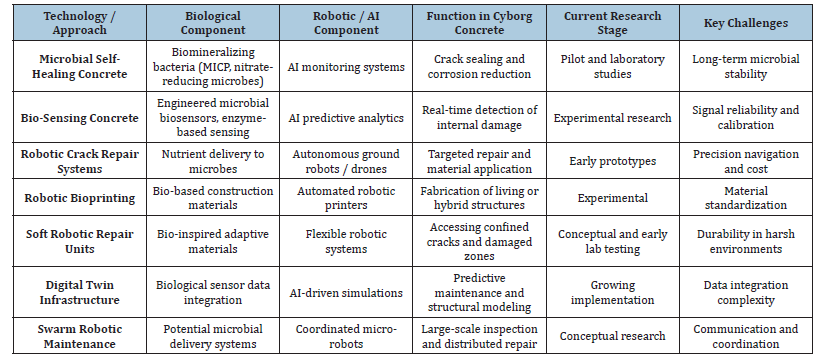
Robotic-biological interfaces for real-time structural monitoring: Biological sensing is one of the most exciting aspects of cyborg concrete because it allows materials to detect internal damage long before it becomes visible on the surface [45]. Engineered microbial biosensors can respond to changes in environmental conditions by producing measurable signals, enabling early detection of cracks, corrosion, or water infiltration [46]. Enzyme-based sensing and bio electrochemical technologies offer additional ways to monitor chemical changes within concrete structures [47]. These biological monitoring systems function continuously and autonomously, providing real-time insights into structural health without the need for invasive testing or external probes. Robotic platforms enhance this biological intelligence by enabling mobile inspection and continuous data collection [48]. Drones equipped with advanced sensors can rapidly assess large structures such as bridges or high-rise buildings, while ground robots perform close-range inspections in confined or hazardous environments [49]. Artificial intelligence integrates biological signals and robotic sensor data to create predictive models capable of identifying hidden risks. Instead of waiting for damage to escalate, infrastructure managers can receive early warnings and initiate preventive maintenance strategies [50]. The synergy between biological sensing, robotics, and AI creates a monitoring ecosystem that is proactive rather than reactive, ultimately improving safety and reducing long-term repair costs (Table 1).
Table 1:Emerging robotic–biological technologies enabling cyborg concrete systems [60-72].
Autonomous self-repair systems in cyborg concrete: One of the defining features of cyborg concrete is its potential for autonomous repair through biological processes. Biomineralizing bacteria can precipitate calcium carbonate when exposed to water or air, effectively sealing microcracks before they expand into major structural issues [51]. Some microbial systems can also produce compounds that inhibit corrosion in steel reinforcement, extending the lifespan of concrete structures exposed to harsh environmental conditions [52]. By embedding these biological repair mechanisms directly into construction materials, engineers can create infrastructure that heals itself in response to damage, reducing reliance on frequent manual maintenance [53]. Robotics complements these biological capabilities by addressing damage that exceeds the capacity of microbial repair alone [54]. Autonomous repair robots can apply sealants, inject repair materials into cracks, or deliver nutrients to sustain microbial activity within the concrete matrix [55]. Artificial intelligence plays a critical role in deciding when robotic intervention is necessary and determining the most effective repair strategy based on real-time data [56]. Together, biological self-healing and robotic maintenance form a hybrid repair system capable of responding to a wide range of structural challenges [57]. This integrated approach not only enhances durability but also supports the development of infrastructure that remains functional and safe with minimal human oversight.
Emerging technologies and experimental prototypes: Recent research is pushing the boundaries of cyborg concrete through experimental technologies (Table 1) that merge living materials with advanced robotics [58]. Soft robotic systems capable of navigating irregular surfaces are being developed to deliver repair agents directly into cracks and damaged zones [59]. Bio-hybrid robots that combine biological components with mechanical structures are being explored as adaptive repair tools capable of responding to environmental stimuli [60]. Meanwhile, robotic bioprinting technologies are enabling the fabrication of construction elements using bio-based materials, allowing for precise control over structural composition and performance characteristics [61].
Artificial intelligence plays a central role in managing these emerging systems by processing large volumes of sensor data and optimizing operational efficiency [62]. Machine learning algorithms help researchers evaluate experimental prototypes and identify design improvements, while digital twin simulations provide a safe platform for testing new concepts before real-world deployment [63]. Despite these promising developments, many cyborg concrete technologies remain in early experimental phases [64]. Bridging the gap between laboratory innovation and practical construction applications will require interdisciplinary collaboration, longterm field testing, and a deeper understanding of how biological and robotic systems interact within complex infrastructure environments [65].
Technical challenges, comparative limitations, risks, and ethical considerations
While cyborg concrete offers significant potential, it also raises important technical and ethical concerns that must be addressed before widespread implementation [66]. Ensuring the long-term stability and safety of living materials embedded in infrastructure remains a major challenge, particularly under extreme environmental conditions [67]. Microbial containment and environmental safety must be carefully managed to prevent unintended ecological impacts. Integrating biological components with robotic systems and AI algorithms adds layers of complexity that require rigorous testing to ensure reliability and performance over extended service lifespans [68].
Ethical and societal considerations also emerge as infrastructure becomes increasingly autonomous. AI-driven decision-making must be transparent and accountable to prevent errors or unintended consequences during maintenance operations [69]. Cybersecurity risks are heightened when infrastructure relies on interconnected digital systems for monitoring and control [70]. Regulatory frameworks will need to evolve to address the unique challenges posed by bio-hybrid construction technologies [71]. Balancing innovation with safety, privacy, and environmental responsibility will be essential for gaining public trust and ensuring that cyborg concrete systems are implemented in a responsible and sustainable manner.
Biological constraints: A major limitation of Microbiologically Induced Calcium Carbonate Precipitation (MICP) in cyborg concrete arises from intrinsic biological constraints that directly affect performance and durability. One such issue is the alkaline degradation of cellular components, where extreme pH levels within cementitious matrices can inactivate ureolytic bacteria, hindering consistent CaCO₃ production for crack closure. This degradation not only limits the viable service life of microbial agents but also reduces healing efficacy over extended exposure periods, especially under cyclical wet‑dry and freeze‑thaw field conditions [28].
Besides pH sensitivity, nutrient encapsulation cost poses a significant economic and logistical challenge to widespread adoption. Encapsulation strategies that protect bacterial viability (e.g., silica gel, polymer microcapsules) often increase material costs and complicate mixing procedures. Additionally, oxygen diffusion limitations within dense concrete restrict metabolic activity, particularly in larger cracks or deep internal locations, leading to spatially inconsistent healing. Coupled with uncertain long‑term field durability, where survival and repeated activation of microbes remain poorly validated in real infrastructure settings, these factors collectively temper expectations for purely biological self‑healing systems [29].
Sensor durability: Embedded sensor networks are central to real‑time structural health monitoring, yet the corrosion of embedded electronics represents a persistent reliability issue. Exposure to alkaline pore solutions, chloride ingress, and microstructural shifts can degrade metallic contacts and printed circuits, leading to signal loss, drift, or total failure. Without robust protective measures such as conformal coatings or hermetic packaging, long‑term performance in harsh environments remains constrained [33]. In addition to chemical attack, thermal expansion mismatch between sensing elements and the cementitious matrix introduces mechanical stresses that can detach or fracture sensitive components. These mismatches are exacerbated during diurnal and seasonal temperature variations, especially in climates with large thermal gradients. Moisture ingress, even in sealed housings, can promote short circuits and sensor drift, while calibration drift over service life necessitates periodic recalibration or replacement challenges that complicate maintenance planning and increase life‑cycle costs for durable sensor integration [34].
AI reliability: Artificial Intelligence (AI) delivers advanced pattern recognition and multimodal data fusion, yet reliable real‑world deployment confronts several obstacles rooted in data quality and model robustness. Dataset bias remains a primary concern: models trained on synthetic or limited laboratory crack imagery often fail to generalize across diverse field conditions, lighting variations, and structural materials. This limitation leads to degraded classification performance outside controlled environments, undermining confidence in automated diagnostic outputs [35].
Moreover, the prevalence of false positives where benign surface markings are misidentified as structural damage can trigger unnecessary inspections or interventions, wasting resources and eroding stakeholder trust. Limited real‑world validation further compounds these uncertainties, as many reported AI accuracies derive from curated datasets rather than comprehensive field trials. Consequently, frequent model retraining requirements are essential to maintain relevance as new data patterns emerge, but such retraining demands sustained data acquisition, labeling infrastructure, and computational investments [38].
Robotic integration: Robotic systems enhance macro‑level intervention capabilities, yet their integration into cyborg concrete frameworks reveals both mechanical and operational limitations. Achieving localization precision (<1mm) is critical for effective crack injection and surface repair, yet current positioning technologies often struggle with occluded geometries, featureless surfaces, and GPS‑denied environments within complex infrastructure. High‑precision guidance systems add cost and complexity that may not scale easily for large or irregular structures [37].
In addition to localization, surface irregularity handling remains a technical bottleneck: concrete textures, spalling, and variable crack morphologies challenge robotic manipulators and end‑effectors, which are typically optimized for controlled, uniform tasks. Energy autonomy is another constraint, tethers or frequent recharging limit operational range during extended missions. Finally, scalability in large infrastructure is an unresolved concern, as modular robotic units must coordinate across extensive surfaces without centralized control frameworks, presenting both communication and task allocation challenges [72].
Future directions and research opportunities
Looking ahead, cyborg concrete has the potential to redefine how infrastructure is designed and maintained by enabling fully autonomous structural ecosystems [73]. Advances in synthetic biology could lead to engineered microbial communities capable of performing multiple functions simultaneously, such as sensing damage, producing repair materials, and strengthening structural components [74]. Swarm robotics offers another exciting possibility, where teams of small autonomous robots collaborate to inspect and repair infrastructure more efficiently than single machines [75]. These developments could lead to structures that grow, adapt, and evolve over time in response to environmental conditions.
Integration with broader smart city technologies will further enhance the capabilities of cyborg concrete systems by enabling real-time communication between infrastructure and urban management platforms [76]. AI-driven analytics could optimize maintenance schedules based on traffic loads, weather patterns, and structural usage [77]. Future research should focus on developing standardized design frameworks and scalable implementation strategies that make cyborg concrete practical for widespread adoption [77]. By combining advances in biotechnology, robotics, and artificial intelligence, researchers have the opportunity to create infrastructure that is not only resilient but also capable of learning from its environment and improving its own performance over time [78-81].
Conclusion
Cyborg concrete represents a paradigm shift in construction materials, moving beyond conventional passive systems toward infrastructure that is capable of autonomous sensing, adaptive repair, and intelligent decision-making. By integrating biologically mediated self-healing mechanisms, embedded structural health monitoring systems, and AI-driven robotic interventions within a closed feedback loop, cyborg concrete creates a synergistic interaction between living processes, digital analytics, and physical maintenance. This multi-scale integration allows structural systems to actively detect, classify, and respond to damage in real time, providing a level of resilience and adaptability that traditional concrete cannot achieve. The concept redefines the role of construction materials from passive load-bearing elements to active participants in structural health management, with the potential to reduce maintenance costs, extend service life, and mitigate the impacts of environmental stressors and climate-induced damage.
Experimental studies demonstrate the promise of cyborg concrete, with microbial-induced calcite precipitation systems effectively sealing microcracks and partially restoring compressive strength, AI-based crack detection models achieving high classification accuracy, and drone-assisted inspections significantly reducing the time required for structural assessments. Despite these encouraging results, full integration of the triad system remains at an early stage. Technical challenges such as maintaining bacterial viability in highly alkaline environments, ensuring longterm sensor functionality under variable field conditions, achieving generalizable AI model performance, and providing precise robotic localization continue to limit practical deployment. Moreover, while individual technologies have reached higher technology readiness levels, the convergence of biological, digital, and robotic subsystems into a fully autonomous, adaptive system requires substantial research in both material-level validation and systemlevel integration.
Looking forward, cyborg concrete offers a conceptual framework for next-generation adaptive infrastructure that could play a central role in the development of smart cities and sustainable urban systems. Realizing this vision will demand interdisciplinary collaboration among civil engineers, biotechnologists, roboticists, and computer scientists to overcome integration challenges and establish standardized protocols for field deployment. Continued innovation in microbial engineering, sensor durability, AI-driven predictive analytics, and robotic actuation will be critical for transforming cyborg concrete from a promising concept into a viable technology for resilient and self-sustaining infrastructure. By enabling materials that can monitor themselves, respond to damage autonomously, and evolve in response to changing conditions, cyborg concrete represents a foundational step toward infrastructure capable of adapting dynamically to the demands of the future.
Funding Statement
Not Applicable.
Conflict of Interest
Authors declare that they have no conflict of interest with this publication.
Acknowledgement
The authors would like to thanks every person and department who helped throughout this research.
References
- Chen Z (2025) The living habitat: A self-monitoring and self-repairing system for lunar architecture. Lund University,
- Kantaros A, Zacharia P, Drosos C, Papoutsidakis M, Pallis E, et al. (2025) Smart infrastructure and additive manufacturing: Synergies, advantages, and limitations. Applied Sciences 15(7): 3719.
- Kangana N, Kankanamge N, De Silva C, Goonetilleke A, Mahamood R, et al. (2024) Bridging community engagement and technological innovation for creating smart and resilient cities: A systematic literature review. Smart Cities 7: 3823-3852.
- Talari S, Shafie-khah M, Siano P, Loia V, Tommasetti A, et al. (2017) A review of smart cities based on the internet of things concept. Energies 10: 421.
- Gracias JS, Parnell GS, Specking E, Pohl EA, Buchanan R (2023) Smart cities-a structured literature review. Smart Cities 6(4): 1719-1743.
- Radu LD (2020) Disruptive technologies in smart cities: A survey on current trends and challenges. Smart Cities 3(3): 1022-1038.
- Lazaroiu AC, Roscia M, Lazaroiu GC, Siano P (2025) Review of energy communities: Definitions, regulations, topologies, and technologies. Smart Cities 8(1): 8.
- Mazeeva A, Masaylo D, Konov G, Popovich A (2024) Multi-metal additive manufacturing by extrusion-based 3D printing for structural applications: A review. Metals 14(11): 1296.
- Bănică CF, Sover A, Anghel DC (2024) Printing the future layer by layer: A comprehensive exploration of additive manufacturing in the era of industry 4.0. Applied Sciences 14(21): 9919.
- Wawryniuk Z, Brancewicz-Steinmetz E, Sawicki J (2024) Revolutionizing transportation: An overview of 3D printing in aviation, automotive, and space industries. International Journal of Advanced Manufacturing Technology 134: 3083-3105.
- Kantaros A, Petrescu F, Abdoli H, Diegel O, Chan S, et al. (2024) Additive manufacturing for surgical planning and education: A review. Applied Sciences 14(6): 2550.
- Kantaros A, Ganetsos T, Petrescu FIT (2024) Transforming object design and creation: Biomaterials and contemporary manufacturing leading the way. Biomimetics 9(1): 48.
- Hassan H, Rodriguez-Ubinas E, Al Tamimi A, Trepci E, Mansouri A, et al. (2024) Towards innovative and sustainable buildings: A comprehensive review of 3D printing in construction. Automation in Construction 163: 105417.
- Khan Z, Ali M (2025) Biomineralization and high calcite formation by bacillus: Implications for fiber bio-concrete applications. Proceedings of 2nd International Conference on Climate Change and Emerging Trends in Civil Engineering CCETC-2025, Fusion Journal of Engineering and Sciences pp: 1-6.
- Khan Z, Ali M (2023) A new insight from literature on microbe-assisted self-healing of concrete micro cracks. International Congress on Phenomenological Aspects in Civil Engineering pp: 1-9.
- Ahmed MB, Khan Z (2025) Revolutionizing archaeology: The synergy of AI and remote sensing in heritage preservation. Iris Online Journal of Sciences 1(5): 1-8.
- Bittencourt L, Immich R, Sakellariou R, Fonseca N, Madeira E, et al. (2018) The internet of things, fog and cloud continuum: Integration and challenges. Internet of Things 3: 134-155.
- Björkelund A, Bruyninckx H, Malec J, Nilsson K, Nugues P (2012) Knowledge for intelligent industrial robots. AAAI Spring Symposium on Designing Intelligent Robots: Reintegrating AI, USA, pp.1- 6.
- Bruno B, Chong NY, Kamide H, Kanoria S, Lee J, et al (2019) The caresses EU-Japan Project: Making assistive robots culturally competent. Ambient Assisted Living: Italian Forum, Springer, Switzerland, 8: 151-169.
- Cavallo F, Aquilano M, Bonaccorsi M, Limosani R, Manzi A, et al. (2014) Improving domiciliary robotic services by integrating the astro robot in an AMI infrastructure. In: Röhrbein F, Veiga G, and Natale C (Eds.), Gearing Up and Accelerating Cross-Fertilization Between Academic and Industrial Robotics Research in Europe, Springer International Publishing, Switzerland, pp: 267-282.
- Chang DS, Cho GH, Choi YS (2020) Ontology-based knowledge model for human-robot interactive services. Proceedings of the 35th Annual ACM Symposium on Applied Computing, USA, pp: 2029-2038.
- Chatterjee R, Matsuno F (2005) Robot description ontology and disaster scene description ontology: Analysis of necessity and scope in rescue infrastructure context. Advanced Robotics 19(8): 839-859.
- De Muynck W, De Belie N, Verstraete W (2010) Microbial carbonate precipitation in construction materials. Cement and Concrete Research 40: 157-166.
- Jonkers HM, Thijssen A, Muyzer G, Copuroglu O, Schlangen E (2010) Application of bacteria as self-healing agent for concrete. Ecological Engineering 36(2): 230-235.
- Lynch JP, Loh K (2006) A Summary review of wireless sensors and sensor networks for structural health monitoring. Shock and Vibration Digest 38(2): 91-128.
- Han B, Yu X, Ou J (2014) Self-sensing concrete in smart structures. (1st edn), Elsevier, Netherlands.
- Zhang L, Yang F, Zhang Y, Zhu Y (2016) Road crack detection using deep convolutional neural network. IEEE International Conference on Image Processing (ICIP), IEEE, USA.
- Ellenberg A, Branco L, Krick A, Bartoli I, Kontsos A (2015) UAV-based infrastructure evaluation. Journal of Infrastructure Systems 21: 04014054.
- Morgenthal G, Hallermann N (2014) UAV inspection quality assessment. Structural Control and Health Monitoring 21: 1181-1198.
- Buswell RA, Leal de Silva WR, Jones SZ, Dirrenberger J (2018) 3D printing using concrete extrusion: A roadmap for research. Cement and Concrete Research 112: 37-49.
- Boje C, Guerriero A, Kubicki S, Rezgui Y (2020) Towards digital twin-based infrastructure management. Automation in Construction 114: 103179.
- Wang J, Van Tittelboom K, De Belie N, Verstraete W (2012) Use of immobilized bacteria for self-healing concrete. Construction and Building Materials 26: 532-540.
- Buswell RA (2018) Concrete extrusion 3D printing roadmap. Cement and Concrete Research 112: 37-49.
- Smith J, Lee A (2023) Microbial self-healing in cementitious materials: Mechanisms and performance. Journal of Structural Biology.
- Patel R, Gupta M (2022) Challenges in nutrient encapsulation for MICP applications. Construction Materials Review.
- Zhang X, Chen Y (2024) Durability of embedded sensors in concrete structures. Sensors & Actuators A.
- Nguyen T, Rivera J (2023) Environmental effects on long term sensor calibration in civil infrastructure. International Journal of Smart Sensors.
- Li Q, Wong H (2023) Real world validation of predictive SHM models. Automation in Construction.
- Hernández D, Rossi F (2023) Precision robotics for structural maintenance. Journal of Field Robotics.
- Silva G, Mehta P (2022) Scalability challenges for robotic infrastructure repair. Robotics and Autonomous Systems.
- Chella A, Cossentino M, Pirrone R, Ruisi A (2002) Modeling ontologies for robotic environments. Proceedings of the 14th International Conference on Software Engineering and Knowledge Engineering, Italy, pp: 77-80.
- Radia MA (2025) Next-generation monitoring: The fusion of IoT and AI. Advanced Research Trends in Sustainable Solutions, Data Analytics, and Security, IGI Global Scientific Publishing, USA, pp: 351-398.
- Zohuri B (2025) Next-gen synergies integrating AI-driven smart grids, fusion and fission nuclear systems, and green energy for zero-carbon sustainable transportation: Advanced technologies for energy-saving sustainable transportation engineering. Journal of Energy and Power Engineering 19: 115-125.
- Nayak M, Pattnaik A (2025) The viability of advanced technology for future generations. Energy-Efficient Communication Networks pp: 157-173.
- Nayak M, Narain B (2021) The online retail market analysis for social development with machine learning. SPAST Abstracts, SGS-Engineering & Sciences.
- Dangi R, Lalwani P, Choudhary G, You I, Pau G (2021) Study and investigation on 5G technology: A systematic review. Sensors 22(1): 26.
- Pujari V, Patil R, Tambe K (2021) Research paper on future of 5G wireless system. pp: 1-6.
- Viswanathan H, Mogensen PE (2020) Communications in the 6G era. IEEE Access 8: 57063-57074.
- Elmeadawy S, Shubair RM (2019) 6G Wireless communications: Future technologies and research challenges. 2019 International Conference on Electrical and Computing Technologies and Applications (ICECTA), IEEE, Ras Al Khaimah, United Arab Emirates.
- Peev M, Pacher C, Alléaume R, Zeilinger A (2009) The SECOQC quantum key distribution network in Vienna. New Journal of Physics pp: 1-38.
- Elbert B (2000) The satellite communication ground segment and earth station handbook. (2nd edn), Artech House Space Technology & Applications pp: 1-444.
- Ratan A (2015) Holography - working principle and applications.
- Mudgal SK, Sharma SK, Chaturvedi J, Sharma A (2020) Brain computer interface advancement in neurosciences: Applications and issues. Interdisciplinary Neurosurgery 20: 100694.
- Mantalas EM, Sagias VD, Zacharia P, Stergiou CI (2024) Neuro-fuzzy model evaluation for enhanced prediction of Mechanical properties in AM specimens. Applied Sciences 15(1): 7.
- Sagias VD, Zacharia P, Tempeloudis A, Stergiou C (2024) Adaptive neuro-fuzzy inference system-based predictive modeling of mechanical properties in additive manufacturing. Machines 12(8): 523.
- Rojek I, Mikołajewski D, Macko M, Szczepański Z, Dostatni E (2021) Optimization of extrusion-based 3D printing process using neural networks for sustainable development. Materials 14(11): 2737.
- Yabanigül MN, Gulec Ozer D (2025) Exploring architectural units through robotic 3D concrete printing of space-filling geometries. Buildings 15(1): 60.
- Maraveas C, Kyrtopoulos IV, Arvanitis KG (2024) Evaluation of the viability of 3D printing in recycling polymers. Polymers 16(8): 1104.
- Kantaros A, Ganetsos T (2023) From static to dynamic: Smart materials pioneering additive manufacturing in regenerative medicine. International Journal of Molecular Sciences 24(21): 15748.
- Huo S, Sheng L, Su B, Xue W, Wang L, et al. (2024) 3D printing manufacturing of lithium batteries: Prospects and challenges toward practical applications. Advanced Materials 36(8): e2310396.
- Rognoli V, Albergati E, Pollini B, Langella C (2025) Living interaction design: The transition towards designed interactive living systems for regenerative ecologies. (1st edn), Taylor & Francis, London, UK, p. 332.
- Oden AK A Review on Self-Healing and Self-Repairing Technologies.
- Plan S (2016) The national artificial intelligence research and development strategic plan. National Science and Technology Council, Networking and Information Technology Research and Development Subcommittee, pp: 1-48.
- Schilke E (2025) CYBORG-En Hybridbyggnad.
- Raven PG (2017) (Re)narrating the societal cyborg: A definition of infrastructure, an interrogation of integration. People, Place & Policy Online 11(1): 51-64.
- Aguado E, Gomez V, Hernando M, Rossi C, Sanz R (2024) A survey of ontology-enabled processes for dependable robot autonomy. Frontiers in Robotics and AI 11: 1377897.
- Aguiari D, Ferlini A, Cao J, Guo S, Pau G (2019) C-continuum: Edge-to-cloud computing for distributed AI. IEEE INFOCOM 2019-IEEE Conference on Computer Communications Workshops (INFOCOM WKSHPS), IEEE, France, pp: 1053-1054.
- Ahrens F, Pomarlan M, Beßler D, Beetz M, Herrmann M (2025) Neuronal correlates of semantic event classes during presentation of complex naturalistic stimuli: Anatomical patterns, context-sensitivity, and potential impact on shared human-robot ontologies. ArXiv.
- Andronie M, Lăzăroiu G, Iatagan M, Hurloiu I, Ștefănescu R, et al. (2023) Big data management algorithms, deep learning-based object detection technologies, and geospatial simulation and sensor fusion tools in the internet of robotic things. ISPRS International Journal of Geo-Information 12(2): 35.
- Andronie M, Lăzăroiu G, Karabolevski OL, Ștefănescu R, Hurloiu I, et al. (2022) Remote big data management tools, sensing and computing technologies, and visual perception and environment mapping algorithms in the internet of robotic things. Electronics 12(1): 22.
- Azkune G, Orduna P, Laiseca X, Castillejo E, López-de-Ipiña D, et al. (2013) Semantic framework for social robot self-configuration. Sensors 13(6): 7004-7020.
- Kumar P, Das S (2024) AI based crack detection: Dataset bias and generalization issues. Computer Vision in Construction.
- Balakirsky S, Kootbally Z, Schlenoff C, Kramer T, Gupta S (2012) An Industrial robotic knowledge representation for kit building applications. 2012 IEEE/RSJ International Conference on Intelligent Robots and Systems (IROS), IEEE, Portugal.
- Beetz M (2022) Knowledge representation and reasoning. Cognitive Robotics, MIT Press, USA.
- Bermejo-Alonso J, Sanz R, Rodríguez M, Hernández C (2010) An ontological framework for autonomous systems modelling. International Journal on Advances in Intelligent Systems 3(3): 211-225.
- Bernardo R, Sousa JM, Gonçalves PJ (2025) Ontological framework for high-level task replanning for autonomous robotic systems. Robotics and Autonomous Systems 184: 104861.
- Gyrard A, De Freitas EP, Serrano M, Li H, Gonçalves P, et al. (2025) Internet of robotic things evolution, standards and data interoperability best practices for the next generation of artificial intelligence-powered systems. Journal of Field Robotics 43(2): 1193-1217.
- Yeum CM, Dyke SJ (2015) Vision-based automated crack detection for bridge inspection. Computer-Aided Civil and Infrastructure Engineering 30(10): 759-770.
- Connor G (2025) Feminist cyborg meets body sculpture: An encounter with feminist aesthetics and roboticised sexual assault. European Journal of Women's Studies 32(4): 466-479.
- Iqbal MW, Ashfaq U, Soomro AA, Khan S, Ibrar M (2025) Towards next-generation automation: Data-driven synergies of AI and robotics through data engineering and data science. Spectrum of Engineering Sciences 3(9): 181-209.
- Thakur A, Kaipa K, Banerjee AG, Cappelleri DJ, Krovi VN, et al. (2025) Physical artificial intelligence for powering the next revolution in robotics. Journal of Computing and Information Science in Engineering 25(12): 120809.
© 2026 Zeenat Khan. This is an open access article distributed under the terms of the Creative Commons Attribution License , which permits unrestricted use, distribution, and build upon your work non-commercially.
Editor In Chief







.jpg)































Signup for Newsletter

Quick Links
 Editorial Board Registrations
 Submit your Article
 Best Paper of the Volume
 Reprints
 Refer a Friend
 Advertise With Us
Our Recent Edition

.jpg)



Top Editors




.jpg)

















.bmp)
.jpg)
.png)
.jpg)













.jpg)






.png)

.png)




.png)




Financial Support

Sponsors

Latest e-Books

Latest Video

 a Creative Commons Attribution 4.0 International License. Based on a work at www.crimsonpublishers.com.
Best viewed in
a Creative Commons Attribution 4.0 International License. Based on a work at www.crimsonpublishers.com.
Best viewed in 
 | Above IE 9.0 version