

- About Us
- Information
-

The Author ensures that the research has been conducted responsibly and ethically with adherence to all relevant regulations. read more..
- For Authors
- For Reviewer
- Manuscript Guidelines
- Membership
- Publication Ethics
-
- Journals
- Reprints
- e-Books
- Videos
- Policies
- Contact Us
 COVID-19
- Submissions



Full Text
COJ Nursing & Healthcare
Courier Fatalities in the Platform Economy: A Media Content Analysis of Traffic Risks, Occupational Conditions, and Social Impacts; Qualitative Research Article
Kenan Kaya*
Department of Forensic Medicine, Cukurova University, Turkey
*Corresponding author: Kenan Kaya, Department of Forensic Medicine, Cukurova University, Turkey`
Submission: April 21, 2026;Published: August 21, 2026

ISSN: 2577-2007Volume9 Issue 5
Abstract
The rapid expansion of platform-based delivery services has increased the number of motorcycle and bicycle couriers operating under intensive time pressure and uncertain working conditions. Courier fatalities have become a growing occupational safety and public health concern in many countries, including Türkiye. This study examines courier fatalities through a media content analysis approach, focusing on traffic risks, injury mechanisms, occupational conditions, and social impacts. Media reports published on courier fatalities were analyzed together with international research on motorcycle safety, occupational health, and the gig economy. The findings indicate that courier fatalities are not solely the result of individual riding behaviour or unexpected traffic incidents. Instead, they emerge from the interaction between severe injury mechanisms, risky traffic environments, inadequate infrastructure, and work-related pressures such as delivery deadlines and extended working hours. The analysis shows that media coverage frequently emphasizes individual accidents while less frequently addressing structural factors behind fatalities. Reported cases also reveal broader social consequences, including family hardship, demands for legal accountability, and public discussions regarding the responsibilities of digital labour platforms. The study argues that courier fatalities should be considered a systemic occupational safety issue requiring integrated interventions in traffic regulation, workplace protection, infrastructure design, and platform governance.
Keywords: Courier fatalities; Motorcycle safety; Media content analysis; Occupational health; Gig economy; Traffic safety
Introduction
The growth of digital platforms has transformed urban delivery services worldwide. Food delivery applications and online commerce platforms have created a rapidly expanding workforce of motorcycle and bicycle couriers who provide essential last-mile delivery services. However, the increasing demand for rapid delivery has also intensified occupational risks faced by these workers. Couriers spend prolonged periods in urban traffic environments, frequently under delivery time pressure and performance-based evaluation systems, increasing their exposure to road hazards.
Motorized two-wheel riders represent one of the most vulnerable groups in road traffic. According to the World Health Organization (WHO), motorcycle users experience substantially higher risks of severe injury and death compared with occupants of passenger vehicles because motorcycles provide limited physical protection during collisions [1]. Studies on motorcycle safety have consistently identified head injuries, high-speed impacts, intersection crashes, and interactions with larger vehicles as major contributors to fatal outcomes [2,3].
Courier riders face additional occupational challenges beyond general motorcycle risks. Unlike recreational motorcycle users, couriers are exposed to traffic hazards as part of their daily employment. Previous studies on delivery workers have highlighted the influence of long working hours, delivery urgency, fatigue, and economic pressure on unsafe riding behaviours [4] (Chang & Wu, 2019). The platform economy may further increase these risks by transferring responsibility for safety management from traditional employers to individual workers.
Media plays an important role in shaping public understanding of courier fatalities. News reports are often the primary source through which society learns about workplace-related deaths. However, media coverage frequently focuses on dramatic accident narratives, such as collisions, driver negligence, or individual tragedies, while broader structural factors-including working conditions, regulatory gaps, and platform responsibilities-receive less attention [5]. Therefore, examining media representations provides valuable insight into how courier deaths are socially constructed and interpreted.
In Türkiye, the rapid expansion of motorcycle-based delivery services has coincided with increasing public concern regarding courier safety. Media reports have documented numerous fatal incidents involving delivery riders, often highlighting traffic conflicts, unsafe road conditions, and occupational pressures. Nevertheless, these deaths are commonly presented as isolated traffic accidents rather than as indicators of wider occupational safety problems.
This study aims to analyze courier fatalities through a media
content analysis framework. Specifically, it addresses four research
questions:
A. How are courier fatalities represented in media reports?
B. What are the primary injury mechanisms and trafficrelated
risk factors associated with courier deaths?
C. How do occupational conditions contribute to courier
vulnerability?
D. What social impacts are reported following courier
fatalities?
By integrating media analysis with occupational health and traffic safety literature, this study contributes to a broader understanding of courier fatalities as a systemic issue involving road safety, labour conditions, and social responsibility.
Materials and Methods
Research design
This study employed a qualitative document analysis design based on media content analysis. The objective was to examine how courier fatalities are represented in public discourse and to identify recurring patterns related to injury mechanisms, traffic risks, occupational conditions, and social consequences.
Media content analysis is an appropriate method for investigating how social problems are framed, interpreted, and communicated to the public [6]. In this study, news reports were not evaluated only as descriptions of individual accidents but as social documents reflecting broader issues related to road safety, labour conditions, and regulatory responsibility.
Data sources and selection criteria
The analysis focused on media reports concerning courier
fatalities in Türkiye. News articles were selected according to the
following criteria:
A. reports published between January 2025 and December
2025;
B. incidents involving motorcycle or bicycle couriers;
C. reports containing information about accident
circumstances, causes, victims, or social reactions;
D. reports published by national and regional news
organizations.
Additional sources, including occupational safety reports, motorcycle safety studies, and international road safety publications, were used to support interpretation of the findings.
The selected reports were analyzed according to four main
dimensions:
a) Fatal injury mechanisms
b) Traffic and riding-related factors
c) Environmental and infrastructure risks
d) Occupational and social impacts
Data analysis
A thematic content analysis approach was applied. Each news report was coded according to recurring themes. The coding framework was developed based on previous motorcycle safety and occupational health research [1,2].
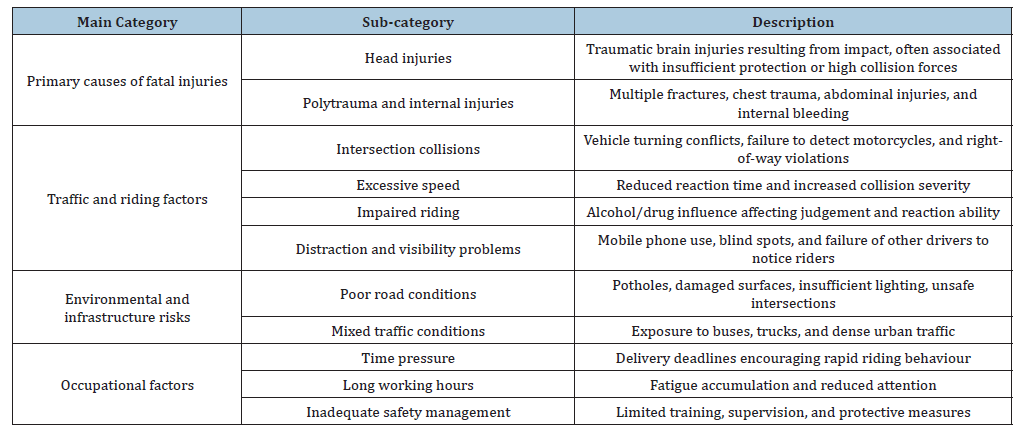
The analysis moved beyond identifying immediate accident causes and examined the interaction between individual, environmental, and structural factors. This approach allowed courier fatalities to be evaluated as occupational safety events rather than isolated traffic incidents (Table 1).
Table 1:Analytical Framework for Courier Fatalities.
Ethical considerations
All analyzed materials were publicly available media reports. The study did not involve direct interaction with human participants; therefore, no personal data collection was conducted. The analysis focused on public representations of fatalities and broader occupational safety patterns.
Results
Media representations of courier fatalities
The analysis indicates that media coverage of courier fatalities generally follows two dominant patterns. The first pattern emphasizes individual tragedy, describing the victim, accident location, and immediate circumstances. Headlines frequently focus on dramatic elements such as “a courier lost his life after being hit by a vehicle” or “a delivery rider died while working.”
The second pattern, although less common, frames courier deaths as a broader occupational and social issue. These reports discuss unsafe working conditions, delivery pressure, traffic regulations, and demands from courier organizations for improved protection.
This distinction reflects a broader issue in media framing: accident-focused reporting can increase public awareness but may reduce attention to systemic causes behind repeated fatalities [5] (Table 2).
Table 2:Media Framing Patterns of Courier Fatalities.

Primary causes of fatal injuries
Although courier fatalities are commonly reported as traffic accidents, the severity of outcomes is largely determined by the type and location of injuries sustained during crashes. Motorized two-wheel riders lack the physical protection provided by passenger vehicles, making them highly vulnerable to direct impact forces. Previous studies have consistently identified traumatic brain injuries and multiple severe injuries as the primary causes of motorcycle-related mortality [1,2].
Head injuries: Head trauma represents one of the most critical determinants of motorcycle fatality outcomes. During a collision, riders may be exposed to direct impact with vehicles, road surfaces, or roadside objects. Helmet use significantly reduces the probability of fatal head injuries; however, inadequate helmet quality, improper use, or absence of helmets continues to contribute to preventable deaths [7].
In courier-related cases, the risk of head injury may be increased by prolonged exposure to traffic environments and frequent travel in congested urban areas. Unlike occasional motorcycle users, couriers experience repeated exposure to crash risks throughout their working hours.
Polytrauma and internal injuries: Severe motorcycle crashes often result in multiple injuries affecting several body regions. Chest trauma, abdominal injuries, spinal damage, and fractures of long bones may lead to rapid deterioration and death even when head protection is available [8].
Media reports analyzed in this study frequently described fatal incidents involving high-energy collisions with passenger cars, buses, and heavy vehicles. These cases demonstrate that injury severity is not determined only by whether a crash occurs but also by collision speed, vehicle type, and the degree of physical protection available to riders (Table 3).
Table 3:Primary Causes of Fatal Injuries Among Motorcycle Couriers.

Common traffic and riding-related factors
The analysis demonstrates that courier fatalities are strongly associated with common motorcycle crash mechanisms. While individual behaviour contributes to risk, these behaviours frequently occur within a broader occupational context characterized by delivery urgency, traffic exposure, and economic pressure.
Intersection Collisions: Intersection crashes represent one of the most frequent fatal scenarios involving motorcycles. A common pattern occurs when passenger vehicles turn across the path of an approaching motorcycle rider. Due to their smaller size and lower visibility, motorcycles are often overlooked by other drivers [9].
For couriers operating in dense urban environments, frequent stops, navigation decisions, and exposure to multiple intersections increase the likelihood of these conflicts.
Excessive speed: Speed is a major determinant of both crash occurrence and injury severity. Higher speeds reduce reaction time and increase impact forces during collisions [1]. In courier work, speed-related risks may be intensified by delivery deadlines and customer expectations for rapid service.
However, speed should not be interpreted only as individual negligence. Platform-based delivery systems may indirectly encourage faster riding through performance indicators, delivery rankings, and time-based incentives [4].
Impaired riding: Alcohol and drug impairment reduce reaction ability, balance, and decision-making capacity. Although impairment appears less dominant in courier-specific cases compared with recreational motorcycle crashes, it remains an important general motorcycle safety factor [2].
Distraction and visibility problems: Motorcycles are frequently involved in crashes because other road users fail to detect them. Driver distraction, mobile phone use, and blind-spot limitations contribute significantly to motorcycle collisions [9].
For couriers, navigation applications and communication systems may create additional attention demands during riding (Table 4).
Table 4:Traffic and Riding Factors Associated with Courier Fatalities.

Environmental and infrastructure risks
Road infrastructure plays an important role in determining motorcycle safety outcomes. Unlike passenger vehicles, motorcycles are highly sensitive to road surface conditions, weather conditions, and traffic organization.
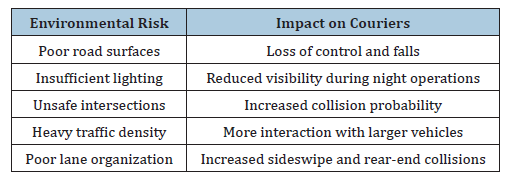
Poor road conditions: Road defects such as potholes, damaged surfaces, insufficient lighting, and poorly designed intersections represent significant hazards for two-wheel riders. A road condition that may be relatively minor for a passenger car can result in loss of control and severe injury for a motorcycle rider.
Media reports examined in this study frequently highlighted unsafe road conditions as contributing factors in fatal incidents. These findings support previous research emphasizing the importance of infrastructure design in reducing motorcycle injury severity [10].
Mixed traffic and congestion: Urban couriers operate in environments characterized by high traffic density and frequent interaction with larger vehicles. Collisions involving trucks, buses, and passenger vehicles often produce severe consequences because of differences in vehicle mass and rider vulnerability.
Traffic congestion may also encourage risky manoeuvres, including lane filtering, sudden lane changes, and riding in limited spaces between vehicles (Table 5).
Table 5:Environmental and Infrastructure Risks.
Occupational factors specific to couriers
Although traffic-related factors represent the immediate causes of many courier fatalities, the occupational context in which these crashes occur is essential for understanding why couriers are continuously exposed to elevated risks. Unlike ordinary motorcycle users, couriers spend extended periods on the road as part of their employment. Therefore, exposure time, work organization, and economic pressures significantly influence their risk profile.
Time pressure and delivery performance: One of the most frequently discussed occupational risks in platform-based delivery work is the pressure to complete orders within short time periods. Digital platforms often evaluate workers according to delivery speed, customer ratings, and task completion rates. Such performance systems may encourage rapid riding behaviours and reduced safety margins [4].
Media reports on courier fatalities frequently mention circumstances in which riders were working during delivery activities. Although delivery pressure is rarely identified as the direct cause of a crash, it represents an important background factor influencing risk-taking behaviour.
Long working hours and fatigue: Fatigue is a recognized occupational safety risk among professional drivers and delivery workers. Extended working hours reduce attention, reaction capacity, and decision-making ability [11].
Courier work may involve long periods of continuous riding, particularly in large cities where demand fluctuates throughout the day. Fatigue-related risks become more significant when combined with poor weather conditions, dense traffic, and time constraints.
Inadequate safety management: Traditional workplaces usually provide structured occupational safety measures, including training, supervision, and protective equipment. However, platform-based delivery work often operates through flexible employment models where responsibility for safety management may be unclear.
Previous research on the gig economy has emphasized that platform workers may experience limited access to occupational protections, despite performing tasks with substantial physical risks [12] (Table 6).
Table 6:Occupational Risk Factors Contributing to Courier Fatalities.

Social Impacts Observed in Media Reports
Unlike general descriptions of social consequences commonly presented in occupational health literature, this study focuses on social impacts specifically observed in media coverage of courier fatalities.
The analysis shows that courier deaths generate consequences extending beyond the individual victim and family. News reports frequently present these deaths as events involving questions of justice, labour rights, and public responsibility.
Family and community consequences
Media reports commonly describe the emotional and economic consequences experienced by families following courier deaths. Many reports emphasize the sudden loss of household income, especially when the deceased worker was a primary income provider.
Family statements published in news reports often include demands for accountability, improved traffic enforcement, and prevention of similar deaths. These reactions demonstrate that courier fatalities are interpreted not only as personal tragedies but also as failures requiring institutional responses.
Public awareness and social mobilization
Several reported courier deaths generated public discussion through social media campaigns, labour organizations, and courier associations. These discussions frequently focused on:
a. unsafe delivery expectations,
b. inadequate legal protection,
c. traffic safety problems,
d. responsibilities of delivery platforms.
Such reactions indicate that courier fatalities contribute to broader debates about the social costs of platform-based labour.
Institutional and policy discussions
Media coverage also contributes to policy discussions by increasing visibility of courier safety issues. Reports following fatal incidents often include calls for:
a. stronger occupational safety regulations,
b. improved motorcycle infrastructure,
c. mandatory safety training,
d. better monitoring of platform companies.
Therefore, media representations can influence how society understands responsibility for courier deaths.
Percentages represent thematic distribution within analyzed media reports and indicate relative emphasis rather than population estimates (Table 7).
Table 7:Social Impacts Identified in Media Reports.
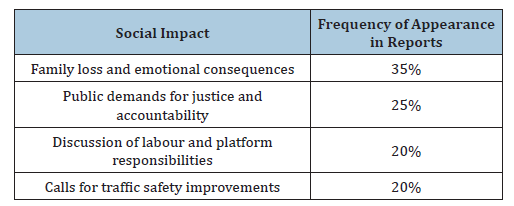
Percentages represent thematic distribution within analyzed media reports and indicate relative emphasis rather than population estimates.
Discussion
This study demonstrates that courier fatalities should be understood as the result of multiple interacting factors rather than isolated traffic incidents. The findings support previous research showing that motorcycle users face elevated risks due to limited physical protection, severe injury mechanisms, and vulnerability in mixed traffic environments [1,2].
The classification of fatality causes highlights three interconnected dimensions. First, injury mechanisms such as traumatic brain injury and polytrauma determine the severity of outcomes. Second, traffic factors including intersection collisions, speeding, and visibility problems represent immediate crash contributors. Third, infrastructure conditions and urban traffic environments influence both crash probability and injury severity.
However, courier fatalities differ from general motorcycle crashes because occupational exposure creates additional vulnerability. Couriers are exposed to traffic risks repeatedly during working hours and operate within economic systems where speed and efficiency are often prioritized. This finding is consistent with research on platform labour, which emphasizes the relationship between digital management systems, worker insecurity, and occupational risk [12].
The media analysis also reveals an important limitation in public representations of courier deaths. While accident-focused reporting successfully increases awareness, it may simplify complex events by emphasizing individual responsibility rather than structural causes. A more comprehensive media approach should consider workplace organization, platform responsibility, and regulatory gaps.
Policy Implications
The findings of this study indicate that reducing courier fatalities requires a multidimensional prevention strategy involving traffic authorities, digital platforms, employers, and urban planners. Since courier deaths emerge from the interaction between individual vulnerability, traffic conditions, infrastructure limitations, and occupational pressures, single interventions are unlikely to provide sufficient protection.
Improving occupational safety standards
Courier work should be recognized as a high-risk occupation requiring specific occupational health and safety measures. Digital delivery platforms should establish systematic safety management procedures, including:
a. mandatory motorcycle safety training,
b. risk assessment procedures,
c. appropriate protective equipment requirements,
d. monitoring of excessive working hours,
e. fatigue management policies.
Occupational safety responsibilities should not be transferred entirely to individual couriers. Platform companies should share responsibility for creating safer working conditions.
Reducing delivery pressure
Time-based performance systems may unintentionally encourage unsafe riding practices. Delivery platforms should redesign performance indicators by prioritizing safe delivery rather than only speed and customer satisfaction.
International experience in occupational safety demonstrates that productivity targets should be balanced with worker protection principles [13].
Improving road infrastructure and traffic safety
Urban transportation policies should consider the specific
vulnerabilities of motorcycle users. Effective measures include:
a. safer intersection design,
b. improved road surface maintenance,
c. better street lighting,
d. motorcycle awareness campaigns,
e. improved visibility between motorcycles and larger
vehicles.
Traffic safety strategies should address motorcycles as a distinct road user group rather than applying only general vehicle regulations.
Strengthening data collection and monitoring
A major challenge in understanding courier fatalities is the lack of systematic occupational accident data. Authorities should establish databases that distinguish professional couriers from general motorcycle users. Better data collection would allow more accurate evaluation of risk factors and prevention strategies [14].
Conclusion
This study examined courier fatalities through a media content analysis perspective, focusing on traffic risks, occupational conditions, and social impacts. The findings demonstrate that courier deaths cannot be explained solely as individual traffic accidents. Instead, they represent the outcome of interacting factors involving injury mechanisms, road environments, motorcycle vulnerability, and platform-based working conditions.
The analysis identified three major categories influencing fatal outcomes. First, severe injuries such as traumatic brain injuries and polytrauma determine the immediate consequences of crashes. Second, traffic-related factors-including intersection collisions, excessive speed, driver distraction, and visibility problemsrepresent common mechanisms leading to fatal events. Third, environmental conditions such as poor infrastructure and mixed traffic increase exposure to severe risks.
Beyond these factors, courier fatalities are strongly connected with occupational conditions. Delivery time pressure, long working hours, insufficient safety management, and insecure employment structures increase vulnerability among courier workers. Therefore, prevention strategies should address not only rider behaviour but also the organization of delivery work.
The media analysis further shows that courier fatalities generate significant social responses. Reported cases frequently involve family demands for justice, public debates about platform responsibility, and calls for improved occupational and traffic safety regulations. These findings demonstrate that courier deaths are increasingly perceived as preventable social and occupational problems.
Future research should combine media analysis with official accident databases, interviews with couriers, and platformlevel data to better understand the relationship between work organization and fatal risks. Effective prevention requires cooperation among policymakers, transportation authorities, digital platforms, and society.
Ultimately, protecting courier workers requires recognizing their deaths not as unavoidable consequences of modern delivery systems, but as preventable outcomes of insufficient occupational protection and road safety management.
References
- World Health Organization (2023) Global status report on road safety 2023. WHO, Geneva, Switzerland.
- Lin MR, Kraus JF (2009) A review of risk factors and patterns of motorcycle injuries. Accident Analysis & Prevention 41(4): 710-722.
- Keall MD, Newstead S, Watson L (2011) Motorcyclist injury outcomes and crash characteristics. Accident Analysis & Prevention 43(3): 1040-1047.
- Veen A, Barratt T, Goods C (2020) Platform-capital’s “App-etite” for control: A labour process analysis of food-delivery work. Work, Employment and Society 34(3): 388-406.
- Entman RM (1993) Framing: Toward clarification of a fractured paradigm. Journal of Communication 43(4): 51-58.
- Krippendorff K (2018) Content analysis: An introduction to its methodology. (4th edn), Sage Publications, Thousand Oaks, California, USA.
- Liu BC, Ivers R, Norton R, Boufous S, Blows S, et al. (2008) Helmets for preventing injury in motorcycle riders. Cochrane Database of Systematic Reviews 2008(1): CD004333.
- Haworth N (2012) Powered two wheelers in a changing world-Challenges and opportunities. Accident Analysis & Prevention 44(1): 12-18.
- Pai CW (2011) Motorcycle right-of-way accidents-A literature review. Accident Analysis & Prevention 43(3): 971-982.
- Organisation for Economic Co-operation and Development/International Transport Forum (2015) Improving safety for motorcycle, scooter and moped riders. OECD Publishing, Paris, France.
- Williamson A, Lombardi DA, Folkard S, Stutts J, Courtney TK, et al. (2011) The link between fatigue and safety. Accident Analysis & Prevention 43(2): 498-515.
- Wood AJ, Graham M, Lehdonvirta V, Hjorth I (2019) Good gig, bad gig: Autonomy and algorithmic control in the global gig economy. Work, Employment and Society 33(1): 56-75.
- International Labour Organization (2021) A call for safer and healthier working environments, International Labour Organization, Geneva, Switzerland.
- Chang HL, Yeh CC (2007) Factors affecting the probability of accidents among motorcycle riders in Taiwan. Traffic Injury Prevention 8(1): 1-9.
© 2026 Kenan Kaya. This is an open access article distributed under the terms of the Creative Commons Attribution License , which permits unrestricted use, distribution, and build upon your work non-commercially.
Editor In Chief







.jpg)































Signup for Newsletter

Quick Links
 Editorial Board Registrations
 Submit your Article
 Best Paper of the Volume
 Reprints
 Refer a Friend
 Advertise With Us
Our Recent Edition

.jpg)



Top Editors




.jpg)

















.bmp)
.jpg)
.png)
.jpg)













.jpg)






.png)

.png)




.png)




Financial Support

Sponsors

Latest e-Books

Latest Video

 a Creative Commons Attribution 4.0 International License. Based on a work at www.crimsonpublishers.com.
Best viewed in
a Creative Commons Attribution 4.0 International License. Based on a work at www.crimsonpublishers.com.
Best viewed in 
 | Above IE 9.0 version