

- About Us
- Information
-

The Author ensures that the research has been conducted responsibly and ethically with adherence to all relevant regulations. read more..
- For Authors
- For Reviewer
- Manuscript Guidelines
- Membership
- Publication Ethics
-
- Journals
- Reprints
- e-Books
- Videos
- Policies
- Contact Us
 COVID-19
- Submissions



Full Text
COJ Biomedical Science & Research
Serious Adverse Events Associated with 250mg Dose of Intravenous Sodium Ferric Gluconate
Dr. Thi-Thi Nguyen1 and Dr. Joshua J Davis2*
1Medication Management Pharmacy Specialist, Ascension Via Christi Hospitals Wichita, KS, USA
2Emergency Medicine Physician and Assistant Medical Director at Vituity and Clinical Instructor at University of Kansas school of Medicine, Wichita, KS, USA
*Corresponding author:Joshua J Davis, MD, Department of Emergency Medicine, Wichita, KS, USA
Submission: March 11, 2026; Published: May 08, 2026

Volume2 Issue 5May 08, 2026
Abstract
Purpose: To evaluate the rate of adverse events associated with the use of intravenous sodium ferric
gluconate in the ambulatory infusion center and to identify factors contributing to serious reactions.
Methods: This retrospective medication use evaluation included adult patients (18 years or older) who
received sodium ferric gluconate infusions from January 1 to December 31, 2020. Adverse events within
48 hours of administration were reviewed and categorized as serious or non-serious. Serious events
were further sub-classified as life-threatening or non-life-threatening. Descriptive statistics were used to
assess patient demographics, dose, and outcomes.
Results: A total of 157 patients received 475 doses of sodium ferric gluconate. Thirty-one adverse
events were reported, including 14 serious events among 13 patients (8%). All serious events occurred
following the 250mg dose except for 1 at the 500mg dose. Most patients experiencing serious events were
female (92%), with a high prevalence of other prior reported drug allergies (77%). The most common
serious adverse event was hypotension (71%). Nine serious events required hospitalization, with a mean
hospital stay of 16 hours. There were five life-threatening events (36%) in four unique patients.
Conclusion and relevance: The overall rate of serious adverse events was similar to previously
reported rates, but the majority occurred at the 250mg dose. These findings prompted a formulary
change at our institution to cap sodium ferric gluconate dosing at 125mg per administration. Continued
pharmacovigilance and dose-specific monitoring are warranted to mitigate risk to patients.
Introduction
Intravenous iron was introduced in 1932 as ferric hydroxide, but a high rate of severe toxic reactions to this initial formulation limited its use. The occurrence of severe toxic reactions was hypothesized to be related to the release of bioactive free iron, stemming from the lack of a carbohydrate shell [1,2]. The use of IV iron has rapidly expanded in the 1990s and 2000s due to newer, safer formulations and evidence of benefit in a wide array of conditions, most notably symptoms associated with iron deficiency anemia. The safety of the latter IV iron formulations is hypothesized to be based on the creation of iron-carbohydrate complexes, which allows for the slower release of iron [1,2]. Stronger complexes are associated with slower release of iron, thereby diminishing the effects of free iron toxicity [2] Despite the growing knowledge of benefits of intravenous iron infusions, adverse reactions are feared, albeit less common than previously thought [3,4]. Administration of IV iron may be associated with acute reactions, specifically, hypersensitivity reactions [5] This is thought to relate, at least in part, to the formulation of iron utilized. It is hypothesized that hypersensitivity reactions may either be IgE-mediated responses or Complement Activation-Related Pseudo- Allergy (CARPA). CARPA may be associated with the activation of mast cells and basophils, subsequently releasing histamine, thromboxanes, leukotrienes, and platelet-activating factor. Clinically, the release of such substances may be associated with bronchospasm, hypertension, hypotension, hypoxia, laryngeal edema, and tachycardia. In the most severe cases of hypersensitivity reactions, the patient may present with circulatory collapse, loss of consciousness, and cardiac and respiratory arrest [5]. However, the details of risk based on formulation are still poorly understood and data is conflicting.
For example, a 2004 study by Chertow, et al. [6] found patients receiving sodium ferric gluconate had an odds ratio of 6.2 of developing any adverse event compared to low molecular weight iron dextran (95% CI of 5.4-7.2). However, sodium ferric gluconate had just been approved, and it was hypothesized that this could have been secondary to increased vigilance [6]. This is further supported by a 2006 study by the same lead author that found patients assigned to iron sucrose or sodium ferric gluconate were less likely to experience an adverse drug event compared to low molecular weight iron dextran (OR 0.5, 95% CI 0.4-0.6) and there was no difference between iron sucrose and sodium ferric gluconate during that time period (OR 1, 95% CI 0.8-1.2) [7]. More recent 2022 data, though, has shown significant differences of adverse reactions based on formulation types although sodium ferric gluconate was not included in the analysis [8].
What also remains unknown is whether the rates of reactions are dose dependent, particularly for sodium ferric gluconate formulation (Ferrlecit®). The original studies in the label for approval by the US Food and Drug Administration for sodium ferric gluconate used a maximum dose of 125mg over 60 minutes [9]. One small study of 20 treatments in 13 patients showed 3 times the risk of adverse reactions in a 500mg dose vs. a 250mg dose [10]. Another slightly larger study on 79 treatments of 40 patients observed that the infusion of a 250mg dose over 1-4 hours was associated with a 5% rate of reactions and the rate of infusion did not appear to influence risk for reactions [11]. In contrast, in a study by Nissenson, et al. [12], administration of eight doses of 125mg of sodium ferric gluconate in 100mL saline over 60 minutes each showed similar rates of reactions to administration of eight doses of 62.5mg of sodium ferric gluconate in 50mL of saline over 30 minutes each [12].
At our institution, we noted an increase in acute reactions to sodium ferric gluconate in 2020. To mitigate these reactions, our pharmacy department switched manufacturers, increased the length of infusion of the medication, and discontinued batching sodium ferric gluconate doses. Batching of sodium ferric gluconate was integrated operationally based on a study by Baribeault observing that the dilution of sodium ferric gluconate in 100mL of 0.9% sodium chloride had a stability of at least 7 days under refrigerated conditions [13]. Despite these measures, we continued to have ongoing acute reactions and therefore, we elected to analyze these reactions for trends in terms of patient characteristics, product or administration characteristics, type and severity of adverse events.
Methods
Patient selection and eligibility criteria
This was a retrospective electronic record review of patients 18 years and older who received intravenous sodium ferric gluconate in the ambulatory infusion center from January 1 to December 31, 2020. This was a quality improvement medication use evaluation and thus did not receive or require Institutional Review Board approval.
Study design
The purpose of this medication use evaluation was to evaluate the rate of reported adverse events associated with the use of intravenous sodium ferric gluconate that required additional treatment. Data from all adults 18 years and older who received IV iron in the infusion center in 2020 were analyzed.
Analytical approach
Data analyzed included patient baseline demographics, dose, infusion time, and adverse event characteristics within 2 days after administration of medication requiring additional care [12].
Adverse events were identified based on electronic progress notes from the nurse or electronic documentation of phone message/ call initiated by the nurse. Thereafter, adverse events were classified as serious or non-serious by one of the authors (TN). Serious adverse events were defined as cardiac arrest, death, myocardial infarction, coma, anaphylactic shock, anaphylactoid reactions, seizures, arrhythmia, apnea, respiratory depression, bradycardia, tachycardia, allergic reaction, hypertension, hypotension, cyanosis, and urticaria. Serious events were then further sub-categorized as life-threatening (anaphylactoid reactions, cardiac arrest, death, and respiratory depression) and non-life threatening. Non serious adverse events were all other adverse events which did not fall under the serious event categorization [6,12,14]
Data were analyzed using descriptive statistics and stored and calculated in GoogleⓇ Sheets. Rates of adverse events by dose were compared using Chi-square and Fisher’s exact test for cell counts less than 5 (including 0). Results are presented in accordance with the STROBE criteria [15].
Results
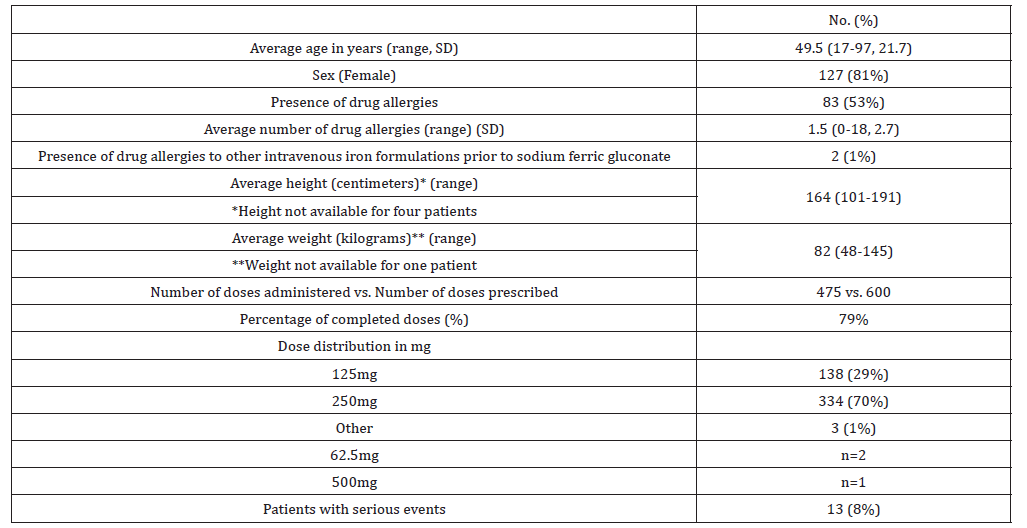
We identified 157 adult patients who received 475 doses of IV sodium ferric gluconate in 2020. The average age was 49.5 years (SD 21.7) and patients were mostly female (81%) (Table 1). During this time frame, there were a total of 31 adverse events, 17 of which were considered non-serious. There were 13 patients with serious adverse events with one patient who had 2 serious adverse events, for a total of 14 serious adverse events. For the patients with serious adverse events, the average age was 43 years (SD 15.6), mostly female (92%), and 77% reported the presence of at least one drug allergy (Table 2). All 13 patients with a serious adverse event were exposed to sodium ferric gluconate 250mg dose, which was significant compared to the 125mg dose (13/334 vs. 0/138, χ2 = 5.52, p=0.02). There were 5 life-threatening serious adverse events. In this string of 14 serious adverse events, 9 of these serious adverse events required hospitalization. Amongst these 9 hospitalizations, 5 required emergency room care, while 4 required observation. The average number of hours spent in the hospital was 16 hours.
Table 1:Baseline demographics of patients who received intravenous sodium ferric gluconate (N=157).
SD: Standard Deviation; VS: Versus
Table 2:Baseline demographics of patients who developed a serious event with intravenous sodium ferric gluconate administration.
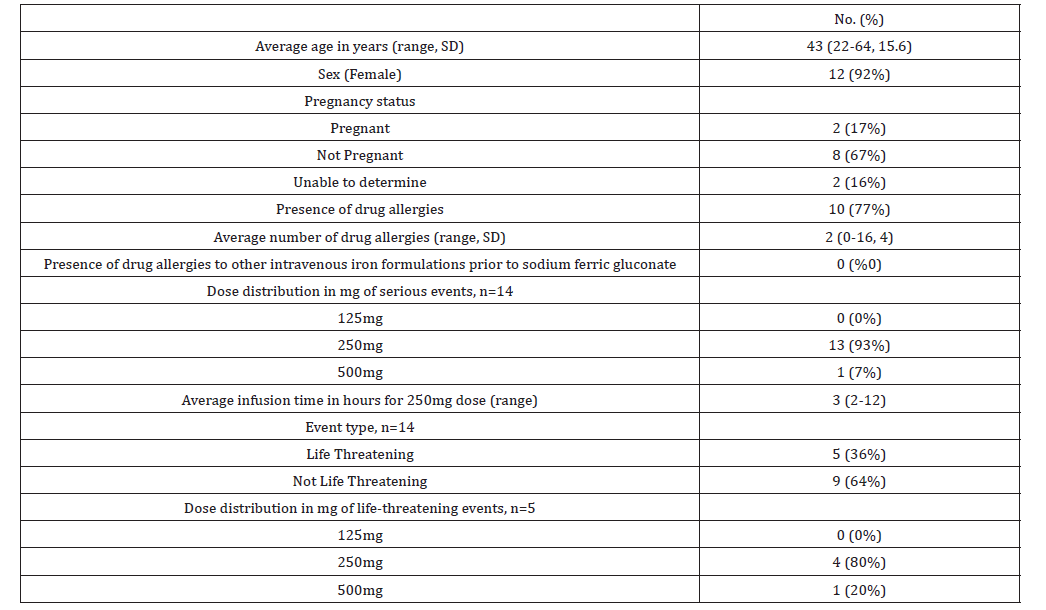
(n=13)-one patient developed two serious events.
SD: Standard Deviation.
The serious adverse events reported were hypotension (10/14) (Reactions 1, 2, 4, 5, 8, 9, 10, 12, 13, 14), urticaria (2/14) (Reactions 6 and 11), hypertension (1/14) (Reaction 3), and respiratory depression (1/14) (Reaction 7).
Discussion
We found that nearly all serious adverse events that occurred with IV sodium ferric gluconate at our institution occurred at the 250mg dose, despite this being reported as a safe dose previously [11]. The overall incidence of serious adverse events was 8% which is similar to what was previously reported by Agarwal et al. [14] (6.8%). In their randomized controlled trial, Agarwal et al. [14] reported hypotension requiring supportive care as the most frequent serious adverse event, and in the present medication use evaluation the most frequent serious adverse event was also hypotension.
Strengths associated with this analysis include all sodium ferric gluconate doses administered in a supervised ambulatory infusion center, single-reviewer data adjudication for serious adverse events, and collecting data regarding the intensity of care associated with the occurrence of serious adverse events. In addition, the definition of serious adverse events in terms of characteristics and onset employed in this retrospective chart review was based on previously published literature [6,12,14].
Limitations associated with this analysis include its retrospective observational nature, inconsistent documentation and missing data, and inability to deduce the true rate of incidence of events as this analysis only applied to patients in the ambulatory infusion center. Observational data like this does not prove causation and can be confounded. Our analysis was based on review of electronic nursing documentation and phone call records which introduces the possibility of underreporting and not capturing events that were not reported. Classification of adverse events was done by a single unblinded reviewer, which could be affected by bias. In addition, the presence of chronic kidney disease could not be collected as a patient characteristic, despite the use of sodium ferric gluconate at doses greater than 125mg being documented in the literature for patients with chronic kidney disease [10,11,16]. We could not make any inferences about the higher 500mg dose as it was only administered at that dose once. Further, we need to repeat the review at the reduced dose of 125mg to ascertain whether the incidence of the adverse effects had become seriously reduced. It was only an observation that most of the adverse effects occurred with the 250mg dose, but that assumes a stochastic approach and that dose is the driving factor determining the occurrence of the adverse effect which may not be the case.
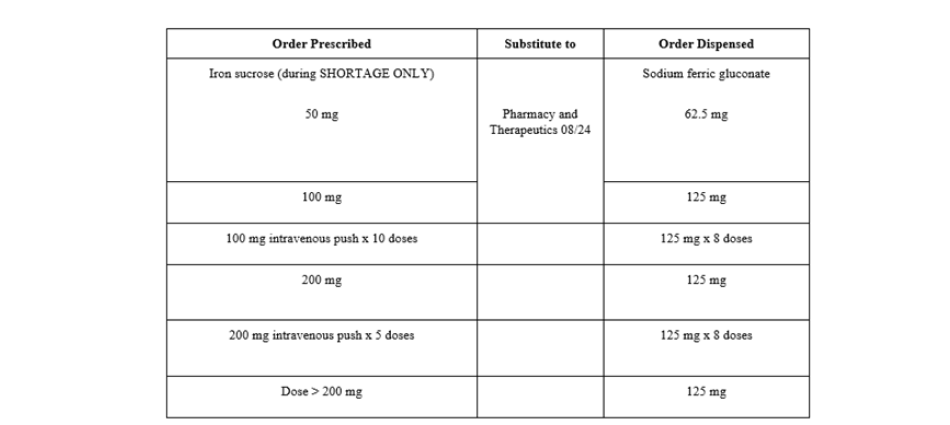
Thus, based on this observational data, our institution changed its parenteral iron on formulary to iron sucrose in March 2021. Nevertheless, with the advent of the shortage of iron sucrose, our institution went back to providing sodium ferric gluconate [17]. In August 2024, our Pharmacy and Therapeutics Committee approved the utilization of sodium ferric gluconate as our preferred parenteral iron while iron sucrose was in shortage. However, based on the analysis from this medication use evaluation, our Pharmacy and Therapeutics Committee approved the implementation of a therapeutic interchange to cap the dose of sodium ferric gluconate to 125mg per dose (Figure 1) [18,19] despite previous literature suggesting that administration of sodium ferric gluconate 250mg was observed to be safe [11].
Figure 1:Therapeutic interchange for parenteral iron during iron sucrose shortage [18,19].
Conclusion
The overall incidence of serious adverse events to sodium ferric gluconate at our institution was 8%, which is similar to what was previously reported. Doses of 250mg were associated with most serious events requiring further hospital care. Thus, based on this observational data, our institution changed its prescribing practices for sodium ferric gluconate to cap the dose of sodium ferric gluconate to 125mg per dose, despite previous literature suggesting that administration of sodium ferric gluconate 250mg was observed to be safe.
Funding Source
None.
Financial Disclosures
The authors have no financial relationships relevant to this article to disclose.
Acknowledgements
We wish to thank all of the members of the Pharmaceutical and Therapeutic Committee
Conflicts of Interest
The authors have no conflicts of interest relevant to this article to disclose.
Word Count
Abstract: 238 words; Manuscript: 1,706 words
Ethics
This was a quality improvement project and exempt from IRB review.
Data Availability
Data is available from the authors upon reasonable request.
Contributions
All authors participated in project design; TN conducted data collection; All authors participated in data analysis; All authors drafted the manuscript, revised the manuscript for critically important content and reviewed the manuscript and agreed to be listed as authors and accept responsibility for the content.
References
- Auerbach M, Macdougall I (2017) The available intravenous iron formulations: History, efficacy, and toxicology. Hemodial Int 21(Suppl 1): S83-S92.
- Auerbach M, Ballard H (2010) Clinical use of intravenous iron: Administration, efficacy, and safety. Hematology Am Soc Hematol Educ Program pp: 338-347.
- Dugan C, Cabolis K, Miles LF, Richards T (2022) Systematic review and meta-analysis of intravenous iron therapy for adults with non-anaemic iron deficiency: An abridged Cochrane review. J Cachexia Sarcopenia Muscle 13(6): 2637-2649.
- Avni T, Bieber A, Grossman A, Green H, Leibovici L, et al. (2015) The safety of intravenous iron preparations: Systematic review and meta-analysis. Mayo Clin Proc 90(1): 12-23.
- Rampton D, Folkersen J, Fishbane S, Hedenus M, Howaldt S, et al. (2014) Hypersensitivity reactions to intravenous iron: Guidance for risk minimization and management. Haematologica 99(11): 1671-1676.
- Chertow GM, Mason PD, Vaage-Nilsen O, Ahlmén J (2004) On the relative safety of parenteral iron formulations. Nephrol Dial Transplant 19(6): 1571-1575.
- Chertow GM, Mason PD, Vaage-Nilsen O, Ahlmén J (2006) Update on adverse drug events associated with parenteral iron. Nephrol Dial Transplant 21(2): 378-382.
- Arastu AH, Elstrott BK, Martens KL, Cohen JL, Oakes MH, et al. (2022) Analysis of adverse events and intravenous iron infusion formulations in adults with and without prior infusion reactions. JAMA Netw Open 5(3): e224488.
- (2025) Ferrlecit. Prescribing information, USA.
- Bastani B, Jain A, Pandurangan G (2003) Incidence of side-effects associated with high-dose ferric gluconate in patients with severe chronic renal failure. Nephrology (Carlton) 8(1): 8-10.
- Jain AK, Bastani B (2002) Safety profile of a high dose ferric gluconate in patients with severe chronic renal insufficiency. J Nephrol 15(6): 681-683.
- Nissenson AR, Lindsay RM, Swan S, Seligman P, Strobos J (1999) Sodium ferric gluconate complex in sucrose is safe and effective in hemodialysis patients: North American clinical trial. Am J Kidney Dis 33(3): 471-482.
- Baribeault D (2011) Short-term stability of a new generic sodium ferric gluconate in complex with sucrose. Curr Med Res Opin 27(12): 2241-2243.
- Agarwal R, Rizkala AR, Bastani B, Kaskas MO, Leehey DJ, et al. (2006) A randomized controlled trial of oral versus intravenous iron in chronic kidney disease. Am J Nephrol 26(5): 445-454.
- von Elm E, Altman DG, Egger M, Pocock SJ, Gotzsche PC, et al. (2007) The Strengthening the Reporting of Observational Studies in Epidemiology (STROBE) statement: Guidelines for reporting observational studies. Ann Intern Med 147(8): 573-577.
- Javier AM (2002) Weekly administration of high-dose sodium ferric gluconate is safe and effective in peritoneal dialysis patients. Nephrol Nurs J 29(2): 183-186.
- (2024) American society of health-system pharmacists. Drug shortage list.
- (2024) Iron sucrose. UpToDate Lexidrug, Pediatric and Neonatal Lexi-Drugs Online. Waltham, MA, USA.
- (2024) Sodium ferric gluconate. UpToDate Lexidrug, Pediatric and Neonatal Lexi-Drugs Online. Waltham, MA, USA.
© 2026 Dr. Joshua J Davis. This is an open access article distributed under the terms of the Creative Commons Attribution License , which permits unrestricted use, distribution, and build upon your work non-commercially.
Editor In Chief







.jpg)































Signup for Newsletter

Quick Links
 Editorial Board Registrations
 Submit your Article
 Best Paper of the Volume
 Reprints
 Refer a Friend
 Advertise With Us
Our Recent Edition
.jpg)



Top Editors




.jpg)

















.bmp)
.jpg)
.png)
.jpg)













.jpg)






.png)

.png)




.png)




Financial Support

Sponsors

Latest e-Books

Latest Video

 a Creative Commons Attribution 4.0 International License. Based on a work at www.crimsonpublishers.com.
Best viewed in
a Creative Commons Attribution 4.0 International License. Based on a work at www.crimsonpublishers.com.
Best viewed in 
 | Above IE 9.0 version