

- About Us
- Information
-

The Author ensures that the research has been conducted responsibly and ethically with adherence to all relevant regulations. read more..
- For Authors
- For Reviewer
- Manuscript Guidelines
- Membership
- Publication Ethics
-
- Journals
- Reprints
- e-Books
- Videos
- Policies
- Contact Us
 COVID-19
- Submissions



Full Text
COJ Biomedical Science & Research
Artificial Intelligence [AI]: The Future of Disease Detection in Biomedical Devices
Dr. Shashank Sharma1*, Dr. Harsha Upadhyay2 and Dr. Archana Mishra3
1Department of Physics, PSSOUCG Bilaspur (C.G.), India
2Department of Chemistry, PSSOUCG Bilaspur (C.G.), India
3Department of Botany, PSSOUCG Bilaspur (C.G.), India
*Corresponding author:Dr. Shashank Sharma, Department of Physics, PSSOUCG Bilaspur (C.G.), India
Submission: March 23, 2026; Published: April 09, 2026

Volume2 Issue 5April 09, 2026
Abstract
Earlier identification of major & dangerous-diseases in biomedical equipment is currently being transformed by Artificial Intelligence (AI), where machine learning algorithms quickly evaluate enormous data sets to provide performance that surpasses that of human physicians. In addition to speeding up the diagnosis process, this technology makes healthcare services more widely available and reasonably priced.
Keywords:Artificial intelligence (AI); Biomedical devices; Diseases; Diagnosis; Machine learning; Healthcare.
Introduction
Science and Technology have become the bedrock of the modern development. The present era in an age defined by technological advancement, wherein the multifaceted applications of Artificial Intelligence (AI) have brought about revolutionary changes in the technological landscape, thereby proving that human life is utterly void without technology. Technology has played an invaluable role in enabling humanity to successfully ascend from absolute zero to the very pinnacle of achievement. Artificial Intelligence, which we regard as one of the most precious inventions of the 21st century, has demonstrated that there exists a realm extending far beyond the scope of human thought: a realm we refer to as the “Machine World.” We can now even envision that, through the medium of Artificial Intelligence, machines are becoming highly capable of independent thought. A specific type of Artificial Intelligence (AI) referred to as machine learning allows computers to acquire information through data, recognize patterns, and arrive at forecasts and recommendations despite the need for specific programming [1-5].
A severe pandemic like COVID-19 shook the entire world to its core. The contagion had spread its tentacles in every direction, and the entire globe was solely focused on combating this crisis. All eyes across the world were fixed upon scientists, with the hope that they would discover a cure for the disease and enable people to recover as quickly as possible. It would be no exaggeration to say that the advent of COVID-19 significantly amplified the utility of artificial intelligence and machine learning. The specific application of machine learning in conjunction with AI has lent a new dimension to digitalization. Consequently, people have become more aware and vigilant regarding their health. The perfect synergy between machine learning and AI aided in detecting the early symptoms of COVID-19, thereby revealing that this pandemic spreads through physical contact as well as through the air.
Machine learning plays a pivotal role in all the biomedical imaging devices; we are able to utilize today. Machine learning is a technology that through the application of artificial intelligence, identifies specific patterns within databases of various diseases, thereby making a wide range of associated information instantly available. In biomedical imaging techniques including MRIs, CT scans, and X-rays, AI exhibits outstanding efficiency. For example, AI is able to recognize unusual infections and tumour grades in histopathology and diagnose diabetic retinopathy and glaucoma with over 95% accuracy when using retinal images. AI-enhanced mammography and the blood sample analysis are 20-30% more effective than conventional techniques for early detection of breast cancer. Recent studies reveal that artificial intelligence can diagnose ailments using images of the tongue or face. One algorithm, trained on over 5,200 photographs, achieved an impressive 98% accuracy. Technologies such as PathAI, which analyzed 5 million digital slides, are used to conduct sophisticated evaluations of tumour microenvironments. Furthermore, predictive analytics, by forecasting hospital readmissions, have the potential to enhance patient outcomes by 15% to 20%. But in 52% of medical emergency situations, general-purpose models like ChatGPT failed, highlighting the urgent need for specialized AI solutions.
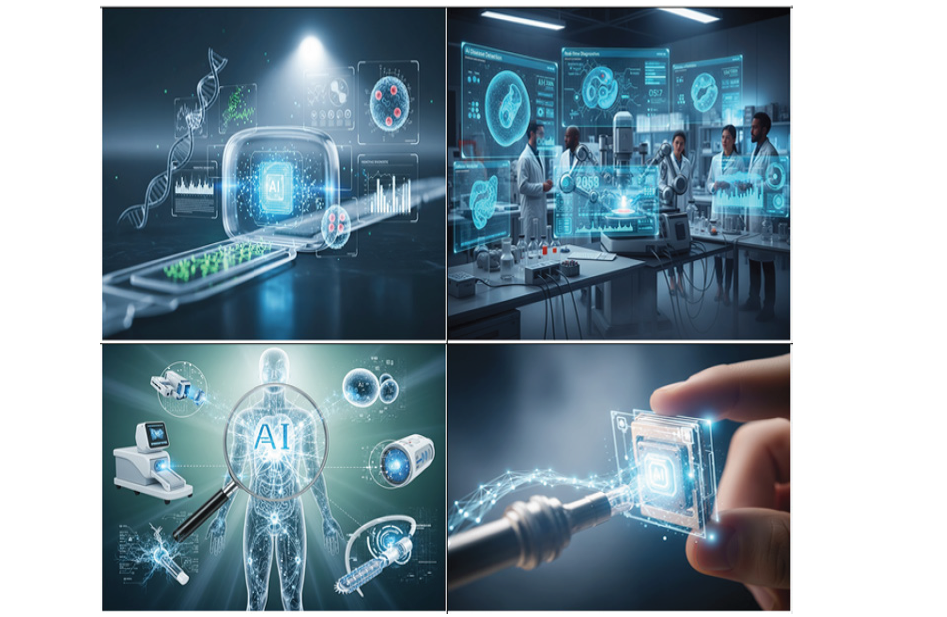
Participants from various nations attending the recently concluded AI Summit in India urged for the optimal utilization of AI for the betterment of both science and society. Nations across the globe are strengthening their economies with the specific objective of ensuring their active participation in the healthcare sector. Plans are even being formulated to equip entire hospitals with AI technology, thereby enabling the saving of as many lives as possible. A collective pledge was taken to realize the vision of a “Healthy- Nation, Prosperous Nation.” Furthermore, AI technology is now being integrated into all digital devices. Through the perfect synergy of AI technology and machine learning within the healthcare sector, we will be able to discover treatments for dangerous diseases that are currently incurable. These technologies will also prove instrumental in the development of vaccines. Furthermore, the integration of AI with machine learning is particularly essential in biomedical devices for the imaging of dangerous diseases (Figure 1).
Figure 1:Biomedical imaging techniques through AI.
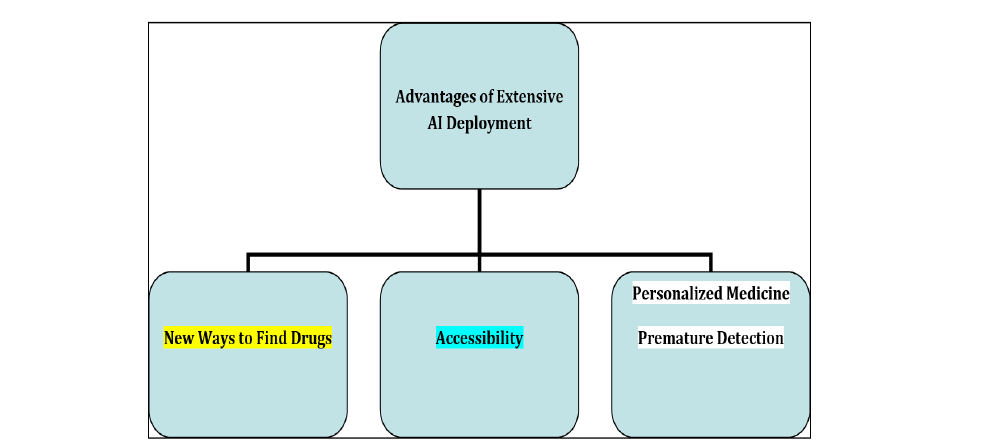
Advantages of Extensive AI Deployment
1. New ways to find drugs: AI can find possible lead
molecules in just a few weeks by looking at billions of different
chemical compounds.
2. Accessibility: AI in telemedicine greatly benefits patients
who reside in remote and rural areas.
3. Personalized medicine: Treatment plans tailored to
a patient’s habits and genetic makeup minimize adverse side
effects.
4. Premature detection: AI scans reduce death rates by
identifying mild indicators for conditions like Parkinson’s,
Alzheimer’s, and cardiovascular diseases (Figure 2).
Figure 2:Advantages of extensive AI deployment.
Key Challenges & Benefits
The development of artificial intelligence has an enormous number of opportunities. But there are also a lot of challenges, such as concerns about data privacy, algorithmic bias, and the need for governmental clearances. Powered by artificial intelligence; scanning technologies are already making it easier to diagnose breast cancer in cities consisting of Bhopal and Lucknow in countries like India [6-9].
Our Opinion
We argue that Artificial Intelligence (AI) deserves to be implemented in partnership with physicians rather than as a replacement, since it has the potential to revolutionize healthcare when combined with human judgment and specialized expertise. By 2030, it is anticipated that 50% of all diagnosis might be AIassisted regarding the help of funding from government as well as a robust ethical framework.
Conclusion
In the future, the number of biomedical devices should be increased and efforts should be made to strengthen the better use of AI technology in them, so that dangerous and serious diseases can be identified and vaccines with high immunity can be developed for their prevention and treatment.
Acknowledgements
Both authors are greatly acknowledged to all references & online sources.
Ethical Statement
This study does not contain any studies with human or animal subjects performed by any of the authors.
Conflicts of Interest
The authors declare that they have no conflicts of interest to this work.
Author Contribution Statement
1) Dr. Shashank Sharma: Conceptualization, Methodology,
Validation, Formal analysis, Investigation, Resources, Data
Curation, Writing - Original Draft, Writing - Review & Editing.
2) Dr. Archana Mishra: Supervision and Visualization.
3) Dr. Harsha Upadhyay: Check Grammar Mistakes &
Punctuation.
References
- (2025) Benefits and Uses of AI in Healthcare.
- (2025) How is AI used in medicine?
- (2023) Dangerous diseases like cancer are also being detected by AI. The Health Sector Is Changing - CNBC Awaaz, USA.
- (2026) Is ChatGPT putting your life at risk? Report reveals it fails to recognize medical emergencies 52% of the time.
- (2026) AI Makes Disease Detection and Treatment More Precise. Hindustan News.
- Using AI in medical research: Transformative potential and challenges.
- (2024) By looking at the tongue, will AI be able to identify which disease you have? Researchers' Claim.
- (2024) Artificial Intelligence (AI) is revolutionizing healthcare services?
- (2025) No Tests, No Machines... Just a Selfie and You Get a Health Report: New AI Technology Achieves a Breakthrough.
© 2026 Dr. Shashank Sharma. This is an open access article distributed under the terms of the Creative Commons Attribution License , which permits unrestricted use, distribution, and build upon your work non-commercially.
Editor In Chief







.jpg)































Signup for Newsletter

Quick Links
 Editorial Board Registrations
 Submit your Article
 Best Paper of the Volume
 Reprints
 Refer a Friend
 Advertise With Us
Our Recent Edition

.jpg)



Top Editors




.jpg)

















.bmp)
.jpg)
.png)
.jpg)













.jpg)






.png)

.png)




.png)




Financial Support

Sponsors

Latest e-Books

Latest Video

 a Creative Commons Attribution 4.0 International License. Based on a work at www.crimsonpublishers.com.
Best viewed in
a Creative Commons Attribution 4.0 International License. Based on a work at www.crimsonpublishers.com.
Best viewed in 
 | Above IE 9.0 version