

- About Us
- Information
-

The Author ensures that the research has been conducted responsibly and ethically with adherence to all relevant regulations. read more..
- For Authors
- For Reviewer
- Manuscript Guidelines
- Membership
- Publication Ethics
-
- Journals
- Reprints
- e-Books
- Videos
- Policies
- Contact Us
 COVID-19
- Submissions



Full Text
COJ Biomedical Science & Research
The Caspian Seal (Pusa Caspica): Biology, Ecology and Conservation Challenges in the Caspian Sea
Mohammad Forouhar Vajargah1* and Seyed Parsa Mousavi2
1PhD of Aquatic Ecology, Shahid Dr. Beheshti Sturgeon Restoration and Genetic Conservation Center, Iranian Fisheries Organization, Iran
2Department of Environmental Sciences and Engineering, Faculty of Natural Resources, University of Guilan, Iran
*Corresponding author:Mohammad Forouhar Vajargah, PhD of Aquatic Ecology, Shahid Dr. Beheshti Sturgeon Restoration and Genetic Conservation Center, Iranian Fisheries Organization, Iran
Submission: November 25, 2025; Published: January 08, 2026

Volume2 Issue 5January 08, 2026
Abstract
The Caspian seal (Pusa caspica), the smallest member of the Phocidae family and the only mammalian species inhabiting the Caspian Sea, has experienced severe population declines in recent decades. Major threats include overexploitation, incidental catch in sturgeon fisheries, outbreaks of Canine Distemper Virus (CDV), environmental pollution and climate change-induced reduction in ice cover. As an apex predator, the Caspian seal plays a critical ecological role, yet its population has decreased from over one million individuals in the early 20th century to approximately 111,000 in 2005. The species exhibits seasonal migrations, monogamous breeding behavior and a diet primarily dependent on Black Sea Sprat (Clupeonella cultriventris). Habitat degradation, bioaccumulation of heavy metals and pesticides and illegal hunting further exacerbate population decline. This study provides a comprehensive overview of the biology, ecology and current conservation status of the Caspian seal, highlighting the urgent need for coordinated conservation strategies to ensure the survival of this endemic species.
Keywords:Caspian seal; Pusa caspica; Endangered species; Bioaccumulation; CDV; Overexploitation; Caspian sea ecosystem; Conservation
Introduction
The Caspian seal (Pusa caspica) is the smallest representative of the Phocidae family and the only mammalian species inhabiting the Caspian Sea. Its distribution extends throughout the Caspian basin, from the northern shores to the coasts of Iran. In recent decades, the species has suffered severe declines due to overexploitation, mortality associated with Canine Distemper Virus (CDV) and various forms of environmental pollution. Consequently, the International Union for Conservation of Nature (IUCN) has listed the Caspian seal as a threatened species, recognizing it as one of the taxa facing a high risk of extinction.
The Caspian seal is a piscivorous predator, with its diet primarily dependent on shortlived fish species, particularly Black Sea Sprat (Clupeonella cultriventris). Breeding grounds are located in the central, eastern and northern regions of the Caspian Sea, with reproduction occurring under favorable conditions during winter. Seasonal migrations are characteristic of the species: In late spring, seals move from the northern to the southern Caspian, while in early autumn they return northward. During winter, early spring and late autumn, large aggregations are observed in the northern Caspian. In autumn, seals congregate at the estuaries of the Aral and Volga rivers, whereas in late spring, summer and early autumn, they are predominantly found in the central and southern Caspian [1,2]. Aquatic mammals, due to their position at the top of the food chain, have the potential to accumulate heavy metals and trace elements in their tissues. In recent years, mass mortality events have been reported in several populations of marine mammals. Consequently, concerns have arisen regarding the adverse effects of trace elements and their bioaccumulation in aquatic mammals.
The Miankaleh Wildlife Refuge, located in the southeastern extremity of the Caspian Sea, is formed around the central part of the Miankaleh wetland and is connected to the Caspian Sea through a narrow channel at its northeastern end. This wetland serves as a habitat for the Caspian seal (Phoca caspica). The wetland is shallow, with a maximum depth of approximately 5 meters. The LaVan devil Wildlife Refuge (Astara, Guilan Province), situated within the Astara district, encompasses diverse aquatic and terrestrial habitats for various animal species. A total of 125 species has been identified in this area, among which the Caspian seal is considered one of the most significant [3-5].
Additional causes of mortality in Caspian seals include the presence of agricultural pesticides such as DDT, industrial effluents accumulating in adipose tissues, the immunosuppressive effects of industrial pollutants that weaken the seals’ immune system against viral infections, high concentrations of chlorine-derived compounds in adipose, hepatic tissues, both legal and illegal overexploitation for industrial and commercial purposes, particularly for the use of seal meat and pelts [6].
Taxonomic Information
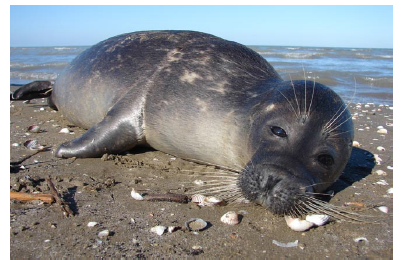
Scientific name: Pusa caspica (syn. Phoca caspica) English name: Caspian seal (Figure 1)
Figure 1:Caspian seal (Pusa caspica).
Morphological Characteristics
The body is fusiform in shape. The eyes are relatively large, the ears are very small and the vibrissae are long and thick. The upper jaw contains 10 pairs of teeth, while the lower jaw has 8 pairs. The forelimbs and hindlimbs each possess five digits with long claws, covered by interdigital membranes that give them a strong resemblance to swimming flippers. The hindlimbs are aligned with the tail. The body surface is covered with short hair; at birth, pups possess soft, dense, wool-like white fur. Pelage color varies with age and season, but is generally gray. The dorsal surface bears relatively broad, dark spots. With increasing age, the body color becomes lighter, while the spots become darker and more numerous. In females, the body spots are lighter in color.
Size: Adult males reach a body length of approximately 150cm, while females measure around 140cm. The average body weight is about 85kg.
Habitat: The Caspian Sea and the major rivers flowing into it constitute the primary habitat of the species.
Distribution
The Caspian seal is endemic to the Caspian Sea and does not occur elsewhere. During late spring, summer and early autumn, individuals inhabit the central and southern regions of the sea, where the waters are deeper and colder. In these seasons, seals can be observed near the coasts of Guilan and Mazandaran provinces, particularly along the eastern shores such as Miankaleh and Babolsar, where groups of seals are often seen with only their heads emerging above the water surface.
Distribution Map
(Figure 2)
Figure 2:Geographical distribution of the Caspian seal (Pusa caspica).

Behavior
The Caspian seal is an aquatic mammal that comes ashore primarily for reproduction and occasionally for resting. Due to the inability of their hind limbs to bend forward, seals move on land by arching their backs and rolling. They are highly skilled swimmers, propelling themselves forward mainly with their hind flippers. Occasionally, particularly in captivity, they swim on their backs or adopt a vertical posture in the water. The species is active both during the day and at night.
In aquatic environments, Caspian seals possess excellent vision and hearing and they utilize their long vibrissae to detect and track prey even in turbid waters. During autumn, they migrate toward the northeastern Caspian, where shallow waters freeze in winter. Initially, the ice forms as floating sheets, which are fragmented by wind and waves into uneven ridges. Seals excavate small holes in the ice for breathing and larger openings for hauling out. In early spring, as the ice melts, they migrate southward and spend the summer in deeper, colder regions of the Caspian Sea, where food resources are abundant. The majority of the specific sites occupied by seals from spring to autumn remain largely unidentified.
Diet
Studies have shown that more than 80% of the Caspian seal’s diet consists of kilka (Clupeonella spp.), while the remainder is composed of gobies (Gobiidae) and Alburnus chalcoides (colma). The sharp decline in fish populations, particularly Black Sea Sprat (Clupeonella Cultriventris), due to the introduction of the comb jelly (Mnemiopsis leidyi), water pollution and overfishing, is considered one of the major factors contributing to the severe reduction in the seal population [7].
Reproduction
Mating occurs from late February to mid-March, when seals inhabit the northern Caspian Sea, especially at the estuaries of the Volga and Ural rivers. A small colony also migrates to islands near Turkmenistan for breeding. Caspian seals are monogamous. The gestation period lasts approximately 11 months, likely including several months of delayed implantation. Before parturition, females excavate holes in the ice, where they give birth to one or two pups, often sheltered within ice cavities.
At birth, pups possess long, dense, wool-like fur that is white with a yellowish tint, which is replaced after about three weeks by dark gray pelage. Newborns measure between 64 and 79cm in length and weigh around 5kg. Mothers nurse their pups for about four to five weeks; seal milk contains approximately 12% fat, making a single daily feeding sufficient. Mating resumes about one month after parturition. After weaning, pups migrate collectively toward the deeper and colder southern Caspian waters. Sexual maturity is reached between five and seven years of age and the species has an average lifespan of about 30 years [8-10].
Current Status
The natural predators of seal pups include eagles and, occasionally, wolves in the northern Caspian region. Each year, a considerable number of seals are incidentally caught in sturgeon fishing nets. Captured individuals either suffocate or are killed by fishermen, typically through stabbing with long knives or striking their heads with hammers. Numerous dead or moribund seals are observed along the coasts of Mazandaran Province, particularly between Miankaleh and Babolsar.
According to available data, thousands of seal pups are hunted annually along the northern Caspian shores for their valuable pelts. In 2005, the Caspian seal population was estimated at approximately 111,000 individuals, compared to over one million at the beginning of the 20th century and about 400,000 in the early 1970s. Approximately 20% of the population decline and 20% of reduced fertility are attributed to environmental pollution, particularly agricultural pesticides.
Between 1997 and 2000, 20 to 30 seals died in the northern Caspian due to outbreaks of Canine Distemper Virus (CDV). The reduction in ice cover in recent years has led to an increased aggregation of seals in limited areas, facilitating the transmission of viruses. Furthermore, diminished ice formation and premature ice breakup-primarily driven by global climate change-have severely impacted pup survival. In addition, following the collapse of the former Soviet Union, illegal hunting and fishing activities have markedly increased.
Conclusion
The Caspian seal (Pusa caspica) is an endemic and endangered species whose survival is increasingly threatened by anthropogenic pressures and environmental changes. The decline in prey availability, widespread pollution, illegal hunting, and the impacts of climate change have collectively resulted in dramatic reductions in population size and reproductive success. Conservation of the Caspian seal requires urgent international collaboration, strict enforcement of hunting regulations, mitigation of industrial and agricultural pollution and protection of critical breeding and feeding habitats. Without immediate and sustained intervention, the species faces a high risk of extinction, with profound ecological consequences for the Caspian Sea ecosystem.
References
- Vajargah MF (2021) A review on the effects of heavy metals on aquatic animals. Environmental Sciences 2(9): 865-869.
- Sattari M, Namin JI, Bibak M, Vajargah MF, Faggio C, et al. (2019) Trace and macro elements bioaccumulation in the muscle and liver tissues of Alburnus chalcoides from the south Caspian Sea and potential human health risk assessment. Journal of Energy, Environmental & Chemical Engineering 4(1): 13-20.
- Mousavi SP, Ramzanipour MM, Vajargah MF (2023) An overview on Lutra lutra. Journal of Biomedical Research Environmental Sciences 4(4): 714-718.
- Forouhar Vajargah M, Sattari M, Imanpour Namin J, Bibak M (2022) Predicting the trace element levels in caspian kutum (Rutilus kutum) from south of the Caspian Sea based on locality, season and fish tissue. Biological Trace Element Research 200(1): 354-363.
- Forouhar Vajargah M, Bibak M (2022) Pollution zoning on the southern shores of the Caspian Sea by measuring metals in Rutilus kutum Biological Trace Element Research 200(10): 4465-4475.
- Namin JI, Forouhar Vajargah M (2022) Heavy metals accumulation in fish, a growing threat in the Caspian Sea. Water and Environmental Sustainability 2(1): 9-13.
- Khojasteh Noshari S, Namin Imanpour J, Forouhar Vajargah M, Bibak M (2024) The use of Anodonta cygnea as an indicator of heavy metal contamination in Anzali wetland. Environmental Health Engineering and Management Journal 11(2): 219-228.
- Montajami S, Hajiahmadyan M, Vajargah MF, Hosseini Zarandeh AS, Shirood Mirzaie F, et al. (2012) Effect of symbiotic (biomin imbo) on growth performance and survival rate of Texas cichlid (Herichthys cyanoguttatus) larvae. Global Veterinaria 9(3): 358-361.
- Vajargah MF, Hossaini SA, Niazie EHN, Hedayati A, Vesaghi MJ (2013) Acute toxicity of two pesticides Diazinon and Deltamethrin on Tench (Tinca tinca) larvae and fingerling. International Journal of Aquatic Biology 1(3): 138-142.
- Azar H, Vajargah MF (2023) Investigating the effects of accumulation of lead and cadmium metals in fish and its impact on human health. Journal of Aquaculture & Marine Biology 12(2): 209-213.
© 2026 Mohammad Forouhar Vajargah. This is an open access article distributed under the terms of the Creative Commons Attribution License , which permits unrestricted use, distribution, and build upon your work non-commercially.
Editor In Chief







.jpg)































Signup for Newsletter

Quick Links
 Editorial Board Registrations
 Submit your Article
 Best Paper of the Volume
 Reprints
 Refer a Friend
 Advertise With Us
Our Recent Edition

.jpg)



Top Editors




.jpg)

















.bmp)
.jpg)
.png)
.jpg)













.jpg)






.png)

.png)




.png)




Financial Support

Sponsors

Latest e-Books

Latest Video

 a Creative Commons Attribution 4.0 International License. Based on a work at www.crimsonpublishers.com.
Best viewed in
a Creative Commons Attribution 4.0 International License. Based on a work at www.crimsonpublishers.com.
Best viewed in 
 | Above IE 9.0 version