

- About Us
- Information
-

The Author ensures that the research has been conducted responsibly and ethically with adherence to all relevant regulations. read more..
- For Authors
- For Reviewer
- Manuscript Guidelines
- Membership
- Publication Ethics
-
- Journals
- Reprints
- e-Books
- Videos
- Policies
- Contact Us
 COVID-19
- Submissions



Full Text
Cohesive Journal of Microbiology & Infectious Disease
Observable Variations in Serum Toll Like Receptors (TLR4) as an Adjunct for Detection of Asymptomatic Neisseria Gonorrhoea Infection Amongst Sexually Active Women in Osun State, Nigeria
Ibeh Nnanna Isaiah1*, Okungbowa Awo Micheal2, Isaiah Nnanna Ibeh2 and Oronsaye Praise Ikponwosa3
1Department of Veterinary Anatomy, Faculty of Veterinary Medicine, Benin
2Department of Medical Laboratory Sciences, School of Basic Medical Sciences, Benin
3Department of Health Services, Benin
*Corresponding author: Ibeh Nnanna Isaiah, Department of Veterinary Anatomy, Faculty of Veterinary Medicine, Benin
Submission: January 17, 2020; Published: February 11, 2020

ISSN 2578-0190 Volume3 issues4
Abstract
Background: The genus Neisseria contains commensal and pathogenic species that colonize human mucosal epithelia. The pathogenic species Neisseria gonorrhoeae and Neisseria meningitidis can induce inflammation and breach mucosal barriers. they have evolved mechanisms to promote growth and persistence in the host. In addition to living freely in the extracellular space, gonorrhoeae can invade the cytoplasm of host phagocytes, thereby evading detection and elimination by the innate immune system.
Aims and objectives: To evaluate molecules from microorganisms known as pathogen-associated molecular patterns through which several host pattern recognition receptors are mediated as an adjunct for early detection of Asymptomatic carriers from symptomatic carriers these molecules are the Toll-like receptors (TLRs). For example, TLR4mediates recognition of extracellular gonococcal lipoolextracecharide (LOS).
Materials and method: Adult sexually active females those who haven’t been diagnosed of any sexually transmitted infection and then positive carriers those who have been diagnosed and confirmed with Gonorrhea infection using the normal healthy females as a baseline of comparison from both. Blood samples were collected, 10 positive Symptomatic carriers and 10 Asymptomatic carriers were inducted into this study all patient on any form of antibacterial treatment were excluded from the study. Venous blood samples were collected and analysed with the flow cytometer to differentiate TLR4 Neutrophils and Monocytes with other proinflammatory mediators.
Result: Observable variations when comparing the normal healthy female and the asymptomatic carrier with a significant difference (p<0.05) from the TLR4 (Neutrophils and Monocytes) although symptoms may not be present, but the body still produces mediators as basline of infectious antigen present.
Conclusion and recommendation: It is possible to include TLR4 as mediator in detecting possible sexually transmitted gonococcal infection in females.
Keywords: Toll like receptors; Mediators; Immunostimulation; Gonococcal; Asymptomatic
Introduction
The detection of pathogens happens through the common mediator molecules from microorganisms known as pathogen-associated molecular patterns (PAMP) through several host pattern recognition receptors including Toll-like receptors (TLRs). For example, TLR4 mediates recognition of extracellular gonococcal lipooligosaccharide (LOS) [1-9]. It has additionally been proven that lipopolysaccharide (LPS) and infection with distinctive gram negative and gram-positive bacteria induces interferon (IFN)-b [7]. The genus Neisseria incorporates commensal and pathogenic species that colonize human mucosal epithelia. The pathogenic species Neisseria gonorrhoeae and Neisseria meningitidis can induce irritation and breach mucosal barriers. Each year N. Gonorrhoeae and N. Meningitidis purpose an envisioned 88 million cases of N. gonorrhea and 500,000 cases of meningococcal meningitis worldwide, respectively. These pathogens are tremendously tailored to humans; in preference to produce cytotoxins or secrete poisonous products, they have advanced mechanisms to promote increase and persistence within the host. In addition to dwelling freely inside the extracellular space, N. Gonorrhoeae can invade the cytoplasm of host phagocytes, thereby evading detection and removal via the innate immune system [1,2]. The sensing of pathogen-derived nucleic acids (DNA and RNA) is a central approach used by the innate immune system to initiate immune responses following microbial invasion. Accumulation of overseas or self-DNA inside the cytosol can result in robust innate immune responses through a lot of sensors. An endoplasmic-reticulum resident host protein called stimulator of IFN genes (STING) is required for a type I IFN response to cytosolic double-stranded DNA (dsDNA) [3], and IFN responses to an own family of specific bacterial nucleic acids that shape cyclic dinucleotides [10]. STING has been shown to have vital roles within the innate immune responses to many bacterial pathogens [5,8]. Recent research has stated that the enzyme cyclic GMPAMP synthase (cGAS) acts as an intracellular DNA sensor for cytosolic DNA, generating the second messenger cGAMP. CGAMP binds to STING and leads to IRF3 phosphorylation and kind I IFN production [10-12].
Materials and Methods
A total of 10 Asymptomatic Culture confirmed cases of Neisseria gonorrhoea infection in 10 sexually active females where identified, a few of them by their sexual male counterpart who experienced symptoms. Venous blood was collected from the asymptomatic confirmed females and the symptomatic confirmed females, the samples was analysed using a flowcytometry, with the forward, sideways and backwards scatter of light calculating the various parts of the Toll like receptors and the inflammatory mediators like the IL (interleukin).
Results and Conclusion
From the result, there was observable elevation of Toll like receptor 4, which serves as a protective mechanism against the LOS of N.gonorrhea and the body response through the medition of Chemokines and recognition by the PAMPS, pathogen associated molecular patterns, the symptomatic females had and elevated TLR4 and inflammatory mediators which is significant (P<0.05) when compared to the uninfected female control groups and the asymptomatic group. For control TLR4 Neutrophil (428.8±12.18, 678.0±13.29 and 495.3±16.64) and TLR4 monocyte (1069±37.86,1591±47.45 and 1347±60.5) as seen in Table 1; Figure 1 & 2.
Table 1: Comparative analysis of TLR4 levels in Symptomatic and Asymptomatic carriers of Neisseira gonorrhoea.
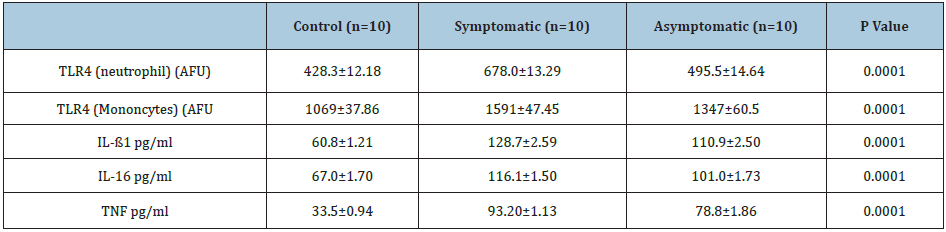
Key: TLR4: Toll Like Receptor; IL-ß1: Interleukin 1 a Chemokine; IL-6: Chemokine; TNF: Tumour Necrosis Factor, all inflammatory mediators.
Figure 1: Comparative Levels of TLR4 Neutrophil and Monocyte in Asymptonmatic and Symptomatic N.gonorrhea Infection in Sexually active females.
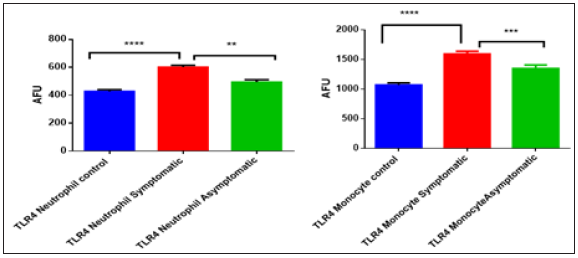
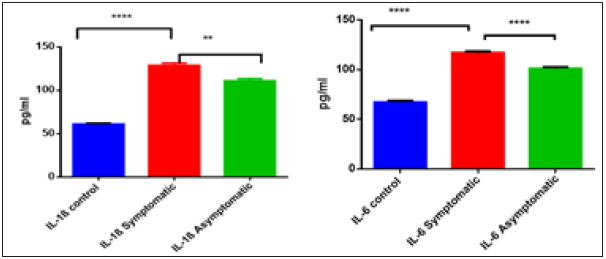
Figure 2: Comparative Levels of the inflammatory mediators Interleukin (IL-ß1 and IL-6) in Asymptonmatic and Symptomatic N.gonorrhea Infection in Sexually active females.
Discussion and Conclusion
TLR4 neutrophils
The TLR4 neutrophil showed a significant increase in the asymptomatic females when compared with the control group 495.5±16.4 and 428.3±12.18 (P<0.05) this shows that there is a significant increase although this increase may not yield to symptoms to it keeps it in check and controlled although there is more attributed to asymptomatic females who seem to be carriers of gonorrhoea with most or all of their male counterparts exhibiting symptoms associated with clap during infectious incubation of the pathogen as compared with other studies with female mice and increased TLR4 and TLr2 in mucosa lining of the cervix.
TLR4 monocytes
The TLR4 neutrophil showed a significant increase in the asymptomatic females when compared with the control group 1069±37.86 and 1347±60.5 (P<0.05) this shows that there is a significant increase although this increase may not yield to symptoms to it keeps it in check and controlled although there is more attributed to asymptomatic females who seem to be carriers of gonorrhoea with most or all of their male counterparts exhibiting symptoms associated with clap during infectious incubation of the pathogen as compared with other studies with female mice and increased TLR4 and TLr2 in mucosa lining of the cervix.
Inflammatory mediators
There was also observable increase in the inflammatory mediators obviously acting as chemokines to recruit TLR4 Monocytes and Neutrophils that inturn act as protective phagocytes either through the complement pathway or by presenting cells to the TH1 cells which inturn activate the complement pathway for the lysis (death) of the pathogen. All these inflammatory markers or mediators thus yield to presentation of symptoms as observable in the males as clap.
Conclusion
The TLR4 and TLR2 both serve as protective mechanism in response to PAMPS, but the TLR4 elevation can be used both as preventive mechanism in immune stimulation as seen in Vaccine or as a determinant for the identification of N. gonorrhea in asymptomatic females. Although more study should be done to identify more inflammatory markers triggered by the PAMPs of N. gonorrhea.
Acknowledgement
Which to acknowledge the profound support in grant and research space of the national academy for the Advancement of science all through the research and the Ladoke Akintola University of technology teaching hospital staff in the laboratory for their immense support.
References
- Criss AK, Seifert HS (2012) A bacterial siren song: intimate interactions between Neisseria and neutrophils. Nat Rev Microbiol 10(3): 178-190.
- Duncan JA, Gao X, Huang MT, Connor BP, Thomas CE, et al. (2009) Neisseria gonorrhoeae activates the proteinase cathepsin B to mediate the signaling activities of the NLRP3 and ASC-containing inflammasome. J Immunol 182(10): 6460-6469.
- Ishikawa H, Ma Z, Barber GN (2009) STING regulates intracellular DNA-mediated, type I interferon-dependent innate immunity. Nature 461: 788-792.
- Kaei N, Hisashi N (2010) Pattern recognition via the toll-like receptor systemin the human female genital tract. Mediators of Inflammation 4(10): 12.
- Manzanillo PS, Shiloh MU, Portnoy DA, Cox JS (2012) Mycobacterium tuberculosis activates the DNA-dependent cytosolic surveillance pathway within macrophages. Cell Host Microbe 11(5): 469-480.
- Mathanraj P, Hong Wu, Sandra JV, Nikolaos M, Ann EJ, et al. (2012) Protective role of toll-like receptor 4 in experimental gonococcal infection of female mice. Mucosal Immunol 5(1): 19-29.
- Monroe KM, McWhirter SM, Vance RE (2010) Induction of type I interferons by bacteria. Cell Microbiol 12(7): 881-890.
- Prantner D, Darville T, Nagarajan UM (2010) Stimulator of IFN gene is critical for induction of IFN-beta during Chlamydia muridarum infection. J Immunol 184(5): 2551-2560.
- Pridmore AC, Jarvis GA, John CM, Jack DL, Dower SK, et al. (2003) Activation of toll-like receptor 2 (TLR2) and TLR4/MD2 by Neisseria is independent of capsule and lipooligosaccharide (LOS) sialylation but varies widely among LOS from different strains. Infect Immun 71(7): 3901-3908.
- Sun L, Wu J, Du F, Chen X, Chen ZJ (2013) Cyclic GMP-AMP synthase is a cytosolic DNA sensor that activates the type I interferon pathway. Science 339(6121): 786-791.
- Wu J, Sun L, Chen X, Du F, Shi H, et al. (2013) Cyclic GMP-AMP is an endogenous second messenger in innate immune signaling by cytosolic DNA. Science 339(6121): 826-830.
- Zhang X, Shi H, Wu J, Zhang X, Sun L, et al. (2013) Cyclic GMP-AMP containing mixed phosphodiester linkages is an endogenous high-affinity ligand for STING. Mol Cell 51(2): 226-235.
© 2020 Ibeh Nnanna Isaiah. This is an open access article distributed under the terms of the Creative Commons Attribution License , which permits unrestricted use, distribution, and build upon your work non-commercially.
Editor In Chief







.jpg)































Signup for Newsletter

Quick Links
 Editorial Board Registrations
 Submit your Article
 Best Paper of the Volume
 Reprints
 Refer a Friend
 Advertise With Us
Our Recent Edition

.jpg)



Top Editors




.jpg)

















.bmp)
.jpg)
.png)
.jpg)













.jpg)






.png)

.png)




.png)




Financial Support

Sponsors

Latest e-Books

Latest Video

 a Creative Commons Attribution 4.0 International License. Based on a work at www.crimsonpublishers.com.
Best viewed in
a Creative Commons Attribution 4.0 International License. Based on a work at www.crimsonpublishers.com.
Best viewed in 
 | Above IE 9.0 version