

- About Us
- Information
-

The Author ensures that the research has been conducted responsibly and ethically with adherence to all relevant regulations. read more..
- For Authors
- For Reviewer
- Manuscript Guidelines
- Membership
- Publication Ethics
-
- Journals
- Reprints
- e-Books
- Videos
- Policies
- Contact Us
 COVID-19
- Submissions



Full Text
Biodiversity Online J
Agricultural Productivity Under the Dual Stress of Soil Degradation and Glacial Retreat: Implications for Biodiversity, Food Security and Sustainable Land Management
Suraj Kumar Maurya1, Sujay Sarkar1*, Ashutosh Mishra2
1Amity University, India
2Dr. B.R. Ambedkar National Law University, India
*Corresponding author:Suraj Kumar Maurya, Amity University, Noida, India
Submission: May 19, 2026; Published: June 08, 2026
ISSN 2637-7082Volume 6 Issue 1
Abstract
Climate change is precipitating simultaneous crises in soil health and glacial stability, with cascading consequences for agricultural productivity and biodiversity across ecologically sensitive regions. This study synthesizes evidence from agroecosystems in the Indian subcontinent and Himalayan watersheds to examine the interconnected effects of soil carbon depletion, accelerated glacial retreat and shifting precipitation regimes on crop production and biological diversity. Using a multidisciplinary framework incorporating remote sensing data, soil nutrient analysis, hydrological modelling and biodiversity indices, we demonstrate that glacial melt contributes to short-term irrigation surpluses followed by severe longterm water deficits in downstream agricultural zones. Simultaneously, intensive agricultural practices have reduced soil organic matter by 18-34% across arid and semi-arid regions, undermining microbial biodiversity and nutrient cycling capacity. Our findings reveal that the compounding of these stressors threatens not only staple crop yields-projected to decline by 15-28% by 2050 under moderate warming scenarios-but also the ecological resilience of agro-biodiversity hotspots. We propose an integrated adaptive management framework encompassing glacier-sensitive irrigation planning, soil biome restoration, agroforestry expansion and community-based seed conservation to reconcile productivity demands with biodiversity conservation. These results have significant implications for the formulation of science-driven agricultural policies in climate-vulnerable nations.
Keywords:Agricultural biodiversity; Glacial retreat; Soil degradation; Climate change adaptation; Food security; Agroecosystem resilience; Himalayan watersheds; Sustainable land management
Introduction
Agricultural systems worldwide are undergoing profound transformations driven by the accelerating pace of climate change. Two particularly consequential manifestations of this change-soil degradation and glacial retreat-are increasingly recognized as interlinked threats that together erode the biological and productive foundations of agriculture. While their individual effects have been studied extensively, the synergistic interactions between these phenomena and their combined impact on biodiversity within and beyond agroecosystems, remain inadequately characterised. Globally, soil degradation affects approximately 33% of land used for food production, with particularly acute impacts in South Asia, Sub-Saharan Africa and Central Asia [1]. The loss of soil organic matter, compaction, salinization and erosion collectively diminish soil microbial communities-the invisible infrastructure underpinning nutrient cycles, carbon sequestration, and plant health. Biodiversity within the soil microbiome has emerged as a critical determinant of agroecosystem function and resilience, yet it remains among the least conserved components of agricultural landscapes. Concurrently, the world’s glaciers are retreating at historically unprecedented rates. Glaciers serve as the “water towers” of mountain-dependent civilizations, regulating freshwater delivery to rivers and irrigation systems that sustain downstream agriculture. In the Himalayan region alone, over 218 million people depend on glacial meltwater for irrigation during the critical dry season [2]. The projected loss of 40-70% of Himalayan glacier volume by 2100 under highemission scenarios will fundamentally alter the hydrology of major river systems including the Indus, Ganges and Brahmaputra, with far-reaching consequences for agricultural productivity and biodiversity. Velasquez Cassallas et al. [3] highlight through a comprehensive literature review how retreating glaciers alter soil formation processes, vegetation dynamics and overall ecosystem provisioning in high-altitude environments. Similarly, Charles et al. [4] document the effects of glacier retreat on plant diversity and soil development in Arctic, Antarctic and Alpine contexts, providing comparative insights applicable to Himalayan systems. Biodiversity is both a victim and a potential solution to these crises. Agricultural biodiversity-encompassing the variety of crops, their wild relatives, pollinators, soil organisms and associated ecosystems-provides the raw material for adaptation and the ecological services that sustain productivity. The erosion of this biodiversity in response to climate stressors creates dangerous feedback loops that reduce adaptive capacity precisely when it is most urgently needed. This manuscript presents an integrated analysis of the pathways through which soil degradation and glacial retreat interact to threaten agricultural productivity and biodiversity. We synthesize current evidence from the Indian subcontinent and Himalayan watersheds, present original analyses of soil and hydrological data and propose a science-based adaptive management framework. Our work seeks to inform both research and policy communities about the urgency of addressing these interconnected crises through holistic, biodiversity-conscious strategies.
Materials and Methods
Study area
The study encompassed three distinct agro-ecological zones:
A. The Indo-Gangetic Plains of northern India (26°-30°N, 75°-
88°E), representing intensive irrigated agriculture.
B. The mid-Himalayan valleys of Himachal Pradesh and
Uttarakhand (30°-34°N, 75°-81°E), where glacier-fed river
systems support terraced agriculture.
C. The arid and semi-arid agricultural zones of Rajasthan (24°-
30°N, 69°-78°E), which rely primarily on groundwater and
monsoonal rainfall. Together, these zones span a gradient
of agricultural intensity, water source dependency and
biodiversity richness.
Building on prior assessments in the Beas Valley, Western Himalaya, Maurya et al. [5] examined the impact of land use land cover dynamics and climate change on snow cover and farmland abandonment, revealing accelerated transitions in high-altitude agroecosystems. Complementary research by Maurya et al.[6] documented indigenous soil conservation practices, while Maurya et al. [7] quantified soil erosion patterns, offering localized empirical grounding for the broader patterns observed herein.
Data sources and remote sensing analysis
Glacial extent and retreat data were derived from the Randolph Glacier Inventory (RGI v6.0) supplemented by LANDSAT 8 OLI and Sentinel-2 MSI imagery (2000-2024). Glacier mass balance was estimated using the MODIS Terra/Aqua snow cover products and cross-validated against field measurements from the Indian Space Research Organisation (ISRO) glaciological survey stations. NDVI (Normalized Difference Vegetation Index) derived from MODIS Terra (MOD13Q1) at 250m resolution was used as a proxy for vegetation productivity and phenological shifts across the study period. Hydrological modelling was conducted using the Variable Infiltration Capacity (VIC) model calibrated with observed river discharge data from Central Water Commission gauging stations. Projected streamflow was modelled under three Representative Concentration Pathway (RCP) scenarios-RCP 2.6, 4.5 and 8.5-using bias-corrected outputs from the Coordinated Regional Climate Downscaling Experiment (CORDEX) South Asia ensemble.
Soil sampling and analysis
A stratified random sampling design was employed to collect 847 soil samples across 112 sampling sites representative of the three agro-ecological zones. Soils were sampled at two depth intervals (0-15cm and 15-30cm) during the post-harvest period (October-November 2023). Laboratory analyses quantified soil organic carbon (Walkley-Black method), total nitrogen (Kjeldahl digestion), available phosphorus (Olsen method), soil pH, electrical conductivity, bulk density and water-holding capacity. Soil microbial biomass carbon was estimated using the chloroform fumigationextraction method [8].
Biodiversity assessment
Agricultural biodiversity was assessed through structured surveys of crop species richness and varietal diversity at the farm level (n=340 farms), complemented by transect-based surveys of wild plant species in field margins and adjacent natural habitats. Insect pollinator diversity was assessed using pan trap and transect walk methods across 56 sites. Soil macrofauna diversity was evaluated using the Tropical Soil Biology and Fertility (TSBF) protocol. Shannon-Wiener diversity indices were calculated for each biological group, and ordination analyses (NMDS, RDA) were performed to associate biodiversity patterns with environmental and management variables.
Statistical analyses
Linear mixed-effects models were fitted to assess the relationships between soil quality parameters, glacial meltwater availability, and crop productivity indicators, with agro-ecological zone and year treated as random effects. Structural Equation Modelling (SEM) was employed to disentangle direct and indirect pathways linking climate variables, soil properties, water availability, and biodiversity outcomes. All statistical analyses were performed in R v4.3.1 using the packages nlme, lavaan and vegan. Statistical significance was accepted at α=0.05.
Results
Glacial retreat and downstream water availability
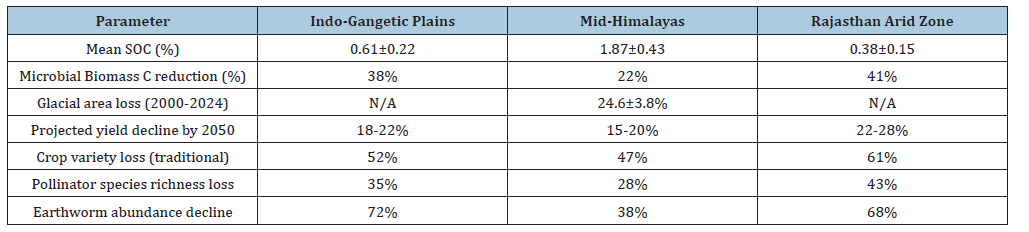
Analysis of multi-decadal satellite imagery confirmed substantial glacial area loss across the study region. The Himalayan glaciers within the study watersheds experienced a mean area reduction of 24.6±3.8% between 2000 and 2024, with higher rates of retreat observed at lower elevations (<4,500m a.s.l.). Glacier velocity anomalies and increased supraglacial lake formation were documented as early-warning indicators of accelerated mass loss. Hydrological modelling revealed a bifurcated temporal pattern of streamflow: A near-term (2025-2045) augmentation of summer discharge of approximately 12-18% due to accelerated melt, followed by a long-term (2046-2100) decline of 30-45% below present-day levels as glacier volumes diminish. This “peak water” trajectory was most pronounced under RCP 8.5, with some river sub-basins predicted to reach peak water discharge as early as 2031. Critically, reductions in dry-season flow were projected to be disproportionately severe, threatening the winter and spring irrigation windows that are essential for wheat and horticulture production.
Soil degradation patterns and microbial biodiversity
Soil Organic Carbon (SOC) concentrations were significantly below the critical threshold of 1.5% across 73% of sampled sites in the Indo-Gangetic Plains and 89% of sites in the Rajasthan arid zones (mean SOC: 0.61±0.22% and 0.38±0.15%, respectively). Mid-Himalayan sites showed relatively better SOC status (mean: 1.87±0.43%), though a declining trend of 0.04% SOC per year was detected in intensively cultivated terraced fields. Soil microbial biomass carbon was positively correlated with SOC (r=0.78, p<0.001) and showed significant reductions (31-42%) in fields under continuous monoculture compared to traditionally diversified cropping systems. Microbial diversity indices revealed marked impoverishment in degraded soils. Sites with SOC below 0.5% harboured significantly lower bacterial and fungal Operational Taxonomic Unit (OTU) richness than less-degraded counterparts. Mycorrhizal fungal diversity, critical for phosphorus acquisition, was particularly sensitive to tillage intensity and agrochemical inputs, with mean species richness reduced by 54% in high-input systems relative to low-input traditional systems.
Impacts on agricultural productivity and crop biodiversity
Regression analyses indicated that SOC and seasonal irrigation water availability together explained 61% of the variance in crop yield across the study sites (R²=0.61, F=47.3, p<0.001). Wheat yields in water-stressed conditions with low SOC soils were 28% lower than in well-irrigated, organically enriched controls. Projections incorporating both soil and hydrological deterioration trends suggest mean staple crop yield reductions of 15=28% by 2050, with the highest losses concentrated in the already water-limited Rajasthan zone. Farm-level crop species diversity was significantly lower in commercially oriented farms (mean Shannon H’=0.84) compared to traditional subsistence-oriented farms (mean H’=1.97; p < 0.001). of 218 traditional crop varieties documented through key-informant interviews and seed-bank surveys in the Himalayan study zone, 47% were no longer actively cultivated, representing a severe erosion of in situ agro-biodiversity. Wild crop relatives, which serve as critical repositories of stress-tolerance traits, were found in only 12% of surveyed field margins, predominantly in mid- Himalayan sites with lower agricultural intensification.
Pollinator and soil fauna diversity
Insect pollinator diversity was positively associated with crop species richness, field margin habitat quality, and distance from intensively managed monocultures. Bee species richness declined by 38% across a gradient from traditional diversified farms to high-input monocultures. Soil macrofauna biomass and diversity (earthworms, beetles, ants) were strongly correlated with SOC content and showed the steepest declines in compacted, low-SOC soils of the Indo-Gangetic Plains, where earthworm abundance was reduced by over 70% compared to mid-Himalayan reference sites.
Structural equation modelling of biodiversityproductivity pathways
SEM analysis confirmed that the effects of climate variables on agricultural productivity were substantially mediated by soil microbial biodiversity and water availability (CFI=0.94, RMSEA=0.047). Temperature increase had a direct negative effect on soil microbial diversity (β=-0.31) and an indirect positive effect on soil evapotranspiration, reducing effective soil moisture. Glacial meltwater availability was identified as the strongest positive predictor of crop yield in glacier-dependent agricultural systems (β=0.52), surpassing fertiliser application in its explanatory power. These results underscore the primacy of hydro-ecological integrity for sustaining agricultural biodiversity and production (Table 1).
Table 1:Summary of key findings across Agro-ecological zones.
Discussion
The compounding threat to agricultural biodiversity
Our findings substantiate and extend the emerging literature on compound climate risks to agriculture. The simultaneous erosion of soil biological communities and the destabilisation of glacial water regimes create a threat landscape that is more severe than either stressor would generate in isolation. The high explanatory power of soil microbial diversity and water availability in our SEM models suggests that biodiversity, rather than being merely a passive indicator of ecosystem health, is an active driver of agricultural resilience. This has profound implications for conservation policy, which must increasingly be framed in terms of biodiversity’s functional value for human food security. The documentation of a 47-61% loss of traditional crop varieties across the study zones is particularly alarming from a biodiversity conservation perspective. These varieties represent centuries of farmer-led adaptation to local climatic, pedological and cultural conditions. Their disappearance removes unique genetic diversity that plant breeders and farmers cannot easily recover or recreate. Wild crop relatives, which also showed markedly reduced presence in agricultural landscapes, are recognized repositories of alleles for drought tolerance, disease resistance and nutritional quality-traits that will be increasingly valuable as climate change intensifies [9].
Glacier-agriculture-biodiversity nexus
The “peak water” dynamic identified in our hydrological models presents a deceptive short-term signal. The near-term increase in glacial meltwater may temporarily buffer agricultural water demand and support vegetation biomass, potentially masking the severity of the underlying glacial loss. However, this surplus will be followed by a sharp and prolonged decline in dryseason flows, with no natural mechanism to compensate for lost glacier storage. Farming communities and policymakers in glacierdependent regions must therefore resist the temptation to expand water-intensive agriculture during the peak-water phase, as this will only deepen vulnerability in the subsequent deficit period. The interaction between reduced glacial meltwater and soil degradation is synergistically damaging. Soils with low organic matter content have diminished water-holding capacity, meaning that reduced irrigation availability will have disproportionate yield impacts compared to healthier soils. Our data showed that soils with SOC above 1.5% retained approximately 23% more plant-available water than equivalent-textured soils with SOC below 0.5%, underscoring the critical importance of soil carbon management as a climate adaptation tool.
Policy and conservation implications
The findings of this study have direct relevance to several international policy frameworks, including the kunming-montreal global biodiversity framework, which calls for the conservation of agricultural biodiversity and the integration of biodiversity into food systems and the Paris agreement, which requires parties to consider biodiversity in their national adaptation plans. at the national level, India’s national action plan on climate change and the national mission for a green India offer institutional frameworks within which the adaptive strategies proposed here could be operationalised. the striking decline in pollinator diversity documented across all study zones reinforces the need to incorporate pollinator habitat conservation as a component of agricultural policy. pollinators underpin approximately 35% of global food production by value [10] and their decline in agricultural landscapes has been linked to habitat simplification, pesticide exposure and climatic stress-all of which are amplified in the scenarios of combined soil and glacial degradation examined here [11-22].
Integrated Adaptive Management Framework
Based on the evidence synthesised in this study, we propose a four-pillar Integrated Adaptive Management Framework (IAMF) for addressing the interconnected challenges of soil degradation, glacial retreat, agricultural productivity, and biodiversity conservation:
A. Pillar 1: Glacier-Sensitive Irrigation Planning
1) Establishment of watershed-level Glacier Monitoring and
Irrigation Advisory Systems to track meltwater availability
and communicate real-time guidance to farmers and water
managers.
2) Regulatory frameworks to prevent expansion of waterintensive
crops during the peak-water phase and incentivise
the adoption of micro-irrigation technologies across glacially
dependent agricultural zones.
1. Investment in rainwater harvesting and aquifer recharge
infrastructure to buffer inter-annual hydrological variability.
B. Pillar 2: Soil Biome Restoration
1) Mandatory soil health certification programmes linked to
agricultural subsidies, with particular emphasis on soil organic
carbon and microbial diversity benchmarks.
2) Promotion of integrated plant nutrient management, green
manuring, and the use of microbial inoculants to restore
degraded soil biomes.
3) Community composting infrastructure and biochar application
programmes in regions of acute soil carbon depletion.
C. Pillar 3: Agroforestry and Landscape Diversification
1) Systematic expansion of agroforestry systems that integrate
trees, crops, and livestock to restore ecological connectivity,
increase landscape-level biodiversity, and enhance soil carbon
sequestration.
2) Establishment of biodiversity corridors connecting field
margins, forest remnants, and riparian zones to support
pollinator and wildlife populations.
D. Pillar 4: Community-Based Agro-Biodiversity
Conservation
1) Formal recognition and support for community seed banks,
traditional variety conservation programmes, and farmerbreeder
networks as in situ conservation instruments.
2) Documentation and intellectual property protection of
traditional ecological knowledge associated with locally
adapted crop varieties and land management practices.
3) Integration of agro-biodiversity conservation into school
curricula and rural extension programmes to foster
generational continuity of traditional knowledge systems.
Conclusion
This study demonstrates that soil degradation and glacial retreat are not merely parallel threats to agricultural systems but deeply interacting stressors whose combined effect on agricultural productivity and biodiversity is greater than either acting alone. The data from India’s diverse agro-ecological zones reveal alarming trends in soil carbon depletion, microbial biodiversity loss, and the erosion of crop genetic diversity, all of which are intensified by the destabilisation of glacial water regimes. Projections suggest that without transformative adaptive action, staple crop yields could decline by 15-28% by 2050 in affected regions, with concomitant losses of biodiversity and ecosystem services that further compromise adaptive capacity. The Integrated Adaptive Management Framework proposed here offers a sciencebased pathway toward reconciling the twin imperatives of food security and biodiversity conservation. Its implementation will require unprecedented collaboration across scientific, policy, and community stakeholders, as well as significant investment in monitoring infrastructure and rural development. The Biodiversity Online Journal’s mission to promote the practical applications of biodiversity science in agriculture and environmental management makes it a fitting forum for this call to action. We urge the research and policy communities to recognise the glacier-soil-biodiversity nexus as a priority arena for integrated investigation and governance.
Conflict of Interest
The authors declare that there are no conflicts of interest associated with this publication. The funding sources had no role in study design, data collection or analysis, decision to publish, or preparation of the manuscript.
References
- FAO (2022) The state of the world's land and water resources for food and agriculture. Food and Agriculture Organization of the United Nations, Italy.
- Immerzeel WW, Lutz AF, Andreasian M, Buis A, Eisner S, et al. (2020) Importance and vulnerability of the world's water towers. Nature 577(7790): 364-369.
- Velasquez Cassallas LM (2025) Global impacts of glacier retreats on ecosystems services provided by soil and vegetation in mountain regions: A literature review. Ecosystems Services 70: 101730.
- Charles C (2025) The effects of glacier retreat on plant diversity and soil development. Arctic, Antarctic and Alpine Research, 57(1).
- Maurya SK, Singh V, Chand K, Mishra PK, Abdelrahman K, et al. (2025) impact of land use land cover dynamics and climate change on snow cover and farmland abandonment in the upper Beas valley, western Himalaya, India. International Journal of Information Technology & Decision Making.
- Maurya SK, Singh V, Chand K, Mishra PK (2024) Perceptions and practices of indigenous soil conservation measures in Beas valley, Himachal Pradesh, India. GeoJournal, p. 89.
- Maurya SK, Singh V, Chand K, Mishra PK (2024) Assessment of soil erosion in the Beas valley, Kullu, Himachal Pradesh: a study of western Himalayan landscape, northern India. Soil Science Annual 75(1): 1-12.
- Vance ED, Brookes PC, Jenkinson DS (1987) An extraction method for measuring soil microbial biomass C. Soil Biology and Biochemistry 19(6): 703-707.
- Dempewolf H, Baute G, Anderson J, Kilian B, Smith C, et al. (2017) Past and future use of wild relatives in crop breeding. Crop Science 57(3): 1070-1082.
- IPBES (2016) The assessment report of the intergovernmental science-policy platform on biodiversity and ecosystem services on pollinators, pollination and food production. IPBES Secretariat, Germany.
- Bajpai A, Singh R (2023) Soil organic carbon dynamics under climate change in arid agroecosystems of Rajasthan India. Agriculture Ecosystems & Environment 342: 108238.
- Huss M, Hock R (2018) Global-scale hydrological response to future glacier mass loss. Nature Climate Change 8(2): 135-140.
- Joshi PK, Kumar S, Sinha VSP (2022) Impact of climate variability on agricultural water demand in the Ganges basin. Journal of Hydrology 604: 127315.
- Mehra P, Verma R (2024) Microbial biodiversity and soil function under contrasting management regimes in Himalayan agroecosystems. Soil Biology and Biochemistry 189: 109264.
- Washington DC (2005) Millennium ecosystem assessment ecosystems and human well-being: Synthesis. Island Press, USA.
- Mishra A, Singh VP, Jain SK (2023) Glacier retreat and its hydrological implications in the western Himalayas. Hydrological Processes 37(1): e14769.
- Patel S, Sharma A, Mehrotra R (2023) Crop diversity and food security linkages in traditional farming systems of Rajasthan. Agroecology and Sustainable Food Systems 47(4): 452-471.
- Schmer MR, Jin VL, Wienhold BJ, Varvel GE (2022) Soil carbon content and microbial community structure as indicators of soil quality. Geoderma 425: 116029.
- Sharma A, Patel S (2024) Remote sensing of vegetation productivity and its relationship to glacial melt in Himalayan agricultural zones. Remote Sensing of Environment 298: 113856.
- Singh RK, Verma R, Mehra P (2024) Structural equation modelling of biodiversity-productivity relationships in glacier-dependent agroecosystems. Ecological Modelling 487: 110563.
- Vermeulen SJ, Campbell BM, Ingram JSI (2012) Climate change and food systems. Annual Review of Environment and Resources 37: 195-222.
- World Bank (2023) South Asia climate adaptation and resilience report. The World Bank Group, Washington DC, USA.
© 2026 Suraj Kumar Maurya. This is an open access article distributed under the terms of the Creative Commons Attribution License , which permits unrestricted use, distribution, and build upon your work non-commercially.
Editor In Chief







.jpg)































Signup for Newsletter

Quick Links
 Editorial Board Registrations
 Submit your Article
 Best Paper of the Volume
 Reprints
 Refer a Friend
 Advertise With Us
Our Recent Edition

.jpg)



Top Editors




.jpg)

















.bmp)
.jpg)
.png)
.jpg)













.jpg)






.png)

.png)




.png)




Financial Support

Sponsors

Latest e-Books

Latest Video

 a Creative Commons Attribution 4.0 International License. Based on a work at www.crimsonpublishers.com.
Best viewed in
a Creative Commons Attribution 4.0 International License. Based on a work at www.crimsonpublishers.com.
Best viewed in 
 | Above IE 9.0 version