

- About Us
- Information
-

The Author ensures that the research has been conducted responsibly and ethically with adherence to all relevant regulations. read more..
- For Authors
- For Reviewer
- Manuscript Guidelines
- Membership
- Publication Ethics
-
- Journals
- Reprints
- e-Books
- Videos
- Policies
- Contact Us
 COVID-19
- Submissions



Full Text
Biodiversity Online J
Supporting Natural Disasters Mitigation in Australia Through Gis- Based Semi-Real-Time Media Content and Social Media
Kithsiri Perera*1 and Thakshila Gunawansa2
1University of Southern Queensland, Australia
2Uva Wellassa University, Sri Lanka
*Corresponding author:Kithsiri Perera, University of Southern Queensland, West Street, Toowoomba, 4350 QLD, Australia
Submission: March 16,2026; Published: April 21, 2026

ISSN 2637-7082Volume 6 Issue 1
Abstract
The application of GIS in natural disaster management has become a vital technological approach. In Australia, floods and bushfires are the foremost natural disasters, causing significant damage each year. Between 1967 and 2013, Australia suffered an annual economic loss of A$943 million due to flood occurrences. Regarding bushfire disasters, the Australian Bureau of Criminology reported that bushfire damage totalled about $2.5 billion from 1967 to 1999, excluding losses to forest cover. After the 2009 Black Saturday bushfires in Victoria, which killed 173 people, the public and authorities paid significant attention to bushfires. The massive losses from these natural disasters prompted scientists to explore new methods to mitigate their impacts. The application of freely available real-time satellite imagery, including NASA’s MODIS data and ESA’s Sentinel data, can be used in GIS-based image processing, the method discussed in this paper, as a new approach to support disaster mitigation. This approach delivers GIS content on the Google Earth platform via social media, preferably using apps. Since mobile phones are the most accessible devices today, social media content can be delivered efficiently to affected people. A case study is presented in this paper, using the free academic app (seesatview) produced by the main author.
Keywords:GIS; Himawari; MODIS; Google Earth; Social Media
Introduction
Natural disasters, including bushfires and floods, have been part of the dynamics of the Australian environment since before human settlement on the continent. Australian ecosystems have evolved with bushfires, floods and droughts and their biological diversity has been shaped by both historical and recent natural disasters [1]. Apart from flood hazards, the Australian Bureau of Meteorology indicates that vast areas of Australia are at risk of bushfires [2]. Among natural disaster casualties, the 2009 Black Saturday bushfire caused 173 deaths [3]. The increasing trend in Australia’s average annual temperature indicates the possible adverse impact on bushfire activity [4]. According to Australia’s geography, when flood hazards occur, floods may spread over thousands of square kilometres and last for several weeks. In recent history, the costliest floods in Australia occurred in 2010-11, with extensive flooding in Queensland’s Lockyer Valley, Ipswich and Brisbane in January 2011, resulting in A$6.64 billion in damage, 35 deaths and 20,000 people left homeless [5]. In the Australian context, the present research suggests that GIS-based bushfire and flood disaster content can be effectively delivered to affected local communities via social media. This short paper presents data and a case study from Australia; however, the methodology presented here can be applied to any location on Earth.
Why does GIS play a critical role?
GIS (Geographic Information System) is a computer system for capturing, storing, checking, analysing and displaying spatial information about the Earth’s surface [6]. The present study focuses on collecting real-time natural disaster information, overlaying data on the Google Earth platform and analysing and visualising the data to present the conditions and impact of the disaster on the affected and surrounding areas. Due to its integration with the Google Earth platform, users of natural disaster GIS content can investigate the infrastructure and geography of the disaster-affected area. An accurate relationship between location and ground conditions helps people in the affected area make decisions and share locational information with other people and services. During a natural disaster, mobile phones are the most accessible devices for local people and through them, GIS content can be delivered efficiently to disaster-affected communities via a social media app.
Generating natural disaster image content with free data
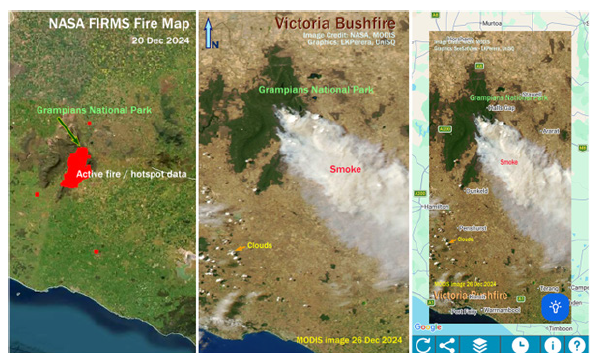
NASA, the European Space Agency (ESA) and the Japan Aerospace Exploration Agency (JAXA) provide a wide range of satellite imagery at no cost for any user. NASA’s MODIS (Moderateresolution Imaging Spectroradiometer) sensors mounted on the Terra and Aqua satellites provide daily imagery highly useful for a range of applications, including bushfire, flood and damage monitoring and assessment [7,8]. Geographically corrected MODIS imagery can be accessed daily and downloaded using Long/Lat coordinates for overlay on Google Earth after image analysis [9]. The Sentinel satellite imagery from ESA can be used for detailed, highresolution mapping, while JAXA’s geostationary Himawari satellite [10] provides hourly imagery with a wide range of low-resolution products. Apart from these satellite data sources, there are various open-source data sources, including OpenStreetMap [11], that the user can access to build GIS content, to present natural disaster incidents with useful information to people in the affected area. The present paper explains only the fundamental-level context and does not extend to detailed image classification and GIS content building. Figure 1 presents a case study of a bushfire recorded in Victoria, Australia, that demonstrates the process and display of GIS content on the app used to deliver it to social media in December 2024. Content production must follow a strict GIS data processing approach, along with spatial data visualisation techniques, to develop content with high visual and information quality.
Figure 1:A GIS content released through a free educational app (seesatview) produced by the author. The left image shows the active fire spots used in GIS data analysis and the centre image is the main GIS content produced for media. The right image shows one of the app’s modes, displaying GIS content on the Google Earth map.
References
- Geoscience Australia (2019) Bushfires.
- BOM (Bureau of Meteorology) (2009) Bushfire Weather.
- CSIRO (2012) Life and house loss database, description and analysis.
- BOM (Bureau of Meteorology) (2013) Annual climate statement.
- gov.au (2021) Where do floods occur in Australia?
- National Geographic (2026) GIS (Geographic Information System)
- CISIRO (2019) Bushfire research.
- Dutta R, Das A, Aryal J (2016) Big data integration shows Australian bush-fire frequency is increasing significantly. R Soc Open Sci 3(2): 150241.
- MODIS (2026).
- JAXA (2026).
- Open Street Map (2026).
© 2026 Kithsiri Perera. This is an open access article distributed under the terms of the Creative Commons Attribution License , which permits unrestricted use, distribution, and build upon your work non-commercially.
Editor In Chief







.jpg)































Signup for Newsletter

Quick Links
 Editorial Board Registrations
 Submit your Article
 Best Paper of the Volume
 Reprints
 Refer a Friend
 Advertise With Us
Our Recent Edition

.jpg)



Top Editors




.jpg)

















.bmp)
.jpg)
.png)
.jpg)













.jpg)






.png)

.png)




.png)




Financial Support

Sponsors

Latest e-Books

Latest Video

 a Creative Commons Attribution 4.0 International License. Based on a work at www.crimsonpublishers.com.
Best viewed in
a Creative Commons Attribution 4.0 International License. Based on a work at www.crimsonpublishers.com.
Best viewed in 
 | Above IE 9.0 version