

- About Us
- Information
-

The Author ensures that the research has been conducted responsibly and ethically with adherence to all relevant regulations. read more..
- For Authors
- For Reviewer
- Manuscript Guidelines
- Membership
- Publication Ethics
-
- Journals
- Reprints
- e-Books
- Videos
- Policies
- Contact Us
 COVID-19
- Submissions



Full Text
Biodiversity Online J
Impact of Ganga Sludge-Based Organic Fertilizer on Growth and Micronutrient Accumulation in Radish (Raphanus sativus L.)
Acharya Balkrishna1,2,3, Nidhi Sharma1*, Ajay Kumar Gautam1, Vedpriya Arya1,2 and Vikram Khelwade1
1Patanjali Herbal Research Department, Patanjali Research Institute, India
2Department of Allied Sciences, University of Patanjali, India
3Patanjali Organic Research Institute (PORI), India
*Corresponding author:Nidhi Sharma, Patanjali Herbal Research Department, Patanjali Research Institute, Haridwar 249405, India
Submission: February 03,2026; Published: March 02, 2026
ISSN 2637-7082Volume5 Issue 5
Abstract
The utilization of sewage sludge in agriculture offers a means of recycling nutrients and organic matter, but its potential contaminants raise concerns. Organic fertilizers synthesized from treated Ganga sludge present a solution by transforming waste into valuable products while mitigating heavy metal concentrations. The study focuses on the effects of these fertilizers on plant growth and heavy metal accumulation, particularly in edible parts, to evaluate their safety. Radish, chosen for its nutritional value and edible roots, serves as the test crop. The study assesses the effectiveness and risks of organic fertilizers derived from Ganga sludge. Various growth parameters are measured, including plant height, leaf area, root length and weight and elemental analysis is conducted for elements such as Fe, Mg, Cu, Zn, Ca, Pb, Cd, Cr and Ni. The balanced NPK content in the organic fertilizers (Jaivik Khad and Dharti ka Chaukidar) promotes optimal growth and shows a 60.94% and 40.10% increase in root diameter over control respectively. The heavy metal content in the soil and radish roots was below the permissible limits, indicating the safety and suitability of these fertilizers for radish cultivation. The research emphasizes balanced nutrient application, promoting organic agriculture, soil improvement and sustainable sewage sludge management. The study’s findings offer insights into eco-friendly farming and safe food production, guiding informed decisions for sustainable, high-yield agricultural systems.
Keywords: Agronomic parameters; Ganga sludge; Eco-friendly management: Organic fertilizers
Introduction
The agricultural utilization of sewage sludge has gained traction due to its substantial content of organic matter and nutrients [1]. This practice not only addresses waste management concerns but also presents a viable option for recycling essential nutrients and organic matter back into the soil [2-4]. However, the beneficial attributes of sewage sludge are juxtaposed with the presence of contaminants such as hormones, pathogens, pharmaceutical compounds and heavy metals, which can pose risks to crop growth and potentially infiltrate the human food chain [5]. In tandem, the agricultural application of sewage sludge necessitates a nuanced consideration of heavy metal introduction into soil matrices, as these persistent elements can amass in soils and ultimately enter the food chain [6,7]. Proposing a solution, the synthesis of organic fertilizers emerges as a scientifically grounded approach to sewage sludge management. By transforming waste into value-added products, this strategy circumvents challenges related to limited application space and temporal constraints. Notably, fertilizers enriched with sewage sludge exhibit diminished heavy metal concentrations, an outcome attributed to the dilution mechanism inherent in their production [8]. This innovative paradigm, aimed at enhancing soil fertility and ameliorating the ecological impact of sewage treatment facilities, presents a sustainable trajectory for sewage sludge management.
In light of these considerations, adequately processed sludge holds the potential to serve as an organic substrate for crop nourishment, imparting essential phosphorus and nitrogen, as well as a spectrum of macro- and microelements. Building upon these premises, the Patanjali Organic Research Institute has introduced a proprietary technology (Patent application number: 202211069280) to manufacture granulated organic fertilizers derived from stabilized Ganga sludge. These formulations, comprising dewatered sludge, beneficial agricultural microorganisms and organic amendments, exhibit heavy metal content below stipulated thresholds while remaining free from pathogenic coliform bacteria.
This investigation directs its focus toward the empirical exploration of sludge-based organic fertilizers across diverse crops, each characterized by distinct edible components such as grains, leaves, fruits and roots. The primary objective revolves around ascertaining the potential for heavy metal accumulation in these edible parts, thereby corroborating the safety profile of the sludgebased fertilizers despite their unconventional origin.
The selected crop for this research is radish (Raphanus sativus L.), an important root vegetable from the Brassicaceae family, known for its global consumption owing to its nutritional value [9,10]. Radish varieties are segregated into spring-summer and winter classes based on their growth seasons. Esteemed for its edible root structure, radish offers a rich reservoir of copper, potassium, calcium, magnesium, manganese, vitamin B6 and vitamin C. Furthermore, the root houses an assortment of phenolic compounds including kaempferol, vanillic acid, cyanide, gentisic acid, hydrocinnamic acid, luteolin, myrcetin and quercetin, accompanied by proteinaceous and vitaminaceous constituents. Demonstrating noteworthy biological activities, radish root and leaf extracts exhibit antimutagenic, antimicrobial, antioxidant and antiviral properties [11,12].
The present study, therefore, endeavours to undertake a comprehensive assessment of the agronomic effectiveness and potential risks associated with organic fertilizers derived from treated Ganga sludge. By focusing on the influence of organomineral fertilizers on plant growth and development, as well as discerning the extent of heavy metal accumulation within plant biomass following their application, this research contributes to an enhanced understanding of the intricate dynamics surrounding the utilization of sludge-based organic fertilizers in agriculture.
Materials and Methods
Study site
The study was carried out during the winters (December- March) in 2024-25 at the experimental farms of Patanjali Research Institute (PRI), Haridwar, India (29° 54` 49″ N and 77°59′ 51″ E) with elevation varying from 314 to 320m above sea level. The area is characterized by a warm and temperate climate having an average annual temperature is 23.0 °C and an annual rainfall is 1262mm. The soil texture from the experimental field was classified as Sandy loam to loam and it has a pH of 6.4 and 0.25% organic matter.
Collection and processing of ganga sludge samples
The samples of Ganga sludge were collected from the Sludge Treatment Plant (STP) in Jagjeetpur, Uttarakhand, India and processed at Patanjali Organic Research Institute (PORI) for the production of five different organic fertilizer products based on a patented technology of Patanjali (Patent application number: 202211069280). Five major organic fertilizer products namely, Jaivik Prom Pori Potash, Dharti ka Chaukidar, Jaivik Poshak and Jaivik Khad were prepared and utilized in field trial experiments individually and in combinations.
Experimental design and treatment
The experimental design was framed based on Randomized Block Design (RBD) with six fertilizer treatments and three replications. The trial consists of 24 ploughed plots arranged as a randomized block design. Five different organic fertilizers were evaluated in this experiment as individual or in combination The details of the experimental design and different treatments are given in (Tables 1 & 2). The roots were harvested on 55 DAS. FYM was applied manually as a base Organic amendment in all plots and also used as a control fertilizer.
Table 1:Overview of experimental plots and treatments used in the study.
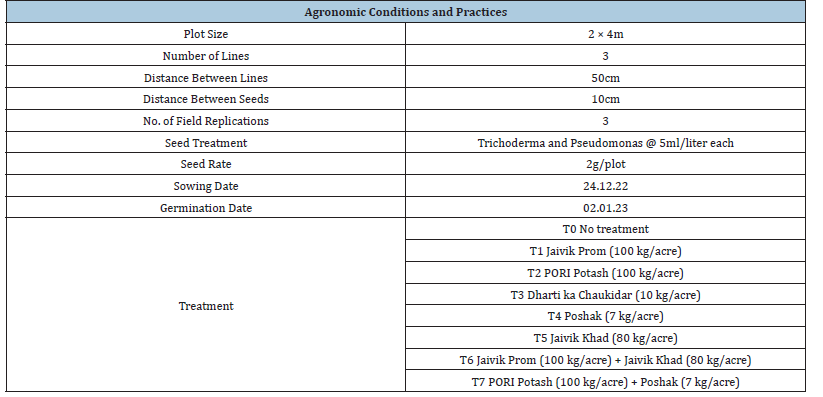
Table 2:Composition of different organic amendments used in the study.

Soil analysis
Soil samples were collected (0-200mm) randomly from each treatment plot at the harvest stage to determine its physicochemical characteristics. All samples were sealed in sterile plastic bags and transported to the laboratory immediately. Micronutrients and heavy metals were determined at the harvest stage in the soil of single treatments (T0-T5) by the Central Laboratory, Patanjali Food & Herbal Park Pvt. Ltd. (NABL Accredited testing laboratory).
Plant sampling and analysis
To assess the impact of various treatments on the growth of crops, a series of quantitative metrics were employed. These metrics encompassed measurements related to growth parameters, notably plant height, leaf count, leaf area and fresh leaf weight, as well as yield parameters encompassing root length, root diameter, fresh and dry root weight. A total of 9 plants were randomly selected from each treatment and their replicates were measured for all parameters at 55 Days After Sowing (DAS). For the determination of elemental constituents such as Fe, Mg, Cu, Zn, Ca, Pb, Cd, Cr and Ni in roots, analysis was conducted at the Central Laboratory of Patanjali Food & Herbal Park Pvt. Ltd., an accredited testing facility endorsed by the National Accreditation Board for Testing and Calibration Laboratories (NABL).
Statistical analysis
Data obtained after analysis of each parameter are presented as mean± Standard Deviation (SD) of nine replicates. One-way and two-way ANOVA with Dunnett’s multiple comparisons test was performed using GraphPad Prism version 8.02 for Windows.
Results and Discussion
Effect on shoot parameters
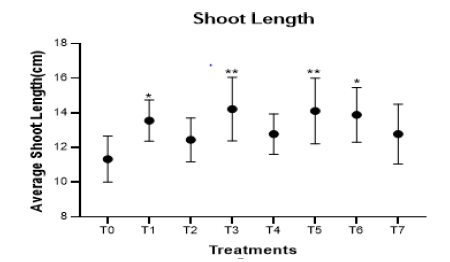
Shoot length: The present investigation revealed an extremely significant difference in shoot length of radish plants grown under different sludge-based organic fertilizers as compared to control after 30 DAS (Figure 1). The control treatment (T0) yielded an average shoot length of 11.333±0.333cm. Among the treatments, T3 and T5 exhibited the most significant positive impact on shoot length, showcasing a remarkable 25.6% and 24.26% increase, respectively, over the control. Additionally, T6 also demonstrated substantial improvements of 22.6%. These results highlight the potential effects of specific treatments on enhancing plant growth, warranting a closer scientific analysis. The observed increase in shoot length can be scientifically attributed to the synergistic interactions between the applied treatments and the underlying physiological processes of the radish plants. In T3, the combination of organic fertilizer with neem oil and neem cake introduces a multifaceted approach to promoting growth. Organic fertilizer serves as a gradual nutrient source, allowing for sustained nutrient uptake by the plants. Neem compounds enhance soil activity and root health, improving nutrient availability and absorption, thus enhancing shoot growth. Similarly, the impressive effect of T5 can be linked to Javik Khad’s organic NPK composition. The organic nature of Javik Khad ensures slow-release nutrient availability, preventing nutrient leaching and maintaining a steady supply for plant uptake. The balanced NPK composition specifically Potassium (K) is known to influence cell division and elongation, directly contributing to shoot growth. further supports various growth stages, leading to enhanced shoot development [13,14].
Figure 1:Average root diameter of Radish grown under different sludge-based organic fertilizers. Value represent mean±standard error of nine replicates; * p<0.05; ** p<0.001.
Number of leaves
Instead of emphasizing extensive spatial dimensions of the origins, achieving optimal and enhanced consistent operational efficacy at a moderate source magnitude proves to be more favourable in actualizing the latent sink capacity within environmental circumstances. The progression of crops is intricately linked with the process of photosynthesis and the pace of growth serves as a direct indicator of the photosynthetic rate [15,16]. The development of shoots and the generation of leaves represent pivotal physiological processes with direct ramifications for crop yield. The representation of leaf count per individual plant is depicted in Figure 2. Comparing the results to the control group, the treatments exhibited varying effects on radish leaf growth.
Figure 2:Average number of leaves and Leaf area (cm2) grown under different sludge-based organic fertilizers. Value represent mean±standard error of nine replicates; * p<0.05.
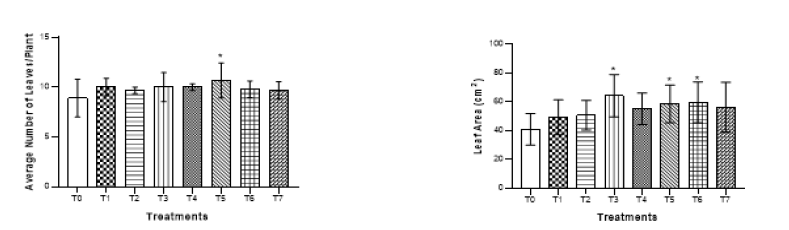
Notably, treatment T5 demonstrated the most substantial effect, resulting in a significantly increased number of leaves compared to the control, showcasing its potential as a potent growth enhancer for radish plants. While number of leaves was observed statistically same in other treatments. Similar findings were noted by Asgar et al. [17] who stated that number of leaves was observed statistically same in recommended nitrogen fertilizer and in the treatments where enriched compost was applied in integration with different levels of chemical fertilizer. The results of our study suggests that the utilization of Javik Khad as an organic NPK source might enhance the growth of radish leaves, potentially due to its balanced nutrient composition and slow-release properties, promoting sustained plant growth [18,19]. Overall, the findings highlight the significance of different organic fertilizers and additives in influencing radish leaf development, with T5 exhibiting the most promising results in terms of leaf count enhancement. The influence of organic sources on vegetative parameters such as leaf length and leaf count per plant was evident, echoing findings reported by Pant and Oli [20] in radish and corroborated by studies conducted by Vijaykumari et al. 2012 and Khede et al. 2016.
Leaf Area
Leaf area plays a vital role in predicting crop growth and dry matter production, influencing agricultural models. Reduced growth often results from decreased photosynthetic pigments and lower photosynthetic rates due to diminished light interception caused by decreased leaf area. Leaf area significantly impacts solar radiation interception, affecting dry matter production [21,18]. Leaf functions like photosynthesis, carbon assimilation, transpiration and volatile organic compound emission occur through leaf surfaces [22].
The study evaluated the influence of various organic fertilizers and combinations on the leaf area of radish plants at the time of harvest (Figure 2). The leaf area increased significantly in all treatments compared to the control (T0). Among the treatments, T3 exhibited the highest average leaf area of 64.22 ± 14.67, followed closely by T6 with an average leaf area of 59.59 ± 14.21. Both T3 and T6 treatments displayed substantial growth enhancement compared to the control (T0) with a 57.06% and 45.73% increase over the control respectively. Treatments involving mycorrhiza (T4, T7) and organic P and K fertilizers (T1, T2) also showed notable increases, reflecting the essential role of these elements in promoting healthy leaf growth in radishes. This significant increase in leaf area implies that the T3 and T6 positively influenced radish plant growth.
The considerable improvement in leaf area under the T3 treatment could be attributed to the combined effects of organic fertilizer, neem oil and neem cake. These components likely contributed to enhanced nutrient availability, pest control and overall plant vigor. In the case of T6, the combined use of fertilizers likely facilitated better nutrient uptake and utilization, resulting in increased growth. The control (T0) and other treatments exhibited comparatively lower average leaf areas, possibly due to the absence of specialized nutrients and growth-promoting substances present in the effective treatments. This study underscores that increased NPK levels help in leaf area expansion and chlorophyll content which further increase net photosynthetic rates and increase the supply of carbohydrates to plants. Nitrogen, phosphorus and potassium favour all the metabolic and auxin activities in plants that ultimately result in increased yield, root length, root diameter and all yield-attributing parameters [18,19,23-25].
Weight of Leaves per plant
Figure 3:Average fresh weight of leaf per plant (gm) of Radish grown under different sludge-based organic fertilizers. Value represent mean±standard error of nine replicates; * p<0.05; ** p<0.001.
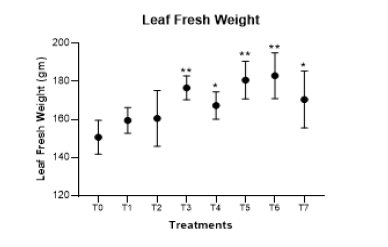
The significance of leaf fresh weight values reflects the impact of different treatments on the growth and development of radish plants (Figure 3). Among the treatments, T3, T6 and T5 treatments displayed the most significant increases in leaf fresh weight, indicating their potential as effective strategies for enhancing radish growth. The difference in leaf weight due to the application of different manures differed in nutrient contents and their efficiency in enhancing leaf weight. This observation aligns with existing research highlighting the benefits of organic fertilizers, bioactive additives and balanced nutrient combinations for plant growth promotion [18]. The increase in the weight of leaves may be due to the beneficial influence of the use of a balanced nutrient supply. Besides, it may also be due to the rapid elongation and multiplication of cells in the presence of adequate quantity of nitrogen [22,26-28].
The observed superior growth performance of treatments T5 and T3, as reflected in their higher leaf area, leaf number and leaf fresh weight compared to the control (T0) and other treatments (T1-T7), can be elucidated through the lens of their specific compositions and synergistic effects. Treatment T5, which involves the application of Javik Khad with organic NPK, seems to have harnessed the benefits of a balanced nutrient supply. The combination of organic nitrogen, phosphorus and potassium has a direct effect on vegetative growth, playing role in cell division, cell enlargement and protein synthesis [29]. Besides the synergistic effect of N with P and K in optimal doses increased the plant height and the total number of leaves [30-32] eventually increasing the photosynthate assimilation [33] and shoot weight. The organic nature of the nutrients might have provided sustained release, promoting prolonged nutrient availability and uptake. This organic approach to nutrient provision might have facilitated better nutrient utilization, ultimately translating into enhanced growth parameters [34].
Effect on root parameters Root length
Results showed a significant increase in root length in all treatments (Figure 4). Analyzing the root length results based on percentage increases over the control, several trends become evident among the different treatments. The results revealed that treatments T1 and T2 exhibited the most significant effects on root growth, showing approximately 17.43% and 19.77% increases, respectively. This outcome aligns with the crucial role of phosphorus and potassium in root development. The introduction of mycorrhizal fungi in T4 and the combination of phosphorus fertilizer with mycorrhizae in T7 also positively influenced root growth, resulting in approximately 16.08% and 11.38% increases, respectively. These findings underline the potential of nutrient supplementation and symbiotic associations to enhance root length and overall plant performance. Additionally, T3, featuring organic fertilizer combined with neem oil and neem cake, demonstrates a 13.08% increase, potentially due to enhanced root growth and nutrient absorption. Similarly, T5, employing Javik Khad with balanced organic NPK, also displays a 13.08% increase, possibly contributing to enhanced root length. The results are in agreement with the findings of previous studies that noted that the application of NPK fertilizer significantly increased the root length in radish [28].
Figure 4:Average root length of Radish grown under different sludge-based fertilizers * p<0.05; ** p<0.001.
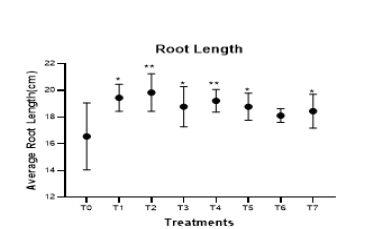
Nutrient levels exerted a very significant effect on the length of the root of the radish. The longest root of T1 and T2 plants indicates that there was interrupt competition for nutrients, suggesting that under N-deficient soil, plants allocated more photosynthate below ground to acquire N, the most limiting resource. An increase in root length might be due to the effect of the environment, soil texture and on-time and balanced manuring practices. Similar results were also recorded in previous studies that show the nitrogen level has a significant influence on root length [35,19].
Root fresh weight
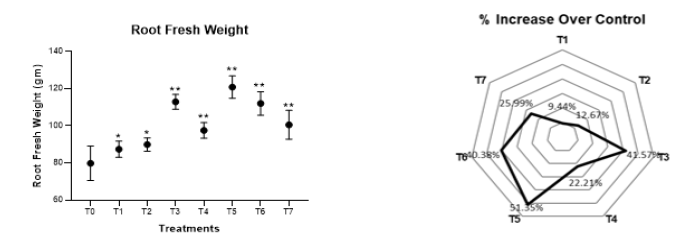
In this study, the results exhibited that all the fertilizers showed a significant effect over control (Figure 5). Comparing the treatments with the control (T0), notable variations in root fresh weight were observed and the percent increase in root fresh weight ranged from 9.44-51.35%. T5 (Javik Khad organic NPK) exhibited the most substantial enhancement, showcasing a remarkable 51.35% increase over the control. Following closely, T3 and T6 displayed substantial improvements of 41.57% and 40.38%, respectively. These outcomes underscore the efficacy of Javik Khad in augmenting root growth, potentially due to its enriched NPK content. Additionally, the synergistic effect of K fertilizer and Javik Khad in T6 could have contributed to the observed growth. The fresh weight of the root was significantly influenced by NK and their interaction [36]. The role of K in root growth is well established. Potassium-deficient plants nearly always have poorly developed root systems [37,38]. The findings highlight the significance of these treatments in promoting radish plant development, shedding light on the role of specific organic amendments in boosting growth metrics.
Figure 5:Average root fresh weight and percent increase over control of Radish grown under different sludge-based organic fertilizers. Value represent mean±standard error of nine replicates; * p<0.05; ** p<0.001.
Dry mass accumulation in root
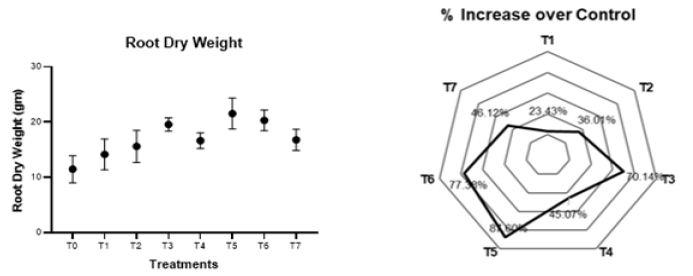
Dry mass accumulation is a direct indicator of plant growth and development. It reflects the amount of biomass produced by the plant, which in turn signifies its overall health, vigor and ability to capture nutrients and resources from the environment. The significant variations in dry mass accumulation highlight the influence of different treatments on radish root growth. The changes in dry weight also were same as in fresh weight (Figure 6). Among the treatments, T5 exhibited the most substantial effect on radish root mass accumulation, recording the highest value of 21.54g. This can be attributed to the balanced and nutrient-rich composition of Javik Khad, promoting optimal root development. Furthermore, T3 and T6 also demonstrated notable enhancements in dry mass accumulation, signifying the positive impact of incorporating organic additives. Javik Khad likely provided a balanced combination of essential nutrients - nitrogen (N), phosphorus (P) and potassium (K) - in an organic form that is readily available to plants. This balanced nutrient supply promotes optimal plant growth and development, leading to enhanced root mass accumulation, nutrient availability and overall plant health. Comparing the results to the control (T0), T5 showed an increase of 87.6%, T3 showed an increase of 70.1% and T6 showed an increase of 77.4%. These findings underscore the significance of using organic-based treatments and balanced N fertilizers to enhance radish root growth, ultimately contributing to improved agricultural practices and sustainable crop production (Yousaf et al. 2021), [16,19].
Figure 6:Average root dry weight and percent increase over control of Radish grown under different sludge-based organic fertilizers. Value represent mean±standard error of nine replicates; * p<0.05; ** p<0.001.
Root diameter
The calculation of root diameter in radish plants serves as a vital metric for evaluating the efficacy of different treatments on root development, offering insights into the effectiveness of various strategies in promoting plant growth and nutrient uptake. The control (T0) had an average root diameter of 2.478. significant results were observed in root diameter ranging from 1.48±0.31cm to 3.97±0.61cm (Figure 7). The results suggest that treatments T3 and T5 had the most significant impact on radish root diameter, displaying substantial increases in comparison to the control. This enhancement in root diameter can be attributed to the synergistic effects of organic nutrients, particularly in T3 where neem oil and neem cake potentially contributed to improved nutrient uptake and root development. Additionally, T5’s use of an organic NPK source likely supported optimal root growth. These outcomes underscore the importance of organic-based treatments in promoting radish root development and further research could delve into the underlying mechanisms driving these observed effects. Similar findings of radish growth and yield have been reported (Khalid et al.2015, Yousaf et al. 2021, ShiYong 2014), [16].
Figure 7:Average root diameter of Radish grown under different sludge-based organic fertilizers. Value represent mean±standard error of nine replicates; * p<0.05; ** p<0.001.
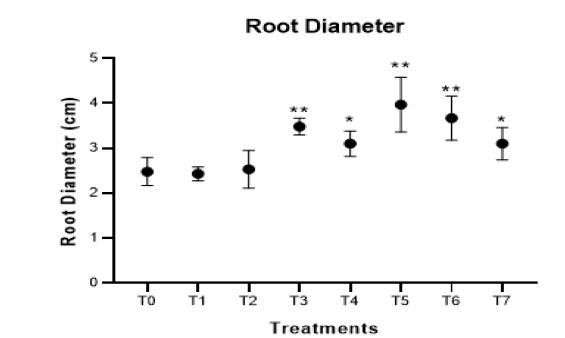
The percentage increase over the control (T0) provides insights into the effectiveness of different treatments in promoting root diameter growth in radish plants. Treatments T3, T5 and T6 exhibited substantial increases of approximately 40.10%, 60.94% and 47.95%, respectively, indicating their strong positive impact on root development compared to the control. On the other hand, treatments T1 and T2 showed marginal deviations from the control. Treatments T4 and T7 demonstrated moderate increases of about 25.10%. This analysis highlights the treatments that significantly enhance radish root diameter and supports the notion that organicbased strategies, particularly those incorporating balanced NPK composition, hold promising potential for optimizing root growth. This result follows the findings of Khalid et al. 2015 and Ahamad et al. [13].
Effects of Different Sludge-Based Organic Fertilizers on Micronutrients in the Soil and Radish Root
Micronutrients in soil
Table 3:Extractable Micronutrient Concentrations in the Soil after the Harvest of Radish under Different sludgebased organic fertilizers.
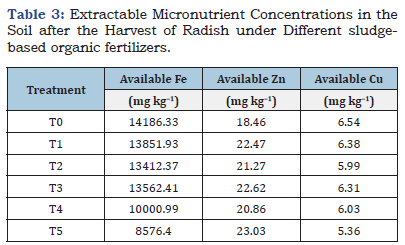
Compared with to treatment, the application of sludge-based organic fertilizer decreased the concentration of soil available Cu and Fe whereas the concentrations of Zn increased (Table 3). The available Fe decreased in the soil in all the treatments in T5 Maximum decrease of 39.59% than that with T0. The application of different sludge-based organic fertilizers has significant effects on the available Zn concentration (Table 3), where T1, T3 and T5 show the highest increases at 21.74%, 22.52% and 24.84% respectively over the control. T2 and T4 show slightly lower increases at 15.22% and 13.04%, but still indicative of enhanced zinc availability. However, the application of organic fertilizer decreased the available Cu compared with the control. The average available Cu concentrations in the soil under treatment vary from 6.38 to 5.4mgkg-1, which were 2.5 to 17.9% lower than that with the control.
Extended use of organic fertilizers has a profound impact on the concentrations of accessible micronutrients within both the soil and plants. In our investigation, the introduction of organic fertilizer resulted in a reduction in the concentration of accessible copper (Cu) and iron (Fe in the soil. Conversely, concentrations of zinc (Zn) were heightened in comparison to the baseline treatment (T0). These findings are consistent with prior research that observed analogous outcomes. This prior work suggested that the application of compost enriched the organic substance within the soil. Notably, it is recognized that copper (Cu) exhibits a notable affinity for organic matter [39,40]. In contrast, findings from a comprehensive, long-term field experiment indicated an inverse correlation between soil organic matter levels and the mobility of copper (Cu) and iron (Fe), within the soil solution. Simultaneously, zinc’s (Zn) mobility increased in such conditions [41,40]. Despite this, the underlying mechanisms driving these effects remained unexplored. This lack of investigation likely stems from the intricate interplay of factors. These factors could include the potent buffering capability of the soil, micronutrient levels linked to soil attributes such as pH, texture, organic composition, redox circumstances, as well as the presence and volume of oxyhydroxides. The specific type of crop species under consideration could also contribute to the observed variability [42-45].
Micronutrients in roots of radish:
The results revealed distinct responses of treatments on the concentration of micronutrients in radish roots. In general, the application of sludge-based organic fertilizer increased the concentrations of Fe, Zn, Ca and Mg in radish root, but the Cu concentrations decreased in the treatments compared with the corresponding control (Table 4).
Table 4:Concentrations of Fe, Zn, and Cu, in Radish Root.

Compared to controls, sludge-based organic fertilizer significantly increased root Fe, Zn, Ca and Mg concentrations up to 69.6, 61.9, 24.8 and 29.4% respectively. Cu concentrations in roots led to a 61.1% decrease, potentially due to factors like competition for uptake, changes in root-soil interactions, or altered root exudates affecting Cu availability. Similar results were reported by Singh et al. [46] and Wang et al. [47]. Cu uptake in radish was lower than Zn uptake according to Dong-Mei et al [41], indicating easier Zn accumulation in vegetables. Notably, the treatment involving Vesicular-Arbuscular (VA) Mycorrhiza (T4) consistently demonstrated the most substantial enhancements in iron (Fe) and zinc (Zn) concentrations. This observation suggests that the introduction of VA mycorrhiza significantly augments the uptake of these specific micronutrients [48-50]. Overall, this fertilizer approach contributed to heightened iron (Fe) and zinc (Zn) concentrations in the radish, while copper (Cu) concentrations demonstrated a tendency to decrease under these treatment conditions in comparison to corresponding controls. These findings echo those documented in studies conducted by Wang et al. [47], Zhang et al. [51] and Dhaliwal et al. [52]. Radishes are rich in calcium, magnesium, copper, vitamin B6, vitamin C and folate [53]. Furthermore, all experimental treatments consistently manifest heightened levels of these micronutrients in comparison to control conditions.
Lead (Pb), Cadmium (Cd), Chromium (Cr) and Nickel (Ni) Concentrations in Soil and Radish Root
Pb, Cd, Cr and Ni concentrations in soil
In general, the concentration of Cd in the soil was not affected by the application of sludge-based organic fertilizer. The organic fertilizer treatment had significant effects on the soil Cr (Table 5). T1 showed a slight increase, while T2 and T3 showed a slight decrease in chromium. T4 and T5 showed a significant decrease, with 20.78 and 29.22% over control respectively. Compared with the control, the soil Pb was increased significantly with the organic fertilizer applications and T3 showed the highest increase i.e. 17.59%. All treatments showed a decrease in nickel concentration, with T5 showing the most significant 29.22% decrease over control.
Table 5:Concentrations of Heavy Metals at Soil Depths of 0-20 cm under Different sludge based organic fertilizers.
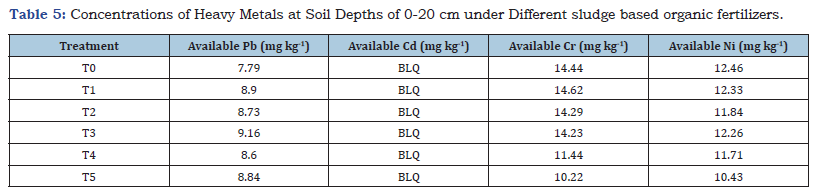
In this study, we present the promising outcomes of utilizing sludge-based organic fertilizer, containing inherent heavy metals, in agricultural applications, demonstrating that post-application, metal concentrations in the study area consistently remained well below established permissible limits [54-56]. Chromium exhibited varying trends across treatments, with an increase in T1, a slight decrease in T2 and T3 and a substantial decrease in T4 and T5. This decline might be linked to interactions between chromium and VA Mycorrhiza in T4, forming complexes that reduce chromium’s availability. Such changes in chromium influence soil microorganisms and plant growth, with outcomes dependent on soil conditions and crop needs. Nickel content also decreased, possibly due to the chelating or binding nature of organic matter, limiting nickel availability. These intricate interactions are influenced by pH, texture and other soil characteristics [57]. The composition of organic fertilizers, including source and nutrients, affects heavy metal interactions, while weather and irrigation impact metal mobility. Findings imply that heavy metal concentrations, though heightened by sludge-based organic fertilizer, remained safe in this study, thus categorizing soils as “clean.”
Pb, Cd, Cr and Ni concentrations in roots
The concentrations of Cd and Pb concentrations in wheat grain were below the limit of quantification (BLQ, below LOQ 0.1mgkg-1), so there is no measurable change over the control for these heavy metals, which indicated that they were not affected by the application of sludge-based organic fertilizer. However, the concentrations of Cr and Ni in radish root were (Table 6).
Table 6:Concentrations of Heavy Metals in Roots.

Under the sludge-based organic fertilizer treatments, the average Cr and Ni concentrations in radish root were ranging from 0.14 to 0.11mgkg-1. In comparison to the established maximum permissible threshold (1.0 mg kg-1) [58], the aggregation of chromium and Nickel in radish roots remained beneath this stipulated limit. This observation implies that the levels of chromium (Cr) and Ni within the consumable components of radish remained within an acceptable range, but the rapid increases in the Cr and Ni contents of radish root when sludge-based organic fertilizers were applied require further investigation [59-61].
Conclusion
In conclusion, the study investigates the effects of Ganga sludgebased organic fertilizer on radish growth, delving into the intricate relationship between nutrient availability, bioactive compounds and plant responses to different fertilizers. The study highlights the influence of various fertilizer types on root and shoots weights, showcasing plants’ ability to adapt carbon allocation based on nutrient levels, impacting growth and nutrient distribution. The balanced organic NPK content in Javik Khad (T5) and DKC (T3) provides the best results by providing necessary nutrients without causing imbalances. Adequate nitrogen, phosphorus and potassium levels in Treatment T3 and T5 lead to increased carbon allocation to roots, enhancing nutrient uptake. Deficiencies, especially in phosphorus and potassium, disrupt nutrient movement in plants, hampering growth. Insufficient nitrogen alters nutrient transport, resulting in sugar accumulation that hampers photosynthesis and food production. Imbalances in these nutrients negatively affect growth, root development, storage and overall vitality in other treatments.
The study underscores the importance of balanced nutrients and bioactive compounds for growth, revealing links between organic inputs, bioactive compounds, nutrient absorption and plant responses. The findings promote organic methods for sustainable agriculture, boosting plant health, productivity and environmental responsibility. The fertilizers also improved the soil physicochemical properties and increased the availability of macro- and micronutrients. The heavy metal content in the soil and radish roots was below the permissible limits, indicating the safety and suitability of these fertilizers for radish cultivation. The study demonstrated that the treated Ganga sludge can be effectively utilized as a source of organic fertilizer, thereby offering a sustainable and eco-friendly solution for sewage sludge management and agricultural productivity enhancement. By shedding light on sewage sludge-based fertilizers, the research offers insights into their viability for eco-friendly farming and safe food generation. By bridging knowledge gaps, this study guides informed decisions, striving for agricultural systems that are both sustainable and high-yielding.
References
- Pereira S, Bamberg AL, Sousa RO, Monteiro AB, Martinazzo R, et al. (2020) Agricultural use and pH correction of anaerobic sewage sludge with acid pH. J Environ Manage 275:
- Bertanza GP, Baroni P, Canato M (2016) Ranking sewage sludge management strategies by means of decision support systems: A case study. Resour Conserv Recycl 110: 1-15.
- Elmi A, Al-Khaldy A, AlOlayan M (2020) Sewage sludge land application: Balancing act between agronomic benefits and environmental concerns. J Clean Prod 250: 119512.
- Laura F, Tamara A, Müller A, Hiroshan H, Christina D, et al. (2020) Selecting sustainable sewage sludge reuse options through a systematic assessment framework: Methodology and case study in Latin America. J Clean Prod 242: 118389.
- Liew C, Kiatkittipong W, Lim J, Lam M, Ho Y, et al. (2021) Stabilization of heavy metals loaded sewage sludge: Reviewing conventional to state-of-the-art thermal treatments in achieving energy sustainability. Chemosphere 277: 130310.
- Islam MS, Ahmed MK, Raknuzzaman M, Habibullah MA, Kundu GK (2017) Heavy metals in the industrial sludge and their ecological risk: A case study for a developing country. J Geochemical Explor 172: 41-49.
- Kominko H, Gorazda K, Wzorek Z (2022) Effect of sewage sludge-based fertilizers on biomass growth and heavy metal accumulation in plants. J Environ Manage 305: 114417.
- Kominko H, Gorazda K, Wzorek Z (2019) Potentiality of sewage sludge-based organo-mineral fertilizer production in Poland considering nutrient value, heavy metal content and phytotoxicity for rapeseed crops. J Environ Manage 248: 109283.
- Xie Y, Xu L, Wang Y, Fan L, Chen Y, et al. (2018) Comparative proteomic analysis provides insight into a complex regulatory network of taproot formation in radish (Raphanus sativus). Hortic Res 5(1): 51.
- Muleke EM, Wang Y, Zhang WT, Liang XU, Ying JL, et al. (2021) Genome-wide identification and expression profiling of MYB transcription factor genes in radish (Raphanus sativus). J Integr Agric 20(1): 120-131.
- Umamaheswari A, Prabu SL, John SA, Puratchikody A (2021) Green synthesis of zinc oxide nanoparticles using leaf extracts of Raphanus sativus var. Longipinnatus and evaluation of their anticancer property in A549 cell lines. Biotechnol Reports 29: e00595.
- Kanjevac M, Jakovljević D, Todorović M, Stanković M, Ćurčić S, et al. (2022) Improvement of germination and early growth of radish (Raphanus sativus L.) through modulation of seed metabolic processes. Plants 11(6): 757.
- Ahamad S, Kumar J, Silas VJ, Lal M, Kumar Y, et al. (2023) Effect of bio-fertilizer and micronutrient on growth and yield of radish (Raphanus sativus L.) var. Pusa Himani. The Pharma Innovation Journal 12(7): 472-474.
- Balkrishna A, Gautam AK., Sharma N, Arya V, Khelwade V (2024) Growth and yield potential of sludge-based organic fertilizers on bell pepper Capsicum annum. Asian Journal of Agriculture 8(1).
- Islam AS, Haque MM, Rehenuma T, Islam MM (2016) Effect of defoliation on growth and yield response in two tomato (Solanum lycopersicum Mill.) varieties. Journal of Agronomy 15(2): 68-75.
- Viraji DM, Karunarathna B (2018) Leaf production and dry matter accumulation in radish (Raphanus sativus L.) to different levels of organic manures and inorganic fertilizer in sand regosol. Int J Econ Plants 5(4): 208-211.
- Asghar HN, Ishaq M, Zahir ZA, Khalid M, Arshad M (2006) Response of radish to integrated use of Nitrogen fertilizer and recycled organic waste. Pakistan J Bot 38(3): 691-700.
- Kiran M, Jilani MS, Waseem K, Sohail M (2016) Effect of organic manures and inorganic fertilizers on growth and yield of radish ( L) Raphanus Sativus. Pakistan J Agric Res 29(4): 363-372.
- Kushwah G, Sharma RK, Kushwah SS, Mishra SN (2019) Effect of organic manures, inorganic fertilizers and varieties on growth, yield and quality of tropical carrot. Indian J Hortic 76(3): 451-456.
- Pant KR, Oli B (2021) Efficacy of nitrogen on growth and yield of radish (Raphanus sativus L.) from different sources of organic manures. Int J Appl Sci Biotechnol 9(3): 203-212.
- Hokmalipour S, Darbandi MH (2012) Effects of nitrogen fertilizer on chlorophyll content and other leaf indicate in three cultivars of maize (Zea mays). World Appl Sci J 16(6): 852-857.
- Patil P, Biradar PU, Bhagawathi AS, Hejjegar I (2018) A review on leaf area index of horticulture crops and its importance. Int J Curr Microbiol Appl Sci 7(4): 505-513.
- Vithwel D, Kanaujia S (2014) Integrated nutrient management on productivity of carrot and fertility of soil. SAARC J Agric 11(2): 173-81.
- Kumawat S, Soni A, Soni V, Sharma D (2018) Effect of organic manures and fertility levels on yield attributes of carrot (Daucus carota) cv. Pusa Rudhira. Int J Chem Stud 6(5): 1613-1616.
- Yadav A, Jakhar RK, Kumari N, Yadav GN, Sharma RK, et al. (2022) Response of organic manures and fertilizers on yield and quality of carrot under sandy soil condition. Pharma Innov J 11(4): 1822-1827.
- Verma UK, Kumar R, Kumar A, Kumar S, Prajapati MK (2017) Integrated effect of organic manures and inorganic fertilizers on growth, yield and yield attributes of Radish CV. Kalyanpur safed. J Pharmacogn Phytochem 6(6): 826-828.
- Kumar P, Soni S, Singh SC, Kumar S, Singh RK, et al. (2022b) Impact of growth and quality on radish ( Raphanus sativus L .) as influenced by different doses of NPK. The Pharma Innovation Journal11(5): 1220-1224.
- Kumar P, Soni S, Kumar S, Singh RK, Kumar R (2022a) Effect of soil application of NPK on yield traits and economics of radish (Raphanus sativus L.) cv. Kashi Hans under Bundelkhand region. Pharma Innov J 11(6): 4-8.
- Khattab EA, Afifi MH, Amin GA (2019) Significance of nitrogen, phosphorus, and boron foliar spray on jojoba plants. Bull Natl Res Cent 43(1).
- Razaq M, Zhang P, Shen HL, Salahuddin (2017) Influence of nitrogen and phosphorous on the growth and root morphology of Acer mono. PLoS One 12(2): 1-13.
- Sujatha G, Lalithadevi B, Priyanka G, Kumar KS, Sri PV (2020) Studies on effect of different organic manures on growth and yield of radish (Raphanus sativus). Int J Current Microbiol Appl Sci 9(5): 1936-1944.
- Shahi P, Pathak R, Kumar PP, Bhandari G, Baral B (2022) Effect of different organic manures on growth and yield of radish at kailali district. J Wastes Biomass Manag 4(2): 92-95.
- Baloch AP, Uddin R, Khan NF, Hameed SA, Siddiqui A (2014) Effect of nitrogen, phosphorus and potassium fertilizers on growth and yield characteristics of radish (Raphinus sativus). Environ Sci 14(6): 565-569.
- Gyewali B, Maharjan B, Rana G, Pandey R, Pathak R, et al. (2021) Effect of different organic manures on growth, yield, and quality of radish (Raphanus Sativus). SAARC J Agric 18(2): 101-114.
- Singh S, Kumari R, Agrawal M, Agrawal SB (2011) Modification in growth, biomass and yield of radish under supplemental UV-B at different NPK levels. Ecotoxicol Environ Saf 74(4): 897-903.
- Ndang Z, Akali S (1999) Effect of nitrogen and potassium on growth and yield of radish. Indian J Hill Farming 12: 84-87.
- Sustr M, Soukup A, Tylova E (2019) Potassium in root growth and development. Plants 8(10): 435.
- Xu X, Du X, Wang F, Sha J, Chen Q, et al. (2020) Effects of potassium levels on plant growth, accumulation and distribution of carbon, and nitrate metabolism in apple dwarf rootstock seedlings. Front Plant Sci 11: 904.
- Li BY, Zhou DM, Cang L, Zhang HL, Fan XH (2007) Soil micronutrient availability to crops as affected by long-term inorganic and organic fertilizer applications. Soil Tillage Res 96(1-2): 166-173.
- Rutkowska B, Szulc W, Sosulski T, Stepień W (2014) Soil micronutrient availability to crops affected by long-term inorganic and organic fertilizer applications. Soil Tillage Res 60(5): 198-203.
- Zhou DM, Hao XZ, Wang YJ, Dong YH, Cang L (2005) Copper and Zn uptake by radish and pakchoi as affected by application of livestock and poultry manures. Chemosphere 59(2): 167-175.
- Marcussen H, Holm PE, Strobel BW, Hansen HC (2009). Nickel sorption to goethite and montmorillonite in presence of citrate. Environ Sci Technol 43(4): 1122-1127.
- Ai C, Liang G, Sun J, Wang X, Zhou W (2012) Responses of extracellular enzyme activities and microbial community in both the rhizosphere and bulk soil to long-term fertilization practices in a fluvo-aquic soil. Geoderma 173-174: 330-338.
- Keshavarzi B, Moore F, Ansari M, Rastegari MM, Kaabi H, Kermani M (2015) Macronutrients and trace metals in soil and food crops of Isfahan Province, Iran. Environmental monitoring and assessment 187: 1-22.
- Mishra B, McDonald LM, Roy M, Lanzirotti A, Myneni SC (2020) Uptake and speciation of zinc in edible plants grown in smelter contaminated soils. PLoS One 15(4): e0226180.
- Singh A, Agrawal M, Marshall FM (2010) The role of organic vs. inorganic fertilizers in reducing phytoavailability of heavy metals in a wastewater-irrigated area. Ecol Eng 36(12): 1733-1740.
- Wang F, Wang Z, Kou C, Ma Z, Zhao D (2016) Responses of wheat yield, macro- and micro-nutrients, and heavy metals in soil and wheat following the application of manure compost on the North China Plain. PLoS One 11(1): e0146453.
- Begum N, Qin C, Ahanger MA, Raza S, Khan MI, et al. (2019) Role of arbuscular mycorrhizal fungi in plant growth regulation: Implications in abiotic stress tolerance. Front Plant Sci 10: 1068.
- Coccina A, Cavagnaro TR, Pellegrino E, Ercoli L, McLaughlin MJ, et al. (2019) The mycorrhizal pathway of zinc uptake contributes to zinc accumulation in barley and wheat grain. BMC Plant Biol 19(1): 133.
- Lu Q, Bunn R, Whitney E, Feng Y, DeVetter LW, et al. (2023) Arbuscular mycorrhizae influence raspberry growth and soil fertility under conventional and organic fertilization. Front Microbiol 14: 1083319.
- Zhang S, Li Z, Liu J, Li Q, Yang X (2015) Long-term effects of straw and manure on crop micronutrient nutrition under a wheat-maize cropping system. J Plant Nutr 38(5): 742-753.
- Dhaliwal SS, Sharma V, Shukla AK, Gupta RK, Verma V, et al. (2023) Residual effect of organic and inorganic fertilizers on growth, yield and nutrient uptake in wheat under a basmati rice-wheat cropping system in north-western india. Agric 13(3): 556.
- Gamba M, Asllanaj E, Raguindin PF, Glisic M, Franco OH, et al. (2021) Nutritional and phytochemical characterization of radish (Raphanus sativus): A systematic review. Trends Food Sci Technol 113: 205-218.
- Srivastava V, Sarkar A, Singh S, Singh P, Araujo AS, et al. (2017) Agroecological responses of heavy metal pollution with special emphasis on soil health and plant performances. Front Environ Sci 5: 1-19.
- Hindarwati Y, Soeprobowati TR (2018) Heavy metal content in terraced rice fields at sruwen tengaran semarang-indonesia. E3S Web Conf 31: 1-6.
- Kumar V, Sharma A, Kaur P, Singh S, Bali AS, et al. (2019) Pollution assessment of heavy metals in soils of India and ecological risk assessment: A state-of-the-art. Chemosphere 216: 449-462.
- Jakubus M, Graczyk M (2020) Availability of nickel in soil evaluated by various chemical extractants and plant accumulation. Agronomy 10(11): 1805.
- FSSAI (2011) Food Safety and Standards (Contaminants, Toxins and residues) Regulations, 2011. Ministry of Health and Family Welfare, India.
- Kumar S, Verma SK, Kumar M, Kumar D (2016) Effect of organic and inorganic fertilizers on growth, yield and quality of radish ( Raphanus Sativus L.) CV. Japanese White. Ann Hortic 9(2): 133.
- Shubha AS, Srinivasa V, Shanwaz A, Anusha RB, Sharavathi MB (2018) Effect of integrated nutrient management on growth and yield of potato (Solanum tuberosum L.). International Journal of Current Microbiology and Applied Sciences 7(9).
- Yuan W, Yuan S, Wang Q, Gan C, Liu Y, et al. (2014) Effect of different amount of N-fertilizers on growth, root yield and nitrate content of white radishes in Southern China. Journal of Food, Agriculture & Environment 12(1): 302-304.
© 2026 Nidhi Sharma. This is an open access article distributed under the terms of the Creative Commons Attribution License , which permits unrestricted use, distribution, and build upon your work non-commercially.
Editor In Chief







.jpg)































Signup for Newsletter

Quick Links
 Editorial Board Registrations
 Submit your Article
 Best Paper of the Volume
 Reprints
 Refer a Friend
 Advertise With Us
Our Recent Edition

.jpg)



Top Editors




.jpg)

















.bmp)
.jpg)
.png)
.jpg)













.jpg)






.png)

.png)




.png)




Financial Support

Sponsors

Latest e-Books

Latest Video

 a Creative Commons Attribution 4.0 International License. Based on a work at www.crimsonpublishers.com.
Best viewed in
a Creative Commons Attribution 4.0 International License. Based on a work at www.crimsonpublishers.com.
Best viewed in 
 | Above IE 9.0 version