

- About Us
- Information
-

The Author ensures that the research has been conducted responsibly and ethically with adherence to all relevant regulations. read more..
- For Authors
- For Reviewer
- Manuscript Guidelines
- Membership
- Publication Ethics
-
- Journals
- Reprints
- e-Books
- Videos
- Policies
- Contact Us
 COVID-19
- Submissions



Full Text
Approaches in Poultry, Dairy & Veterinary Sciences
Dietary Digestible Lysine, Energy and Available Phosphorus Requirements for Broiler Chickens
Yumin Bao*
Animal Nutrition, Redox Pty Ltd, Australia
*Corresponding author: Yumin Bao, Animal Nutrition, Redox Pty Ltd, Minto, Australia
Submission: September 29, 2025;Published: December 09, 2025

ISSN: 2576-9162 Volume 10 Issue 1
Introduction
Energy, amino acids and phosphorus are the three largest and most expensive components in broiler chicken diets. The dietary amino acids requirements usually use the digestible lysine or Standardised Ileal Digestible lysine (SID Lysine) as a reference amino acid, with the requirements of all other indispensable amino acids expressed as a percentage of lysine [1]. Therefore, the requirements of energy, digestible lysine, and available phosphorus are the continuous and critical process in modern poultry science. It’s driven by a combination of economic, ethical and environmental pressures. Unfortunately, there is little information on interactions among the dietary energy, digestible lysine and available phosphorus on the chicken performance. The commercial amino acids producers usually focus on building up the ideal amino acids profile. The commercial feed enzyme companies often emphasize the release of phytate phosphorus.
All other commercial feed additives producers normally work out their products’ energy matrix values to cover their products cost. In 2018, Sharma et al. [2] in the University of New England, used the Box-Behnken design to simultaneously determine the requirements of energy, digestible lysine and available phosphorus for broiler chickens from d 14 to 34, indicating that digestible lysine levels linearly increased chicken body weight gain and an optimal digestible lysine (g/kg) to AMEn (MJ/kg) ratio was reached at 0.92 (g/MJ). Interestingly, there was an interaction between AMEn and available phosphorus on chicken feed intake, suggesting that with a relatively low available phosphorus level (3g/kg), increasing AMEn will reduce the feed intake. The optimal digestible lysine to available phosphors ratio was achieved at 2.90. However, this conclusion was not confirmed by two recent similar experimental designs although these recent two trials resulted in conflicting results [3]. In the current Ross 308 nutrients specification [4], the digestible lysine concentration is 13.2, 11.8,10.8 and 10.2g/ kg in the starter, grower, finisher and withdrawal period, respectively. The AMEn is 12.4, 12.8, 13.0, and 13.1MJ/kg, respectively. The available phosphorus concentration is 5.0, 4.2, 3.6 and 3.4g/kg, respectively. Accordingly, the digestible lysine to available ratio is 2.64, 2.81, 3, and 3.29, respectively.
The Ideal Amino Acids Profile for Broiler Chickens
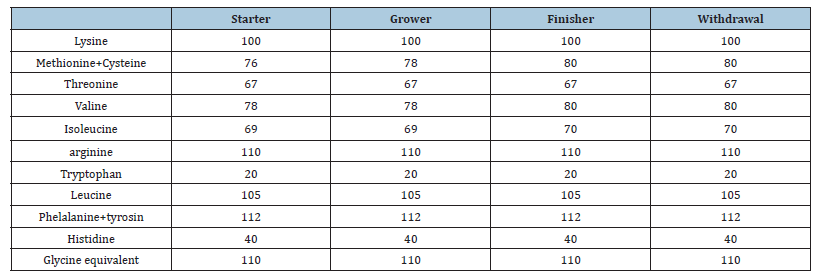
The current Aviagen recommendation for an ideal amino acids profile is shown in Table 1. It is noticed that in this table, it did not provide the optimal histidine (His), Phenylalanine plus Tyrosine (P+T), Glycine equivalent (Glyequi) to Lysine ratios. In the grower period (d 8-17), Franco et al. [5] recommended His, P+T, and Leucine (Leu) to lysine ratios are 112%, 38% and 104%, respectively. Recently, it was shown that in the finisher period, when His to Lysine ratio was 35%, Arginine (Arg) to Lysine ratio was 107, the plasma levels of His and Arg were significantly drooped than that when His to Lysine was 40% and Arg to Lysine ratio was 113% [6]. In the grower period, Maynard et al. [7] reported that when Tryptophan (Trp) to Lysine ratio was 22%, chickens’ FCR was significantly improved compared with that when Trp to Lysine ratio was 17%. Surprisingly in this study, when Glyequi to Lysine was 90%, there was no significant difference in the chicken performance compared with that when Glyequi was 121%. Therefore, we updated ideal amino acids profile shown in Table 2.
Table 1:The ideal amino acids profile for broiler chickens recommended by Aviagen (%).
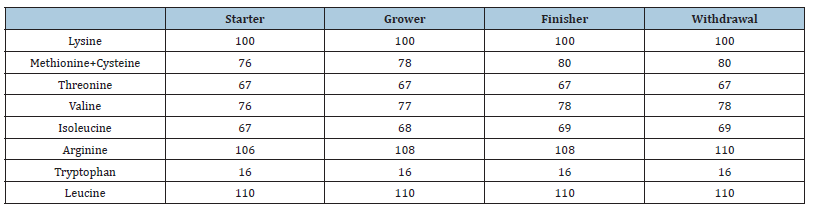
Table 2:The updated ideal amino acids profile for broiler chickens recommended by Redox (%).
The Optimal Digestible Lysine to AMEn Ratio for Broiler Chickens (g/MJ)
In the Aviagen recommendation, the current digestible Lysine to AMEn ratios in the starter, grower, finisher and withdrawal period are 1.06, 0.92, 0.84, and 0.78g/MJ, respectively. However, recently Toghyani et al. [8] reported that based on the Aviagen recommendation, reducing 0.63MJ/kg AMEn did not affect broiler chicken body weight gain but increased FCR by 6 points due to increased feed intake. While increasing digestible Lysine by 3%, the broiler chicken’s body weight gain was improved by 4.5%, and FCR was reduced by about 5 points. It seems that the digestible lysine to AMEn ratio is strongly related to the feed intake and the optimal digestible lysine to AMEn ratio was achieved at 1.00g/MJ. Therefore, based on the digestible lysine levels recommended by Aviagen, we suggest that the AMEn in the starter, grower, finisher, and withdrawal period will be 13.20, 12.20, 12.40, and 12.50MJ/ kg. Accordingly, the digestible lysine to AMEn ratio is 1.00, 0.84, 0.87 and 0.82, respectively. When the chicken meat price is higher, increasing the digestible lysine concentrations in all 4 periods will increase total income.
The Available Phosphorus Requirements for Broilers Chickens
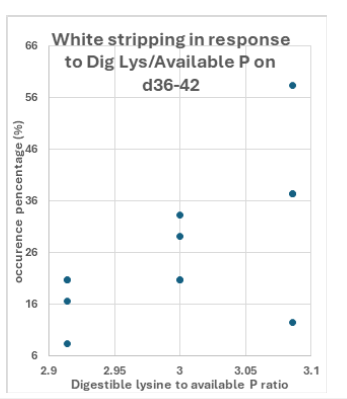
In Toghyani et al. [8] report, it seemed that in the withdrawal period, the relatively lower available phosphorus concentrations resulted in the higher occurrence of white stripping and wooden breast in chicken carcass (Figure 1 & 2). Therefore, we recommend that the dietary available phosphorus requirement in the starter, grower, finisher, and withdrawal period will be 5.0, 4.2, 3.7 and 3.5g/kg, respectively. Accordingly, the digestible Lysine to available ratio will be 2.64, 2.81, 2.91 and 2.91, respectively [9].
Figure 1:The wood breast and white stripping occurrence in response to digestible Lysine to available phosphorus ratios in the withdrawal period.
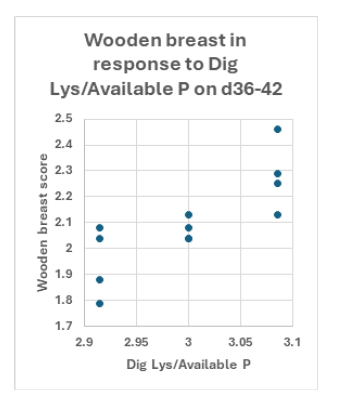
Figure 2:The wood breast and white stripping occurrence in response to digestible Lysine to available phosphorus ratios in the withdrawal period.
References
- Baker DH, Han Y (1994) Ideal amino acid profile for chicks during the first three weeks post hatching. Poult Sci 73(9): 1441-1447.
- Sharma NK, Choct M, Toghyani M, Yan CSM, Laurenson CK, et al. (2018) Dietary energy, digestible lysine and available phosphorus levels affect growth performance, carcass traits, and amino acid digestibility of broilers. Poult Sci 97(4): 1189-1198.
- Cozannet P, Jlali M, Moore D, Archibeque M, Preynat A (2023) Evaluation of phytase dose effect on performance, bone mineralization, and prececal phosphorus digestibility in broilers fed diets with varying metabolizable energy, digestible amino acids, and available phosphorus concentration. Poult Sci 102(7): 102755.
- Aviagen (2022) Ross Broiler Nutrition Specification. Aviagen Inc, Huntsville, AL, USA.
- Franco SM, F De, Tavernari C, Maia RC, Barros VRSM, et al. (2017) Estimation of optimal ratios of digestible phenylalanine+tyrosine, histidine, and leucine to digestible lysine for performance and breast yield in broilers. Poult Sci 96(4): 829-837.
- Bao YM, Macelline SP, Selle PH, Crystal PV, Wang MZ, et al. (2025) Dietary bile acid supplementation influences protein digestibility and altera plasma amino acid profiles in broiler chickens fed conventional and reduced protein diets. Poul Sci 104(6): 105107.
- Maynard CW, Kidd MT, Crystal PV, McQuade LR, Mclnerney BV, et al. (2022) Assessment of limiting dietary amino acids in broiler chickens offered reduced crude protein diets. Anim Nutri 10: 1-11.
- Toghyani M, MacElline S, Selle PH, Liu SY (2024) Interactive effects of dietary energy levels with amino acid density on growth performance and optimal digestible Lys to energy ratio of male broiler chickens. Poul Sci 103(12): 104316.
- Cozannet P, Davin R, Jlali M, Jachacz J, Preynat A, et al. (2021) Dietary metabolizable energy, digestible lysine, available phosphorus levels and exogenous enzymes affect broiler chicken performance. Animals 15(5): 100206.
© 2025 Yumin Bao. This is an open access article distributed under the terms of the Creative Commons Attribution License , which permits unrestricted use, distribution, and build upon your work non-commercially.
Editor In Chief







.jpg)






























Signup for Newsletter

Quick Links
 Editorial Board Registrations
 Submit your Article
 Best Paper of the Volume
 Reprints
 Refer a Friend
 Advertise With Us
Our Recent Edition
.jpg)


Top Editors




.jpg)

















.bmp)
.jpg)
.png)
.jpg)













.jpg)






.png)

.png)




.png)




Financial Support

Sponsors

Latest e-Books

Latest Video

 a Creative Commons Attribution 4.0 International License. Based on a work at www.crimsonpublishers.com.
Best viewed in
a Creative Commons Attribution 4.0 International License. Based on a work at www.crimsonpublishers.com.
Best viewed in 
 | Above IE 9.0 version