

- About Us
- Information
-

The Author ensures that the research has been conducted responsibly and ethically with adherence to all relevant regulations. read more..
- For Authors
- For Reviewer
- Manuscript Guidelines
- Membership
- Publication Ethics
-
- Journals
- Reprints
- e-Books
- Videos
- Policies
- Contact Us
 COVID-19
- Submissions



Full Text
Aspects in Mining & Mineral Science
Development of Physicochemical Principles for the Creation of High-Capacity Hydride-Forming Materials and their Use in Stationary Hydrogen Storage Systems and as Electrodes for Electrochemical Energy Systems
Ershova OG* and Dobrovolsky VD
Frantsevich Institute for Problems of Materials Science, Ukraine
*Corresponding author:Ershova OG, Frantsevich Institute for Problems of Materials Science, NAS of Ukraine, Kyiv, Ukraine
Submission: June 18, 2026: Published: November 13, 2026

ISSN 2578-0255Volume15 Issue 4
Abstract
The paper reviews of studies on synthesizing mechanical alloys (MA) of the Mg-Me-H system using the mechanochemical method. The research focuses on the Mg+10wt. % Me (Al-Ni, Al-Ti, Ti, Si, Fe, Ni) alloy. It investigates how adding a small amount of Me, which acts as a catalyst, and varying the method and conditions for obtaining mechanical alloys affect their hydrogen sorption properties, cyclic hydrogen de-/sorption kinetics, and thermal stability.
Keywords:Mechanical alloy; Kinetics; Hydrogen sorption properties; Thermal stability
Hydrogen Energy is the Main Field of Application of Hydrogen-Sorption Materials
Therefore, our scientific developments are aimed at solving the problem of providing the needs of hydrogen energy with highly efficient materials for hydrogen storage [1], namely those that decompose at low temperatures and, thus, have a combination of properties such as high hydrogen storage capacity and cyclic stability during fast hydrogen sorption-desorption kinetics. The goal of one of the tasks of our projects is to reduce the thermal stability of hydride phases of mechanical alloys based on Mg by selecting and optimizing the composition and conditions of their production, as well as by dispersing and mechanical alloying.
In the part devoted to the development of methods for obtaining and improving the properties of hydrogen-absorbing materials for magnesium-based hydrogen storage alloys, we conduct research aimed at obtaining a set of characteristics of these materials necessary for their practical application as hydrogen batteries, and, above all, fast kinetics and low temperature of complete hydrogen evolution at a pressure of 1 bar. To achieve the specified improving characteristics of the obtained materials, we use the synthesis methods of mechanical and reactive-mechanical alloying, and also involve the processes of mechanical alloying and dispersion, which allow us to change and generate the necessary hydrogen-absorbing properties, the required chemical state of their surfaces by influencing the electronic and thermodynamic properties. We have carried out a number of mechanical syntheses of magnesium-based alloys with different compositions of alloying elements, in particular Mg-Si-Ti-Fe (Ni) alloys [2-4]. As a result, the optimal composition of the alloys and the conditions of their synthesis were determined, which provide an improved set of specified essential characteristics. X-ray phase and X-ray structural analysis showed that all obtained mechanical alloys are nanocomposites with crystallite sizes of 6-10nm.
The results of design studies of the influence of various alloying elements and different synthesis conditions on the hydrogen sorption properties, thermal stability and kinetics of the hydrogen desorption process of mechanical composites based on Mg allow us to improve the mechanochemical methods used to obtain materials for hydrogen storage and optimize the conditions of their synthesis. We have established that mechanical alloying of Mg Al- Fe, Al-Ti provides the best hydrogen sorption characteristics and kinetics of hydrogen desorption from the hydride phase MgH2 compared to alloying of pure Fe [5]. As a result of reactive grinding for 10 hours of mixtures of Mg+(10 wt.% Al+10 wt.% Ti); Mg+(10 wt.% Al+10 wt.% Ni) we achieved a higher hydrogen capacity: 6.57 wt.% H2 - 5.57 wt.% H2. After reactive grinding for 20 hours, we achieved a hydrogen capacity of 5.58 wt.% H2. The temperature of the beginning of the 1st H2 desorption (immediately after synthesis) was 260 °C (pH2=1 bar in the reactor).
We investigated the contribution to the decrease in the thermal stability and decomposition temperature of the MgH2 hydride phase of mechanical alloys Mg+(Si-Ti-Fe) synthesized under different hydrogenation conditions. It was found that the addition of Si, Ti, Fe to magnesium leads to a significant improvement in the kinetics of hydrogen desorption from the MgH2 hydride phase by 6 times. At the same time, the analysis of experimental data allows us to conclude that the addition of 10 wt.% Ni to magnesium leads to a significant improvement in the kinetics of hydrogen desorption from the hydride phase MgH2 of the indicated nanocomposite alloys. At the same time, the effect of improving the kinetics in the case of adding Ni is much greater than in the case of adding other alloying elements [6-8]. This is evidenced by the experimentally recorded reduction in the time of release of all desorbed H2 in the case of magnesium alloys with nickel, respectively, by 16 times in relation to unalloyed MgH2.
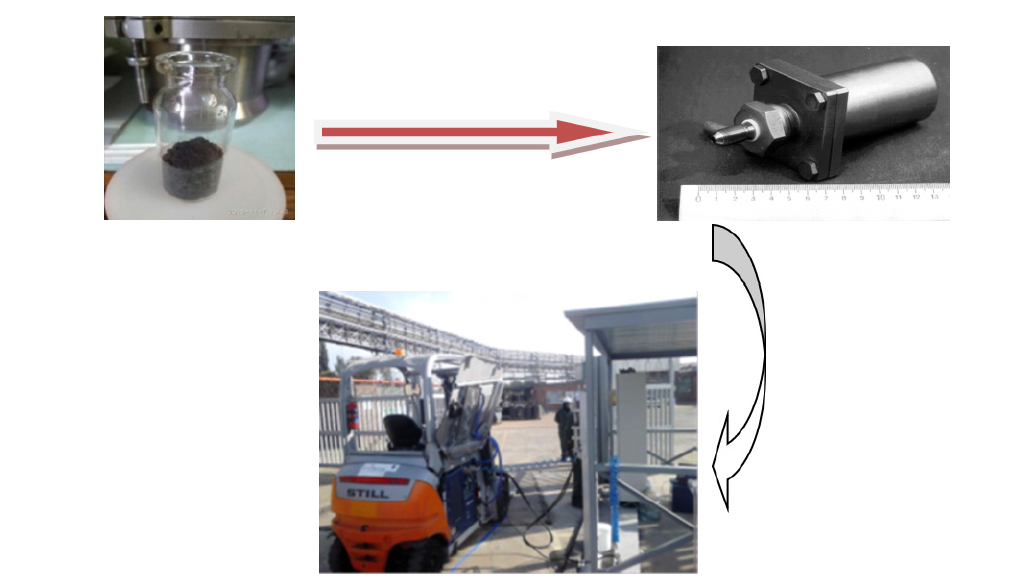
The study of hydrogen-sorption, kinetic characteristics of the developed materials is carried out by the method of Thermal Desorption Spectroscopy (TDS). This method is carried out by original apparatus and it allows measuring hydrogen-sorption properties and thermal stabilities of the mechanical alloys using methods of isobaric and isochoric thermal desorption spectroscopy and allows also studying kinetics of processes of hydrogen desorption-resorption from hydride phases of the mechanical alloys. The apparatus also allows measurements of isobars of hydrogen desorption-resorption at hydrogen P=0.1-1.0MPa in the reactor, to provide hydrogenation-dehydrogenation of the samples and temperatures 20 °C - 1000 °C. The results indicate that our studies allow us to select the composition of alloying elements and the synthesis conditions of mechanical alloys that provide maximum heat resistance and low decomposition temperature of MgH2, while simultaneously improving the kinetics of hydrogen sorption/ desorption. The use of the developed hydrogen sorption materials based on magnesium and its alloys in laboratory installations for studies of thermal hydrogen desorption, in powerful energy converter modules and hydride heat pumps, etc. (Figure 1).
Figure 1:Ways of hydrogen storage
References
- Ershova OG, Dobrovolsky VD, Solonin YM, Khyzhun OY, Koval AY (2015) The effect of Al on thermal stability and kinetics of decomposition of MgH2 prepared by mechanochemical reaction at different conditions. Materials Chemistry and Physics 162: 408-416.
- Dobrovolsky VD, Ershova OG, Solonin YM (2016) Thermal resistance and the kinetics of hydrogen desorption from hydrides of the Mg-Al-Ni-Ti mechanical alloy. Materials Science 51(4): 457-464.
- Dobrovolsky VD, Khyzhun OY, Sinelnichenko AK, Ershova OG, Solonin YM (2017) XPS study of influence of exposure to air on thermal stability and kinetics of hydrogen decomposition of MgH2 films obtained by direct hydrogenation from gaseous phase of metallic. Journal of Electron Spectroscopy and Related Phenomena 215: 28-35.
- Dobrovolsky VD, Ershova OG, Solonin YM (2017) Alloying effect of Ti, Fe, Ni and Al on hydrogen desorption behavior of MgH2 synthesized by reactive mechanical alloying. Innovations in Corrosion and Materials Science 7(2): 84-98.
- Ershova OG, Dobrovolsky VD, Solonin YM (2018) Mechanical alloys Mg-Me (Me: Ti, Fe, Ni, Al) & Mg-Me1-Me2 (Ме1: Al; Me2: Ti, Fe, Ni) with low resistance and improved kinetics of hydrogenation/dehydrogenation for hydrogen storage applications. French-Ukrainia Journal of Chemistry 6(1): 31-55.
- Ershova OG, Dobrovolsky VD, Solonin YM, Koval AY (2019) Hydrogen sorption properties, thermal stability and kinetics of hydrogen desorption from the hydride phase of the MgH2 of a mechanical alloy of magnesium with Ti and Y. Met Phys and Novel Tech 41(8): 981-1001.
- Ershova O, Dobrovolsky V, Saenko A, Khyzhun O, Solonin Y (2022) The role of Ni additive, size factor and surface chemical state in decreasing temperature and improving decomposition kinetics of the nanosized MgH2 hydride phase of mechanical alloys Mg+10wt.% Ni and MgH2+10wt.% Ni. International Independent Scientific Journal 38: 22-32.
- Olga E, Valentin D, Yuriy S (2023) Effect of Ti additive and preparation procedure on the temperature and decomposition kinetics of the MgH2 phase in the synthesized mechanicals alloys. International Science Journal of Engineering & Agriculture 2(2): 125-141.
© 2026 Ershova OG. This is an open access article distributed under the terms of the Creative Commons Attribution License , which permits unrestricted use, distribution, and build upon your work non-commercially.
Editor In Chief







.jpg)































Signup for Newsletter

Quick Links
 Editorial Board Registrations
 Submit your Article
 Best Paper of the Volume
 Reprints
 Refer a Friend
 Advertise With Us
Our Recent Edition



Top Editors




.jpg)

















.bmp)
.jpg)
.png)
.jpg)













.jpg)






.png)

.png)




.png)




Financial Support

Sponsors

Latest e-Books

Latest Video

 a Creative Commons Attribution 4.0 International License. Based on a work at www.crimsonpublishers.com.
Best viewed in

 | Above IE 9.0 version